INTESTINAL NEMATODES
• 1) introduction :
• Phylum : nematoda (nema: thread )
• Elongated , bilateral symmetrical , cylindrical and unsegmented
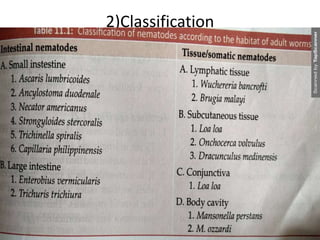
2)Classification
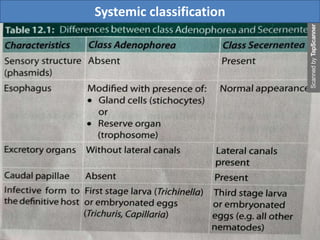
Systemic classification
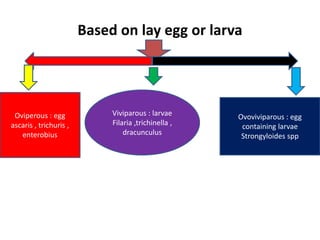
Based on lay egg or larva
Oviperous : egg
ascaris , trichuris ,
enterobius
Viviparous : larvae
Filaria ,trichinella ,
dracunculus
Ovoviviparous : egg
containing larvae
Strongyloides spp
3)General characteristics
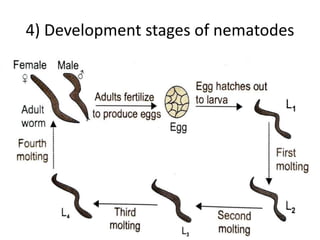
• I) Development stages : 6 (adult worm , egg , 4 larvae (L1-L4)
)
• II) Adult worm
• a) shape: elongated , cylindrical , both end pointed and unsegmented
• B) size: 5cm (hook worm , trichinella and strongyloides) and 1 meter
dracunculus. Female langer than male
• C) Body cavity : outer layer (cuticle) , inner layer (longitudinal muscles)
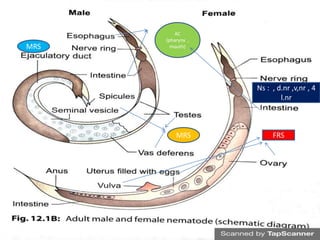
MRS
MRS
FRS
Ns : , d.nr ,v,nr , 4
l.nr
AC
(pharynx ,
mouth)
4) Development stages of nematodes
5) Life cycle
• Life cycle : one host (man) [except –filarial worm-d.h
(man) and i.h(mosquito) and dracunculus- D.H- man
and I.H-cyclops]
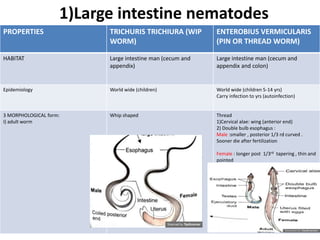
1)Large intestine nematodes
PROPERTIES TRICHURIS TRICHIURA (WIP
WORM)
ENTEROBIUS VERMICULARIS
(PIN OR THREAD WORM)
HABITAT Large intestine man (cecum and
appendix)
Large intestine man (cecum and
appendix and colon)
Epidemiology World wide (children) World wide (children 5-14 yrs)
Carry infection to yrs (autoinfection)
3 MORPHOLOGICAL form:
I) adult worm
Whip shaped Thread
1)Cervical alae: wing (anterior end)
2) Double bulb esophagus :
Male :smaller , posterior 1/3 rd curved .
Sooner die after fertilization
Female : longer post 1/3rd tapering , thin and
pointed
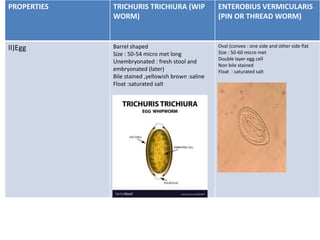
PROPERTIES TRICHURIS TRICHIURA (WIP
WORM)
ENTEROBIUS VERMICULARIS
(PIN OR THREAD WORM)
II)Egg Barrel shaped
Size : 50-54 micro met long
Unembryonated : fresh stool and
embryonated (later)
Bile stained ,yellowish brown :saline
Float :saturated salt
Oval (convex : one side and other side flat
Size : 50-60 micro met
Double layer egg cell
Non bile stained
Float : saturated salt
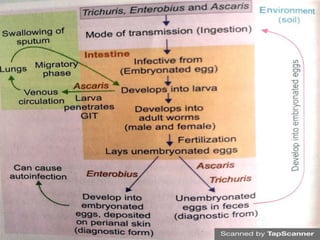
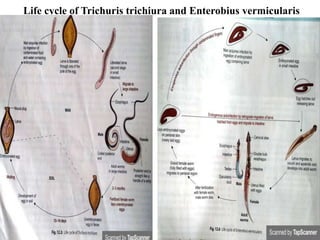
Life cycle of Trichuris trichiura and Enterobius vermicularis
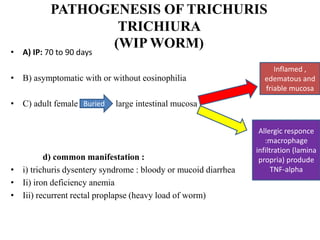
PATHOGENESIS OF TRICHURIS
TRICHIURA
(WIP WORM)
• A) IP: 70 to 90 days
• B) asymptomatic with or without eosinophilia
• C) adult female large intestinal mucosa
d) common manifestation :
• i) trichuris dysentery syndrome : bloody or mucoid diarrhea
• Ii) iron deficiency anemia
• Iii) recurrent rectal proplapse (heavy load of worm)
Buried
Inflamed ,
edematous and
friable mucosa
Allergic responce
:macrophage
infiltration (lamina
propria) produde
TNF-alpha
PATHOGENESIS OF ENTEROBIUS
VERMICULARIS
(PIN OR THREAD WORM)
• A) asymptomatic
• B) symptomatic patients :
• i) age and sex : females , children young adult
• Ii) cardinal symptom : perianal pruritus found in buttock of children
• iii) migration of worm :
• a) vulvoveginitis
• b) pritoneal granulomas
• c) UT , LUNG , LIVER
•
Migration
(female worm)
Repeated
scratching
Autoinfection with
contaminated finger
Excoriation
of skin
Secondary bacterial
infections
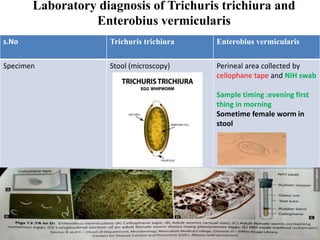
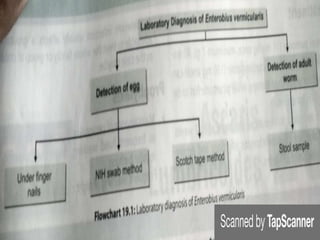
Laboratory diagnosis of Trichuris trichiura and
Enterobius vermicularis
s.No Trichuris trichiura Enterobius vermicularis
Specimen Stool (microscopy) Perineal area collected by
cellophane tape and NIH swab
Sample timing :evening first
thing in morning
Sometime female worm in
stool
Small intestinal nematodes
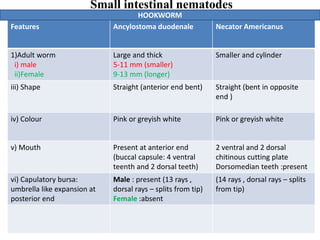
Features Ancylostoma duodenale Necator Americanus
1)Adult worm
i) male
ii)Female
Large and thick
5-11 mm (smaller)
9-13 mm (longer)
Smaller and cylinder
iii) Shape Straight (anterior end bent) Straight (bent in opposite
end )
iv) Colour Pink or greyish white Pink or greyish white
v) Mouth Present at anterior end
(buccal capsule: 4 ventral
teenth and 2 dorsal teeth)
2 ventral and 2 dorsal
chitinous cutting plate
Dorsomedian teeth :present
vi) Capulatory bursa:
umbrella like expansion at
posterior end
Male : present (13 rays ,
dorsal rays – splits from tip)
Female :absent
(14 rays , dorsal rays – splits
from tip)
HOOKWORM
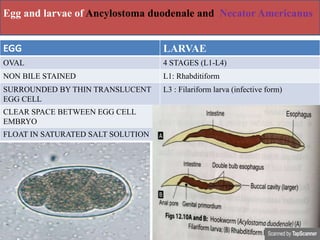
Egg and larvae of Ancylostoma duodenale and Necator Americanus
EGG LARVAE
OVAL 4 STAGES (L1-L4)
NON BILE STAINED L1: Rhabditiform
SURROUNDED BY THIN TRANSLUCENT
EGG CELL
L3 : Filariform larva (infective form)
CLEAR SPACE BETWEEN EGG CELL
EMBRYO
FLOAT IN SATURATED SALT SOLUTION
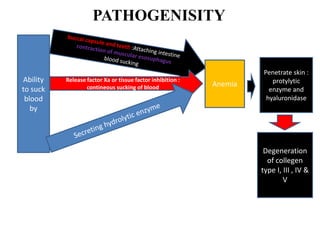
PATHOGENISITY
Ability
to suck
blood
by
Release factor Xa or tissue factor inhibition :
contineous sucking of blood
Penetrate skin :
protylytic
enzyme and
hyaluronidase
Degeneration
of collegen
type I, III , IV &
V
Anemia
Lab diagnosis
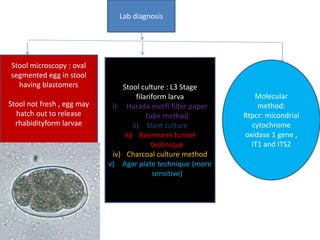
Stool microscopy : oval
segmented egg in stool
having blastomers
Stool not fresh , egg may
hatch out to release
rhabidityform larvae
Stool culture : L3 Stage
filariform larva
i) Harada morfi filter paper
tube method
ii) Slant culture
iii) Baermann funnel
technique
iv) Charcoal culture method
v) Agar plate technique (more
sensitive)
Molecular
method:
Rtpcr: micondrial
cytochrome
oxidase 1 gene ,
IT1 and ITS2
PROPERTIES STRONGYLOIDES
STERCORALIS /MILITARY
WORM
ASCARIS LUMBRICOIDES
(LARGEST NEMATODES /
ROUND WORM)
EPIDERMIOLOGY South east Asia (India) , Sub-
Saharan Africa and south
America,
Tropical country (India)
Risk factor: children (most
common)
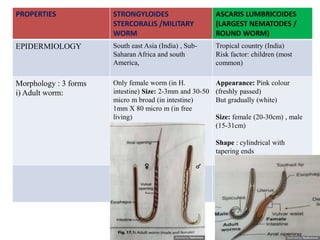
Morphology : 3 forms
i) Adult worm:
Only female worm (in H.
intestine) Size: 2-3mm and 30-50
micro m broad (in intestine)
1mm X 80 micro m (in free
living)
Appearance: Pink colour
(freshly passed)
But gradually (white)
Size: female (20-30cm) , male
(15-31cm)
Shape : cylindrical with
tapering ends
PROPERTIES STRONGYLOIDES STERCORALIS
/MILITARY WORM
ASCARIS LUMBRICOIDES (LARGEST NEMATODES / ROUND
WORM)
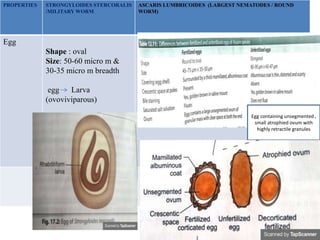
Egg
Shape : oval
Size: 50-60 micro m &
30-35 micro m breadth
egg Larva
(ovoviviparous)
Egg containing unsegmented ,
small atrophied ovum with
highly retractile granules
PROPERTIES STRONGYLOIDES STERCORALIS
/MILITARY WORM
ASCARIS LUMBRICOIDES
(LARGEST NEMATODES / ROUND
WORM)
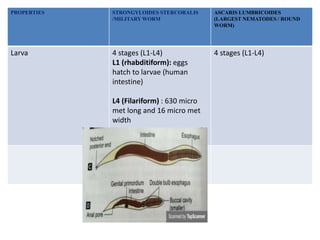
Larva 4 stages (L1-L4)
L1 (rhabditiform): eggs
hatch to larvae (human
intestine)
L4 (Filariform) : 630 micro
met long and 16 micro met
width
4 stages (L1-L4)
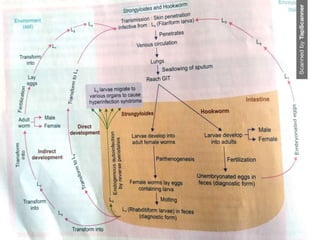
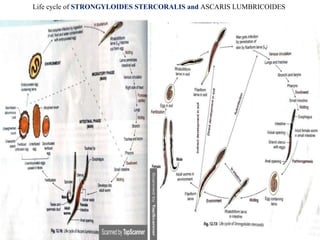
Life cycle of STRONGYLOIDES STERCORALIS and ASCARIS LUMBRICOIDES
Pathogenesis of STRONGYLOIDES STERCORALIS
Pathogenesis
Effect due to Migrating Larva :
i) Asymptomatic (50% patients)
ii) Rashes : recurrent maculopapular or urticarial
rashes at buttocks , perineum and thighs
iii) Cutaneous larva migrans: larva currens
(serpiginous rash due to migration of F. Larva)
iv) Pulmonary symptom : larva from pulmonary
capillaries to alveoli and bronchioles ( bronchio
pneumonia , chronic bronchitis and asthamatic
symptoms
Effect due to Adult worm :
i) Mild to moderate worm load : epigastric
pain , nausea , diarrhoea constipation and
blood loss (travelling of Adult worm and
larva)
ii) Heavy larva load : hyperinfection
syndrome and disseminated
strongyloidiasis
a) Hyperinfection syndrome: repeated
autoinfection gneration of large
number of F. Larva penetrate GIT mucosa
(colitis , entritis , or malabsorption )
b) Disseminated strongyloidiasis: in severe
cases ,larva migrate to GIT , CNS , LIVER ,
KIDNEY ( MENINGITIS , BRAIN ABSCESS ,
GNB BACTERIAL SEPSIS )
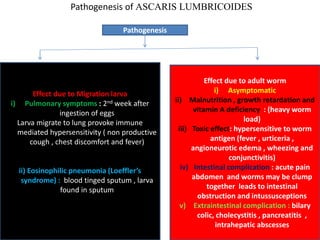
Pathogenesis of ASCARIS LUMBRICOIDES
Pathogenesis
Effect due to Migration larva
i) Pulmonary symptoms : 2nd week after
ingestion of eggs
Larva migrate to lung provoke immune
mediated hypersensitivity ( non productive
cough , chest discomfort and fever)
ii) Eosinophilic pneumonia (Loeffler’s
syndrome) : blood tinged sputum , larva
found in sputum
Effect due to adult worm
i) Asymptomatic
ii) Malnutrition , growth retardation and
vitamin A deficiency : (heavy worm
load)
iii) Toxic effect: hypersensitive to worm
antigen (fever , urticeria ,
angioneurotic edema , wheezing and
conjunctivitis)
iv) Intestinal complication : acute pain
abdomen and worms may be clump
together leads to intestinal
obstruction and intussusceptions
v) Extraintestinal complication : bilary
colic, cholecystitis , pancreatitis ,
intrahepatic abscesses
Intestinal nematodes

Intestinal nematodes

  • 1.
    INTESTINAL NEMATODES • 1)introduction : • Phylum : nematoda (nema: thread ) • Elongated , bilateral symmetrical , cylindrical and unsegmented
  • 2.
  • 3.
  • 4.
    Based on layegg or larva Oviperous : egg ascaris , trichuris , enterobius Viviparous : larvae Filaria ,trichinella , dracunculus Ovoviviparous : egg containing larvae Strongyloides spp
  • 5.
    3)General characteristics • I)Development stages : 6 (adult worm , egg , 4 larvae (L1-L4) ) • II) Adult worm • a) shape: elongated , cylindrical , both end pointed and unsegmented • B) size: 5cm (hook worm , trichinella and strongyloides) and 1 meter dracunculus. Female langer than male • C) Body cavity : outer layer (cuticle) , inner layer (longitudinal muscles)
  • 6.
    MRS MRS FRS Ns : ,d.nr ,v,nr , 4 l.nr AC (pharynx , mouth)
  • 7.
  • 8.
    5) Life cycle •Life cycle : one host (man) [except –filarial worm-d.h (man) and i.h(mosquito) and dracunculus- D.H- man and I.H-cyclops]
  • 11.
    1)Large intestine nematodes PROPERTIESTRICHURIS TRICHIURA (WIP WORM) ENTEROBIUS VERMICULARIS (PIN OR THREAD WORM) HABITAT Large intestine man (cecum and appendix) Large intestine man (cecum and appendix and colon) Epidemiology World wide (children) World wide (children 5-14 yrs) Carry infection to yrs (autoinfection) 3 MORPHOLOGICAL form: I) adult worm Whip shaped Thread 1)Cervical alae: wing (anterior end) 2) Double bulb esophagus : Male :smaller , posterior 1/3 rd curved . Sooner die after fertilization Female : longer post 1/3rd tapering , thin and pointed
  • 12.
    PROPERTIES TRICHURIS TRICHIURA(WIP WORM) ENTEROBIUS VERMICULARIS (PIN OR THREAD WORM) II)Egg Barrel shaped Size : 50-54 micro met long Unembryonated : fresh stool and embryonated (later) Bile stained ,yellowish brown :saline Float :saturated salt Oval (convex : one side and other side flat Size : 50-60 micro met Double layer egg cell Non bile stained Float : saturated salt
  • 13.
    Life cycle ofTrichuris trichiura and Enterobius vermicularis
  • 14.
    PATHOGENESIS OF TRICHURIS TRICHIURA (WIPWORM) • A) IP: 70 to 90 days • B) asymptomatic with or without eosinophilia • C) adult female large intestinal mucosa d) common manifestation : • i) trichuris dysentery syndrome : bloody or mucoid diarrhea • Ii) iron deficiency anemia • Iii) recurrent rectal proplapse (heavy load of worm) Buried Inflamed , edematous and friable mucosa Allergic responce :macrophage infiltration (lamina propria) produde TNF-alpha
  • 15.
    PATHOGENESIS OF ENTEROBIUS VERMICULARIS (PINOR THREAD WORM) • A) asymptomatic • B) symptomatic patients : • i) age and sex : females , children young adult • Ii) cardinal symptom : perianal pruritus found in buttock of children • iii) migration of worm : • a) vulvoveginitis • b) pritoneal granulomas • c) UT , LUNG , LIVER • Migration (female worm) Repeated scratching Autoinfection with contaminated finger Excoriation of skin Secondary bacterial infections
  • 16.
    Laboratory diagnosis ofTrichuris trichiura and Enterobius vermicularis s.No Trichuris trichiura Enterobius vermicularis Specimen Stool (microscopy) Perineal area collected by cellophane tape and NIH swab Sample timing :evening first thing in morning Sometime female worm in stool
  • 19.
    Small intestinal nematodes FeaturesAncylostoma duodenale Necator Americanus 1)Adult worm i) male ii)Female Large and thick 5-11 mm (smaller) 9-13 mm (longer) Smaller and cylinder iii) Shape Straight (anterior end bent) Straight (bent in opposite end ) iv) Colour Pink or greyish white Pink or greyish white v) Mouth Present at anterior end (buccal capsule: 4 ventral teenth and 2 dorsal teeth) 2 ventral and 2 dorsal chitinous cutting plate Dorsomedian teeth :present vi) Capulatory bursa: umbrella like expansion at posterior end Male : present (13 rays , dorsal rays – splits from tip) Female :absent (14 rays , dorsal rays – splits from tip) HOOKWORM
  • 20.
    Egg and larvaeof Ancylostoma duodenale and Necator Americanus EGG LARVAE OVAL 4 STAGES (L1-L4) NON BILE STAINED L1: Rhabditiform SURROUNDED BY THIN TRANSLUCENT EGG CELL L3 : Filariform larva (infective form) CLEAR SPACE BETWEEN EGG CELL EMBRYO FLOAT IN SATURATED SALT SOLUTION
  • 21.
    PATHOGENISITY Ability to suck blood by Release factorXa or tissue factor inhibition : contineous sucking of blood Penetrate skin : protylytic enzyme and hyaluronidase Degeneration of collegen type I, III , IV & V Anemia
  • 23.
    Lab diagnosis Stool microscopy: oval segmented egg in stool having blastomers Stool not fresh , egg may hatch out to release rhabidityform larvae Stool culture : L3 Stage filariform larva i) Harada morfi filter paper tube method ii) Slant culture iii) Baermann funnel technique iv) Charcoal culture method v) Agar plate technique (more sensitive) Molecular method: Rtpcr: micondrial cytochrome oxidase 1 gene , IT1 and ITS2
  • 24.
    PROPERTIES STRONGYLOIDES STERCORALIS /MILITARY WORM ASCARISLUMBRICOIDES (LARGEST NEMATODES / ROUND WORM) EPIDERMIOLOGY South east Asia (India) , Sub- Saharan Africa and south America, Tropical country (India) Risk factor: children (most common) Morphology : 3 forms i) Adult worm: Only female worm (in H. intestine) Size: 2-3mm and 30-50 micro m broad (in intestine) 1mm X 80 micro m (in free living) Appearance: Pink colour (freshly passed) But gradually (white) Size: female (20-30cm) , male (15-31cm) Shape : cylindrical with tapering ends
  • 25.
    PROPERTIES STRONGYLOIDES STERCORALIS /MILITARYWORM ASCARIS LUMBRICOIDES (LARGEST NEMATODES / ROUND WORM) Egg Shape : oval Size: 50-60 micro m & 30-35 micro m breadth egg Larva (ovoviviparous) Egg containing unsegmented , small atrophied ovum with highly retractile granules
  • 26.
    PROPERTIES STRONGYLOIDES STERCORALIS /MILITARYWORM ASCARIS LUMBRICOIDES (LARGEST NEMATODES / ROUND WORM) Larva 4 stages (L1-L4) L1 (rhabditiform): eggs hatch to larvae (human intestine) L4 (Filariform) : 630 micro met long and 16 micro met width 4 stages (L1-L4)
  • 27.
    Life cycle ofSTRONGYLOIDES STERCORALIS and ASCARIS LUMBRICOIDES
  • 28.
    Pathogenesis of STRONGYLOIDESSTERCORALIS Pathogenesis Effect due to Migrating Larva : i) Asymptomatic (50% patients) ii) Rashes : recurrent maculopapular or urticarial rashes at buttocks , perineum and thighs iii) Cutaneous larva migrans: larva currens (serpiginous rash due to migration of F. Larva) iv) Pulmonary symptom : larva from pulmonary capillaries to alveoli and bronchioles ( bronchio pneumonia , chronic bronchitis and asthamatic symptoms Effect due to Adult worm : i) Mild to moderate worm load : epigastric pain , nausea , diarrhoea constipation and blood loss (travelling of Adult worm and larva) ii) Heavy larva load : hyperinfection syndrome and disseminated strongyloidiasis a) Hyperinfection syndrome: repeated autoinfection gneration of large number of F. Larva penetrate GIT mucosa (colitis , entritis , or malabsorption ) b) Disseminated strongyloidiasis: in severe cases ,larva migrate to GIT , CNS , LIVER , KIDNEY ( MENINGITIS , BRAIN ABSCESS , GNB BACTERIAL SEPSIS )
  • 29.
    Pathogenesis of ASCARISLUMBRICOIDES Pathogenesis Effect due to Migration larva i) Pulmonary symptoms : 2nd week after ingestion of eggs Larva migrate to lung provoke immune mediated hypersensitivity ( non productive cough , chest discomfort and fever) ii) Eosinophilic pneumonia (Loeffler’s syndrome) : blood tinged sputum , larva found in sputum Effect due to adult worm i) Asymptomatic ii) Malnutrition , growth retardation and vitamin A deficiency : (heavy worm load) iii) Toxic effect: hypersensitive to worm antigen (fever , urticeria , angioneurotic edema , wheezing and conjunctivitis) iv) Intestinal complication : acute pain abdomen and worms may be clump together leads to intestinal obstruction and intussusceptions v) Extraintestinal complication : bilary colic, cholecystitis , pancreatitis , intrahepatic abscesses