Skin and soft tissue infections
INTRODUCTION
• Skin and soft tissue infection : invasion of organism through skin or
organism reach the skin from blood
• Pyogenic infections : pus produced
• Pus : localized deep tissue , surface ( pahrynx) , musosa of bladder ,
meninges and any part of body
Clinical types (SSTIs)
• 1) PRIMARY LESION: due to damage of trauma or disease
• 2) SECONDARY LESION: As a result of any primary infections
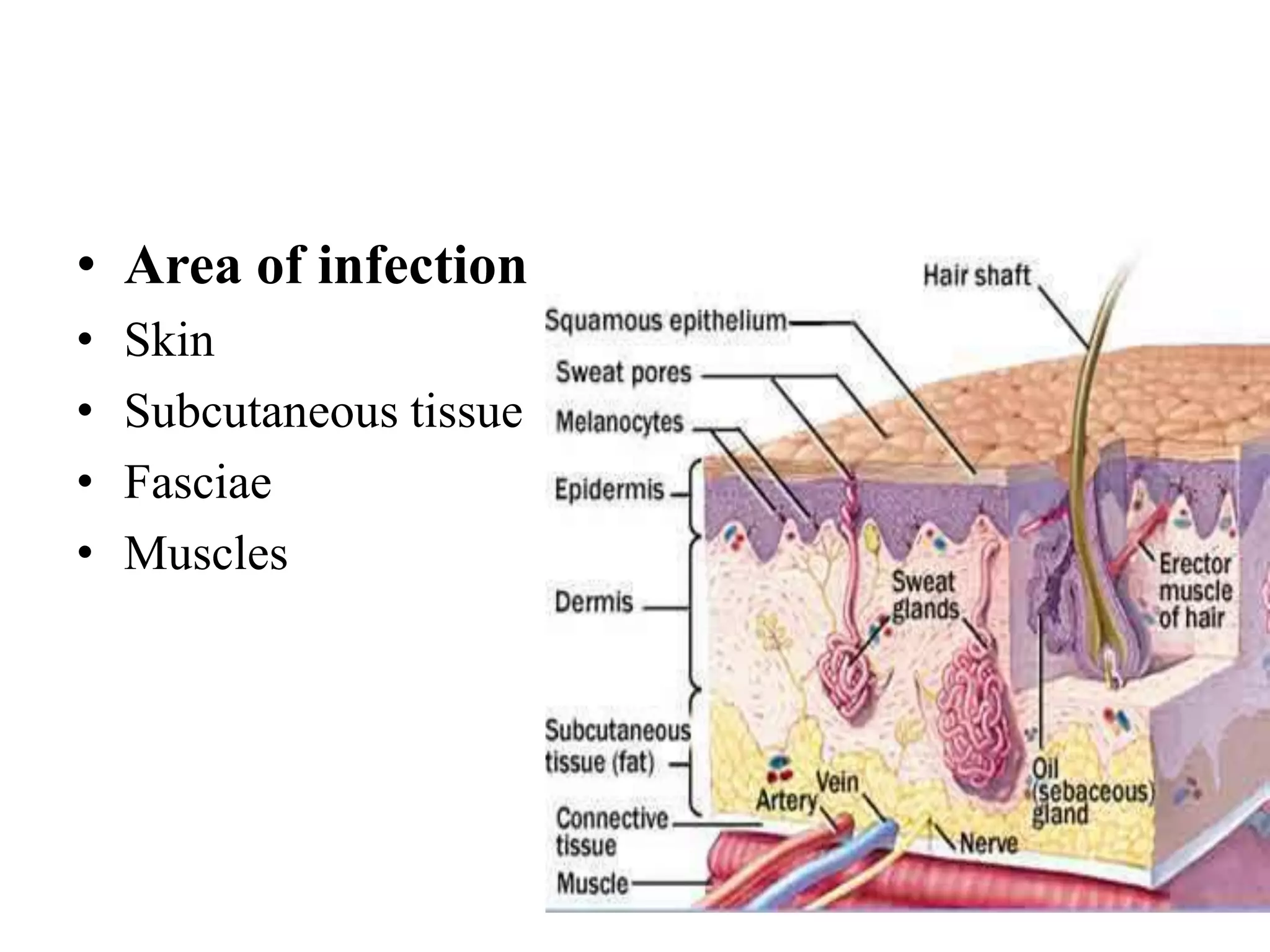
• Area of infection
• Skin
• Subcutaneous tissue
• Fasciae
• Muscles
SKIN LESION ETIOLOGICAL AGENT
SCALE DERMATOPHYTES
S.PYOGENES
ULCER B.ANTHRAX
ERYSIPELAS S.PYOGENES
OTHER STREPTOCOCCI
IMPETIGO NON –BULLOUS –S.PYOGENES
BULLOUS-S.AUREUS
CELLULITIS S.PYOGENES
S.AUREUS
HIDRADENITIS S.AUREUS
STREPTOCOCCUS ANGINOSUS
SECONDARY LESION
FOLLICULITIS S.AUREUS
FURUNCLE S.AUREUS
CARBUNCLE S.AUREUS
HAIR FOLLICLE INFECTIONS
FASCIA AND MUSCLES
SKIN LESION ETIOLOGICAL AGENT
Necrotizing fasciitis S.PYOGENES
PYOMYOSITIS S.PYOGENES
S.AUREUS
MYONECROSIS CLOSTRIDIAL MYONECROSIS
Erysipelas
• Common in very young, old, debilitated patients
• Symptoms:fever, shivering, chills, fatigue, headaches, v
omiting (48 hrs of infection)
• Well demarcated, painful, erythematous indurated
plaques, Blisters & ulceration
• More severe infections: lymphedema
• Face, legs
• Cause: Streptococcus pyogenes , Streptococcus
agalactiae (newborns)
Impetigo
• A contagious superficial infection of the skin
• common in children
• involves : face, around the mouth and nose
.
• spread by direct contact
 Symptoms: red sores to yellowish-brown crust
• Prevention :good hygiene and hand washing .
 Staphylococci or β-haemolytic streptococci
• It has two forms
• 1) non-bullous (crusted):
Streptococcus pyogenes
"honey-crust" lesions
• 2) Bullous impetigo:
• Staphylococcus aureus, rupture of the
bullae
• "varnish-like" crust
Treatment
• Usually self-limiting
• Localized
• – topical fusidic acid . (for MRSA)
• Mild and localized – Topical antibiotic
• e.g.; topical mupirocin
• Extensive disease
• – oral flucloxacillin, Erythromycin
Folliculitis
• Infections of the superficial part of the single
hair follicle
• Itchy or tender papules and pustules.
• Small pustules often pierced by a hair
• arms, legs, buttocks, genitals, chest, back,
head, and face (except the lips, palms of the
hands, and soles of the feet)
• Staphylococcus aureus
Treatment
• Topical antiseptics
-Topical sodium fusidate
- Mupirocin containing ointment
• Oral antibiotics : Flucloxacillin or erythromycin
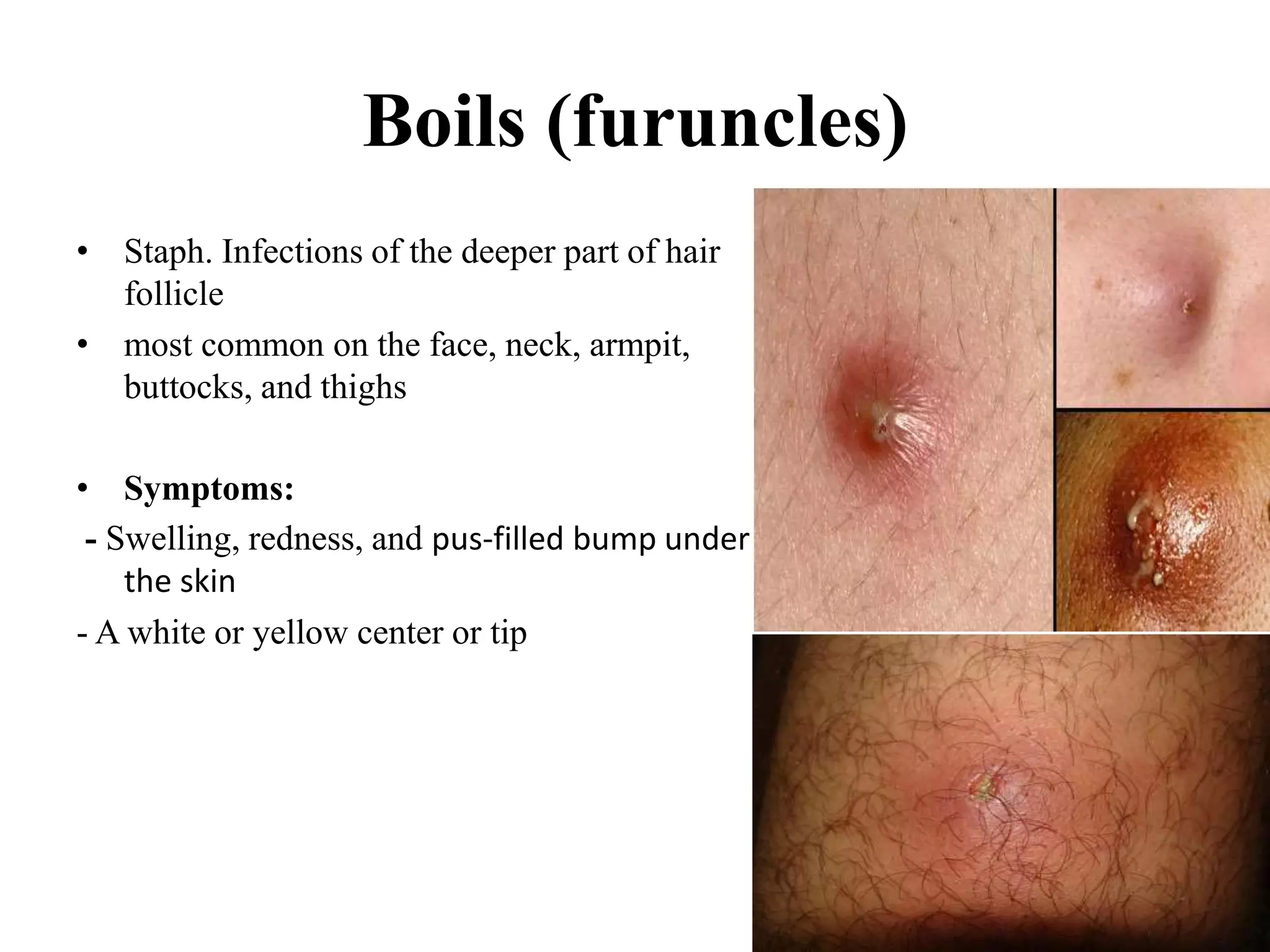
Boils (furuncles)
• Staph. Infections of the deeper part of hair
follicle
• most common on the face, neck, armpit,
buttocks, and thighs
• Symptoms:
- Swelling, redness, and pus-filled bump under
the skin
- A white or yellow center or tip
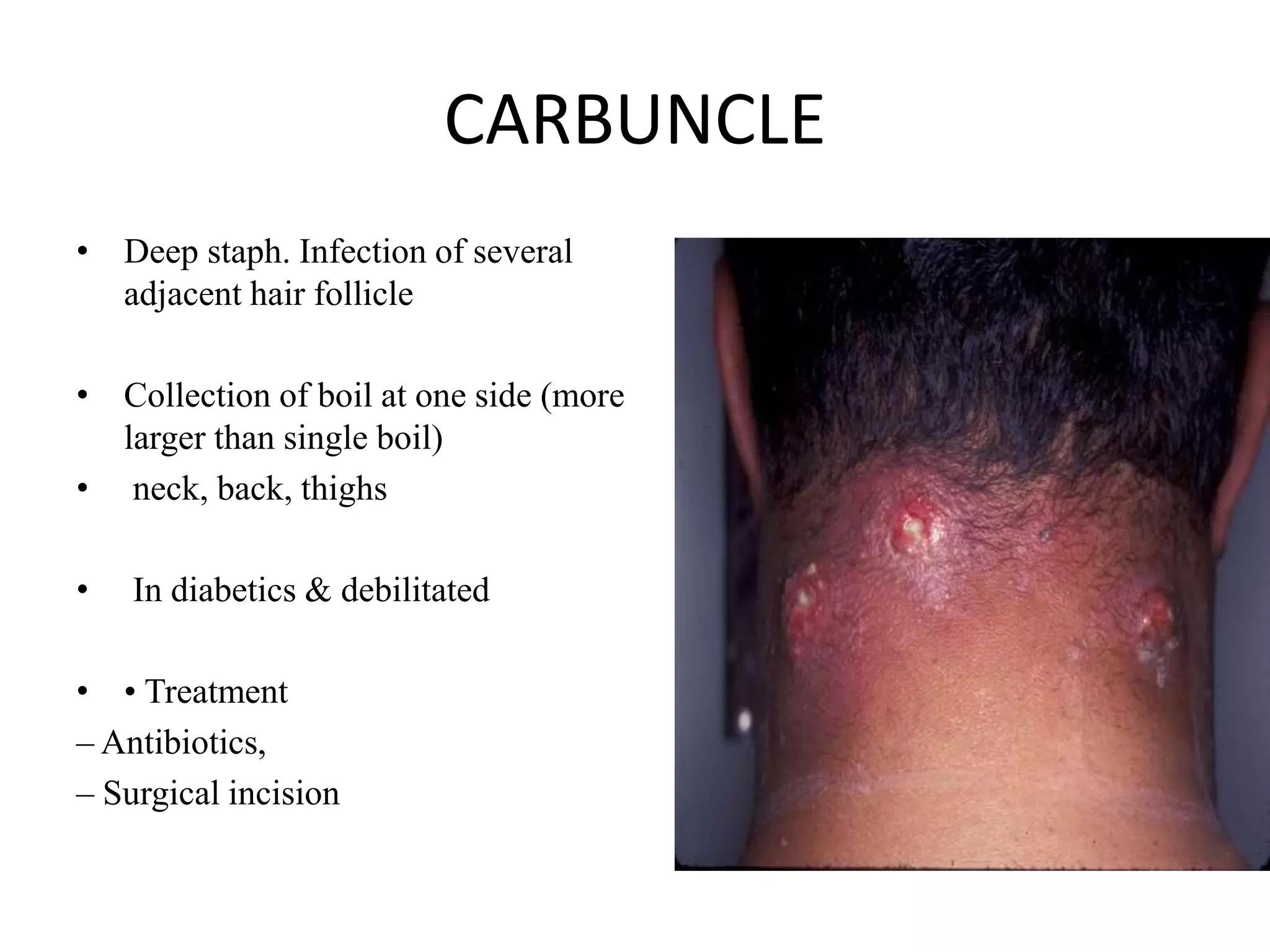
CARBUNCLE
• Deep staph. Infection of several
adjacent hair follicle
• Collection of boil at one side (more
larger than single boil)
• neck, back, thighs
• In diabetics & debilitated
• • Treatment
– Antibiotics,
– Surgical incision
Ecthyma
• By both streptococci and staphylococci
• Ulcer forms under a crusted surface of the
infection
• Heals with scarring
• predisposing factors :Poor hygiene and
malnutrition , Minor injuries
• Treatment-
– Improved hygiene and nutrition
– Antibiotics
(phenoxymethylpenicillin and flucloxacillin)
Cellulitis
• Infection of normal skin flora or exogenous Bacteria
 S. aureus and ß-haemolytic streptococci)
• Skin on the lower legs (face, arms and other areas)
• Trauma and Ulceration
• Infection can spread to blood stream
• Bacteremia /septicemia
• Associated with fever and lymphadenopathy
• Affected skin appears swollen , red, typically painful ,
and warm to the touch
Clinical features
• Acute localised pain
• Oedema
•
• Lymphangitis & lymphadenitis
• Fever, Malaise, Leucocytosis
• progressing proximally from the affected area
• More serious staphylococcus infection called methicillin-resistant
Staphylococcus aureus (MRSA)
Predisposing factors:
Diabetes
Alcoholism
Malignancy
Drug abuse
venous stasis
Risk factors
Injury
Weakened immune system
Skin conditions (eczema, athlete's foot )
• Investigations
• Swabs taken from relevant sites (from leading edge or aspirating blisters)
• Gram stain and Blood cultures
•
Serological-
– antistreptolysin O titre (ASOT)
– antiDNAse B titre (ADB)
TREATMENT
• Antibiotics
• – Phenoxymethylpenicillin
• – erythromycin
• – flucloxacillin
• – Vancomycin
• – Linezolid
• – Clindamycin
MRSA Cellulitis
Necrotizing fasciitis/flesh-eating
disease
• Infection that results in the death of parts of the
body's soft tissue
• limbs and perineum.
• Symptoms : red or purple skin in the affected
area, severe pain, fever, and vomiting
• Mode of infection : break in the skin such as a cut
or burn
• Risk factors : poor immune function such
as diabetes or cancer, obesity, alcoholism, intrave
nous drug use, and peripheral artery disease
• Classification : 4 types (types of bacteria infecting the soft tissue)
1) Type I infection: most common type (70-80 % cases) , abdominal or groin
areas ,
• Staphylococcus aureus, Streptococcus pyogenes, and enterococci ,
Escherichia coli, Pseudomonas aeruginosa, and anaerobes,
(Bacteroides and Clostridium species [ Clostridium perfringens, Clostridium
septicum, and Clostridium sordellii] )
• Trauma is not the cause of such infections ( Previous history of abscess
infection or gut perforation)
Clostridium perfringens
alpha-
toxin
theta-
toxin
excessive
platelet
aggregation
blocks blood vessels and deprives
the vital organs of oxygen supply
C
R
E
A
T
E
acidic, oxygen-deficient
environment for the
proliferation of bacteria
once alpha-toxin absorbed by soft tissues
inhibit the migration of white blood cells from blood vessels into the
soft tissue, thus impairing phagocyte function
destruction of red blood cells
in blood vessels, damage to the
integrity of the blood vessels,
and suppression of heart
function
• 2) Type 2 : 20 to 30% of cases ,
• Streptococcus pyogenes bacteria
• young, healthy adults with a history of injury
• 3) Type III infection: Vibrio vulnificus
• 4) Type iv : related to fungal infection
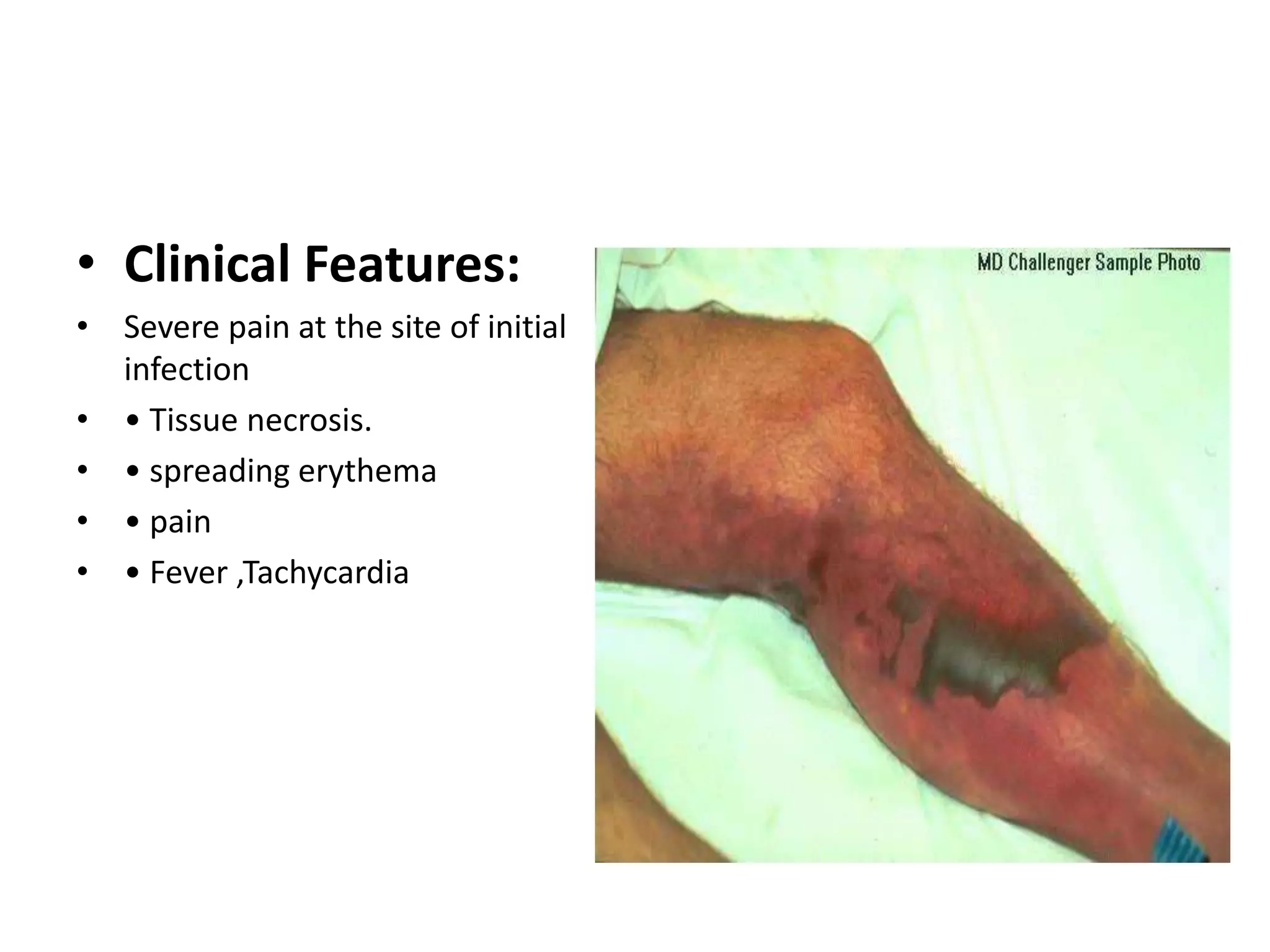
• Clinical Features:
• Severe pain at the site of initial
infection
• • Tissue necrosis.
• • spreading erythema
• • pain
• • Fever ,Tachycardia
• Treatment
• –Type 1-
• - Broad-spectrum combination
• (amoxicillin , imipenem, levofloxacin)
• –Type 2
• • benzylpenicillin and clindamycin
• urgent surgical exploration
• – amputation (if necessary)
Staphylococcal scalded skin
syndrome
• Exfoliate or epidermolytic toxin.
• Skin looks like (scalded or burned)
• Risk factors : any age (children under 5 years),
Weak immune system, chronic kidney disease or
kidney failure
• SYMPTOMS :
-Fussiness (irritability)
-Tiredness
-Fever
-Redness of the skin
-Fluid-filled blisters
- Top layer of skin may peel away
Hidradenitis suppurativa
• Chronic infection of obstructed sweat
gland
• Staphylococcus aureus and
streptococcus anginosus group
• Multiple tender swellings (Enlarging and
discharging pus)
Pyomyositis
• S. aureus & Streptococcus infection of the
skeletal muscles
• Pus forming in muscle layer
• Symptoms: Fever, Sepsis, Localized
inflammation , Muscle pain
• Predisposing factors: Immunodeficiency,
Trauma and malnutrition
Gas Gangrene
(Clostridial myonecrosis)
• Clostridium perfringens
• Extensive tissue destruction
• gas production by fermentative action of
bacteria.
• Swollen reddish-black
• foul smelling tissue with crepitus.
LABORATORY DIAGNOSIS OF
Skin and soft tissue infections
• 1) SPECIMEN COLLECTION :
• Pus : wound by sterile swab
• Pus from abscess :by incision and needle aspiration
• Vesicle or bulla fluid : needle aspiration
• Subcutaneous infection: base of lesion or biopsy of deep tissues
• Skin scrapping : hair and nail clipping (fungal infections)
• 2) Microscopy :
• Gram staining : morphology of causative agent
• KOH mount : fungal suspected
• Tzanck smear : HSV and varicella virus
• 3) Culture :
• Aerobic bacteria : BA and MA for overnight at 37 o c
• Atypical mycobacterium : LJ media
• Dermatophytes : SDA
• Anaerobic organisms : RCM and BHI
•
• 4) Identification : colony morphology , culture smear and
biochemical reactions
• 5) AST : Based on type of organism

Skin and soft tissue infections

  • 1.
    Skin and softtissue infections
  • 2.
    INTRODUCTION • Skin andsoft tissue infection : invasion of organism through skin or organism reach the skin from blood • Pyogenic infections : pus produced • Pus : localized deep tissue , surface ( pahrynx) , musosa of bladder , meninges and any part of body
  • 3.
    Clinical types (SSTIs) •1) PRIMARY LESION: due to damage of trauma or disease • 2) SECONDARY LESION: As a result of any primary infections
  • 4.
    • Area ofinfection • Skin • Subcutaneous tissue • Fasciae • Muscles
  • 6.
    SKIN LESION ETIOLOGICALAGENT SCALE DERMATOPHYTES S.PYOGENES ULCER B.ANTHRAX ERYSIPELAS S.PYOGENES OTHER STREPTOCOCCI IMPETIGO NON –BULLOUS –S.PYOGENES BULLOUS-S.AUREUS CELLULITIS S.PYOGENES S.AUREUS HIDRADENITIS S.AUREUS STREPTOCOCCUS ANGINOSUS SECONDARY LESION
  • 7.
    FOLLICULITIS S.AUREUS FURUNCLE S.AUREUS CARBUNCLES.AUREUS HAIR FOLLICLE INFECTIONS
  • 8.
    FASCIA AND MUSCLES SKINLESION ETIOLOGICAL AGENT Necrotizing fasciitis S.PYOGENES PYOMYOSITIS S.PYOGENES S.AUREUS MYONECROSIS CLOSTRIDIAL MYONECROSIS
  • 9.
    Erysipelas • Common invery young, old, debilitated patients • Symptoms:fever, shivering, chills, fatigue, headaches, v omiting (48 hrs of infection) • Well demarcated, painful, erythematous indurated plaques, Blisters & ulceration • More severe infections: lymphedema • Face, legs • Cause: Streptococcus pyogenes , Streptococcus agalactiae (newborns)
  • 10.
    Impetigo • A contagioussuperficial infection of the skin • common in children • involves : face, around the mouth and nose . • spread by direct contact  Symptoms: red sores to yellowish-brown crust • Prevention :good hygiene and hand washing .  Staphylococci or β-haemolytic streptococci
  • 11.
    • It hastwo forms • 1) non-bullous (crusted): Streptococcus pyogenes "honey-crust" lesions • 2) Bullous impetigo: • Staphylococcus aureus, rupture of the bullae • "varnish-like" crust
  • 12.
    Treatment • Usually self-limiting •Localized • – topical fusidic acid . (for MRSA) • Mild and localized – Topical antibiotic • e.g.; topical mupirocin • Extensive disease • – oral flucloxacillin, Erythromycin
  • 13.
    Folliculitis • Infections ofthe superficial part of the single hair follicle • Itchy or tender papules and pustules. • Small pustules often pierced by a hair • arms, legs, buttocks, genitals, chest, back, head, and face (except the lips, palms of the hands, and soles of the feet) • Staphylococcus aureus
  • 14.
    Treatment • Topical antiseptics -Topicalsodium fusidate - Mupirocin containing ointment • Oral antibiotics : Flucloxacillin or erythromycin
  • 15.
    Boils (furuncles) • Staph.Infections of the deeper part of hair follicle • most common on the face, neck, armpit, buttocks, and thighs • Symptoms: - Swelling, redness, and pus-filled bump under the skin - A white or yellow center or tip
  • 16.
    CARBUNCLE • Deep staph.Infection of several adjacent hair follicle • Collection of boil at one side (more larger than single boil) • neck, back, thighs • In diabetics & debilitated • • Treatment – Antibiotics, – Surgical incision
  • 17.
    Ecthyma • By bothstreptococci and staphylococci • Ulcer forms under a crusted surface of the infection • Heals with scarring • predisposing factors :Poor hygiene and malnutrition , Minor injuries
  • 18.
    • Treatment- – Improvedhygiene and nutrition – Antibiotics (phenoxymethylpenicillin and flucloxacillin)
  • 19.
    Cellulitis • Infection ofnormal skin flora or exogenous Bacteria  S. aureus and ß-haemolytic streptococci) • Skin on the lower legs (face, arms and other areas) • Trauma and Ulceration • Infection can spread to blood stream • Bacteremia /septicemia • Associated with fever and lymphadenopathy • Affected skin appears swollen , red, typically painful , and warm to the touch
  • 20.
    Clinical features • Acutelocalised pain • Oedema • • Lymphangitis & lymphadenitis • Fever, Malaise, Leucocytosis • progressing proximally from the affected area • More serious staphylococcus infection called methicillin-resistant Staphylococcus aureus (MRSA)
  • 21.
    Predisposing factors: Diabetes Alcoholism Malignancy Drug abuse venousstasis Risk factors Injury Weakened immune system Skin conditions (eczema, athlete's foot )
  • 23.
    • Investigations • Swabstaken from relevant sites (from leading edge or aspirating blisters) • Gram stain and Blood cultures • Serological- – antistreptolysin O titre (ASOT) – antiDNAse B titre (ADB)
  • 24.
    TREATMENT • Antibiotics • –Phenoxymethylpenicillin • – erythromycin • – flucloxacillin • – Vancomycin • – Linezolid • – Clindamycin MRSA Cellulitis
  • 25.
    Necrotizing fasciitis/flesh-eating disease • Infectionthat results in the death of parts of the body's soft tissue • limbs and perineum. • Symptoms : red or purple skin in the affected area, severe pain, fever, and vomiting • Mode of infection : break in the skin such as a cut or burn • Risk factors : poor immune function such as diabetes or cancer, obesity, alcoholism, intrave nous drug use, and peripheral artery disease
  • 26.
    • Classification :4 types (types of bacteria infecting the soft tissue) 1) Type I infection: most common type (70-80 % cases) , abdominal or groin areas , • Staphylococcus aureus, Streptococcus pyogenes, and enterococci , Escherichia coli, Pseudomonas aeruginosa, and anaerobes, (Bacteroides and Clostridium species [ Clostridium perfringens, Clostridium septicum, and Clostridium sordellii] ) • Trauma is not the cause of such infections ( Previous history of abscess infection or gut perforation)
  • 27.
    Clostridium perfringens alpha- toxin theta- toxin excessive platelet aggregation blocks bloodvessels and deprives the vital organs of oxygen supply C R E A T E acidic, oxygen-deficient environment for the proliferation of bacteria once alpha-toxin absorbed by soft tissues inhibit the migration of white blood cells from blood vessels into the soft tissue, thus impairing phagocyte function destruction of red blood cells in blood vessels, damage to the integrity of the blood vessels, and suppression of heart function
  • 28.
    • 2) Type2 : 20 to 30% of cases , • Streptococcus pyogenes bacteria • young, healthy adults with a history of injury • 3) Type III infection: Vibrio vulnificus • 4) Type iv : related to fungal infection
  • 30.
    • Clinical Features: •Severe pain at the site of initial infection • • Tissue necrosis. • • spreading erythema • • pain • • Fever ,Tachycardia
  • 31.
    • Treatment • –Type1- • - Broad-spectrum combination • (amoxicillin , imipenem, levofloxacin) • –Type 2 • • benzylpenicillin and clindamycin • urgent surgical exploration • – amputation (if necessary)
  • 32.
    Staphylococcal scalded skin syndrome •Exfoliate or epidermolytic toxin. • Skin looks like (scalded or burned) • Risk factors : any age (children under 5 years), Weak immune system, chronic kidney disease or kidney failure • SYMPTOMS : -Fussiness (irritability) -Tiredness -Fever -Redness of the skin -Fluid-filled blisters - Top layer of skin may peel away
  • 33.
    Hidradenitis suppurativa • Chronicinfection of obstructed sweat gland • Staphylococcus aureus and streptococcus anginosus group • Multiple tender swellings (Enlarging and discharging pus)
  • 34.
    Pyomyositis • S. aureus& Streptococcus infection of the skeletal muscles • Pus forming in muscle layer • Symptoms: Fever, Sepsis, Localized inflammation , Muscle pain • Predisposing factors: Immunodeficiency, Trauma and malnutrition
  • 35.
    Gas Gangrene (Clostridial myonecrosis) •Clostridium perfringens • Extensive tissue destruction • gas production by fermentative action of bacteria. • Swollen reddish-black • foul smelling tissue with crepitus.
  • 36.
    LABORATORY DIAGNOSIS OF Skinand soft tissue infections • 1) SPECIMEN COLLECTION : • Pus : wound by sterile swab • Pus from abscess :by incision and needle aspiration • Vesicle or bulla fluid : needle aspiration • Subcutaneous infection: base of lesion or biopsy of deep tissues • Skin scrapping : hair and nail clipping (fungal infections)
  • 37.
    • 2) Microscopy: • Gram staining : morphology of causative agent • KOH mount : fungal suspected • Tzanck smear : HSV and varicella virus
  • 38.
    • 3) Culture: • Aerobic bacteria : BA and MA for overnight at 37 o c • Atypical mycobacterium : LJ media • Dermatophytes : SDA • Anaerobic organisms : RCM and BHI •
  • 39.
    • 4) Identification: colony morphology , culture smear and biochemical reactions • 5) AST : Based on type of organism