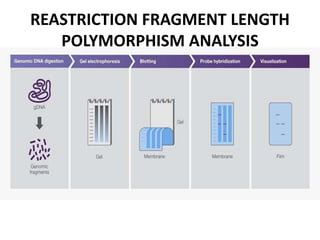
REASTRICTION FRAGMENT LENGTH
POLYMORPHISM ANALYSIS
• Definition : used to detect variation in length of
DNA (polymorphisms) in order to distinguish
individuals, populations, or species or to pinpoint
the locations of genes within a sequence.
• Restriction endonuclease enzyme recognisation
site : in DND
• Variations in pattern of restriction endonuclease
enzyme recognisation in two different DNA is due
to variable number of tandem repeats(VNTRs)
• Hybridization based method
• Cannot run pcr as require more amount of
DNA
• If DNA is incubated with specific restriction
endonuclease enzyme produce cut after
recognising specific sequence on DNA
sequence.
• EcoRV restriction endonuclease site
TWO DIFFERENT DNA SEGMENT
INCUBATE WITH SAME
RESTRICTION
ENDONUCLEASE ENZYME
DIFFERENT DNA FRAGMENTS
agarose gel electrophoresis , Southern
blotting respectively
Applications
1) genetic fingerprinting : criminal
identification
2) Paternity testing
3) Diversity or phylogeny study
Random amplification of polymorphic
DNA (RAPD)
• PCR based method
• Random primer is used to compare
polymorphism in different DNA
• 1990 BY WILLIUM et.al
• Lab technique by which amplify unknown
sequence
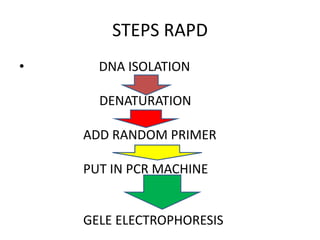
STEPS RAPD
• DNA ISOLATION
DENATURATION
ADD RANDOM PRIMER
PUT IN PCR MACHINE
GELE ELECTROPHORESIS
Amplified fragment length
polymorphism (AFLP)
• AFLP is a technique used to detect
polymorphisms in DNA when no information
about the genome is known
• Method based on pcr
• Involve use of rflp and pcr techniques
• Faster and less labor require
• Use for geneting mapping
• Developed in 1990s by Keygene
• Uses two different restriction enzyme (6 base
cutter and 4 base cutter)
• 6 base cutter (EcoRI) and 4 base cutter (Mse1)
cut only complementary DNA sequences.
Restriction digestion by two different restriction enzyme
(6 base cutter (EcoR1) and 4 base cutter (Mse1)
DNA isolation
5’ GAATTC 3’
3’CTTAAG5’
5’ TTAA 3’
3’AATT 5’
DNA with complementary sites
GAATTC…..//……TTAA…..//
CTTAAG…//….AATT…//
RESTRICTIO
N PRODUCT
AATTC…//…T
G….//…AAT
LIGATIONS WITH ADOPTORS TO
COMPLEMENTORY DNA
Pcr amplification 2 times to get more
numbers of fragments
EcoR1 and Mse1 Adaptor specific primers (consisting of
complementary to restriction ,adaptors . Add adenine at 3
prime end and cytocin at 5 prime end on both primers
respectively
Selective amplifications
EcoR1: consisting of complementary to
restriction ,adaptors and AGC
Mse1: : consisting of complementary to
restriction ,adaptors and CAG
GEL ELECTROPHORESIS
• THANK YOU

Rflp

  • 1.
  • 2.
    • Definition :used to detect variation in length of DNA (polymorphisms) in order to distinguish individuals, populations, or species or to pinpoint the locations of genes within a sequence. • Restriction endonuclease enzyme recognisation site : in DND • Variations in pattern of restriction endonuclease enzyme recognisation in two different DNA is due to variable number of tandem repeats(VNTRs)
  • 3.
    • Hybridization basedmethod • Cannot run pcr as require more amount of DNA
  • 4.
    • If DNAis incubated with specific restriction endonuclease enzyme produce cut after recognising specific sequence on DNA sequence. • EcoRV restriction endonuclease site TWO DIFFERENT DNA SEGMENT INCUBATE WITH SAME RESTRICTION ENDONUCLEASE ENZYME DIFFERENT DNA FRAGMENTS agarose gel electrophoresis , Southern blotting respectively
  • 5.
    Applications 1) genetic fingerprinting: criminal identification 2) Paternity testing 3) Diversity or phylogeny study
  • 6.
    Random amplification ofpolymorphic DNA (RAPD) • PCR based method • Random primer is used to compare polymorphism in different DNA • 1990 BY WILLIUM et.al • Lab technique by which amplify unknown sequence
  • 7.
    STEPS RAPD • DNAISOLATION DENATURATION ADD RANDOM PRIMER PUT IN PCR MACHINE GELE ELECTROPHORESIS
  • 8.
    Amplified fragment length polymorphism(AFLP) • AFLP is a technique used to detect polymorphisms in DNA when no information about the genome is known • Method based on pcr • Involve use of rflp and pcr techniques • Faster and less labor require • Use for geneting mapping
  • 9.
    • Developed in1990s by Keygene • Uses two different restriction enzyme (6 base cutter and 4 base cutter)
  • 10.
    • 6 basecutter (EcoRI) and 4 base cutter (Mse1) cut only complementary DNA sequences.
  • 11.
    Restriction digestion bytwo different restriction enzyme (6 base cutter (EcoR1) and 4 base cutter (Mse1) DNA isolation 5’ GAATTC 3’ 3’CTTAAG5’ 5’ TTAA 3’ 3’AATT 5’ DNA with complementary sites GAATTC…..//……TTAA…..// CTTAAG…//….AATT…// RESTRICTIO N PRODUCT AATTC…//…T G….//…AAT LIGATIONS WITH ADOPTORS TO COMPLEMENTORY DNA Pcr amplification 2 times to get more numbers of fragments EcoR1 and Mse1 Adaptor specific primers (consisting of complementary to restriction ,adaptors . Add adenine at 3 prime end and cytocin at 5 prime end on both primers respectively Selective amplifications EcoR1: consisting of complementary to restriction ,adaptors and AGC Mse1: : consisting of complementary to restriction ,adaptors and CAG GEL ELECTROPHORESIS
  • 12.