Zimbabwe tusk burning
TRADE
Benefits, Costs, and Obstacles
Outline
• Why do countries trade?
• Comparative Advantage
• How much trade?
• Go to the data
• Within countries who benefits from trade?
• It depends, look at demand and supply
Why trade?
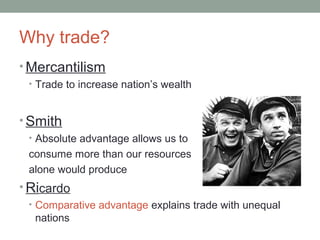
• Mercantilism
• Trade to increase nation’s wealth
• Smith
• Absolute advantage allows us to
consume more than our resources
alone would produce
• Ricardo
• Comparative advantage explains trade with unequal
nations
Trade leads to:
• Specialization thus advancement of knowledge
• Economies of scale and competition
• Comparative advantage thus greater overall production
Production Possibilities Frontier
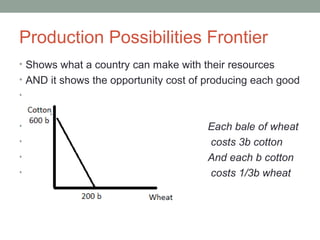
• Shows what a country can make with their resources
• AND it shows the opportunity cost of producing each good
•
• Each bale of wheat
• costs 3b cotton
• And each b cotton
• costs 1/3b wheat
Calculating those opportunity costs:
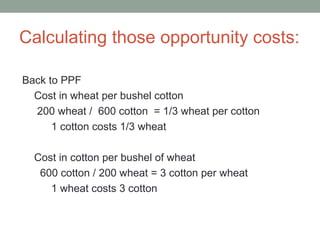
Back to PPF
Cost in wheat per bushel cotton
200 wheat / 600 cotton = 1/3 wheat per cotton
1 cotton costs 1/3 wheat
Cost in cotton per bushel of wheat
600 cotton / 200 wheat = 3 cotton per wheat
1 wheat costs 3 cotton
Compare PPFs
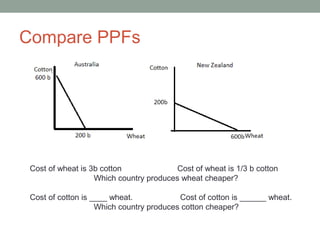
Cost of wheat is 3b cotton Cost of wheat is 1/3 b cotton
Which country produces wheat cheaper?
Cost of cotton is ____ wheat. Cost of cotton is ______ wheat.
Which country produces cotton cheaper?
Comparative Advantage
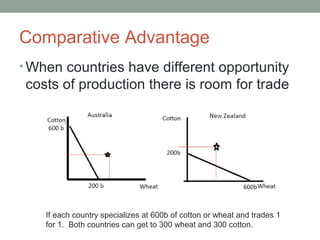
• When countries have different opportunity
costs of production there is room for trade
If each country specializes at 600b of cotton or wheat and trades 1
for 1. Both countries can get to 300 wheat and 300 cotton.
Free trade can:
•Increase the consumption
possibilities for each nation
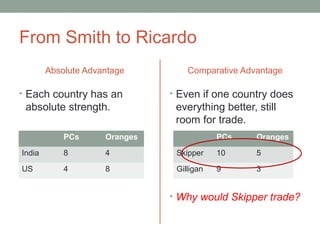
From Smith to Ricardo
Absolute Advantage
• Each country has an
absolute strength.
Comparative Advantage
• Even if one country does
everything better, still
room for trade.
• Why would Skipper trade?
PCs Oranges
India 8 4
US 4 8
PCs Oranges
Skipper 10 5
Gilligan 9 3
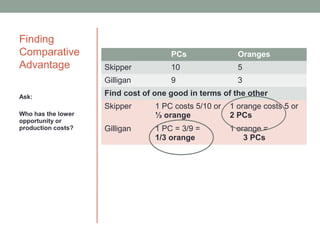
Finding
Comparative
Advantage
PCs Oranges
Skipper 10 5
Gilligan 9 3
Find cost of one good in terms of the other
Skipper 1 PC costs 5/10 or
½ orange
1 orange costs 5 or
2 PCs
Gilligan 1 PC = 3/9 =
1/3 orange
1 orange =
3 PCs
Ask:
Who has the lower
opportunity or
production costs?
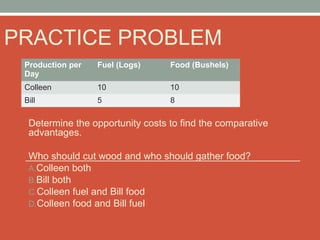
PRACTICE PROBLEM
Determine the opportunity costs to find the comparative
advantages.
Who should cut wood and who should gather food?
A.Colleen both
B.Bill both
C.Colleen fuel and Bill food
D.Colleen food and Bill fuel
Production per
Day
Fuel (Logs) Food (Bushels)
Colleen 10 10
Bill 5 8
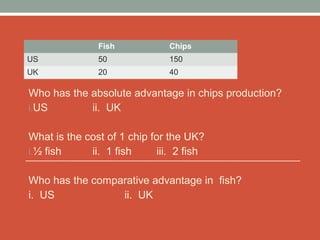
Who has the absolute advantage in chips production?
i.US ii. UK
What is the cost of 1 chip for the UK?
i.½ fish ii. 1 fish iii. 2 fish
Who has the comparative advantage in fish?
i. US ii. UK
Fish Chips
US 50 150
UK 20 40
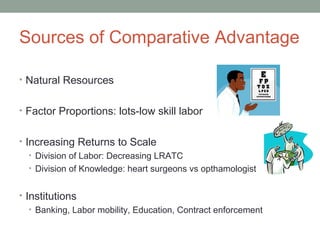
Sources of Comparative Advantage
• Natural Resources
• Factor Proportions: lots-low skill labor
• Increasing Returns to Scale
• Division of Labor: Decreasing LRATC
• Division of Knowledge: heart surgeons vs opthamologist
• Institutions
• Banking, Labor mobility, Education, Contract enforcement
WHO BENEFITS
WITHIN COUNTRIES?
Look to demand and supply
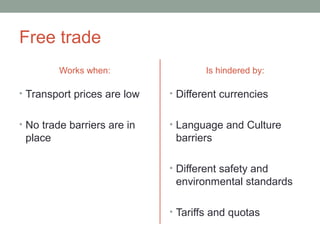
Free trade
Works when:
• Transport prices are low
• No trade barriers are in
place
Is hindered by:
• Different currencies
• Language and Culture
barriers
• Different safety and
environmental standards
• Tariffs and quotas
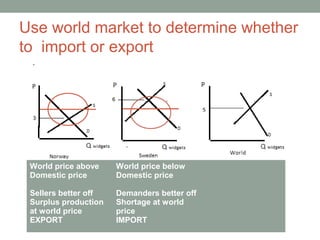
Use world market to determine whether
to import or export
World price above
Domestic price
Sellers better off
Surplus production
at world price
EXPORT
World price below
Domestic price
Demanders better off
Shortage at world
price
IMPORT
Trade makes countries better off
overall
• But in some cases, consumers pay more
• And in other cases, suppliers lose sales and
profits
The costs of trade can lead to protectionism.
Usually from producers who cannot compete against cheaper
imports.
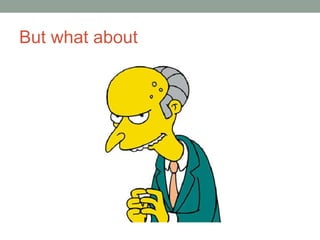
But what about
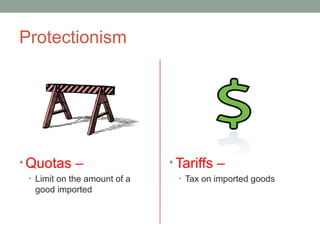
Protectionism
• Quotas –
• Limit on the amount of a
good imported
• Tariffs –
• Tax on imported goods
Quota
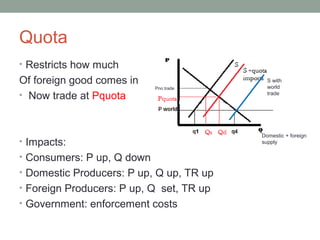
• Restricts how much
Of foreign good comes in
• Now trade at Pquota
• Impacts:
• Consumers: P up, Q down
• Domestic Producers: P up, Q up, TR up
• Foreign Producers: P up, Q set, TR up
• Government: enforcement costs
Domestic + foreign
supply
S with
world
trade
Pno trade
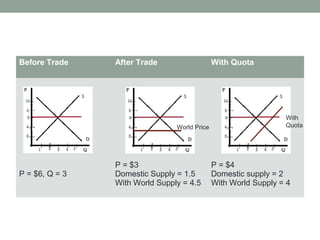
Before Trade After Trade With Quota
P = $6, Q = 3
P = $3
Domestic Supply = 1.5
With World Supply = 4.5
P = $4
Domestic supply = 2
With World Supply = 4
World Price
With
Quota
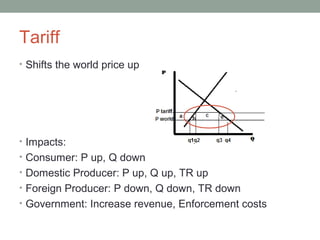
Tariff
• Shifts the world price up
• Impacts:
• Consumer: P up, Q down
• Domestic Producer: P up, Q up, TR up
• Foreign Producer: P down, Q down, TR down
• Government: Increase revenue, Enforcement costs
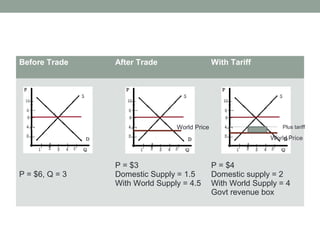
Before Trade After Trade With Tariff
P = $6, Q = 3
P = $3
Domestic Supply = 1.5
With World Supply = 4.5
P = $4
Domestic supply = 2
With World Supply = 4
Govt revenue box
World Price Plus tariff
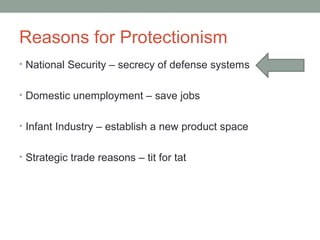
Reasons for Protectionism
• National Security – secrecy of defense systems
• Domestic unemployment – save jobs
• Infant Industry – establish a new product space
• Strategic trade reasons – tit for tat
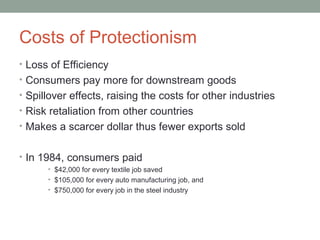
Costs of Protectionism
• Loss of Efficiency
• Consumers pay more for downstream goods
• Spillover effects, raising the costs for other industries
• Risk retaliation from other countries
• Makes a scarcer dollar thus fewer exports sold
• In 1984, consumers paid
• $42,000 for every textile job saved
• $105,000 for every auto manufacturing job, and
• $750,000 for every job in the steel industry
Candlemaker’
s Petition
Frederic Bastiat
Mid 1800s
France
Because trade hurts
someone – there will
always be calls for help
Usually from the
producers
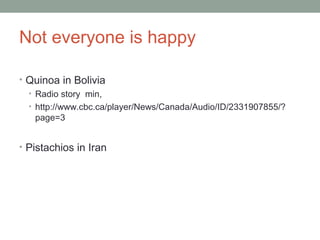
Not everyone is happy
• Quinoa in Bolivia
• Radio story min,
• http://www.cbc.ca/player/News/Canada/Audio/ID/2331907855/?
page=3
• Pistachios in Iran
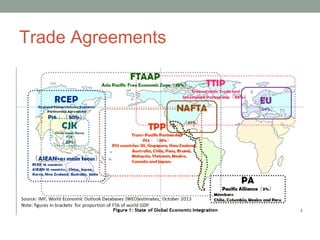
Trade Agreements
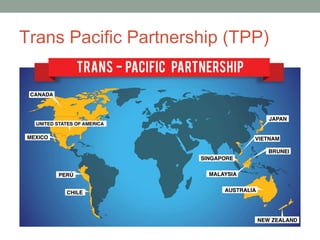
Trans Pacific Partnership (TPP)
What about Fair trade?
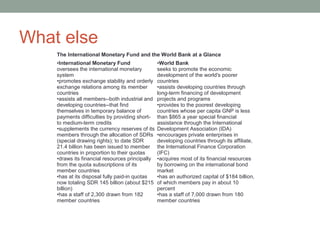
What else
The International Monetary Fund and the World Bank at a Glance
•International Monetary Fund
oversees the international monetary
system
•promotes exchange stability and orderly
exchange relations among its member
countries
•assists all members--both industrial and
developing countries--that find
themselves in temporary balance of
payments difficulties by providing short-
to medium-term credits
•supplements the currency reserves of its
members through the allocation of SDRs
(special drawing rights); to date SDR
21.4 billion has been issued to member
countries in proportion to their quotas
•draws its financial resources principally
from the quota subscriptions of its
member countries
•has at its disposal fully paid-in quotas
now totaling SDR 145 billion (about $215
billion)
•has a staff of 2,300 drawn from 182
member countries
•World Bank
seeks to promote the economic
development of the world's poorer
countries
•assists developing countries through
long-term financing of development
projects and programs
•provides to the poorest developing
countries whose per capita GNP is less
than $865 a year special financial
assistance through the International
Development Association (IDA)
•encourages private enterprises in
developing countries through its affiliate,
the International Finance Corporation
(IFC)
•acquires most of its financial resources
by borrowing on the international bond
market
•has an authorized capital of $184 billion,
of which members pay in about 10
percent
•has a staff of 7,000 drawn from 180
member countries
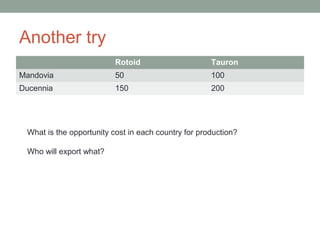
Another try
Rotoid Tauron
Mandovia 50 100
Ducennia 150 200
What is the opportunity cost in each country for production?
Who will export what?

International Trade hs

  • 1.
  • 2.
  • 3.
    Outline • Why docountries trade? • Comparative Advantage • How much trade? • Go to the data • Within countries who benefits from trade? • It depends, look at demand and supply
  • 4.
    Why trade? • Mercantilism •Trade to increase nation’s wealth • Smith • Absolute advantage allows us to consume more than our resources alone would produce • Ricardo • Comparative advantage explains trade with unequal nations
  • 5.
    Trade leads to: •Specialization thus advancement of knowledge • Economies of scale and competition • Comparative advantage thus greater overall production
  • 6.
    Production Possibilities Frontier •Shows what a country can make with their resources • AND it shows the opportunity cost of producing each good • • Each bale of wheat • costs 3b cotton • And each b cotton • costs 1/3b wheat
  • 7.
    Calculating those opportunitycosts: Back to PPF Cost in wheat per bushel cotton 200 wheat / 600 cotton = 1/3 wheat per cotton 1 cotton costs 1/3 wheat Cost in cotton per bushel of wheat 600 cotton / 200 wheat = 3 cotton per wheat 1 wheat costs 3 cotton
  • 8.
    Compare PPFs Cost ofwheat is 3b cotton Cost of wheat is 1/3 b cotton Which country produces wheat cheaper? Cost of cotton is ____ wheat. Cost of cotton is ______ wheat. Which country produces cotton cheaper?
  • 9.
    Comparative Advantage • Whencountries have different opportunity costs of production there is room for trade If each country specializes at 600b of cotton or wheat and trades 1 for 1. Both countries can get to 300 wheat and 300 cotton.
  • 10.
    Free trade can: •Increasethe consumption possibilities for each nation
  • 11.
    From Smith toRicardo Absolute Advantage • Each country has an absolute strength. Comparative Advantage • Even if one country does everything better, still room for trade. • Why would Skipper trade? PCs Oranges India 8 4 US 4 8 PCs Oranges Skipper 10 5 Gilligan 9 3
  • 12.
    Finding Comparative Advantage PCs Oranges Skipper 105 Gilligan 9 3 Find cost of one good in terms of the other Skipper 1 PC costs 5/10 or ½ orange 1 orange costs 5 or 2 PCs Gilligan 1 PC = 3/9 = 1/3 orange 1 orange = 3 PCs Ask: Who has the lower opportunity or production costs?
  • 13.
    PRACTICE PROBLEM Determine theopportunity costs to find the comparative advantages. Who should cut wood and who should gather food? A.Colleen both B.Bill both C.Colleen fuel and Bill food D.Colleen food and Bill fuel Production per Day Fuel (Logs) Food (Bushels) Colleen 10 10 Bill 5 8
  • 14.
    Who has theabsolute advantage in chips production? i.US ii. UK What is the cost of 1 chip for the UK? i.½ fish ii. 1 fish iii. 2 fish Who has the comparative advantage in fish? i. US ii. UK Fish Chips US 50 150 UK 20 40
  • 15.
    Sources of ComparativeAdvantage • Natural Resources • Factor Proportions: lots-low skill labor • Increasing Returns to Scale • Division of Labor: Decreasing LRATC • Division of Knowledge: heart surgeons vs opthamologist • Institutions • Banking, Labor mobility, Education, Contract enforcement
  • 16.
  • 17.
    Free trade Works when: •Transport prices are low • No trade barriers are in place Is hindered by: • Different currencies • Language and Culture barriers • Different safety and environmental standards • Tariffs and quotas
  • 18.
    Use world marketto determine whether to import or export World price above Domestic price Sellers better off Surplus production at world price EXPORT World price below Domestic price Demanders better off Shortage at world price IMPORT
  • 19.
    Trade makes countriesbetter off overall • But in some cases, consumers pay more • And in other cases, suppliers lose sales and profits The costs of trade can lead to protectionism. Usually from producers who cannot compete against cheaper imports.
  • 20.
  • 21.
    Protectionism • Quotas – •Limit on the amount of a good imported • Tariffs – • Tax on imported goods
  • 22.
    Quota • Restricts howmuch Of foreign good comes in • Now trade at Pquota • Impacts: • Consumers: P up, Q down • Domestic Producers: P up, Q up, TR up • Foreign Producers: P up, Q set, TR up • Government: enforcement costs Domestic + foreign supply S with world trade Pno trade
  • 23.
    Before Trade AfterTrade With Quota P = $6, Q = 3 P = $3 Domestic Supply = 1.5 With World Supply = 4.5 P = $4 Domestic supply = 2 With World Supply = 4 World Price With Quota
  • 24.
    Tariff • Shifts theworld price up • Impacts: • Consumer: P up, Q down • Domestic Producer: P up, Q up, TR up • Foreign Producer: P down, Q down, TR down • Government: Increase revenue, Enforcement costs
  • 25.
    Before Trade AfterTrade With Tariff P = $6, Q = 3 P = $3 Domestic Supply = 1.5 With World Supply = 4.5 P = $4 Domestic supply = 2 With World Supply = 4 Govt revenue box World Price Plus tariff
  • 26.
    Reasons for Protectionism •National Security – secrecy of defense systems • Domestic unemployment – save jobs • Infant Industry – establish a new product space • Strategic trade reasons – tit for tat
  • 27.
    Costs of Protectionism •Loss of Efficiency • Consumers pay more for downstream goods • Spillover effects, raising the costs for other industries • Risk retaliation from other countries • Makes a scarcer dollar thus fewer exports sold • In 1984, consumers paid • $42,000 for every textile job saved • $105,000 for every auto manufacturing job, and • $750,000 for every job in the steel industry
  • 28.
    Candlemaker’ s Petition Frederic Bastiat Mid1800s France Because trade hurts someone – there will always be calls for help Usually from the producers
  • 29.
    Not everyone ishappy • Quinoa in Bolivia • Radio story min, • http://www.cbc.ca/player/News/Canada/Audio/ID/2331907855/? page=3 • Pistachios in Iran
  • 30.
  • 31.
  • 32.
  • 33.
    What else The InternationalMonetary Fund and the World Bank at a Glance •International Monetary Fund oversees the international monetary system •promotes exchange stability and orderly exchange relations among its member countries •assists all members--both industrial and developing countries--that find themselves in temporary balance of payments difficulties by providing short- to medium-term credits •supplements the currency reserves of its members through the allocation of SDRs (special drawing rights); to date SDR 21.4 billion has been issued to member countries in proportion to their quotas •draws its financial resources principally from the quota subscriptions of its member countries •has at its disposal fully paid-in quotas now totaling SDR 145 billion (about $215 billion) •has a staff of 2,300 drawn from 182 member countries •World Bank seeks to promote the economic development of the world's poorer countries •assists developing countries through long-term financing of development projects and programs •provides to the poorest developing countries whose per capita GNP is less than $865 a year special financial assistance through the International Development Association (IDA) •encourages private enterprises in developing countries through its affiliate, the International Finance Corporation (IFC) •acquires most of its financial resources by borrowing on the international bond market •has an authorized capital of $184 billion, of which members pay in about 10 percent •has a staff of 7,000 drawn from 180 member countries
  • 34.
    Another try Rotoid Tauron Mandovia50 100 Ducennia 150 200 What is the opportunity cost in each country for production? Who will export what?

Editor's Notes

  • #2 Pic: http://www.theguardian.com/environment/2016/apr/29/kenya-to-burn-biggest-ever-stockpile-of-ivory
  • #3 Start with Gilligan’s Island
  • #5 Picture credit: http://timstvshowcase.com/gilligan.html
  • #21 http://www.criticalcommons.org/Members/AdrianFohr/clips/the-candle-makers-petition Pic: http://media.nbcchicago.com/images/1200*675/mr-burns-resized-p1.jpg
  • #31 https://intellectualcommonwealth.wordpress.com/2014/08/06/regional-economic-integration-what-are-ftas/
  • #32 https://tax.thomsonreuters.com/blog/onesource/tpp-trans-pacific-partnership-overview/
  • #34 https://www.imf.org/external/pubs/ft/exrp/differ/differ.htm