The document discusses the concepts of equilibrium income, excess demand, deficient demand, and the multiplier effect in Keynesian economics. It provides definitions and diagrams to illustrate:
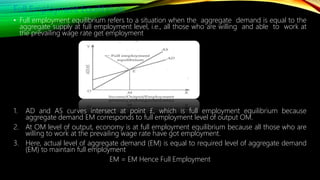
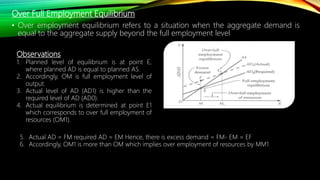
1) Equilibrium income is determined by the point where aggregate demand (AD) equals aggregate supply (AS). The economy can be at full employment, under-employment, or over-employment.
2) Excess demand occurs when AD is greater than AS at full employment, leading to inflation. Deficient demand is when AD is less than AS, resulting in under-employment.
3) The investment multiplier shows how a initial change in investment causes a multiplied change in equilibrium income through subsequent rounds of spending. A higher multiplier coefficient corresponds to












![Implications
• Fiscal deficit is an estimate of borrowings by the government. Greater fiscal deficit
implies greater borrowings by the government. It has following implications:
1. Inflationary Spiral: Borrowing from RBI is often linked to inflationary spiral in the
economy. This is how it happens: Borrowing from RBI increases money supply
in the economy.Increase in money supply leads to increase in the general price
level. A persistent increase in the general price level (over a period of time)
leads to inflationary spiral
2. National Debt: Fiscal deficit leads to national debt. It hinders growth. Because, a
significant percentage of national * :cme is used up to pay the past debts.
3. Vicious Circle of High Fiscal Deficit and Low GDP Growth:Constantly high
fiscal deficit leads to a situation where: (a) GDP growth remains low because of
high fiscal deficit, and (b) fiscal deficit remains high because of low GDP
growth.[High fiscal deficit —> Low GDP growth -* High fiscal deficit.]](https://image.slidesharecdn.com/incomedeterminationandmultiplierexcessdemandanddeficientgovernmentbudgetandtheeconomy-200710102842/85/MACROECOMICS-77-320.jpg)


