Trade Policy
Adolfo Yinshi WU, Phd
Bachelor’s Program in Interdisciplinary Studies
02/03/2023
Slide 9-2
Copyright © 2003 Pearson Education, Inc.
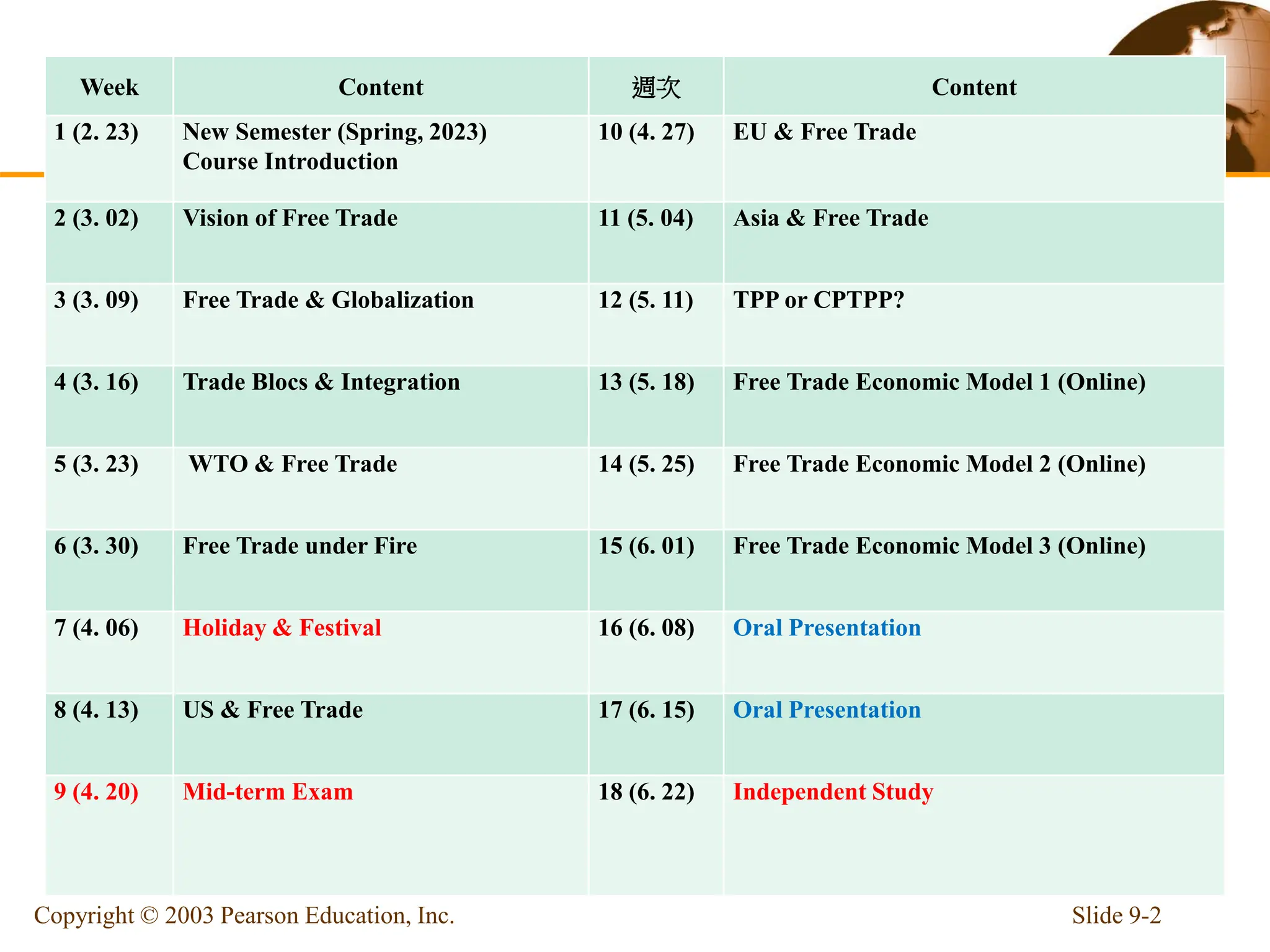
Week Content 週次 Content
1 (2. 23) New Semester (Spring, 2023)
Course Introduction
10 (4. 27) EU & Free Trade
2 (3. 02) Vision of Free Trade 11 (5. 04) Asia & Free Trade
3 (3. 09) Free Trade & Globalization 12 (5. 11) TPP or CPTPP?
4 (3. 16) Trade Blocs & Integration 13 (5. 18) Free Trade Economic Model 1 (Online)
5 (3. 23) WTO & Free Trade 14 (5. 25) Free Trade Economic Model 2 (Online)
6 (3. 30) Free Trade under Fire 15 (6. 01) Free Trade Economic Model 3 (Online)
7 (4. 06) Holiday & Festival 16 (6. 08) Oral Presentation
8 (4. 13) US & Free Trade 17 (6. 15) Oral Presentation
9 (4. 20) Mid-term Exam 18 (6. 22) Independent Study
Notes
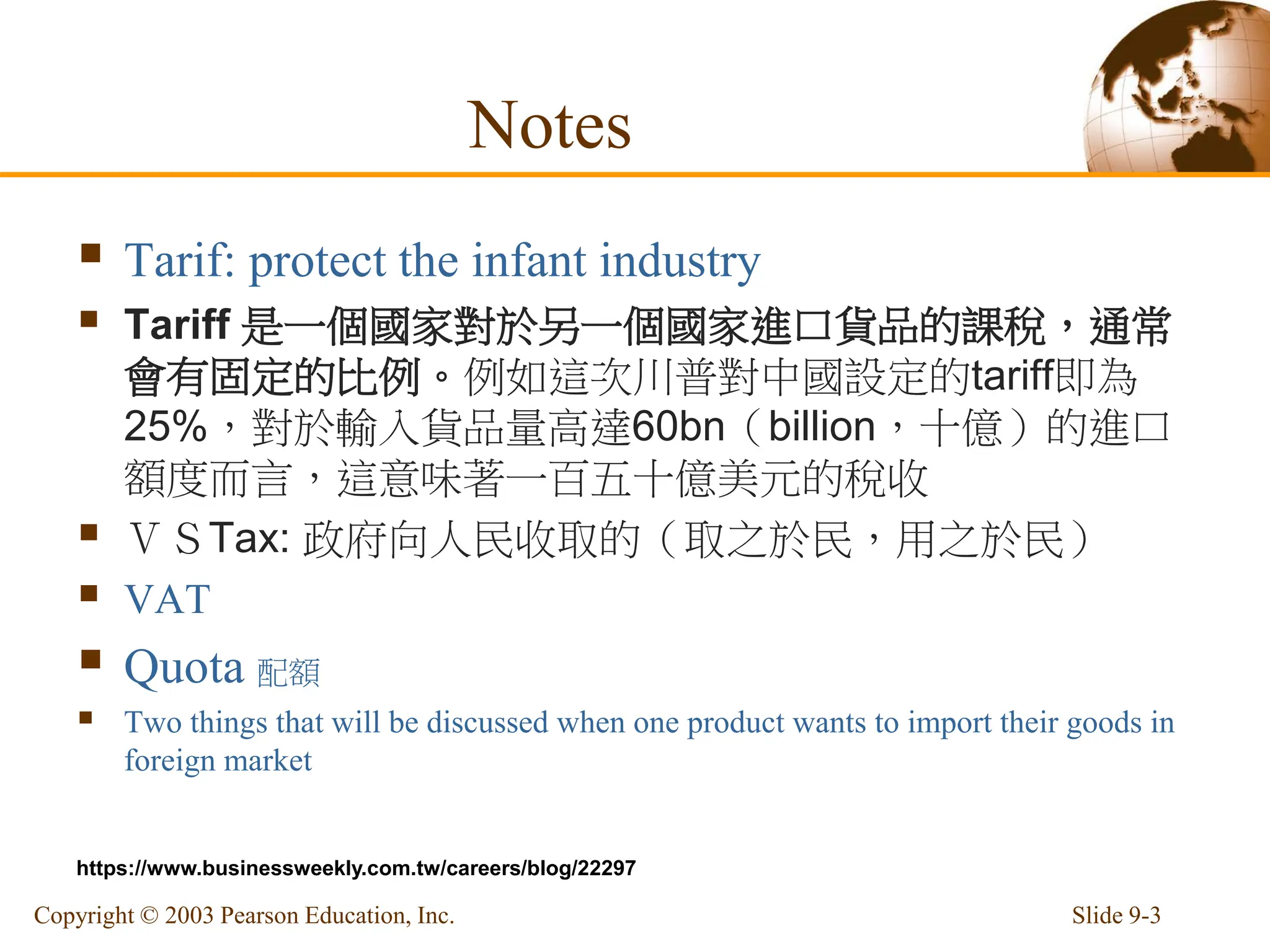
 Tarif: protect the infant industry
 Tariff 是一個國家對於另一個國家進口貨品的課稅,通常
會有固定的比例。例如這次川普對中國設定的tariff即為
25%,對於輸入貨品量高達60bn(billion,十億)的進口
額度而言,這意味著一百五十億美元的稅收
 VSTax: 政府向人民收取的(取之於民,用之於民)
 VAT
 Quota 配額
 Two things that will be discussed when one product wants to import their goods in
foreign market
Slide 9-3
Copyright © 2003 Pearson Education, Inc.
https://www.businessweekly.com.tw/careers/blog/22297
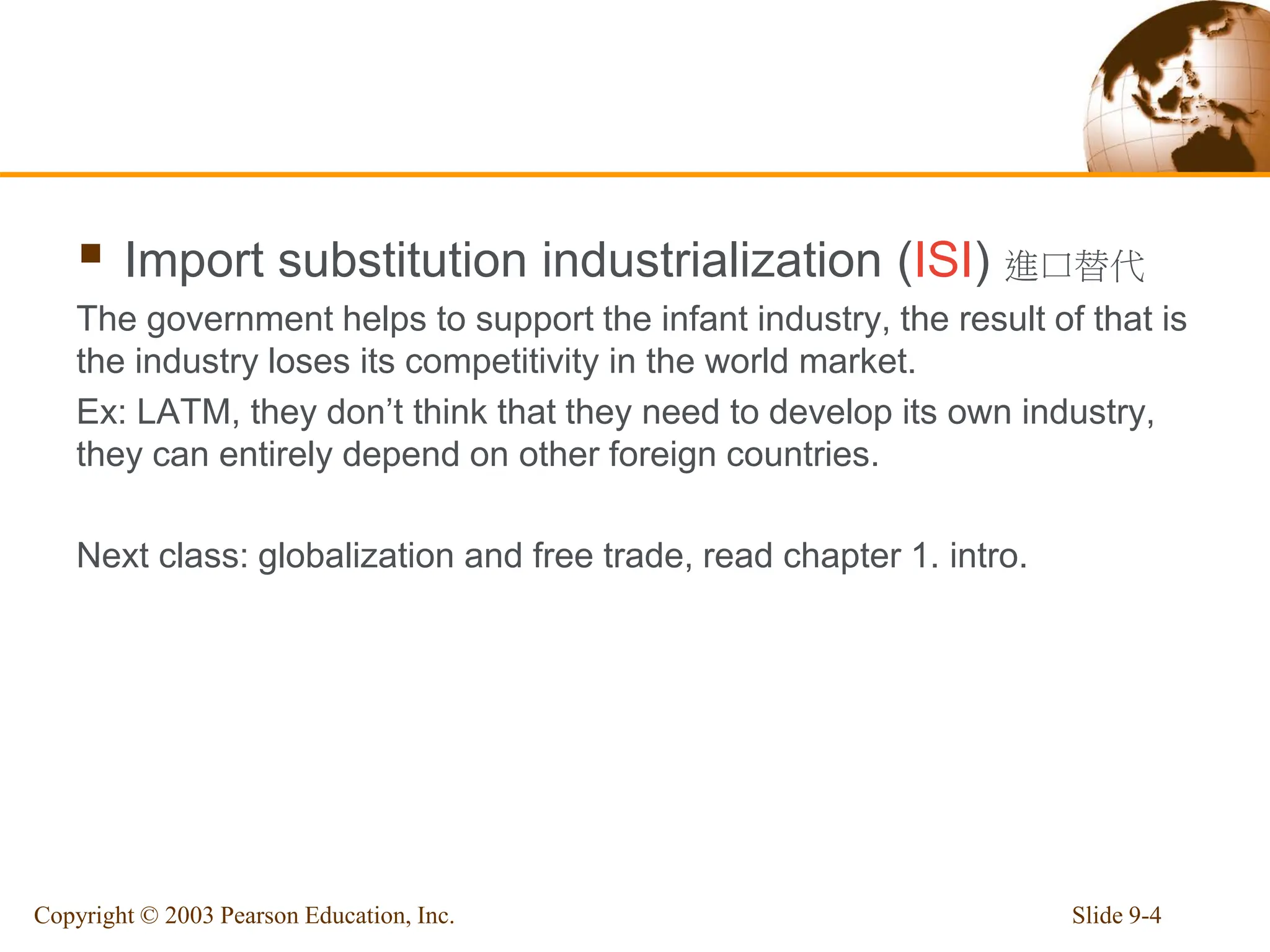
 Import substitution industrialization (ISI) 進口替代
The government helps to support the infant industry, the result of that is
the industry loses its competitivity in the world market.
Ex: LATM, they don’t think that they need to develop its own industry,
they can entirely depend on other foreign countries.
Next class: globalization and free trade, read chapter 1. intro.
Slide 9-4
Copyright © 2003 Pearson Education, Inc.
Contents of Lecture
 What is ”Free Trade”
 Free Trade & World System
Slide 9-5
Copyright © 2003 Pearson Education, Inc.
 「If a foreign country can supply us with a
commodity cheaper than we ourselves can make it,
better buy it of them with some part of the produce of
our own industry, employed in a way in which we
have some advantage.
 Adam Smith (1776, 1: 478-9)」 (Graham Dunkley,
2013)
 絕對利益;比較利益 comparative advantage
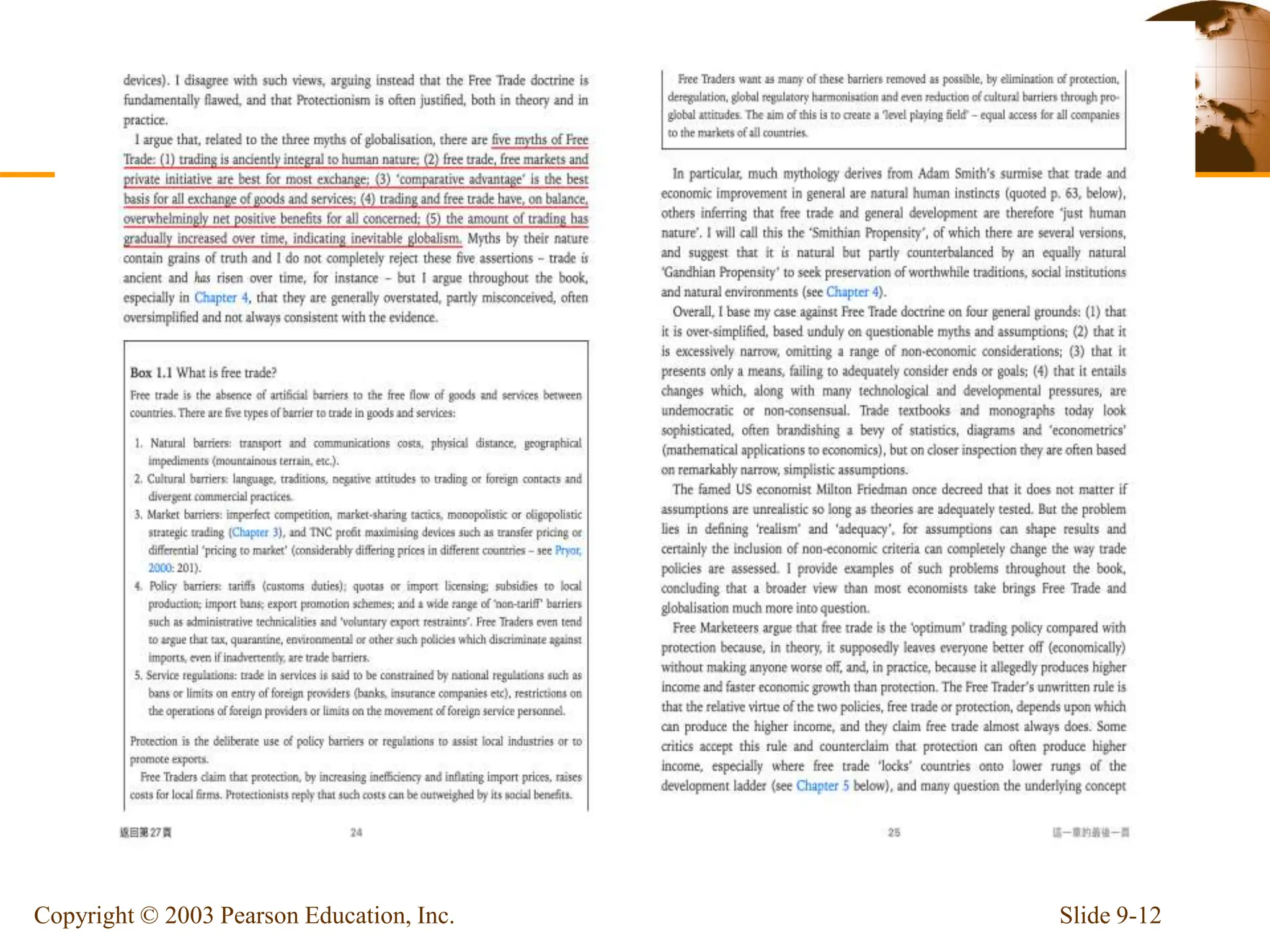
「Free trade is the absence of artificial
barriers to the free flow of goods and
services between countries. There are five
types of barrier to trade in goods and
services:」 (Graham Dunkley, 2013)
Slide 9-7
Copyright © 2003 Pearson Education, Inc.
Free Market Economic Rationalist
(Smith/Ricardo) approach
「Smith (1776), Ricardo (1817), Mill
(1848) and other ‘Classical’ economists
pioneered the claim that free markets and
free trade are beneficial, but were not
dogmatic about it; ‘Neo-classical’
economists from the mid-nineteenth
century until today greatly rigidifying the
doctrine.」 (Graham Dunkley, 2013)
Slide 9-8
Copyright © 2003 Pearson Education, Inc.
Free Trade
 「Economists such as Bhagwati (1998) and
Krugman stoutly defend free trade but query
the benefits of free investment, speculative
capital and extreme economic deregulation.」
(Graham Dunkley, 2013)
Free Trade
「Most Free Market international
economists focus very narrowly on trade,
assume materialistic goals and neglect
non-economic issues, the almost
exclusive target of mainstream trade
theory being maximisation of GDP and
growth thereof.」 (Graham Dunkley,
2013)
Slide 9-10
Copyright © 2003 Pearson Education, Inc.
Free Trade
「In a clear statement of ‘trade
determinism’, former WTO director
general, Renato Ruggiero (in Aga Khan,
1998: 22) has stated that ‘Trade
liberalisation is not just a recipe for
growth, but also for security and peace,
as history has shown us.’ 」 (Graham
Dunkley, 2013)
Slide 9-12
Copyright © 2003 Pearson Education, Inc.
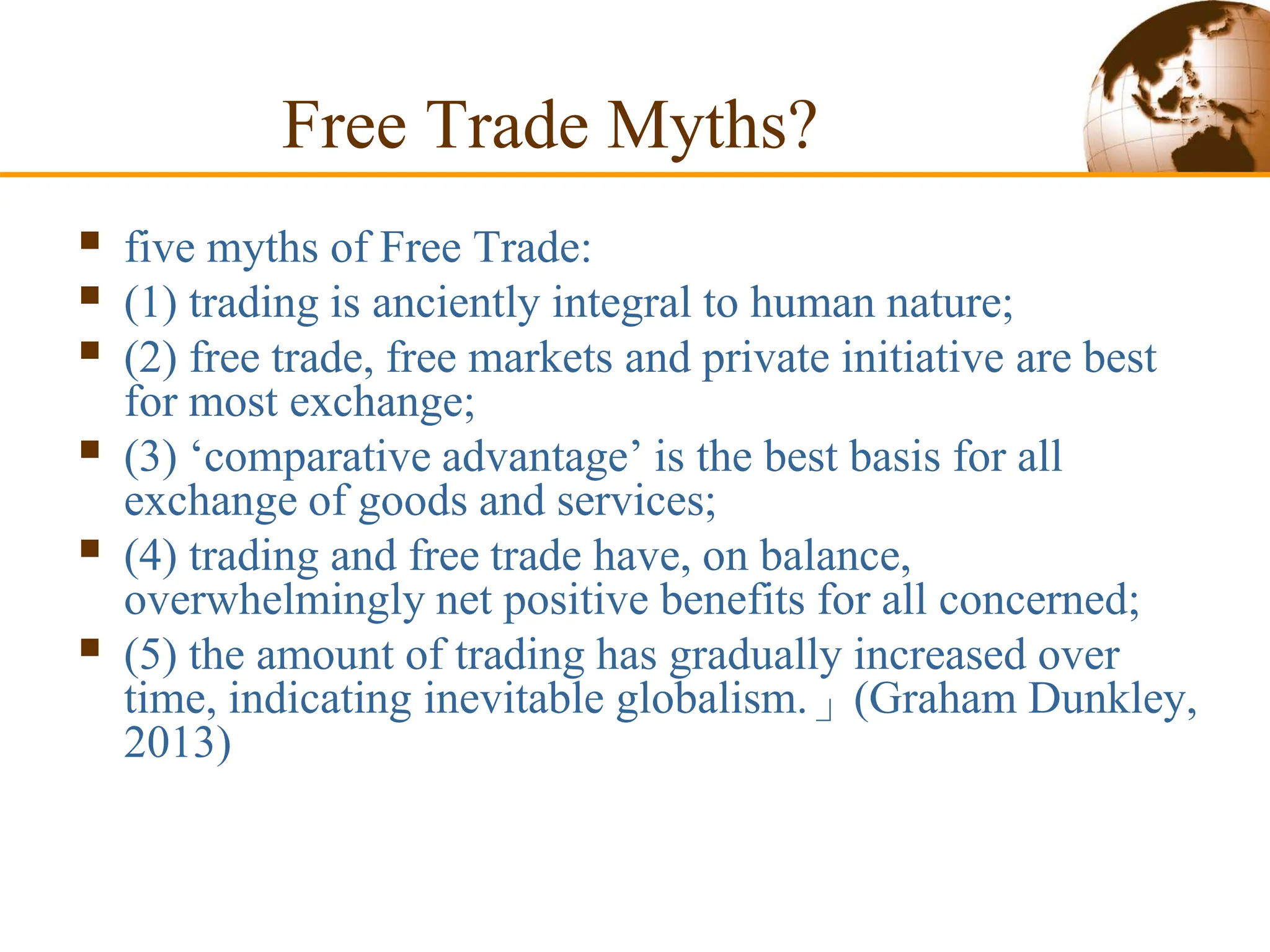
Free Trade Myths?
 five myths of Free Trade:
 (1) trading is anciently integral to human nature;
 (2) free trade, free markets and private initiative are best
for most exchange;
 (3) ‘comparative advantage’ is the best basis for all
exchange of goods and services;
 (4) trading and free trade have, on balance,
overwhelmingly net positive benefits for all concerned;
 (5) the amount of trading has gradually increased over
time, indicating inevitable globalism.」(Graham Dunkley,
2013)
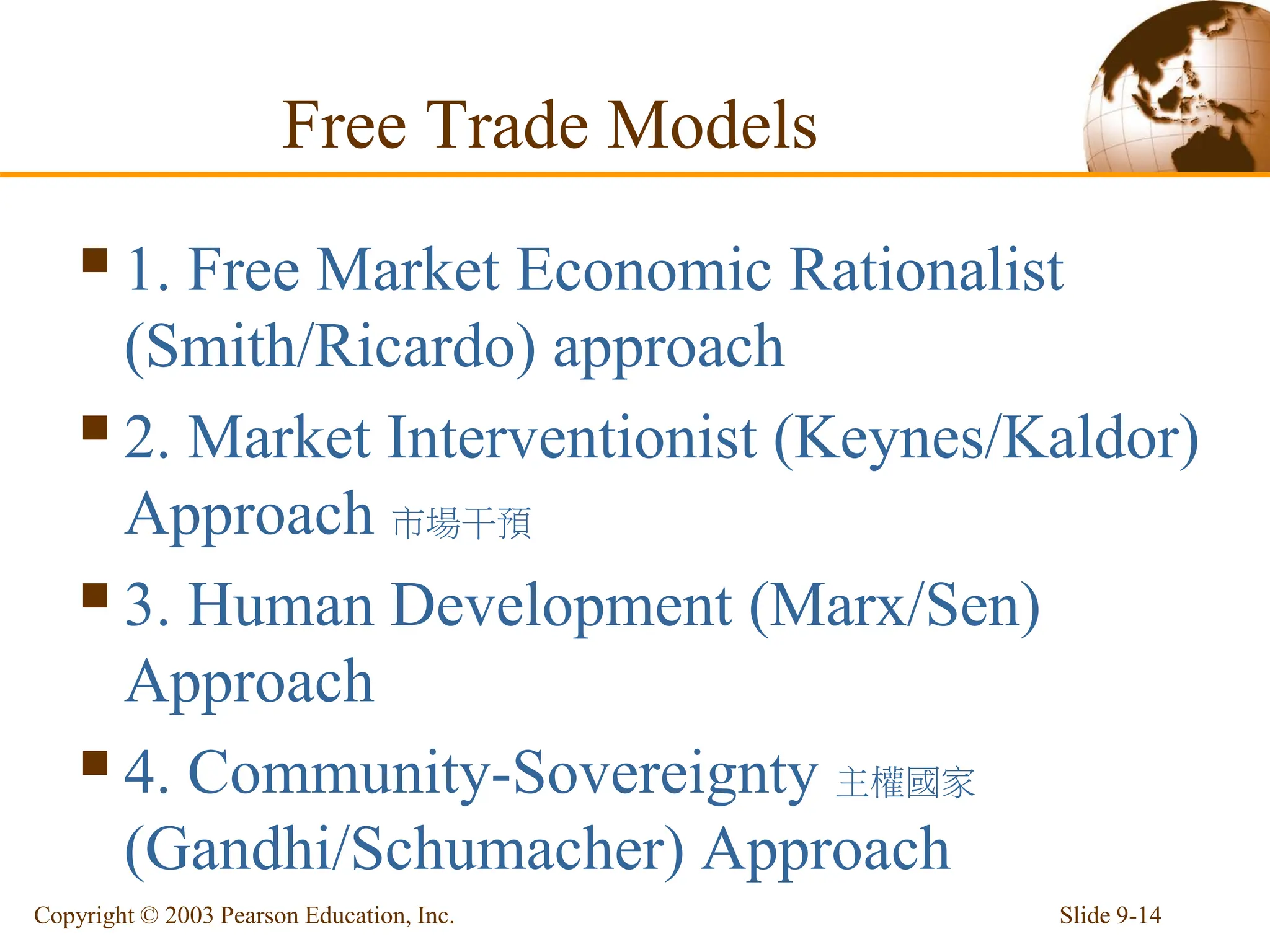
Free Trade Models
1. Free Market Economic Rationalist
(Smith/Ricardo) approach
2. Market Interventionist (Keynes/Kaldor)
Approach 市場干預
3. Human Development (Marx/Sen)
Approach
4. Community-Sovereignty 主權國家
(Gandhi/Schumacher) Approach
Slide 9-14
Copyright © 2003 Pearson Education, Inc.
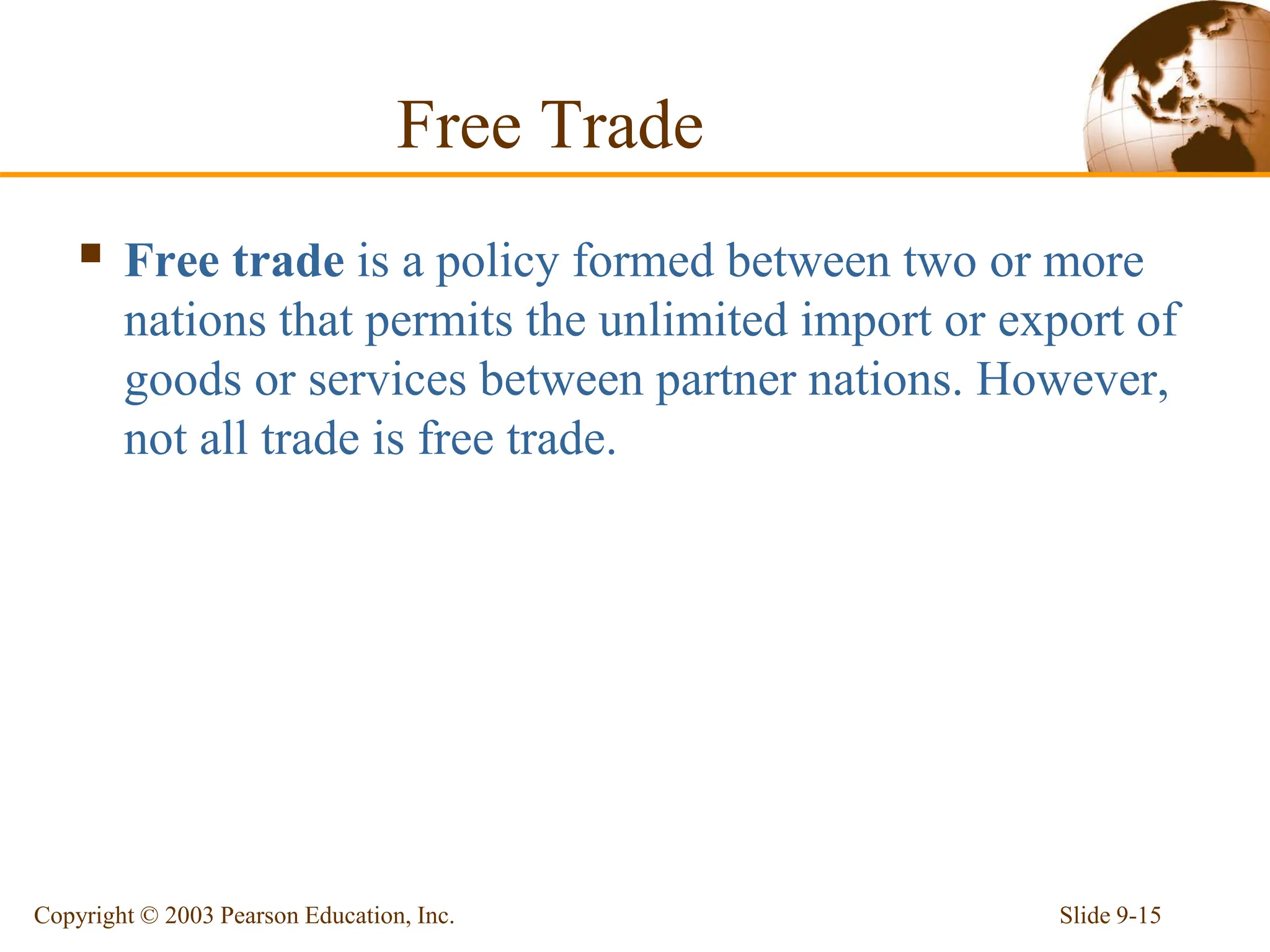
Free Trade
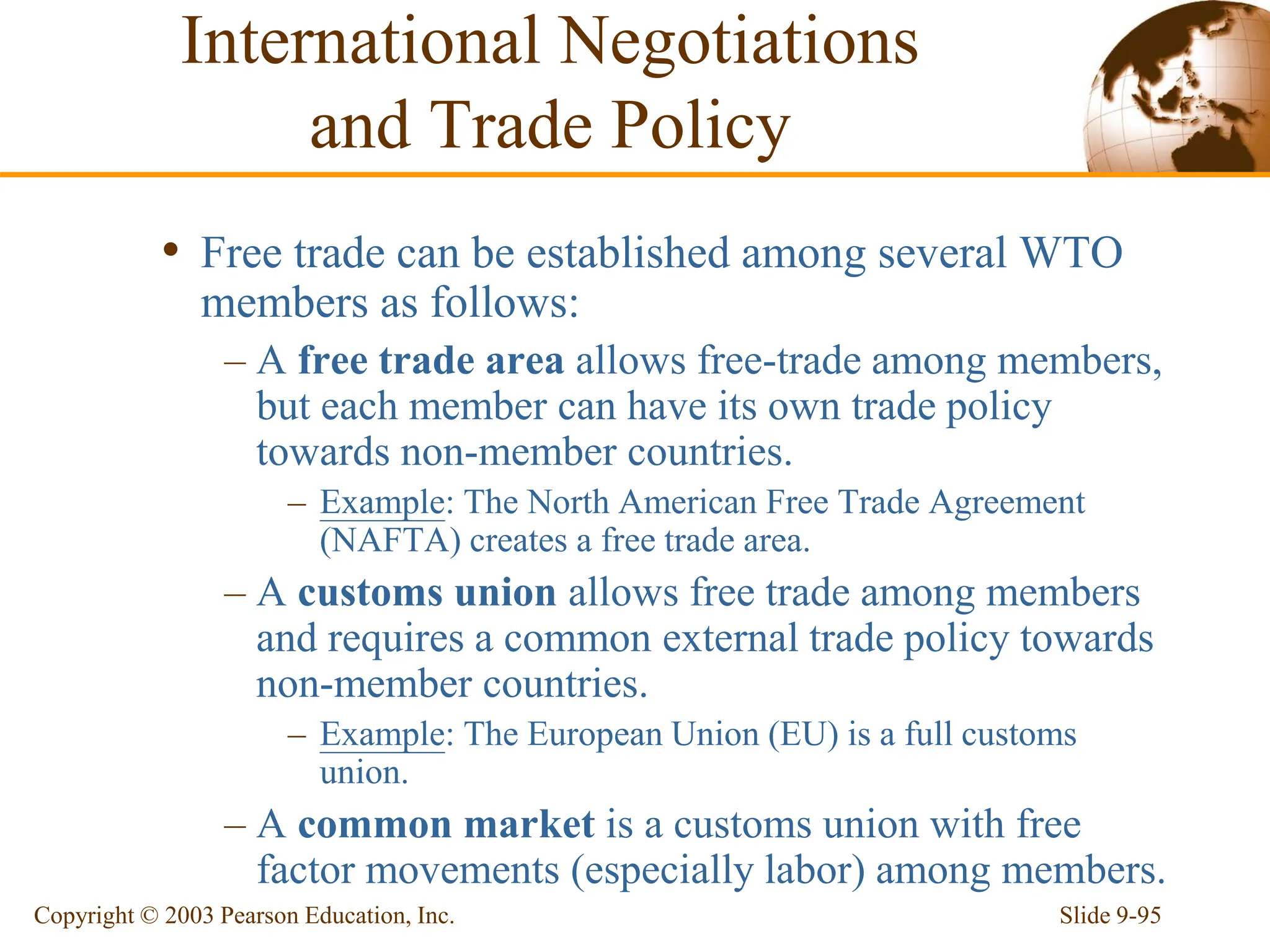
 Free trade is a policy formed between two or more
nations that permits the unlimited import or export of
goods or services between partner nations. However,
not all trade is free trade.
Slide 9-15
Copyright © 2003 Pearson Education, Inc.
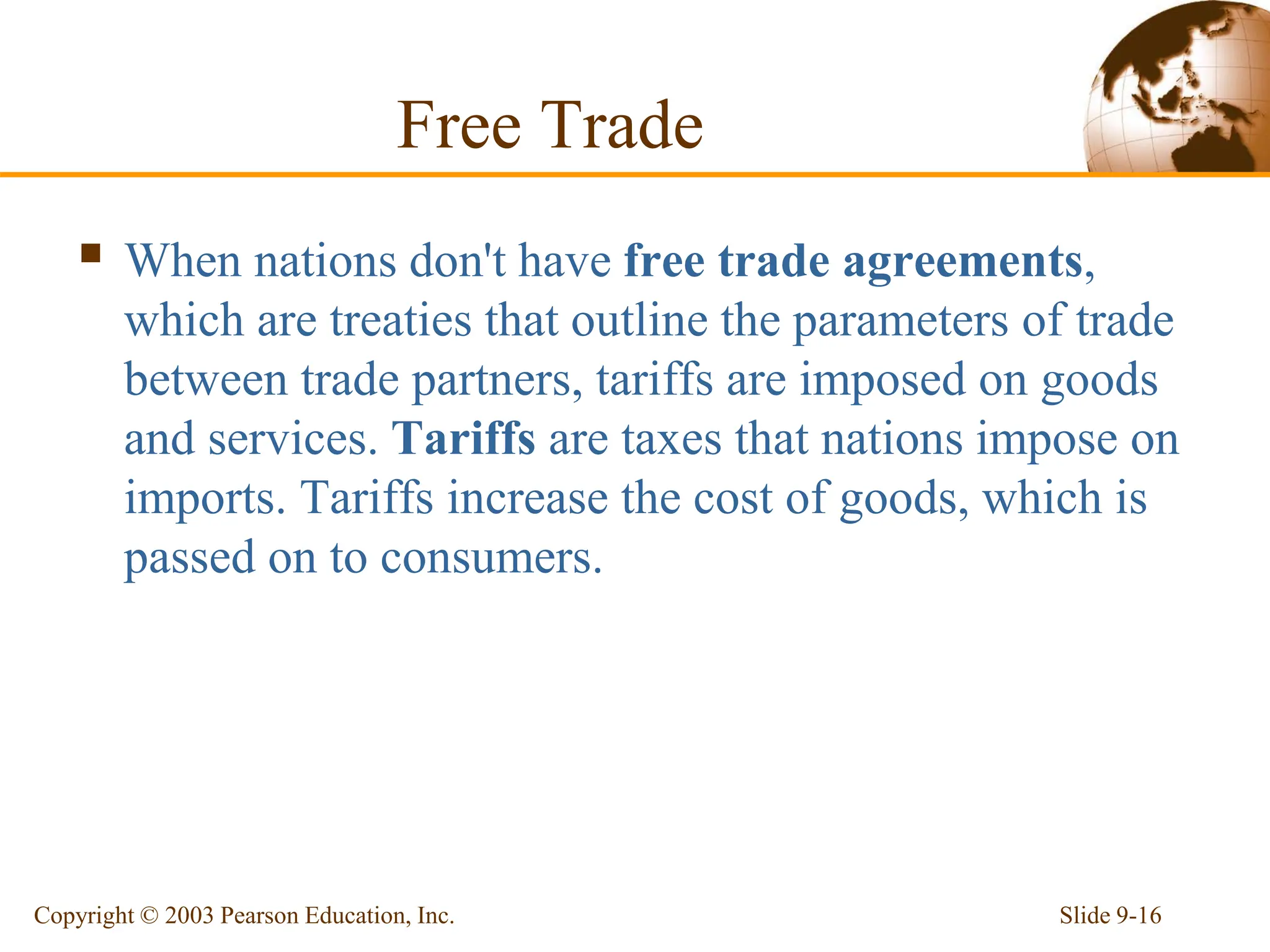
Free Trade
 When nations don't have free trade agreements,
which are treaties that outline the parameters of trade
between trade partners, tariffs are imposed on goods
and services. Tariffs are taxes that nations impose on
imports. Tariffs increase the cost of goods, which is
passed on to consumers.
Slide 9-16
Copyright © 2003 Pearson Education, Inc.
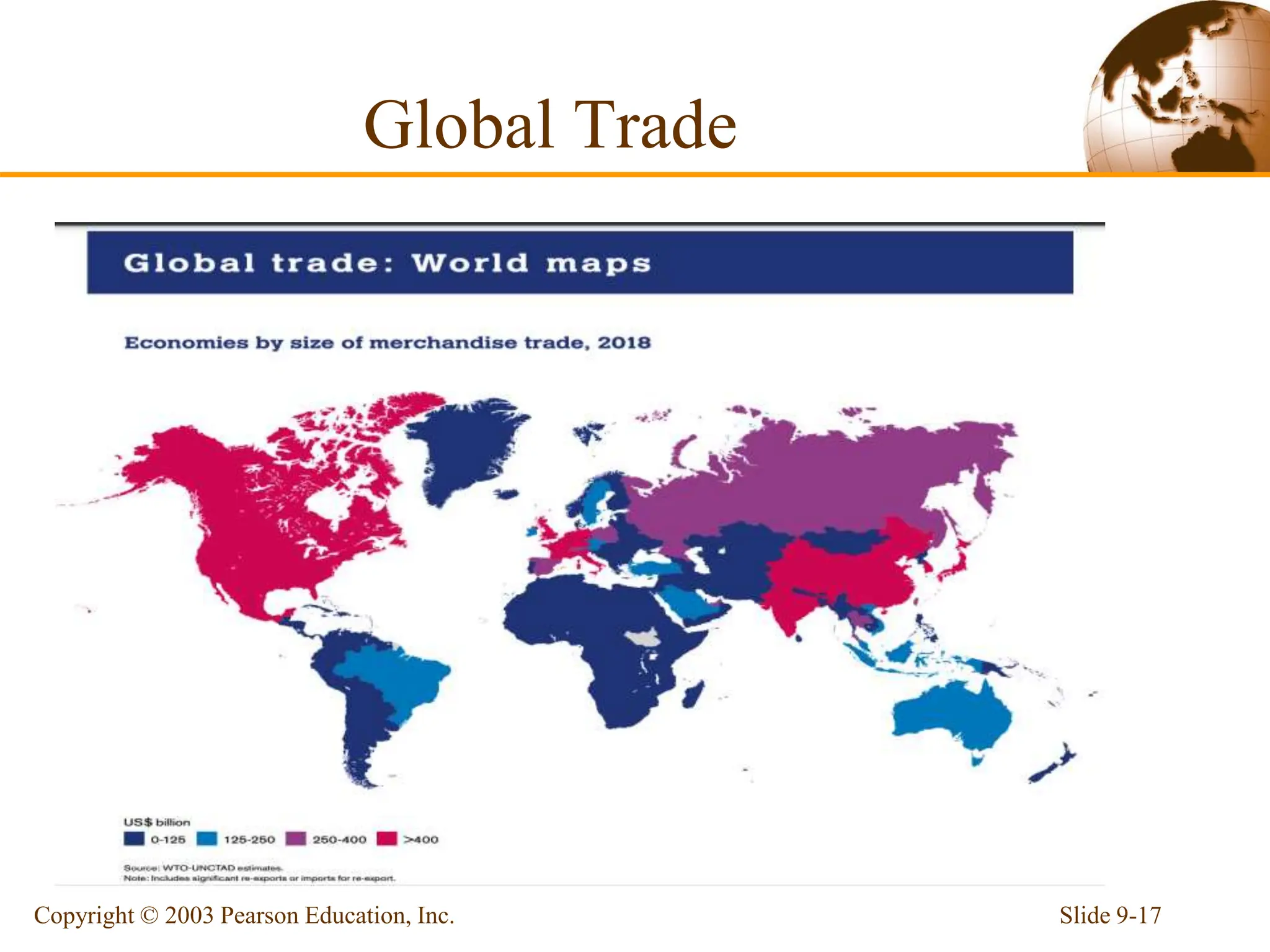
Global Trade
Slide 9-17
Copyright © 2003 Pearson Education, Inc.
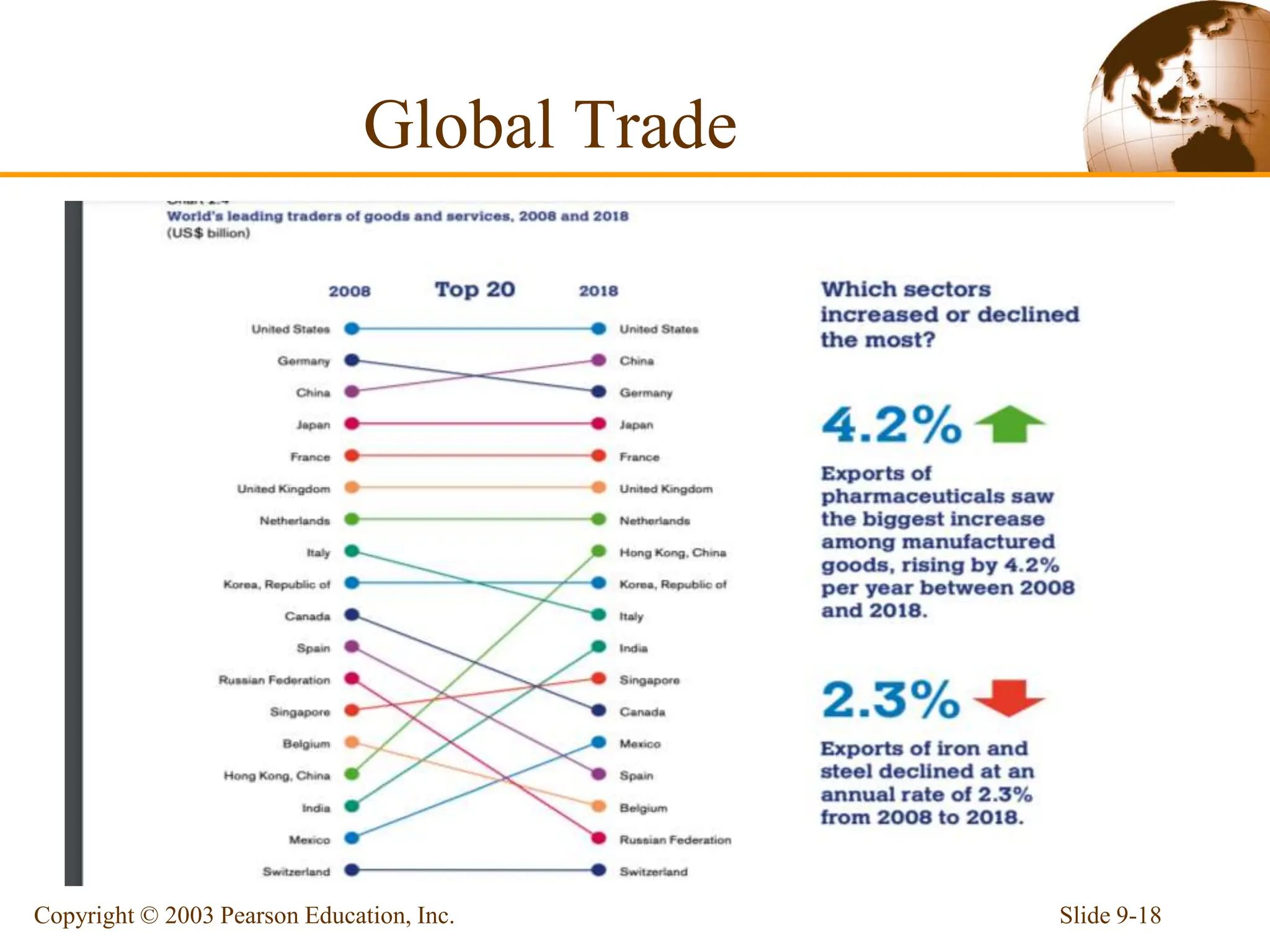
Global Trade
Slide 9-18
Copyright © 2003 Pearson Education, Inc.
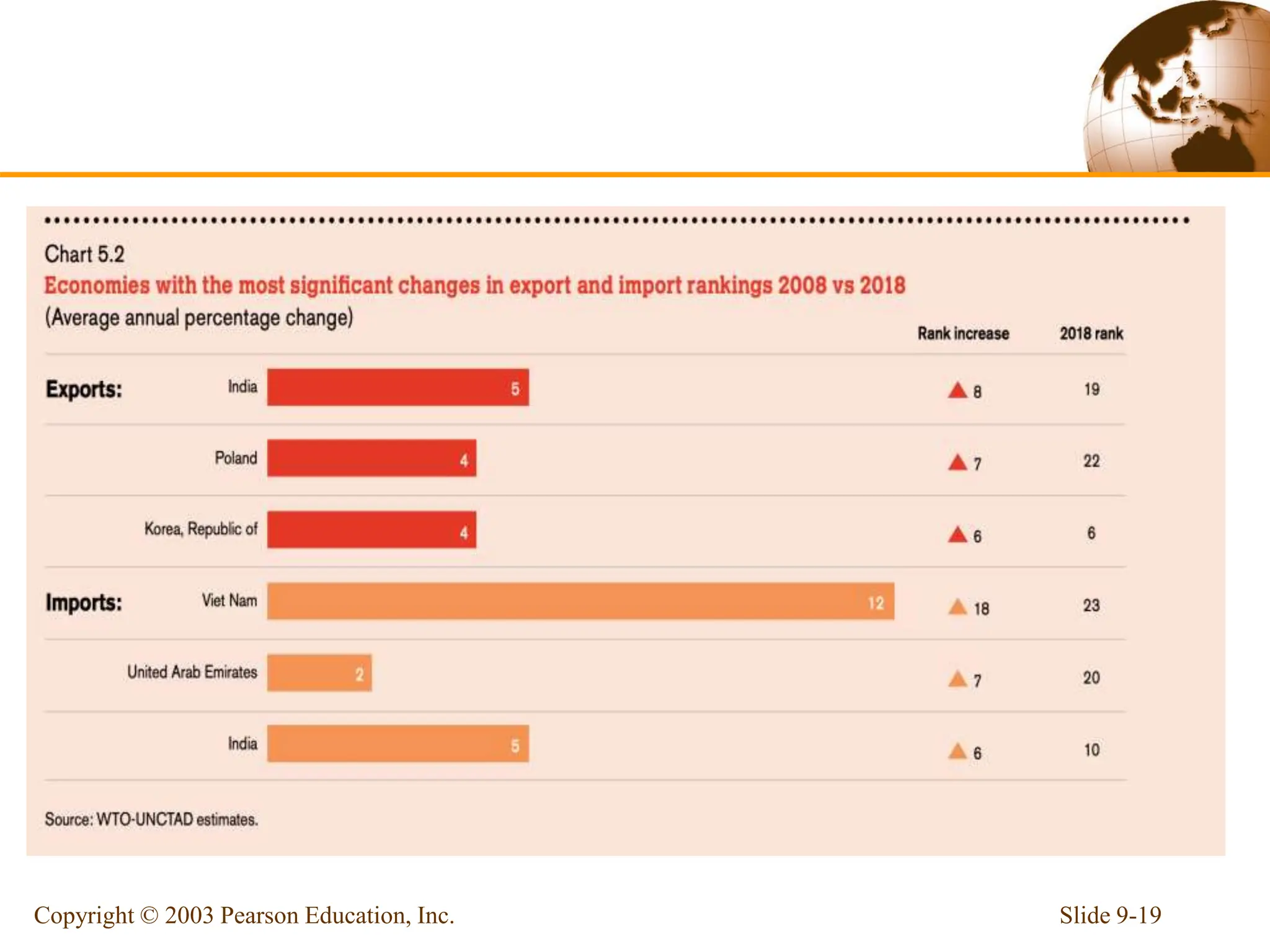
Slide 9-19
Copyright © 2003 Pearson Education, Inc.
Question
 Question
Explain two reasons why
countries may engage in
international trade.
Slide 9-20
Copyright © 2003 Pearson Education, Inc.
Why trade?
All trade is voluntary??
People trade because they believe that
they will be better off by trading??
Why trade?
 Different factor endowments基金 - some
economies are rich in natural resources
while others have relatively little.
 Increased welfare trade allow countries
to gain a higher level of consumption than
they would do domestically and this leads
to increased welfare and higher living
standards.
Slide 9-22
Copyright © 2003 Pearson Education, Inc.
Why trade?
 To gain economies of scale - with
specialisation and production on a larger
scale than may be possible domestically, a
country may be able to gain more
economies of scale.
 Diversity of choice - trade enables us to
access goods and services that we may
not be able to produce ourselves.
Slide 9-23
Copyright © 2003 Pearson Education, Inc.
Why trade?
 Political / historical reasons - some
trade takes place for political and other
reasons relating to history and tradition,
though this is generally diminishing in
importance.
 Increased competition - increased
global competition may help to spur
domestic productivity improvements and
give domestic firms a better incentive to
innovate and improve their products.
Slide 9-24
Copyright © 2003 Pearson Education, Inc.
Why trade?
 Trade may be an 'engine for growth' -
increased trade may help to spur greater
domestic economic growth and drive
further improvements in living standards.
 China is not market-oriented?
Slide 9-25
Copyright © 2003 Pearson Education, Inc.
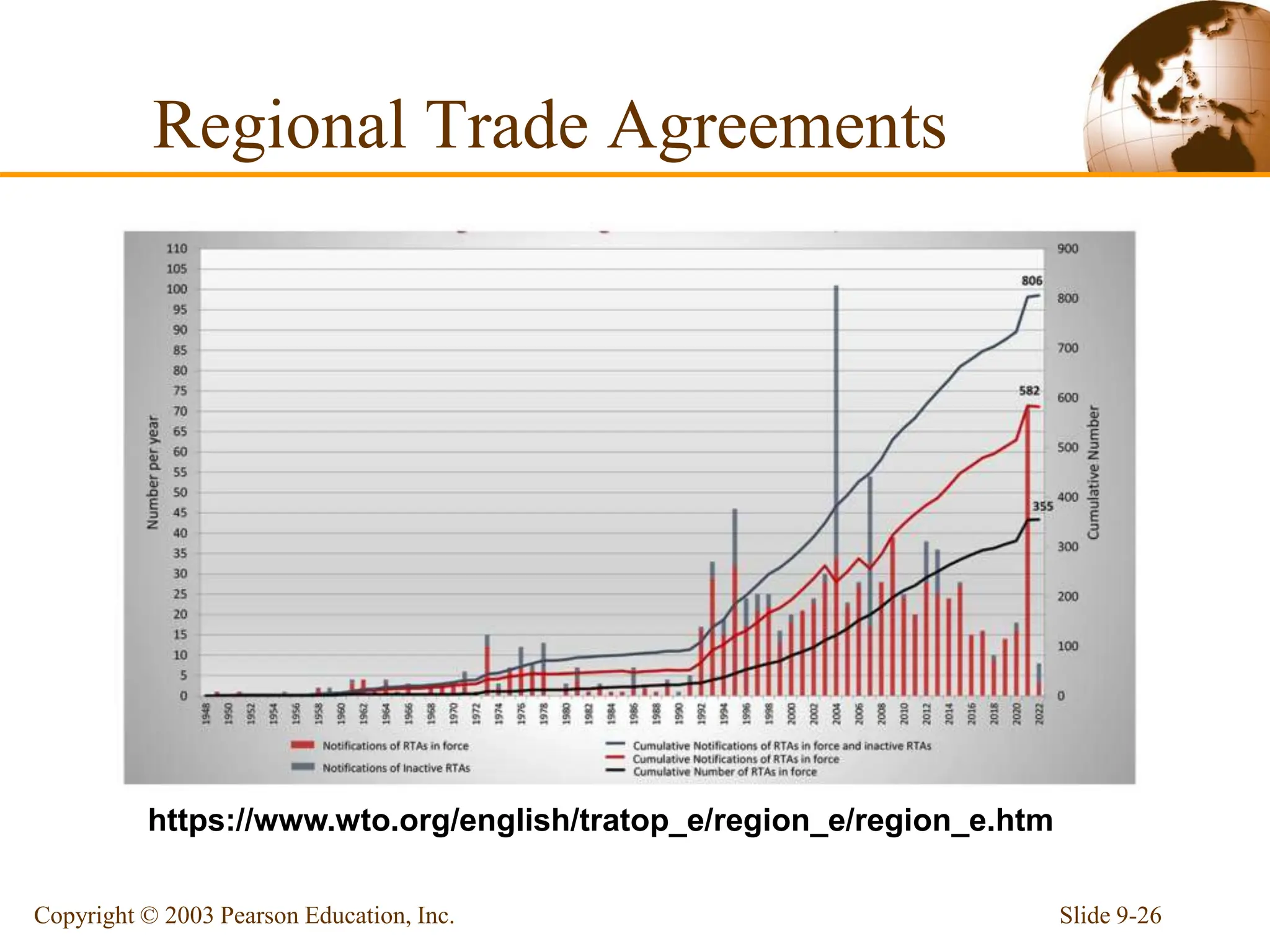
Regional Trade Agreements
Slide 9-26
Copyright © 2003 Pearson Education, Inc.
https://www.wto.org/english/tratop_e/region_e/region_e.htm
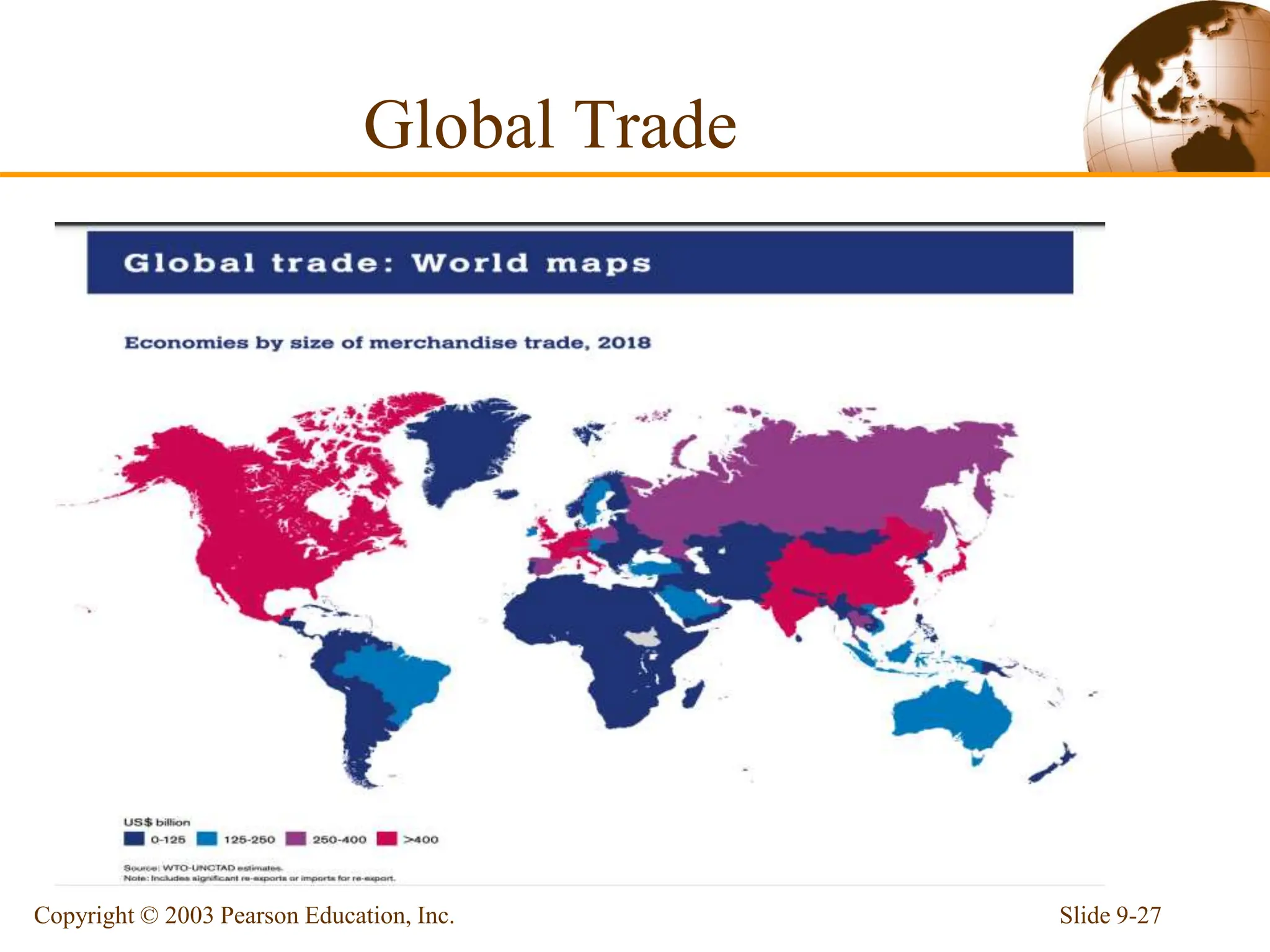
Global Trade
Slide 9-27
Copyright © 2003 Pearson Education, Inc.
Absolute Advantage
“The natural advantages which one country
has over another in producing particular
commodities are sometimes so great that
it is acknowledged by all the world to be
in vain to struggle with them.”
Adam Smith in “Wealth of Nations” Book IV, Chapter
2
Comparative Advantage
 David Ricardo extended the ideas of Adam Smith
 Nations could benefit from trade based on
comparative advantage, not just absolute advantage
 Comparative advantage refers to a country’s ability
to produce a good at a lower opportunity cost than
another country
Sources of Comparative Advantage
 Differences in technology
 Differences in climate
 Differences in factor endowments
• Factors of production – land, labor and capital
• Factor intensity – the factor that is used intensively in
production
• Heckscher-Ohlin model
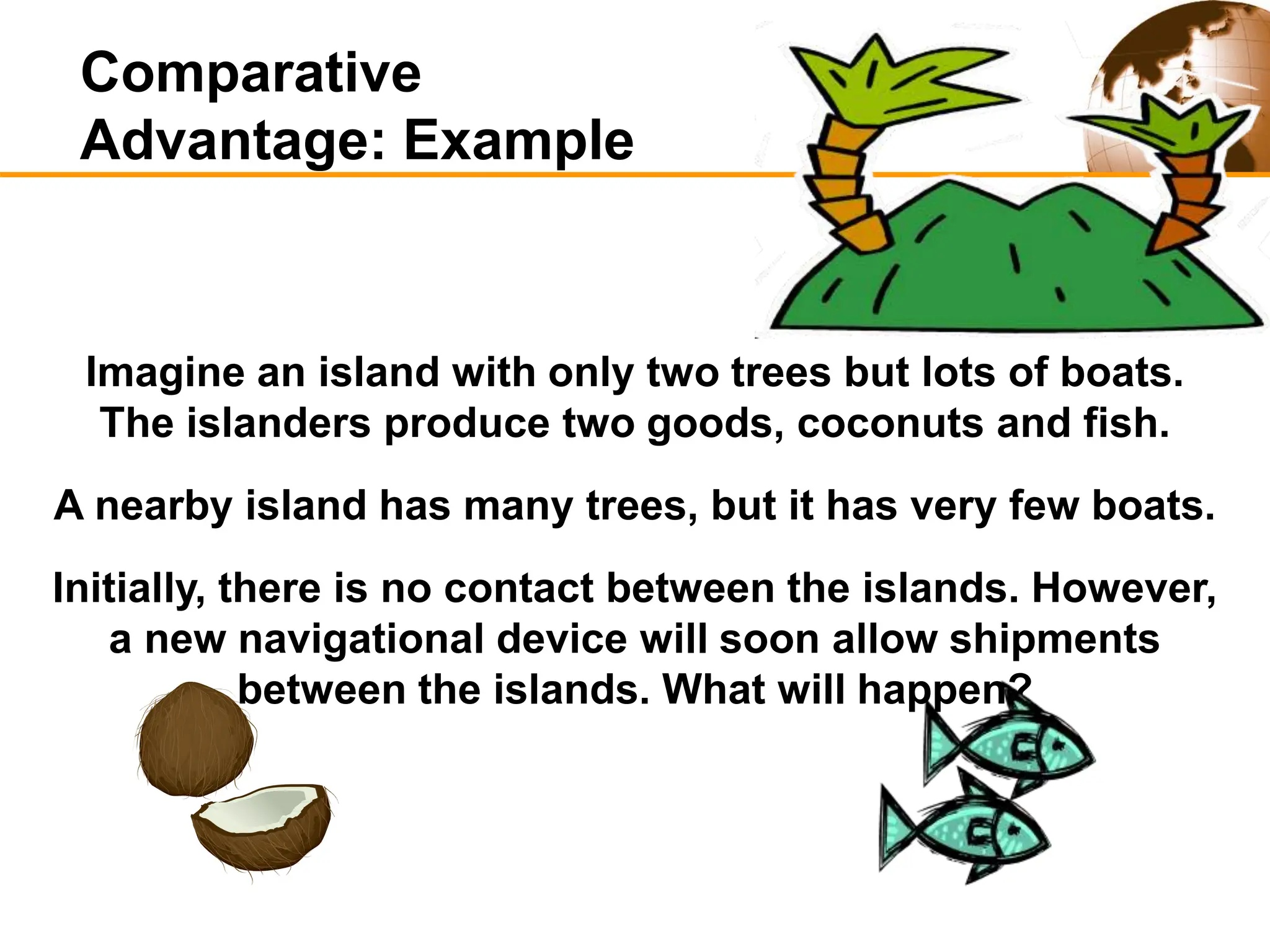
Imagine an island with only two trees but lots of boats.
The islanders produce two goods, coconuts and fish.
A nearby island has many trees, but it has very few boats.
Initially, there is no contact between the islands. However,
a new navigational device will soon allow shipments
between the islands. What will happen?
Comparative
Advantage: Example
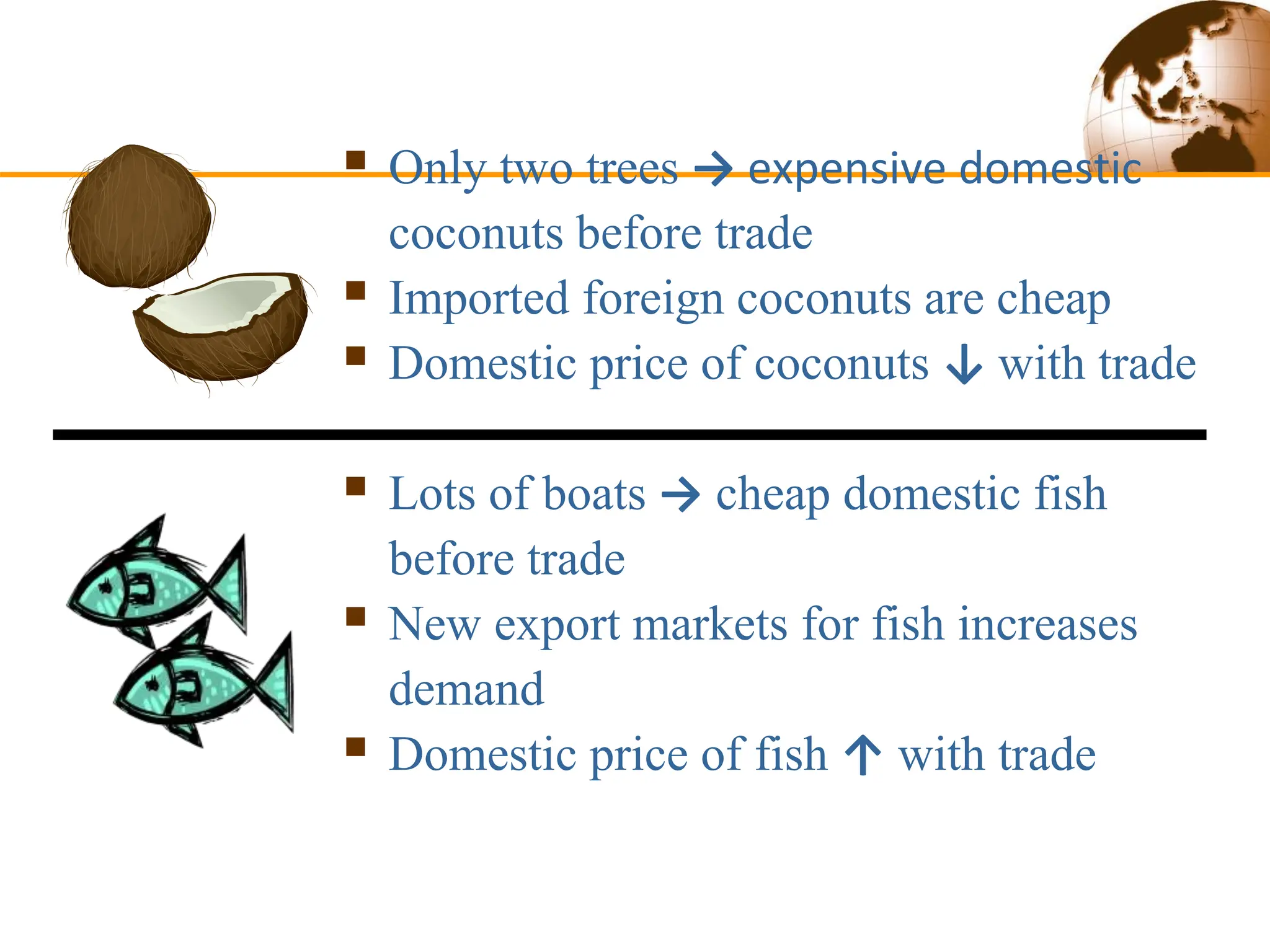
 Only two trees → expensive domestic
coconuts before trade
 Imported foreign coconuts are cheap
 Domestic price of coconuts ↓ with trade
 Lots of boats → cheap domestic fish
before trade
 New export markets for fish increases
demand
 Domestic price of fish ↑ with trade
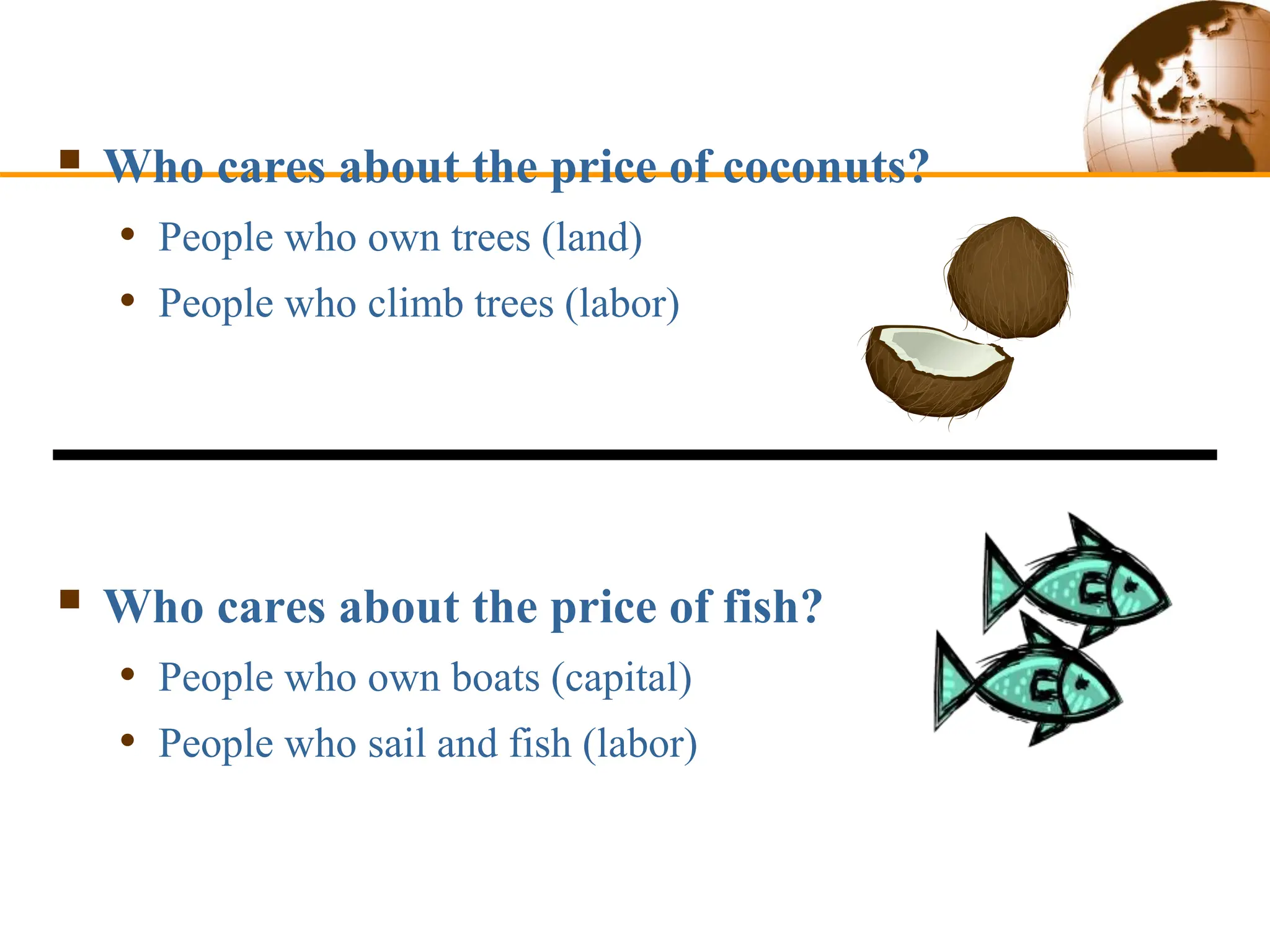
 Who cares about the price of coconuts?
• People who own trees (land)
• People who climb trees (labor)
 Who cares about the price of fish?
• People who own boats (capital)
• People who sail and fish (labor)
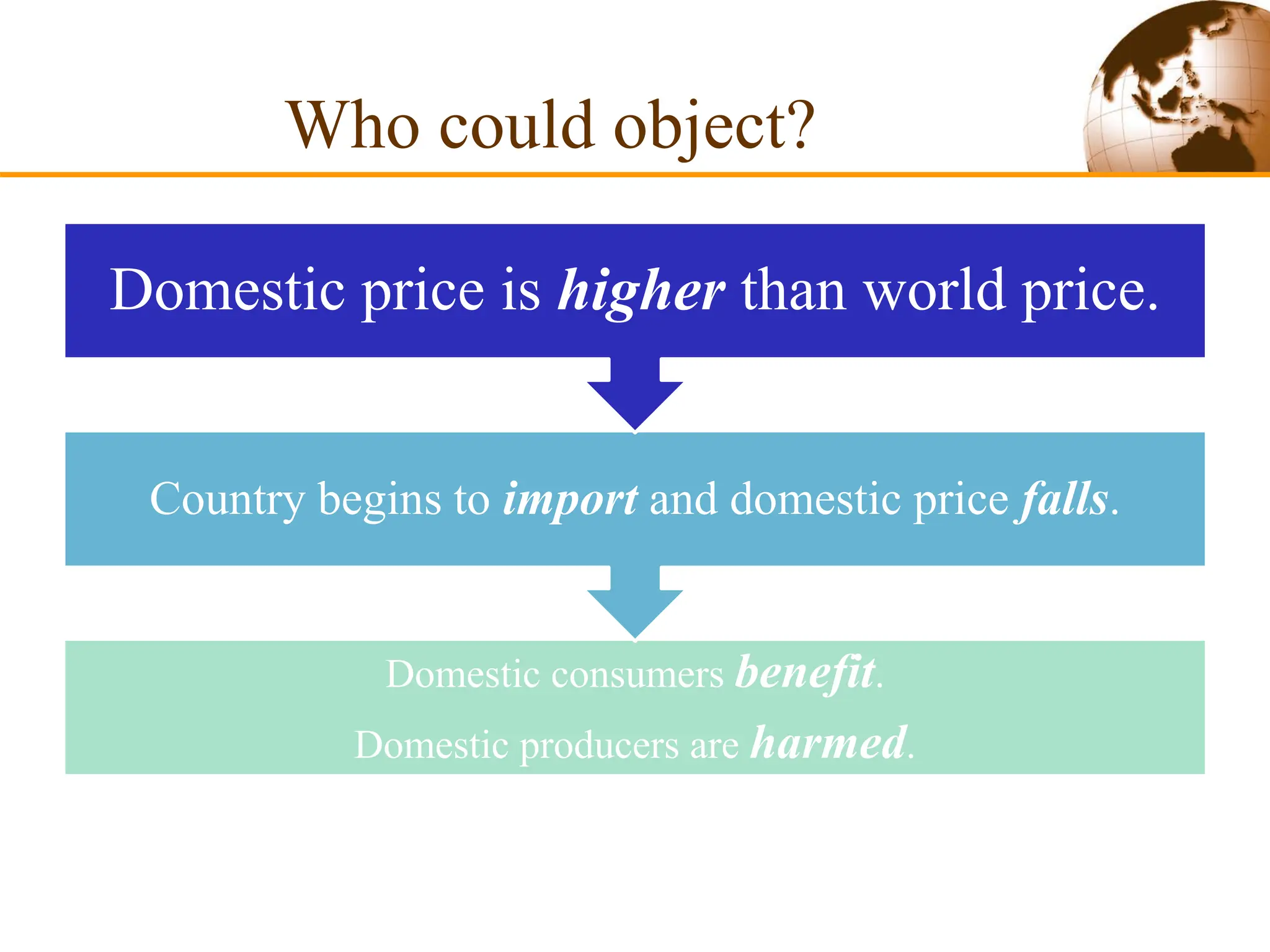
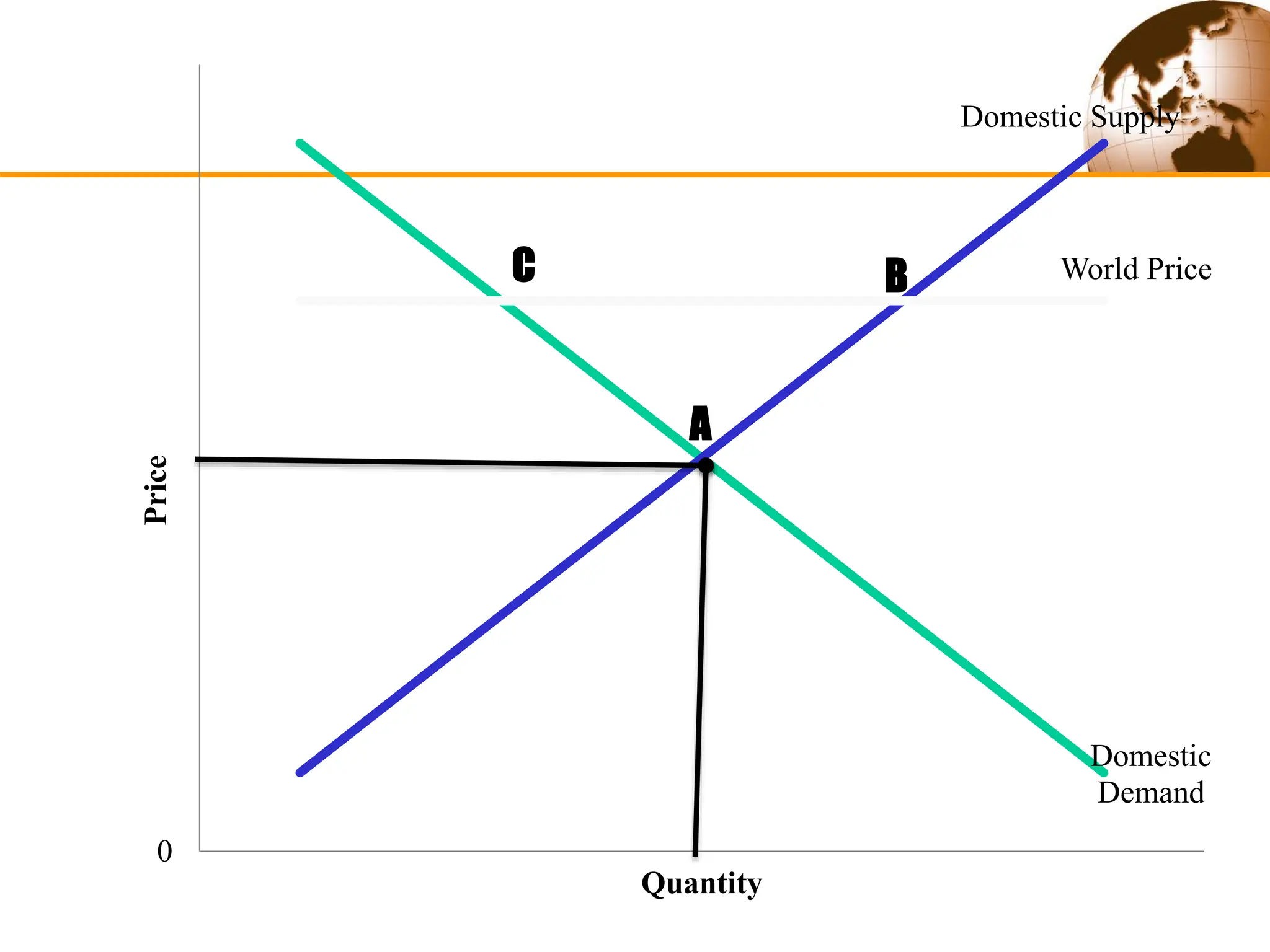
Who could object?
Domestic consumers benefit.
Domestic producers are harmed.
Country begins to import and domestic price falls.
Domestic price is higher than world price.
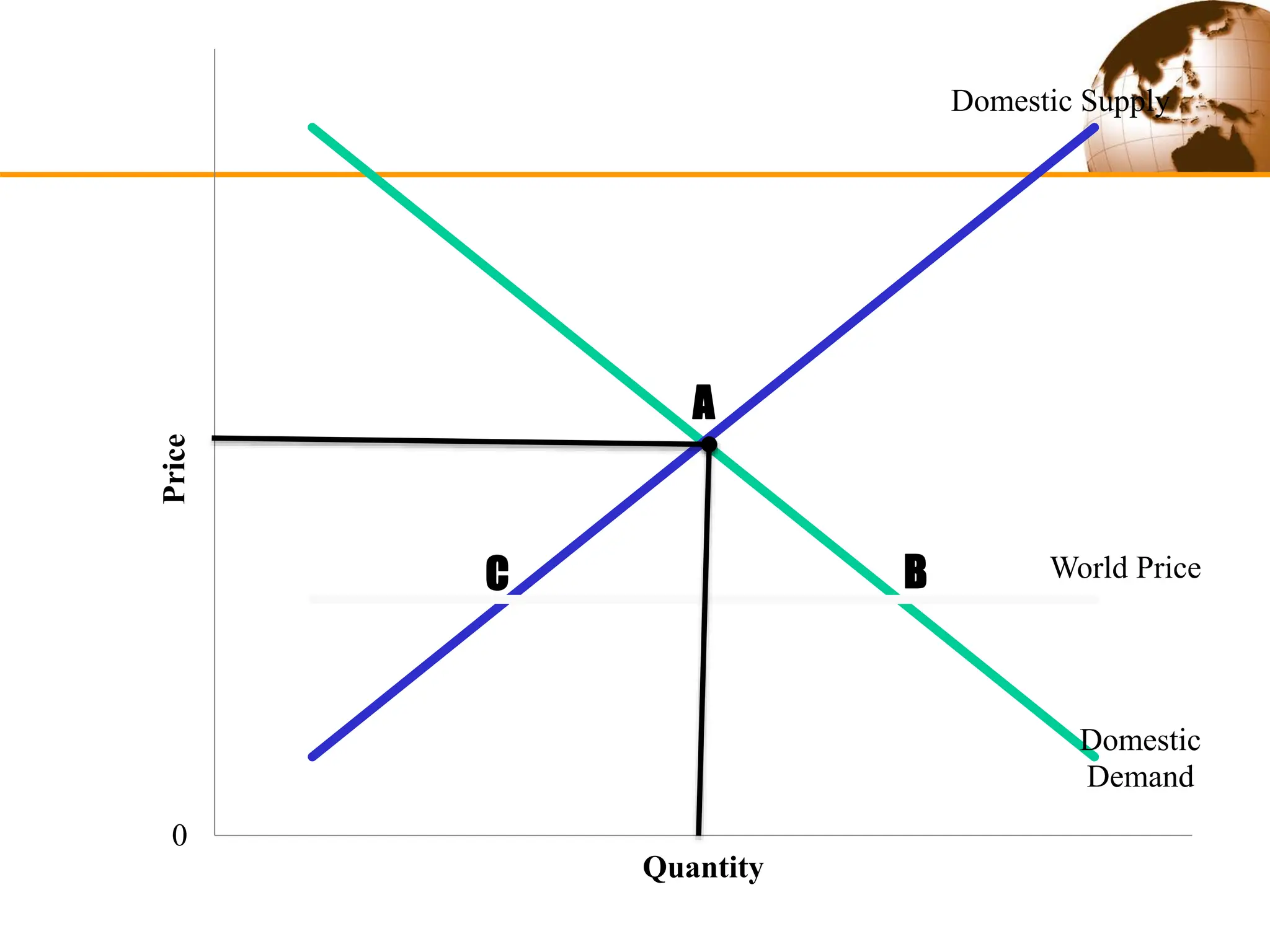
Domestic
Demand
Domestic Supply
World Price
0
Price
Quantity
A
B
C
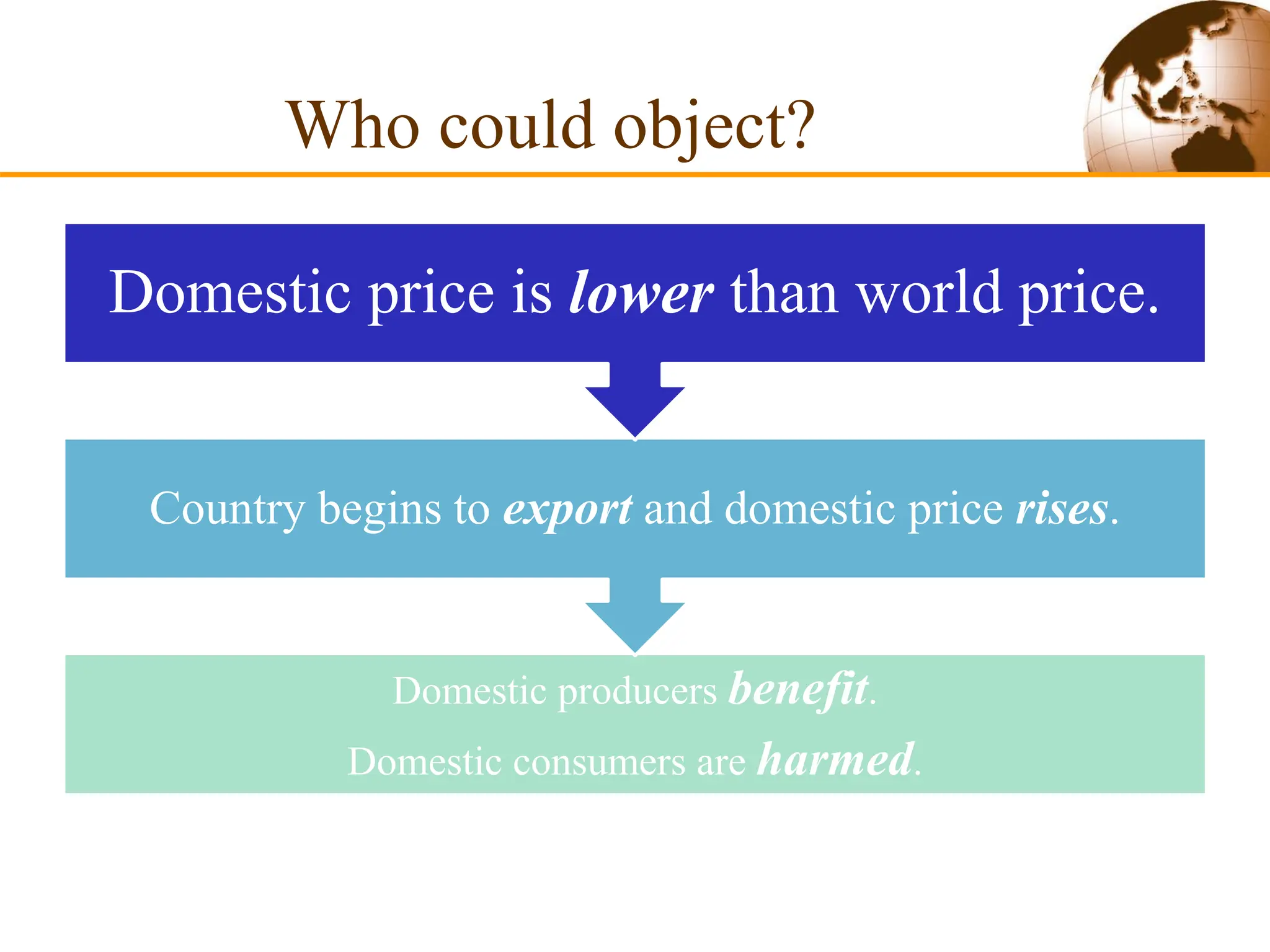
Who could object?
Domestic producers benefit.
Domestic consumers are harmed.
Country begins to export and domestic price rises.
Domestic price is lower than world price.
Domestic
Demand
Domestic Supply
World Price
0
Price
Quantity
A
B
C
Who could object?
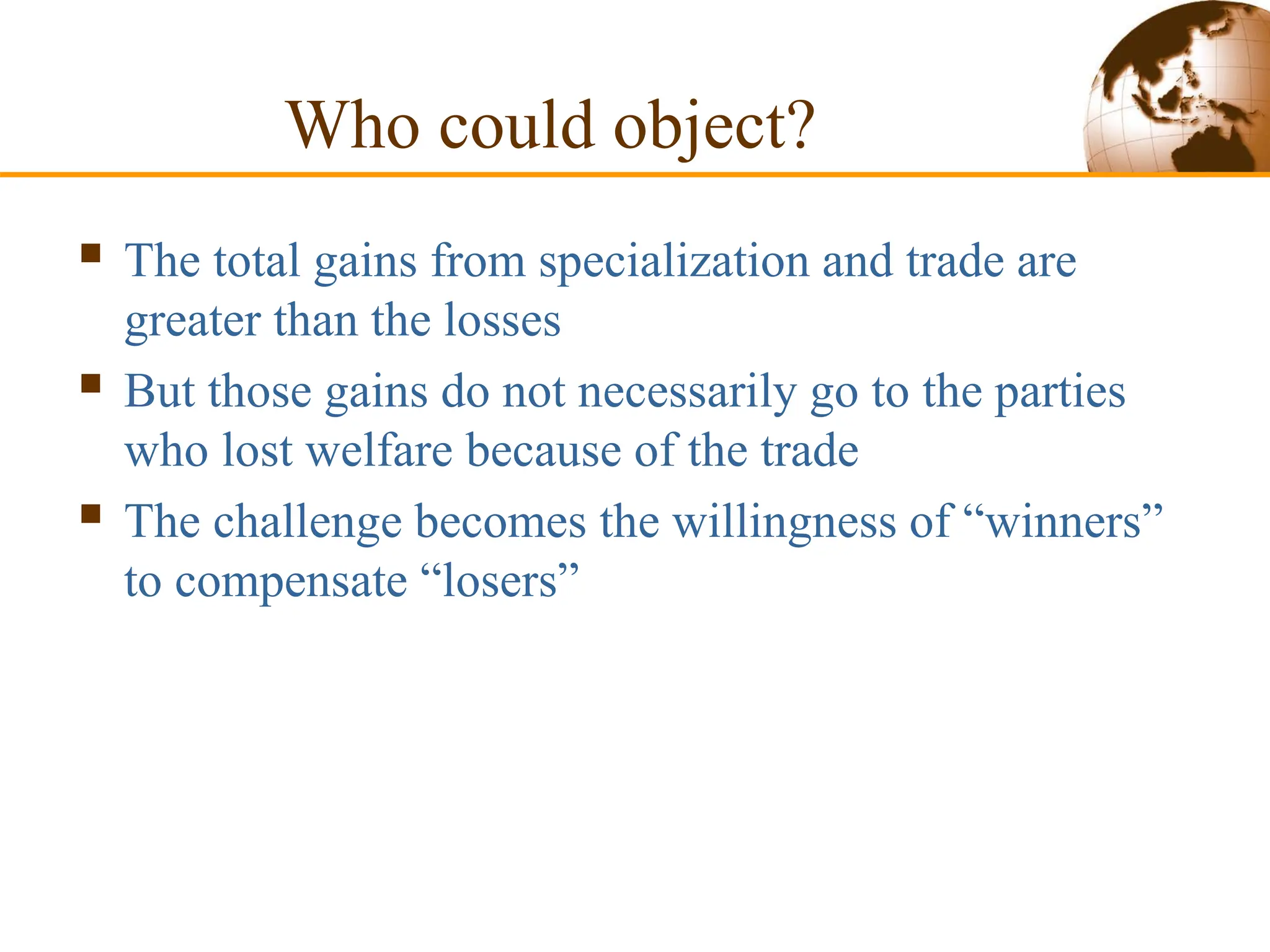
 The total gains from specialization and trade are
greater than the losses
 But those gains do not necessarily go to the parties
who lost welfare because of the trade
 The challenge becomes the willingness of “winners”
to compensate “losers”
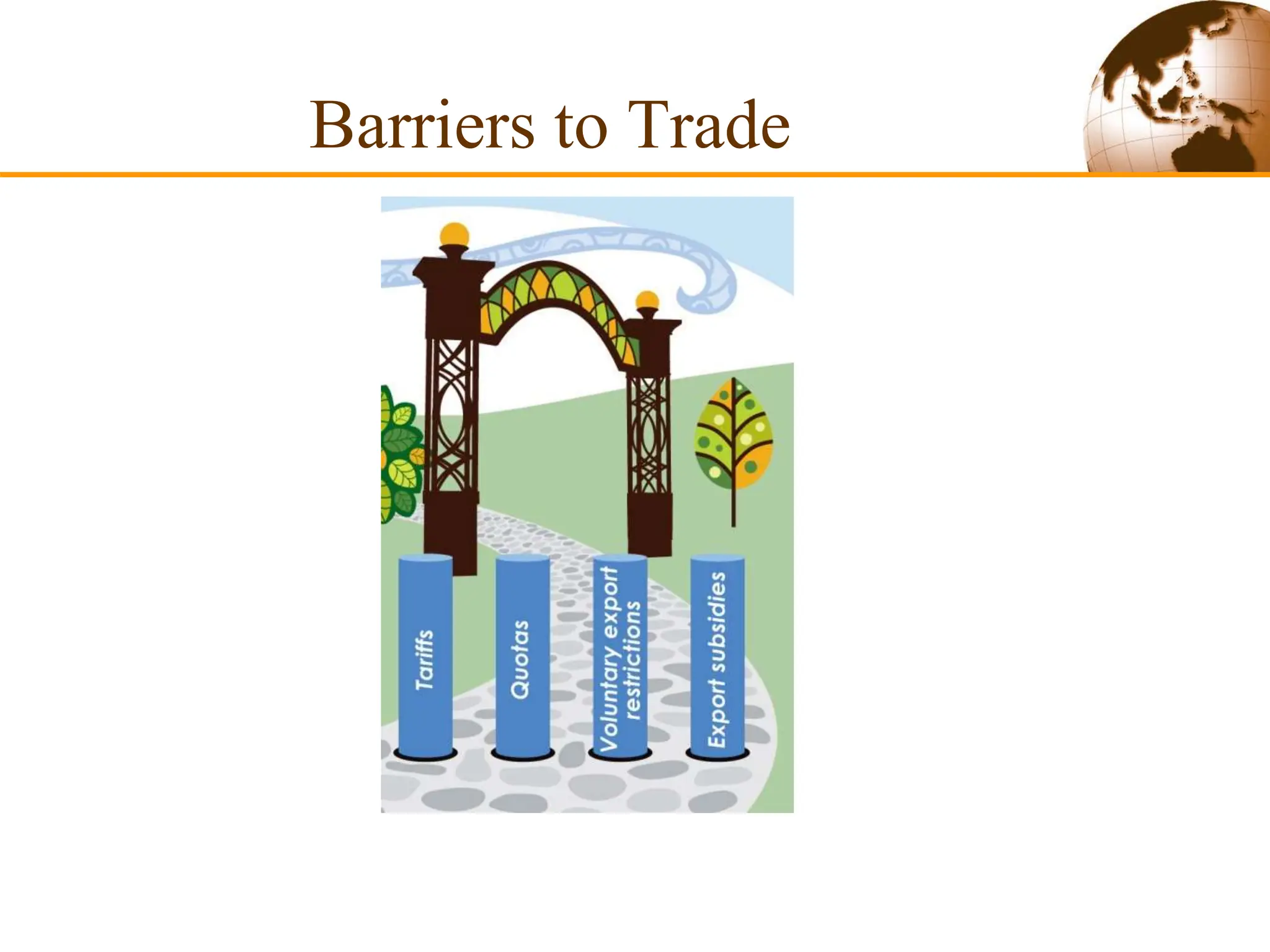
Barriers to Trade
Tariff
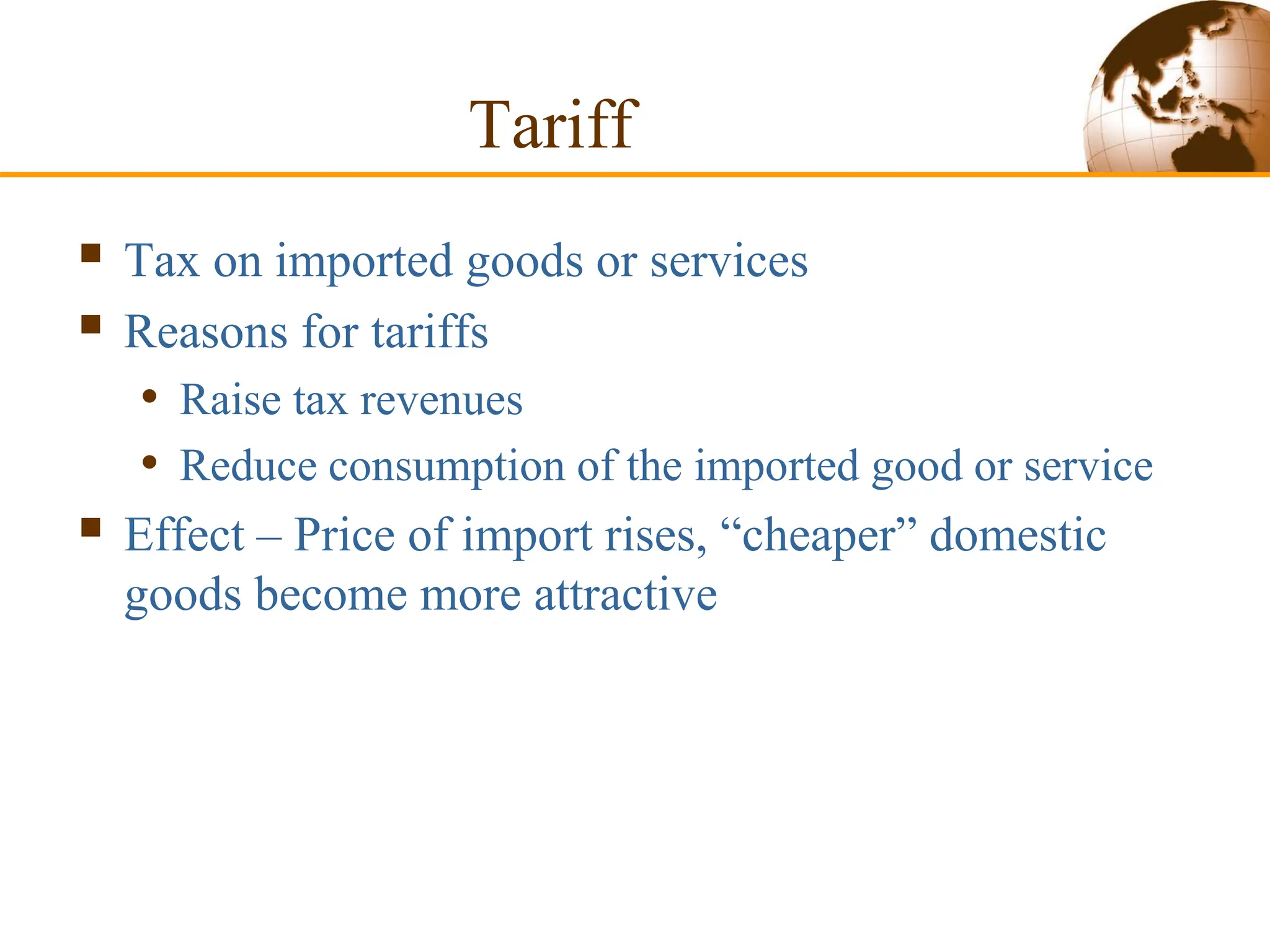
 Tax on imported goods or services
 Reasons for tariffs
• Raise tax revenues
• Reduce consumption of the imported good or service
 Effect – Price of import rises, “cheaper” domestic
goods become more attractive
Quota
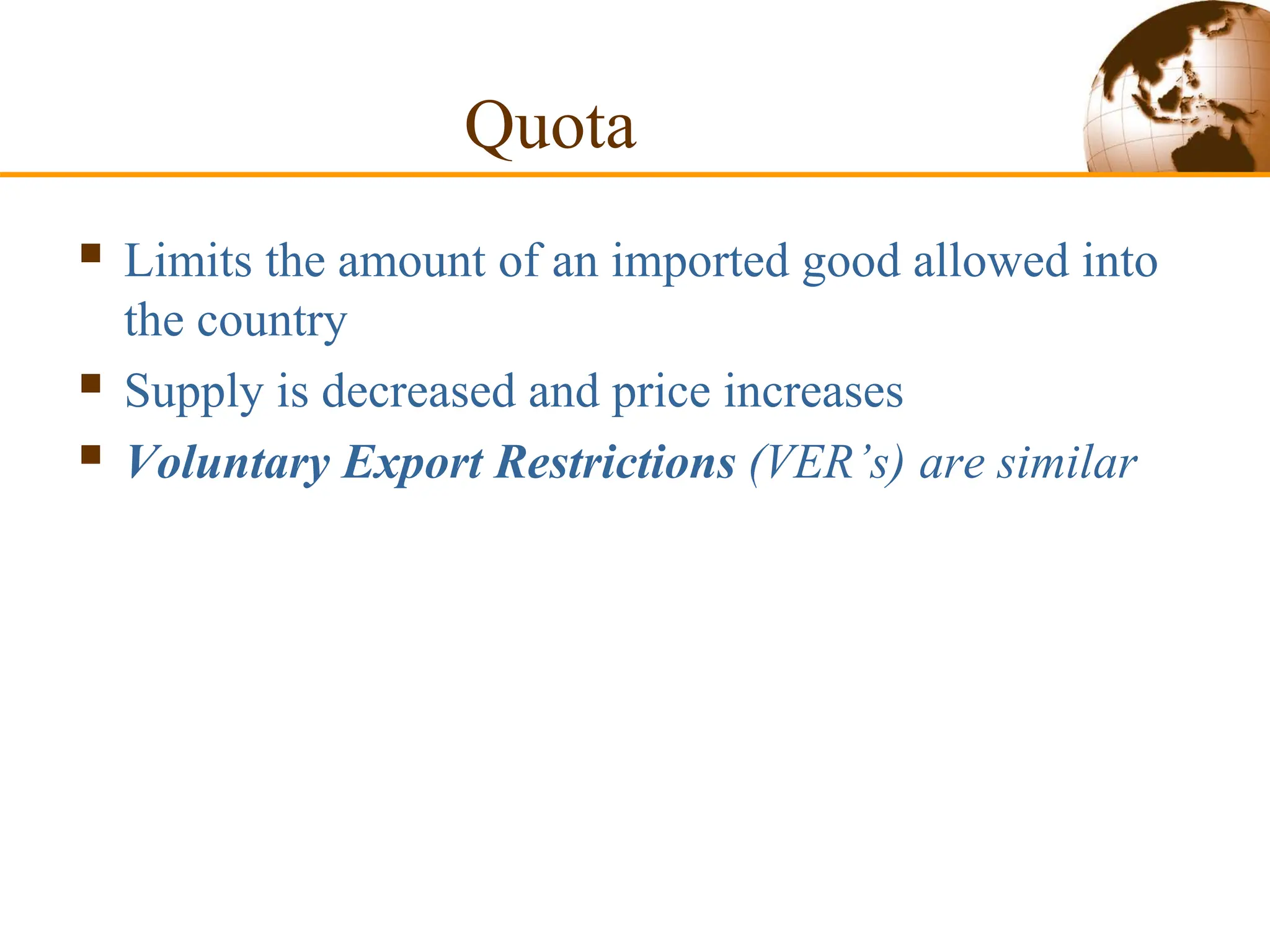
 Limits the amount of an imported good allowed into
the country
 Supply is decreased and price increases
 Voluntary Export Restrictions (VER’s) are similar
Export Subsidy
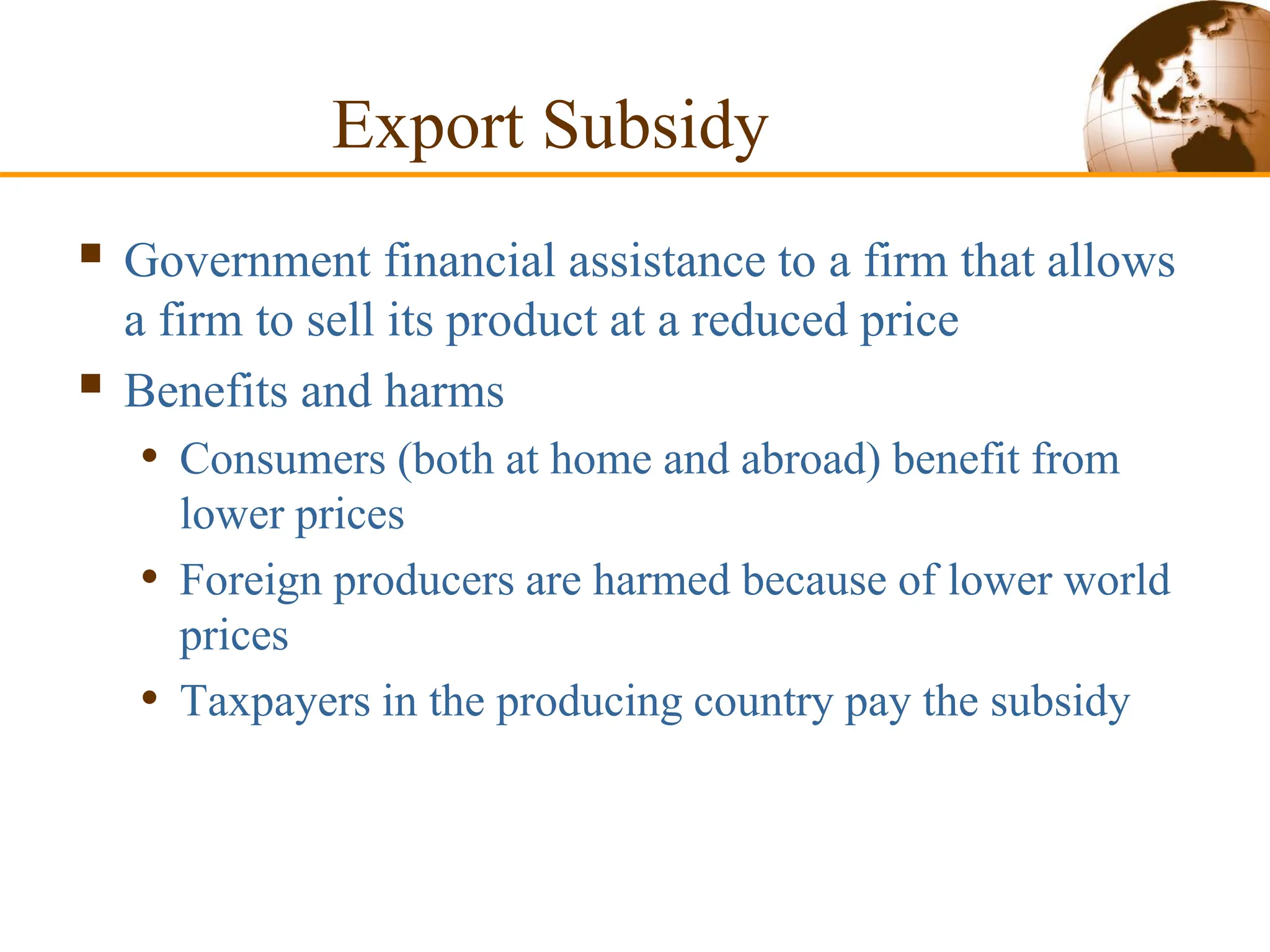
 Government financial assistance to a firm that allows
a firm to sell its product at a reduced price
 Benefits and harms
• Consumers (both at home and abroad) benefit from
lower prices
• Foreign producers are harmed because of lower world
prices
• Taxpayers in the producing country pay the subsidy
Product Standards
 A type of “hidden” trade barrier
 Types of standards
• Product safety
• Content
• Packaging
Trade Agreements
 General Agreement on Trade and Tariffs (GATT) and
World Trade Organization (WTO)
 Regional trade agreements
GATT
 “Provisional” agreement (1948 – 1994)
 Dramatic tariff reductions were negotiated in a series
of trade rounds
 Grew from 23 to 123 countries
WTO
 WTO created in the Uruguay trade round
 Established in Geneva in 1995
 153 member countries
 GATT was updated and still forms the legal
framework for WTO negotiations on the goods trade
What is the WTO?
 A negotiating forum
 A set of rules (international agreements)
• GATT
• GATS (General Agreement on Trade in Services)
• TRIPS (Agreement on Trade-Related Aspects of
Intellectual Property Rights)
 A place to settle trade disputes
Regional Trade Agreements
 Examples include
• North American Free Trade Agreement
• Association of Southeast Asian Nations
• Common Market of the South (MERCOSUR)
• European Union
 Regional agreements have been praised and criticized
Slide 9-49 Copyright © 2003 Pearson Education, Inc.
 International Trade Agreements: A Brief History
• Internationally coordinated tariff reduction as
a trade policy dates back to the 1930s (the
Smoot-Hawley Act).
• The multilateral tariff reductions since World
War II have taken place under the General
Agreement on Tariffs and Trade (GATT),
established in 1947 and located in Geneva.
–It is now called the World Trade
Organization (WTO).
–The GATT-WTO system is a legal
organization that embodies a set of rules of
conduct for international trade policy.
International Negotiations
&Trade Policy
Slide 9-50 Copyright © 2003 Pearson Education,
• The GATT-WTO system prohibits the imposition of:
– Export Subsidies (except for agricultural products)
– Import quotas (except when imports threaten “market
disruption”)
– Tariffs (any new tariff or increase in a tariff must be offset
by reductions in other tariffs to compensate the affected
exporting countries)
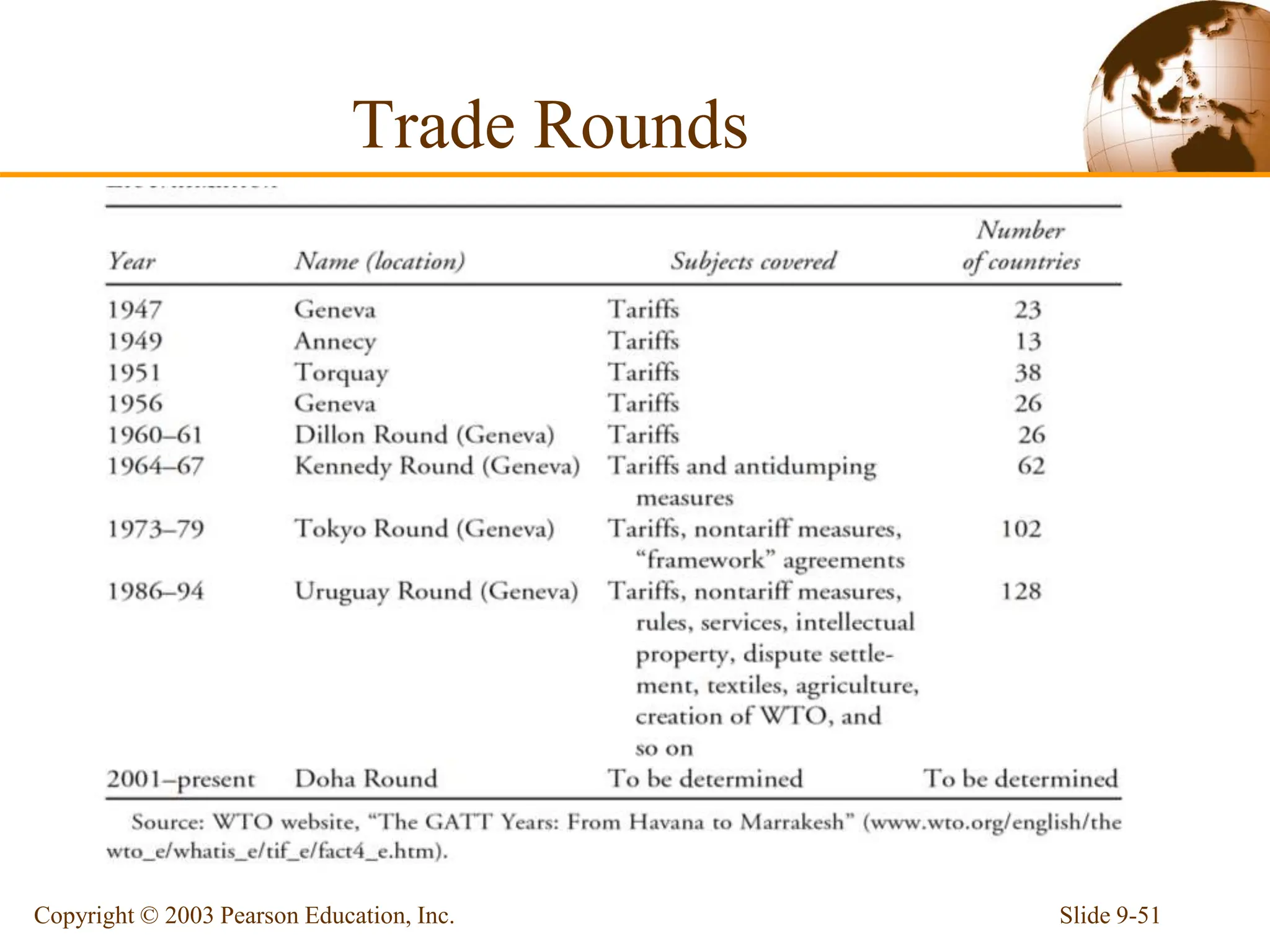
• Trade round
– A large group of countries get together to negotiate a set of
tariff reductions and other measures to liberalize trade.
International Negotiations
& Trade Policy
Trade Rounds
Slide 9-51
Copyright © 2003 Pearson Education, Inc.
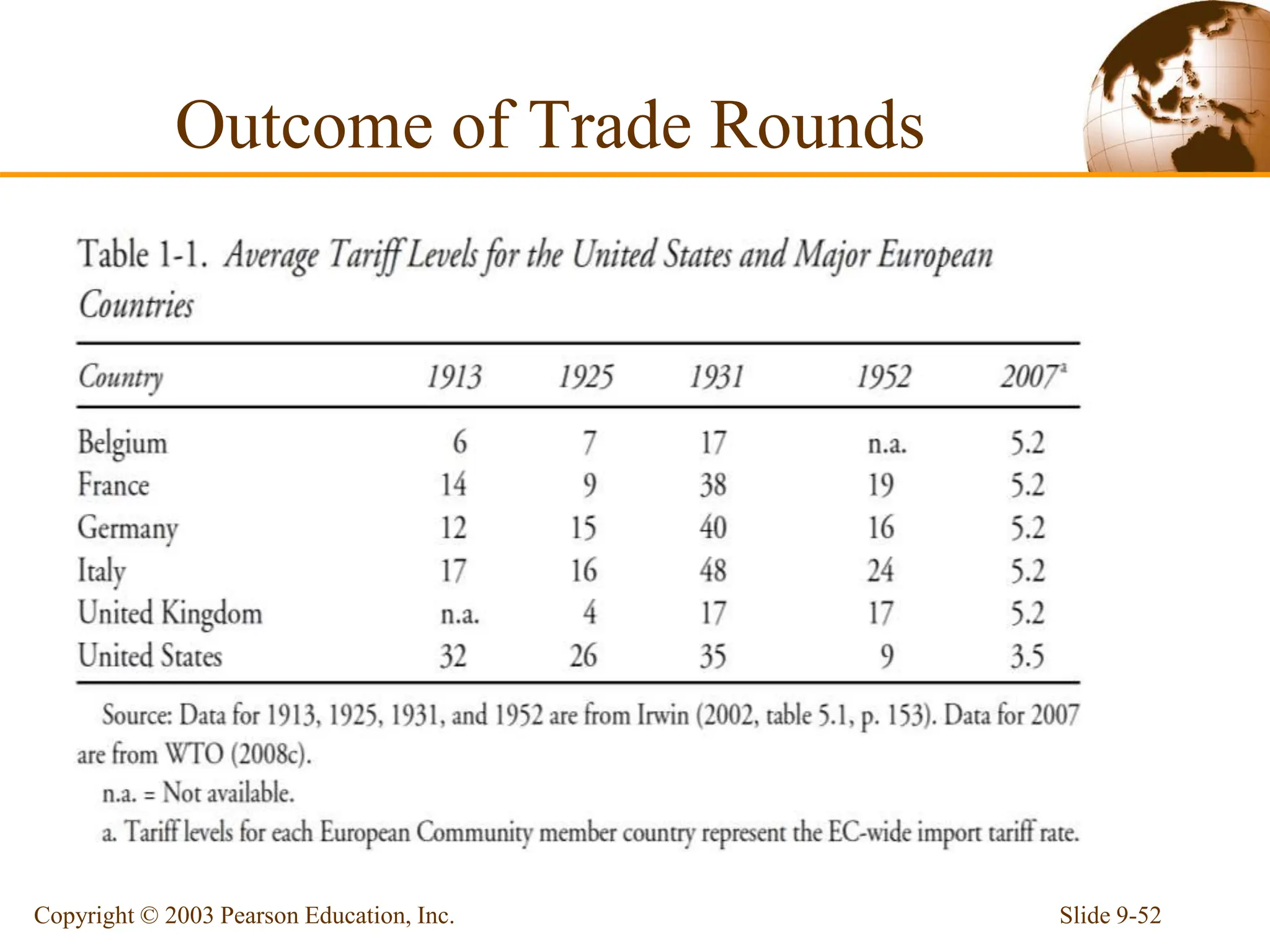
Outcome of Trade Rounds
Slide 9-52
Copyright © 2003 Pearson Education, Inc.
Slide 9-53 Copyright © 2003 Pearson Education,
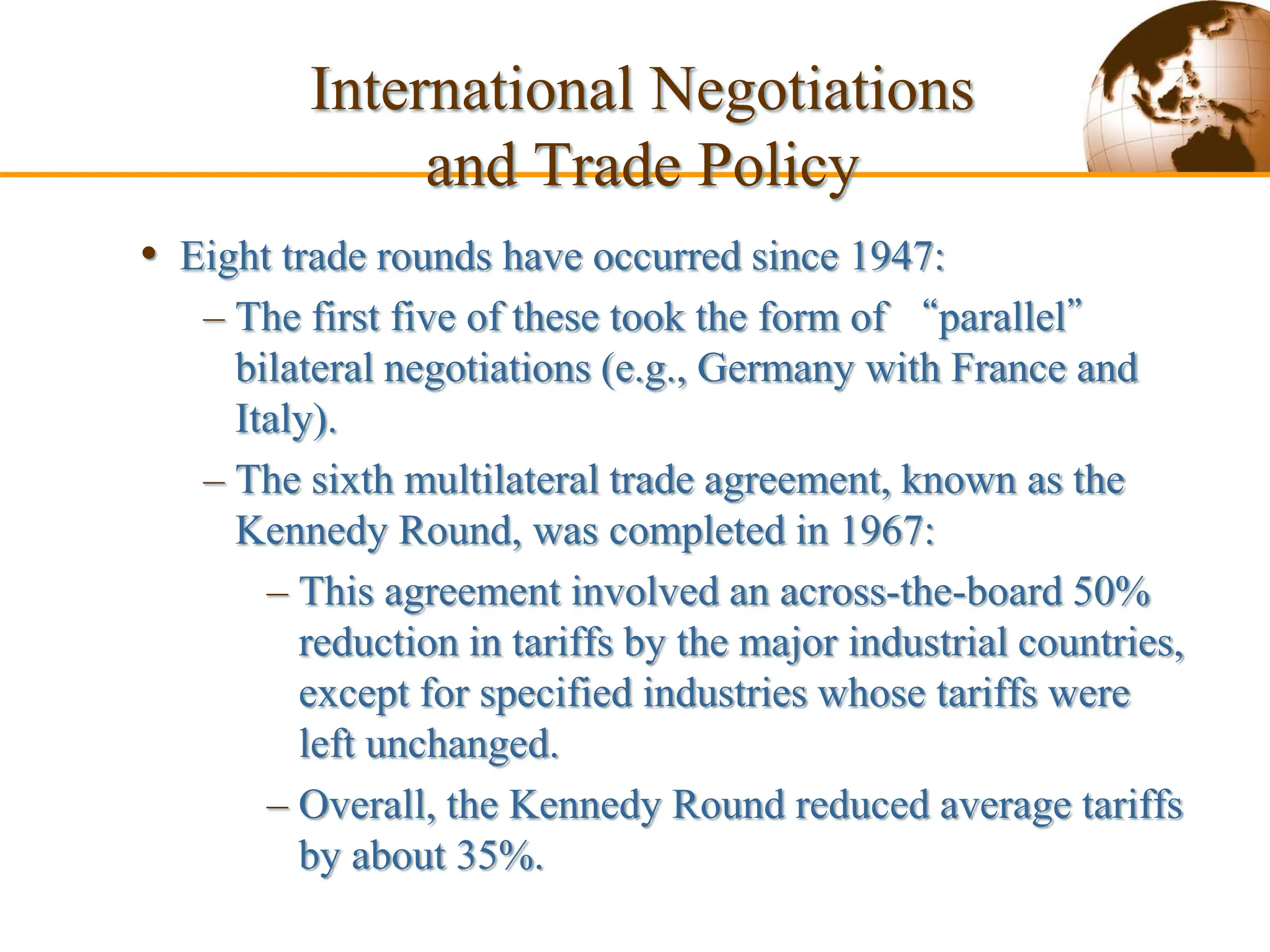
• Eight trade rounds have occurred since 1947:
– The first five of these took the form of “parallel”
bilateral negotiations (e.g., Germany with France and
Italy).
– The sixth multilateral trade agreement, known as the
Kennedy Round, was completed in 1967:
– This agreement involved an across-the-board 50%
reduction in tariffs by the major industrial countries,
except for specified industries whose tariffs were
left unchanged.
– Overall, the Kennedy Round reduced average tariffs
by about 35%.
International Negotiations
and Trade Policy
Slide 9-54 Copyright © 2003 Pearson Education, Inc.
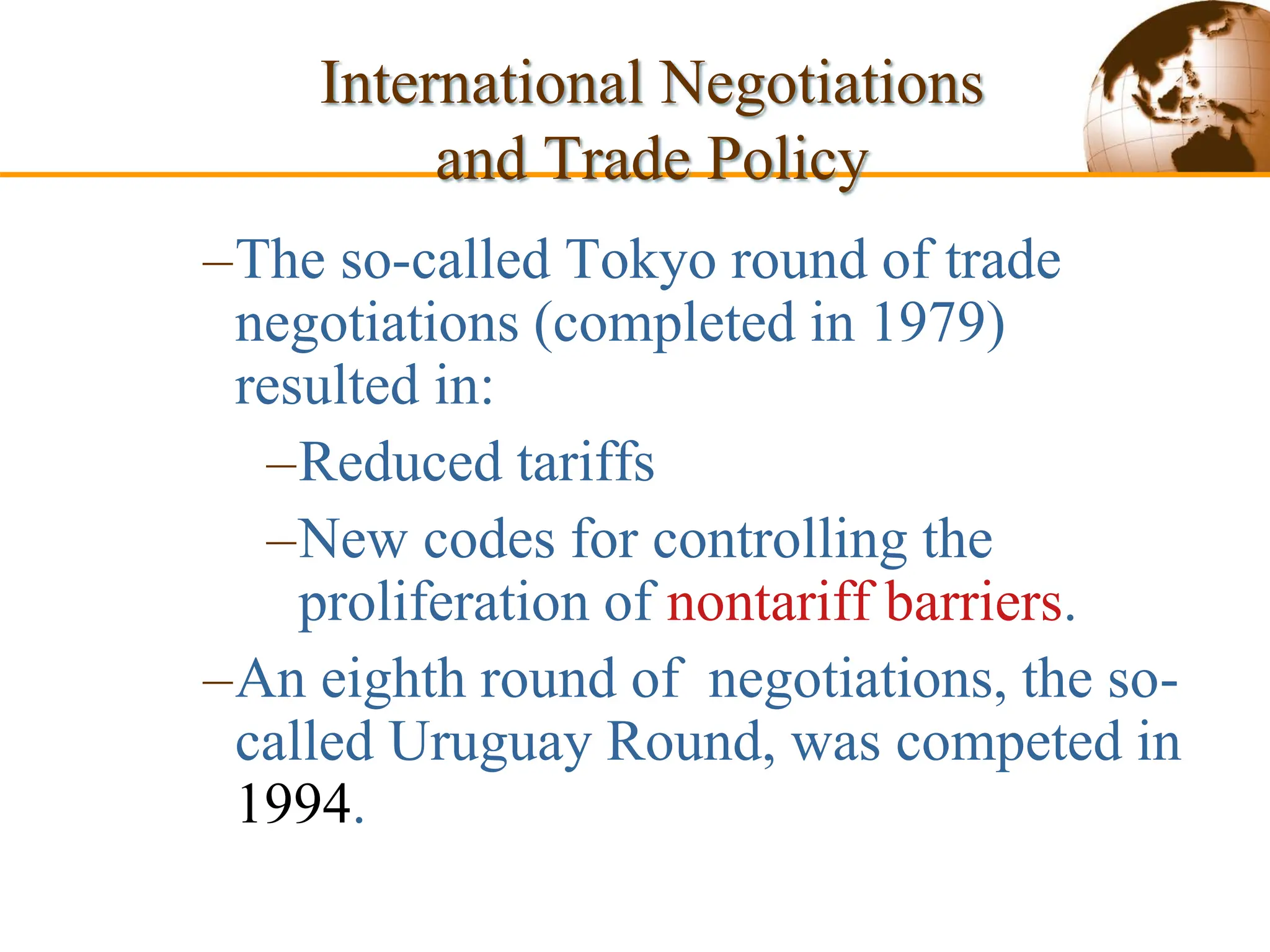
–The so-called Tokyo round of trade
negotiations (completed in 1979)
resulted in:
–Reduced tariffs
–New codes for controlling the
proliferation of nontariff barriers.
–An eighth round of negotiations, the so-
called Uruguay Round, was competed in
1994.
International Negotiations
and Trade Policy
Slide 9-55 Copyright © 2003 Pearson Education, Inc.
 The Uruguay Round
• Its most important results are:
– Trade liberalization
– Administrative reforms
 Trade Liberalization
• The average tariff imposed by advanced countries
decreased by almost 40%.
– More important is the move to liberalize trade in two
important sectors: agricultural and clothing.
 From the GATT to the WTO
• Much of the publicity surrounding the Uruguay Round
focused on its creation of the WTO.
International Negotiations
and Trade Policy
Slide 9-56 Copyright
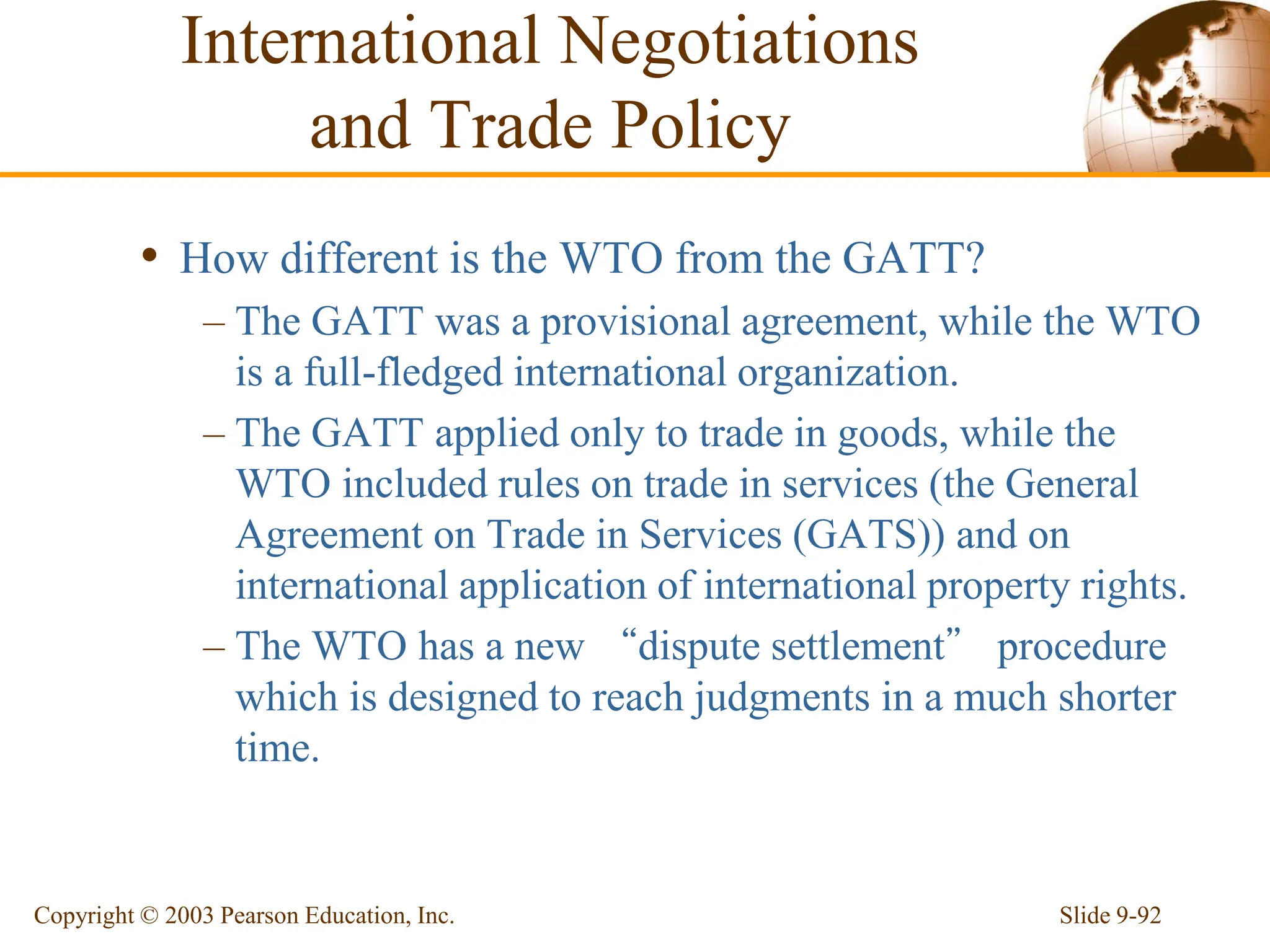
• How different is the WTO from the GATT?
– The GATT was a provisional agreement, while the WTO
is a full-fledged international organization.
– The GATT applied only to trade in goods, while the
WTO included rules on trade in services (the General
Agreement on Trade in Services (GATS)) and on
international application of international property rights.
– The WTO has a new “dispute settlement” procedure
which is designed to reach judgments in a much shorter
time.
International Negotiations
and Trade Policy
Slide 9-57
Copyright © 2003 Pearson Education, Inc.
Questions?
FREE TRADE & WORLD
SYSTEM
02/03/2023
Slide 9-59
Copyright © 2003 Pearson Education, Inc.
Slide 9-60
Copyright © 2003 Pearson Education, Inc.
Introduction
 What reasons are there for governments not to
interfere with trade?
• There are three arguments in favor of free trade:
– Free trade and efficiency
– Economies of scale in production
– Political argument
Slide 9-61
Copyright © 2003 Pearson Education, Inc.
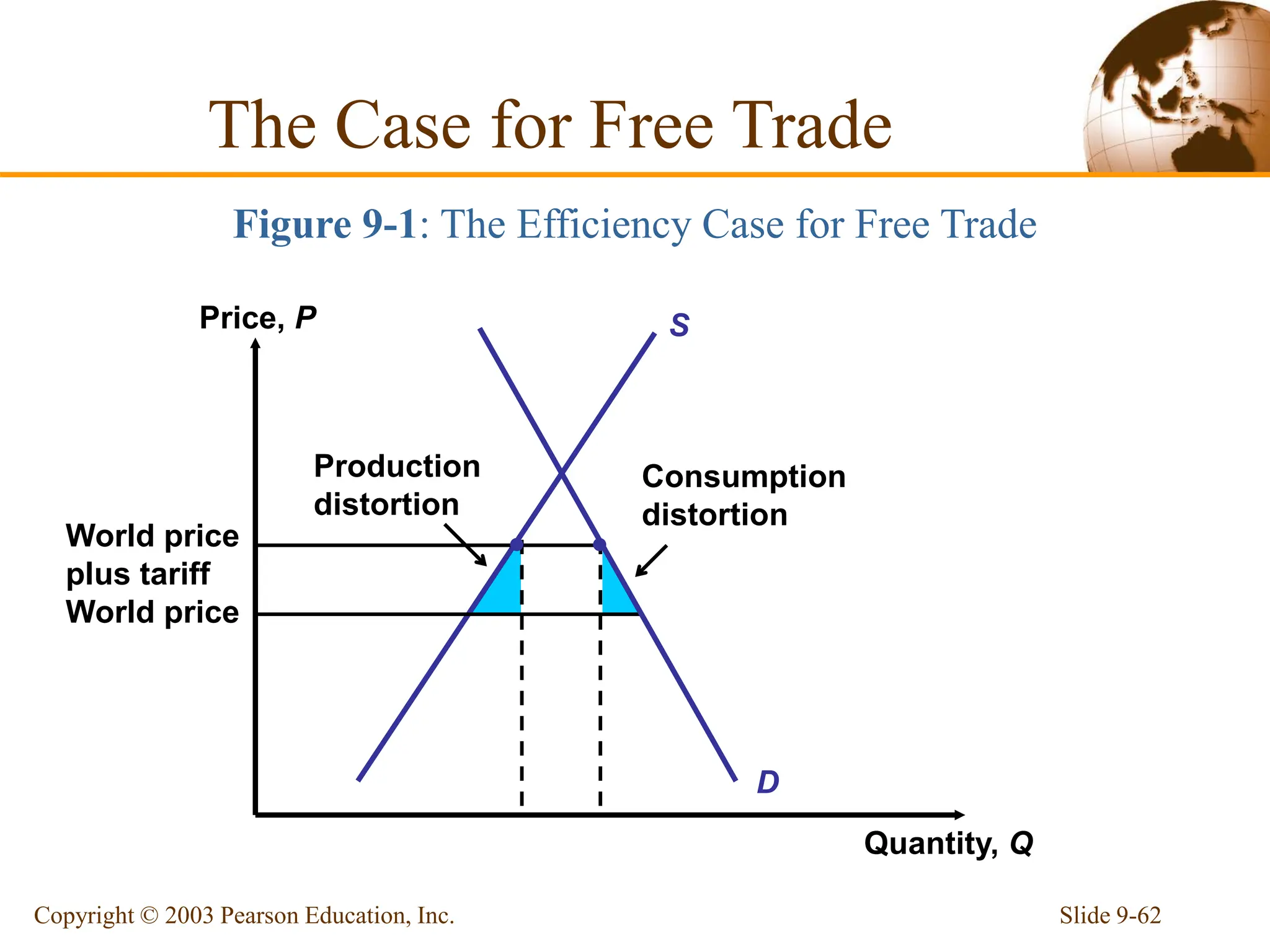
 Free Trade and Efficiency
• The efficiency argument for free trade is based on the
result that in the case of a small country, free trade is
the best policy.
– A tariff causes a net loss to the economy.
– A move from a tariff equilibrium to free trade
eliminates the efficiency loss and increases national
welfare.
The Case for Free Trade
Slide 9-62
Copyright © 2003 Pearson Education, Inc.
World price
plus tariff
World price
Price, P
Quantity, Q
S
D
Consumption
distortion
Production
distortion
Figure 9-1: The Efficiency Case for Free Trade
The Case for Free Trade
Slide 9-63
Copyright © 2003 Pearson Education, Inc.
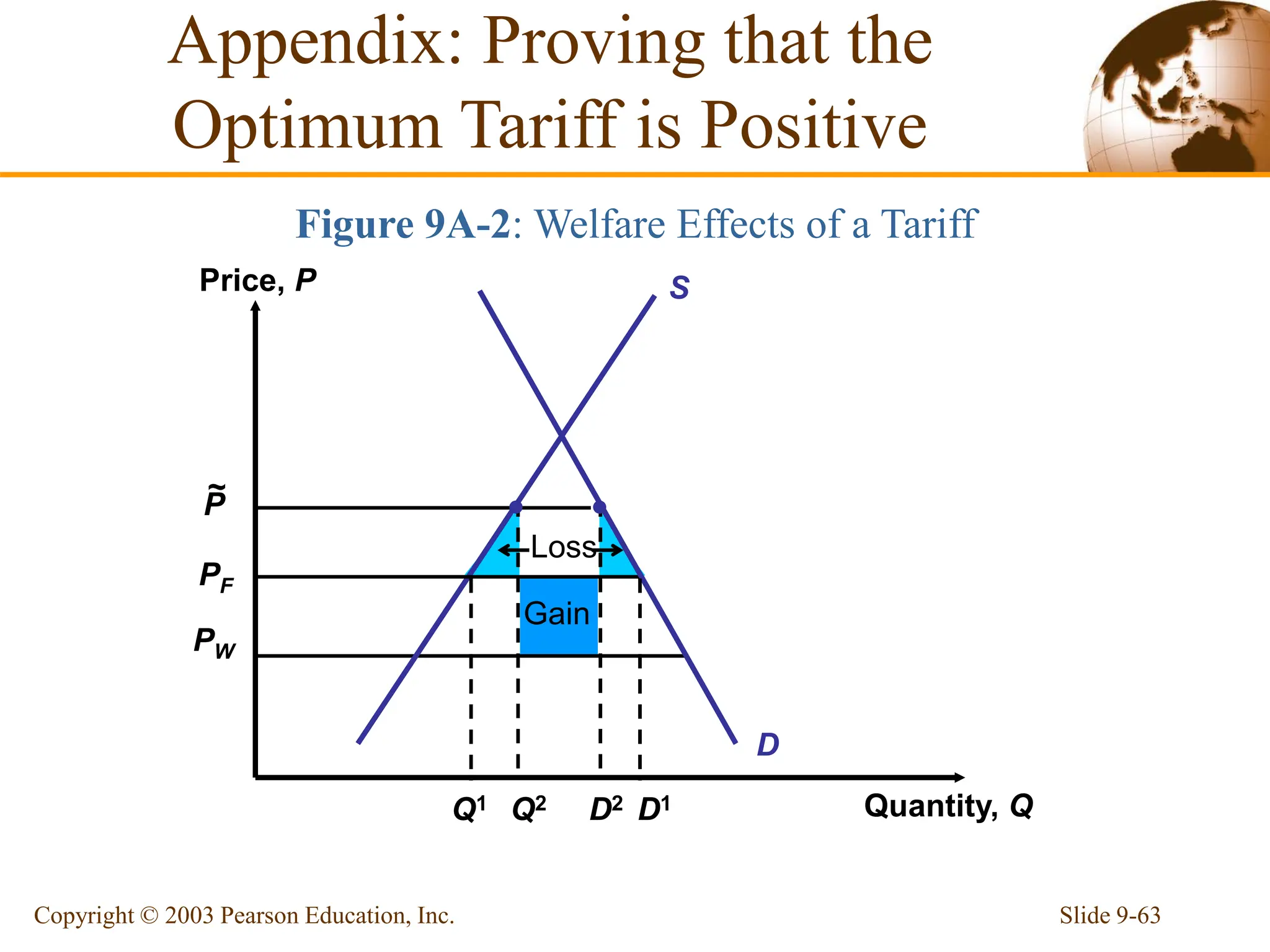
PF
PW
Price, P
Quantity, Q
S
D
P
~
Gain
Loss
Q1 D1
Q2 D2
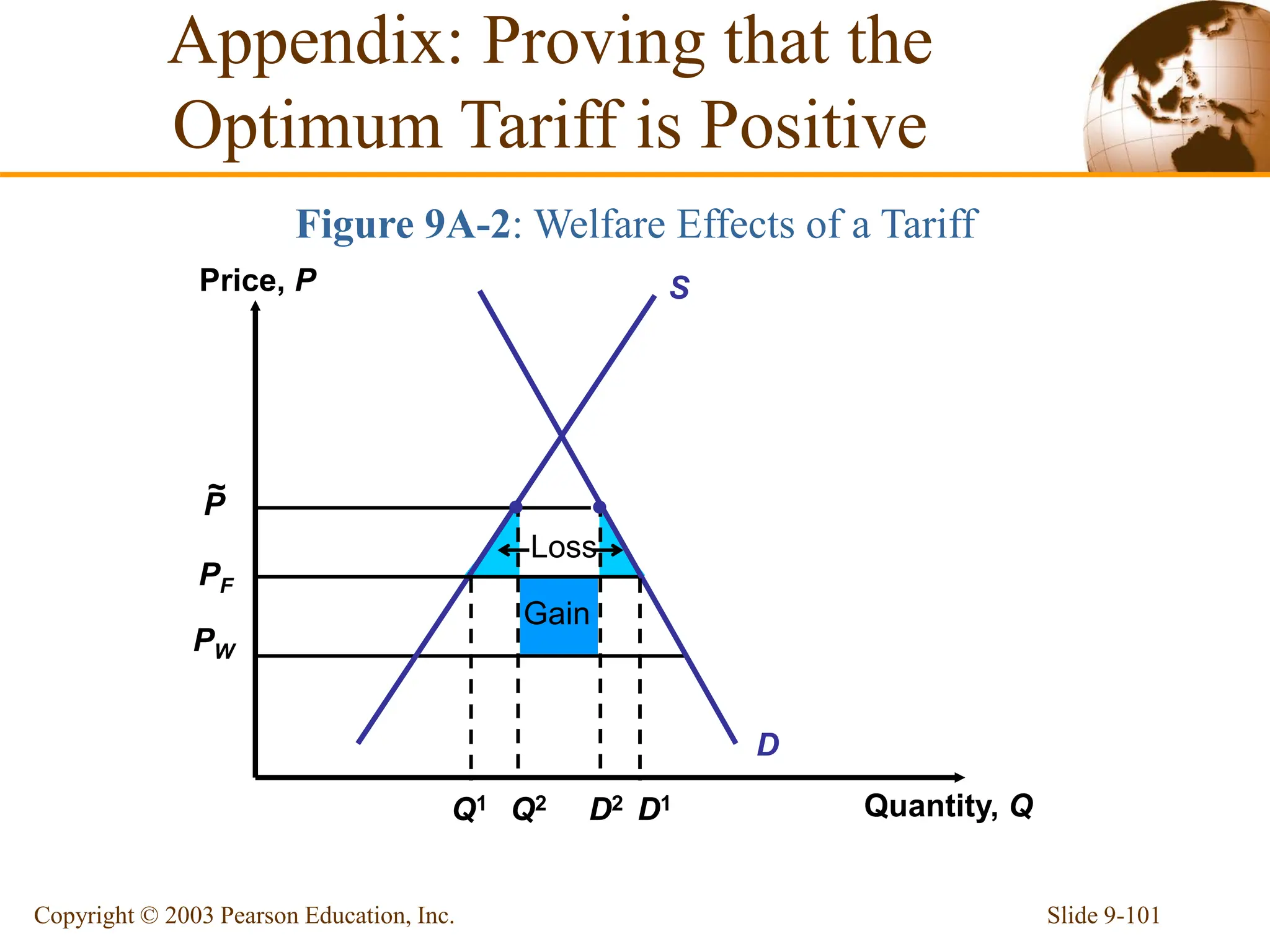
Figure 9A-2: Welfare Effects of a Tariff
Appendix: Proving that the
Optimum Tariff is Positive
Slide 9-64
Copyright © 2003 Pearson Education, Inc.
 Additional Gains from Free Trade
• Protected markets in small countries do not allow firms
to exploit scale economies.
– Example: In the auto industry, an efficient scale assembly
should make a minimum of 80,000 cars per year.
– In Argentina, 13 firms produced a total of 166,000 cars per year.
• The presence of scale economies favors free trade that
generates more varieties and results in lower prices.
• Free trade, as opposed to “managed” trade, provides
a wider range of opportunities and thus a wider scope
for innovation.
The Case for Free Trade
Slide 9-65
Copyright © 2003 Pearson Education, Inc.
 Political Argument for Free Trade
• A political commitment to free trade may be a good
idea in practice.
• Trade policies in practice are dominated by special-
interest politics rather than consideration of national
costs and benefits.
The Case for Free Trade
Slide 9-66
Copyright © 2003 Pearson Education, Inc.
 Activist trade policies can sometimes increase the
welfare of the nation as a whole.
 There are two theoretical arguments against the
policy of free trade:
• The terms of trade argument for a tariff
• The domestic market failure
National Welfare Arguments
Against Free Trade
Slide 9-67
Copyright © 2003 Pearson Education, Inc.
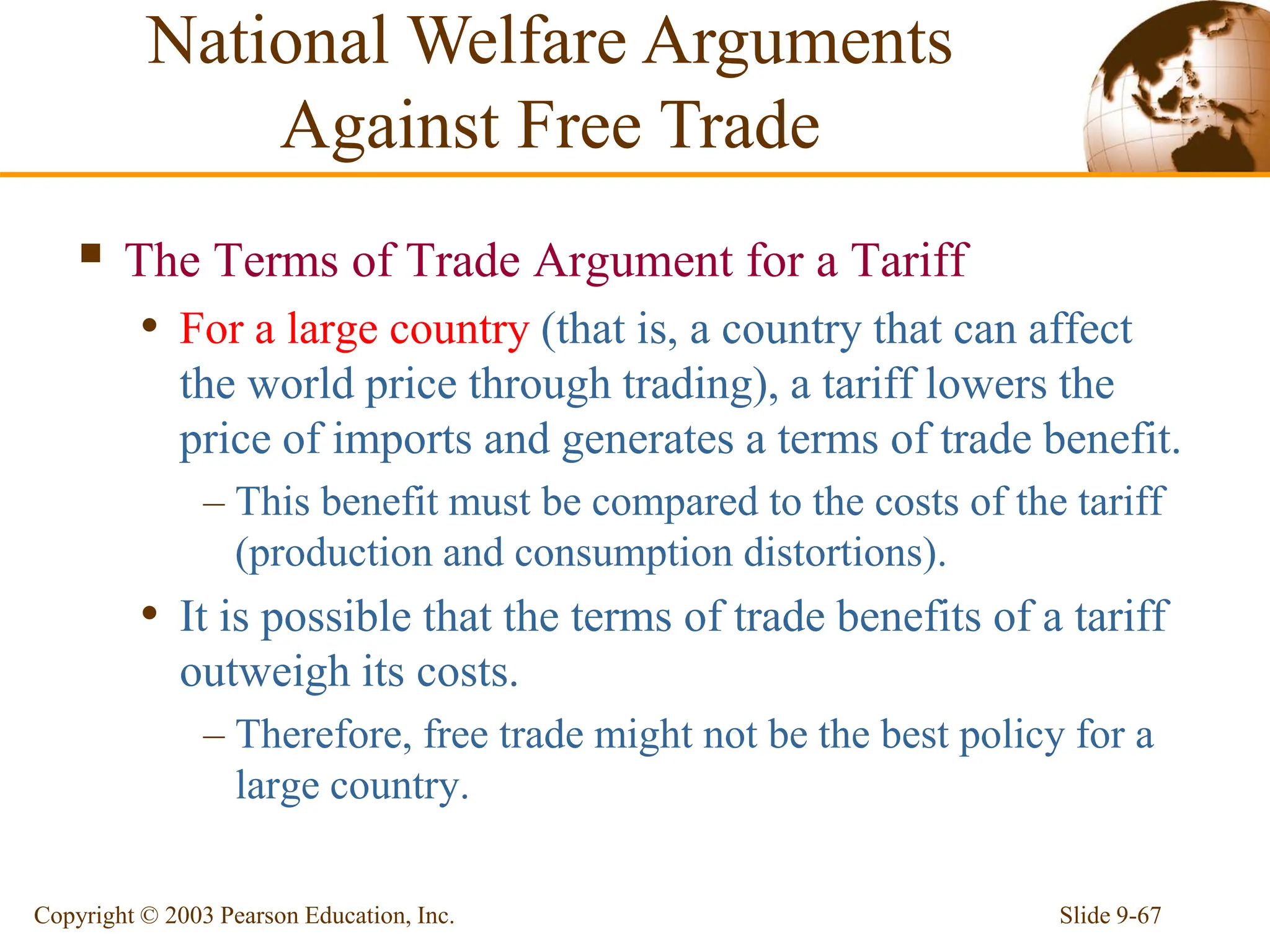
 The Terms of Trade Argument for a Tariff
• For a large country (that is, a country that can affect
the world price through trading), a tariff lowers the
price of imports and generates a terms of trade benefit.
– This benefit must be compared to the costs of the tariff
(production and consumption distortions).
• It is possible that the terms of trade benefits of a tariff
outweigh its costs.
– Therefore, free trade might not be the best policy for a
large country.
National Welfare Arguments
Against Free Trade
Slide 9-68
Copyright © 2003 Pearson Education, Inc.
1
National welfare
Tariff rate
Optimum
tariff, to
Prohibitive
tariff rate, tp
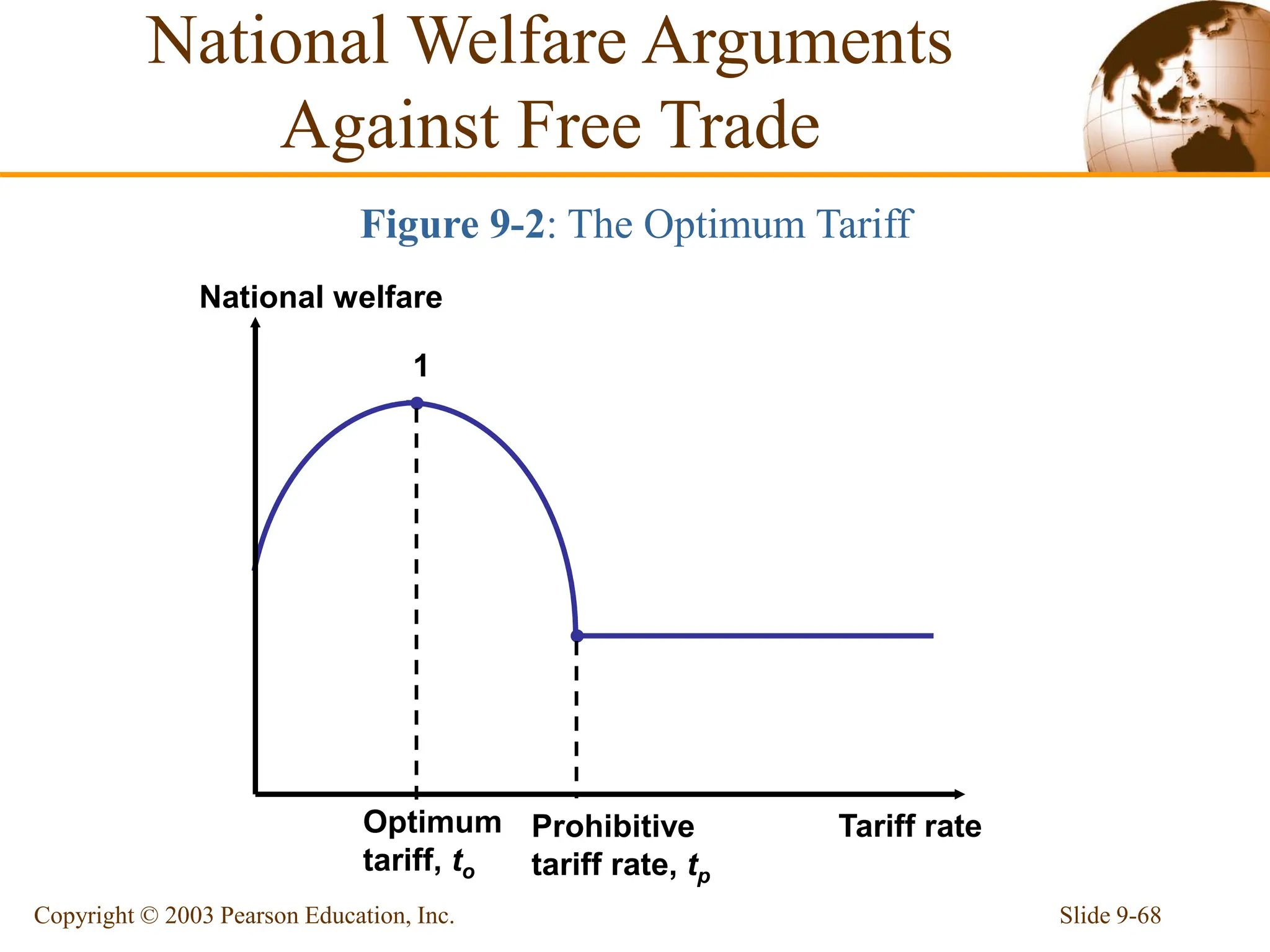
Figure 9-2: The Optimum Tariff
National Welfare Arguments
Against Free Trade
Slide 9-69
Copyright © 2003 Pearson Education, Inc.
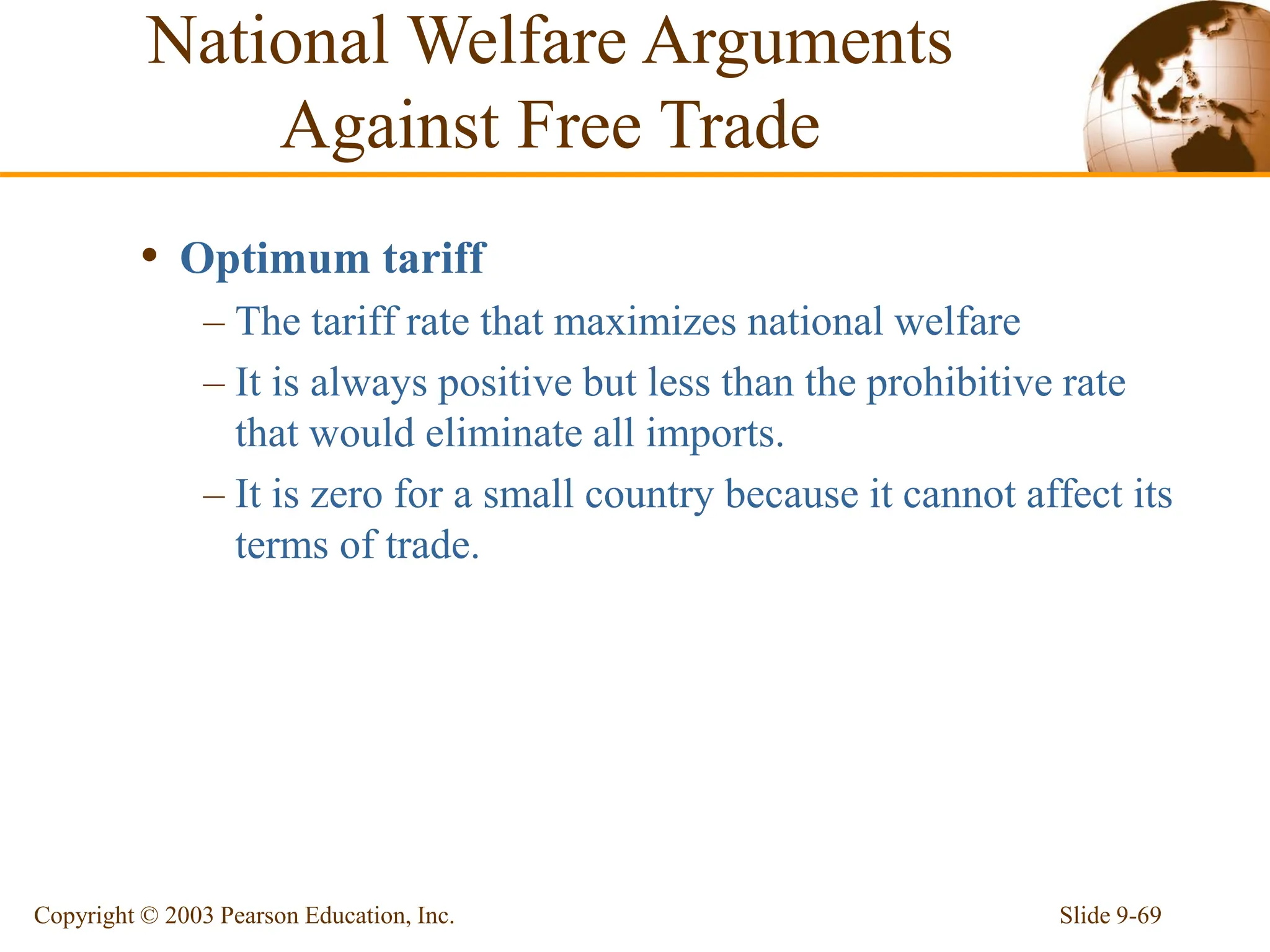
• Optimum tariff
– The tariff rate that maximizes national welfare
– It is always positive but less than the prohibitive rate
that would eliminate all imports.
– It is zero for a small country because it cannot affect its
terms of trade.
National Welfare Arguments
Against Free Trade
Slide 9-70
Copyright © 2003 Pearson Education, Inc.
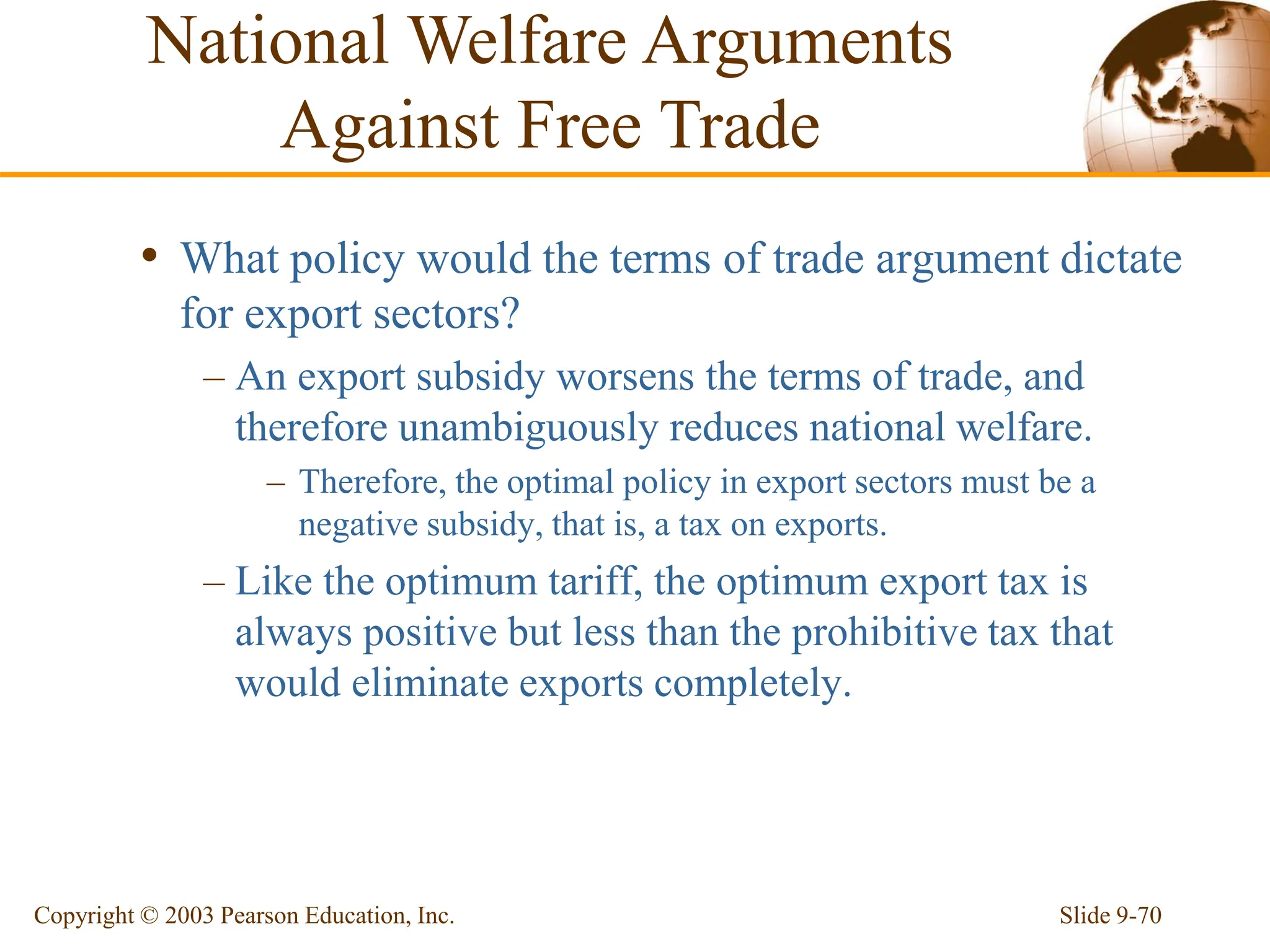
• What policy would the terms of trade argument dictate
for export sectors?
– An export subsidy worsens the terms of trade, and
therefore unambiguously reduces national welfare.
– Therefore, the optimal policy in export sectors must be a
negative subsidy, that is, a tax on exports.
– Like the optimum tariff, the optimum export tax is
always positive but less than the prohibitive tax that
would eliminate exports completely.
National Welfare Arguments
Against Free Trade
Slide 9-71
Copyright © 2003 Pearson Education, Inc.
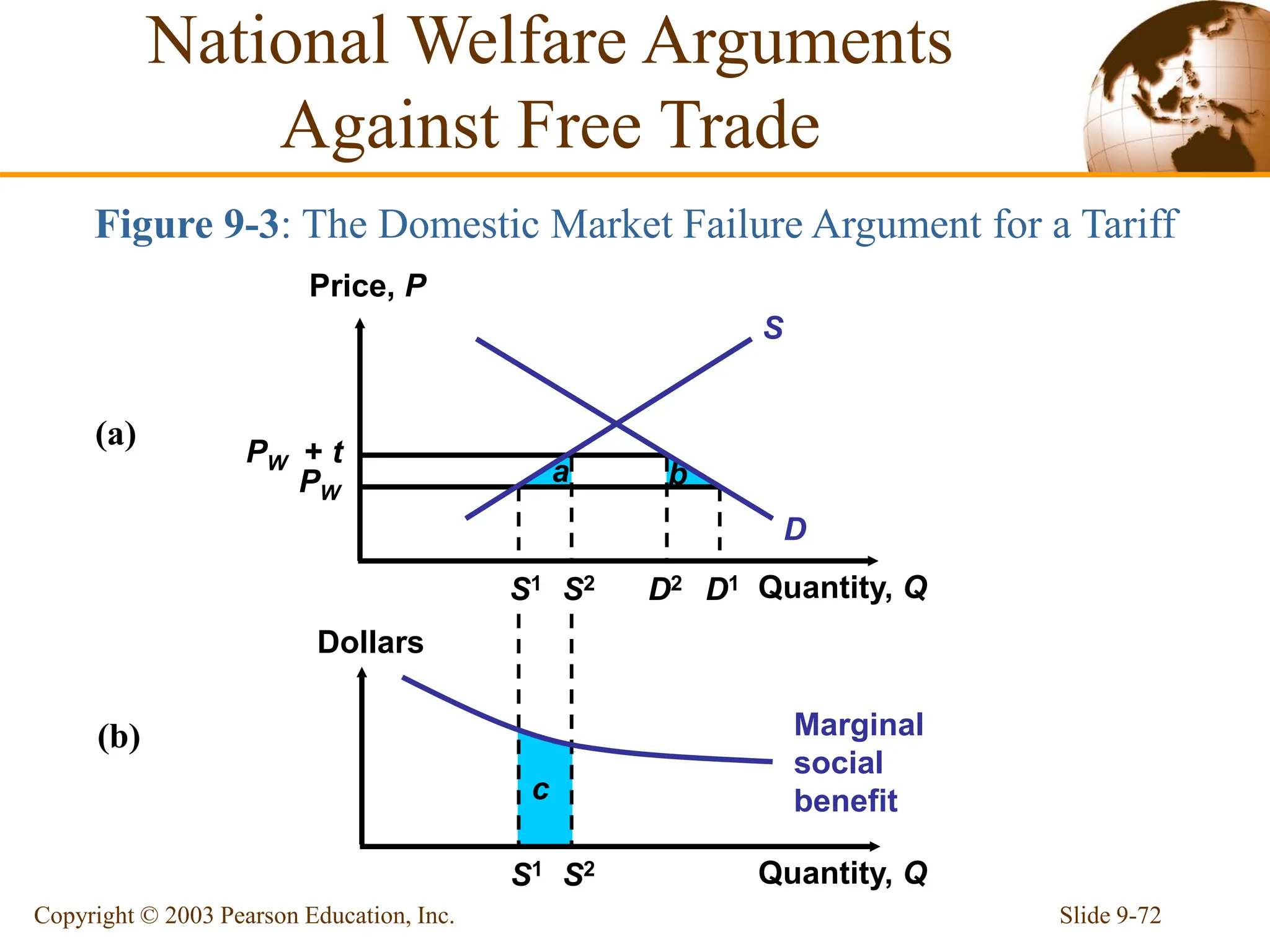
 The Domestic Market Failure Argument Against
Free Trade
• Producer and consumer surplus do not properly
measure social costs and benefits.
– Consumer and producer surplus ignore domestic
market failures such as:
– Unemployment or underemployment of labor
– Technological spillovers from industries that are new or
particularly innovative
– Environmental externalities
• A tariff may raise welfare if there is a marginal social
benefit to production of a good that is not captured by
producer surplus measures.
National Welfare Arguments
Against Free Trade
Slide 9-72
Copyright © 2003 Pearson Education, Inc.
c
a b
S1
S1
S2
S2
D2 D1
PW + t
PW
Price, P
Quantity, Q
Dollars
Quantity, Q
S
D
(a)
(b)
Figure 9-3: The Domestic Market Failure Argument for a Tariff
National Welfare Arguments
Against Free Trade
Marginal
social
benefit
Slide 9-73
Copyright © 2003 Pearson Education, Inc.
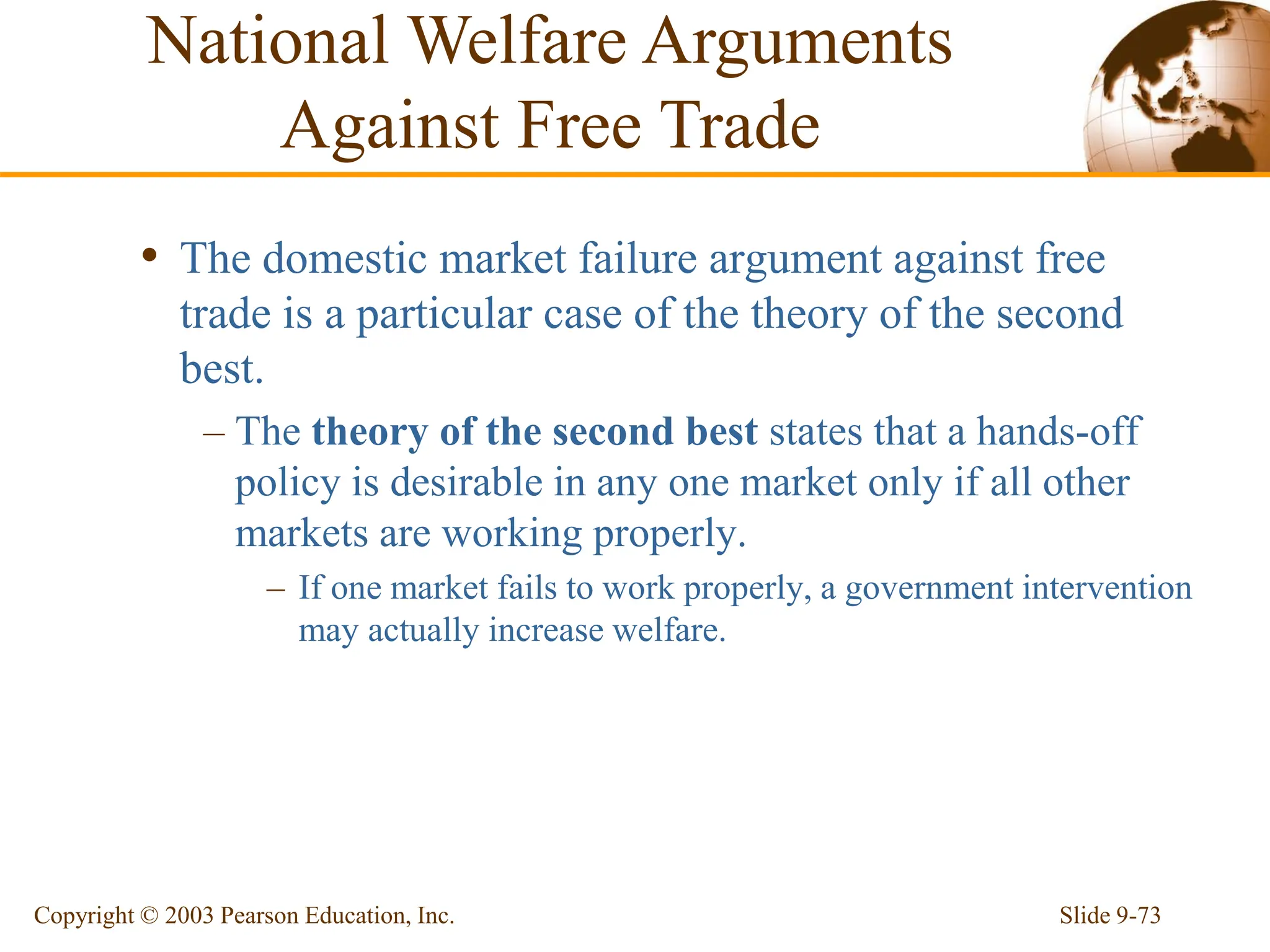
• The domestic market failure argument against free
trade is a particular case of the theory of the second
best.
– The theory of the second best states that a hands-off
policy is desirable in any one market only if all other
markets are working properly.
– If one market fails to work properly, a government intervention
may actually increase welfare.
National Welfare Arguments
Against Free Trade
Slide 9-74
Copyright © 2003 Pearson Education, Inc.
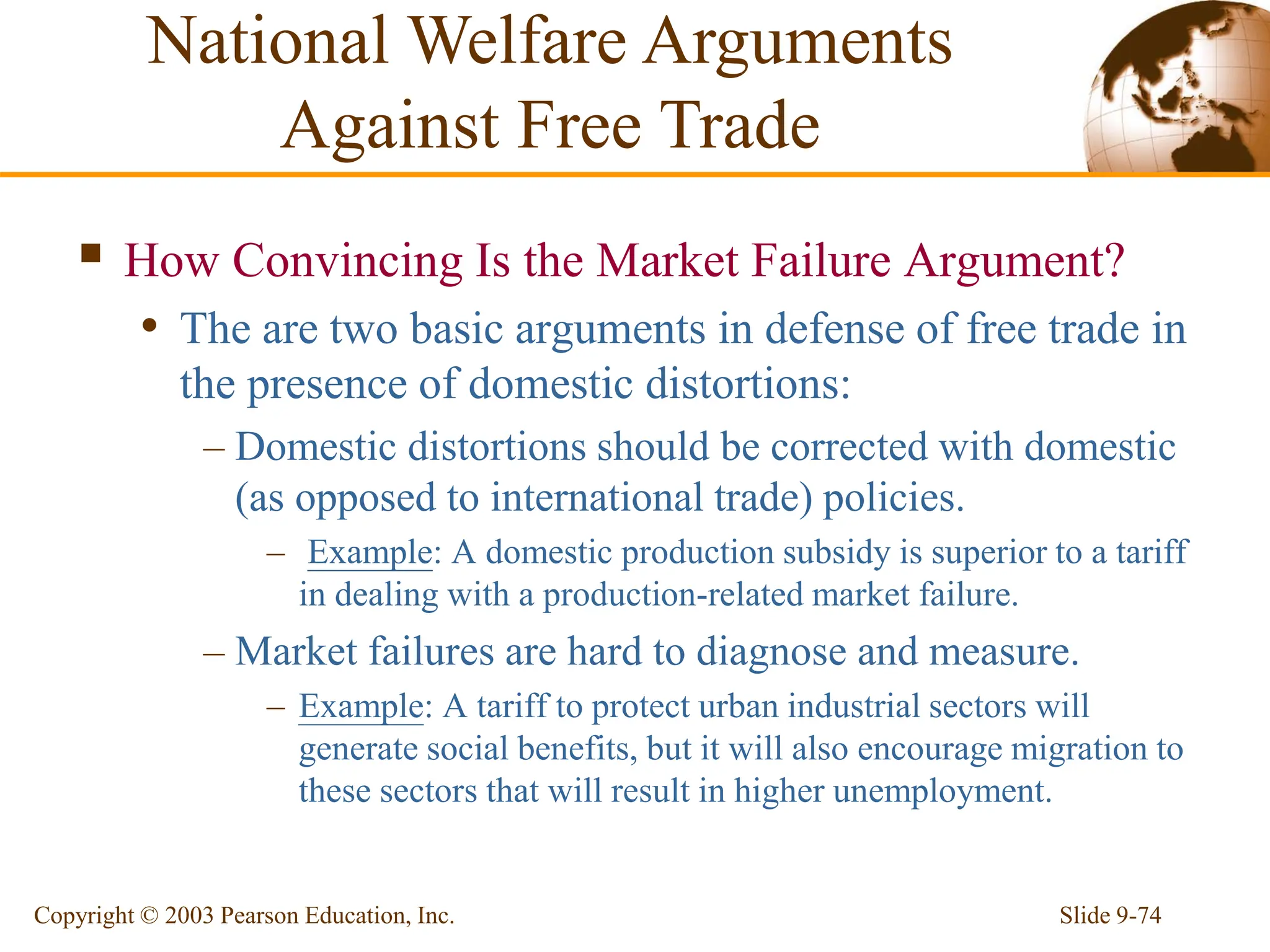
 How Convincing Is the Market Failure Argument?
• The are two basic arguments in defense of free trade in
the presence of domestic distortions:
– Domestic distortions should be corrected with domestic
(as opposed to international trade) policies.
– Example: A domestic production subsidy is superior to a tariff
in dealing with a production-related market failure.
– Market failures are hard to diagnose and measure.
– Example: A tariff to protect urban industrial sectors will
generate social benefits, but it will also encourage migration to
these sectors that will result in higher unemployment.
National Welfare Arguments
Against Free Trade
Slide 9-75
Copyright © 2003 Pearson Education, Inc.
 In practice, trade policy is dominated by income
distribution considerations.
• The desires of individuals get more or less imperfectly
reflected in the objectives of government.
– There exist models in which governments try to
maximize political success.
 Electoral Competition
• Political scientists argue that policies are determined
by competition among political parties that try to
attract as many votes as possible.
Income Distribution
and Trade Policy
Slide 9-76
Copyright © 2003 Pearson Education, Inc.
• Assumptions of the model:
– There are two competing political parties.
– The objective of each party is to get elected.
– Each party has to decide on the level of the tariff
imposed (this is the only policy available).
– Voters differ in the tariff they prefer.
• What policies will the two parties promise to follow?
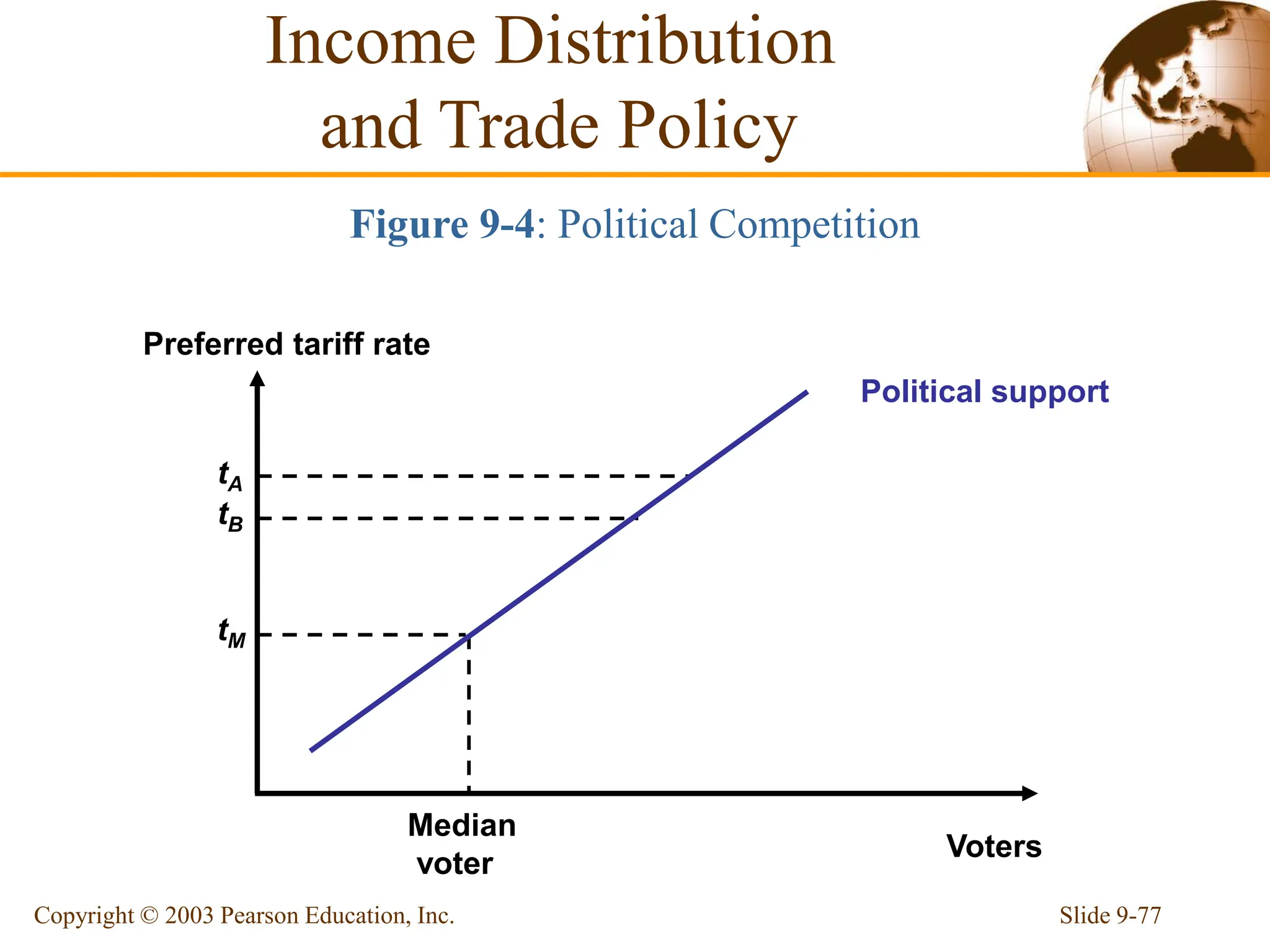
– Both parties will offer the same policy consisting of the
tariff that the median voter (the voter who is exactly
halfway up the lineup) prefers.
Income Distribution
and Trade Policy
Slide 9-77
Copyright © 2003 Pearson Education, Inc.
Voters
Preferred tariff rate
Median
voter
tM
tB
tA
Political support
Income Distribution
and Trade Policy
Figure 9-4: Political Competition
Slide 9-78
Copyright © 2003 Pearson Education, Inc.
 Collective Action
• This approach views political activity as a public
good.
– For instance, the imposition of a tariff protects all
firms in an industry, but the lobbying costs for
imposing the tariff are covered by only a few firms.
• Trade policies that impose total large losses that are
spread among many individual firms or consumers
may not face opposition.
– Industries that are well organized (or have a small
number of firms) get protection.
Income Distribution
and Trade Policy
Slide 9-79
Copyright © 2003 Pearson Education, Inc.
 Modeling the Political Process
• Interest groups “buy” policies by offering
contributions contingent on the policies followed by
the government.
Income Distribution
and Trade Policy
Slide 9-80
Copyright © 2003 Pearson Education, Inc.
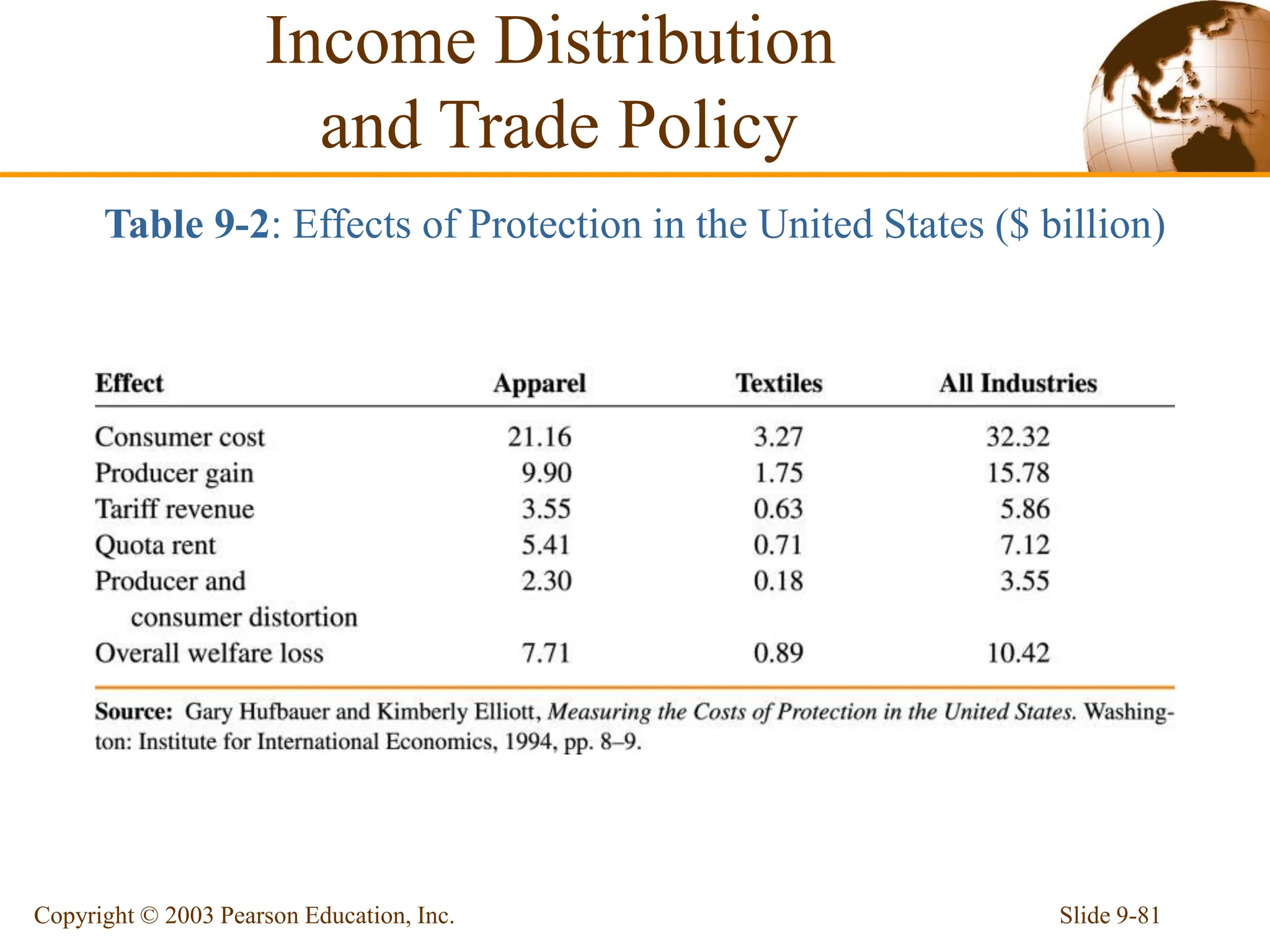
 Who Gets Protected?
• Two sectors seem to get protected in advanced
countries:
– Agriculture
– Farmers are well organized and the structure of the U.S.
government enhances their political power.
– Clothing
– Both textiles and apparel have enjoyed substantial protection.
This sector employs less skilled workers and it is unionized as
well.
• Protection is very likely to diminish in the future in
both sectors (due to international trade negotiations).
Income Distribution
and Trade Policy
Slide 9-81
Copyright © 2003 Pearson Education, Inc.
Income Distribution
and Trade Policy
Table 9-2: Effects of Protection in the United States ($ billion)
Slide 9-82
Copyright © 2003 Pearson Education, Inc.
International Negotiations
and Trade Policy
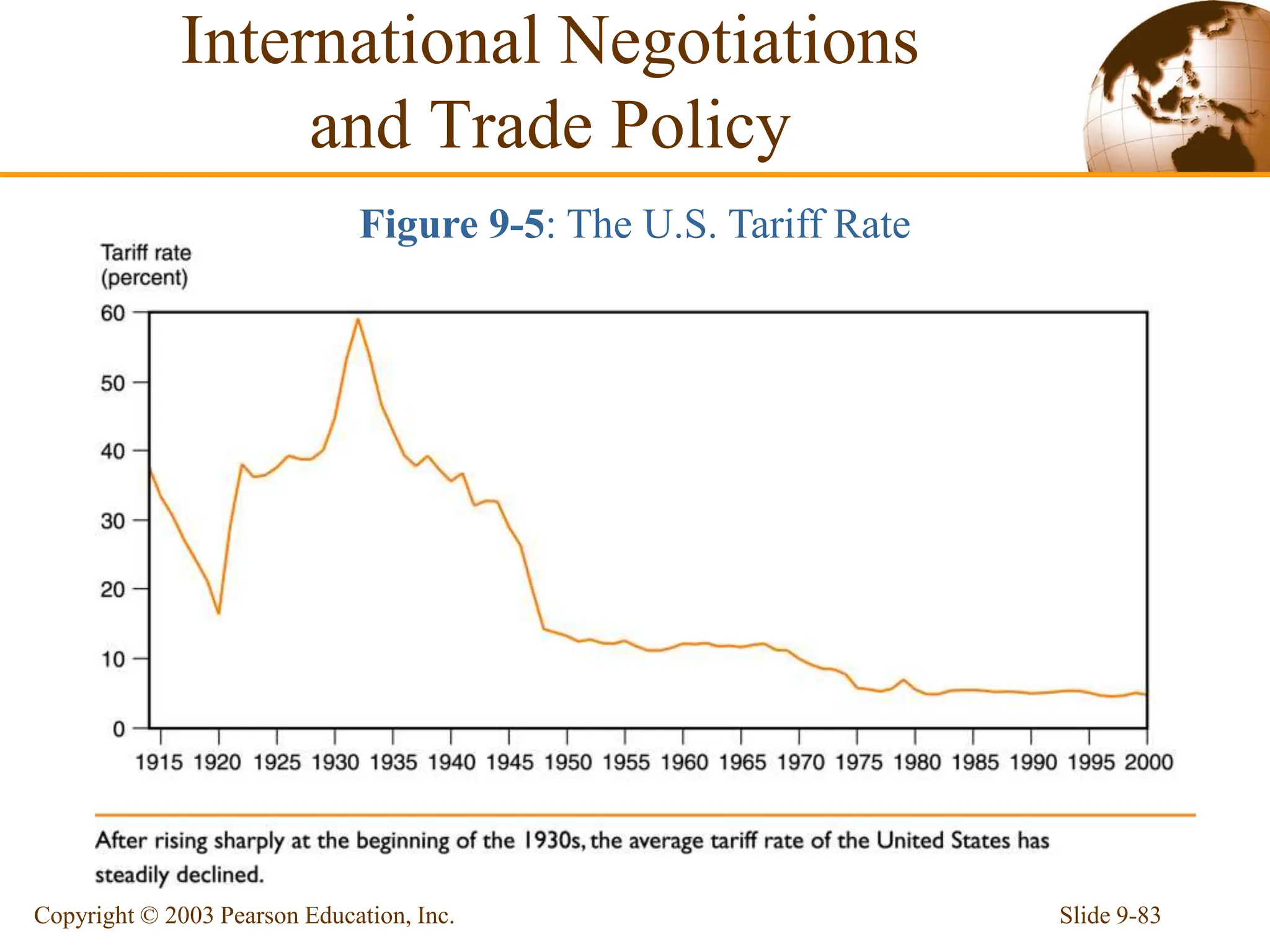
 International integration has increased from the mid-
1930s until about 1980 because the United States and
other advanced countries gradually removed tariffs
and nontariff barriers to trade.
Slide 9-83
Copyright © 2003 Pearson Education, Inc.
Figure 9-5: The U.S. Tariff Rate
International Negotiations
and Trade Policy
Slide 9-84
Copyright © 2003 Pearson Education, Inc.
 How was the removal of tariffs politically possible?
• The postwar liberalization of trade was achieved
through international negotiation.
– Governments agreed to engage in mutual tariff
reduction.
 The Advantages of Negotiation
• It is easier to lower tariffs as part of a mutual
agreement than to do so as a unilateral policy
because:
– It helps mobilize exporters to support freer trade.
– It can help governments avoid getting caught in
destructive trade wars.
International Negotiations
and Trade Policy
Slide 9-85
Copyright © 2003 Pearson Education, Inc.
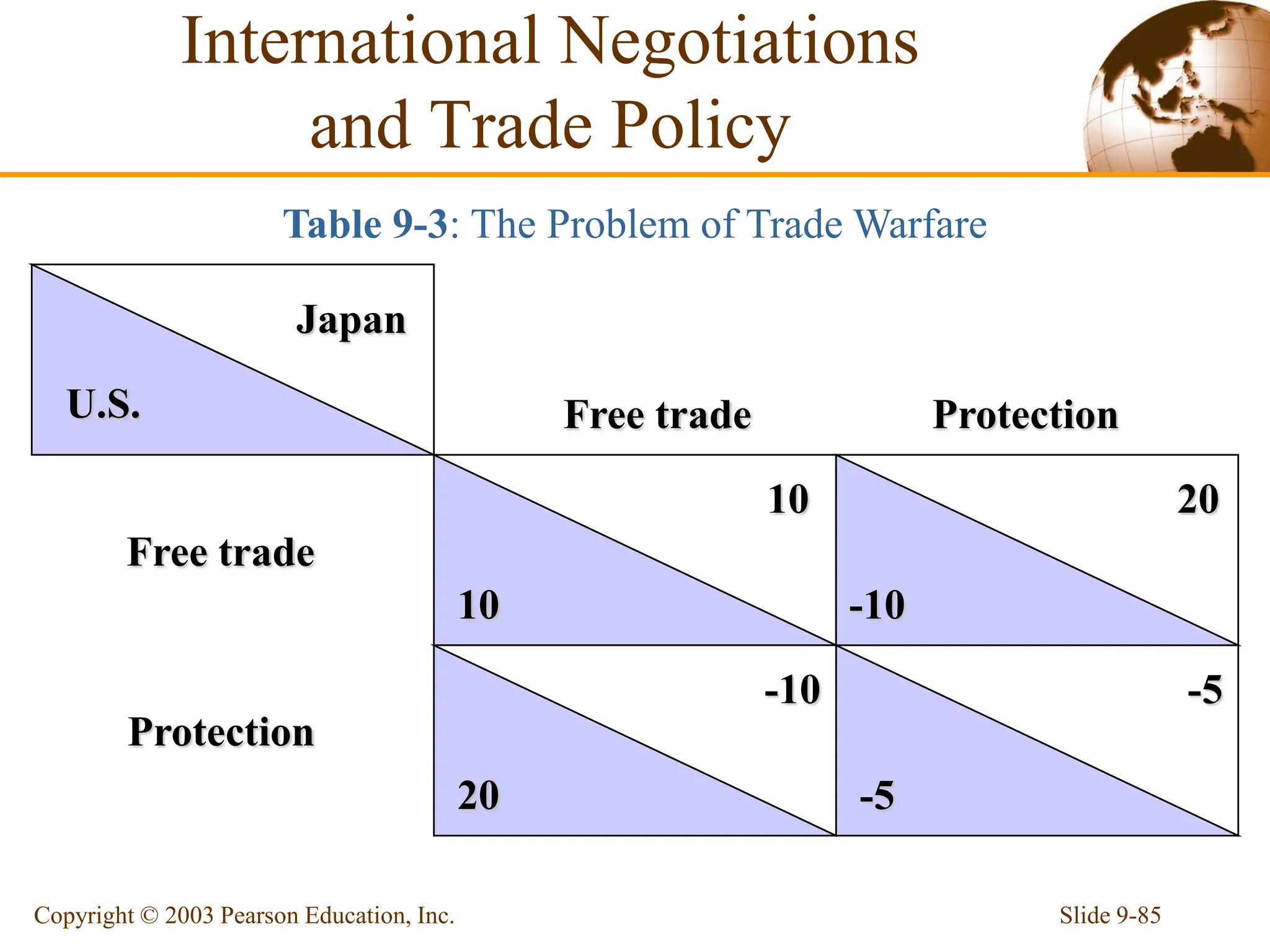
Japan
U.S.
10
10
-5
-5
20
-10
20
-10
Free trade
Free trade
Protection
Protection
Table 9-3: The Problem of Trade Warfare
International Negotiations
and Trade Policy
Slide 9-86
Copyright © 2003 Pearson Education, Inc.
 In Table 9-3, each country has a dominant strategy:
Protection.
 Even though each country acting individually would
be better off with protection, they would both be
better off if both chose free trade.
• In game theory, this situation is known as a
Prisoner’s dilemma.
• Japan and the U.S. can establish a binding agreement
to maintain free trade.
International Negotiations
and Trade Policy
Slide 9-87
Copyright © 2003 Pearson Education, Inc.
 International Trade Agreements: A Brief History
• Internationally coordinated tariff reduction as a trade
policy dates back to the 1930s (the Smoot-Hawley
Act).
• The multilateral tariff reductions since World War II
have taken place under the General Agreement on
Tariffs and Trade (GATT), established in 1947 and
located in Geneva.
– It is now called the World Trade Organization
(WTO).
– The GATT-WTO system is a legal organization that
embodies a set of rules of conduct for international trade
policy.
International Negotiations
and Trade Policy
Slide 9-88
Copyright © 2003 Pearson Education, Inc.
• The GATT-WTO system prohibits the imposition of:
– Export Subsidies (except for agricultural products)
– Import quotas (except when imports threaten “market
disruption”)
– Tariffs (any new tariff or increase in a tariff must be
offset by reductions in other tariffs to compensate the
affected exporting countries)
• Trade round
– A large group of countries get together to negotiate a set
of tariff reductions and other measures to liberalize
trade.
International Negotiations
and Trade Policy
Slide 9-89
Copyright © 2003 Pearson Education, Inc.
• Eight trade rounds have occurred since 1947:
– The first five of these took the form of “parallel”
bilateral negotiations (e.g., Germany with France and
Italy).
– The sixth multilateral trade agreement, known as the
Kennedy Round, was completed in 1967:
– This agreement involved an across-the-board 50% reduction in
tariffs by the major industrial countries, except for specified
industries whose tariffs were left unchanged.
– Overall, the Kennedy Round reduced average tariffs by about
35%.
International Negotiations
and Trade Policy
Slide 9-90
Copyright © 2003 Pearson Education, Inc.
– The so-called Tokyo round of trade negotiations
(completed in 1979) resulted in:
– Reduced tariffs
– New codes for controlling the proliferation of nontariff
barriers, such as VER’s.
– An eighth round of negotiations, the so-called Uruguay
Round, was competed in 1994.
International Negotiations
and Trade Policy
Slide 9-91
Copyright © 2003 Pearson Education, Inc.
 The Uruguay Round
• Its most important results are:
– Trade liberalization
– Administrative reforms
 Trade Liberalization
• The average tariff imposed by advanced countries decreased by
almost 40%.
– More important is the move to liberalize trade in two important
sectors: agricultural and clothing.
 From the GATT to the WTO
• Much of the publicity surrounding the Uruguay Round focused
on its creation of the WTO.
International Negotiations
and Trade Policy
Slide 9-92
Copyright © 2003 Pearson Education, Inc.
• How different is the WTO from the GATT?
– The GATT was a provisional agreement, while the WTO
is a full-fledged international organization.
– The GATT applied only to trade in goods, while the
WTO included rules on trade in services (the General
Agreement on Trade in Services (GATS)) and on
international application of international property rights.
– The WTO has a new “dispute settlement” procedure
which is designed to reach judgments in a much shorter
time.
International Negotiations
and Trade Policy
Slide 9-93
Copyright © 2003 Pearson Education, Inc.
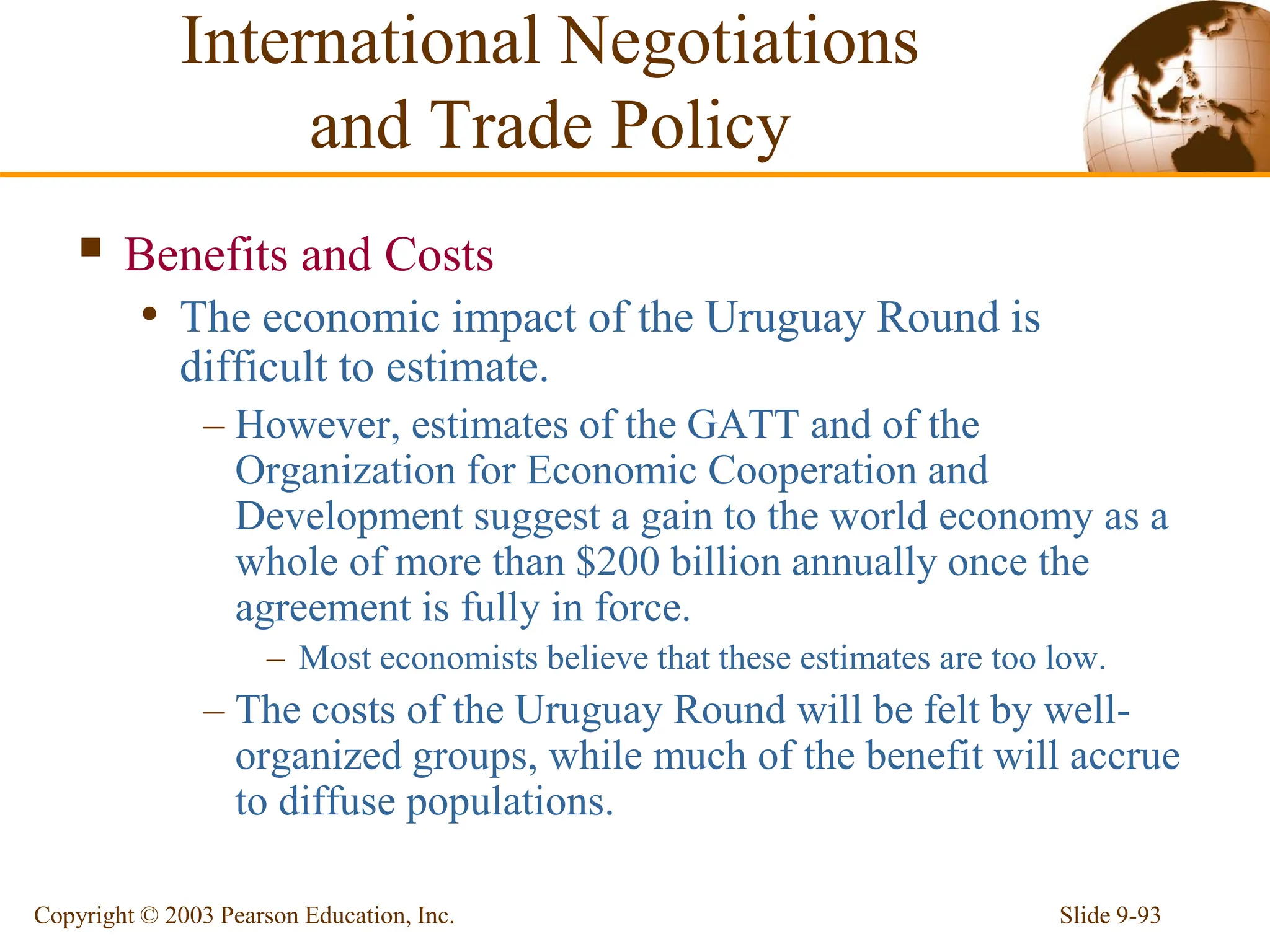
 Benefits and Costs
• The economic impact of the Uruguay Round is
difficult to estimate.
– However, estimates of the GATT and of the
Organization for Economic Cooperation and
Development suggest a gain to the world economy as a
whole of more than $200 billion annually once the
agreement is fully in force.
– Most economists believe that these estimates are too low.
– The costs of the Uruguay Round will be felt by well-
organized groups, while much of the benefit will accrue
to diffuse populations.
International Negotiations
and Trade Policy
Slide 9-94
Copyright © 2003 Pearson Education, Inc.
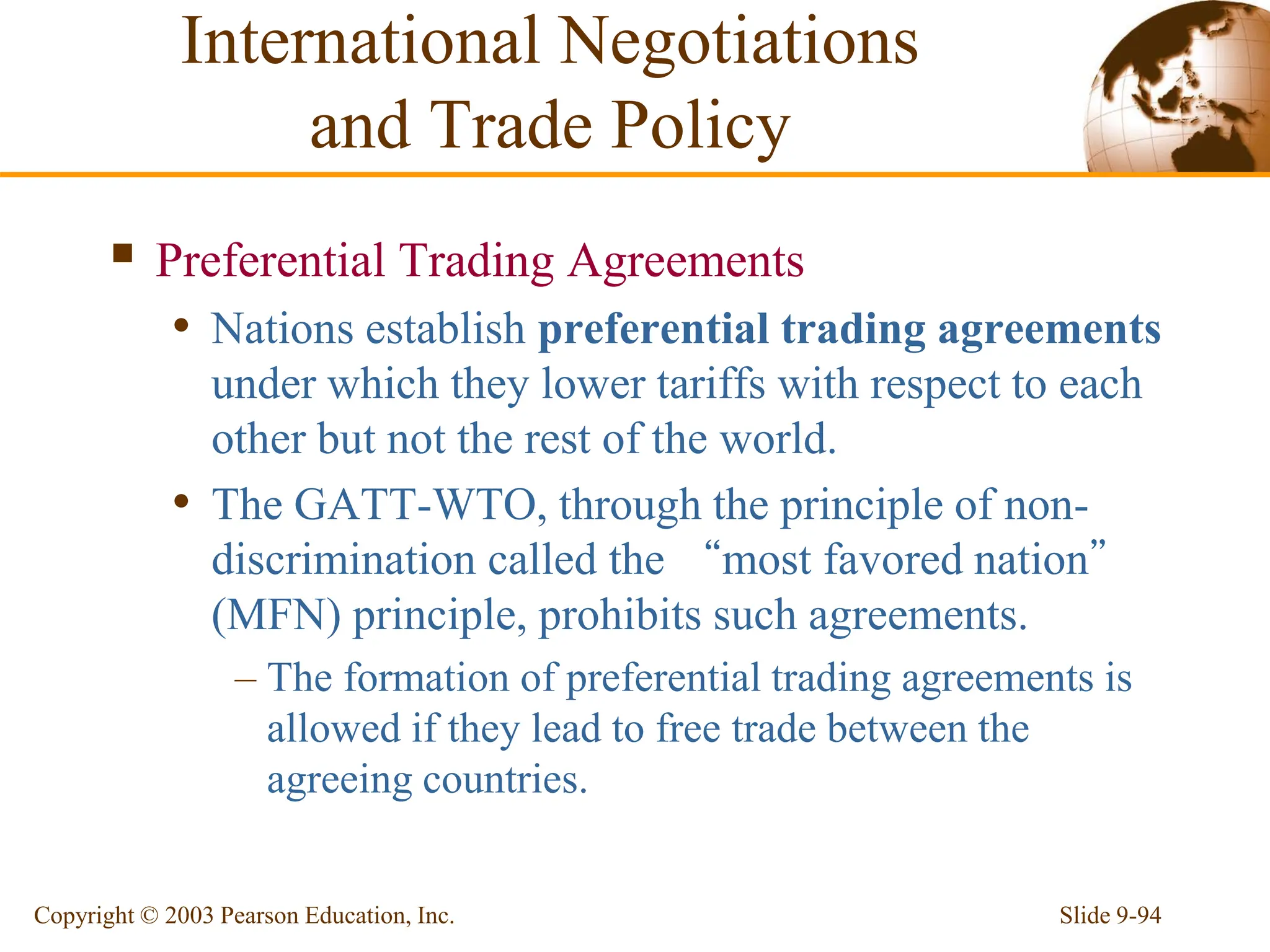
 Preferential Trading Agreements
• Nations establish preferential trading agreements
under which they lower tariffs with respect to each
other but not the rest of the world.
• The GATT-WTO, through the principle of non-
discrimination called the “most favored nation”
(MFN) principle, prohibits such agreements.
– The formation of preferential trading agreements is
allowed if they lead to free trade between the
agreeing countries.
International Negotiations
and Trade Policy
Slide 9-95
Copyright © 2003 Pearson Education, Inc.
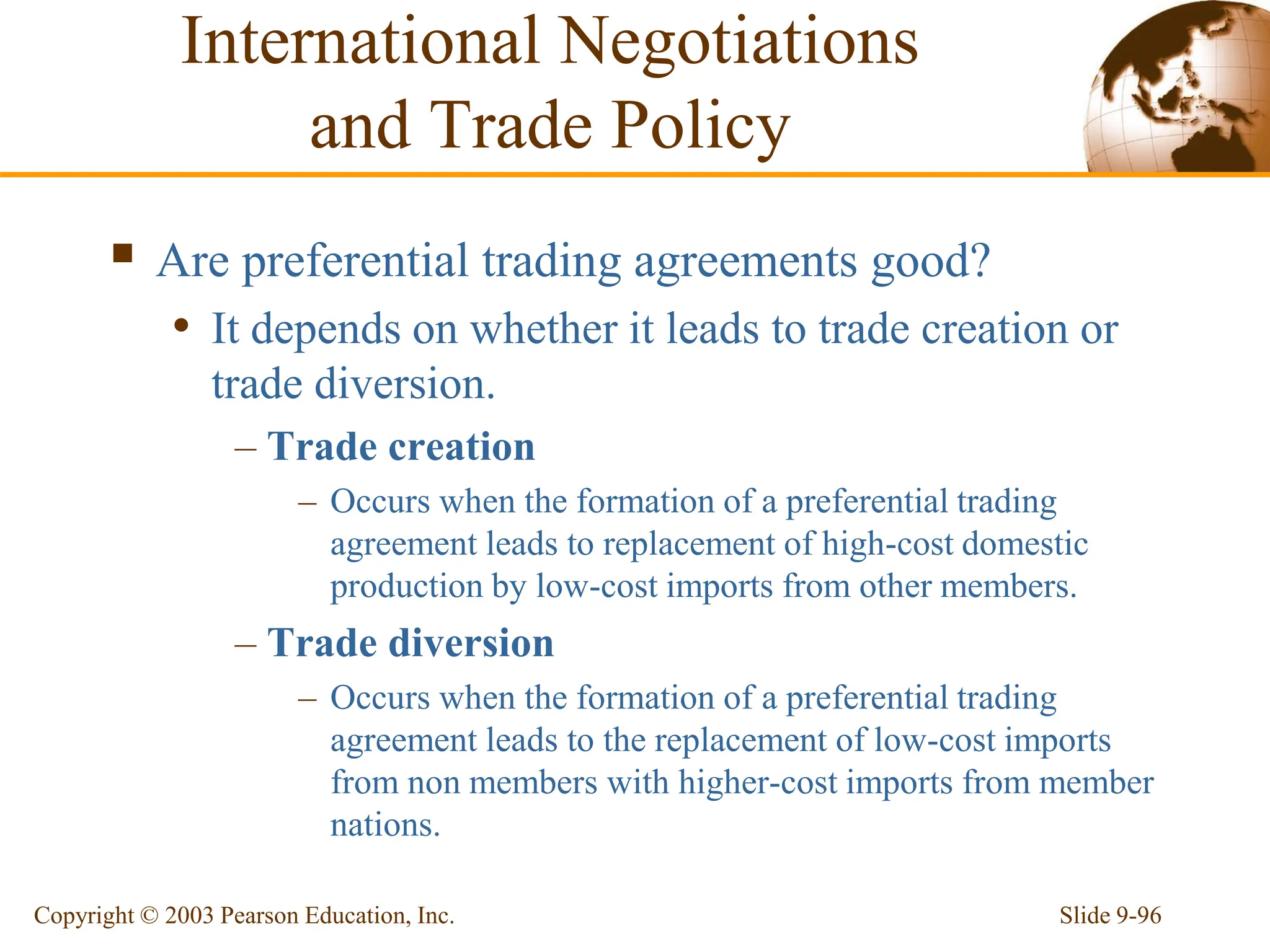
• Free trade can be established among several WTO
members as follows:
– A free trade area allows free-trade among members,
but each member can have its own trade policy
towards non-member countries.
– Example: The North American Free Trade Agreement
(NAFTA) creates a free trade area.
– A customs union allows free trade among members
and requires a common external trade policy towards
non-member countries.
– Example: The European Union (EU) is a full customs
union.
– A common market is a customs union with free
factor movements (especially labor) among members.
International Negotiations
and Trade Policy
Slide 9-96
Copyright © 2003 Pearson Education, Inc.
 Are preferential trading agreements good?
• It depends on whether it leads to trade creation or
trade diversion.
– Trade creation
– Occurs when the formation of a preferential trading
agreement leads to replacement of high-cost domestic
production by low-cost imports from other members.
– Trade diversion
– Occurs when the formation of a preferential trading
agreement leads to the replacement of low-cost imports
from non members with higher-cost imports from member
nations.
International Negotiations
and Trade Policy
Slide 9-97
Copyright © 2003 Pearson Education, Inc.
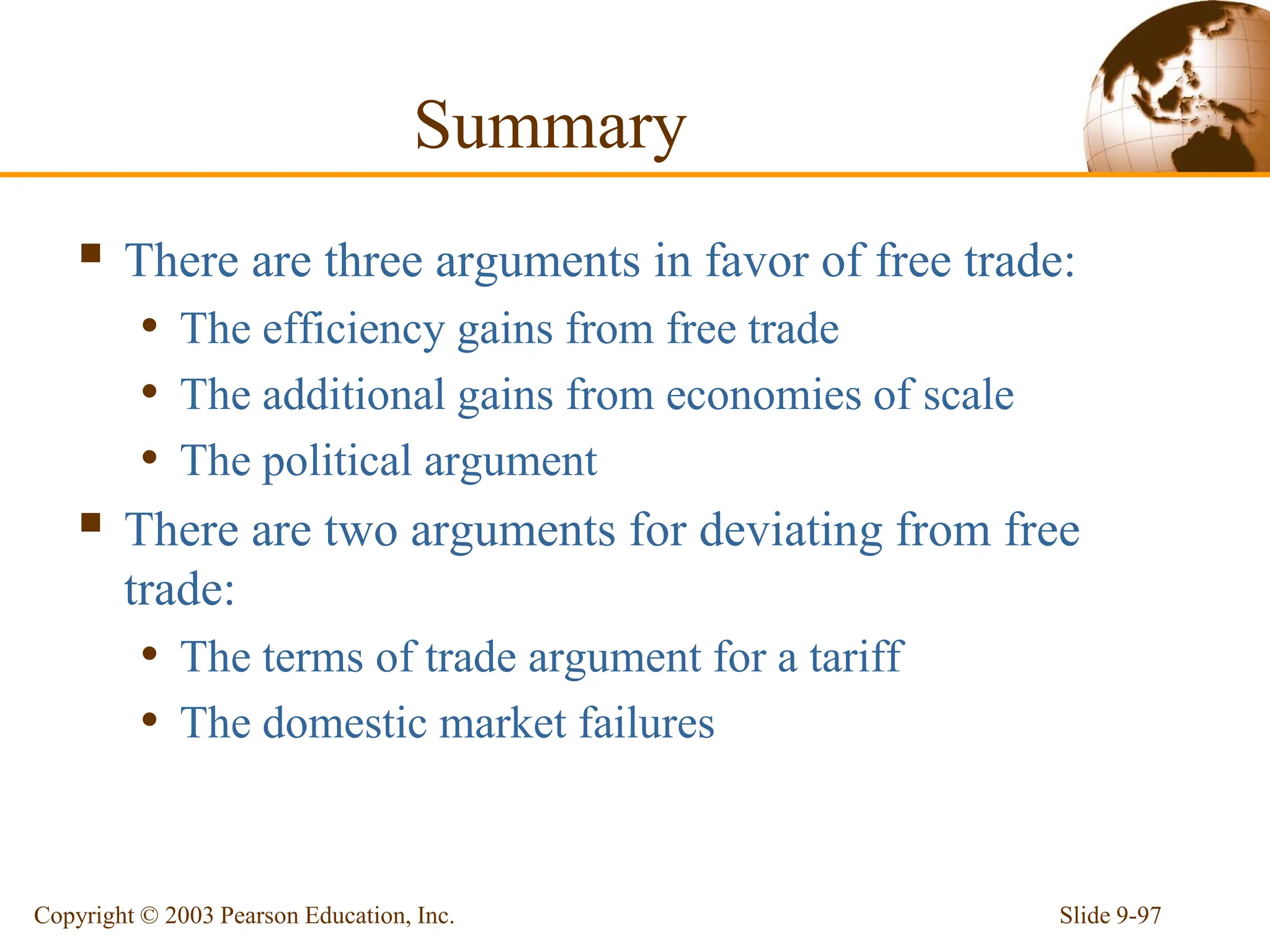
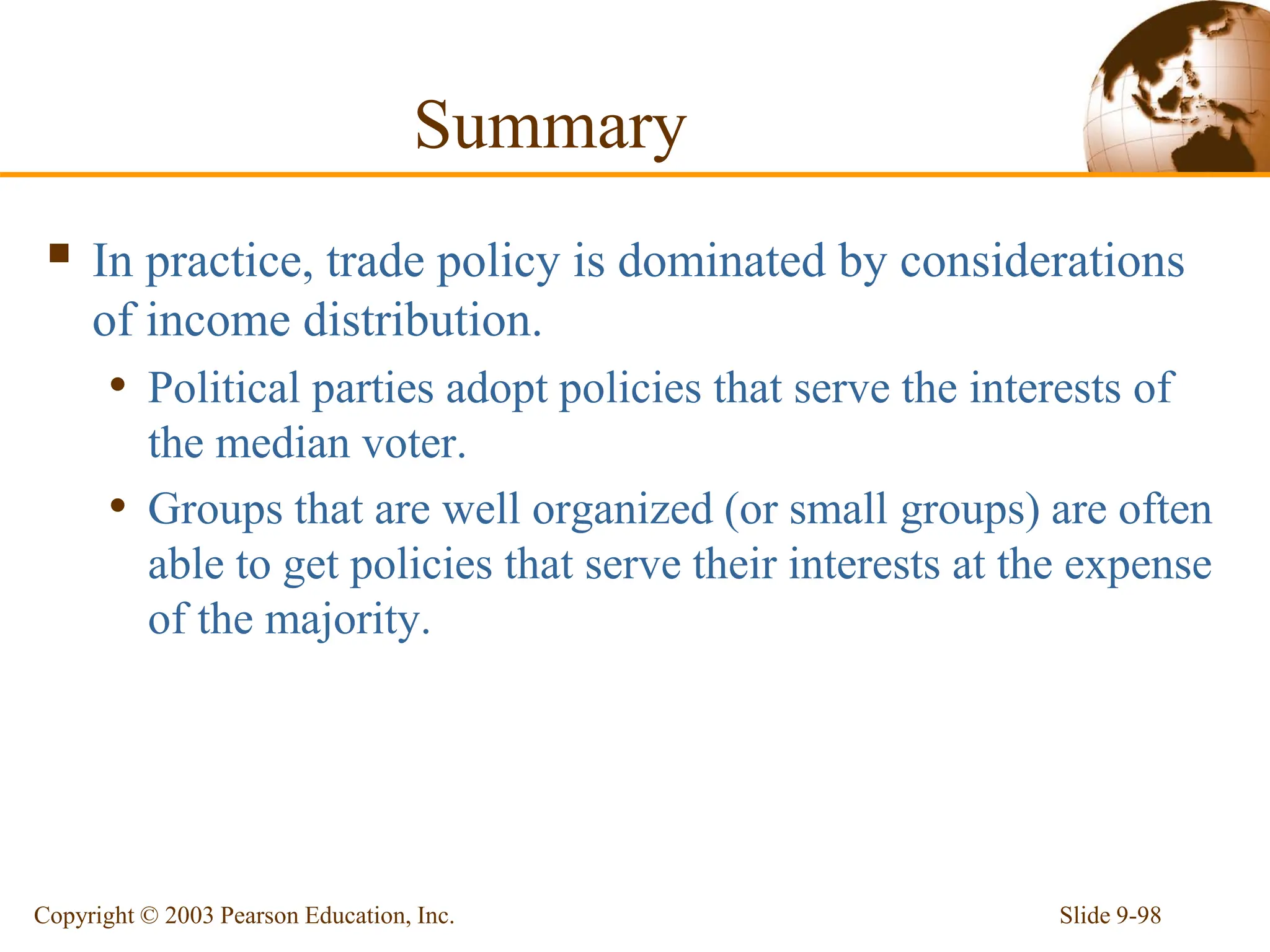
Summary
 There are three arguments in favor of free trade:
• The efficiency gains from free trade
• The additional gains from economies of scale
• The political argument
 There are two arguments for deviating from free
trade:
• The terms of trade argument for a tariff
• The domestic market failures
Slide 9-98
Copyright © 2003 Pearson Education, Inc.
Summary
 In practice, trade policy is dominated by considerations
of income distribution.
• Political parties adopt policies that serve the interests of
the median voter.
• Groups that are well organized (or small groups) are often
able to get policies that serve their interests at the expense
of the majority.
Slide 9-99
Copyright © 2003 Pearson Education, Inc.
Summary
 International negotiation helps reduce tariffs in
industrial countries and avoid trade wars.
 The GATT is the central institution of the international
trading system.
• The most recent worldwide GATT agreement also sets
up a new organization, the WTO.
 Three kinds of preferential trading agreements are
allowed under the WTO: free trade areas, customs
unions, and common markets.
 Preferential trading agreements can be good or bad
depending on the magnitude of trade creation and trade
diversion effects.
Slide 9-100
Copyright © 2003 Pearson Education, Inc.
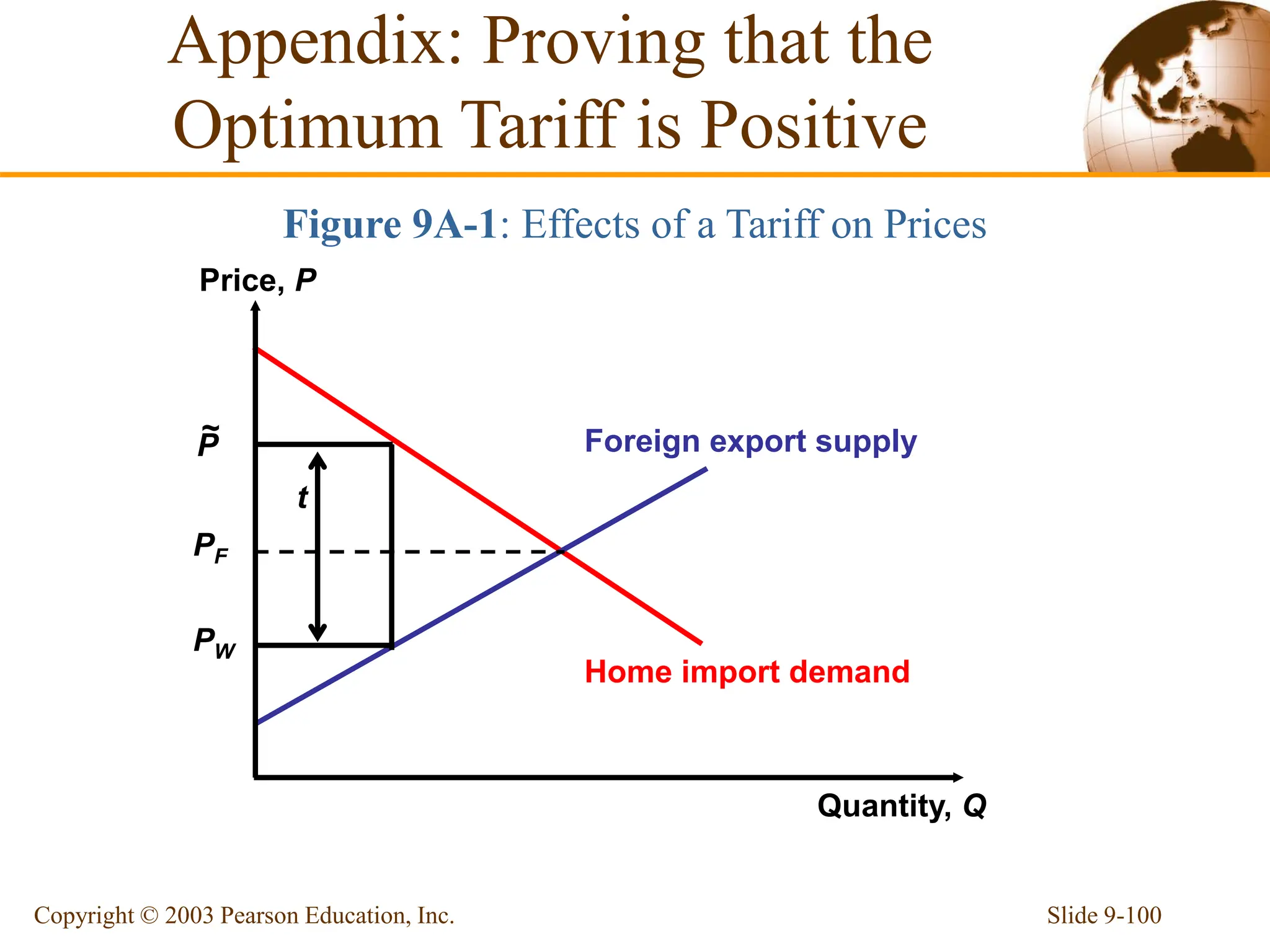
Home import demand
Foreign export supply
PF
Price, P
Quantity, Q
P
~
PW
t
Appendix: Proving that the
Optimum Tariff is Positive
Figure 9A-1: Effects of a Tariff on Prices
Slide 9-101
Copyright © 2003 Pearson Education, Inc.
PF
PW
Price, P
Quantity, Q
S
D
P
~
Gain
Loss
Q1 D1
Q2 D2
Figure 9A-2: Welfare Effects of a Tariff
Appendix: Proving that the
Optimum Tariff is Positive

Class Free Trade Policy presented by case study

  • 1.
    Trade Policy Adolfo YinshiWU, Phd Bachelor’s Program in Interdisciplinary Studies 02/03/2023
  • 2.
    Slide 9-2 Copyright ©2003 Pearson Education, Inc. Week Content 週次 Content 1 (2. 23) New Semester (Spring, 2023) Course Introduction 10 (4. 27) EU & Free Trade 2 (3. 02) Vision of Free Trade 11 (5. 04) Asia & Free Trade 3 (3. 09) Free Trade & Globalization 12 (5. 11) TPP or CPTPP? 4 (3. 16) Trade Blocs & Integration 13 (5. 18) Free Trade Economic Model 1 (Online) 5 (3. 23) WTO & Free Trade 14 (5. 25) Free Trade Economic Model 2 (Online) 6 (3. 30) Free Trade under Fire 15 (6. 01) Free Trade Economic Model 3 (Online) 7 (4. 06) Holiday & Festival 16 (6. 08) Oral Presentation 8 (4. 13) US & Free Trade 17 (6. 15) Oral Presentation 9 (4. 20) Mid-term Exam 18 (6. 22) Independent Study
  • 3.
    Notes  Tarif: protectthe infant industry  Tariff 是一個國家對於另一個國家進口貨品的課稅,通常 會有固定的比例。例如這次川普對中國設定的tariff即為 25%,對於輸入貨品量高達60bn(billion,十億)的進口 額度而言,這意味著一百五十億美元的稅收  VSTax: 政府向人民收取的(取之於民,用之於民)  VAT  Quota 配額  Two things that will be discussed when one product wants to import their goods in foreign market Slide 9-3 Copyright © 2003 Pearson Education, Inc. https://www.businessweekly.com.tw/careers/blog/22297
  • 4.
     Import substitutionindustrialization (ISI) 進口替代 The government helps to support the infant industry, the result of that is the industry loses its competitivity in the world market. Ex: LATM, they don’t think that they need to develop its own industry, they can entirely depend on other foreign countries. Next class: globalization and free trade, read chapter 1. intro. Slide 9-4 Copyright © 2003 Pearson Education, Inc.
  • 5.
    Contents of Lecture What is ”Free Trade”  Free Trade & World System Slide 9-5 Copyright © 2003 Pearson Education, Inc.
  • 6.
     「If aforeign country can supply us with a commodity cheaper than we ourselves can make it, better buy it of them with some part of the produce of our own industry, employed in a way in which we have some advantage.  Adam Smith (1776, 1: 478-9)」 (Graham Dunkley, 2013)  絕對利益;比較利益 comparative advantage
  • 7.
    「Free trade isthe absence of artificial barriers to the free flow of goods and services between countries. There are five types of barrier to trade in goods and services:」 (Graham Dunkley, 2013) Slide 9-7 Copyright © 2003 Pearson Education, Inc.
  • 8.
    Free Market EconomicRationalist (Smith/Ricardo) approach 「Smith (1776), Ricardo (1817), Mill (1848) and other ‘Classical’ economists pioneered the claim that free markets and free trade are beneficial, but were not dogmatic about it; ‘Neo-classical’ economists from the mid-nineteenth century until today greatly rigidifying the doctrine.」 (Graham Dunkley, 2013) Slide 9-8 Copyright © 2003 Pearson Education, Inc.
  • 9.
    Free Trade  「Economistssuch as Bhagwati (1998) and Krugman stoutly defend free trade but query the benefits of free investment, speculative capital and extreme economic deregulation.」 (Graham Dunkley, 2013)
  • 10.
    Free Trade 「Most FreeMarket international economists focus very narrowly on trade, assume materialistic goals and neglect non-economic issues, the almost exclusive target of mainstream trade theory being maximisation of GDP and growth thereof.」 (Graham Dunkley, 2013) Slide 9-10 Copyright © 2003 Pearson Education, Inc.
  • 11.
    Free Trade 「In aclear statement of ‘trade determinism’, former WTO director general, Renato Ruggiero (in Aga Khan, 1998: 22) has stated that ‘Trade liberalisation is not just a recipe for growth, but also for security and peace, as history has shown us.’ 」 (Graham Dunkley, 2013)
  • 12.
    Slide 9-12 Copyright ©2003 Pearson Education, Inc.
  • 13.
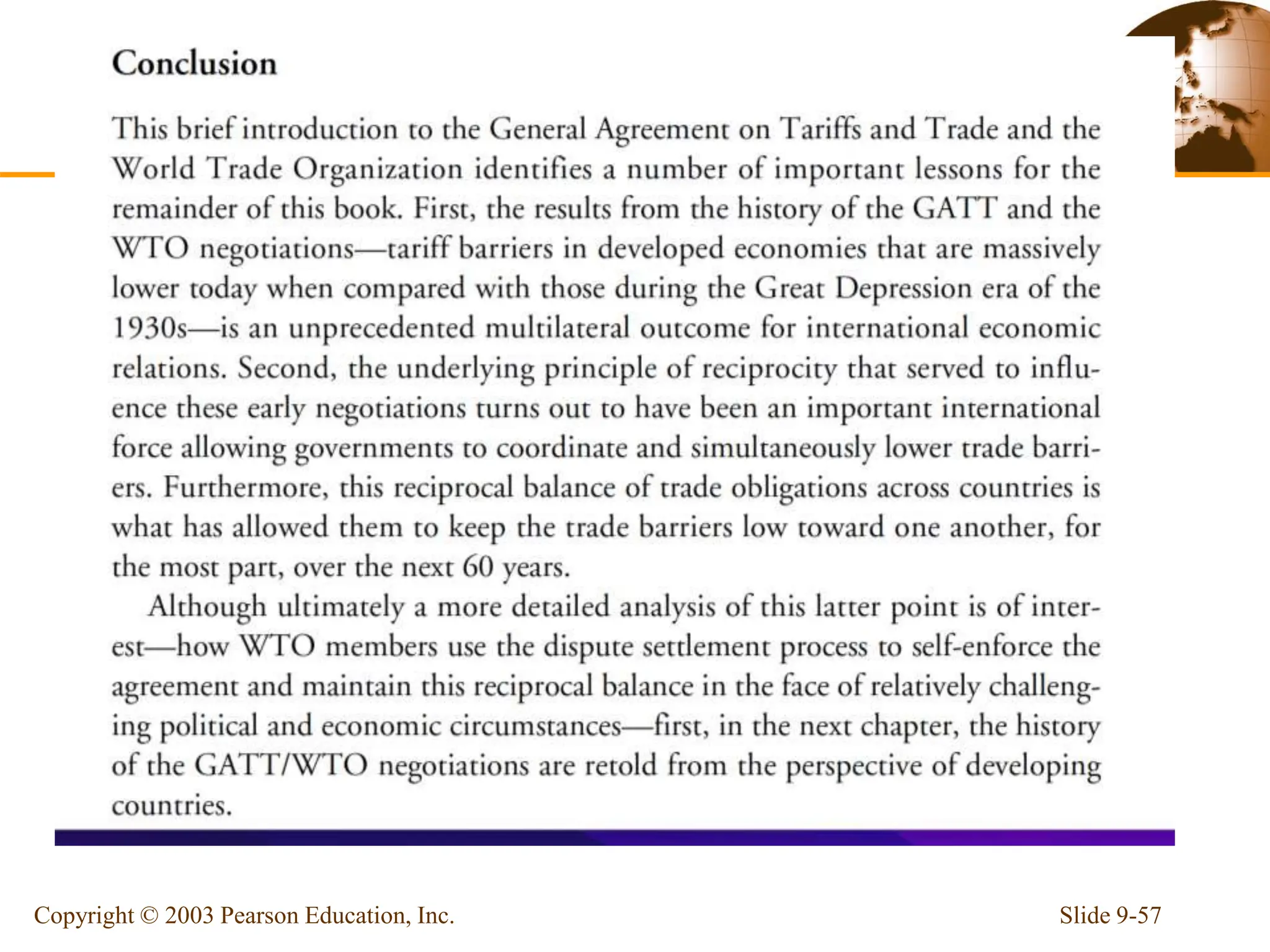
    Free Trade Myths? five myths of Free Trade:  (1) trading is anciently integral to human nature;  (2) free trade, free markets and private initiative are best for most exchange;  (3) ‘comparative advantage’ is the best basis for all exchange of goods and services;  (4) trading and free trade have, on balance, overwhelmingly net positive benefits for all concerned;  (5) the amount of trading has gradually increased over time, indicating inevitable globalism.」(Graham Dunkley, 2013)
  • 14.
    Free Trade Models 1.Free Market Economic Rationalist (Smith/Ricardo) approach 2. Market Interventionist (Keynes/Kaldor) Approach 市場干預 3. Human Development (Marx/Sen) Approach 4. Community-Sovereignty 主權國家 (Gandhi/Schumacher) Approach Slide 9-14 Copyright © 2003 Pearson Education, Inc.
  • 15.
    Free Trade  Freetrade is a policy formed between two or more nations that permits the unlimited import or export of goods or services between partner nations. However, not all trade is free trade. Slide 9-15 Copyright © 2003 Pearson Education, Inc.
  • 16.
    Free Trade  Whennations don't have free trade agreements, which are treaties that outline the parameters of trade between trade partners, tariffs are imposed on goods and services. Tariffs are taxes that nations impose on imports. Tariffs increase the cost of goods, which is passed on to consumers. Slide 9-16 Copyright © 2003 Pearson Education, Inc.
  • 17.
    Global Trade Slide 9-17 Copyright© 2003 Pearson Education, Inc.
  • 18.
    Global Trade Slide 9-18 Copyright© 2003 Pearson Education, Inc.
  • 19.
    Slide 9-19 Copyright ©2003 Pearson Education, Inc.
  • 20.
    Question  Question Explain tworeasons why countries may engage in international trade. Slide 9-20 Copyright © 2003 Pearson Education, Inc.
  • 21.
    Why trade? All tradeis voluntary?? People trade because they believe that they will be better off by trading??
  • 22.
    Why trade?  Differentfactor endowments基金 - some economies are rich in natural resources while others have relatively little.  Increased welfare trade allow countries to gain a higher level of consumption than they would do domestically and this leads to increased welfare and higher living standards. Slide 9-22 Copyright © 2003 Pearson Education, Inc.
  • 23.
    Why trade?  Togain economies of scale - with specialisation and production on a larger scale than may be possible domestically, a country may be able to gain more economies of scale.  Diversity of choice - trade enables us to access goods and services that we may not be able to produce ourselves. Slide 9-23 Copyright © 2003 Pearson Education, Inc.
  • 24.
    Why trade?  Political/ historical reasons - some trade takes place for political and other reasons relating to history and tradition, though this is generally diminishing in importance.  Increased competition - increased global competition may help to spur domestic productivity improvements and give domestic firms a better incentive to innovate and improve their products. Slide 9-24 Copyright © 2003 Pearson Education, Inc.
  • 25.
    Why trade?  Trademay be an 'engine for growth' - increased trade may help to spur greater domestic economic growth and drive further improvements in living standards.  China is not market-oriented? Slide 9-25 Copyright © 2003 Pearson Education, Inc.
  • 26.
    Regional Trade Agreements Slide9-26 Copyright © 2003 Pearson Education, Inc. https://www.wto.org/english/tratop_e/region_e/region_e.htm
  • 27.
    Global Trade Slide 9-27 Copyright© 2003 Pearson Education, Inc.
  • 28.
    Absolute Advantage “The naturaladvantages which one country has over another in producing particular commodities are sometimes so great that it is acknowledged by all the world to be in vain to struggle with them.” Adam Smith in “Wealth of Nations” Book IV, Chapter 2
  • 29.
    Comparative Advantage  DavidRicardo extended the ideas of Adam Smith  Nations could benefit from trade based on comparative advantage, not just absolute advantage  Comparative advantage refers to a country’s ability to produce a good at a lower opportunity cost than another country
  • 30.
    Sources of ComparativeAdvantage  Differences in technology  Differences in climate  Differences in factor endowments • Factors of production – land, labor and capital • Factor intensity – the factor that is used intensively in production • Heckscher-Ohlin model
  • 31.
    Imagine an islandwith only two trees but lots of boats. The islanders produce two goods, coconuts and fish. A nearby island has many trees, but it has very few boats. Initially, there is no contact between the islands. However, a new navigational device will soon allow shipments between the islands. What will happen? Comparative Advantage: Example
  • 32.
     Only twotrees → expensive domestic coconuts before trade  Imported foreign coconuts are cheap  Domestic price of coconuts ↓ with trade  Lots of boats → cheap domestic fish before trade  New export markets for fish increases demand  Domestic price of fish ↑ with trade
  • 33.
     Who caresabout the price of coconuts? • People who own trees (land) • People who climb trees (labor)  Who cares about the price of fish? • People who own boats (capital) • People who sail and fish (labor)
  • 34.
    Who could object? Domesticconsumers benefit. Domestic producers are harmed. Country begins to import and domestic price falls. Domestic price is higher than world price.
  • 35.
  • 36.
    Who could object? Domesticproducers benefit. Domestic consumers are harmed. Country begins to export and domestic price rises. Domestic price is lower than world price.
  • 37.
  • 38.
    Who could object? The total gains from specialization and trade are greater than the losses  But those gains do not necessarily go to the parties who lost welfare because of the trade  The challenge becomes the willingness of “winners” to compensate “losers”
  • 39.
  • 40.
    Tariff  Tax onimported goods or services  Reasons for tariffs • Raise tax revenues • Reduce consumption of the imported good or service  Effect – Price of import rises, “cheaper” domestic goods become more attractive
  • 41.
    Quota  Limits theamount of an imported good allowed into the country  Supply is decreased and price increases  Voluntary Export Restrictions (VER’s) are similar
  • 42.
    Export Subsidy  Governmentfinancial assistance to a firm that allows a firm to sell its product at a reduced price  Benefits and harms • Consumers (both at home and abroad) benefit from lower prices • Foreign producers are harmed because of lower world prices • Taxpayers in the producing country pay the subsidy
  • 43.
    Product Standards  Atype of “hidden” trade barrier  Types of standards • Product safety • Content • Packaging
  • 44.
    Trade Agreements  GeneralAgreement on Trade and Tariffs (GATT) and World Trade Organization (WTO)  Regional trade agreements
  • 45.
    GATT  “Provisional” agreement(1948 – 1994)  Dramatic tariff reductions were negotiated in a series of trade rounds  Grew from 23 to 123 countries
  • 46.
    WTO  WTO createdin the Uruguay trade round  Established in Geneva in 1995  153 member countries  GATT was updated and still forms the legal framework for WTO negotiations on the goods trade
  • 47.
    What is theWTO?  A negotiating forum  A set of rules (international agreements) • GATT • GATS (General Agreement on Trade in Services) • TRIPS (Agreement on Trade-Related Aspects of Intellectual Property Rights)  A place to settle trade disputes
  • 48.
    Regional Trade Agreements Examples include • North American Free Trade Agreement • Association of Southeast Asian Nations • Common Market of the South (MERCOSUR) • European Union  Regional agreements have been praised and criticized
  • 49.
    Slide 9-49 Copyright© 2003 Pearson Education, Inc.  International Trade Agreements: A Brief History • Internationally coordinated tariff reduction as a trade policy dates back to the 1930s (the Smoot-Hawley Act). • The multilateral tariff reductions since World War II have taken place under the General Agreement on Tariffs and Trade (GATT), established in 1947 and located in Geneva. –It is now called the World Trade Organization (WTO). –The GATT-WTO system is a legal organization that embodies a set of rules of conduct for international trade policy. International Negotiations &Trade Policy
  • 50.
    Slide 9-50 Copyright© 2003 Pearson Education, • The GATT-WTO system prohibits the imposition of: – Export Subsidies (except for agricultural products) – Import quotas (except when imports threaten “market disruption”) – Tariffs (any new tariff or increase in a tariff must be offset by reductions in other tariffs to compensate the affected exporting countries) • Trade round – A large group of countries get together to negotiate a set of tariff reductions and other measures to liberalize trade. International Negotiations & Trade Policy
  • 51.
    Trade Rounds Slide 9-51 Copyright© 2003 Pearson Education, Inc.
  • 52.
    Outcome of TradeRounds Slide 9-52 Copyright © 2003 Pearson Education, Inc.
  • 53.
    Slide 9-53 Copyright© 2003 Pearson Education, • Eight trade rounds have occurred since 1947: – The first five of these took the form of “parallel” bilateral negotiations (e.g., Germany with France and Italy). – The sixth multilateral trade agreement, known as the Kennedy Round, was completed in 1967: – This agreement involved an across-the-board 50% reduction in tariffs by the major industrial countries, except for specified industries whose tariffs were left unchanged. – Overall, the Kennedy Round reduced average tariffs by about 35%. International Negotiations and Trade Policy
  • 54.
    Slide 9-54 Copyright© 2003 Pearson Education, Inc. –The so-called Tokyo round of trade negotiations (completed in 1979) resulted in: –Reduced tariffs –New codes for controlling the proliferation of nontariff barriers. –An eighth round of negotiations, the so- called Uruguay Round, was competed in 1994. International Negotiations and Trade Policy
  • 55.
    Slide 9-55 Copyright© 2003 Pearson Education, Inc.  The Uruguay Round • Its most important results are: – Trade liberalization – Administrative reforms  Trade Liberalization • The average tariff imposed by advanced countries decreased by almost 40%. – More important is the move to liberalize trade in two important sectors: agricultural and clothing.  From the GATT to the WTO • Much of the publicity surrounding the Uruguay Round focused on its creation of the WTO. International Negotiations and Trade Policy
  • 56.
    Slide 9-56 Copyright •How different is the WTO from the GATT? – The GATT was a provisional agreement, while the WTO is a full-fledged international organization. – The GATT applied only to trade in goods, while the WTO included rules on trade in services (the General Agreement on Trade in Services (GATS)) and on international application of international property rights. – The WTO has a new “dispute settlement” procedure which is designed to reach judgments in a much shorter time. International Negotiations and Trade Policy
  • 57.
    Slide 9-57 Copyright ©2003 Pearson Education, Inc.
  • 58.
  • 59.
    FREE TRADE &WORLD SYSTEM 02/03/2023 Slide 9-59 Copyright © 2003 Pearson Education, Inc.
  • 60.
    Slide 9-60 Copyright ©2003 Pearson Education, Inc. Introduction  What reasons are there for governments not to interfere with trade? • There are three arguments in favor of free trade: – Free trade and efficiency – Economies of scale in production – Political argument
  • 61.
    Slide 9-61 Copyright ©2003 Pearson Education, Inc.  Free Trade and Efficiency • The efficiency argument for free trade is based on the result that in the case of a small country, free trade is the best policy. – A tariff causes a net loss to the economy. – A move from a tariff equilibrium to free trade eliminates the efficiency loss and increases national welfare. The Case for Free Trade
  • 62.
    Slide 9-62 Copyright ©2003 Pearson Education, Inc. World price plus tariff World price Price, P Quantity, Q S D Consumption distortion Production distortion Figure 9-1: The Efficiency Case for Free Trade The Case for Free Trade
  • 63.
    Slide 9-63 Copyright ©2003 Pearson Education, Inc. PF PW Price, P Quantity, Q S D P ~ Gain Loss Q1 D1 Q2 D2 Figure 9A-2: Welfare Effects of a Tariff Appendix: Proving that the Optimum Tariff is Positive
  • 64.
    Slide 9-64 Copyright ©2003 Pearson Education, Inc.  Additional Gains from Free Trade • Protected markets in small countries do not allow firms to exploit scale economies. – Example: In the auto industry, an efficient scale assembly should make a minimum of 80,000 cars per year. – In Argentina, 13 firms produced a total of 166,000 cars per year. • The presence of scale economies favors free trade that generates more varieties and results in lower prices. • Free trade, as opposed to “managed” trade, provides a wider range of opportunities and thus a wider scope for innovation. The Case for Free Trade
  • 65.
    Slide 9-65 Copyright ©2003 Pearson Education, Inc.  Political Argument for Free Trade • A political commitment to free trade may be a good idea in practice. • Trade policies in practice are dominated by special- interest politics rather than consideration of national costs and benefits. The Case for Free Trade
  • 66.
    Slide 9-66 Copyright ©2003 Pearson Education, Inc.  Activist trade policies can sometimes increase the welfare of the nation as a whole.  There are two theoretical arguments against the policy of free trade: • The terms of trade argument for a tariff • The domestic market failure National Welfare Arguments Against Free Trade
  • 67.
    Slide 9-67 Copyright ©2003 Pearson Education, Inc.  The Terms of Trade Argument for a Tariff • For a large country (that is, a country that can affect the world price through trading), a tariff lowers the price of imports and generates a terms of trade benefit. – This benefit must be compared to the costs of the tariff (production and consumption distortions). • It is possible that the terms of trade benefits of a tariff outweigh its costs. – Therefore, free trade might not be the best policy for a large country. National Welfare Arguments Against Free Trade
  • 68.
    Slide 9-68 Copyright ©2003 Pearson Education, Inc. 1 National welfare Tariff rate Optimum tariff, to Prohibitive tariff rate, tp Figure 9-2: The Optimum Tariff National Welfare Arguments Against Free Trade
  • 69.
    Slide 9-69 Copyright ©2003 Pearson Education, Inc. • Optimum tariff – The tariff rate that maximizes national welfare – It is always positive but less than the prohibitive rate that would eliminate all imports. – It is zero for a small country because it cannot affect its terms of trade. National Welfare Arguments Against Free Trade
  • 70.
    Slide 9-70 Copyright ©2003 Pearson Education, Inc. • What policy would the terms of trade argument dictate for export sectors? – An export subsidy worsens the terms of trade, and therefore unambiguously reduces national welfare. – Therefore, the optimal policy in export sectors must be a negative subsidy, that is, a tax on exports. – Like the optimum tariff, the optimum export tax is always positive but less than the prohibitive tax that would eliminate exports completely. National Welfare Arguments Against Free Trade
  • 71.
    Slide 9-71 Copyright ©2003 Pearson Education, Inc.  The Domestic Market Failure Argument Against Free Trade • Producer and consumer surplus do not properly measure social costs and benefits. – Consumer and producer surplus ignore domestic market failures such as: – Unemployment or underemployment of labor – Technological spillovers from industries that are new or particularly innovative – Environmental externalities • A tariff may raise welfare if there is a marginal social benefit to production of a good that is not captured by producer surplus measures. National Welfare Arguments Against Free Trade
  • 72.
    Slide 9-72 Copyright ©2003 Pearson Education, Inc. c a b S1 S1 S2 S2 D2 D1 PW + t PW Price, P Quantity, Q Dollars Quantity, Q S D (a) (b) Figure 9-3: The Domestic Market Failure Argument for a Tariff National Welfare Arguments Against Free Trade Marginal social benefit
  • 73.
    Slide 9-73 Copyright ©2003 Pearson Education, Inc. • The domestic market failure argument against free trade is a particular case of the theory of the second best. – The theory of the second best states that a hands-off policy is desirable in any one market only if all other markets are working properly. – If one market fails to work properly, a government intervention may actually increase welfare. National Welfare Arguments Against Free Trade
  • 74.
    Slide 9-74 Copyright ©2003 Pearson Education, Inc.  How Convincing Is the Market Failure Argument? • The are two basic arguments in defense of free trade in the presence of domestic distortions: – Domestic distortions should be corrected with domestic (as opposed to international trade) policies. – Example: A domestic production subsidy is superior to a tariff in dealing with a production-related market failure. – Market failures are hard to diagnose and measure. – Example: A tariff to protect urban industrial sectors will generate social benefits, but it will also encourage migration to these sectors that will result in higher unemployment. National Welfare Arguments Against Free Trade
  • 75.
    Slide 9-75 Copyright ©2003 Pearson Education, Inc.  In practice, trade policy is dominated by income distribution considerations. • The desires of individuals get more or less imperfectly reflected in the objectives of government. – There exist models in which governments try to maximize political success.  Electoral Competition • Political scientists argue that policies are determined by competition among political parties that try to attract as many votes as possible. Income Distribution and Trade Policy
  • 76.
    Slide 9-76 Copyright ©2003 Pearson Education, Inc. • Assumptions of the model: – There are two competing political parties. – The objective of each party is to get elected. – Each party has to decide on the level of the tariff imposed (this is the only policy available). – Voters differ in the tariff they prefer. • What policies will the two parties promise to follow? – Both parties will offer the same policy consisting of the tariff that the median voter (the voter who is exactly halfway up the lineup) prefers. Income Distribution and Trade Policy
  • 77.
    Slide 9-77 Copyright ©2003 Pearson Education, Inc. Voters Preferred tariff rate Median voter tM tB tA Political support Income Distribution and Trade Policy Figure 9-4: Political Competition
  • 78.
    Slide 9-78 Copyright ©2003 Pearson Education, Inc.  Collective Action • This approach views political activity as a public good. – For instance, the imposition of a tariff protects all firms in an industry, but the lobbying costs for imposing the tariff are covered by only a few firms. • Trade policies that impose total large losses that are spread among many individual firms or consumers may not face opposition. – Industries that are well organized (or have a small number of firms) get protection. Income Distribution and Trade Policy
  • 79.
    Slide 9-79 Copyright ©2003 Pearson Education, Inc.  Modeling the Political Process • Interest groups “buy” policies by offering contributions contingent on the policies followed by the government. Income Distribution and Trade Policy
  • 80.
    Slide 9-80 Copyright ©2003 Pearson Education, Inc.  Who Gets Protected? • Two sectors seem to get protected in advanced countries: – Agriculture – Farmers are well organized and the structure of the U.S. government enhances their political power. – Clothing – Both textiles and apparel have enjoyed substantial protection. This sector employs less skilled workers and it is unionized as well. • Protection is very likely to diminish in the future in both sectors (due to international trade negotiations). Income Distribution and Trade Policy
  • 81.
    Slide 9-81 Copyright ©2003 Pearson Education, Inc. Income Distribution and Trade Policy Table 9-2: Effects of Protection in the United States ($ billion)
  • 82.
    Slide 9-82 Copyright ©2003 Pearson Education, Inc. International Negotiations and Trade Policy  International integration has increased from the mid- 1930s until about 1980 because the United States and other advanced countries gradually removed tariffs and nontariff barriers to trade.
  • 83.
    Slide 9-83 Copyright ©2003 Pearson Education, Inc. Figure 9-5: The U.S. Tariff Rate International Negotiations and Trade Policy
  • 84.
    Slide 9-84 Copyright ©2003 Pearson Education, Inc.  How was the removal of tariffs politically possible? • The postwar liberalization of trade was achieved through international negotiation. – Governments agreed to engage in mutual tariff reduction.  The Advantages of Negotiation • It is easier to lower tariffs as part of a mutual agreement than to do so as a unilateral policy because: – It helps mobilize exporters to support freer trade. – It can help governments avoid getting caught in destructive trade wars. International Negotiations and Trade Policy
  • 85.
    Slide 9-85 Copyright ©2003 Pearson Education, Inc. Japan U.S. 10 10 -5 -5 20 -10 20 -10 Free trade Free trade Protection Protection Table 9-3: The Problem of Trade Warfare International Negotiations and Trade Policy
  • 86.
    Slide 9-86 Copyright ©2003 Pearson Education, Inc.  In Table 9-3, each country has a dominant strategy: Protection.  Even though each country acting individually would be better off with protection, they would both be better off if both chose free trade. • In game theory, this situation is known as a Prisoner’s dilemma. • Japan and the U.S. can establish a binding agreement to maintain free trade. International Negotiations and Trade Policy
  • 87.
    Slide 9-87 Copyright ©2003 Pearson Education, Inc.  International Trade Agreements: A Brief History • Internationally coordinated tariff reduction as a trade policy dates back to the 1930s (the Smoot-Hawley Act). • The multilateral tariff reductions since World War II have taken place under the General Agreement on Tariffs and Trade (GATT), established in 1947 and located in Geneva. – It is now called the World Trade Organization (WTO). – The GATT-WTO system is a legal organization that embodies a set of rules of conduct for international trade policy. International Negotiations and Trade Policy
  • 88.
    Slide 9-88 Copyright ©2003 Pearson Education, Inc. • The GATT-WTO system prohibits the imposition of: – Export Subsidies (except for agricultural products) – Import quotas (except when imports threaten “market disruption”) – Tariffs (any new tariff or increase in a tariff must be offset by reductions in other tariffs to compensate the affected exporting countries) • Trade round – A large group of countries get together to negotiate a set of tariff reductions and other measures to liberalize trade. International Negotiations and Trade Policy
  • 89.
    Slide 9-89 Copyright ©2003 Pearson Education, Inc. • Eight trade rounds have occurred since 1947: – The first five of these took the form of “parallel” bilateral negotiations (e.g., Germany with France and Italy). – The sixth multilateral trade agreement, known as the Kennedy Round, was completed in 1967: – This agreement involved an across-the-board 50% reduction in tariffs by the major industrial countries, except for specified industries whose tariffs were left unchanged. – Overall, the Kennedy Round reduced average tariffs by about 35%. International Negotiations and Trade Policy
  • 90.
    Slide 9-90 Copyright ©2003 Pearson Education, Inc. – The so-called Tokyo round of trade negotiations (completed in 1979) resulted in: – Reduced tariffs – New codes for controlling the proliferation of nontariff barriers, such as VER’s. – An eighth round of negotiations, the so-called Uruguay Round, was competed in 1994. International Negotiations and Trade Policy
  • 91.
    Slide 9-91 Copyright ©2003 Pearson Education, Inc.  The Uruguay Round • Its most important results are: – Trade liberalization – Administrative reforms  Trade Liberalization • The average tariff imposed by advanced countries decreased by almost 40%. – More important is the move to liberalize trade in two important sectors: agricultural and clothing.  From the GATT to the WTO • Much of the publicity surrounding the Uruguay Round focused on its creation of the WTO. International Negotiations and Trade Policy
  • 92.
    Slide 9-92 Copyright ©2003 Pearson Education, Inc. • How different is the WTO from the GATT? – The GATT was a provisional agreement, while the WTO is a full-fledged international organization. – The GATT applied only to trade in goods, while the WTO included rules on trade in services (the General Agreement on Trade in Services (GATS)) and on international application of international property rights. – The WTO has a new “dispute settlement” procedure which is designed to reach judgments in a much shorter time. International Negotiations and Trade Policy
  • 93.
    Slide 9-93 Copyright ©2003 Pearson Education, Inc.  Benefits and Costs • The economic impact of the Uruguay Round is difficult to estimate. – However, estimates of the GATT and of the Organization for Economic Cooperation and Development suggest a gain to the world economy as a whole of more than $200 billion annually once the agreement is fully in force. – Most economists believe that these estimates are too low. – The costs of the Uruguay Round will be felt by well- organized groups, while much of the benefit will accrue to diffuse populations. International Negotiations and Trade Policy
  • 94.
    Slide 9-94 Copyright ©2003 Pearson Education, Inc.  Preferential Trading Agreements • Nations establish preferential trading agreements under which they lower tariffs with respect to each other but not the rest of the world. • The GATT-WTO, through the principle of non- discrimination called the “most favored nation” (MFN) principle, prohibits such agreements. – The formation of preferential trading agreements is allowed if they lead to free trade between the agreeing countries. International Negotiations and Trade Policy
  • 95.
    Slide 9-95 Copyright ©2003 Pearson Education, Inc. • Free trade can be established among several WTO members as follows: – A free trade area allows free-trade among members, but each member can have its own trade policy towards non-member countries. – Example: The North American Free Trade Agreement (NAFTA) creates a free trade area. – A customs union allows free trade among members and requires a common external trade policy towards non-member countries. – Example: The European Union (EU) is a full customs union. – A common market is a customs union with free factor movements (especially labor) among members. International Negotiations and Trade Policy
  • 96.
    Slide 9-96 Copyright ©2003 Pearson Education, Inc.  Are preferential trading agreements good? • It depends on whether it leads to trade creation or trade diversion. – Trade creation – Occurs when the formation of a preferential trading agreement leads to replacement of high-cost domestic production by low-cost imports from other members. – Trade diversion – Occurs when the formation of a preferential trading agreement leads to the replacement of low-cost imports from non members with higher-cost imports from member nations. International Negotiations and Trade Policy
  • 97.
    Slide 9-97 Copyright ©2003 Pearson Education, Inc. Summary  There are three arguments in favor of free trade: • The efficiency gains from free trade • The additional gains from economies of scale • The political argument  There are two arguments for deviating from free trade: • The terms of trade argument for a tariff • The domestic market failures
  • 98.
    Slide 9-98 Copyright ©2003 Pearson Education, Inc. Summary  In practice, trade policy is dominated by considerations of income distribution. • Political parties adopt policies that serve the interests of the median voter. • Groups that are well organized (or small groups) are often able to get policies that serve their interests at the expense of the majority.
  • 99.
    Slide 9-99 Copyright ©2003 Pearson Education, Inc. Summary  International negotiation helps reduce tariffs in industrial countries and avoid trade wars.  The GATT is the central institution of the international trading system. • The most recent worldwide GATT agreement also sets up a new organization, the WTO.  Three kinds of preferential trading agreements are allowed under the WTO: free trade areas, customs unions, and common markets.  Preferential trading agreements can be good or bad depending on the magnitude of trade creation and trade diversion effects.
  • 100.
    Slide 9-100 Copyright ©2003 Pearson Education, Inc. Home import demand Foreign export supply PF Price, P Quantity, Q P ~ PW t Appendix: Proving that the Optimum Tariff is Positive Figure 9A-1: Effects of a Tariff on Prices
  • 101.
    Slide 9-101 Copyright ©2003 Pearson Education, Inc. PF PW Price, P Quantity, Q S D P ~ Gain Loss Q1 D1 Q2 D2 Figure 9A-2: Welfare Effects of a Tariff Appendix: Proving that the Optimum Tariff is Positive