Chapter 2Chapter 2
Thinking Like anThinking Like an
EconomistEconomist
©© 2002 by Nelson, a division of Thomson Canada Limited2002 by Nelson, a division of Thomson Canada Limited
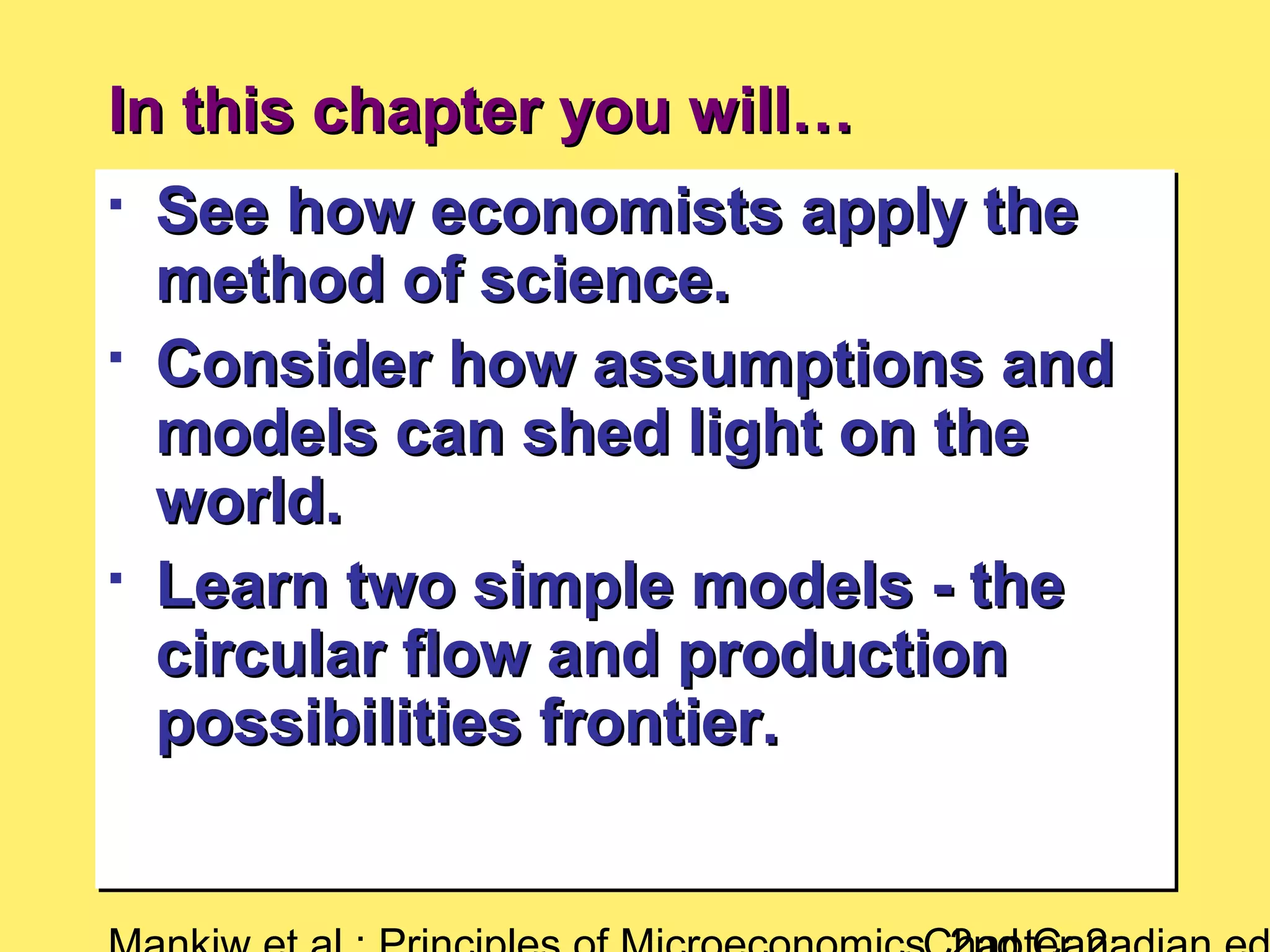
In this chapter you will…In this chapter you will…

See how economists apply theSee how economists apply the
method of science.method of science.

Consider how assumptions andConsider how assumptions and
models can shed light on themodels can shed light on the
world.world.

Learn two simple models - theLearn two simple models - the
circular flow and productioncircular flow and production
possibilities frontier.possibilities frontier.

See how economists apply theSee how economists apply the
method of science.method of science.

Consider how assumptions andConsider how assumptions and
models can shed light on themodels can shed light on the
world.world.

Learn two simple models - theLearn two simple models - the
circular flow and productioncircular flow and production
possibilities frontier.possibilities frontier.
In this chapter you will…In this chapter you will…

Distinguish betweenDistinguish between
microeconomics andmicroeconomics and
macroeconomics.macroeconomics.

Learn the difference between andLearn the difference between and
normative statements.normative statements.

Examine the role of economists inExamine the role of economists in
making policy.making policy.

Consider why economistsConsider why economists
sometimes disagree with onesometimes disagree with one
another.another.

Distinguish betweenDistinguish between
microeconomics andmicroeconomics and
macroeconomics.macroeconomics.

Learn the difference between andLearn the difference between and
normative statements.normative statements.

Examine the role of economists inExamine the role of economists in
making policy.making policy.

Consider why economistsConsider why economists
sometimes disagree with onesometimes disagree with one
another.another.
Thinking Like an EconomistThinking Like an Economist
Every field of study has its own terminology
– Mathematics
• integrals  axioms  vector spaces
– Psychology
• ego  id  cognitive dissonance
– Law
• promissory  estoppels  torts  venues
– Economics
• supply  opportunity cost  elasticity 
consumer surplus  demand 
comparative advantage  deadweight loss
Every field of study has its own terminology
– Mathematics
• integrals  axioms  vector spaces
– Psychology
• ego  id  cognitive dissonance
– Law
• promissory  estoppels  torts  venues
– Economics
• supply  opportunity cost  elasticity 
consumer surplus  demand 
comparative advantage  deadweight loss
Thinking Like an EconomistThinking Like an Economist
Economics trains you to. . . .
– Think in terms of alternatives.
– Evaluate the cost of individual and
social choices.
– Examine and understand how certain
events and issues are related.
Economics trains you to. . . .
– Think in terms of alternatives.
– Evaluate the cost of individual and
social choices.
– Examine and understand how certain
events and issues are related.
THE ECONOMIST AS A SCIENTISTTHE ECONOMIST AS A SCIENTIST
The economic way of thinking . . .
– Involves thinking analytically and
objectively.
– Economists…
• Devise theories
• Collect data
• Analyze the data to verify or refute their
theories
– Economics makes use of the scientific
method.
The economic way of thinking . . .
– Involves thinking analytically and
objectively.
– Economists…
• Devise theories
• Collect data
• Analyze the data to verify or refute their
theories
– Economics makes use of the scientific
method.
The Scientific Method:The Scientific Method:
observation, theory, and moreobservation, theory, and more
observationobservation
• Uses abstract models to help explain how
a complex, real world operates.
• Develops theories, collects, and analyzes
data to evaluate the theories.
• Uses abstract models to help explain how
a complex, real world operates.
• Develops theories, collects, and analyzes
data to evaluate the theories.
The Role of AssumptionsThe Role of Assumptions
• Economists make assumptions in order to
make the world easier to understand.
• The art in scientific thinking is deciding
which assumptions to make.
• Economists use different assumptions to
answer different questions.
• Economists make assumptions in order to
make the world easier to understand.
• The art in scientific thinking is deciding
which assumptions to make.
• Economists use different assumptions to
answer different questions.
Economic ModelsEconomic Models
• Economists use models to simplify
reality in order to improve our
understanding of the world
• Two of the most basic economic
models include:
–The Circular Flow Diagram
–The Production Possibilities
Frontier
• Economists use models to simplify
reality in order to improve our
understanding of the world
• Two of the most basic economic
models include:
–The Circular Flow Diagram
–The Production Possibilities
Frontier
Our First Model: The Circular-FlowOur First Model: The Circular-Flow
DiagramDiagram
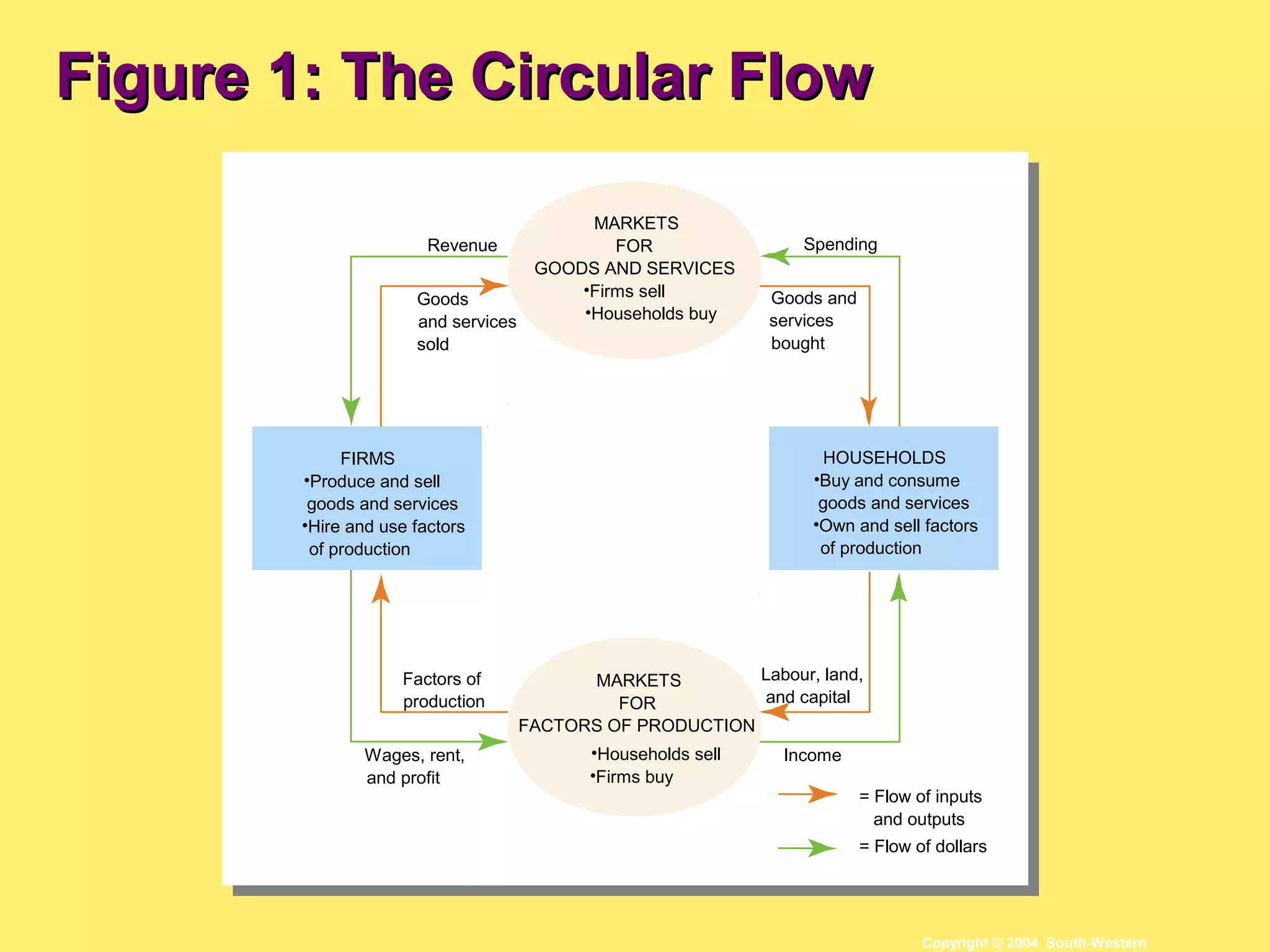
• The circular-flow diagram is a visual model of
the economy that shows how dollars flow
through markets among households and
firms.
• The circular-flow diagram is a visual model of
the economy that shows how dollars flow
through markets among households and
firms.
Figure 1: The Circular FlowFigure 1: The Circular Flow
Copyright © 2004 South-Western
Spending
Goods and
services
bought
Revenue
Goods
and services
sold
Labour, land,
and capital
Income
= Flow of inputs
and outputs
= Flow of dollars
Factors of
production
Wages, rent,
and profit
FIRMS
•Produce and sell
goods and services
•Hire and use factors
of production
•Buy and consume
goods and services
•Own and sell factors
of production
HOUSEHOLDS
•Households sell
•Firms buy
MARKETS
FOR
FACTORS OF PRODUCTION
•Firms sell
•Households buy
MARKETS
FOR
GOODS AND SERVICES
Our First Model: The Circular-FlowOur First Model: The Circular-Flow
DiagramDiagram
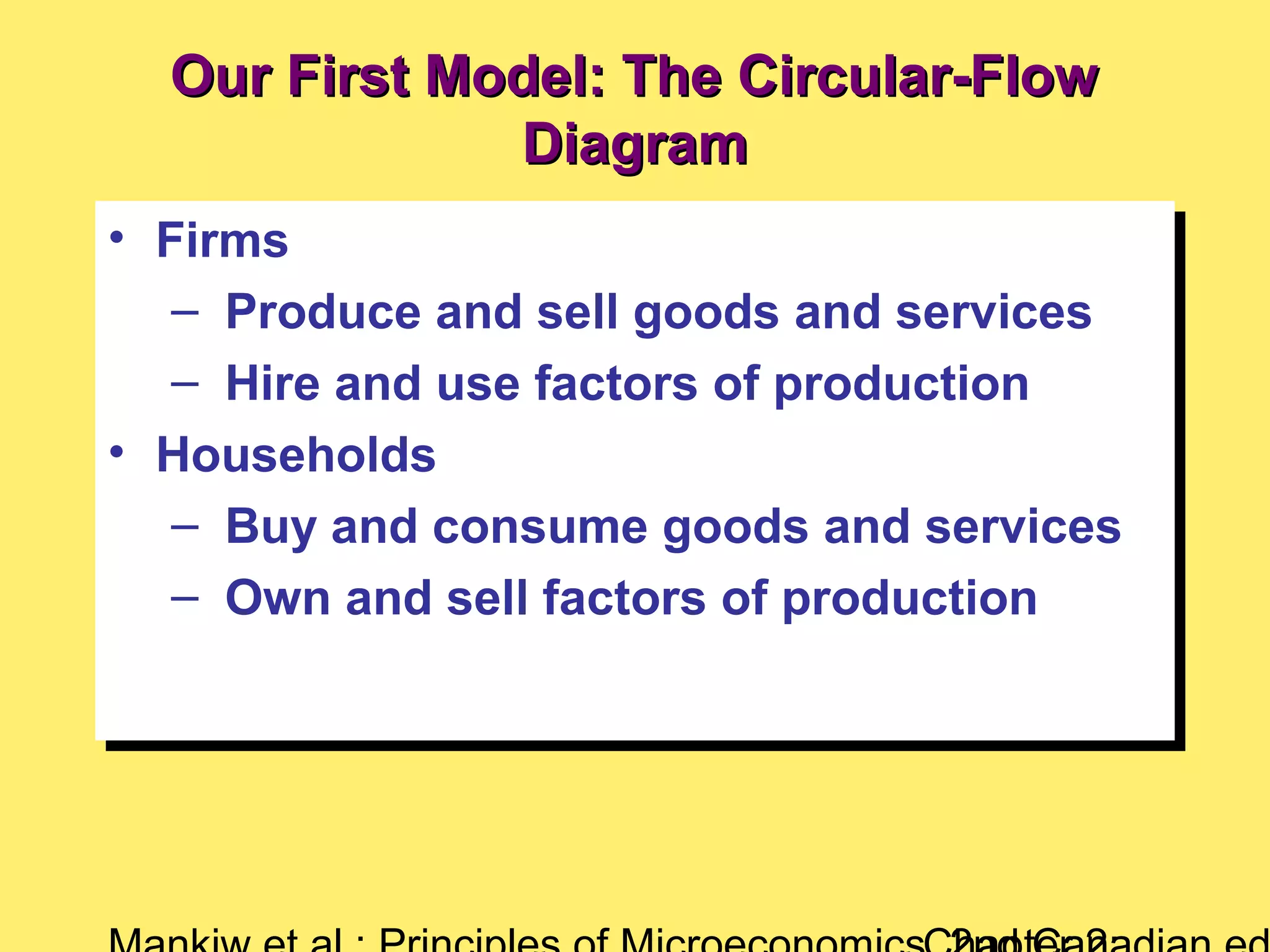
• Firms
– Produce and sell goods and services
– Hire and use factors of production
• Households
– Buy and consume goods and services
– Own and sell factors of production
• Firms
– Produce and sell goods and services
– Hire and use factors of production
• Households
– Buy and consume goods and services
– Own and sell factors of production
Our First Model: The Circular-FlowOur First Model: The Circular-Flow
DiagramDiagram
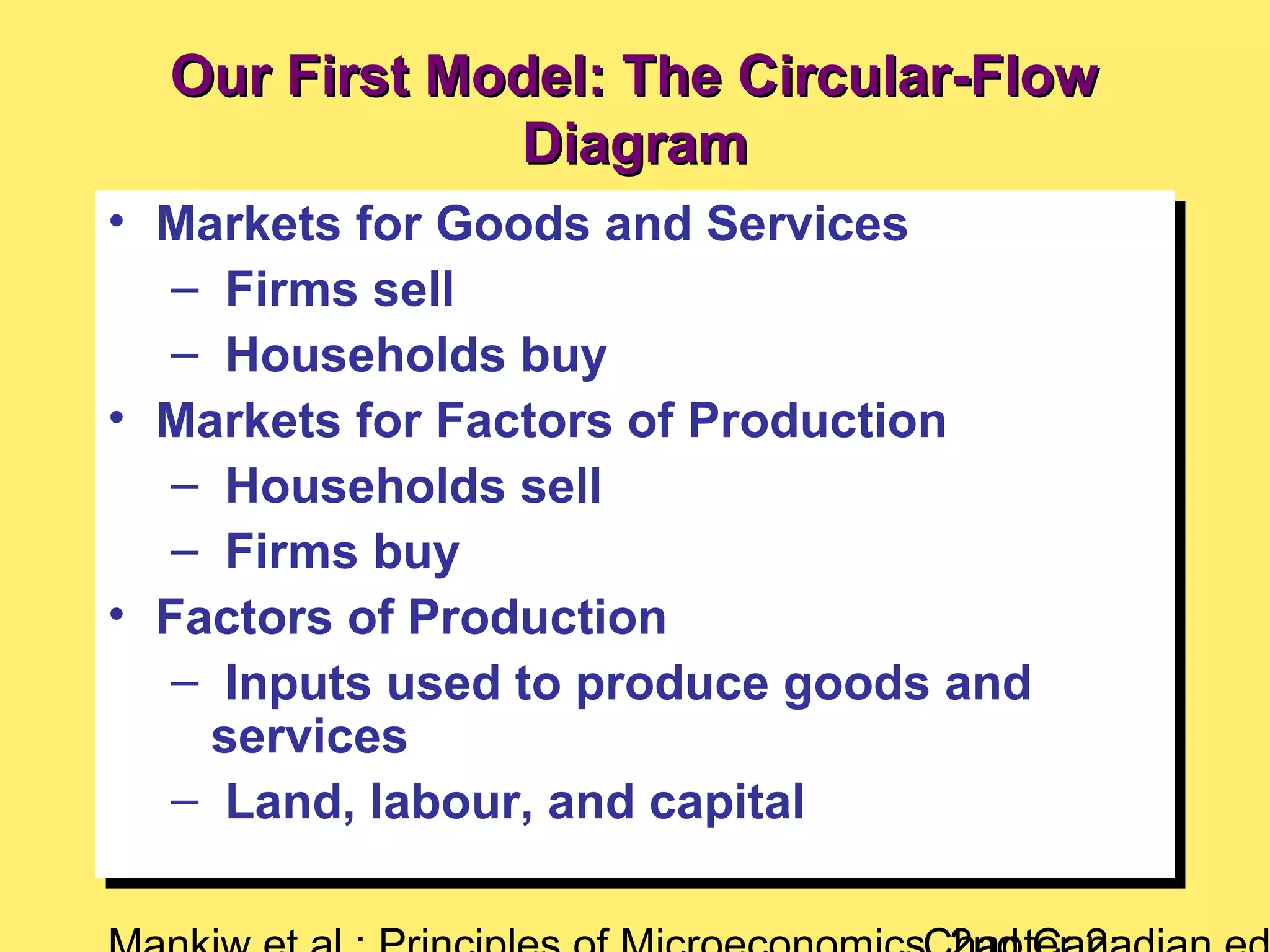
• Markets for Goods and Services
– Firms sell
– Households buy
• Markets for Factors of Production
– Households sell
– Firms buy
• Factors of Production
– Inputs used to produce goods and
services
– Land, labour, and capital
• Markets for Goods and Services
– Firms sell
– Households buy
• Markets for Factors of Production
– Households sell
– Firms buy
• Factors of Production
– Inputs used to produce goods and
services
– Land, labour, and capital
Our Second Model:Our Second Model:
The Production Possibilities FrontierThe Production Possibilities Frontier
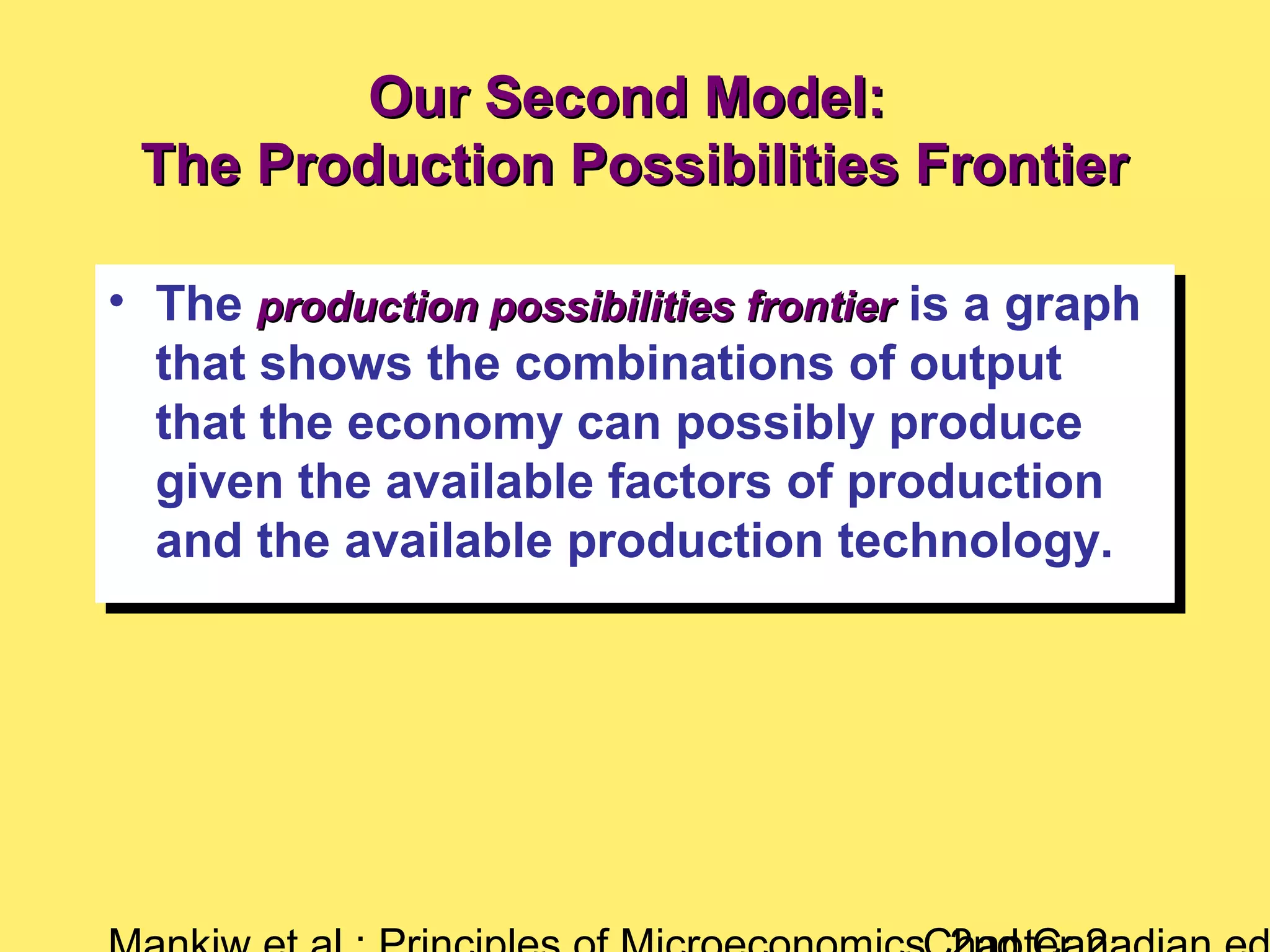
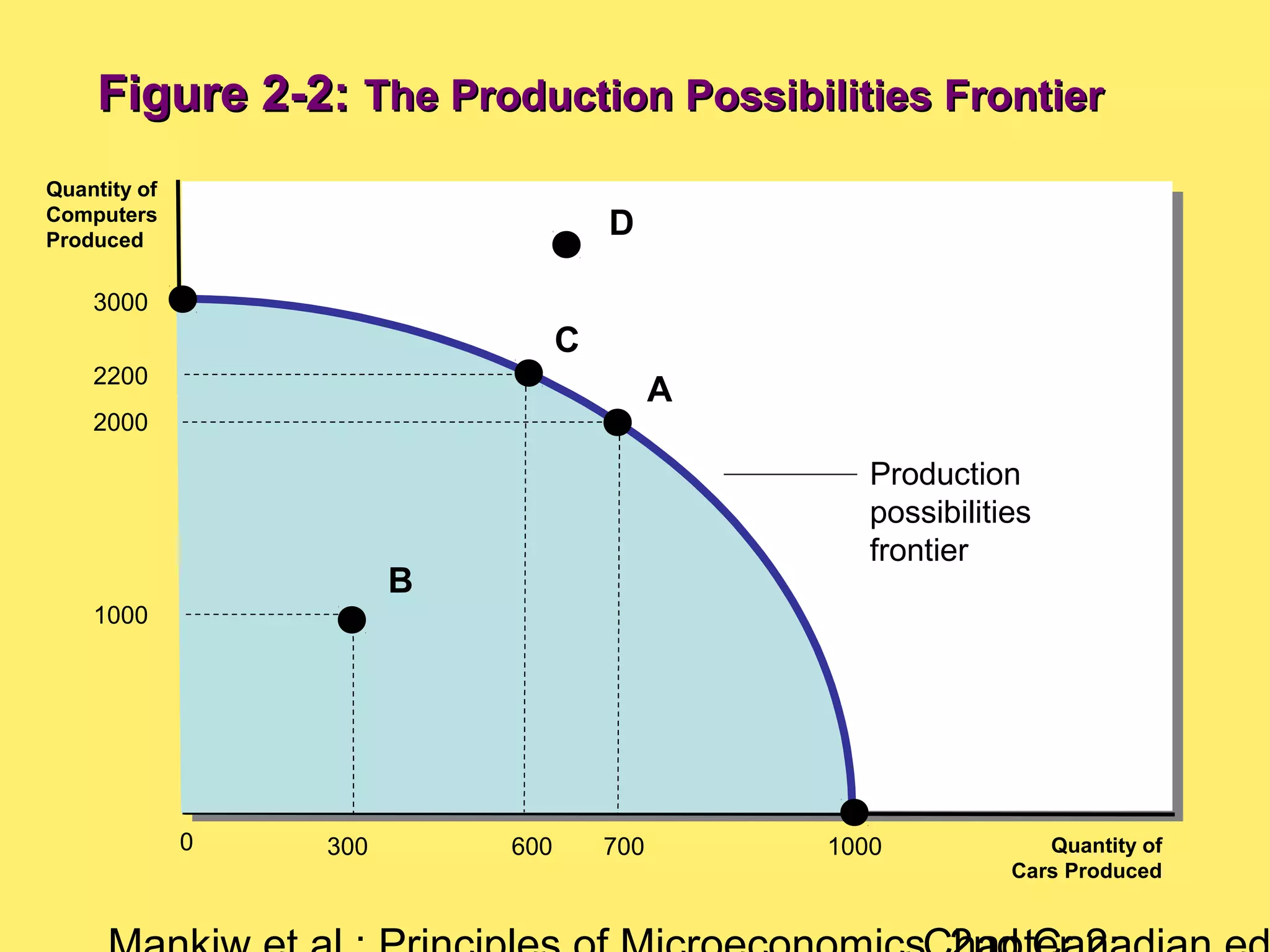
• The production possibilities frontierproduction possibilities frontier is a graph
that shows the combinations of output
that the economy can possibly produce
given the available factors of production
and the available production technology.
• The production possibilities frontierproduction possibilities frontier is a graph
that shows the combinations of output
that the economy can possibly produce
given the available factors of production
and the available production technology.
Quantity of
Computers
Produced
Quantity of
Cars Produced
0
Figure 2-2:Figure 2-2: The Production Possibilities FrontierThe Production Possibilities Frontier
3000
2000
700
A
1000
300
B
2200
600
C
D
1000
Production
possibilities
frontier
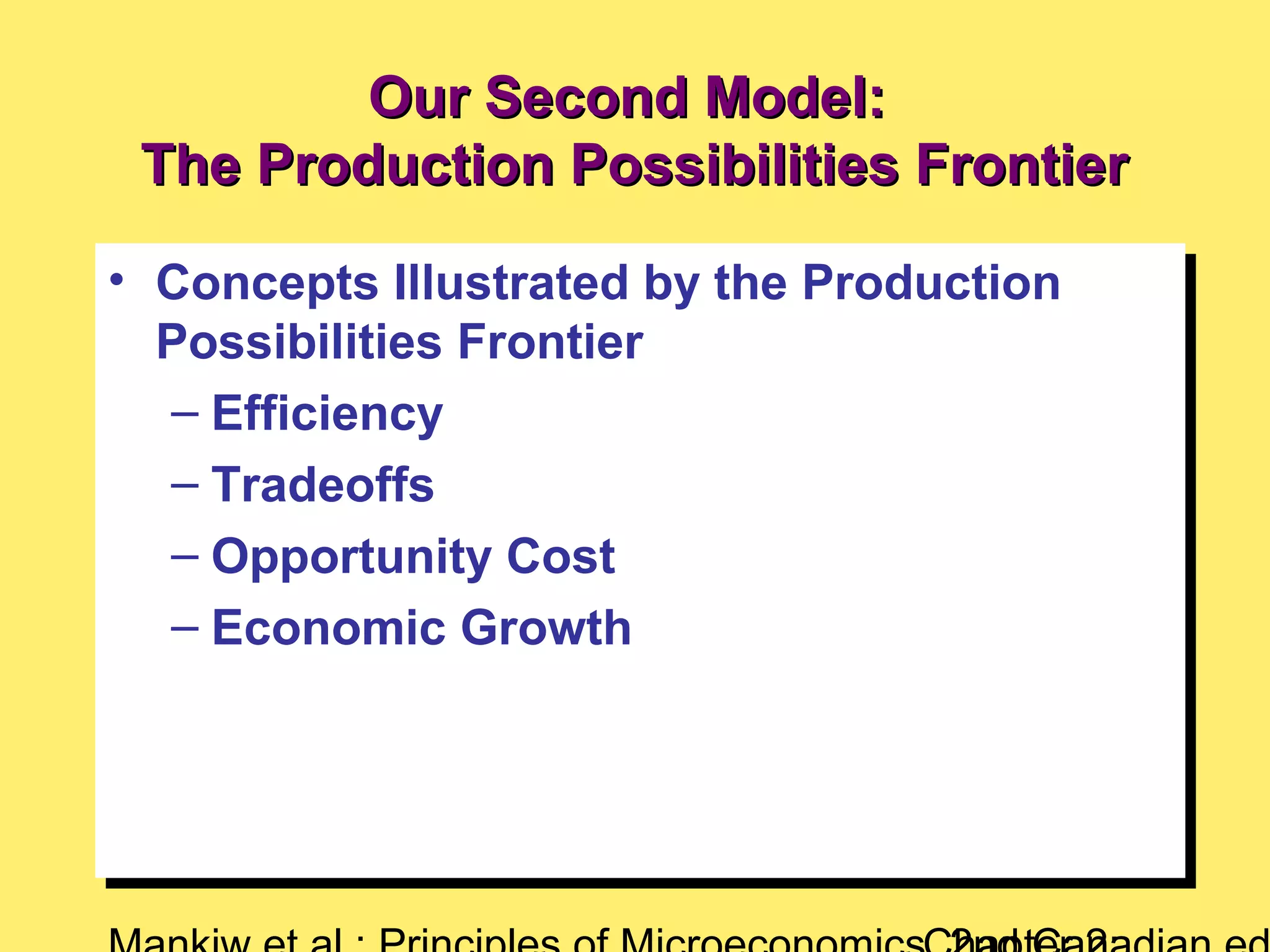
• Concepts Illustrated by the Production
Possibilities Frontier
– Efficiency
– Tradeoffs
– Opportunity Cost
– Economic Growth
• Concepts Illustrated by the Production
Possibilities Frontier
– Efficiency
– Tradeoffs
– Opportunity Cost
– Economic Growth
Our Second Model:Our Second Model:
The Production Possibilities FrontierThe Production Possibilities Frontier
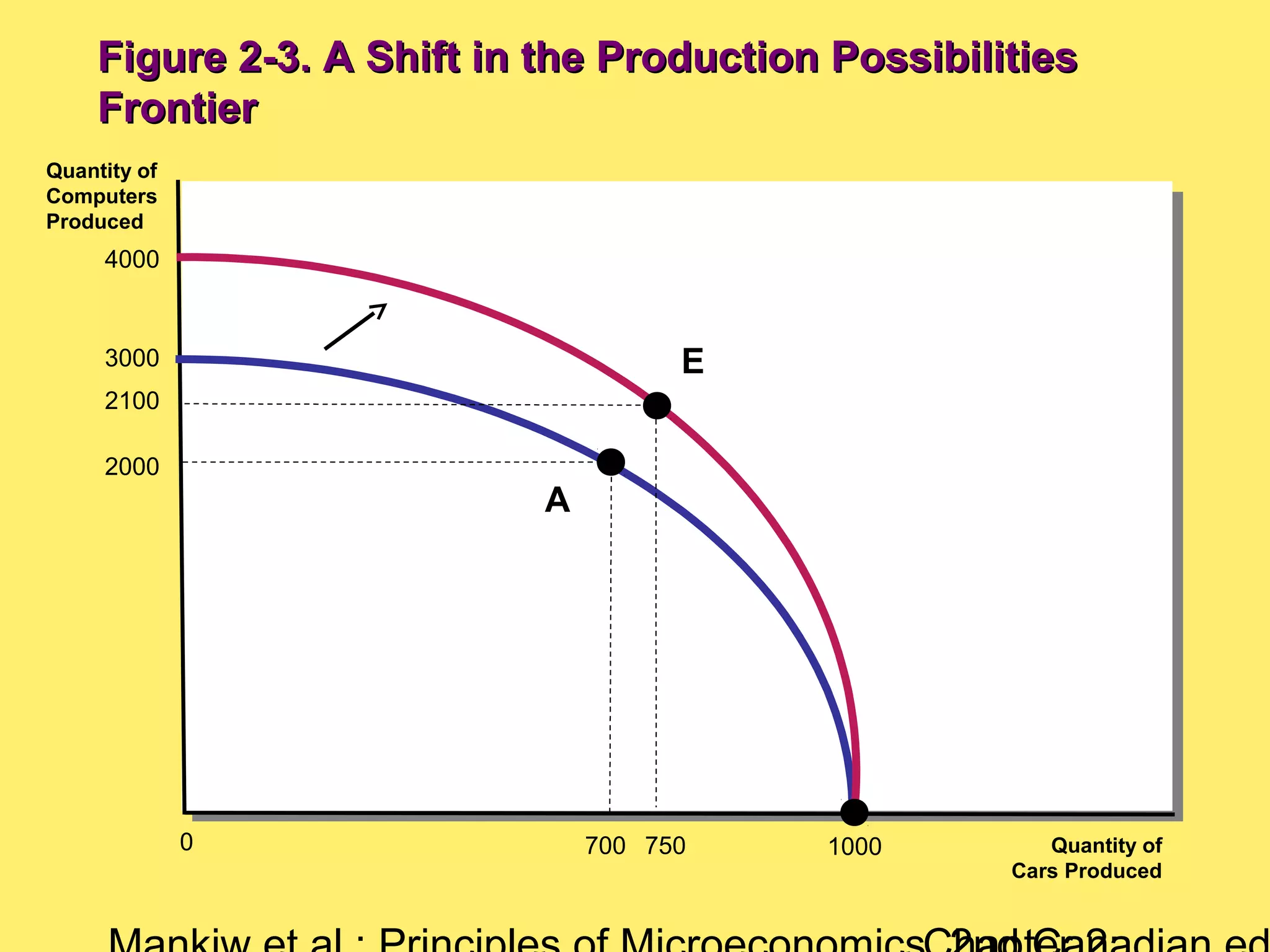
Figure 2-3. A Shift in the Production PossibilitiesFigure 2-3. A Shift in the Production Possibilities
FrontierFrontier
Quantity of
Computers
Produced
Quantity of
Cars Produced
3000
2000
700
A
0
4000
2100
750
E
1000
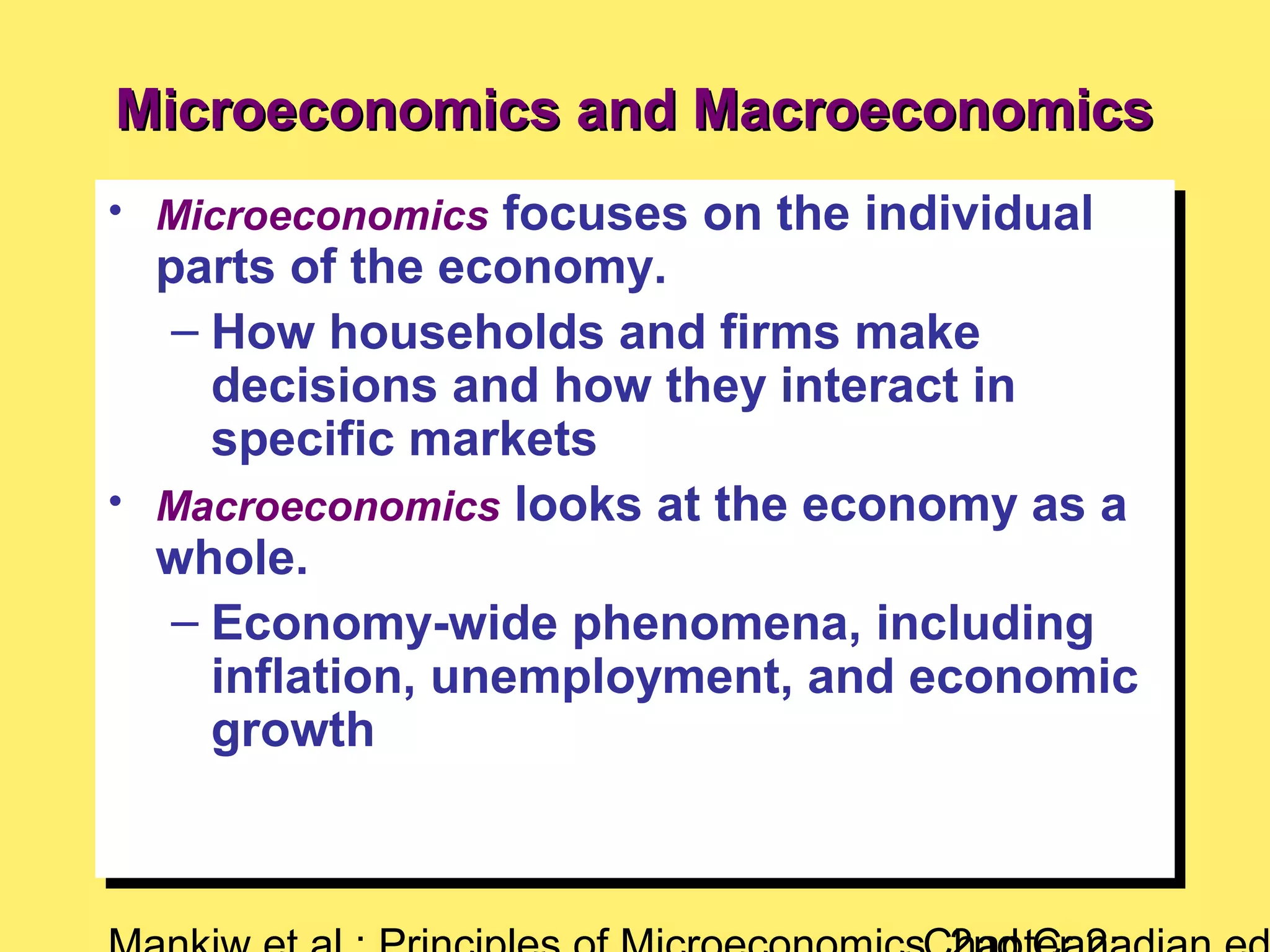
Microeconomics and MacroeconomicsMicroeconomics and Macroeconomics
• Microeconomics focuses on the individual
parts of the economy.
– How households and firms make
decisions and how they interact in
specific markets
• Macroeconomics looks at the economy as a
whole.
– Economy-wide phenomena, including
inflation, unemployment, and economic
growth
• Microeconomics focuses on the individual
parts of the economy.
– How households and firms make
decisions and how they interact in
specific markets
• Macroeconomics looks at the economy as a
whole.
– Economy-wide phenomena, including
inflation, unemployment, and economic
growth
THE ECONOMIST AS POLICYTHE ECONOMIST AS POLICY
ADVISERADVISER
• When economists are trying to explain the
world, they are scientists.
• When economists are trying to change the
world, they are policy advisor.
• When economists are trying to explain the
world, they are scientists.
• When economists are trying to change the
world, they are policy advisor.
PositivePositive VersusVersus Normative StatementsNormative Statements
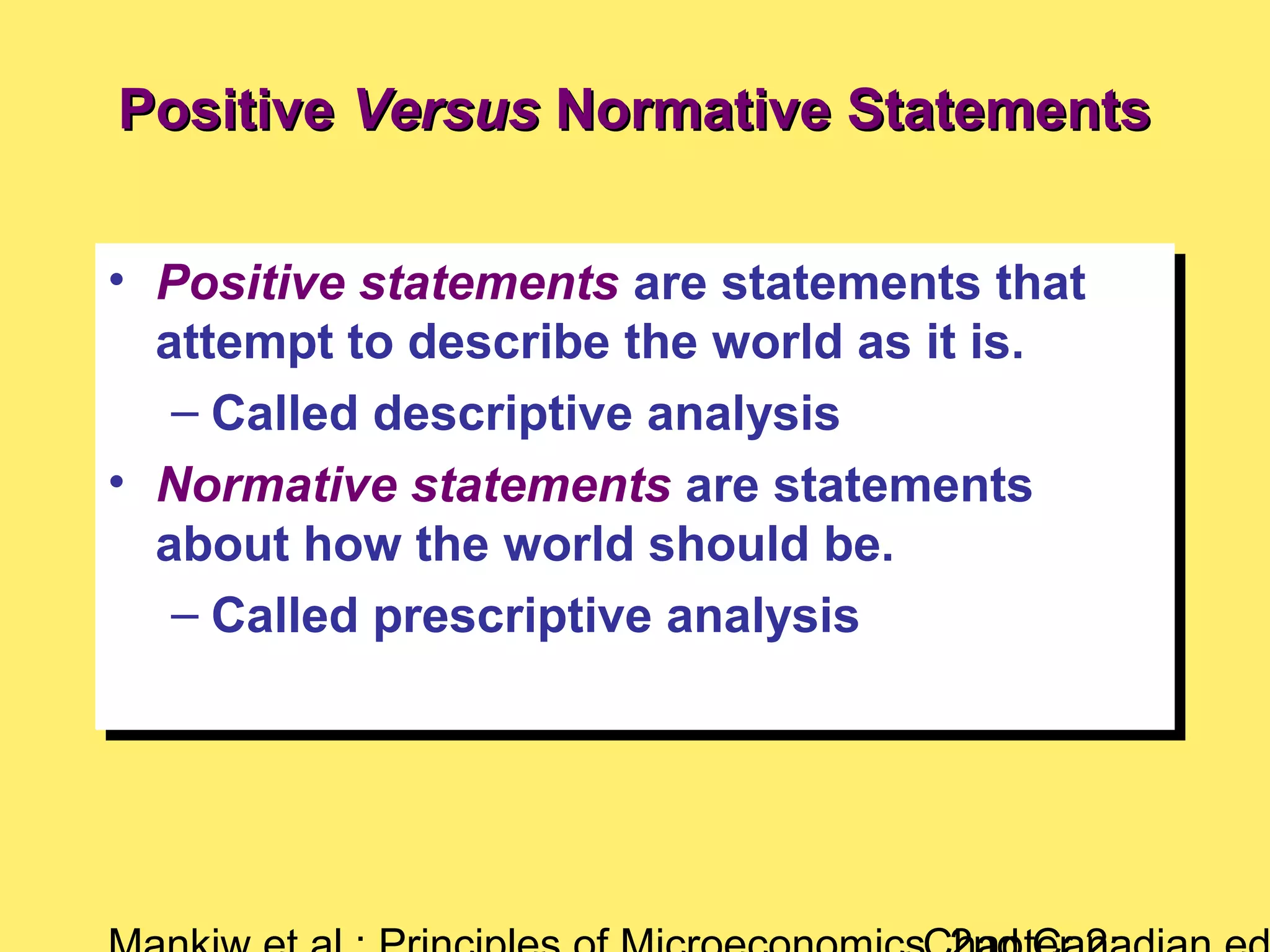
• Positive statements are statements that
attempt to describe the world as it is.
– Called descriptive analysis
• Normative statements are statements
about how the world should be.
– Called prescriptive analysis
• Positive statements are statements that
attempt to describe the world as it is.
– Called descriptive analysis
• Normative statements are statements
about how the world should be.
– Called prescriptive analysis
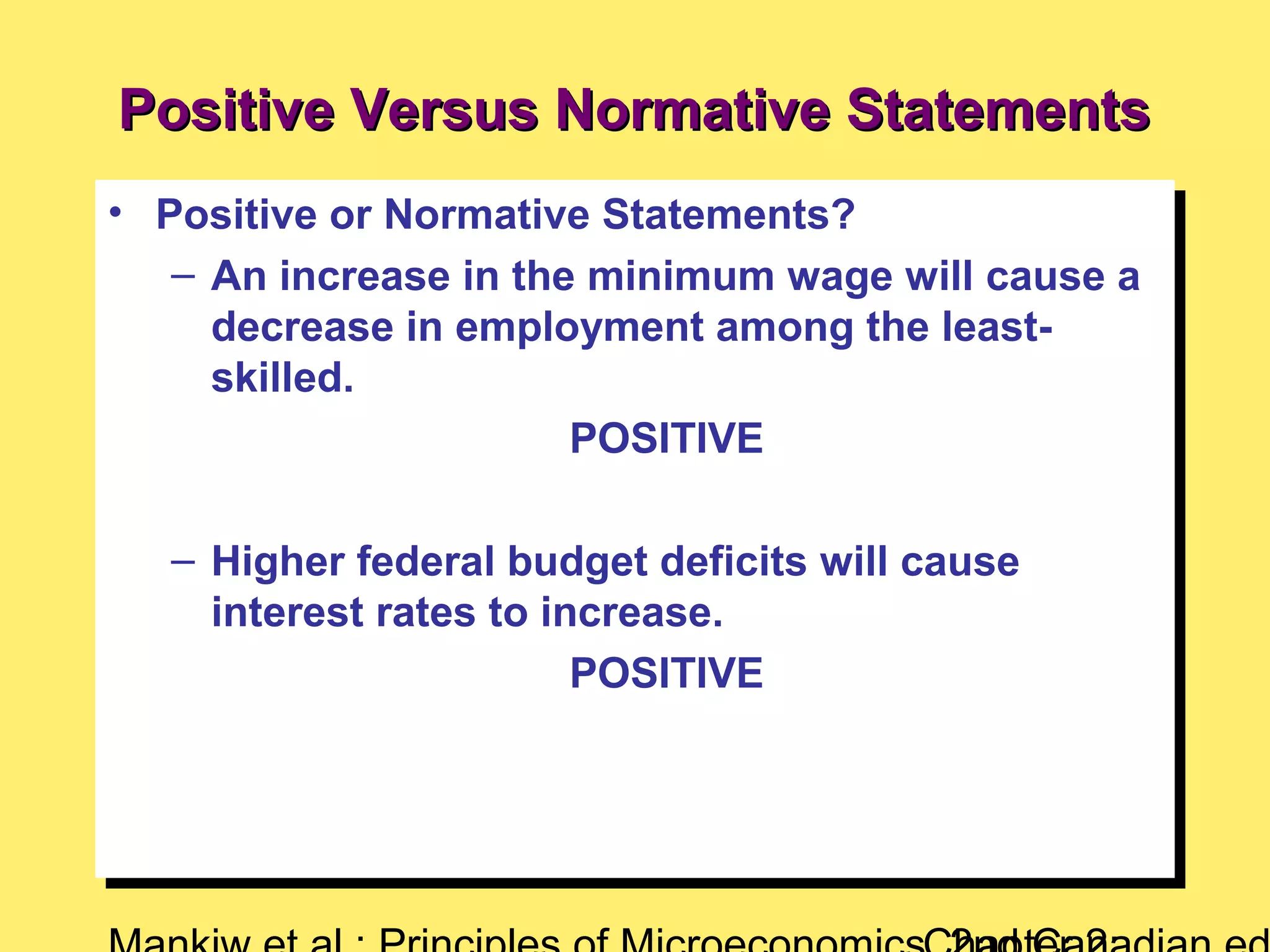
• Positive or Normative Statements?
– An increase in the minimum wage will cause a
decrease in employment among the least-
skilled.
POSITIVE
– Higher federal budget deficits will cause
interest rates to increase.
POSITIVE
• Positive or Normative Statements?
– An increase in the minimum wage will cause a
decrease in employment among the least-
skilled.
POSITIVE
– Higher federal budget deficits will cause
interest rates to increase.
POSITIVE
Positive Versus Normative StatementsPositive Versus Normative Statements
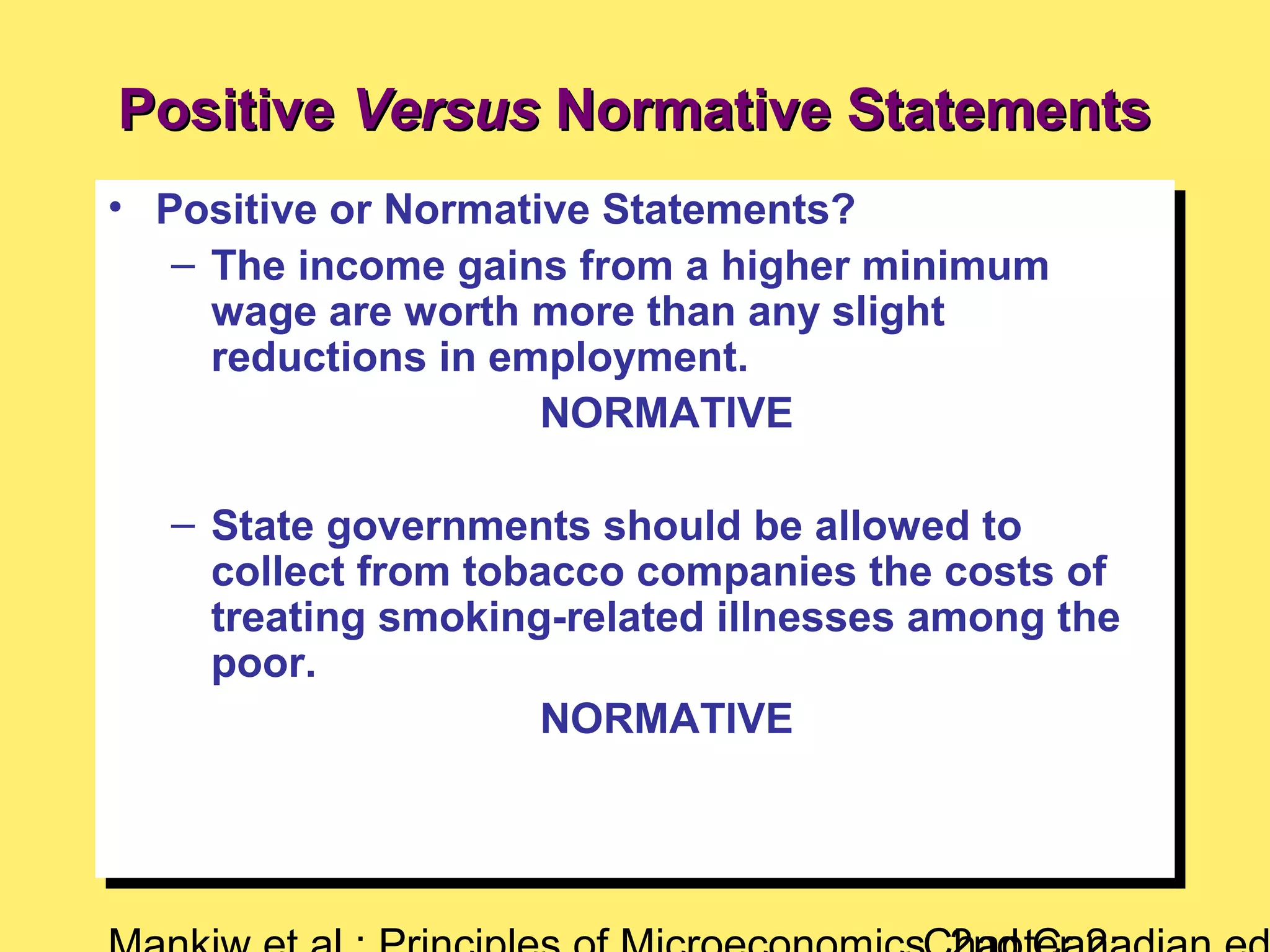
• Positive or Normative Statements?
– The income gains from a higher minimum
wage are worth more than any slight
reductions in employment.
NORMATIVE
– State governments should be allowed to
collect from tobacco companies the costs of
treating smoking-related illnesses among the
poor.
NORMATIVE
• Positive or Normative Statements?
– The income gains from a higher minimum
wage are worth more than any slight
reductions in employment.
NORMATIVE
– State governments should be allowed to
collect from tobacco companies the costs of
treating smoking-related illnesses among the
poor.
NORMATIVE
PositivePositive VersusVersus Normative StatementsNormative Statements
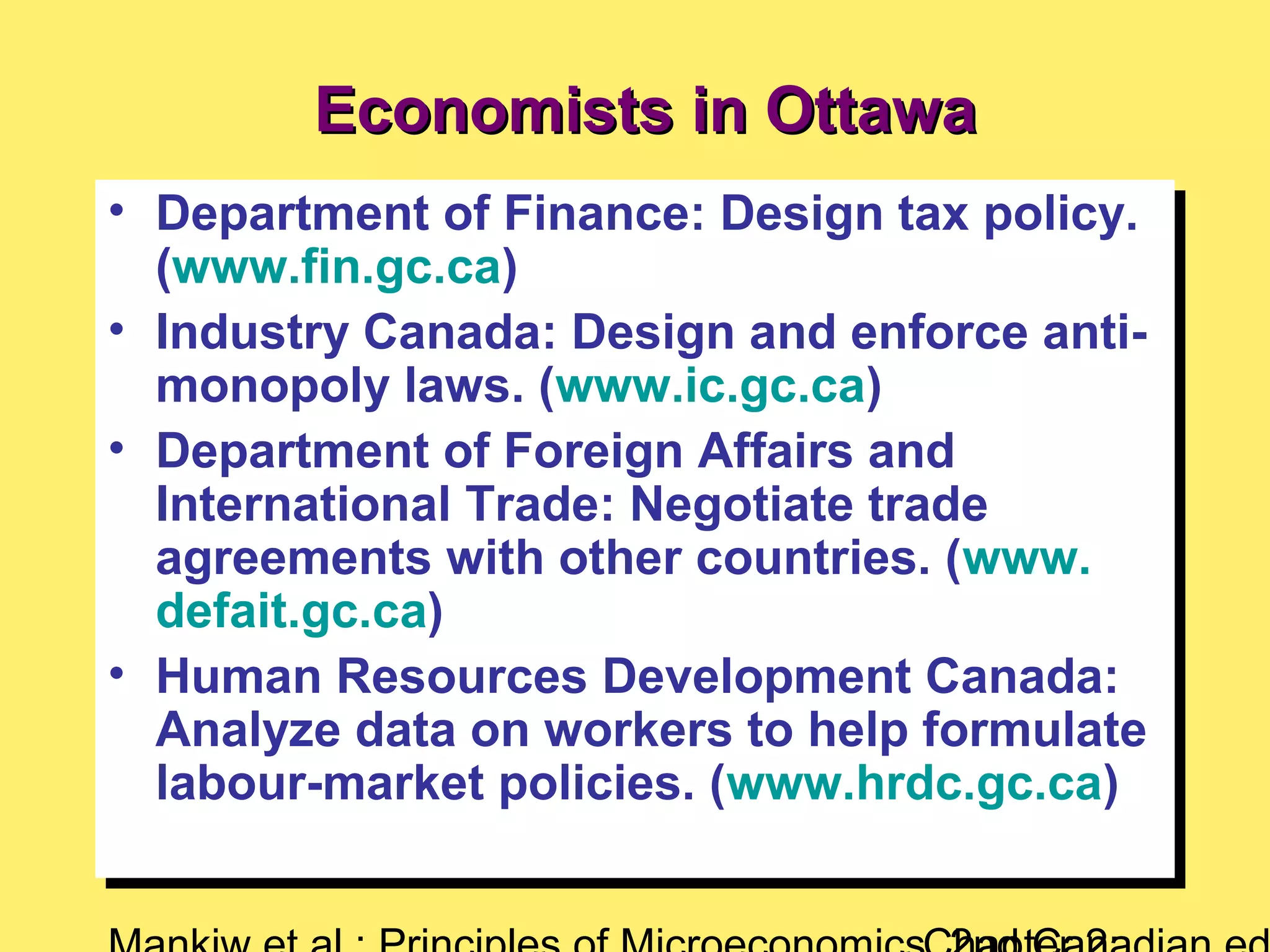
Economists in OttawaEconomists in Ottawa
• Department of Finance: Design tax policy.
(www.fin.gc.ca)
• Industry Canada: Design and enforce anti-
monopoly laws. (www.ic.gc.ca)
• Department of Foreign Affairs and
International Trade: Negotiate trade
agreements with other countries. (www.
defait.gc.ca)
• Human Resources Development Canada:
Analyze data on workers to help formulate
labour-market policies. (www.hrdc.gc.ca)
• Department of Finance: Design tax policy.
(www.fin.gc.ca)
• Industry Canada: Design and enforce anti-
monopoly laws. (www.ic.gc.ca)
• Department of Foreign Affairs and
International Trade: Negotiate trade
agreements with other countries. (www.
defait.gc.ca)
• Human Resources Development Canada:
Analyze data on workers to help formulate
labour-market policies. (www.hrdc.gc.ca)
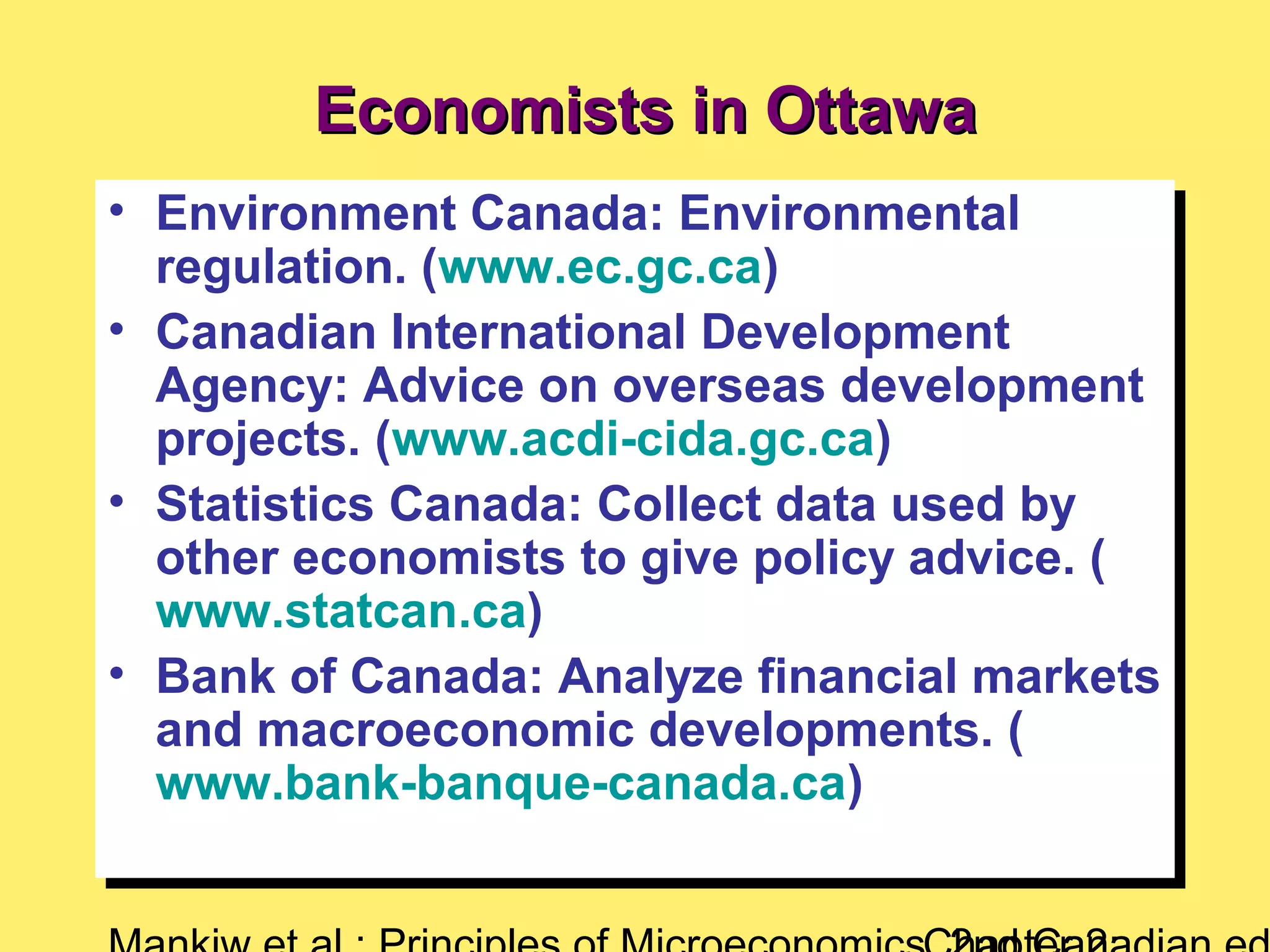
Economists in OttawaEconomists in Ottawa
• Environment Canada: Environmental
regulation. (www.ec.gc.ca)
• Canadian International Development
Agency: Advice on overseas development
projects. (www.acdi-cida.gc.ca)
• Statistics Canada: Collect data used by
other economists to give policy advice. (
www.statcan.ca)
• Bank of Canada: Analyze financial markets
and macroeconomic developments. (
www.bank-banque-canada.ca)
• Environment Canada: Environmental
regulation. (www.ec.gc.ca)
• Canadian International Development
Agency: Advice on overseas development
projects. (www.acdi-cida.gc.ca)
• Statistics Canada: Collect data used by
other economists to give policy advice. (
www.statcan.ca)
• Bank of Canada: Analyze financial markets
and macroeconomic developments. (
www.bank-banque-canada.ca)
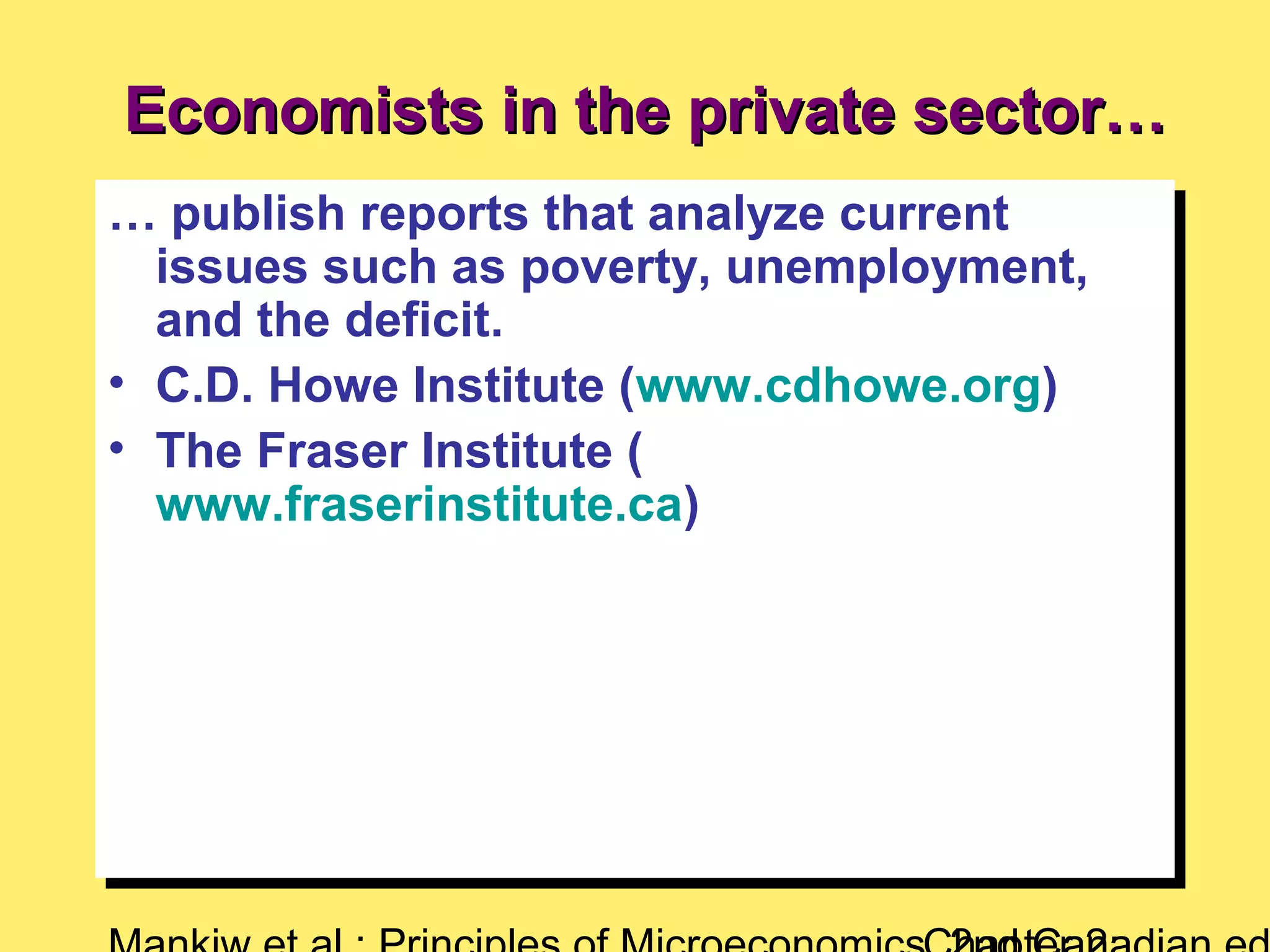
Economists in the private sector…Economists in the private sector…
… publish reports that analyze current
issues such as poverty, unemployment,
and the deficit.
• C.D. Howe Institute (www.cdhowe.org)
• The Fraser Institute (
www.fraserinstitute.ca)
… publish reports that analyze current
issues such as poverty, unemployment,
and the deficit.
• C.D. Howe Institute (www.cdhowe.org)
• The Fraser Institute (
www.fraserinstitute.ca)
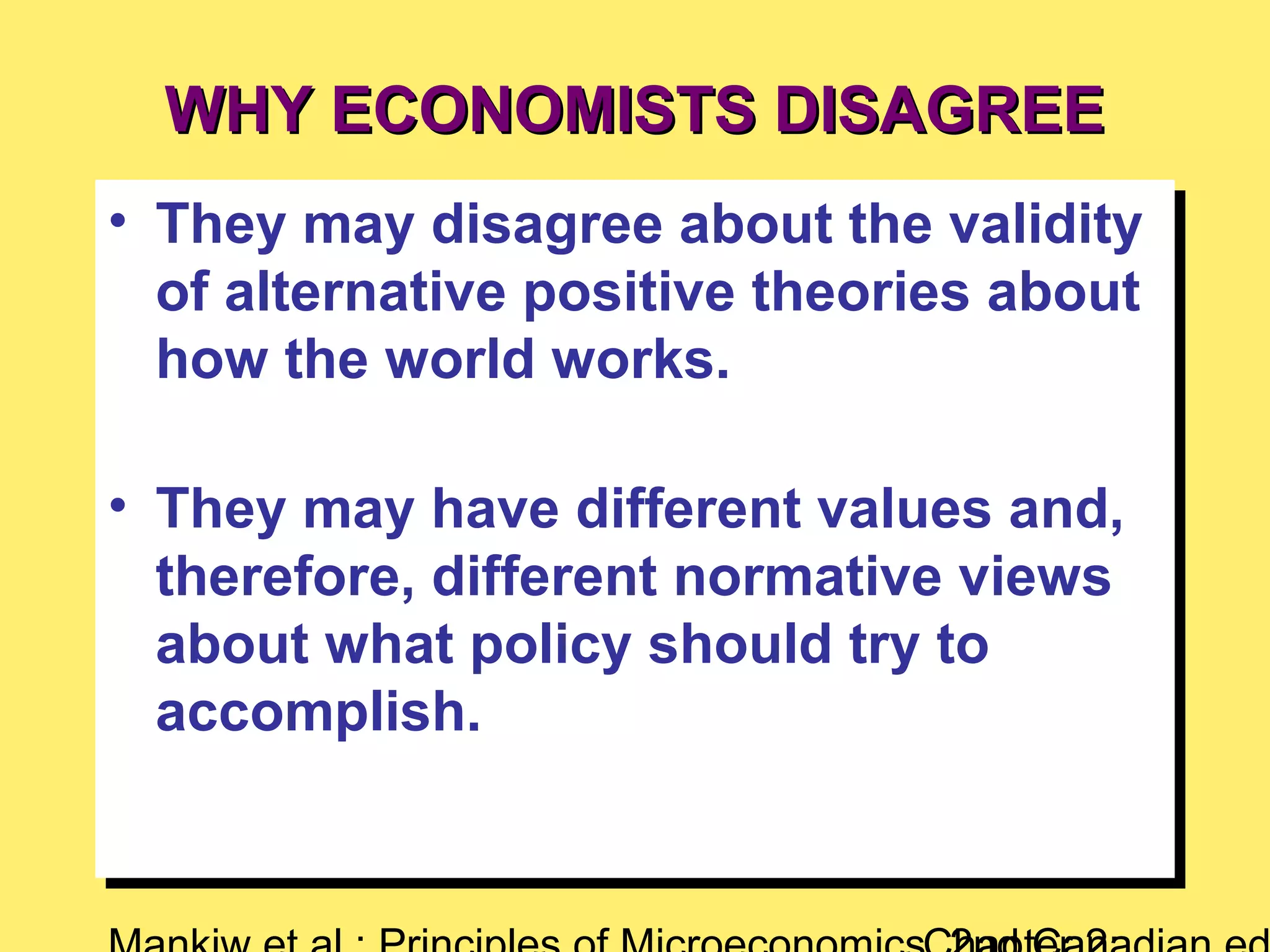
WHY ECONOMISTS DISAGREEWHY ECONOMISTS DISAGREE
• They may disagree about the validity
of alternative positive theories about
how the world works.
• They may have different values and,
therefore, different normative views
about what policy should try to
accomplish.
• They may disagree about the validity
of alternative positive theories about
how the world works.
• They may have different values and,
therefore, different normative views
about what policy should try to
accomplish.
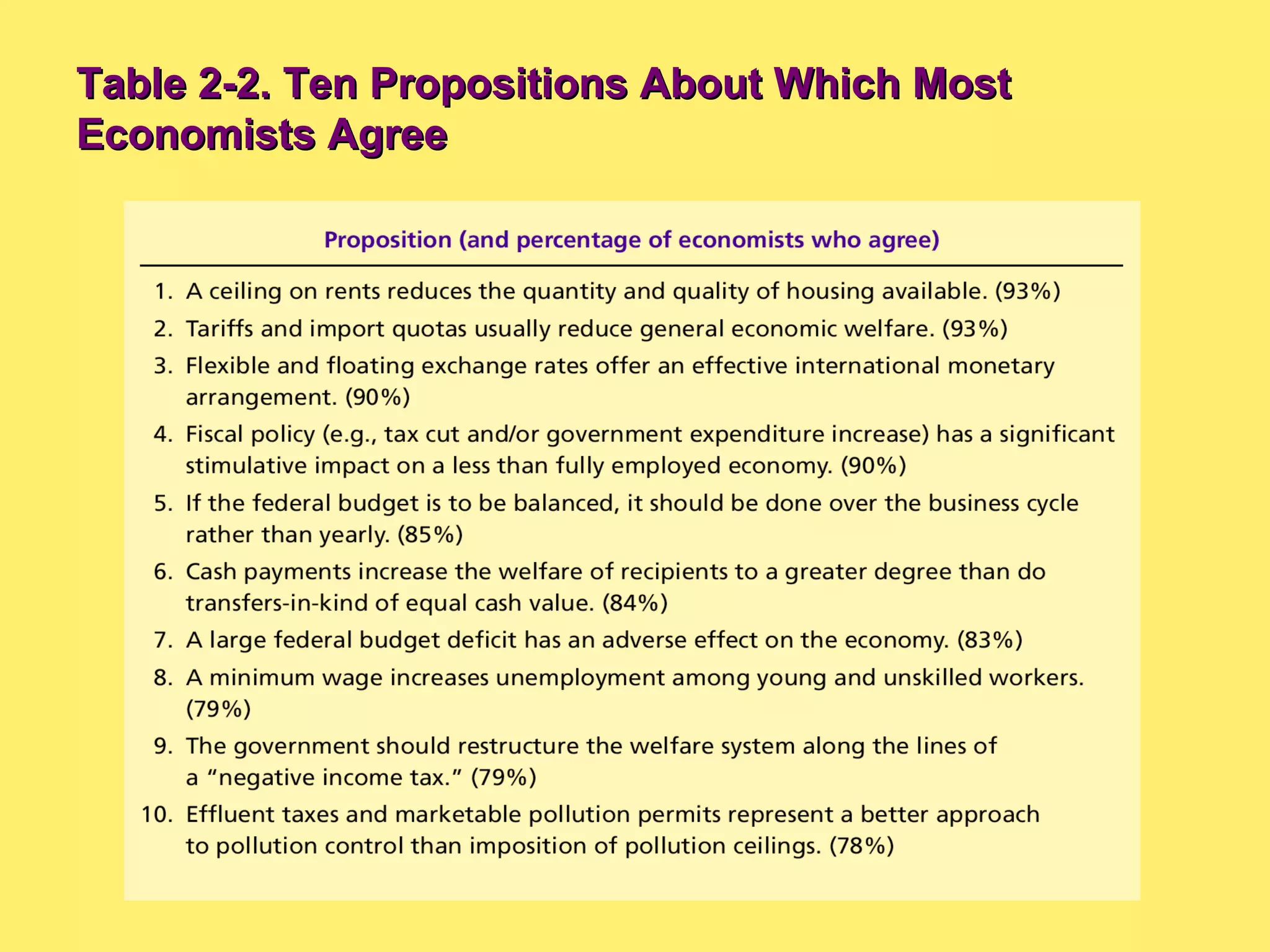
Table 2-2. Ten Propositions About Which MostTable 2-2. Ten Propositions About Which Most
Economists AgreeEconomists Agree
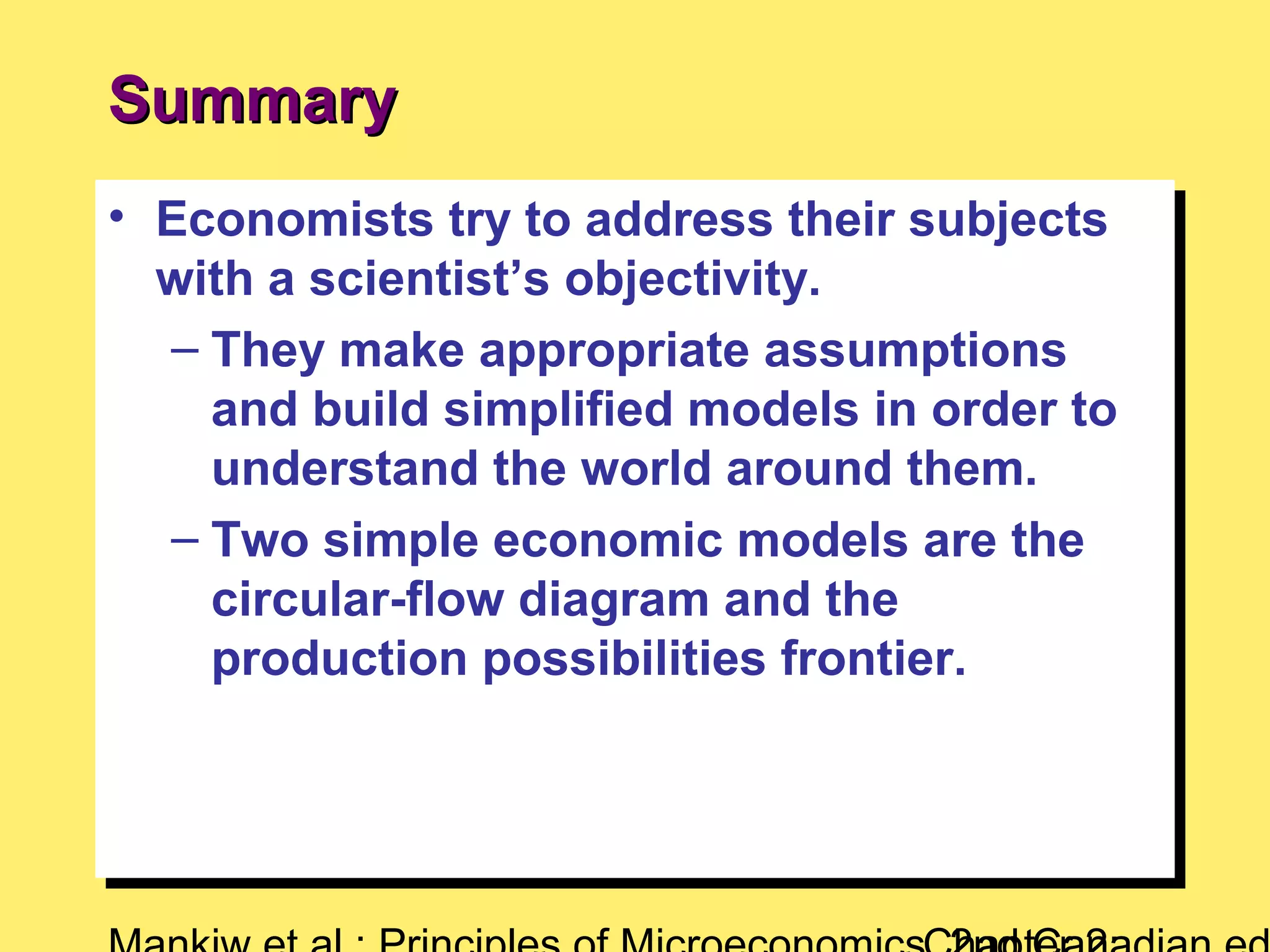
SummarySummary
• Economists try to address their subjects
with a scientist’s objectivity.
– They make appropriate assumptions
and build simplified models in order to
understand the world around them.
– Two simple economic models are the
circular-flow diagram and the
production possibilities frontier.
• Economists try to address their subjects
with a scientist’s objectivity.
– They make appropriate assumptions
and build simplified models in order to
understand the world around them.
– Two simple economic models are the
circular-flow diagram and the
production possibilities frontier.
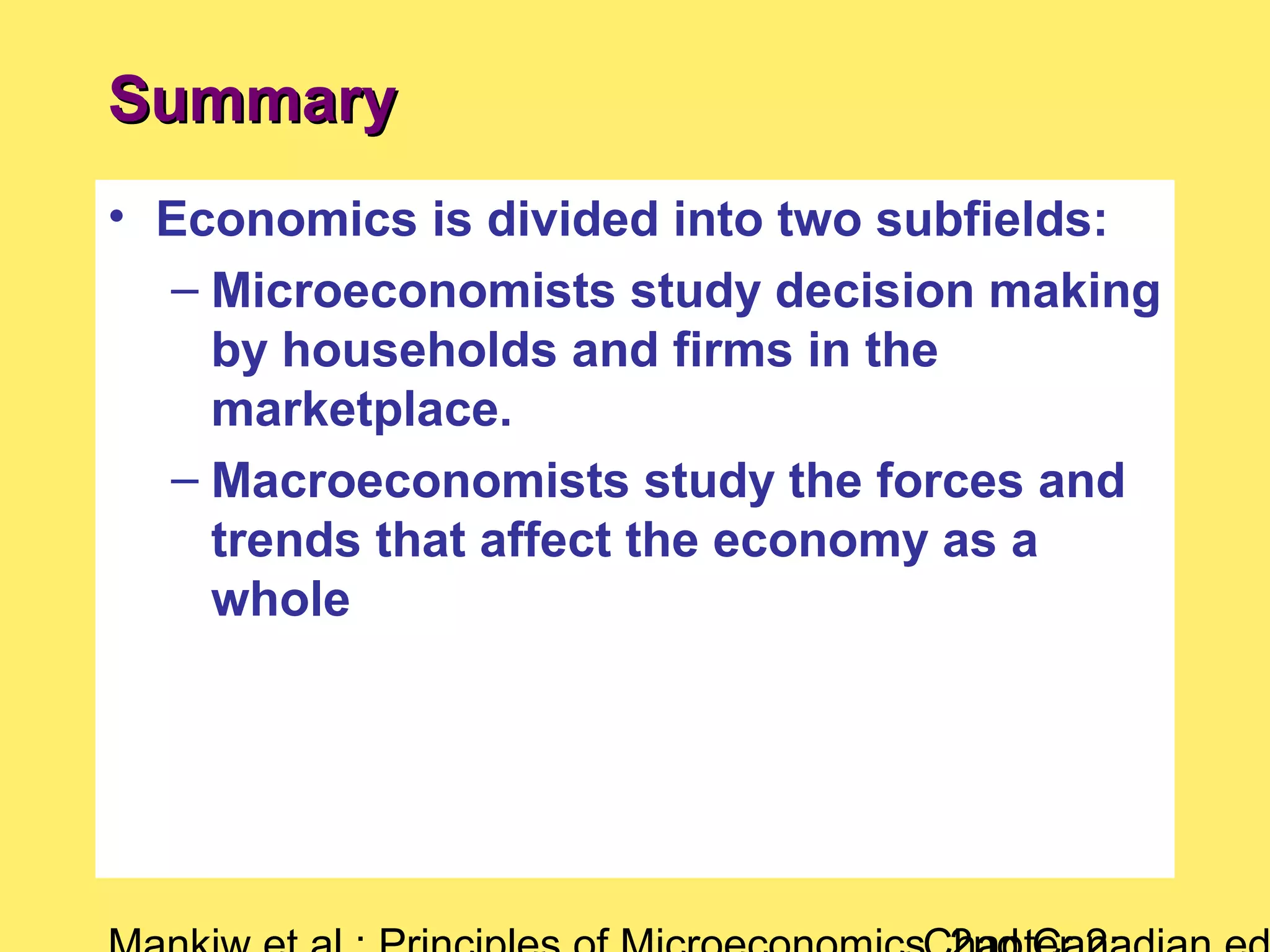
• Economics is divided into two subfields:
– Microeconomists study decision making
by households and firms in the
marketplace.
– Macroeconomists study the forces and
trends that affect the economy as a
whole
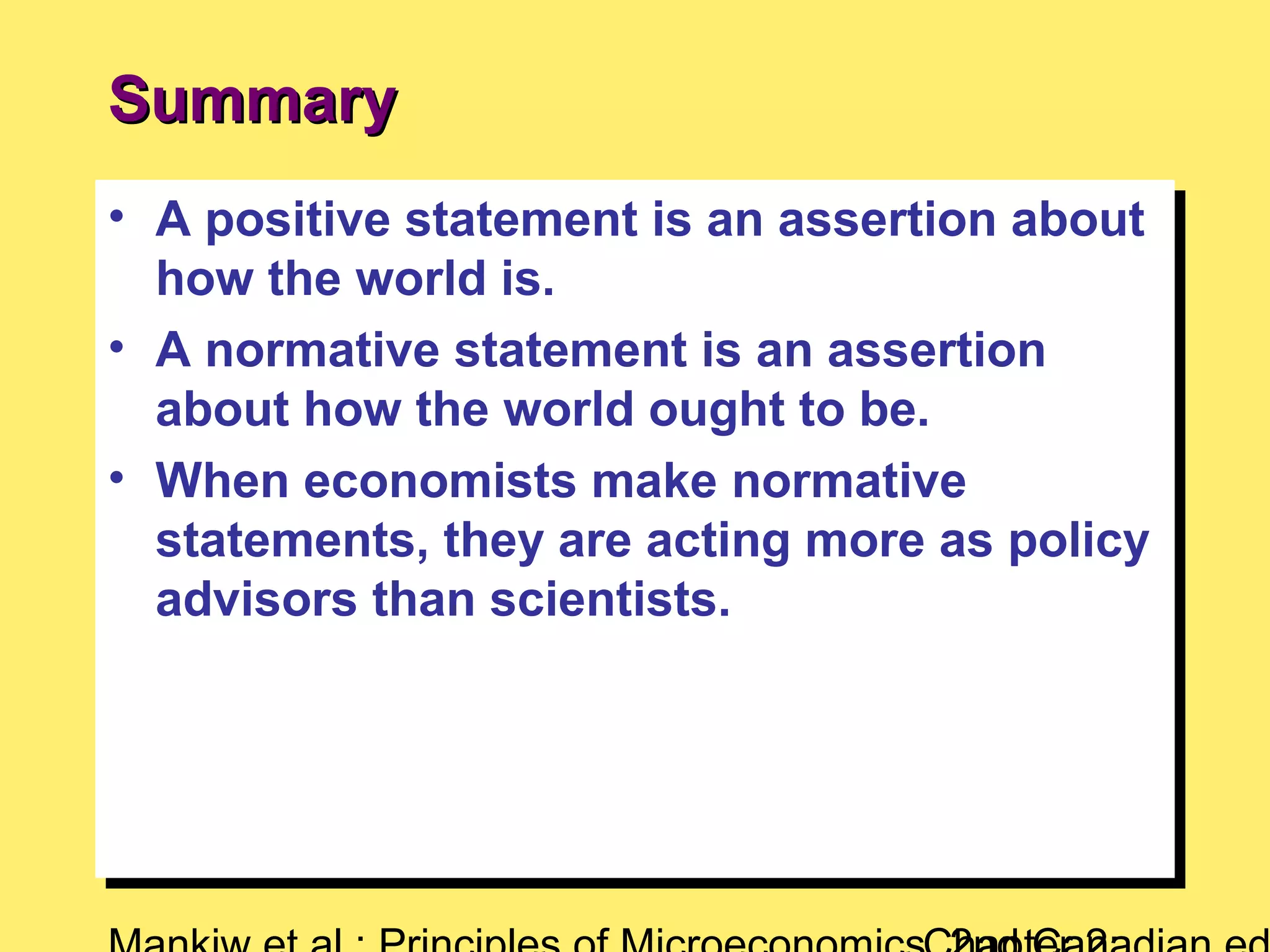
SummarySummary
• A positive statement is an assertion about
how the world is.
• A normative statement is an assertion
about how the world ought to be.
• When economists make normative
statements, they are acting more as policy
advisors than scientists.
• A positive statement is an assertion about
how the world is.
• A normative statement is an assertion
about how the world ought to be.
• When economists make normative
statements, they are acting more as policy
advisors than scientists.
SummarySummary
• Economists who advise policymakers
offer conflicting advice either because of
differences in scientific judgments or
because of differences in values.
• At other times, economists are united in
the advice they offer, but policymakers
may choose to ignore it.
• Economists who advise policymakers
offer conflicting advice either because of
differences in scientific judgments or
because of differences in values.
• At other times, economists are united in
the advice they offer, but policymakers
may choose to ignore it.
SummarySummary
AppendixAppendix
Graphing: A BriefGraphing: A Brief
ReviewReview
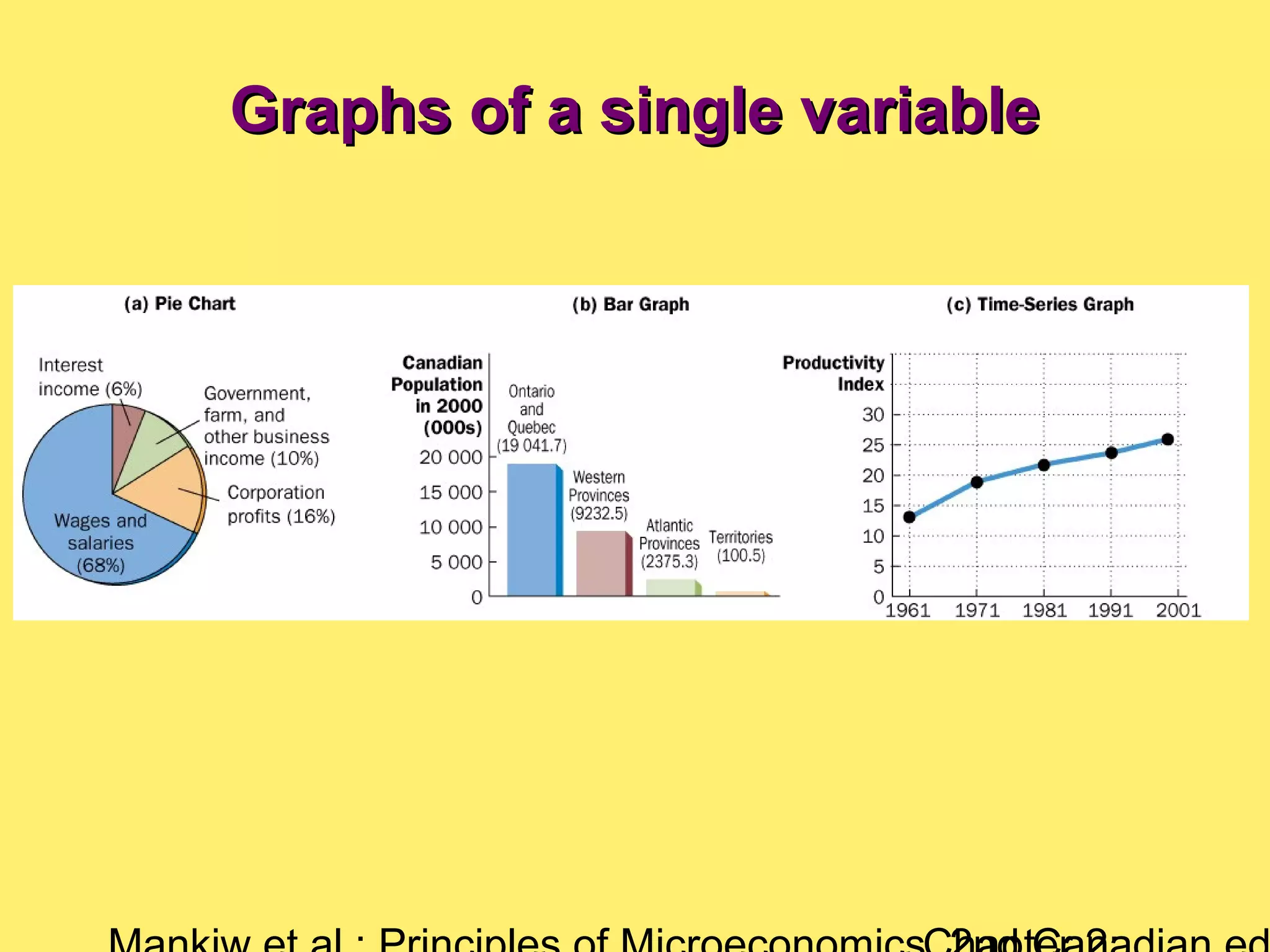
Graphs of a single variableGraphs of a single variable
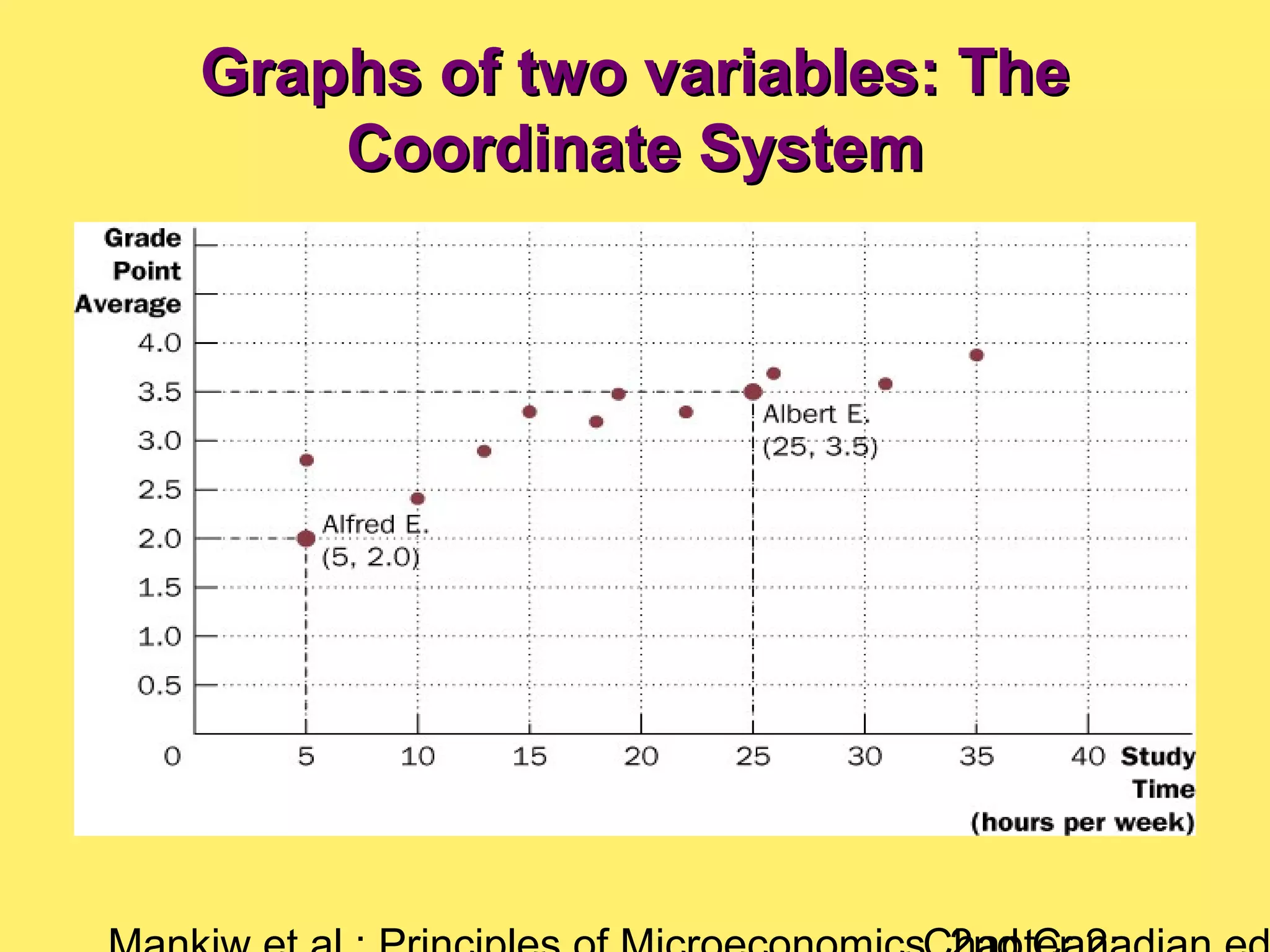
Graphs of two variables: TheGraphs of two variables: The
Coordinate SystemCoordinate System
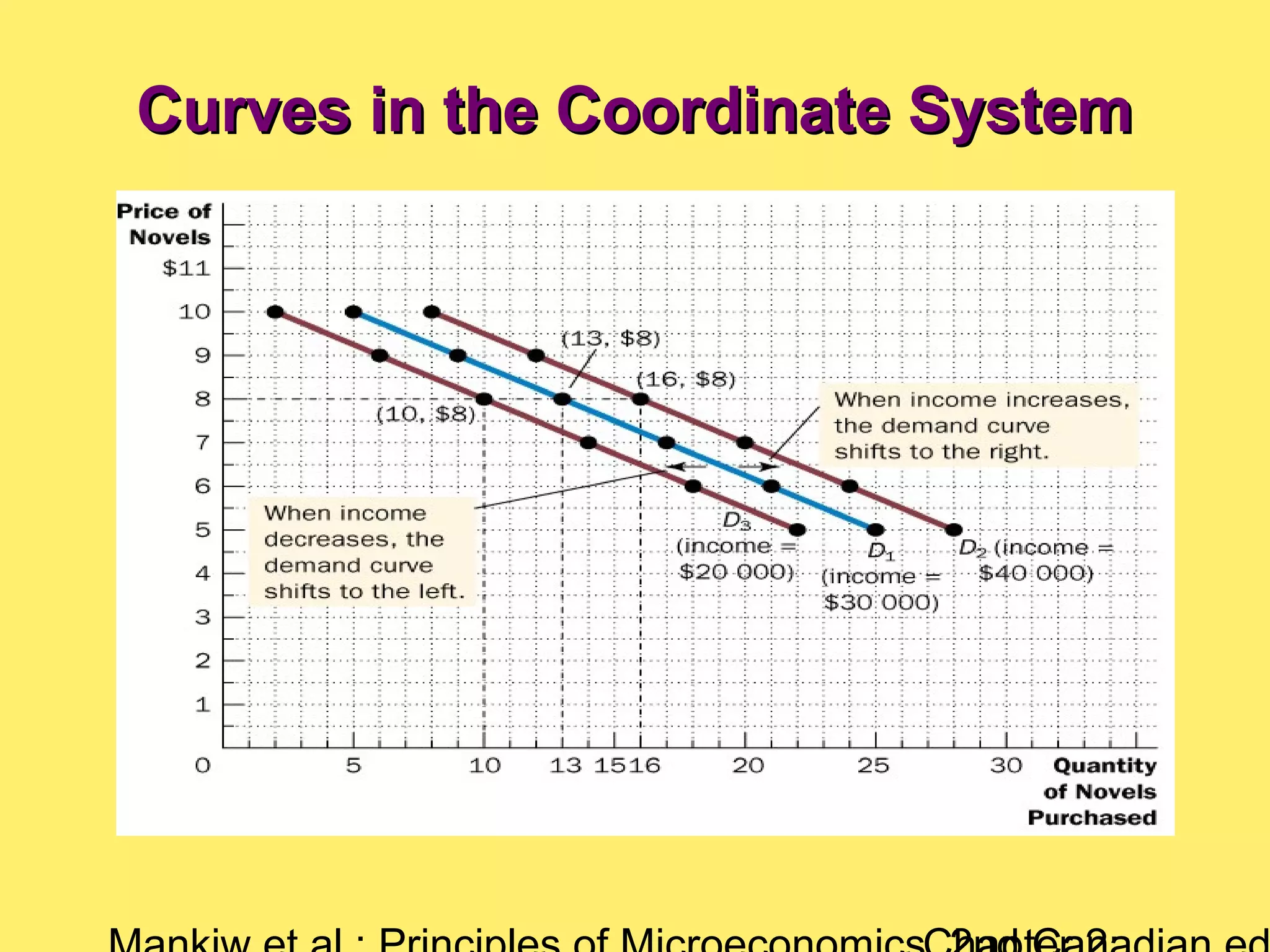
Curves in the Coordinate SystemCurves in the Coordinate System
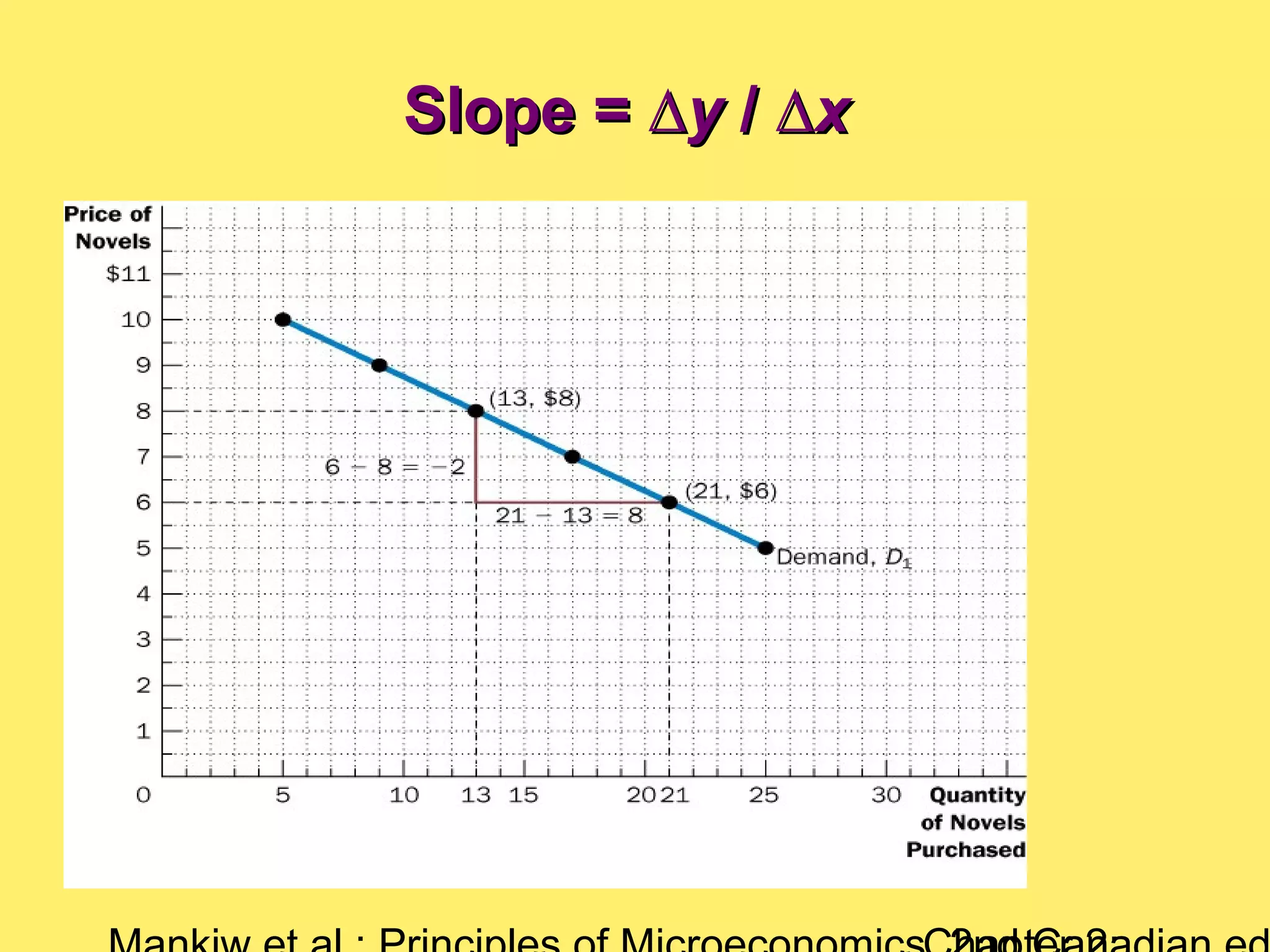
Slope = ∆Slope = ∆yy / ∆/ ∆xx
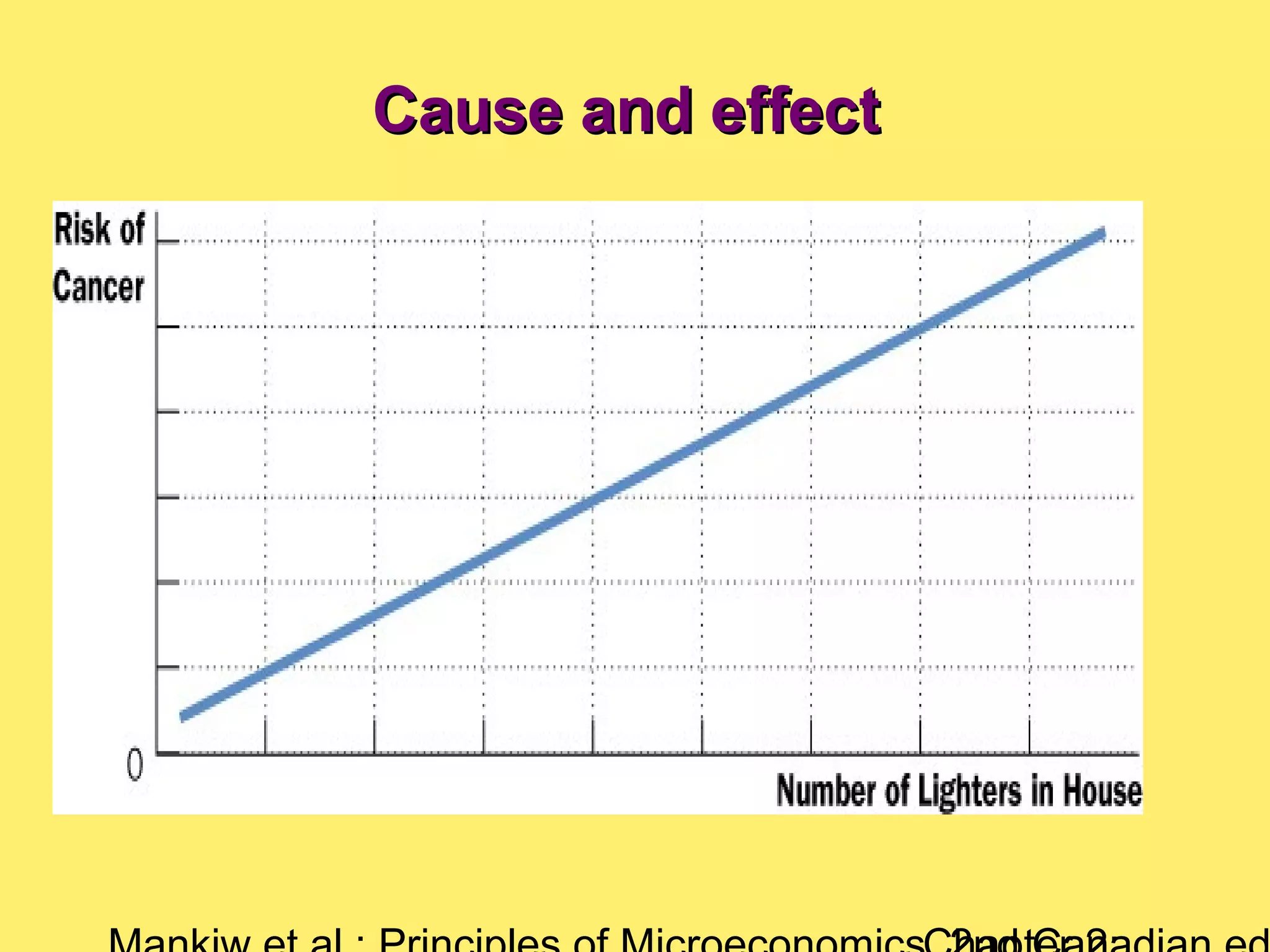
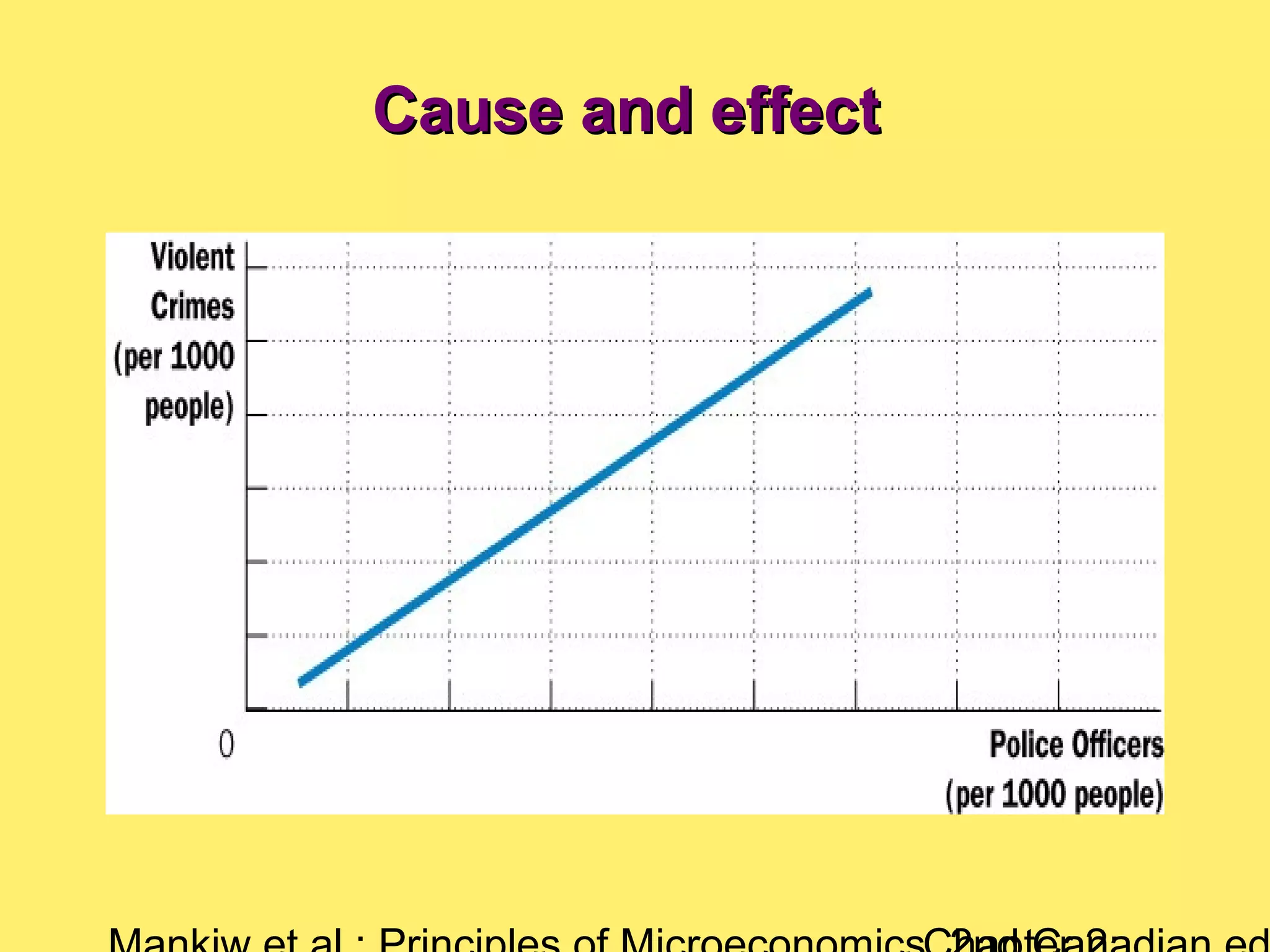
Cause and effectCause and effect
The EndThe End

Thinking Like An Economist_Chapter 2_By G. Mankew

  • 1.
    Chapter 2Chapter 2 ThinkingLike anThinking Like an EconomistEconomist ©© 2002 by Nelson, a division of Thomson Canada Limited2002 by Nelson, a division of Thomson Canada Limited
  • 2.
    In this chapteryou will…In this chapter you will…  See how economists apply theSee how economists apply the method of science.method of science.  Consider how assumptions andConsider how assumptions and models can shed light on themodels can shed light on the world.world.  Learn two simple models - theLearn two simple models - the circular flow and productioncircular flow and production possibilities frontier.possibilities frontier.  See how economists apply theSee how economists apply the method of science.method of science.  Consider how assumptions andConsider how assumptions and models can shed light on themodels can shed light on the world.world.  Learn two simple models - theLearn two simple models - the circular flow and productioncircular flow and production possibilities frontier.possibilities frontier.
  • 3.
    In this chapteryou will…In this chapter you will…  Distinguish betweenDistinguish between microeconomics andmicroeconomics and macroeconomics.macroeconomics.  Learn the difference between andLearn the difference between and normative statements.normative statements.  Examine the role of economists inExamine the role of economists in making policy.making policy.  Consider why economistsConsider why economists sometimes disagree with onesometimes disagree with one another.another.  Distinguish betweenDistinguish between microeconomics andmicroeconomics and macroeconomics.macroeconomics.  Learn the difference between andLearn the difference between and normative statements.normative statements.  Examine the role of economists inExamine the role of economists in making policy.making policy.  Consider why economistsConsider why economists sometimes disagree with onesometimes disagree with one another.another.
  • 4.
    Thinking Like anEconomistThinking Like an Economist Every field of study has its own terminology – Mathematics • integrals  axioms  vector spaces – Psychology • ego  id  cognitive dissonance – Law • promissory  estoppels  torts  venues – Economics • supply  opportunity cost  elasticity  consumer surplus  demand  comparative advantage  deadweight loss Every field of study has its own terminology – Mathematics • integrals  axioms  vector spaces – Psychology • ego  id  cognitive dissonance – Law • promissory  estoppels  torts  venues – Economics • supply  opportunity cost  elasticity  consumer surplus  demand  comparative advantage  deadweight loss
  • 5.
    Thinking Like anEconomistThinking Like an Economist Economics trains you to. . . . – Think in terms of alternatives. – Evaluate the cost of individual and social choices. – Examine and understand how certain events and issues are related. Economics trains you to. . . . – Think in terms of alternatives. – Evaluate the cost of individual and social choices. – Examine and understand how certain events and issues are related.
  • 6.
    THE ECONOMIST ASA SCIENTISTTHE ECONOMIST AS A SCIENTIST The economic way of thinking . . . – Involves thinking analytically and objectively. – Economists… • Devise theories • Collect data • Analyze the data to verify or refute their theories – Economics makes use of the scientific method. The economic way of thinking . . . – Involves thinking analytically and objectively. – Economists… • Devise theories • Collect data • Analyze the data to verify or refute their theories – Economics makes use of the scientific method.
  • 7.
    The Scientific Method:TheScientific Method: observation, theory, and moreobservation, theory, and more observationobservation • Uses abstract models to help explain how a complex, real world operates. • Develops theories, collects, and analyzes data to evaluate the theories. • Uses abstract models to help explain how a complex, real world operates. • Develops theories, collects, and analyzes data to evaluate the theories.
  • 8.
    The Role ofAssumptionsThe Role of Assumptions • Economists make assumptions in order to make the world easier to understand. • The art in scientific thinking is deciding which assumptions to make. • Economists use different assumptions to answer different questions. • Economists make assumptions in order to make the world easier to understand. • The art in scientific thinking is deciding which assumptions to make. • Economists use different assumptions to answer different questions.
  • 9.
    Economic ModelsEconomic Models •Economists use models to simplify reality in order to improve our understanding of the world • Two of the most basic economic models include: –The Circular Flow Diagram –The Production Possibilities Frontier • Economists use models to simplify reality in order to improve our understanding of the world • Two of the most basic economic models include: –The Circular Flow Diagram –The Production Possibilities Frontier
  • 10.
    Our First Model:The Circular-FlowOur First Model: The Circular-Flow DiagramDiagram • The circular-flow diagram is a visual model of the economy that shows how dollars flow through markets among households and firms. • The circular-flow diagram is a visual model of the economy that shows how dollars flow through markets among households and firms.
  • 11.
    Figure 1: TheCircular FlowFigure 1: The Circular Flow Copyright © 2004 South-Western Spending Goods and services bought Revenue Goods and services sold Labour, land, and capital Income = Flow of inputs and outputs = Flow of dollars Factors of production Wages, rent, and profit FIRMS •Produce and sell goods and services •Hire and use factors of production •Buy and consume goods and services •Own and sell factors of production HOUSEHOLDS •Households sell •Firms buy MARKETS FOR FACTORS OF PRODUCTION •Firms sell •Households buy MARKETS FOR GOODS AND SERVICES
  • 12.
    Our First Model:The Circular-FlowOur First Model: The Circular-Flow DiagramDiagram • Firms – Produce and sell goods and services – Hire and use factors of production • Households – Buy and consume goods and services – Own and sell factors of production • Firms – Produce and sell goods and services – Hire and use factors of production • Households – Buy and consume goods and services – Own and sell factors of production
  • 13.
    Our First Model:The Circular-FlowOur First Model: The Circular-Flow DiagramDiagram • Markets for Goods and Services – Firms sell – Households buy • Markets for Factors of Production – Households sell – Firms buy • Factors of Production – Inputs used to produce goods and services – Land, labour, and capital • Markets for Goods and Services – Firms sell – Households buy • Markets for Factors of Production – Households sell – Firms buy • Factors of Production – Inputs used to produce goods and services – Land, labour, and capital
  • 14.
    Our Second Model:OurSecond Model: The Production Possibilities FrontierThe Production Possibilities Frontier • The production possibilities frontierproduction possibilities frontier is a graph that shows the combinations of output that the economy can possibly produce given the available factors of production and the available production technology. • The production possibilities frontierproduction possibilities frontier is a graph that shows the combinations of output that the economy can possibly produce given the available factors of production and the available production technology.
  • 15.
    Quantity of Computers Produced Quantity of CarsProduced 0 Figure 2-2:Figure 2-2: The Production Possibilities FrontierThe Production Possibilities Frontier 3000 2000 700 A 1000 300 B 2200 600 C D 1000 Production possibilities frontier
  • 16.
    • Concepts Illustratedby the Production Possibilities Frontier – Efficiency – Tradeoffs – Opportunity Cost – Economic Growth • Concepts Illustrated by the Production Possibilities Frontier – Efficiency – Tradeoffs – Opportunity Cost – Economic Growth Our Second Model:Our Second Model: The Production Possibilities FrontierThe Production Possibilities Frontier
  • 17.
    Figure 2-3. AShift in the Production PossibilitiesFigure 2-3. A Shift in the Production Possibilities FrontierFrontier Quantity of Computers Produced Quantity of Cars Produced 3000 2000 700 A 0 4000 2100 750 E 1000
  • 18.
    Microeconomics and MacroeconomicsMicroeconomicsand Macroeconomics • Microeconomics focuses on the individual parts of the economy. – How households and firms make decisions and how they interact in specific markets • Macroeconomics looks at the economy as a whole. – Economy-wide phenomena, including inflation, unemployment, and economic growth • Microeconomics focuses on the individual parts of the economy. – How households and firms make decisions and how they interact in specific markets • Macroeconomics looks at the economy as a whole. – Economy-wide phenomena, including inflation, unemployment, and economic growth
  • 19.
    THE ECONOMIST ASPOLICYTHE ECONOMIST AS POLICY ADVISERADVISER • When economists are trying to explain the world, they are scientists. • When economists are trying to change the world, they are policy advisor. • When economists are trying to explain the world, they are scientists. • When economists are trying to change the world, they are policy advisor.
  • 20.
    PositivePositive VersusVersus NormativeStatementsNormative Statements • Positive statements are statements that attempt to describe the world as it is. – Called descriptive analysis • Normative statements are statements about how the world should be. – Called prescriptive analysis • Positive statements are statements that attempt to describe the world as it is. – Called descriptive analysis • Normative statements are statements about how the world should be. – Called prescriptive analysis
  • 21.
    • Positive orNormative Statements? – An increase in the minimum wage will cause a decrease in employment among the least- skilled. POSITIVE – Higher federal budget deficits will cause interest rates to increase. POSITIVE • Positive or Normative Statements? – An increase in the minimum wage will cause a decrease in employment among the least- skilled. POSITIVE – Higher federal budget deficits will cause interest rates to increase. POSITIVE Positive Versus Normative StatementsPositive Versus Normative Statements
  • 22.
    • Positive orNormative Statements? – The income gains from a higher minimum wage are worth more than any slight reductions in employment. NORMATIVE – State governments should be allowed to collect from tobacco companies the costs of treating smoking-related illnesses among the poor. NORMATIVE • Positive or Normative Statements? – The income gains from a higher minimum wage are worth more than any slight reductions in employment. NORMATIVE – State governments should be allowed to collect from tobacco companies the costs of treating smoking-related illnesses among the poor. NORMATIVE PositivePositive VersusVersus Normative StatementsNormative Statements
  • 23.
    Economists in OttawaEconomistsin Ottawa • Department of Finance: Design tax policy. (www.fin.gc.ca) • Industry Canada: Design and enforce anti- monopoly laws. (www.ic.gc.ca) • Department of Foreign Affairs and International Trade: Negotiate trade agreements with other countries. (www. defait.gc.ca) • Human Resources Development Canada: Analyze data on workers to help formulate labour-market policies. (www.hrdc.gc.ca) • Department of Finance: Design tax policy. (www.fin.gc.ca) • Industry Canada: Design and enforce anti- monopoly laws. (www.ic.gc.ca) • Department of Foreign Affairs and International Trade: Negotiate trade agreements with other countries. (www. defait.gc.ca) • Human Resources Development Canada: Analyze data on workers to help formulate labour-market policies. (www.hrdc.gc.ca)
  • 24.
    Economists in OttawaEconomistsin Ottawa • Environment Canada: Environmental regulation. (www.ec.gc.ca) • Canadian International Development Agency: Advice on overseas development projects. (www.acdi-cida.gc.ca) • Statistics Canada: Collect data used by other economists to give policy advice. ( www.statcan.ca) • Bank of Canada: Analyze financial markets and macroeconomic developments. ( www.bank-banque-canada.ca) • Environment Canada: Environmental regulation. (www.ec.gc.ca) • Canadian International Development Agency: Advice on overseas development projects. (www.acdi-cida.gc.ca) • Statistics Canada: Collect data used by other economists to give policy advice. ( www.statcan.ca) • Bank of Canada: Analyze financial markets and macroeconomic developments. ( www.bank-banque-canada.ca)
  • 25.
    Economists in theprivate sector…Economists in the private sector… … publish reports that analyze current issues such as poverty, unemployment, and the deficit. • C.D. Howe Institute (www.cdhowe.org) • The Fraser Institute ( www.fraserinstitute.ca) … publish reports that analyze current issues such as poverty, unemployment, and the deficit. • C.D. Howe Institute (www.cdhowe.org) • The Fraser Institute ( www.fraserinstitute.ca)
  • 26.
    WHY ECONOMISTS DISAGREEWHYECONOMISTS DISAGREE • They may disagree about the validity of alternative positive theories about how the world works. • They may have different values and, therefore, different normative views about what policy should try to accomplish. • They may disagree about the validity of alternative positive theories about how the world works. • They may have different values and, therefore, different normative views about what policy should try to accomplish.
  • 27.
    Table 2-2. TenPropositions About Which MostTable 2-2. Ten Propositions About Which Most Economists AgreeEconomists Agree
  • 28.
    SummarySummary • Economists tryto address their subjects with a scientist’s objectivity. – They make appropriate assumptions and build simplified models in order to understand the world around them. – Two simple economic models are the circular-flow diagram and the production possibilities frontier. • Economists try to address their subjects with a scientist’s objectivity. – They make appropriate assumptions and build simplified models in order to understand the world around them. – Two simple economic models are the circular-flow diagram and the production possibilities frontier.
  • 29.
    • Economics isdivided into two subfields: – Microeconomists study decision making by households and firms in the marketplace. – Macroeconomists study the forces and trends that affect the economy as a whole SummarySummary
  • 30.
    • A positivestatement is an assertion about how the world is. • A normative statement is an assertion about how the world ought to be. • When economists make normative statements, they are acting more as policy advisors than scientists. • A positive statement is an assertion about how the world is. • A normative statement is an assertion about how the world ought to be. • When economists make normative statements, they are acting more as policy advisors than scientists. SummarySummary
  • 31.
    • Economists whoadvise policymakers offer conflicting advice either because of differences in scientific judgments or because of differences in values. • At other times, economists are united in the advice they offer, but policymakers may choose to ignore it. • Economists who advise policymakers offer conflicting advice either because of differences in scientific judgments or because of differences in values. • At other times, economists are united in the advice they offer, but policymakers may choose to ignore it. SummarySummary
  • 32.
  • 33.
    Graphs of asingle variableGraphs of a single variable
  • 34.
    Graphs of twovariables: TheGraphs of two variables: The Coordinate SystemCoordinate System
  • 35.
    Curves in theCoordinate SystemCurves in the Coordinate System
  • 36.
    Curves in theCoordinate SystemCurves in the Coordinate System
  • 37.
    Slope = ∆Slope= ∆yy / ∆/ ∆xx
  • 38.
  • 39.
  • 40.

Editor's Notes

  • #6 <number>
  • #7 <number>
  • #8 <number>
  • #11 <number>
  • #13 <number>
  • #14 <number>
  • #15 <number>
  • #17 <number>
  • #19 <number>
  • #20 <number>
  • #21 <number>
  • #22 <number>
  • #23 <number>
  • #24 <number>
  • #25 <number>
  • #26 <number>
  • #27 <number>
  • #29 <number>
  • #30 <number>
  • #31 <number>
  • #32 <number>