KYOTO PROTOCOL 
Presented by : 
ANUJ KUMAR
What is kyoto protocol? 
• The Kyoto Protocol is a protocol linked to the 
United Nations Framework Convention on 
Climate Change (UNFCCC or FCCC), aimed at 
fighting global warming. 
• The UNFCCC is an international environmental 
treaty with the goal of achieving the 
"stabilization of greenhouse gas concentrations 
in the atmosphere at a level that would prevent 
dangerous anthropogenic interference with the 
climate system."
UNFCCC VS KYOTO PROTOCOL 
• The major distinction between the Protocol 
and the Convention is that while the 
Convention encouraged industrialised 
countries to stabilize GHG emissions, the 
Protocol commits them to do so.
background 
• The Kyoto Protocol was negotiated in Kyoto, 
Japan, in December 1997. 
• It was opened for signature on March 16, 1998, 
and closed a year later. 
• Ratifying countries had to represent at least 55 
percent of the world’s total carbon dioxide 
emissions for 1990. 
• The first condition was met on May 23, 2002, 
when Iceland became the 55th country to ratify 
the Kyoto Protocol.
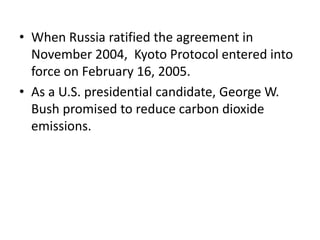
• When Russia ratified the agreement in 
November 2004, Kyoto Protocol entered into 
force on February 16, 2005. 
• As a U.S. presidential candidate, George W. 
Bush promised to reduce carbon dioxide 
emissions.
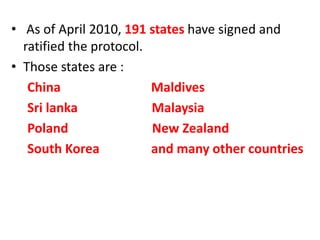
• As of April 2010, 191 states have signed and 
ratified the protocol. 
• Those states are : 
China Maldives 
Sri lanka Malaysia 
Poland New Zealand 
South Korea and many other countries
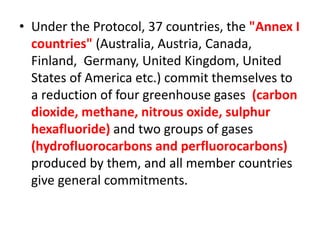
• Under the Protocol, 37 countries, the "Annex I 
countries" (Australia, Austria, Canada, 
Finland, Germany, United Kingdom, United 
States of America etc.) commit themselves to 
a reduction of four greenhouse gases (carbon 
dioxide, methane, nitrous oxide, sulphur 
hexafluoride) and two groups of gases 
(hydrofluorocarbons and perfluorocarbons) 
produced by them, and all member countries 
give general commitments.
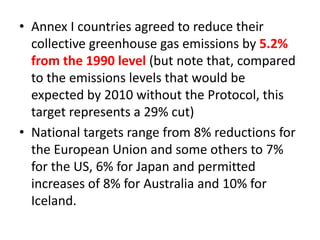
• Annex I countries agreed to reduce their 
collective greenhouse gas emissions by 5.2% 
from the 1990 level (but note that, compared 
to the emissions levels that would be 
expected by 2010 without the Protocol, this 
target represents a 29% cut) 
• National targets range from 8% reductions for 
the European Union and some others to 7% 
for the US, 6% for Japan and permitted 
increases of 8% for Australia and 10% for 
Iceland.
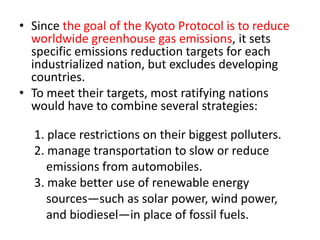
• Since the goal of the Kyoto Protocol is to reduce 
worldwide greenhouse gas emissions, it sets 
specific emissions reduction targets for each 
industrialized nation, but excludes developing 
countries. 
• To meet their targets, most ratifying nations 
would have to combine several strategies: 
1. place restrictions on their biggest polluters. 
2. manage transportation to slow or reduce 
emissions from automobiles. 
3. make better use of renewable energy 
sources—such as solar power, wind power, 
and biodiesel—in place of fossil fuels.
Mechanisms under kyoto protocol 
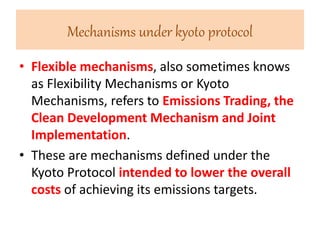
• Flexible mechanisms, also sometimes knows 
as Flexibility Mechanisms or Kyoto 
Mechanisms, refers to Emissions Trading, the 
Clean Development Mechanism and Joint 
Implementation. 
• These are mechanisms defined under the 
Kyoto Protocol intended to lower the overall 
costs of achieving its emissions targets.
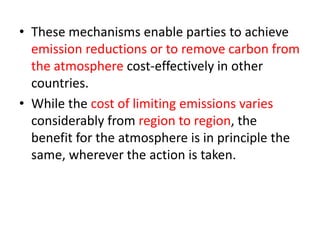
• These mechanisms enable parties to achieve 
emission reductions or to remove carbon from 
the atmosphere cost-effectively in other 
countries. 
• While the cost of limiting emissions varies 
considerably from region to region, the 
benefit for the atmosphere is in principle the 
same, wherever the action is taken.
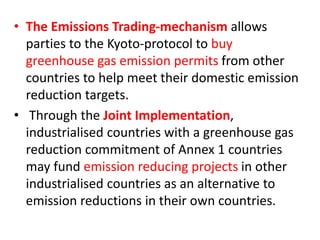
• The Emissions Trading-mechanism allows 
parties to the Kyoto-protocol to buy 
greenhouse gas emission permits from other 
countries to help meet their domestic emission 
reduction targets. 
• Through the Joint Implementation, 
industrialised countries with a greenhouse gas 
reduction commitment of Annex 1 countries 
may fund emission reducing projects in other 
industrialised countries as an alternative to 
emission reductions in their own countries.
• The Clean Development Mechanism (CDM) is 
an arrangement under the Kyoto Protocol 
allowing industrialised countries with a 
greenhouse gas reduction commitment of 
Annex 1 countries to invest in projects that 
reduce emissions in developing countries. 
• The CDM allows net global greenhouse gas 
emissions to be reduced at a much lower 
global cost by financing emissions reduction 
projects in developing countries where costs 
are lower than in industrialised countries.
Current status? 
• Most of the world’s industrialized nations 
support the Kyoto Protocol. 
• Australia also declined in the emissions of 
those gases. 
• One notable exception is the United States, 
which releases more greenhouse gases than 
any other nation and accounts for more than 
25 percent of those generated by humans 
worldwide.
Post- Kyoto Protocol 
• It refer to high level talks attempting to 
address global warming by limiting greenhouse 
gas emissions. 
• Generally part of the United Nations Framework 
Convention on Climate Change (UNFCCC), these 
talks concern the period after the first 
"commitment period" of the Kyoto Protocol, 
which expired at the end of 2012. Negotiations 
have been mandated by the adoption of the Bali 
Road Map and Decision 1/CP.13 ("The Bali Action 
Plan").
• UNFCCC negotiations are conducted within two 
subsidiary bodies, the Ad Hoc Working Group on 
Long-term Cooperative Action under the 
Convention (AWG-LCA) and the Ad Hoc Working 
Group on Further Commitments for Annex I 
Parties under the Kyoto Protocol (AWG-KP). 
• The United Nations Climate Change Conference 
take place in December 2009 in Copenhagen 
(COP-15); negotiations are supported by a 
number of external processes, including the G8 
process, a number of regional meetings and the 
Major Economies Forum on Energy and Climate 
that was launched by US President Barack 
Obama in March 2009.
• On February 16, 2007, The Global Legislators 
Organisation (GLOBE International) held a 
meeting of the G8+5 Climate Change Dialogue at 
the GLOBE Washington Legislators Forum 
in Washington, D.C. 
• Where a non-binding agreement was reached to 
co-operate on tackling global warming. 
• The group accepted that the existence of man-made 
climate change was beyond doubt and 
there should be a global system of emission caps 
and carbon emissions trading applying to 
both industrialized nations and developing 
countries.
• The leaders at the 33rd G8 summit issued a non-binding 
communiqué announcing that the G8 
nations would "aim to at least halve 
global CO2 emissions by 2050". 
• In 2007 UN General Assembly plenary debate on 
climate change that include adaptation, 
mitigation, clean technologies, deforestation. 
• In 2007 Vienna Climate Change Talks and 
agreement. 
• In 2007 United Nations Climate Change 
Conference held in Bali, where a meeting of 
environment ministers and experts held to agree-
on a road-map, timetable and "concrete steps for the 
negotiations" with a view to reaching an agreement. 
• September 2009 United Nations Secretary General's 
Summit on Climate Change to which Heads of State 
and Government have been invited. This event was 
intended to build further political momentum for an 
ambitious Copenhagen agreed outcome to be adopted 
at COP-15. 
• In 2011, 2012, 2013 United Nations Climate Change 
Conference. 
• At 23rd September 2014, the UN Climate Summit 2014 
was held. India, Russia, Canada and Australia did not 
attend the meeting. 125 other countries did attend. 
The beginning of the private investors and large 
companies now withdrawing from polluting industries, 
at a time when the political motivation for reducing 
GHG emissions is starting to stall.
PRE- KYOTO PROTOCOL 
• A 2007 study by Gupta et al. assessed the 
literature on climate change policy which showed 
no authoritative assessments of the UNFCCC or 
its Protocol, that assert these agreements have, 
or will, succeed in fully solving the climate 
problem. 
• It was assumed that the UNFCCC or its Protocol 
would not be changed. The Framework 
Convention and its Protocol, include provisions 
for future policy actions to be taken.
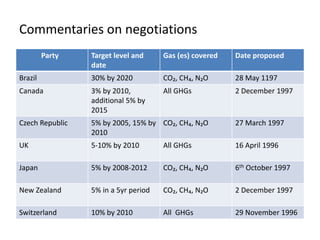
Commentaries on negotiations 
Party Target level and 
date 
Gas (es) covered Date proposed 
Brazil 30% by 2020 CO₂, CH₄, N₂O 28 May 1197 
Canada 3% by 2010, 
additional 5% by 
2015 
All GHGs 2 December 1997 
Czech Republic 5% by 2005, 15% by 
2010 
CO₂, CH₄, N₂O 27 March 1997 
UK 5-10% by 2010 All GHGs 16 April 1996 
Japan 5% by 2008-2012 CO₂, CH₄, N₂O 6th October 1997 
New Zealand 5% in a 5yr period CO₂, CH₄, N₂O 2 December 1997 
Switzerland 10% by 2010 All GHGs 29 November 1996
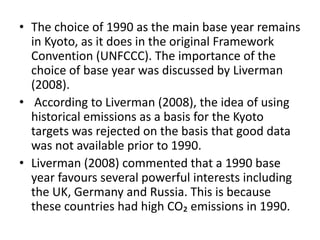
• The choice of 1990 as the main base year remains 
in Kyoto, as it does in the original Framework 
Convention (UNFCCC). The importance of the 
choice of base year was discussed by Liverman 
(2008). 
• According to Liverman (2008), the idea of using 
historical emissions as a basis for the Kyoto 
targets was rejected on the basis that good data 
was not available prior to 1990. 
• Liverman (2008) commented that a 1990 base 
year favours several powerful interests including 
the UK, Germany and Russia. This is because 
these countries had high CO₂ emissions in 1990.
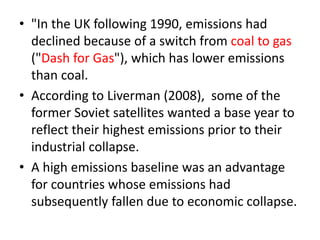
• "In the UK following 1990, emissions had 
declined because of a switch from coal to gas 
("Dash for Gas"), which has lower emissions 
than coal. 
• According to Liverman (2008), some of the 
former Soviet satellites wanted a base year to 
reflect their highest emissions prior to their 
industrial collapse. 
• A high emissions baseline was an advantage 
for countries whose emissions had 
subsequently fallen due to economic collapse.
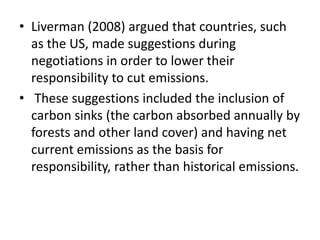
• Liverman (2008) argued that countries, such 
as the US, made suggestions during 
negotiations in order to lower their 
responsibility to cut emissions. 
• These suggestions included the inclusion of 
carbon sinks (the carbon absorbed annually by 
forests and other land cover) and having net 
current emissions as the basis for 
responsibility, rather than historical emissions.
CRITICISM 
• Some argue the protocol does not go far enough 
to curb greenhouse emissions. 
• Some environmental economists have been 
critical of the Kyoto Protocol. 
• Many see the costs of the Kyoto Protocol as 
outweighing the benefits, some believing the 
standards which Kyoto sets to be too optimistic. 
• Others seeing a highly inequitable and inefficient 
agreement which would do little to curb 
greenhouse gas emissions.
• Stavins (2005) criticized the Protocol as doing 
"too little, too fast," in that it asks for excessively 
costly short-term reductions in emissions, 
without determining what should be done over 
longer timeframes. 
• The Protocol does not provide any guidance or 
formulae linking the action required in the first 
commitment period to an overall global quantity 
constraint on emissions, or to a long-term 
timetable for emissions reductions.
CONCLUSION 
• A comprehensive emissions reduction strategy 
must set a long-term goal for atmospheric 
concentrations of CO2, combining International 
Protocols with efficiency initiatives, financial 
markets intervention (Cap & Trade) and 
engineering ingenuity if it is to work. 
• The impacts of climate change are not evenly 
distributed – the poorest countries and people 
will suffer earliest and most. And if the damages 
appear it will be too late to reverse the process.
Thank You 
T

Kyoto protocol (Pre/Post)

  • 1.
    KYOTO PROTOCOL Presentedby : ANUJ KUMAR
  • 2.
    What is kyotoprotocol? • The Kyoto Protocol is a protocol linked to the United Nations Framework Convention on Climate Change (UNFCCC or FCCC), aimed at fighting global warming. • The UNFCCC is an international environmental treaty with the goal of achieving the "stabilization of greenhouse gas concentrations in the atmosphere at a level that would prevent dangerous anthropogenic interference with the climate system."
  • 3.
    UNFCCC VS KYOTOPROTOCOL • The major distinction between the Protocol and the Convention is that while the Convention encouraged industrialised countries to stabilize GHG emissions, the Protocol commits them to do so.
  • 4.
    background • TheKyoto Protocol was negotiated in Kyoto, Japan, in December 1997. • It was opened for signature on March 16, 1998, and closed a year later. • Ratifying countries had to represent at least 55 percent of the world’s total carbon dioxide emissions for 1990. • The first condition was met on May 23, 2002, when Iceland became the 55th country to ratify the Kyoto Protocol.
  • 5.
    • When Russiaratified the agreement in November 2004, Kyoto Protocol entered into force on February 16, 2005. • As a U.S. presidential candidate, George W. Bush promised to reduce carbon dioxide emissions.
  • 6.
    • As ofApril 2010, 191 states have signed and ratified the protocol. • Those states are : China Maldives Sri lanka Malaysia Poland New Zealand South Korea and many other countries
  • 7.
    • Under theProtocol, 37 countries, the "Annex I countries" (Australia, Austria, Canada, Finland, Germany, United Kingdom, United States of America etc.) commit themselves to a reduction of four greenhouse gases (carbon dioxide, methane, nitrous oxide, sulphur hexafluoride) and two groups of gases (hydrofluorocarbons and perfluorocarbons) produced by them, and all member countries give general commitments.
  • 8.
    • Annex Icountries agreed to reduce their collective greenhouse gas emissions by 5.2% from the 1990 level (but note that, compared to the emissions levels that would be expected by 2010 without the Protocol, this target represents a 29% cut) • National targets range from 8% reductions for the European Union and some others to 7% for the US, 6% for Japan and permitted increases of 8% for Australia and 10% for Iceland.
  • 9.
    • Since thegoal of the Kyoto Protocol is to reduce worldwide greenhouse gas emissions, it sets specific emissions reduction targets for each industrialized nation, but excludes developing countries. • To meet their targets, most ratifying nations would have to combine several strategies: 1. place restrictions on their biggest polluters. 2. manage transportation to slow or reduce emissions from automobiles. 3. make better use of renewable energy sources—such as solar power, wind power, and biodiesel—in place of fossil fuels.
  • 10.
    Mechanisms under kyotoprotocol • Flexible mechanisms, also sometimes knows as Flexibility Mechanisms or Kyoto Mechanisms, refers to Emissions Trading, the Clean Development Mechanism and Joint Implementation. • These are mechanisms defined under the Kyoto Protocol intended to lower the overall costs of achieving its emissions targets.
  • 11.
    • These mechanismsenable parties to achieve emission reductions or to remove carbon from the atmosphere cost-effectively in other countries. • While the cost of limiting emissions varies considerably from region to region, the benefit for the atmosphere is in principle the same, wherever the action is taken.
  • 12.
    • The EmissionsTrading-mechanism allows parties to the Kyoto-protocol to buy greenhouse gas emission permits from other countries to help meet their domestic emission reduction targets. • Through the Joint Implementation, industrialised countries with a greenhouse gas reduction commitment of Annex 1 countries may fund emission reducing projects in other industrialised countries as an alternative to emission reductions in their own countries.
  • 13.
    • The CleanDevelopment Mechanism (CDM) is an arrangement under the Kyoto Protocol allowing industrialised countries with a greenhouse gas reduction commitment of Annex 1 countries to invest in projects that reduce emissions in developing countries. • The CDM allows net global greenhouse gas emissions to be reduced at a much lower global cost by financing emissions reduction projects in developing countries where costs are lower than in industrialised countries.
  • 14.
    Current status? •Most of the world’s industrialized nations support the Kyoto Protocol. • Australia also declined in the emissions of those gases. • One notable exception is the United States, which releases more greenhouse gases than any other nation and accounts for more than 25 percent of those generated by humans worldwide.
  • 15.
    Post- Kyoto Protocol • It refer to high level talks attempting to address global warming by limiting greenhouse gas emissions. • Generally part of the United Nations Framework Convention on Climate Change (UNFCCC), these talks concern the period after the first "commitment period" of the Kyoto Protocol, which expired at the end of 2012. Negotiations have been mandated by the adoption of the Bali Road Map and Decision 1/CP.13 ("The Bali Action Plan").
  • 16.
    • UNFCCC negotiationsare conducted within two subsidiary bodies, the Ad Hoc Working Group on Long-term Cooperative Action under the Convention (AWG-LCA) and the Ad Hoc Working Group on Further Commitments for Annex I Parties under the Kyoto Protocol (AWG-KP). • The United Nations Climate Change Conference take place in December 2009 in Copenhagen (COP-15); negotiations are supported by a number of external processes, including the G8 process, a number of regional meetings and the Major Economies Forum on Energy and Climate that was launched by US President Barack Obama in March 2009.
  • 17.
    • On February16, 2007, The Global Legislators Organisation (GLOBE International) held a meeting of the G8+5 Climate Change Dialogue at the GLOBE Washington Legislators Forum in Washington, D.C. • Where a non-binding agreement was reached to co-operate on tackling global warming. • The group accepted that the existence of man-made climate change was beyond doubt and there should be a global system of emission caps and carbon emissions trading applying to both industrialized nations and developing countries.
  • 18.
    • The leadersat the 33rd G8 summit issued a non-binding communiqué announcing that the G8 nations would "aim to at least halve global CO2 emissions by 2050". • In 2007 UN General Assembly plenary debate on climate change that include adaptation, mitigation, clean technologies, deforestation. • In 2007 Vienna Climate Change Talks and agreement. • In 2007 United Nations Climate Change Conference held in Bali, where a meeting of environment ministers and experts held to agree-
  • 19.
    on a road-map,timetable and "concrete steps for the negotiations" with a view to reaching an agreement. • September 2009 United Nations Secretary General's Summit on Climate Change to which Heads of State and Government have been invited. This event was intended to build further political momentum for an ambitious Copenhagen agreed outcome to be adopted at COP-15. • In 2011, 2012, 2013 United Nations Climate Change Conference. • At 23rd September 2014, the UN Climate Summit 2014 was held. India, Russia, Canada and Australia did not attend the meeting. 125 other countries did attend. The beginning of the private investors and large companies now withdrawing from polluting industries, at a time when the political motivation for reducing GHG emissions is starting to stall.
  • 20.
    PRE- KYOTO PROTOCOL • A 2007 study by Gupta et al. assessed the literature on climate change policy which showed no authoritative assessments of the UNFCCC or its Protocol, that assert these agreements have, or will, succeed in fully solving the climate problem. • It was assumed that the UNFCCC or its Protocol would not be changed. The Framework Convention and its Protocol, include provisions for future policy actions to be taken.
  • 21.
    Commentaries on negotiations Party Target level and date Gas (es) covered Date proposed Brazil 30% by 2020 CO₂, CH₄, N₂O 28 May 1197 Canada 3% by 2010, additional 5% by 2015 All GHGs 2 December 1997 Czech Republic 5% by 2005, 15% by 2010 CO₂, CH₄, N₂O 27 March 1997 UK 5-10% by 2010 All GHGs 16 April 1996 Japan 5% by 2008-2012 CO₂, CH₄, N₂O 6th October 1997 New Zealand 5% in a 5yr period CO₂, CH₄, N₂O 2 December 1997 Switzerland 10% by 2010 All GHGs 29 November 1996
  • 22.
    • The choiceof 1990 as the main base year remains in Kyoto, as it does in the original Framework Convention (UNFCCC). The importance of the choice of base year was discussed by Liverman (2008). • According to Liverman (2008), the idea of using historical emissions as a basis for the Kyoto targets was rejected on the basis that good data was not available prior to 1990. • Liverman (2008) commented that a 1990 base year favours several powerful interests including the UK, Germany and Russia. This is because these countries had high CO₂ emissions in 1990.
  • 23.
    • "In theUK following 1990, emissions had declined because of a switch from coal to gas ("Dash for Gas"), which has lower emissions than coal. • According to Liverman (2008), some of the former Soviet satellites wanted a base year to reflect their highest emissions prior to their industrial collapse. • A high emissions baseline was an advantage for countries whose emissions had subsequently fallen due to economic collapse.
  • 24.
    • Liverman (2008)argued that countries, such as the US, made suggestions during negotiations in order to lower their responsibility to cut emissions. • These suggestions included the inclusion of carbon sinks (the carbon absorbed annually by forests and other land cover) and having net current emissions as the basis for responsibility, rather than historical emissions.
  • 25.
    CRITICISM • Someargue the protocol does not go far enough to curb greenhouse emissions. • Some environmental economists have been critical of the Kyoto Protocol. • Many see the costs of the Kyoto Protocol as outweighing the benefits, some believing the standards which Kyoto sets to be too optimistic. • Others seeing a highly inequitable and inefficient agreement which would do little to curb greenhouse gas emissions.
  • 26.
    • Stavins (2005)criticized the Protocol as doing "too little, too fast," in that it asks for excessively costly short-term reductions in emissions, without determining what should be done over longer timeframes. • The Protocol does not provide any guidance or formulae linking the action required in the first commitment period to an overall global quantity constraint on emissions, or to a long-term timetable for emissions reductions.
  • 27.
    CONCLUSION • Acomprehensive emissions reduction strategy must set a long-term goal for atmospheric concentrations of CO2, combining International Protocols with efficiency initiatives, financial markets intervention (Cap & Trade) and engineering ingenuity if it is to work. • The impacts of climate change are not evenly distributed – the poorest countries and people will suffer earliest and most. And if the damages appear it will be too late to reverse the process.
  • 28.