A Complementary Action to the IEL on Issuing a Solution to the Global Warming Problem International Environmental Law
Content:  A complementary action to the IEL on issuing a solution to the global warming problem Introduction Past Present Future: conclusions Case study
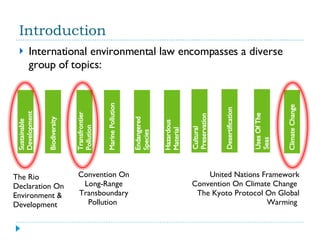
Introduction International environmental law encompasses a diverse group of topics: Sustainable Development   Biodiversity  Transfrontier Pollution Marine Pollution   Endangered Species   Hazardous Material Cultural Preservation   Desertification   Uses Of The Seas   Climate Change The Rio Declaration On Environment & Development  Convention On Long-Range Transboundary Pollution  United Nations Framework Convention On Climate Change  The Kyoto Protocol On Global Warming
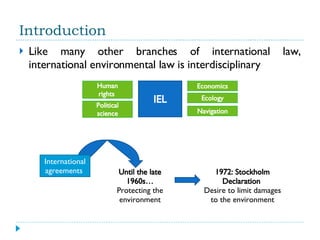
Introduction Like many other branches of international law, international environmental law is interdisciplinary Economics Political science Ecology Navigation Human rights  IEL International agreements  Until the late 1960s… Protecting the environment 1972: Stockholm Declaration  Desire to limit damages to the environment
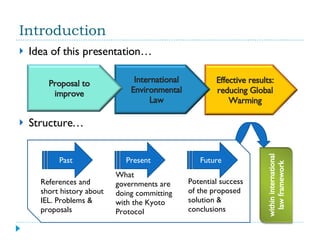
Introduction Idea of this presentation… Structure… R eferences and short history about IEL. Problems & proposals What governments are doing committing with the Kyoto Protocol  Potential success of the proposed solution & conclusions Past Present Future Effective results: reducing Global Warming International Environmental Law Proposal to improve within international law framework
Content:  A complementary action to the IEL on issuing a solution to the global warming problem Introduction Past Present Future: conclusions Case study
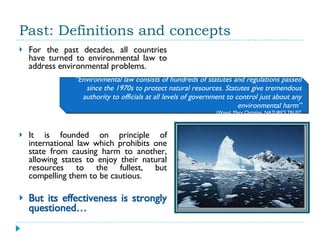
Past: Definitions and concepts For the past decades, all countries have turned to environmental law to address environmental problems.  It is founded on principle of international law which prohibits one state from causing harm to another, allowing states to enjoy their natural resources to the fullest, but compelling them to be cautious. But its effectiveness is strongly questioned… “ Environmental law consists of hundreds of statutes and regulations passed since the 1970s to protect natural resources. Statutes give tremendous authority to officials at all levels of government to control just about any environmental harm” (Wood, Mary Christina. NATURE'S TRUST
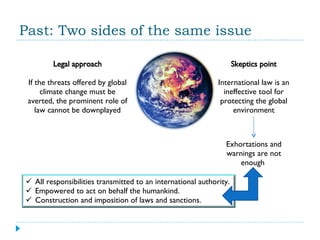
Past: Two sides of the same issue Legal approach If the threats offered by global climate change must be averted, the prominent role of law cannot be downplayed Skeptics point International law is an ineffective tool for protecting the global environment Exhortations and warnings are not enough  All responsibilities transmitted to an international authority. Empowered to act on behalf the humankind. Construction and imposition of laws and sanctions.

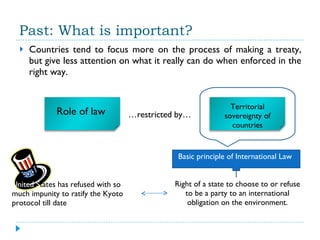
Past: What is important? Countries tend to focus more on the process of making a treaty, but give less attention on what it really can do when enforced in the right way. … restricted by…  Basic principle of International Law Right of a state to choose to or refuse to be a party to an international obligation on the environment. United S tates has refused with so much impunity to ratify the Kyoto protocol till date Role of law  Territorial sovereignty of countries
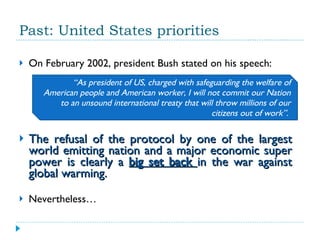
Past: United States priorities On February 2002, president Bush stated on his speech:  The refusal of the protocol by one of the largest world emitting nation and a major economic super power is clearly a  big set back  in the war against global warming. Nevertheless… “ As president of US, charged with safeguarding the welfare of American people and American worker, I will not commit our Nation to an unsound international treaty that will throw millions of our citizens out of work”.
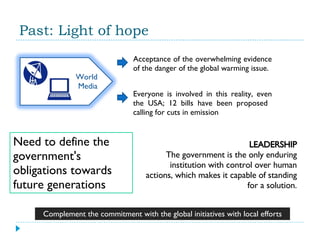
Past: Light of hope Acceptance of the overwhelming evidence of the danger of the global warming issue. Everyone is involved in this reality, even the USA; 12 bills have been proposed  calling for cuts in emission Need to define the government's obligations towards future generations LEADERSHIP The government is the only enduring institution with control over human actions, which makes it capable of standing for a solution. Complement the commitment with the global initiatives with local efforts World Media
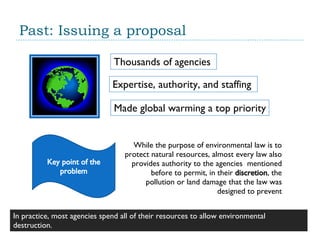
Past: Issuing a proposal Thousands of agencies  Expertise, authority, and staffing  Made global warming a top priority Key point of the problem While the purpose of environmental law is to protect natural resources, almost every law also provides authority to the agencies  mentioned before to permit, in their  discretion ,  the pollution or land damage that the law was designed to prevent In practice, most agencies spend all of their resources to allow environmental destruction.
Content:  A complementary action to the IEL on issuing a solution to the global warming problem Introduction Past Present Future: conclusions Case study
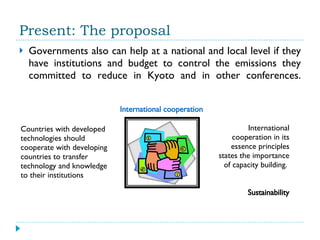
Present: The proposal Governments also can help at a national and local level if they have institutions and budget to control the emissions they committed to reduce in Kyoto and in other conferences. International cooperation Countries with developed technologies should cooperate with developing countries to transfer technology and knowledge to their institutions  International cooperation in its essence principles states the importance of capacity building.  Sustainability
Present: The starting point is the law According to the Kyoto Protocol… “ All parties shall cooperate in and promote at the international level, and, where appropriate, using existing bodies, the development and implementation of education and training programmes, including the strengthening of national capacity building”. (Kyoto Protocol)
Present: Political will Government’s help at a national and local level: Based on  Political will.  It grows overnight when citizens demand action.  Problem… Most people do not perceive global warming as an immediate threat.  Without a sense of immediate loss, the public will not feel the urgency to demand government to take leadership Create sense of urgency and reality in the people People are more focused on their energy on reducing their own contamination rather than holding their leaders accountable.
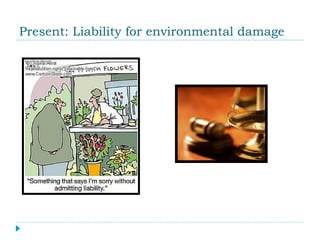
Present: Liability for environmental damage
Present: Important Concepts The polluter pays Environmental impact assessment  (EIA) The precautionary approach or precautionary principle: The polluter pays
Content:  A complementary action to the IEL on issuing a solution to the global warming problem Introduction Past Present Future: conclusions Case study
 
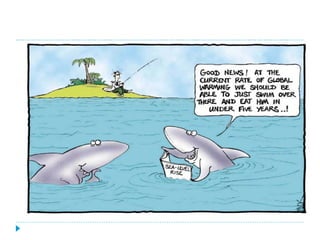
Future: Conclusions Here some effects of global warming in 100 years in time: Warming of up to six degrees Celsius (which can be the difference between an ice age and an interglacial period). Sea level rise of up to 60 centimeters (the threat to hundred of millions of people in the river deltas and islands around the globe).  Intense weather extremes (hurricanes, floods and droughts). Disappearance of mountain glaciers.  The spread of infectious diseases like malaria.
Future: Conclusions At this point the  Kyoto Protocol had been ratified by 151 states and the European Community. To enter in to force, it needed 55 % of the states whose aggregate carbon dioxide emissions for 1990 amount to 55 % of total emissions. Since emissions from Russia and the United States are such large proportion of the total, in practice this needed at least one of them to ratified, which Russia did in 2004. The Protocol then entered in force in 2005, without USA, the protocol’s effectiveness will be that much less, though its approach remains controversial. (Aust, 2005: 340)
Future: Conclusions “ All countries should take climate change concerns as seriously as possible by enacting domestic legislations which limits emission reduction within their territories. Legislations at national levels which restrict GHG emitting activities by industries and by large emitting sectors will go along way to reduce aggregate emissions in industrialized countries ”  DAMILOLA, Sunday Olawuyi. (2007) Detonating the Global Climate Change Time Bomb: The Role of Law. University of Calgary - Faculty of Law
Future: Conclusions The promotion of sustainable development through legal means at national and international levels has led to recognition of judicial efforts to develop and consolidate environmental law. The intervention of the judiciary is necessary to the development of environmental law, particularly in implementation and enforcement of laws and regulatory provisions dealing with environmental conservation and management. (UNEP: 1998)
The Future: The Conclusion. Environmental protection and the conservation of natural resources would keep competing with the commercial interest worldwide.
Content:  A complementary action to the IEL on issuing a solution to the global warming problem Introduction Past Present Future: conclusions Case study
Case study: Trail Smelter. U.S vs Canada (1937) What happened?  The dispute arose as a result of damage occurring in the territory of the US due to activity of a smelter situated in Canada. The damage arose from sulphur dioxide fumes which were emitted from the smelter. It was claimed that the height of stacks increased the area of damage in the US.  In 1927 the US proposed that the matter be referred to the  International Joint Commission for investigation . Its report was presented in 1931. It determined that up to 1 January 1932 the damages incurred by the US should be compensated in the sum of US $350,000.  Two years after this Report the US indicated to Canada that damage was still occurring and negotiations were renewed leading to the signing of the Convention.
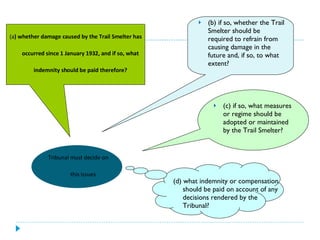
(d) what indemnity or compensation should be paid on account of any decisions rendered by the Tribunal? (c) if so, what measures or regime should be adopted or maintained by the Trail Smelter? (b) if so, whether the Trail Smelter should be required to refrain from causing damage in the future and, if so, to what extent? ( a ) whether damage caused by the Trail Smelter has occurred since 1 January 1932, and if so, what indemnity should be paid therefore? Tribunal must decide on this issues
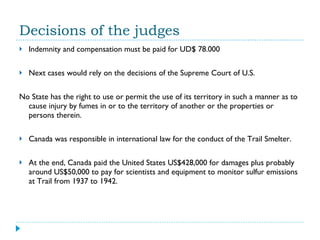
Decisions of the judges Indemnity and compensation must be paid for UD$ 78.000 Next cases would rely on the decisions of the Supreme Court of U.S.  No State has the right to use or permit the use of its territory in such a manner as to cause injury by fumes in or to the territory of another or the properties or persons therein. Canada was responsible in international law for the conduct of the Trail Smelter. At the end, Canada paid the United States US$428,000 for damages plus probably around US$50,000 to pay for scientists and equipment to monitor sulfur emissions at Trail from 1937 to 1942.
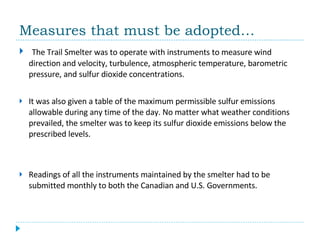
Measures that must be adopted… The Trail Smelter was to operate with instruments to measure wind direction and velocity, turbulence, atmospheric temperature, barometric pressure, and sulfur dioxide concentrations.  It was also given a table of the maximum permissible sulfur emissions allowable during any time of the day. No matter what weather conditions prevailed, the smelter was to keep its sulfur dioxide emissions below the prescribed levels.  Readings of all the instruments maintained by the smelter had to be submitted monthly to both the Canadian and U.S. Governments.
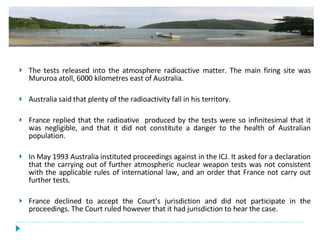
Case Study:  Nuclear test case. France vs Australia 1966 - 1972 What Happened?  Between 1966 and 1972 France had conducted atmospheric tests of nuclear weapons in the territory of French Polynesia in the South Pacific Ocean. This had released into the atmosphere radioactive matter.  France created “prohibited zones” for aircraft and “dangerous zones” for aircraft and shipping, in order to exclude aircraft and shipping from the area. These zones had been put into effect during the period of testing in each year in which the tests had been carried out.
 
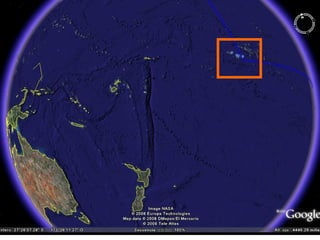
The tests released into the atmosphere radioactive matter. The main firing site was Mururoa atoll, 6000 kilometres east of Australia.  Australia said that plenty of the radioactivity fall in his territory. France replied that the radioative  produced by the tests were so infinitesimal that it was negligible, and that it did not constitute a danger to the health of Australian population. In May 1993 Australia instituted proceedings against in the ICJ. It asked for a declaration that the carrying out of further atmospheric nuclear weapon tests was not consistent with the applicable rules of international law, and an order that France not carry out further tests.  France declined to accept the Court’s jurisdiction and did not participate in the proceedings. The Court ruled however that it had jurisdiction to hear the case.
Australia claimed that France had violated the following rights: a right possessed by every state to be free from atmospheric nuclear tests conducted by any state arising from what is now a generally accepted rule of customary international law prohibiting all such tests; a right inherent in Australia’s own territorial sovereignity to be free from the deposit on her territory and dispersion in her air space, without her consent, of radioactive fall-out from the nuclear tests.
But the court… The Court held that before deciding on the legality of the tests it needed to examine, as a preliminary matter, the Court had to decide the true object and purpose of the claim. THE SOLUTION… The Court held therefore that, in announcing that the 1974 series of tests would be the last, the French Government conveyed to the world at large its intention to terminate the tests. In light of this development Australia’s objective had in effect been accomplished in as much as France had undertaken to hold no further atmospheric tests. These declarations had caused the dispute between the parties to disappear. Therefore, no further judicial action was required as there was nothing on which to give judgement.
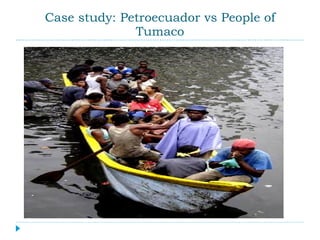
Case study: Petroecuador vs People of Tumaco
Thank you! April 16th 2008 ANY QUESTION !!!

International Environmental Law

  • 1.
    A Complementary Actionto the IEL on Issuing a Solution to the Global Warming Problem International Environmental Law
  • 2.
    Content: Acomplementary action to the IEL on issuing a solution to the global warming problem Introduction Past Present Future: conclusions Case study
  • 3.
    Content: Acomplementary action to the IEL on issuing a solution to the global warming problem Introduction Past Present Future: conclusions Case study
  • 4.
    Introduction International environmentallaw encompasses a diverse group of topics: Sustainable Development Biodiversity Transfrontier Pollution Marine Pollution Endangered Species Hazardous Material Cultural Preservation Desertification Uses Of The Seas Climate Change The Rio Declaration On Environment & Development Convention On Long-Range Transboundary Pollution United Nations Framework Convention On Climate Change The Kyoto Protocol On Global Warming
  • 5.
    Introduction Like manyother branches of international law, international environmental law is interdisciplinary Economics Political science Ecology Navigation Human rights IEL International agreements Until the late 1960s… Protecting the environment 1972: Stockholm Declaration Desire to limit damages to the environment
  • 6.
    Introduction Idea ofthis presentation… Structure… R eferences and short history about IEL. Problems & proposals What governments are doing committing with the Kyoto Protocol Potential success of the proposed solution & conclusions Past Present Future Effective results: reducing Global Warming International Environmental Law Proposal to improve within international law framework
  • 7.
    Content: Acomplementary action to the IEL on issuing a solution to the global warming problem Introduction Past Present Future: conclusions Case study
  • 8.
    Past: Definitions andconcepts For the past decades, all countries have turned to environmental law to address environmental problems. It is founded on principle of international law which prohibits one state from causing harm to another, allowing states to enjoy their natural resources to the fullest, but compelling them to be cautious. But its effectiveness is strongly questioned… “ Environmental law consists of hundreds of statutes and regulations passed since the 1970s to protect natural resources. Statutes give tremendous authority to officials at all levels of government to control just about any environmental harm” (Wood, Mary Christina. NATURE'S TRUST
  • 9.
    Past: Two sidesof the same issue Legal approach If the threats offered by global climate change must be averted, the prominent role of law cannot be downplayed Skeptics point International law is an ineffective tool for protecting the global environment Exhortations and warnings are not enough All responsibilities transmitted to an international authority. Empowered to act on behalf the humankind. Construction and imposition of laws and sanctions.
  • 10.
    Past: What isimportant? Countries tend to focus more on the process of making a treaty, but give less attention on what it really can do when enforced in the right way. … restricted by… Basic principle of International Law Right of a state to choose to or refuse to be a party to an international obligation on the environment. United S tates has refused with so much impunity to ratify the Kyoto protocol till date Role of law Territorial sovereignty of countries
  • 11.
    Past: United Statespriorities On February 2002, president Bush stated on his speech: The refusal of the protocol by one of the largest world emitting nation and a major economic super power is clearly a big set back in the war against global warming. Nevertheless… “ As president of US, charged with safeguarding the welfare of American people and American worker, I will not commit our Nation to an unsound international treaty that will throw millions of our citizens out of work”.
  • 12.
    Past: Light ofhope Acceptance of the overwhelming evidence of the danger of the global warming issue. Everyone is involved in this reality, even the USA; 12 bills have been proposed calling for cuts in emission Need to define the government's obligations towards future generations LEADERSHIP The government is the only enduring institution with control over human actions, which makes it capable of standing for a solution. Complement the commitment with the global initiatives with local efforts World Media
  • 13.
    Past: Issuing aproposal Thousands of agencies Expertise, authority, and staffing Made global warming a top priority Key point of the problem While the purpose of environmental law is to protect natural resources, almost every law also provides authority to the agencies mentioned before to permit, in their discretion , the pollution or land damage that the law was designed to prevent In practice, most agencies spend all of their resources to allow environmental destruction.
  • 14.
    Content: Acomplementary action to the IEL on issuing a solution to the global warming problem Introduction Past Present Future: conclusions Case study
  • 15.
    Present: The proposalGovernments also can help at a national and local level if they have institutions and budget to control the emissions they committed to reduce in Kyoto and in other conferences. International cooperation Countries with developed technologies should cooperate with developing countries to transfer technology and knowledge to their institutions International cooperation in its essence principles states the importance of capacity building. Sustainability
  • 16.
    Present: The startingpoint is the law According to the Kyoto Protocol… “ All parties shall cooperate in and promote at the international level, and, where appropriate, using existing bodies, the development and implementation of education and training programmes, including the strengthening of national capacity building”. (Kyoto Protocol)
  • 17.
    Present: Political willGovernment’s help at a national and local level: Based on Political will. It grows overnight when citizens demand action. Problem… Most people do not perceive global warming as an immediate threat. Without a sense of immediate loss, the public will not feel the urgency to demand government to take leadership Create sense of urgency and reality in the people People are more focused on their energy on reducing their own contamination rather than holding their leaders accountable.
  • 18.
    Present: Liability forenvironmental damage
  • 19.
    Present: Important ConceptsThe polluter pays Environmental impact assessment (EIA) The precautionary approach or precautionary principle: The polluter pays
  • 20.
    Content: Acomplementary action to the IEL on issuing a solution to the global warming problem Introduction Past Present Future: conclusions Case study
  • 21.
  • 22.
    Future: Conclusions Heresome effects of global warming in 100 years in time: Warming of up to six degrees Celsius (which can be the difference between an ice age and an interglacial period). Sea level rise of up to 60 centimeters (the threat to hundred of millions of people in the river deltas and islands around the globe). Intense weather extremes (hurricanes, floods and droughts). Disappearance of mountain glaciers. The spread of infectious diseases like malaria.
  • 23.
    Future: Conclusions Atthis point the Kyoto Protocol had been ratified by 151 states and the European Community. To enter in to force, it needed 55 % of the states whose aggregate carbon dioxide emissions for 1990 amount to 55 % of total emissions. Since emissions from Russia and the United States are such large proportion of the total, in practice this needed at least one of them to ratified, which Russia did in 2004. The Protocol then entered in force in 2005, without USA, the protocol’s effectiveness will be that much less, though its approach remains controversial. (Aust, 2005: 340)
  • 24.
    Future: Conclusions “All countries should take climate change concerns as seriously as possible by enacting domestic legislations which limits emission reduction within their territories. Legislations at national levels which restrict GHG emitting activities by industries and by large emitting sectors will go along way to reduce aggregate emissions in industrialized countries ” DAMILOLA, Sunday Olawuyi. (2007) Detonating the Global Climate Change Time Bomb: The Role of Law. University of Calgary - Faculty of Law
  • 25.
    Future: Conclusions Thepromotion of sustainable development through legal means at national and international levels has led to recognition of judicial efforts to develop and consolidate environmental law. The intervention of the judiciary is necessary to the development of environmental law, particularly in implementation and enforcement of laws and regulatory provisions dealing with environmental conservation and management. (UNEP: 1998)
  • 26.
    The Future: TheConclusion. Environmental protection and the conservation of natural resources would keep competing with the commercial interest worldwide.
  • 27.
    Content: Acomplementary action to the IEL on issuing a solution to the global warming problem Introduction Past Present Future: conclusions Case study
  • 28.
    Case study: TrailSmelter. U.S vs Canada (1937) What happened? The dispute arose as a result of damage occurring in the territory of the US due to activity of a smelter situated in Canada. The damage arose from sulphur dioxide fumes which were emitted from the smelter. It was claimed that the height of stacks increased the area of damage in the US. In 1927 the US proposed that the matter be referred to the International Joint Commission for investigation . Its report was presented in 1931. It determined that up to 1 January 1932 the damages incurred by the US should be compensated in the sum of US $350,000. Two years after this Report the US indicated to Canada that damage was still occurring and negotiations were renewed leading to the signing of the Convention.
  • 29.
    (d) what indemnityor compensation should be paid on account of any decisions rendered by the Tribunal? (c) if so, what measures or regime should be adopted or maintained by the Trail Smelter? (b) if so, whether the Trail Smelter should be required to refrain from causing damage in the future and, if so, to what extent? ( a ) whether damage caused by the Trail Smelter has occurred since 1 January 1932, and if so, what indemnity should be paid therefore? Tribunal must decide on this issues
  • 30.
    Decisions of thejudges Indemnity and compensation must be paid for UD$ 78.000 Next cases would rely on the decisions of the Supreme Court of U.S. No State has the right to use or permit the use of its territory in such a manner as to cause injury by fumes in or to the territory of another or the properties or persons therein. Canada was responsible in international law for the conduct of the Trail Smelter. At the end, Canada paid the United States US$428,000 for damages plus probably around US$50,000 to pay for scientists and equipment to monitor sulfur emissions at Trail from 1937 to 1942.
  • 31.
    Measures that mustbe adopted… The Trail Smelter was to operate with instruments to measure wind direction and velocity, turbulence, atmospheric temperature, barometric pressure, and sulfur dioxide concentrations. It was also given a table of the maximum permissible sulfur emissions allowable during any time of the day. No matter what weather conditions prevailed, the smelter was to keep its sulfur dioxide emissions below the prescribed levels. Readings of all the instruments maintained by the smelter had to be submitted monthly to both the Canadian and U.S. Governments.
  • 32.
    Case Study: Nuclear test case. France vs Australia 1966 - 1972 What Happened? Between 1966 and 1972 France had conducted atmospheric tests of nuclear weapons in the territory of French Polynesia in the South Pacific Ocean. This had released into the atmosphere radioactive matter. France created “prohibited zones” for aircraft and “dangerous zones” for aircraft and shipping, in order to exclude aircraft and shipping from the area. These zones had been put into effect during the period of testing in each year in which the tests had been carried out.
  • 33.
  • 34.
    The tests releasedinto the atmosphere radioactive matter. The main firing site was Mururoa atoll, 6000 kilometres east of Australia. Australia said that plenty of the radioactivity fall in his territory. France replied that the radioative produced by the tests were so infinitesimal that it was negligible, and that it did not constitute a danger to the health of Australian population. In May 1993 Australia instituted proceedings against in the ICJ. It asked for a declaration that the carrying out of further atmospheric nuclear weapon tests was not consistent with the applicable rules of international law, and an order that France not carry out further tests. France declined to accept the Court’s jurisdiction and did not participate in the proceedings. The Court ruled however that it had jurisdiction to hear the case.
  • 35.
    Australia claimed thatFrance had violated the following rights: a right possessed by every state to be free from atmospheric nuclear tests conducted by any state arising from what is now a generally accepted rule of customary international law prohibiting all such tests; a right inherent in Australia’s own territorial sovereignity to be free from the deposit on her territory and dispersion in her air space, without her consent, of radioactive fall-out from the nuclear tests.
  • 36.
    But the court…The Court held that before deciding on the legality of the tests it needed to examine, as a preliminary matter, the Court had to decide the true object and purpose of the claim. THE SOLUTION… The Court held therefore that, in announcing that the 1974 series of tests would be the last, the French Government conveyed to the world at large its intention to terminate the tests. In light of this development Australia’s objective had in effect been accomplished in as much as France had undertaken to hold no further atmospheric tests. These declarations had caused the dispute between the parties to disappear. Therefore, no further judicial action was required as there was nothing on which to give judgement.
  • 37.
    Case study: Petroecuadorvs People of Tumaco
  • 38.
    Thank you! April16th 2008 ANY QUESTION !!!