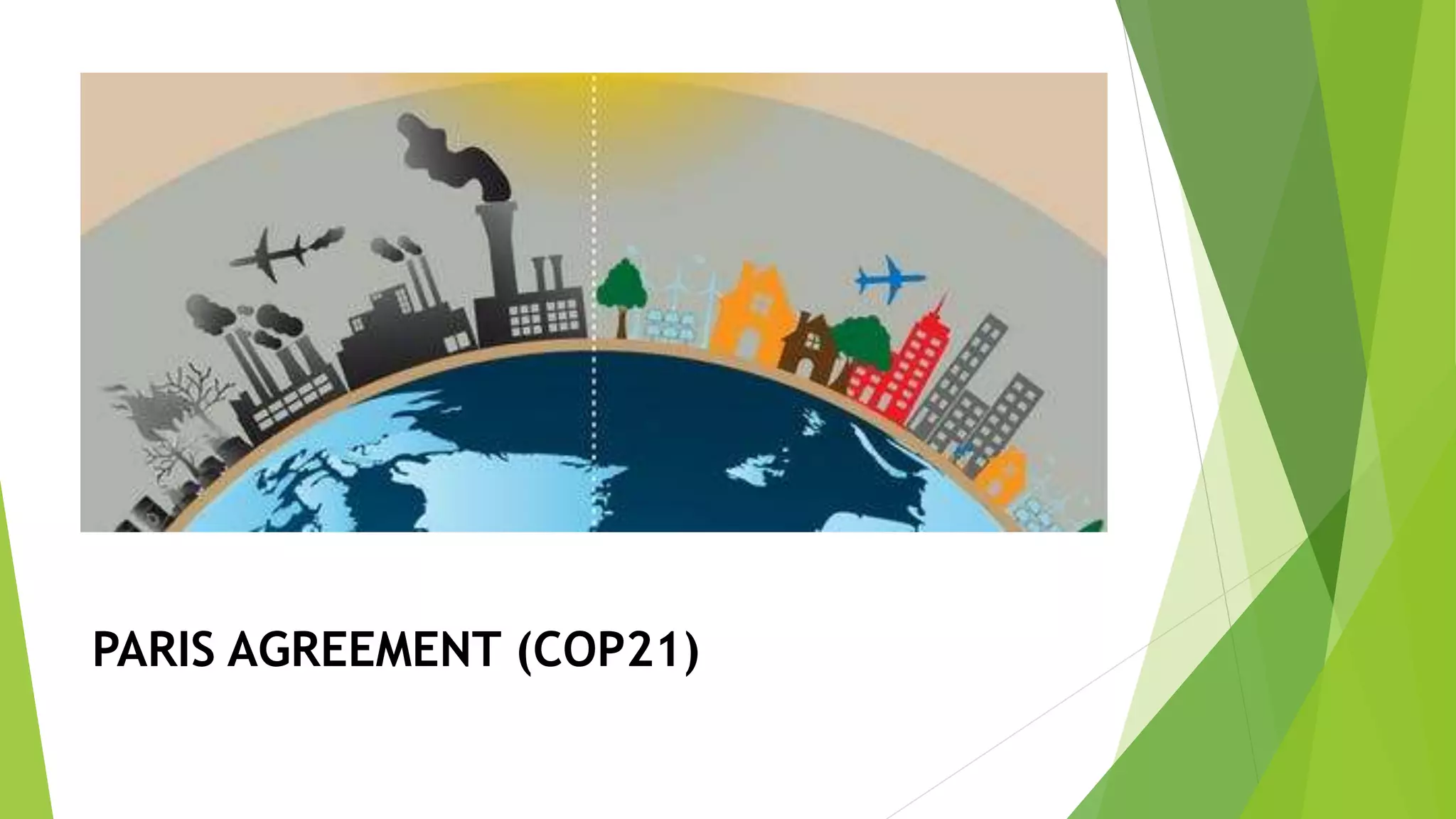




PARIS AGREEMENT (COP21)
Paris Agreement
 The Paris Agreement is an agreement within the
United Nations Framework Convention on Climate
Change, on climate change mitigation,
adaptation, and finance.
When and Where Started?
 22/04/2016
 Paris, France
Objective
 Reduce and Mitigate Greenhouse gas emission
Greenhouse Gases
 Carbon dioxide (CO2)
 Methane (CH4)
 Nitrous oxide (NO)
 Water vapour (H2O)
Greenhouse Gases Effects
 Climate change
 For human- Respiratory disease
 Air pollution
 Food supply disruption
 Increased wildfires
Goals of PA
 Curtail the raise of Global temp below 2 degree
celsius
 Support countries that are very vulnerable
 Developed countries to developing countries
provide financial and technological support
Targets 20|20|20
 CO2 emission reduction by 20%
 Increasing renewable energy market share by 20%
 Increase energy efficiency by 20%
NDC – Nationally Determined
Controbutions
 Need to be done by each country to achieve the
overall global goal
 Reported every 5 years to UNFCCC.
 Not legally binding
Goal of NDC
 Make sure that all countries have access to
technical expertise and financial capability to
meet the climate challenges
Climate Ambition Summit 2020
5th Anniversary of PA
 UN, France, UK in partnership with Itally and
Chile hosted in Glasgow Scotland
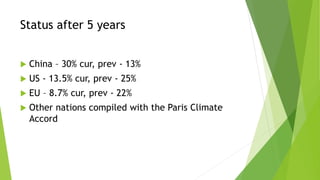
Status after 5 years
 China – 30% cur, prev - 13%
 US - 13.5% cur, prev - 25%
 EU – 8.7% cur, prev - 22%
 Other nations compiled with the Paris Climate
Accord
Paris Climate Accord
 It is a legally binding international treaty on
climate change that was adopted by 196 countries
at the Conference of the Parties COP 21 in Paris in
December 2015
India’s status of current emission
 UN Report – India’s per capita emission 60% lower
than the global average
 International Organization Report –
Emission grew – 1.4% in 2019
Over last decade – 3.3% per year
India’s plan to control emission
 National Solar Mission
 Bharat Stage (BS) VI norms
 National Wind – Solar Hybrid Policy 2018
Diff btw Kyoto Protocol & Paris
Agreement
 In Paris Agreement – No differences between
developed and developing countries
 In Kyoto Protocol – Differences by annex1
countries and non annex1 countries
Financial support pledged
 Developed countries have committed $ 100 Billion
a year
 $ 3 Billion commitment for Green Climate
 Finance would be balanced between mitigation
and adaptation
Article 6 of PA
 Help Governments establish and implement NDC
 Help establish a global price of carbon
 The use of establishing a global price in Carbon is
that if countries exceed their NDC, those
countries will have to bear the cost of global
warming
India at COP21
 Aiming to reach 40% of installed capacity from
non - fossi-fuels
 175 GW of renewable energy generation by 2022
 Enlarge forest cover to absorb 2.5 billion tonnes
worth of CO2
 Reducing dependence on fossil – fuels through
levies and reduction subsidies
“
”
குறள் 11:
வான்நின்று உலகம் வழங்கி வருதலால்
தான்அமிழ்தம் என்றுணரற் பாற்று
உரிய காலத்தில் இடைவிைாது மடழ பபய்வதால்தான் உலகம்
நிடலபபற்று வருகிறது; அதனால் மடழயய அமிழ்தம் எனலாம்.
By the continuance of rain the world is preserved in
existence; it is therefore worthy to be called ambrosia
THANKS FOR WATCHING
SUBSCRIBE FOR MORE VIDEOS

Paris agreement cop21

  • 1.
  • 2.
    Paris Agreement  TheParis Agreement is an agreement within the United Nations Framework Convention on Climate Change, on climate change mitigation, adaptation, and finance.
  • 3.
    When and WhereStarted?  22/04/2016  Paris, France
  • 4.
    Objective  Reduce andMitigate Greenhouse gas emission
  • 5.
    Greenhouse Gases  Carbondioxide (CO2)  Methane (CH4)  Nitrous oxide (NO)  Water vapour (H2O)
  • 6.
    Greenhouse Gases Effects Climate change  For human- Respiratory disease  Air pollution  Food supply disruption  Increased wildfires
  • 7.
    Goals of PA Curtail the raise of Global temp below 2 degree celsius  Support countries that are very vulnerable  Developed countries to developing countries provide financial and technological support
  • 8.
    Targets 20|20|20  CO2emission reduction by 20%  Increasing renewable energy market share by 20%  Increase energy efficiency by 20%
  • 9.
    NDC – NationallyDetermined Controbutions  Need to be done by each country to achieve the overall global goal  Reported every 5 years to UNFCCC.  Not legally binding
  • 10.
    Goal of NDC Make sure that all countries have access to technical expertise and financial capability to meet the climate challenges
  • 11.
    Climate Ambition Summit2020 5th Anniversary of PA  UN, France, UK in partnership with Itally and Chile hosted in Glasgow Scotland
  • 12.
    Status after 5years  China – 30% cur, prev - 13%  US - 13.5% cur, prev - 25%  EU – 8.7% cur, prev - 22%  Other nations compiled with the Paris Climate Accord
  • 13.
    Paris Climate Accord It is a legally binding international treaty on climate change that was adopted by 196 countries at the Conference of the Parties COP 21 in Paris in December 2015
  • 14.
    India’s status ofcurrent emission  UN Report – India’s per capita emission 60% lower than the global average  International Organization Report – Emission grew – 1.4% in 2019 Over last decade – 3.3% per year
  • 15.
    India’s plan tocontrol emission  National Solar Mission  Bharat Stage (BS) VI norms  National Wind – Solar Hybrid Policy 2018
  • 16.
    Diff btw KyotoProtocol & Paris Agreement  In Paris Agreement – No differences between developed and developing countries  In Kyoto Protocol – Differences by annex1 countries and non annex1 countries
  • 17.
    Financial support pledged Developed countries have committed $ 100 Billion a year  $ 3 Billion commitment for Green Climate  Finance would be balanced between mitigation and adaptation
  • 18.
    Article 6 ofPA  Help Governments establish and implement NDC  Help establish a global price of carbon  The use of establishing a global price in Carbon is that if countries exceed their NDC, those countries will have to bear the cost of global warming
  • 19.
    India at COP21 Aiming to reach 40% of installed capacity from non - fossi-fuels  175 GW of renewable energy generation by 2022  Enlarge forest cover to absorb 2.5 billion tonnes worth of CO2  Reducing dependence on fossil – fuels through levies and reduction subsidies
  • 20.
    “ ” குறள் 11: வான்நின்று உலகம்வழங்கி வருதலால் தான்அமிழ்தம் என்றுணரற் பாற்று உரிய காலத்தில் இடைவிைாது மடழ பபய்வதால்தான் உலகம் நிடலபபற்று வருகிறது; அதனால் மடழயய அமிழ்தம் எனலாம். By the continuance of rain the world is preserved in existence; it is therefore worthy to be called ambrosia
  • 21.