International
Environmental Law
“
Environmental law includes
principles, policies, derivatives
and regulations enacted and
enforced by international entities
to regulate human treatment of the
nonhuman world.
2
WHY ENVIRONMENTAL LAW AT INTERNATIONAL LEVEL?
❧Environmental issues are global in nature
❧Sources and implications are global
❧Global cooperation is needed to overcome global issues
❧Examples: climate change, ozone depletion, migratory
species, international trade in wildlife
❧Domestic issues e.g. biodiversity
3
“
The agreements
between states for
regulation of
matters affecting
all of them
4
Conventions
Ramsar
Convention
In 1971
At Ramsar, Iran
5
Ramsar Convention
❧Intergovernmental treaty
❧90% of UN member states have signed
the contract
❧Provides the framework for the
conservation and wise use of wetlands
and their resources
6
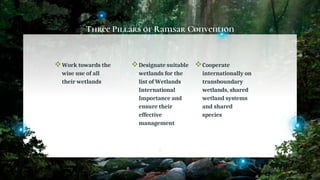
Three Pillars of Ramsar Convention
Work towards the
wise use of all
their wetlands
Designate suitable
wetlands for the
list of Wetlands
International
Importance and
ensure their
effective
management
Cooperate
internationally on
transboundary
wetlands, shared
wetland systems
and shared
species
7
8
Convention on The Conservation
of Migratory Species of Wild
Animals
In 1977
At Bonn, Germany
9
BONN Convention
CMS or the Bonn
Convention aims to
conserve terrestrial,
marine and avian
migratory species
throughout their range
10
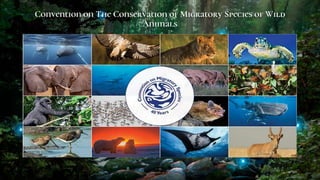
Convention on The Conservation of Migratory Species of Wild
Animals
11
BONN Convention
❧Established at the initiative of the United Nations Conference on
the human environment
❧Came into force on Nov 01, 1983.
❧132 countries have signed the agreement
❧Covers migratory animal species i.e. whales, dolphins, bats,
terrestrial mammals, some reptiles, fish and butterfly
❧Migratory birds make up the largest part of all migratory species
12
Convention Concerning the
Protection of the World Cultural
and Natural Heritage
In 1972
At Paris, France
Convention Concerning the Protection of the World Cultural
and Natural Heritage
❧The convention was adopted by the General
Conference of United Nations Educational, Scientific
and Cultural Organization (UNESCO)
❧It was enforced in 1975
❧It has been ratified by 194 states which include 190
UN member states, 2 UN observer states (the Holy
See and Palestine), and 2 states in free association
with New Zealand (the Cook Islands and Niue)
14
Convention Concerning the Protection of the World Cultural
and Natural Heritage
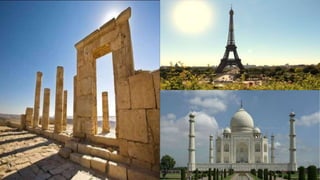
Cultural Heritage:
Monuments (architectural works, works of monumental sculpture and painting,
elements or structures of an archaeological nature, inscriptions, cave dwellings
and combinations of features, which are of outstanding universal value from the
point of view of history, art or science).
15
Convention Concerning the Protection of the World Cultural
and Natural Heritage
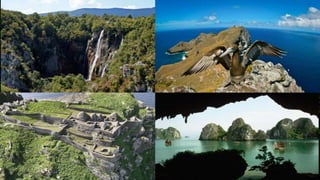
Natural Heritage:
Natural Features (physical and biological formations or groups of such
formations, which are of outstanding universal value from the aesthetic or
scientific point of view)
Natural Sites (delineated natural areas of outstanding universal value from the
point of view of science, conservation or natural beauty)
17
18
Convention Concerning the Protection of the World
Cultural and Natural Heritage
Motive of Convention:
To ensure the identification, protection, conservation, presentation and
transmission of the cultural and natural heritage to future generations.
Each party of the convention will do all it can to this end, to the utmost of
Under the convention, World Heritage Committee was formed to implement
the World Heritage Convention, define the use of the World Heritage Fund
and allocate financial assistance upon requests from States Parties.
19
United Nations Framework
Convention on Climate
Change (UNFCCC)
In 1992
At Rio de janeiro
United Nations Framework Convention on Climate Change
(UNFCCC)
❧Signed by 154 states initially yet today it has near
universal membership
❧Contains 26 articles
21
United Nations Framework Convention on Climate Change
(UNFCCC)
❧Indicates widespread recognition regarding threats of climate change
❧To stabilize greenhouse gas concentration in the atmosphere at a level
that would not jeopardize climate
❧Requires all parties to develop, periodically update, publish and make
available to the conference of the parties (COP) their national
inventories of anthropogenic emissions of all greenhouse gases not
controlled by the Montreal Protocol
❧Promotes sustainable development
❧Encourages the developed countries parties to assist the developing
country parties in meeting costs of adaptation to the adverse effects of
climate change
22
Convention on
International Trade in
Endangered Species of
Wild Fauna and Flora
(CITES) In 1973
At Geneva,
Switzerland
24
Convention on International Trade in Endangered Species of Wild
Fauna and Flora (CITES)
 Includes species for
which country has asked
the other CITES parties to
help control
international trade.
 Includes species that are
not currently threatened
with extinction, but may
become so without trade
controls. Regulatory trade
is allowed if the exporting
country issues a permit
based on findings that the
specimens were legally
acquired and the trade will
not be detrimental to the
survival of the species or its
role in the ecosystem
 Includes species for
which country has asked
the other CITES parties to
help control
international trade.
25
Convention on International Trade in Endangered Species of Wild
Fauna and Flora (CITES)
❧The nineteenth meeting of the Conference of the
Parties (CoP19) recently held in Panama, from Nov 14
to 25, 2022. The purpose was to take stricter trade
regulations for nearly six hundred species of animals
and plants believed to be under increased threat of
extinction from international trade
26
United Nations Convention on
the Law of the Sea
In 1982
At Montego Bay,
Jamaica
United Nations Convention on the Law of the Sea
❧Convention was adopted by the Third United Nations
Conference on the Law of the Sea
❧Came into force in 1994
❧168 parties have signed the Convention
❧Concerned with internal waters, the territorial sea, the
contiguous zone, the exclusive economic zone, the continental
shelf and the high seas
28
Convention on the Control
of Transboundary
Movement of Hazardous
Wastes and their Disposal
(BASEL Convention)
In 1988
At Basel, Switzerland
30
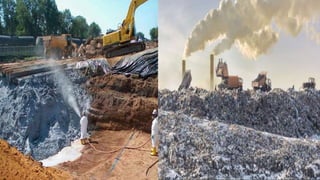
Convention on the Control of Transboundary Movement of
Hazardous Wastes and their Disposal (BASEL Convention)
❧To reduce hazardous Wastes generation and the promotion of environmentally
sound management of Hazardous Wastes, wherever the place of disposal
❧To restrict transboundary movements of Hazardous Wastes except where it is
perceived to be in accordance with the principles of environmentally sound
management
❧To regulate a system applying to cases where transboundary movements are
permissible
❧To establish regional or sub-regional centres for training and technology
transfers regarding the management of Hazardous Wastes and other Wastes
31
Convention on Biological
Diversity
In 1992
At Rio De Janeiro
Convention on Biological Diversity
❧Responsible for the conservation of biological diversity
❧First global agreement to cover all aspects of biological
diversity
❧Enforced in 1993
❧Particularly covers the environment, ecology and
biodiversity
❧Signed by 196 parties
33
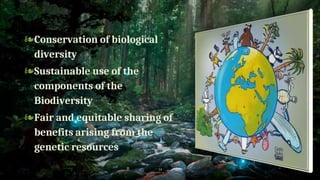
❧Conservation of biological
diversity
❧Sustainable use of the
components of the
Biodiversity
❧Fair and equitable sharing of
benefits arising from the
genetic resources
34
35
Montreal Protocol
In 1987
At Montreal, Canada
Montreal Protocol
❧The protocol phases down the consumption and production of the
different Ozone Depleting Substances (ODS) in a step-wise manner,
with different timetables for developed and developing countries
❧The protocol includes provisions related to control measures,
calculation of control levels, control of trade with non-parties, special
situation of developing countries, reporting of data, non-compliance
and technical assistance etc
❧The treaty evolves over time in light of new scientific, technical and
economic developments, and it continues to be amended and adjusted
37
Montreal Protocol
Multilateral Fund
The Fund's objective is to provide financial and technical assistance to
developing country parties to the Montreal Protocol
38
Kyoto Protocol
In 1997
At Kyoto, Japan
Kyoto Protocol
❧Signed by 191 countries
❧An agreement to lower the amount of
greenhouse gases entered into the atmosphere
40
Kyoto Protocol
41
Protocol provided several means for countries to reach their targets.
One approach was to make use of natural processes called ‘sinks’
that remove greenhouse gases from the atmosphere (planting of
trees, which take up carbon dioxide from the air, would be an
example)
Another approach was the international program called the Clean
Development Mechanism (CDM), which encouraged developed
countries to invest in technology and infrastructure in less
developed countries where there were often significant opportunities
to reduce emissions
Kyoto Protocol
❧Although the Kyoto protocol represented a landmark diplomatic
accomplishment, its success was far from assured.
❧The initial reports indicated that most participants would fail to meet
their emission targets
❧Even if the targets were met, however, the ultimate benefit to the
environment would not be significant
❧Some critics claimed that since world’s largest emitters of greenhouse
gases i.e. China and US not bound by the protocol
❧Developing countries argued that improving adaptation to climate
variability and change was of equal importance to reducing greenhouse
gas
42
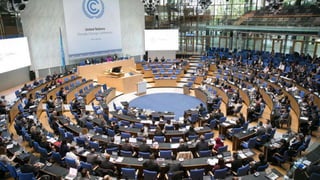
Conference of the Parties
(C0P)
What is the COP?
❧Supreme decision-making body of the convention
❧Reviews the national communications and emission inventories
submitted by Parties
❧Assesses the effects of the measures taken by Parties and the
progress made in achieving the ultimate objective of the
Convention
❧All states that are parties to the Convention are represented at
COP
44
The Paris Agreement in
COP21
In 2015,
At Paris, France
The Paris Agreement in COP21
❧Legally binding international treaty on climate change
❧A landmark in the multilateral climate change process
❧The first binding agreement to bring all nations into a
common cause to undertake ambitious efforts to combat
climate change and adapt to its effects
❧Adopted by 196 parties at COP21 in Paris on 2015
46
The Paris Agreement in COP21
❧The goal is to limit global warming to well below 2 degrees
Celsius
❧To reduce carbon emission and reach net zero by 2050
❧The agreement works on 5-year cycle of increasingly
ambitious climate action carried out by countries
❧The agreement provides a framework for, financial,
technical and capacity building support to those countries
who need it
47
53
54
https://www.encyclopedia.com/environment/energy-government-and-defense-
magazines/international-environmental-law
https://www.imo.org/en/OurWork/Legal/Pages/UnitedNationsConventionOnTheLawOfTheS
ea.aspx#:~:text=The%20United%20Nations%20Convention%20on,the%20oceans%20and
%20their%20resources.
https://www.eea.europa.eu/help/glossary/eea-glossary/bonn-convention
https://www.britannica.com/event/Convention-on-Biological-Diversity
https://whc.unesco.org/en/conventiontext/
https://www.state.gov/key-topics-office-of-environmental-quality-and-transboundary-
issues/the-montreal-protocol-on-substances-that-deplete-the-ozone-layer/
https://unfccc.int/process-and-meetings/the-kyoto-protocol/what-is-the-kyoto-protocol/kyoto-
protocol-targets-for-the-first-commitment-period
References:
55

Environmental laws edited.pptx

  • 1.
  • 2.
    “ Environmental law includes principles,policies, derivatives and regulations enacted and enforced by international entities to regulate human treatment of the nonhuman world. 2
  • 3.
    WHY ENVIRONMENTAL LAWAT INTERNATIONAL LEVEL? ❧Environmental issues are global in nature ❧Sources and implications are global ❧Global cooperation is needed to overcome global issues ❧Examples: climate change, ozone depletion, migratory species, international trade in wildlife ❧Domestic issues e.g. biodiversity 3
  • 4.
    “ The agreements between statesfor regulation of matters affecting all of them 4 Conventions
  • 5.
  • 6.
    Ramsar Convention ❧Intergovernmental treaty ❧90%of UN member states have signed the contract ❧Provides the framework for the conservation and wise use of wetlands and their resources 6
  • 7.
    Three Pillars ofRamsar Convention Work towards the wise use of all their wetlands Designate suitable wetlands for the list of Wetlands International Importance and ensure their effective management Cooperate internationally on transboundary wetlands, shared wetland systems and shared species 7
  • 8.
  • 9.
    Convention on TheConservation of Migratory Species of Wild Animals In 1977 At Bonn, Germany 9
  • 10.
    BONN Convention CMS orthe Bonn Convention aims to conserve terrestrial, marine and avian migratory species throughout their range 10
  • 11.
    Convention on TheConservation of Migratory Species of Wild Animals 11
  • 12.
    BONN Convention ❧Established atthe initiative of the United Nations Conference on the human environment ❧Came into force on Nov 01, 1983. ❧132 countries have signed the agreement ❧Covers migratory animal species i.e. whales, dolphins, bats, terrestrial mammals, some reptiles, fish and butterfly ❧Migratory birds make up the largest part of all migratory species 12
  • 13.
    Convention Concerning the Protectionof the World Cultural and Natural Heritage In 1972 At Paris, France
  • 14.
    Convention Concerning theProtection of the World Cultural and Natural Heritage ❧The convention was adopted by the General Conference of United Nations Educational, Scientific and Cultural Organization (UNESCO) ❧It was enforced in 1975 ❧It has been ratified by 194 states which include 190 UN member states, 2 UN observer states (the Holy See and Palestine), and 2 states in free association with New Zealand (the Cook Islands and Niue) 14
  • 15.
    Convention Concerning theProtection of the World Cultural and Natural Heritage Cultural Heritage: Monuments (architectural works, works of monumental sculpture and painting, elements or structures of an archaeological nature, inscriptions, cave dwellings and combinations of features, which are of outstanding universal value from the point of view of history, art or science). 15
  • 17.
    Convention Concerning theProtection of the World Cultural and Natural Heritage Natural Heritage: Natural Features (physical and biological formations or groups of such formations, which are of outstanding universal value from the aesthetic or scientific point of view) Natural Sites (delineated natural areas of outstanding universal value from the point of view of science, conservation or natural beauty) 17
  • 18.
  • 19.
    Convention Concerning theProtection of the World Cultural and Natural Heritage Motive of Convention: To ensure the identification, protection, conservation, presentation and transmission of the cultural and natural heritage to future generations. Each party of the convention will do all it can to this end, to the utmost of Under the convention, World Heritage Committee was formed to implement the World Heritage Convention, define the use of the World Heritage Fund and allocate financial assistance upon requests from States Parties. 19
  • 20.
    United Nations Framework Conventionon Climate Change (UNFCCC) In 1992 At Rio de janeiro
  • 21.
    United Nations FrameworkConvention on Climate Change (UNFCCC) ❧Signed by 154 states initially yet today it has near universal membership ❧Contains 26 articles 21
  • 22.
    United Nations FrameworkConvention on Climate Change (UNFCCC) ❧Indicates widespread recognition regarding threats of climate change ❧To stabilize greenhouse gas concentration in the atmosphere at a level that would not jeopardize climate ❧Requires all parties to develop, periodically update, publish and make available to the conference of the parties (COP) their national inventories of anthropogenic emissions of all greenhouse gases not controlled by the Montreal Protocol ❧Promotes sustainable development ❧Encourages the developed countries parties to assist the developing country parties in meeting costs of adaptation to the adverse effects of climate change 22
  • 23.
    Convention on International Tradein Endangered Species of Wild Fauna and Flora (CITES) In 1973 At Geneva, Switzerland
  • 24.
  • 25.
    Convention on InternationalTrade in Endangered Species of Wild Fauna and Flora (CITES)  Includes species for which country has asked the other CITES parties to help control international trade.  Includes species that are not currently threatened with extinction, but may become so without trade controls. Regulatory trade is allowed if the exporting country issues a permit based on findings that the specimens were legally acquired and the trade will not be detrimental to the survival of the species or its role in the ecosystem  Includes species for which country has asked the other CITES parties to help control international trade. 25
  • 26.
    Convention on InternationalTrade in Endangered Species of Wild Fauna and Flora (CITES) ❧The nineteenth meeting of the Conference of the Parties (CoP19) recently held in Panama, from Nov 14 to 25, 2022. The purpose was to take stricter trade regulations for nearly six hundred species of animals and plants believed to be under increased threat of extinction from international trade 26
  • 27.
    United Nations Conventionon the Law of the Sea In 1982 At Montego Bay, Jamaica
  • 28.
    United Nations Conventionon the Law of the Sea ❧Convention was adopted by the Third United Nations Conference on the Law of the Sea ❧Came into force in 1994 ❧168 parties have signed the Convention ❧Concerned with internal waters, the territorial sea, the contiguous zone, the exclusive economic zone, the continental shelf and the high seas 28
  • 29.
    Convention on theControl of Transboundary Movement of Hazardous Wastes and their Disposal (BASEL Convention) In 1988 At Basel, Switzerland
  • 30.
  • 31.
    Convention on theControl of Transboundary Movement of Hazardous Wastes and their Disposal (BASEL Convention) ❧To reduce hazardous Wastes generation and the promotion of environmentally sound management of Hazardous Wastes, wherever the place of disposal ❧To restrict transboundary movements of Hazardous Wastes except where it is perceived to be in accordance with the principles of environmentally sound management ❧To regulate a system applying to cases where transboundary movements are permissible ❧To establish regional or sub-regional centres for training and technology transfers regarding the management of Hazardous Wastes and other Wastes 31
  • 32.
  • 33.
    Convention on BiologicalDiversity ❧Responsible for the conservation of biological diversity ❧First global agreement to cover all aspects of biological diversity ❧Enforced in 1993 ❧Particularly covers the environment, ecology and biodiversity ❧Signed by 196 parties 33
  • 34.
    ❧Conservation of biological diversity ❧Sustainableuse of the components of the Biodiversity ❧Fair and equitable sharing of benefits arising from the genetic resources 34
  • 35.
  • 36.
  • 37.
    Montreal Protocol ❧The protocolphases down the consumption and production of the different Ozone Depleting Substances (ODS) in a step-wise manner, with different timetables for developed and developing countries ❧The protocol includes provisions related to control measures, calculation of control levels, control of trade with non-parties, special situation of developing countries, reporting of data, non-compliance and technical assistance etc ❧The treaty evolves over time in light of new scientific, technical and economic developments, and it continues to be amended and adjusted 37
  • 38.
    Montreal Protocol Multilateral Fund TheFund's objective is to provide financial and technical assistance to developing country parties to the Montreal Protocol 38
  • 39.
  • 40.
    Kyoto Protocol ❧Signed by191 countries ❧An agreement to lower the amount of greenhouse gases entered into the atmosphere 40
  • 41.
    Kyoto Protocol 41 Protocol providedseveral means for countries to reach their targets. One approach was to make use of natural processes called ‘sinks’ that remove greenhouse gases from the atmosphere (planting of trees, which take up carbon dioxide from the air, would be an example) Another approach was the international program called the Clean Development Mechanism (CDM), which encouraged developed countries to invest in technology and infrastructure in less developed countries where there were often significant opportunities to reduce emissions
  • 42.
    Kyoto Protocol ❧Although theKyoto protocol represented a landmark diplomatic accomplishment, its success was far from assured. ❧The initial reports indicated that most participants would fail to meet their emission targets ❧Even if the targets were met, however, the ultimate benefit to the environment would not be significant ❧Some critics claimed that since world’s largest emitters of greenhouse gases i.e. China and US not bound by the protocol ❧Developing countries argued that improving adaptation to climate variability and change was of equal importance to reducing greenhouse gas 42
  • 43.
    Conference of theParties (C0P)
  • 44.
    What is theCOP? ❧Supreme decision-making body of the convention ❧Reviews the national communications and emission inventories submitted by Parties ❧Assesses the effects of the measures taken by Parties and the progress made in achieving the ultimate objective of the Convention ❧All states that are parties to the Convention are represented at COP 44
  • 45.
    The Paris Agreementin COP21 In 2015, At Paris, France
  • 46.
    The Paris Agreementin COP21 ❧Legally binding international treaty on climate change ❧A landmark in the multilateral climate change process ❧The first binding agreement to bring all nations into a common cause to undertake ambitious efforts to combat climate change and adapt to its effects ❧Adopted by 196 parties at COP21 in Paris on 2015 46
  • 47.
    The Paris Agreementin COP21 ❧The goal is to limit global warming to well below 2 degrees Celsius ❧To reduce carbon emission and reach net zero by 2050 ❧The agreement works on 5-year cycle of increasingly ambitious climate action carried out by countries ❧The agreement provides a framework for, financial, technical and capacity building support to those countries who need it 47
  • 48.
  • 49.
  • 50.