Earth summit
Presentation by
Hari Sharma
Message
• The Summit’s message — that nothing
less than a transformation of our
attitudes and behaviour would bring
about the necessary changes
Basics
• The United Nations Conference on Environment
and Development (UNCED)/ Rio Summit/Rio
Conference/Earth
• Date 3-14 June 1992.
• Number of Governments participating:172, 108
at level of heads of State or Government.
• Principal themes:Environment and sustainable
development
• Previous conference: UN Conference on the
Human Environment, Stockholm (1972)
The issues addressed
• Patterns of production — particularly the
production of toxic components, such as lead
in gasoline, or poisonous waste — are being
scrutinized in a systematic manner by the UN
and Governments alike.
…………………….
• Alternative sources of energy are being sought to replace
the use of fossil fuels which are linked to global climate
change;
• New reliance on public transportation systems is being
emphasized in order to reduce vehicle emissions,
congestion in cities and the health problems caused by
polluted air and smog;
• There is much greater awareness of and concern over the
growing scarcity of water.
Results
• Agenda 21
• The Rio Declaration on Environment and
Development
• The United Nations Framework Convention on
Climate Change
• United Nations Convention on Biological
Diversity.
• The Statement of Forest Principles.
• United Nations Convention to Combat
Desertification
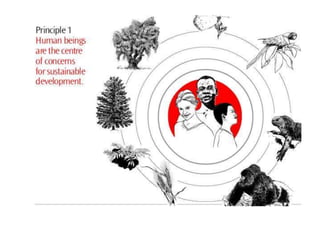
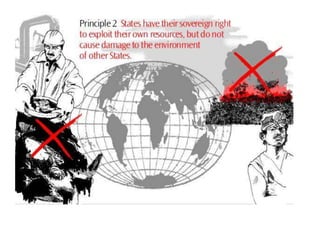
Rio Declaration
• The Rio Declaration consisted of 27 principles
intended to guide future sustainable
development around the world.
Principle 4
In order to achieve sustainable development,
environmental protection shall constitute an
integral part of the development process and
cannot be considered in isolation from it.
Principle 8
To achieve sustainable development and a
higher quality of life for all people, States
should reduce and eliminate unsustainable
patterns of production and consumption and
promote appropriate demographic policies.
Principle 11
States shall enact effective environmental
legislation. Environmental standards,
management objectives and priorities should
reflect the environmental and developmental
context to which they apply. Standards applied
by some countries may be inappropriate
and of unwarranted economic and social cost to
other countries, in particular
developing countries.
Principle 12
States should cooperate to promote a supportive and open
international economic system that would lead to
economic growth and sustainable development in all
countries, to better address the problems of environmental
degradation. Trade policy measures for environmental
purposes should not constitute a means of arbitrary or
unjustifiable discrimination or a disguised restriction on
international trade. Unilateral actions to deal with
environmental challenges outside the jurisdiction of the
importing country should be avoided. Environmental
measures addressing transboundary or global
environmental problems should, as far as possible, be
based on an international consensus.
Principle 13
States shall develop national law regarding liability
and compensation for the victims
of pollution and other environmental damage.
States shall also cooperate in an expeditious and
more determined manner to develop further
international law regarding
liability and compensation for adverse effects of
environmental damage caused by activities
within their jurisdiction or control to areas
beyond their jurisdiction.
Principle 14
States should effectively cooperate to
discourage or prevent the relocation and
transfer to other States of any activities and
substances that cause severe environmental
degradation or are found to be harmful to
human health.
Principle 15
In order to protect the environment, the
precautionary approach shall be widely ap-
plied by States according to their capabilities.
Where there are threats of serious or
irreversible damage, lack of full scientific
certainty shall not be used as a reason for
postponing cost-effective measures to prevent
environmental degradation.
Principle 16
National authorities should endeavour to
promote the internalization of environmental
costs and the use of economic instruments,
taking into account the approach that the
polluter should, in principle, bear the cost of
pollution, with due regard to the public
interest and without distorting international
trade and investment.
Principle 17
Environmental impact assessment, as a national
instrument, shall be undertaken for
proposed activities that are likely to have a
significant adverse impact on the environment
and are subject to a decision of a competent
national authority.
Principle 19
States shall provide prior and timely notification
and relevant information to potentially
affected States on activities that may have a
significant adverse transboundary
environmental effect and shall consult with
those States at an early stage and in good
faith.
Principle 23
The environment and natural resources of
people under oppression, domination and
occupation shall be protected.
Principle 24
Warfare is inherently destructive of sustainable
development. States shall therefore
respect international law providing protection
for the environment in times of armed
conflict and cooperate in its further
development, as necessary
Principle 25
Peace, development and environmental
protection are interdependent and indivisible.
Principle 26
States shall resolve all their environmental
disputes peacefully and by appropriate
means in accordance with the Charter of the
United Nations.
Principle 27
States and people shall cooperate in good faith
and in a spirit of partnership in the
fulfillment of the principles embodied in this
Declaration and in the further development
of international law in the field of sustainable
development.
AGENDA 21
• Agenda 21 is a non-binding, voluntarily
implemented action plan of the United
Nations with regard to sustainable development
• Agenda 21 is a 300-page document divided into
40 chapters that have been grouped into
4 sections
• Global  National  Local
• The "21" in Agenda 21 refers to the 21st Century
• Signed by 178 countries
• What we do locally …
• … affects what happens nationally…
• …affects what happens globally.
Section I
• Social and Economic Dimensions is directed
toward combating poverty, especially
in developing countries, changing
consumption patterns, promoting health,
achieving a more sustainable population, and
sustainable settlement in decision making.
Section II
• Conservation and Management of Resources
for Development Includes atmospheric
protection, combating deforestation,
protecting fragile environments, conservation
of biological diversity (biodiversity), control of
pollution and the management
of biotechnology, and radioactive wastes.
Section III
• Strengthening the Role of Major
Groups includes the roles of children and
youth, women, NGOs, local authorities,
business and industry, and workers; and
strengthening the role of indigenous peoples,
their communities, and farmers.
Section IV
• Means of
Implementation: implementation includes scie
nce, technology
transfer, education, international
institutions and financial mechanisms.
Framework Convention on Climate
Change (UNFCCC)
• The objective of the treaty is to
"stabilize greenhouse gas concentrations in
the atmosphere at a level that would prevent
dangerous anthropogenic interference with
the climate system“
• Nearly every country is party to the UNFCC.
• Its urges the signatory nation to reduce green
house gases emission to 1990 level by 2000
..
• The signatory nation meet every year to
discuss climate change strategy.
• First COP/COP1 was held in Berlin .
• The third COP was held in Kyoto Japan (Kyoto
protocol )
• In detail later……….
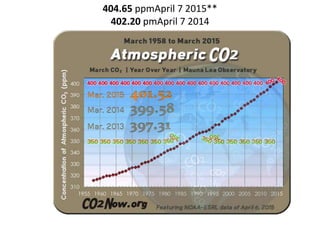
404.65 ppmApril 7 2015**
402.20 pmApril 7 2014
Earth Summit 2002
• Johannesburg, South Africa, from 26 August to 4
September 2002.
• agreement was made to restore the world's
depleted fisheries for 2015
• means to achieve the Millennium Development
Goals was discussed .
• Millennium Development Goals (MDGs) are
eight international development goals that were
established following the Millennium Summit of
the United Nations in 2000.
8 goals
• To eradicate extreme poverty and hunger
• To achieve universal primary education
• To promote gender equality and empower
women
• To reduce child mortality
• To improve maternal health
• To combat HIV/AIDS, malaria, and other diseases
• To ensure environmental sustainability
• To develop a global partnership for development
Latest :::RIO +20 Summit
• Rio+20 – the short name for the United
Nations Conference on Sustainable
Development.
• It took place in Rio de Janeiro, Brazil, in June
2012
• Since there is twenty years of gap (2012-1992)
between these two summits, the latest RIO
Summit is nicknamed “RIO +20”
To be continue with ……
Continue with ……..
• Rio 20: India’s stand
• Why US didn’t ratify kyoto protocol?
• Where does India and China stands?
• Criticism

Earth summit by hari luitel

  • 1.
  • 2.
    Message • The Summit’smessage — that nothing less than a transformation of our attitudes and behaviour would bring about the necessary changes
  • 3.
    Basics • The UnitedNations Conference on Environment and Development (UNCED)/ Rio Summit/Rio Conference/Earth • Date 3-14 June 1992. • Number of Governments participating:172, 108 at level of heads of State or Government. • Principal themes:Environment and sustainable development • Previous conference: UN Conference on the Human Environment, Stockholm (1972)
  • 4.
    The issues addressed •Patterns of production — particularly the production of toxic components, such as lead in gasoline, or poisonous waste — are being scrutinized in a systematic manner by the UN and Governments alike.
  • 5.
    ……………………. • Alternative sourcesof energy are being sought to replace the use of fossil fuels which are linked to global climate change; • New reliance on public transportation systems is being emphasized in order to reduce vehicle emissions, congestion in cities and the health problems caused by polluted air and smog; • There is much greater awareness of and concern over the growing scarcity of water.
  • 6.
    Results • Agenda 21 •The Rio Declaration on Environment and Development • The United Nations Framework Convention on Climate Change • United Nations Convention on Biological Diversity. • The Statement of Forest Principles. • United Nations Convention to Combat Desertification
  • 7.
    Rio Declaration • TheRio Declaration consisted of 27 principles intended to guide future sustainable development around the world.
  • 11.
    Principle 4 In orderto achieve sustainable development, environmental protection shall constitute an integral part of the development process and cannot be considered in isolation from it.
  • 15.
    Principle 8 To achievesustainable development and a higher quality of life for all people, States should reduce and eliminate unsustainable patterns of production and consumption and promote appropriate demographic policies.
  • 18.
    Principle 11 States shallenact effective environmental legislation. Environmental standards, management objectives and priorities should reflect the environmental and developmental context to which they apply. Standards applied by some countries may be inappropriate and of unwarranted economic and social cost to other countries, in particular developing countries.
  • 19.
    Principle 12 States shouldcooperate to promote a supportive and open international economic system that would lead to economic growth and sustainable development in all countries, to better address the problems of environmental degradation. Trade policy measures for environmental purposes should not constitute a means of arbitrary or unjustifiable discrimination or a disguised restriction on international trade. Unilateral actions to deal with environmental challenges outside the jurisdiction of the importing country should be avoided. Environmental measures addressing transboundary or global environmental problems should, as far as possible, be based on an international consensus.
  • 20.
    Principle 13 States shalldevelop national law regarding liability and compensation for the victims of pollution and other environmental damage. States shall also cooperate in an expeditious and more determined manner to develop further international law regarding liability and compensation for adverse effects of environmental damage caused by activities within their jurisdiction or control to areas beyond their jurisdiction.
  • 21.
    Principle 14 States shouldeffectively cooperate to discourage or prevent the relocation and transfer to other States of any activities and substances that cause severe environmental degradation or are found to be harmful to human health.
  • 22.
    Principle 15 In orderto protect the environment, the precautionary approach shall be widely ap- plied by States according to their capabilities. Where there are threats of serious or irreversible damage, lack of full scientific certainty shall not be used as a reason for postponing cost-effective measures to prevent environmental degradation.
  • 23.
    Principle 16 National authoritiesshould endeavour to promote the internalization of environmental costs and the use of economic instruments, taking into account the approach that the polluter should, in principle, bear the cost of pollution, with due regard to the public interest and without distorting international trade and investment.
  • 24.
    Principle 17 Environmental impactassessment, as a national instrument, shall be undertaken for proposed activities that are likely to have a significant adverse impact on the environment and are subject to a decision of a competent national authority.
  • 26.
    Principle 19 States shallprovide prior and timely notification and relevant information to potentially affected States on activities that may have a significant adverse transboundary environmental effect and shall consult with those States at an early stage and in good faith.
  • 30.
    Principle 23 The environmentand natural resources of people under oppression, domination and occupation shall be protected.
  • 31.
    Principle 24 Warfare isinherently destructive of sustainable development. States shall therefore respect international law providing protection for the environment in times of armed conflict and cooperate in its further development, as necessary
  • 32.
    Principle 25 Peace, developmentand environmental protection are interdependent and indivisible.
  • 33.
    Principle 26 States shallresolve all their environmental disputes peacefully and by appropriate means in accordance with the Charter of the United Nations.
  • 34.
    Principle 27 States andpeople shall cooperate in good faith and in a spirit of partnership in the fulfillment of the principles embodied in this Declaration and in the further development of international law in the field of sustainable development.
  • 36.
    AGENDA 21 • Agenda21 is a non-binding, voluntarily implemented action plan of the United Nations with regard to sustainable development • Agenda 21 is a 300-page document divided into 40 chapters that have been grouped into 4 sections • Global  National  Local • The "21" in Agenda 21 refers to the 21st Century
  • 37.
    • Signed by178 countries • What we do locally … • … affects what happens nationally… • …affects what happens globally.
  • 38.
    Section I • Socialand Economic Dimensions is directed toward combating poverty, especially in developing countries, changing consumption patterns, promoting health, achieving a more sustainable population, and sustainable settlement in decision making.
  • 39.
    Section II • Conservationand Management of Resources for Development Includes atmospheric protection, combating deforestation, protecting fragile environments, conservation of biological diversity (biodiversity), control of pollution and the management of biotechnology, and radioactive wastes.
  • 40.
    Section III • Strengtheningthe Role of Major Groups includes the roles of children and youth, women, NGOs, local authorities, business and industry, and workers; and strengthening the role of indigenous peoples, their communities, and farmers.
  • 41.
    Section IV • Meansof Implementation: implementation includes scie nce, technology transfer, education, international institutions and financial mechanisms.
  • 42.
    Framework Convention onClimate Change (UNFCCC) • The objective of the treaty is to "stabilize greenhouse gas concentrations in the atmosphere at a level that would prevent dangerous anthropogenic interference with the climate system“ • Nearly every country is party to the UNFCC. • Its urges the signatory nation to reduce green house gases emission to 1990 level by 2000
  • 43.
    .. • The signatorynation meet every year to discuss climate change strategy. • First COP/COP1 was held in Berlin . • The third COP was held in Kyoto Japan (Kyoto protocol ) • In detail later……….
  • 44.
    404.65 ppmApril 72015** 402.20 pmApril 7 2014
  • 45.
    Earth Summit 2002 •Johannesburg, South Africa, from 26 August to 4 September 2002. • agreement was made to restore the world's depleted fisheries for 2015 • means to achieve the Millennium Development Goals was discussed . • Millennium Development Goals (MDGs) are eight international development goals that were established following the Millennium Summit of the United Nations in 2000.
  • 46.
    8 goals • Toeradicate extreme poverty and hunger • To achieve universal primary education • To promote gender equality and empower women • To reduce child mortality • To improve maternal health • To combat HIV/AIDS, malaria, and other diseases • To ensure environmental sustainability • To develop a global partnership for development
  • 47.
    Latest :::RIO +20Summit • Rio+20 – the short name for the United Nations Conference on Sustainable Development. • It took place in Rio de Janeiro, Brazil, in June 2012 • Since there is twenty years of gap (2012-1992) between these two summits, the latest RIO Summit is nicknamed “RIO +20”
  • 48.
    To be continuewith ……
  • 49.
    Continue with …….. •Rio 20: India’s stand • Why US didn’t ratify kyoto protocol? • Where does India and China stands? • Criticism