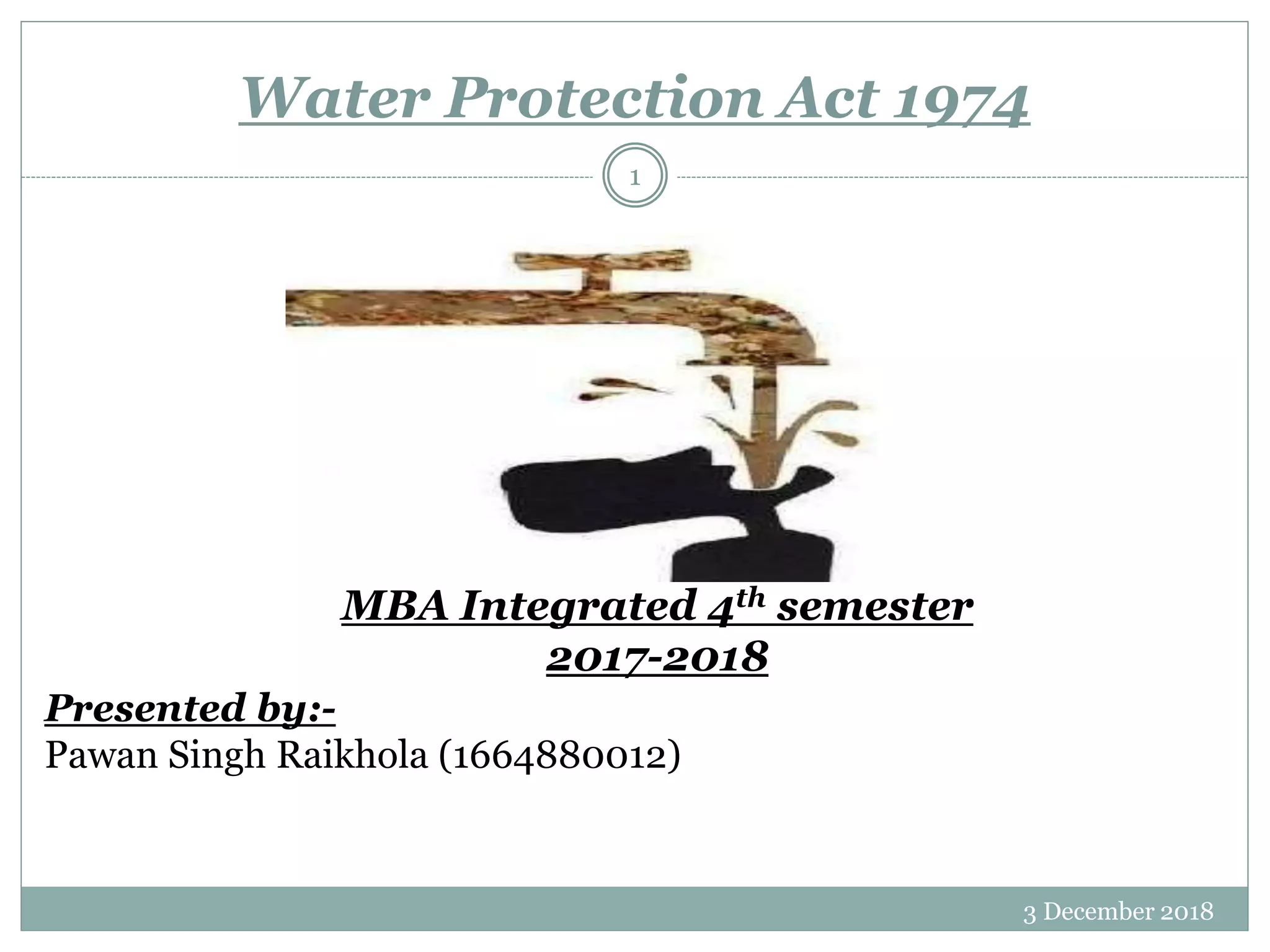
Water Protection Act 1974
MBA Integrated 4th semester
2017-2018
Presented by:-
Pawan Singh Raikhola (1664880012)
3 December 2018
1
What is it for?????
3 December 2018
2
An Act to provide for the prevention and control of water
pollution and the maintaining or restoring of wholesomeness
of water, for the establishment , with a view to carrying out
the purposes of boards for the prevention and control of
water pollution, for conferring on and assigning to such with
board powers and functions relating there to and for matters
connected there with.
Features Of Act
3 December 2018
3
• It provides for maintenance and restoration of quality of all
types of surface and ground water.
•It provides for the establishment of central and state boards
of pollution control.
•It confers them with powers and functions to control
pollution.
•It has provision for funds, budgets, accounts and audit of the
central and state pollution control boards.
•It also makes provision for various penalties for the
defaulters and procedure for the same
Application and Commencement
3 December 2018
4
• It applies in the first instance to the whole of the states of
Assam, Gujarat, Haryana, Himanchal Pradesh, Jammu and
Kashmir, Karnataka, Kerala, Madhya Pradesh, Rajasthan
and West Bengal and the Union Territories.
Central Pollution Control Board
3 December 2018
5
•It is the main governmental organization at central level for
prevention and control of water pollution.
CPCB’S OBJECTIVES
3 December 2018
6
• It Advises the central government in matters related to
prevention and control of water pollution.
• All the state pollution control boards (SPCBs) are guided
and technically assisted by CPCB.
• It organizes training programs for prevention and control of
pollution at various places (seminars).
Continued……
3 December 2018
7
• It also organizes comprehensive programs on pollution
related issues through mass media.
• It collects, compiles and publishes technical and statistical
data related to pollution.
• It prepares manuals for treatment and disposal of sewage
and trade effluents.
• Lays down standards for water quality parameters.
Continued…….
3 December 2018
8
• It plans nation-wide programs for prevention, control of
pollution.
• It establishes and recognizes laboratories for analysis of
water, sewage or trade effluent samples.
State Pollution Control Board
3 December 2018
9
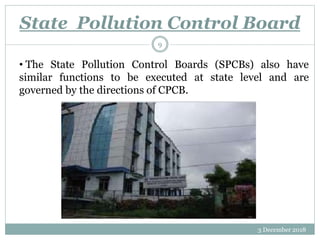
• The State Pollution Control Boards (SPCBs) also have
similar functions to be executed at state level and are
governed by the directions of CPCB.
SPCB’S Objectives
3 December 2018
10
• The board advices the state government with respect to the
locations of any industry that might pollute a stream, well or
any water body.
•It lays down standard for effluents and is empowered to
take samples from any stream, well or trade effluent or
sewage passing through an industry.
•The board suggests efficient methods for utilization,
treatment and disposal of trade effluents.
Identification Of Polluted Water Bodies
3 December 2018
11
•CPCB identified 10 polluted stretches for prioritizing
pollution control efforts in 1988-1989.
•The number of stretches increased to 37 during 1992-1993.
•The list is now revised to include 86 stretches.
•The concerned State Pollution Control Boards were asked to
take adequate measures to restore the desired level.
River Action Plan
3 December 2018
12
•CPCB identified polluted water bodies, which leads to
formulation of action plan for restoration of the water body.
•Based on CPCB’s Recommendations, Ganga Action Plan was
Launched in 1986 to restore the Ganga by interception,
diversion and treatment of wastewater from 27 cities/towns
located along the river.
•Based on the experience gained during implementation of
the Ganga Action Plan, Govt. of India extends river cleaning
program to other rivers and lakes.
Water Pollution Control Strategy
3 December 2018
13
• Urban sources – National River Action Plan.
• Industrial Sources – Through consent (SPCB).
• Special Drives: 17 categories of industries.
• Industries discharging into rivers and lakes.
• 24 Problem Areas Action Plan.
• Environmental Auditing.
• Common effluent treatment plants for cluster of SSI
units(124).
• Promotion of low-waste and no-waste technology.
How did GAP came into being?
3 December 2018
14
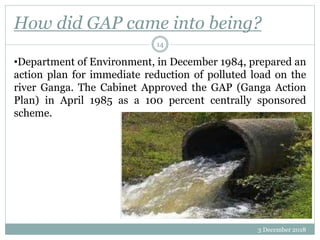
•Department of Environment, in December 1984, prepared an
action plan for immediate reduction of polluted load on the
river Ganga. The Cabinet Approved the GAP (Ganga Action
Plan) in April 1985 as a 100 percent centrally sponsored
scheme.
Changes in GAP
3 December 2018
15
• To oversee the implementation of the GAP and to lay down
policies and programmes, Government of India constituted
the CGA (Central Ganga Authority) in February 1985,
renamed as the NRCA (National River Conservation
Authority) in September 1995, under the chairmanship of
Prime Minister.
•The Government also established the GPD (Ganga Project
Directorate) in June 1985 as a wing of the guidance and
supervision of the CGA.
•The Government renamed the GPD as the NRCD (National
River Conservation Directorate) in June 1994.
GAP 1
3 December 2018
16
• The GAP-1 intercept, divert and treat 882 mld (Million
Litres per day) out of 1340 mld of wastewater, generated in 25
towns in 3 states of Uttar Pradesh, Bihar and West Bengal.
The NRCD has scheduled the GAP-1 for the completion by
March 1990, but extended it progressively up to March 2000.
While the GAP-1 was still in progress, the CGA (Controller
General of Account) decided in February 1991 to take up the
GAP-2, covering the following pollution works:
(a) On the tributaries of river Ganga, Yamuna, Damodar and
Gomati.
(b) In 25 towns left out in Phase-1.
(C) In the other polluting towns along the river.
GAP-2
3 December 2018
17
• The CCEA (Cabinet Committee on Economic Affairs)
approved the GAP-2 in various stages during April 1993 to
October 1996. The States of Uttar Pradesh, Bihar, West
Bengal, Delhi and Haryana were to implement the GAP-2 by
treating 1912 mld of sewage. GAP-2 is scheduled for
completion by December 2001
Financial Profile…
3 December 2018
18
• Approved outlays for the GAP-1 and the GAP-2 were Rs
462.04 Crore and Rs 1276.25 Crore respectively. The Central
Government was to bear the entire expenditure on schemes
under the GAP-1, and to share it equally with the States in
the GAP-2. The Government of India decided in November
1998 to bear the entire expenditure on schemes from April
1997, as the States found it difficult to provide their
matching share.
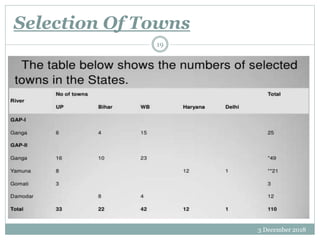
Selection Of Towns
3 December 2018
19
Experience From Industries
3 December 2018
20
• High Organic load – Distillers.
• High TDS – Pharmaceuticals, Pesticides, Rayon, Dye and
Dye intermediates.
• Small Scale industries – location (residential areas),
inadequate resources, skill etc.
Conclusion…..
3 December 2018
21
•Obtaining future supplies of freshwater will be an
environmental challenge.
•With expanding population and increasing water usage, this
Act is approaching conditions of widespread scarcity.
•Water pollution is already harming freshwater around the
world.
3 December 201822
For Paying Attention

Water protection act 1974

  • 1.
    Water Protection Act1974 MBA Integrated 4th semester 2017-2018 Presented by:- Pawan Singh Raikhola (1664880012) 3 December 2018 1
  • 2.
    What is itfor????? 3 December 2018 2 An Act to provide for the prevention and control of water pollution and the maintaining or restoring of wholesomeness of water, for the establishment , with a view to carrying out the purposes of boards for the prevention and control of water pollution, for conferring on and assigning to such with board powers and functions relating there to and for matters connected there with.
  • 3.
    Features Of Act 3December 2018 3 • It provides for maintenance and restoration of quality of all types of surface and ground water. •It provides for the establishment of central and state boards of pollution control. •It confers them with powers and functions to control pollution. •It has provision for funds, budgets, accounts and audit of the central and state pollution control boards. •It also makes provision for various penalties for the defaulters and procedure for the same
  • 4.
    Application and Commencement 3December 2018 4 • It applies in the first instance to the whole of the states of Assam, Gujarat, Haryana, Himanchal Pradesh, Jammu and Kashmir, Karnataka, Kerala, Madhya Pradesh, Rajasthan and West Bengal and the Union Territories.
  • 5.
    Central Pollution ControlBoard 3 December 2018 5 •It is the main governmental organization at central level for prevention and control of water pollution.
  • 6.
    CPCB’S OBJECTIVES 3 December2018 6 • It Advises the central government in matters related to prevention and control of water pollution. • All the state pollution control boards (SPCBs) are guided and technically assisted by CPCB. • It organizes training programs for prevention and control of pollution at various places (seminars).
  • 7.
    Continued…… 3 December 2018 7 •It also organizes comprehensive programs on pollution related issues through mass media. • It collects, compiles and publishes technical and statistical data related to pollution. • It prepares manuals for treatment and disposal of sewage and trade effluents. • Lays down standards for water quality parameters.
  • 8.
    Continued……. 3 December 2018 8 •It plans nation-wide programs for prevention, control of pollution. • It establishes and recognizes laboratories for analysis of water, sewage or trade effluent samples.
  • 9.
    State Pollution ControlBoard 3 December 2018 9 • The State Pollution Control Boards (SPCBs) also have similar functions to be executed at state level and are governed by the directions of CPCB.
  • 10.
    SPCB’S Objectives 3 December2018 10 • The board advices the state government with respect to the locations of any industry that might pollute a stream, well or any water body. •It lays down standard for effluents and is empowered to take samples from any stream, well or trade effluent or sewage passing through an industry. •The board suggests efficient methods for utilization, treatment and disposal of trade effluents.
  • 11.
    Identification Of PollutedWater Bodies 3 December 2018 11 •CPCB identified 10 polluted stretches for prioritizing pollution control efforts in 1988-1989. •The number of stretches increased to 37 during 1992-1993. •The list is now revised to include 86 stretches. •The concerned State Pollution Control Boards were asked to take adequate measures to restore the desired level.
  • 12.
    River Action Plan 3December 2018 12 •CPCB identified polluted water bodies, which leads to formulation of action plan for restoration of the water body. •Based on CPCB’s Recommendations, Ganga Action Plan was Launched in 1986 to restore the Ganga by interception, diversion and treatment of wastewater from 27 cities/towns located along the river. •Based on the experience gained during implementation of the Ganga Action Plan, Govt. of India extends river cleaning program to other rivers and lakes.
  • 13.
    Water Pollution ControlStrategy 3 December 2018 13 • Urban sources – National River Action Plan. • Industrial Sources – Through consent (SPCB). • Special Drives: 17 categories of industries. • Industries discharging into rivers and lakes. • 24 Problem Areas Action Plan. • Environmental Auditing. • Common effluent treatment plants for cluster of SSI units(124). • Promotion of low-waste and no-waste technology.
  • 14.
    How did GAPcame into being? 3 December 2018 14 •Department of Environment, in December 1984, prepared an action plan for immediate reduction of polluted load on the river Ganga. The Cabinet Approved the GAP (Ganga Action Plan) in April 1985 as a 100 percent centrally sponsored scheme.
  • 15.
    Changes in GAP 3December 2018 15 • To oversee the implementation of the GAP and to lay down policies and programmes, Government of India constituted the CGA (Central Ganga Authority) in February 1985, renamed as the NRCA (National River Conservation Authority) in September 1995, under the chairmanship of Prime Minister. •The Government also established the GPD (Ganga Project Directorate) in June 1985 as a wing of the guidance and supervision of the CGA. •The Government renamed the GPD as the NRCD (National River Conservation Directorate) in June 1994.
  • 16.
    GAP 1 3 December2018 16 • The GAP-1 intercept, divert and treat 882 mld (Million Litres per day) out of 1340 mld of wastewater, generated in 25 towns in 3 states of Uttar Pradesh, Bihar and West Bengal. The NRCD has scheduled the GAP-1 for the completion by March 1990, but extended it progressively up to March 2000. While the GAP-1 was still in progress, the CGA (Controller General of Account) decided in February 1991 to take up the GAP-2, covering the following pollution works: (a) On the tributaries of river Ganga, Yamuna, Damodar and Gomati. (b) In 25 towns left out in Phase-1. (C) In the other polluting towns along the river.
  • 17.
    GAP-2 3 December 2018 17 •The CCEA (Cabinet Committee on Economic Affairs) approved the GAP-2 in various stages during April 1993 to October 1996. The States of Uttar Pradesh, Bihar, West Bengal, Delhi and Haryana were to implement the GAP-2 by treating 1912 mld of sewage. GAP-2 is scheduled for completion by December 2001
  • 18.
    Financial Profile… 3 December2018 18 • Approved outlays for the GAP-1 and the GAP-2 were Rs 462.04 Crore and Rs 1276.25 Crore respectively. The Central Government was to bear the entire expenditure on schemes under the GAP-1, and to share it equally with the States in the GAP-2. The Government of India decided in November 1998 to bear the entire expenditure on schemes from April 1997, as the States found it difficult to provide their matching share.
  • 19.
    Selection Of Towns 3December 2018 19
  • 20.
    Experience From Industries 3December 2018 20 • High Organic load – Distillers. • High TDS – Pharmaceuticals, Pesticides, Rayon, Dye and Dye intermediates. • Small Scale industries – location (residential areas), inadequate resources, skill etc.
  • 21.
    Conclusion….. 3 December 2018 21 •Obtainingfuture supplies of freshwater will be an environmental challenge. •With expanding population and increasing water usage, this Act is approaching conditions of widespread scarcity. •Water pollution is already harming freshwater around the world.
  • 22.
    3 December 201822 ForPaying Attention