UNFCCC: WHETHER HELPFUL
TO MITIGATE CLIMATE
CHANGE PROBLEMS?
Presentation By:-
ABHIJEET RAIPURE (PP18022)
ARPAN WASAN (PP18023)
UMASHANKAR (PP18067)
MANSI THAKKER (PP18075)
SHIVAM SOOD (PP18085)
SWAPNIL BHARGAVA (PP18104)
KESHVI SHAH (PP18131)
Guided By:-
Dr. M.S. Jain
WHAT IS UNFCCC?
• UNFCCC stands for United Nations
Framework Convention on Climate Change.
• It was adopted on 5 June 1992.
• The objective of the UNFCCC is to stabilize
greenhouse gas concentrations in the
atmosphere at a level that would prevent
dangerous anthropogenic interference with the
climate system.
• It also states that “such a level should be
achieved within a time frame sufficient to
allow ecosystems to adopt naturally to climate
change, to ensure that food production is not
threatened and enable economic development
to proceed in a sustainable manner”.
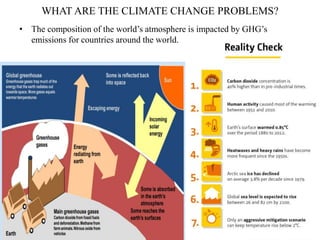
WHAT ARE THE CLIMATE CHANGE PROBLEMS?
• The composition of the world’s atmosphere is impacted by GHG’s
emissions for countries around the world.
REASONS FOR CLIMATE CHANGE
PROBLEMS.
• Clear filling of forests.
• Certain farming methods that increased level
of GHG’s.
• Burning of fossil fuels.
• Production and use of energy by individuals
and businesses.
• Activities essential for raising the standard of
living for people everywhere.
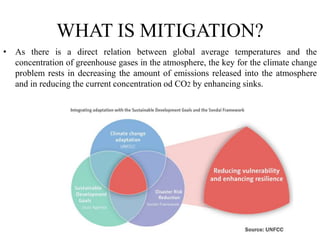
WHAT IS MITIGATION?
• As there is a direct relation between global average temperatures and the
concentration of greenhouse gases in the atmosphere, the key for the climate change
problem rests in decreasing the amount of emissions released into the atmosphere
and in reducing the current concentration od CO2 by enhancing sinks.
ACTIONS TAKEN
• Targeting activities that results in large amount
of GHG’s. example- Policies, Incentives
schemes and investment programmes which
address all sectors, including energy
generation and use, transport, buildings,
industry, agriculture forestry and other land
use.
• Promoting use of renewable energy.
• Promoting use of new technology such as
electric cars, or changes in practices or
behaviours such as driving less.
• Expanding forests and other sinks to remove
greater amounts of CO2 from the atmosphere.
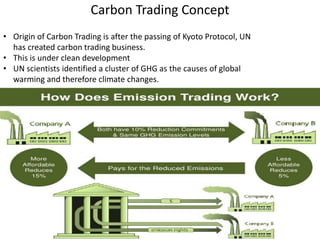
Carbon Trading Concept
• Origin of Carbon Trading is after the passing of Kyoto Protocol, UN
has created carbon trading business.
• This is under clean development
• UN scientists identified a cluster of GHG as the causes of global
warming and therefore climate changes.
How Carbon Credits Works
Need of CC
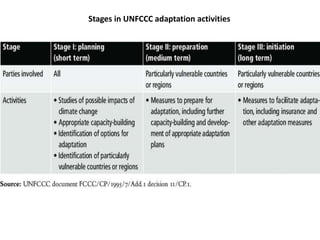
Stages in UNFCCC adaptation activities
Conclusion
• UNFCCC was adopted with an objective to “stabilize greenhouse gas
concentrations in the atmosphere at a level that would prevent dangerous
anthropogenic interference with the climate system”.
• Over the past 25 years, greenhouse gas (GHG) concentrations, far from
stabilizing, have reached record levels. The atmospheric concentration of
carbon dioxide (CO2), the main GHG, has increased from 358 parts per
million (ppm) in 1994 to 412 ppm in 2018. 400 ppm of CO2 was last
witnessed on earth about 3 million years ago.
• The global temperature too has steadily increased from 0.25C above the
pre-industrial era in the early 1990s to an increase of 1.1C in 2018.
• Very soon, the temperature increase is likely to hit 1.5C, declared recently
as a guardrail by the Intergovernmental Panel on Climate Change (IPCC) to
avoid catastrophic impacts of climate change.
• All this while, the intensity and frequency of extreme weather events have
significantly increased, destroying lives and livelihoods. Between 1997 and
2016, extreme weather events caused more than 500,000 deaths and
economic losses of around US $3.16 trillion worldwide. And, if we do not
heed the warning of the IPCC’s special report on 1.5C, these numbers would
seem minuscule ten years from now.
• Instead of reducing, annual emissions of GHG continue to
increase and are today 60% above 1994 levels. In fact, in
2018, global CO2 emissions increased by 2.7%, one of the high
annual increases in the decade. Emissions are increasing in
almost all countries, including developed countries that had
pledged to reduce emissions.
• We have neither been able to shift the global energy system
away from fossil fuels nor have we been able to provide
adequate amounts of clean energy to all.
• This has happened because global cooperation on energy and
climate change has weakened, rather than strengthened, over
the years.
• IPCC’s special report on 1.5C makes it clear that the Paris
Agreement cannot limit warming to even 2C. In fact, global
warming is likely to reach 1.5C between 2030 and 2052. To
limit warming at 1.5C, CO2 emissions will have to be reduced
by 45% by 2030 from 2010 levels and reach net-zero by 2050.
This means that we have 12 years to turn around the energy
system of the world and cut emissions drastically.
• The UNFCCC has moved from a top-down legally binding
Kyoto Protocol to a bottom-up ‘self-determined’ voluntary
Paris Agreement. Today, there is a question mark over the
survival of the weak Paris Agreement itself. The United States
has promised to leave the agreement and on its way out it,
along with other big polluters, fatally weakened the Paris
rulebook along with its legal bindings.
UNFCCC NOW?
• The UNFCCC is now simply a platform to collect, synthesize
and disseminate information.
• It doesn’t have the tools to drive global collective action to
combat climate change.
• In such a situation, the continuation of the international
effort at the UNFCCC should be curtailed and energy
directed elsewhere.
• The UNFCCC is now simply a platform to collect, synthesize
and disseminate information. It doesn’t have the tools to
drive global collective action to combat climate change. In
such a situation, the continuation of the international effort
at the UNFCCC should be curtailed and energy directed
elsewhere.
Proposed Strategies
By Chandra Bhushan is deputy director federal of the Centre for Science and Environment in
New Delhi.
• First, let’s create multiple sectoral and regional platforms to drive
transformation. We could push for international ‘sectoral’ treaties to
achieve real transition in energy, transport, agriculture and industrial
sectors like steel and cement. To support countries to implement these
treaties, regional platforms could be set-up to build capacity and facilitate
technology transfer.
• Second, climate change is too important an issue to be left to governments
alone. We need government-plus strategy, especially concrete actions from
the private sector. Many would argue that the Paris Agreement engages
the private sector. But private-sector engagement in the Paris Agreement is
voluntary and has not added up to much. To push private sector, we will
have to make climate change a fiduciary duty of corporations and hold
them accountable for polluting the climate. I know that all these ideas
would be considered a non-starter. But it is better we try something
different now than regret later.
THANK YOU

UNFCCC

  • 1.
    UNFCCC: WHETHER HELPFUL TOMITIGATE CLIMATE CHANGE PROBLEMS? Presentation By:- ABHIJEET RAIPURE (PP18022) ARPAN WASAN (PP18023) UMASHANKAR (PP18067) MANSI THAKKER (PP18075) SHIVAM SOOD (PP18085) SWAPNIL BHARGAVA (PP18104) KESHVI SHAH (PP18131) Guided By:- Dr. M.S. Jain
  • 2.
    WHAT IS UNFCCC? •UNFCCC stands for United Nations Framework Convention on Climate Change. • It was adopted on 5 June 1992. • The objective of the UNFCCC is to stabilize greenhouse gas concentrations in the atmosphere at a level that would prevent dangerous anthropogenic interference with the climate system.
  • 3.
    • It alsostates that “such a level should be achieved within a time frame sufficient to allow ecosystems to adopt naturally to climate change, to ensure that food production is not threatened and enable economic development to proceed in a sustainable manner”.
  • 4.
    WHAT ARE THECLIMATE CHANGE PROBLEMS? • The composition of the world’s atmosphere is impacted by GHG’s emissions for countries around the world.
  • 5.
    REASONS FOR CLIMATECHANGE PROBLEMS. • Clear filling of forests. • Certain farming methods that increased level of GHG’s. • Burning of fossil fuels. • Production and use of energy by individuals and businesses. • Activities essential for raising the standard of living for people everywhere.
  • 6.
    WHAT IS MITIGATION? •As there is a direct relation between global average temperatures and the concentration of greenhouse gases in the atmosphere, the key for the climate change problem rests in decreasing the amount of emissions released into the atmosphere and in reducing the current concentration od CO2 by enhancing sinks.
  • 7.
    ACTIONS TAKEN • Targetingactivities that results in large amount of GHG’s. example- Policies, Incentives schemes and investment programmes which address all sectors, including energy generation and use, transport, buildings, industry, agriculture forestry and other land use. • Promoting use of renewable energy.
  • 8.
    • Promoting useof new technology such as electric cars, or changes in practices or behaviours such as driving less. • Expanding forests and other sinks to remove greater amounts of CO2 from the atmosphere.
  • 9.
    Carbon Trading Concept •Origin of Carbon Trading is after the passing of Kyoto Protocol, UN has created carbon trading business. • This is under clean development • UN scientists identified a cluster of GHG as the causes of global warming and therefore climate changes.
  • 10.
  • 11.
  • 12.
    Stages in UNFCCCadaptation activities
  • 13.
    Conclusion • UNFCCC wasadopted with an objective to “stabilize greenhouse gas concentrations in the atmosphere at a level that would prevent dangerous anthropogenic interference with the climate system”. • Over the past 25 years, greenhouse gas (GHG) concentrations, far from stabilizing, have reached record levels. The atmospheric concentration of carbon dioxide (CO2), the main GHG, has increased from 358 parts per million (ppm) in 1994 to 412 ppm in 2018. 400 ppm of CO2 was last witnessed on earth about 3 million years ago. • The global temperature too has steadily increased from 0.25C above the pre-industrial era in the early 1990s to an increase of 1.1C in 2018. • Very soon, the temperature increase is likely to hit 1.5C, declared recently as a guardrail by the Intergovernmental Panel on Climate Change (IPCC) to avoid catastrophic impacts of climate change. • All this while, the intensity and frequency of extreme weather events have significantly increased, destroying lives and livelihoods. Between 1997 and 2016, extreme weather events caused more than 500,000 deaths and economic losses of around US $3.16 trillion worldwide. And, if we do not heed the warning of the IPCC’s special report on 1.5C, these numbers would seem minuscule ten years from now.
  • 14.
    • Instead ofreducing, annual emissions of GHG continue to increase and are today 60% above 1994 levels. In fact, in 2018, global CO2 emissions increased by 2.7%, one of the high annual increases in the decade. Emissions are increasing in almost all countries, including developed countries that had pledged to reduce emissions. • We have neither been able to shift the global energy system away from fossil fuels nor have we been able to provide adequate amounts of clean energy to all. • This has happened because global cooperation on energy and climate change has weakened, rather than strengthened, over the years. • IPCC’s special report on 1.5C makes it clear that the Paris Agreement cannot limit warming to even 2C. In fact, global warming is likely to reach 1.5C between 2030 and 2052. To limit warming at 1.5C, CO2 emissions will have to be reduced by 45% by 2030 from 2010 levels and reach net-zero by 2050. This means that we have 12 years to turn around the energy system of the world and cut emissions drastically.
  • 15.
    • The UNFCCChas moved from a top-down legally binding Kyoto Protocol to a bottom-up ‘self-determined’ voluntary Paris Agreement. Today, there is a question mark over the survival of the weak Paris Agreement itself. The United States has promised to leave the agreement and on its way out it, along with other big polluters, fatally weakened the Paris rulebook along with its legal bindings.
  • 16.
    UNFCCC NOW? • TheUNFCCC is now simply a platform to collect, synthesize and disseminate information. • It doesn’t have the tools to drive global collective action to combat climate change. • In such a situation, the continuation of the international effort at the UNFCCC should be curtailed and energy directed elsewhere. • The UNFCCC is now simply a platform to collect, synthesize and disseminate information. It doesn’t have the tools to drive global collective action to combat climate change. In such a situation, the continuation of the international effort at the UNFCCC should be curtailed and energy directed elsewhere.
  • 17.
    Proposed Strategies By ChandraBhushan is deputy director federal of the Centre for Science and Environment in New Delhi. • First, let’s create multiple sectoral and regional platforms to drive transformation. We could push for international ‘sectoral’ treaties to achieve real transition in energy, transport, agriculture and industrial sectors like steel and cement. To support countries to implement these treaties, regional platforms could be set-up to build capacity and facilitate technology transfer. • Second, climate change is too important an issue to be left to governments alone. We need government-plus strategy, especially concrete actions from the private sector. Many would argue that the Paris Agreement engages the private sector. But private-sector engagement in the Paris Agreement is voluntary and has not added up to much. To push private sector, we will have to make climate change a fiduciary duty of corporations and hold them accountable for polluting the climate. I know that all these ideas would be considered a non-starter. But it is better we try something different now than regret later.
  • 18.

Editor's Notes

  • #14 Reference: After 25 years of failure, we should abandon the UNFCCC Published on 27/03/2019, 1:24pm https://www.climatechangenews.com/2019/03/27/25-years-failure-abandon-unfccc/