INTERNATIONAL AGREEMENTS
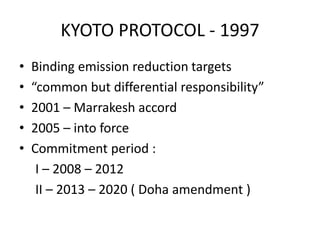
KYOTO PROTOCOL - 1997
• Binding emission reduction targets
• “common but differential responsibility”
• 2001 – Marrakesh accord
• 2005 – into force
• Commitment period :
I – 2008 – 2012
II – 2013 – 2020 ( Doha amendment )
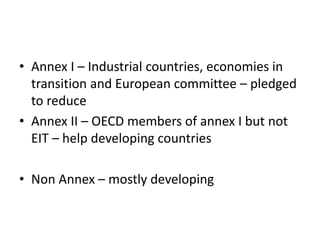
• Annex I – Industrial countries, economies in
transition and European committee – pledged
to reduce
• Annex II – OECD members of annex I but not
EIT – help developing countries
• Non Annex – mostly developing
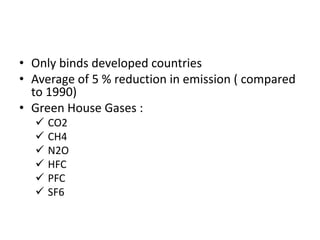
• Only binds developed countries
• Average of 5 % reduction in emission ( compared
to 1990)
• Green House Gases :
 CO2
 CH4
 N2O
 HFC
 PFC
 SF6
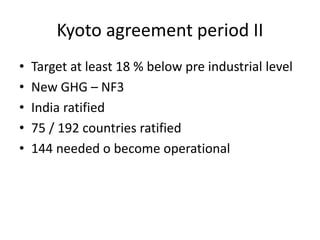
Kyoto agreement period II
• Target at least 18 % below pre industrial level
• New GHG – NF3
• India ratified
• 75 / 192 countries ratified
• 144 needed o become operational
Flexible Trading Mechanisms
• International Emission Trading - AAU
• Joint Implementation – ERU
• Clean Development Mechanism – CER
Funding Mechanisms
• Adaptation Fund (2001)– fund projects in
developing countries ( 2% from CER)
• World bank – trustee
• Green Climate Fund (2010) – support
developing countries to reduce GHG emission
and adapt to climate change.
• Invest in low emission and climate resilient
development
• 2009 – Copenhagen Accord
 Developing nations block – BASIC
 Pledge voluntary reduction targets
 Goal - $ 100 bi per yr by 2020
 Global warming should be limited to below 2
deg C
• 2014 – Lima
• 2015 - Paris
LIMA
• Goal – limit global rise in temperature below 2
deg C (pre industrial level) by 2030 - reducing
GHG emission.
• Lack of consensus
• Outcomes :
INDC ( pledge before Paris summit)
Developed countries agreed to finance developing
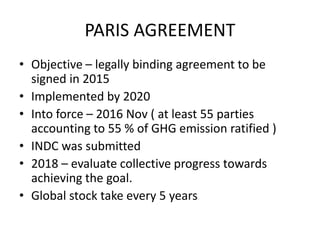
PARIS AGREEMENT
• Objective – legally binding agreement to be
signed in 2015
• Implemented by 2020
• Into force – 2016 Nov ( at least 55 parties
accounting to 55 % of GHG emission ratified )
• INDC was submitted
• 2018 – evaluate collective progress towards
achieving the goal.
• Global stock take every 5 years
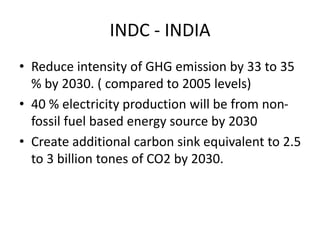
INDC - INDIA
• Reduce intensity of GHG emission by 33 to 35
% by 2030. ( compared to 2005 levels)
• 40 % electricity production will be from non-
fossil fuel based energy source by 2030
• Create additional carbon sink equivalent to 2.5
to 3 billion tones of CO2 by 2030.
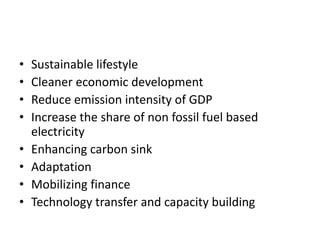
• Sustainable lifestyle
• Cleaner economic development
• Reduce emission intensity of GDP
• Increase the share of non fossil fuel based
electricity
• Enhancing carbon sink
• Adaptation
• Mobilizing finance
• Technology transfer and capacity building
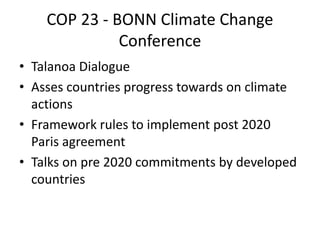
COP 23 - BONN Climate Change
Conference
• Talanoa Dialogue
• Asses countries progress towards on climate
actions
• Framework rules to implement post 2020
Paris agreement
• Talks on pre 2020 commitments by developed
countries
Vienna Convention 1985
• Into force 1988
• 2009 universal ratification
Montreal Protocol 1987
• Reduce production and consumption of ozone
depleting substances
• Into force – 1989
• 6 amendments
• Ozone depleting substances
 CFC
 Halons
 CCl4
 Methyl chloroform
 HCFC
 HBFC
 Methyl bromide
 Bromochloro methane
 HFC
Kigali Amendment
• Aimed at including HFC
• GHG with a GWP
• Binding on countries from 2019
• Reduce HFC by 85 % of the baseline by 2045
• Target - 3 groups
• Rich and industrialized countries
Freeze production and consumption by 2018
85 % reduction in production and consumption of HFC
of 2012 level by 2036
• China, brazil, south Africa etc
Freeze HFC use by 2024
Reduce production and consumption by 80 % of
2021 levels by 2045
• India, Pakistan, Iran, Saudi Arabia, etc
Freeze HFC production and consumption by 2028
Reduction in consumption and production by 85 %
of 2025 level by 2047.
REDD ( Reducing Emissions From
Deforestation And Forest Degradation)
• FAO + UNDP + UNEP
• Bali action plan of UNFCCC 2007 – REDD +
Reducing emissions from deforestation
Reducing emissions from forest degradation
Conservation of forest carbon stock
Sustainable management of forests
Enhancement of forest carbon stock
3 phases of implementation
• Development of National strategies or action
plans, policies ,measures and capacity
building.
• Implementation of National policies, National
strategies or action plans.
• Result based action that should fully be
measured, reported and verified.
In India
• Green India Mission - National Action Plan On
Climate Change
• REDD sustainable management of forest and
afforestation & reforestation
• REDD + coordinating agency
CBD – CONVENTION ON BIOLOGICAL
DIVERSITY
• Into force 1993
• Conservation of biological diversity
• Sustainable use of the components of
biological diversity
• Fair and equitable sharing of the benefits
arising out of utilization of genetic resources
CARTAGENA PROTOCOL ON BIOSAFETY
• Adopted in 2000
• Into force 2003
• Governing the movement of living modified
organisms ( LMO )
• Advanced Informed Agreement (AIA)
• Biosafety Clearing House
• Nagoya – Kuala Lumpur supplementary protocol
Response measures in case of damage to biodiversity
by LMO
NAGOYA PROTOCOL
• Adopted 2010
• Into force 2014
• Access to genetic resources and the fair and
equitable sharing of benefits arising from their
utilization (ABS)
• Conservation and sustainable use of
biodiversity – includes traditional knowledge
• ABS clearing house
AICHI BIODIVERSITY TARGETS
2011-2020
• 5 Strategic goals and 20 Targets
• Goal A : Address the underlying causes of
biodiversity loss by mainstreaming
biodiversity across government and society
• Goal B : Reduce direct pressure on biodiversity
and promote sustainable use
• Goal C : To improve the status of biodiversity
by safeguarding ecosystems, species and
genetic diversity
• Goal D : Enhance the benefits to all from
biodiversity and ecosystem services
• Goal E : Enhance implementation through
participatory planning, knowledge
management and capacity building
IUCN- A just world that values and
conserves nature
• Global authority on the status of the natural
world and the measures needed to safeguard it.
• IUPN – 1948
• IUCN – 1956
• World Conservation Union - 1990
• Observer status at UN
• IUCN world conservation congress – meets once
in 4 years
Conservation Tools
• IUCN red list of threatened species
• IUCN red list of ecosystems
• World database on key Biodiversity areas –
Birdlife International & IUCN
• Protected planet – UNEP & IUCN
• ECOLEX – FAO , UNEP & IUCN
CITES
• Convention on International Trade in
Endangered Species of Wild Fauna and Flora
• Resolution under IUCN in 1963
• 1975- Washington convention
• Legally binding ( does not take the place of
national law)
• Under UNEP
Appendices
• I – species threatened with extinction. Trade
in specimens of these species is permitted
only in exceptional circumstances.
• II – species not necessarily threatened with
extinction , may become so without trade
restrictions.
• III – species that are protected in at least one
country, which has asked other CITES parties
for assistance in controlling the trade.
TRAFFIC
• Wildlife trade monitoring network
• IUCN & WWF
• Fauna and flora
• Red stream : Wildlife crime and illegal trade
• Green stream : Sustainable, legal wildlife trade
CMS – Convention of Migratory
Species
• Under UNEP - 1983
• Internationally coordinated conservation
measure throughout the migratory range.
• Appendix I – Migratory species threatened
with extinction
• Appendix II – Migratory species that need or
would significantly benefit from international
cooperation.
GLOBAL TIGER FORUM
• Delhi declaration -1993
• Consists of
Tiger range countries
Non tiger range countries
International organizations
Honorary individual members
National NGOs
Associated members
• Members – India, Nepal, Bhutan, Bangladesh,
Myanmar, Cambodia, Vietnam, UK
• Report by IUCN & GTF
• 22 % increase in tiger population around the
world (base 2010)
• 1972 – UN Conference on Human
Environment – UNEP
• 1988 – UNEP & WMO – IPCC
• 1992 – GEF
UNFCCC
UNCBD
UNCCD
Stockholm convention on PoP
Minamata convention on mercury
• Basel convention – 1989
• Rotterdam convention – 1998
• Stockholm convention on PoP - 2004

CH 6.pptx

  • 1.
  • 2.
    KYOTO PROTOCOL -1997 • Binding emission reduction targets • “common but differential responsibility” • 2001 – Marrakesh accord • 2005 – into force • Commitment period : I – 2008 – 2012 II – 2013 – 2020 ( Doha amendment )
  • 3.
    • Annex I– Industrial countries, economies in transition and European committee – pledged to reduce • Annex II – OECD members of annex I but not EIT – help developing countries • Non Annex – mostly developing
  • 4.
    • Only bindsdeveloped countries • Average of 5 % reduction in emission ( compared to 1990) • Green House Gases :  CO2  CH4  N2O  HFC  PFC  SF6
  • 5.
    Kyoto agreement periodII • Target at least 18 % below pre industrial level • New GHG – NF3 • India ratified • 75 / 192 countries ratified • 144 needed o become operational
  • 6.
    Flexible Trading Mechanisms •International Emission Trading - AAU • Joint Implementation – ERU • Clean Development Mechanism – CER
  • 7.
    Funding Mechanisms • AdaptationFund (2001)– fund projects in developing countries ( 2% from CER) • World bank – trustee • Green Climate Fund (2010) – support developing countries to reduce GHG emission and adapt to climate change. • Invest in low emission and climate resilient development
  • 8.
    • 2009 –Copenhagen Accord  Developing nations block – BASIC  Pledge voluntary reduction targets  Goal - $ 100 bi per yr by 2020  Global warming should be limited to below 2 deg C • 2014 – Lima • 2015 - Paris
  • 9.
    LIMA • Goal –limit global rise in temperature below 2 deg C (pre industrial level) by 2030 - reducing GHG emission. • Lack of consensus • Outcomes : INDC ( pledge before Paris summit) Developed countries agreed to finance developing
  • 10.
    PARIS AGREEMENT • Objective– legally binding agreement to be signed in 2015 • Implemented by 2020 • Into force – 2016 Nov ( at least 55 parties accounting to 55 % of GHG emission ratified ) • INDC was submitted • 2018 – evaluate collective progress towards achieving the goal. • Global stock take every 5 years
  • 11.
    INDC - INDIA •Reduce intensity of GHG emission by 33 to 35 % by 2030. ( compared to 2005 levels) • 40 % electricity production will be from non- fossil fuel based energy source by 2030 • Create additional carbon sink equivalent to 2.5 to 3 billion tones of CO2 by 2030.
  • 12.
    • Sustainable lifestyle •Cleaner economic development • Reduce emission intensity of GDP • Increase the share of non fossil fuel based electricity • Enhancing carbon sink • Adaptation • Mobilizing finance • Technology transfer and capacity building
  • 13.
    COP 23 -BONN Climate Change Conference • Talanoa Dialogue • Asses countries progress towards on climate actions • Framework rules to implement post 2020 Paris agreement • Talks on pre 2020 commitments by developed countries
  • 14.
    Vienna Convention 1985 •Into force 1988 • 2009 universal ratification
  • 15.
    Montreal Protocol 1987 •Reduce production and consumption of ozone depleting substances • Into force – 1989 • 6 amendments • Ozone depleting substances  CFC  Halons  CCl4  Methyl chloroform  HCFC  HBFC  Methyl bromide  Bromochloro methane  HFC
  • 16.
    Kigali Amendment • Aimedat including HFC • GHG with a GWP • Binding on countries from 2019 • Reduce HFC by 85 % of the baseline by 2045 • Target - 3 groups • Rich and industrialized countries Freeze production and consumption by 2018 85 % reduction in production and consumption of HFC of 2012 level by 2036
  • 17.
    • China, brazil,south Africa etc Freeze HFC use by 2024 Reduce production and consumption by 80 % of 2021 levels by 2045 • India, Pakistan, Iran, Saudi Arabia, etc Freeze HFC production and consumption by 2028 Reduction in consumption and production by 85 % of 2025 level by 2047.
  • 18.
    REDD ( ReducingEmissions From Deforestation And Forest Degradation) • FAO + UNDP + UNEP • Bali action plan of UNFCCC 2007 – REDD + Reducing emissions from deforestation Reducing emissions from forest degradation Conservation of forest carbon stock Sustainable management of forests Enhancement of forest carbon stock
  • 19.
    3 phases ofimplementation • Development of National strategies or action plans, policies ,measures and capacity building. • Implementation of National policies, National strategies or action plans. • Result based action that should fully be measured, reported and verified.
  • 20.
    In India • GreenIndia Mission - National Action Plan On Climate Change • REDD sustainable management of forest and afforestation & reforestation • REDD + coordinating agency
  • 21.
    CBD – CONVENTIONON BIOLOGICAL DIVERSITY • Into force 1993 • Conservation of biological diversity • Sustainable use of the components of biological diversity • Fair and equitable sharing of the benefits arising out of utilization of genetic resources
  • 22.
    CARTAGENA PROTOCOL ONBIOSAFETY • Adopted in 2000 • Into force 2003 • Governing the movement of living modified organisms ( LMO ) • Advanced Informed Agreement (AIA) • Biosafety Clearing House • Nagoya – Kuala Lumpur supplementary protocol Response measures in case of damage to biodiversity by LMO
  • 23.
    NAGOYA PROTOCOL • Adopted2010 • Into force 2014 • Access to genetic resources and the fair and equitable sharing of benefits arising from their utilization (ABS) • Conservation and sustainable use of biodiversity – includes traditional knowledge • ABS clearing house
  • 24.
    AICHI BIODIVERSITY TARGETS 2011-2020 •5 Strategic goals and 20 Targets • Goal A : Address the underlying causes of biodiversity loss by mainstreaming biodiversity across government and society • Goal B : Reduce direct pressure on biodiversity and promote sustainable use • Goal C : To improve the status of biodiversity by safeguarding ecosystems, species and genetic diversity
  • 25.
    • Goal D: Enhance the benefits to all from biodiversity and ecosystem services • Goal E : Enhance implementation through participatory planning, knowledge management and capacity building
  • 26.
    IUCN- A justworld that values and conserves nature • Global authority on the status of the natural world and the measures needed to safeguard it. • IUPN – 1948 • IUCN – 1956 • World Conservation Union - 1990 • Observer status at UN • IUCN world conservation congress – meets once in 4 years
  • 27.
    Conservation Tools • IUCNred list of threatened species • IUCN red list of ecosystems • World database on key Biodiversity areas – Birdlife International & IUCN • Protected planet – UNEP & IUCN • ECOLEX – FAO , UNEP & IUCN
  • 28.
    CITES • Convention onInternational Trade in Endangered Species of Wild Fauna and Flora • Resolution under IUCN in 1963 • 1975- Washington convention • Legally binding ( does not take the place of national law) • Under UNEP
  • 29.
    Appendices • I –species threatened with extinction. Trade in specimens of these species is permitted only in exceptional circumstances. • II – species not necessarily threatened with extinction , may become so without trade restrictions. • III – species that are protected in at least one country, which has asked other CITES parties for assistance in controlling the trade.
  • 30.
    TRAFFIC • Wildlife trademonitoring network • IUCN & WWF • Fauna and flora • Red stream : Wildlife crime and illegal trade • Green stream : Sustainable, legal wildlife trade
  • 31.
    CMS – Conventionof Migratory Species • Under UNEP - 1983 • Internationally coordinated conservation measure throughout the migratory range. • Appendix I – Migratory species threatened with extinction • Appendix II – Migratory species that need or would significantly benefit from international cooperation.
  • 32.
    GLOBAL TIGER FORUM •Delhi declaration -1993 • Consists of Tiger range countries Non tiger range countries International organizations Honorary individual members National NGOs Associated members
  • 33.
    • Members –India, Nepal, Bhutan, Bangladesh, Myanmar, Cambodia, Vietnam, UK • Report by IUCN & GTF • 22 % increase in tiger population around the world (base 2010)
  • 34.
    • 1972 –UN Conference on Human Environment – UNEP • 1988 – UNEP & WMO – IPCC • 1992 – GEF UNFCCC UNCBD UNCCD Stockholm convention on PoP Minamata convention on mercury
  • 35.
    • Basel convention– 1989 • Rotterdam convention – 1998 • Stockholm convention on PoP - 2004