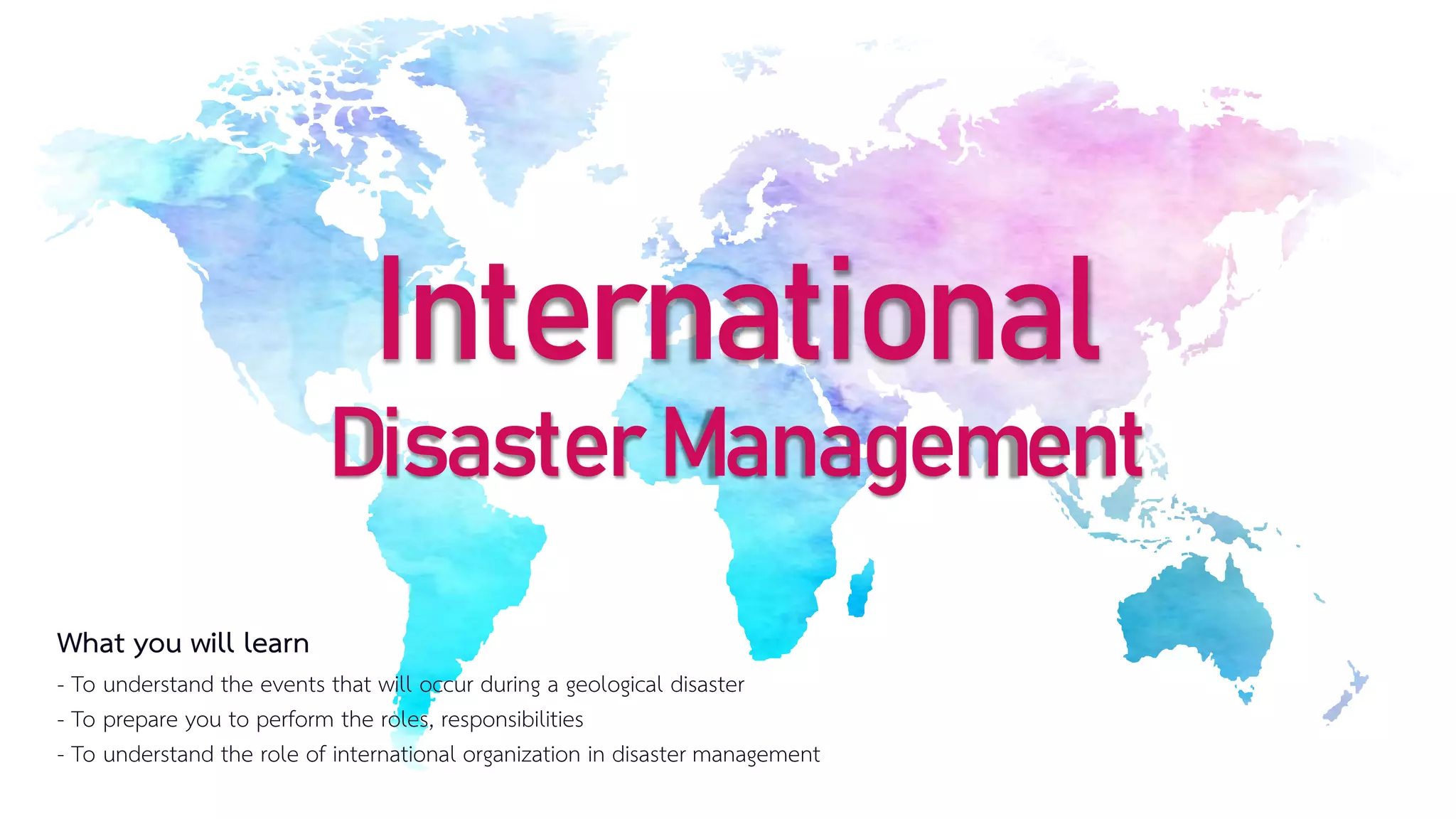
International
Disaster Management
What you will learn
- To understand the events that will occur during a geological disaster
- To prepare you to perform the roles, responsibilities
- To understand the role of international organization in disaster management
บัญชาการเหตุ
จัดการผู้บาดเจ็บ
DPMRC15, DPM Chaingrai’s office launch One School One Search and
Rescue Program in 65 affected school.
DPMRC15, DPM Chaingrai’s office, Chaingrai’s Army and related agency
had rehearsed in Provincial disaster Prevention and Mitigation Plan
DPM Chaingrai’s office was improved the disaster Prevention and
Mitigation Plan in sub-district level, district level and provincial level
Preparednessphase
9 months later
1 year later
Chiangrai civil society ‘s
disaster management network is establish
North Regional public health launch
primary Care and mental health mobile Unit.
The workshop of house reconstruction and earthquake strengthening from to
local building contractor are started.
Public seminar sharing lessons learned in earthquake recovery by
Chiangrai civil society ‘s disaster management network.
Recoveryphase
3 months later
4 days later
14 days later
1 month later
Dpm Chaingrai’s office, Public Works’s office, academic institutes and
Provincial administration inspect and manage the damage building data.
Seismic Shaking / Electricity Black out / Telephone communications
disrupted. Village leader announce to the villagers go to safety place
provincial governor establish Emergency Operations Center (EOC) to
coping with the earthquake at Chiangrai city hall.
The hospital in the affect area evacuate the patients from high-rise building
to the ground, then set up the field hospital for 3 days.
Army disaster relief center of Chiangrai, dpmrc15 established Front
Operation Center in the affected area.
Chaingrai Public Works and Urban Planning ‘s office establish the
coordination center of building inspection.
Army disaster relief center of Chiangrai , dpmrc15 and Highway police
responded to the Chiangmai-Chaingrai road collapse.
Earthquake
6.3 Ricthers
1 hour later
2 hours later
24 hours later
48 hours later
72 hours later
Emergencyphase
Building Inspection and Earthquake Relief
Emergency Operation Center of Chiangrai Province
Front Line Operation Center
(DPMRC15 Chaingrai / DPMRC 10
Lampang)
at Ban Huay San Yao School,
and Pan District Office
mobile medical services
District EOC
Sub-district EOC
Donate Center of
Disaster Relief for
Chaingrai Earthquake
Army disaster relief center
of Chiangrai at Mae Lao
Witthayakom school
Building Inspection for the
earthquake Reconstruction
in Chaiangrai Coordinating Center
Government Agency, State
enterprises Private Sector, Civil
Society ,Chairty , ETC.
Symbols
Command
Coordination
the operation in emergency phase are
systematics because the procedure and the
personnel’s duty are provided prior follow
Basic Needs aid. (Department of Disaster
Prevention and Mitigation. 2010). Which the
emergency support must be provide;
 Frist 24 hours Food, drinking water, cloth,
health, rescue, collect situation data
 24 - 48 hours shelter, properties, facilities,
find the lost person, body recovery, etc.
 48 - 72 hours loss assessment, primary
relief, pay compensate money, etc.
72 hours and long-term recovery finding
victim, social welfare, job rehabilitation,
housing, impact assessment, etc.
MODERN DISASTER MANAGEMENT – A FOUR-PHASE APPROACH
1. Mitigation involves reducing or eliminating the likelihood or the consequences of a hazard, or
both. Mitigation seeks to “treat” the hazard such that it impacts society to a lesser degree.
2. Preparedness involves equipping people who may be impacted by a disaster or who may be
able to help those impacted with the tools to increase their chances of survival and to minimize
their financial and other losses.
3. Response involves taking action to reduce or eliminate the impact of disasters that have
occurred or are currently occurring, in order to prevent further suffering, financial loss, or a
combination of both. Relief is one component of response.
4. Recovery involves returning victims’ lives back to a normal state following the impact of
disaster consequences. The recovery phase generally begins after the immediate response has
ended, and can persist for months or years thereafter.
Strength Weakness
- Broad authority and function of the
organization enough to achieve the
vision in framework of Public disaster
prevention and mitigation act 2007.
- Uncleared role, ignored by operation level.
- Centralized management authority
- Lack of knowledge and skill support to Local
administration organization personnel.
- Lack of participation and neglected public issue communication causes
conflicts.
- Uncleared proactive prevention and ignore necessity
that need to be done beforehand.
Threat Opportunity
- Thai society don’t have awareness culture. Which caused
flexibility to respond the sign of changed situations.
- Thai society lack of the alternative innovation.
- Thai society don’t understand democracy, lack of
openness and respect others. Also lack of agreement of
commitment.
- All sectors are policy, private sector, state enterprise, civil society
and local operation level interested in public disaster. And try to
improve their operation to be more flexible for disasters.
- Social media have more role in severe flood in 2011. Improve
Information technology to connect and more efficient for
operation is important. Source: Wattakan Lapsan, 2014.
SWOT Analysis of the DDPM Operation
Disaster is Politics
Response and Recovery-Based Management versus Prevention and Risk Reduction Based Management
Response and Recovery-Based Efforts Prevention and Risk Reduction-Based Efforts
• Primary focus on disaster events
• Single, event-based scenarios Basic
responsibility to respond to an event
• Often fixed, location-specific conditions
Responsibility in single authority or agency
• Command and control, directed operations
• Established hierarchical relationships Often
focused on hardware and equipment
• Dependent on specialized expertise
• Urgent, immediate, and short timeframes in
outlook,
• planning, attention, and returns
• Rapidly changing, dynamic information
usage, which is often conflicting or sensitive
in nature
• Primary, authorized, or singular information
sources; need for definitive facts
• In-out or vertical flows of information
• Relates to matters of public security, safety
• Focus on vulnerability and risk issues
• Dynamic, multiple-risk issues and development scenarios
• Fundamental need to assess, monitor, and update exposure to
changing conditions
• Extended, changing, shared or regional, local variations
• Involves multiple authorities, interests, actors
• Situation-specific functions, free and open association and
participation
• Shifting, fluid, and tangential relationships
• Dependent on related practices, abilities, and knowledge base
• Focused on aligning specialized expertise with public views and
priorities
• Moderate and long timeframes in outlook, planning, values, and
returns
• Accumulated, historical, layered, updated, or comparative use of
information
• Open or public information; multiple, diverse, or changing sources;
differing perspectives and points of view
• Dispersed, lateral flows of information
• Matters of public interest, investment, and safety
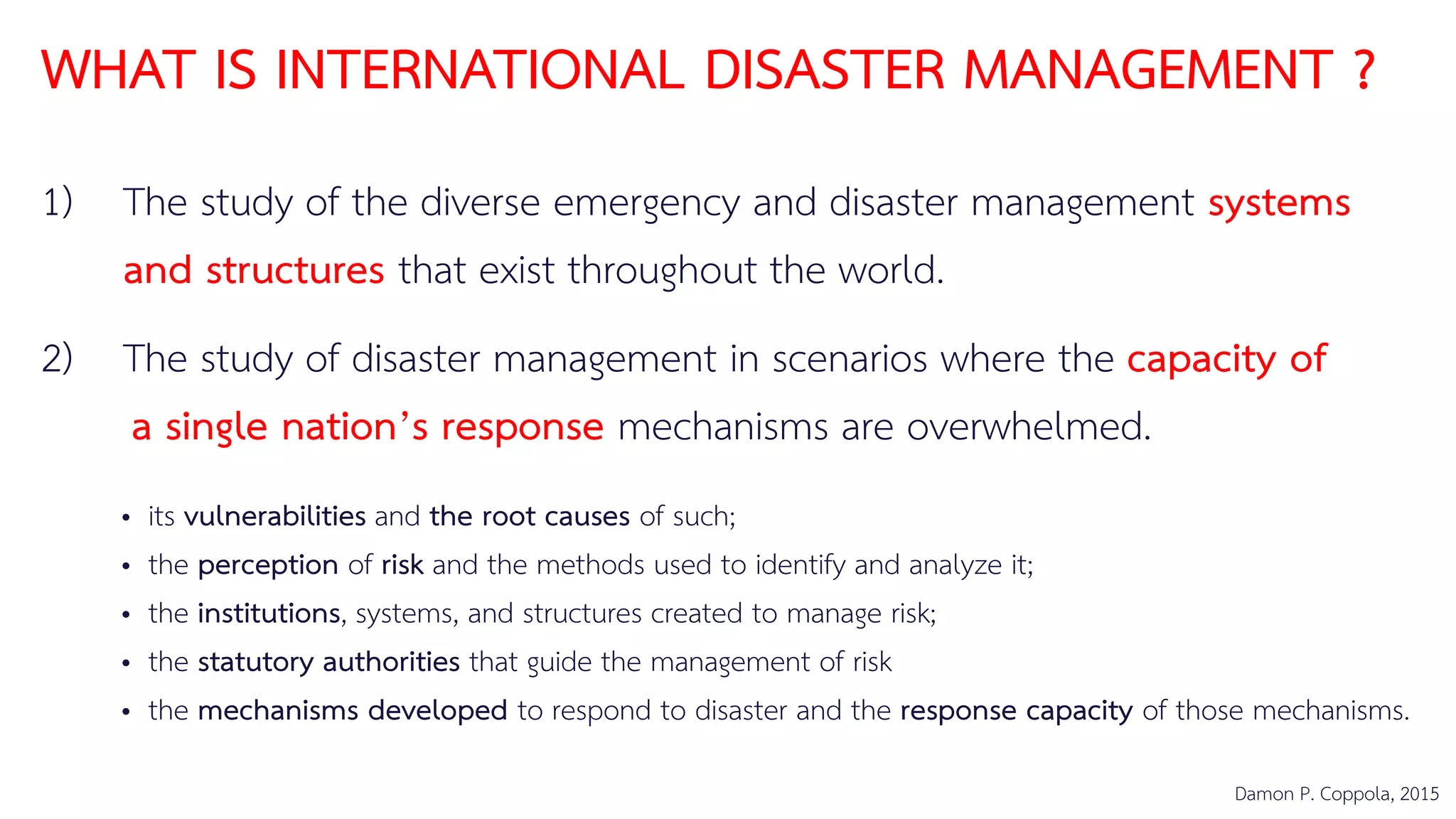
WHAT IS INTERNATIONAL DISASTER MANAGEMENT ?
1) The study of the diverse emergency and disaster management systems
and structures that exist throughout the world.
Damon P. Coppola, 2015
2) The study of disaster management in scenarios where the capacity of
a single nation’s response mechanisms are overwhelmed.
• its vulnerabilities and the root causes of such;
• the perception of risk and the methods used to identify and analyze it;
• the institutions, systems, and structures created to manage risk;
• the statutory authorities that guide the management of risk
• the mechanisms developed to respond to disaster and the response capacity of those mechanisms.
Write the name of organization or person
related disaster management
in local level
into the post-it as much as possible
Pair a friend
Write the name of organization related
disaster management
in National or Internation level
into the post-it as much as possible
Let’s Classify Level and Type of these organization
Local organization
Provincial / Regional
organization
National organization International organization
Govern
ment
NGO Private
sector, etc
Govern
ment
NGO Private
sector, etc
Govern
ment
NGO Private
sector, etc
Govern
ment
NGO Private
sector, etc
INTERNATIONAL DISASTER MANAGEMENT PARTICIPANTS
• Victims
• Local first responders
• Governments of the affected countries
• Governments of other countries
• International organizations
• International financial institutions
• Regional organizations and associations
• Nonprofit organizations
• Private organizations—business and industry
• Local and regional donors
What is the role of social and policy work in disaster event?
And Do you found some constraint on Inter-organization coordination ?
Score criteria 1 2 3
Understand the
operation in each
phase of disaster
management
Able to identified
the operation in
each phase, but
partially correct
Able to identified
the operation in
each phase,
correctly
Understand the
Disaster governance
on Inter-organization
coordination
Able to reflect
the structural
constraint among
agency, but only
in partially issue
such as only
social work or
policy work.
Able to reflect
the structural
constraint among
agency both
social work and
policy work. in
some level
Able to reflect
the structural
constraint
among agency
both social
work and
policy work. As
well in all
level
https://forms.gle/UHYaLqRf7qyvjvHZ9
Sendai Framework
OutcomeThe substantial reduction of disaster risk and losses in lives, livelihoods and
health and in the economic, physical, social, cultural and environmental assets of persons, businesses,
communities and countries
Goal Prevent new and reduce existing disaster risk through the implementation of integrated and
inclusive economic, structural, legal, social, health, cultural, educational, environmental, technological,
political and institutional measures that prevent and
reduce hazard exposure and vulnerability to disaster, increase preparedness for response and recovery,
and thus strengthen resilience
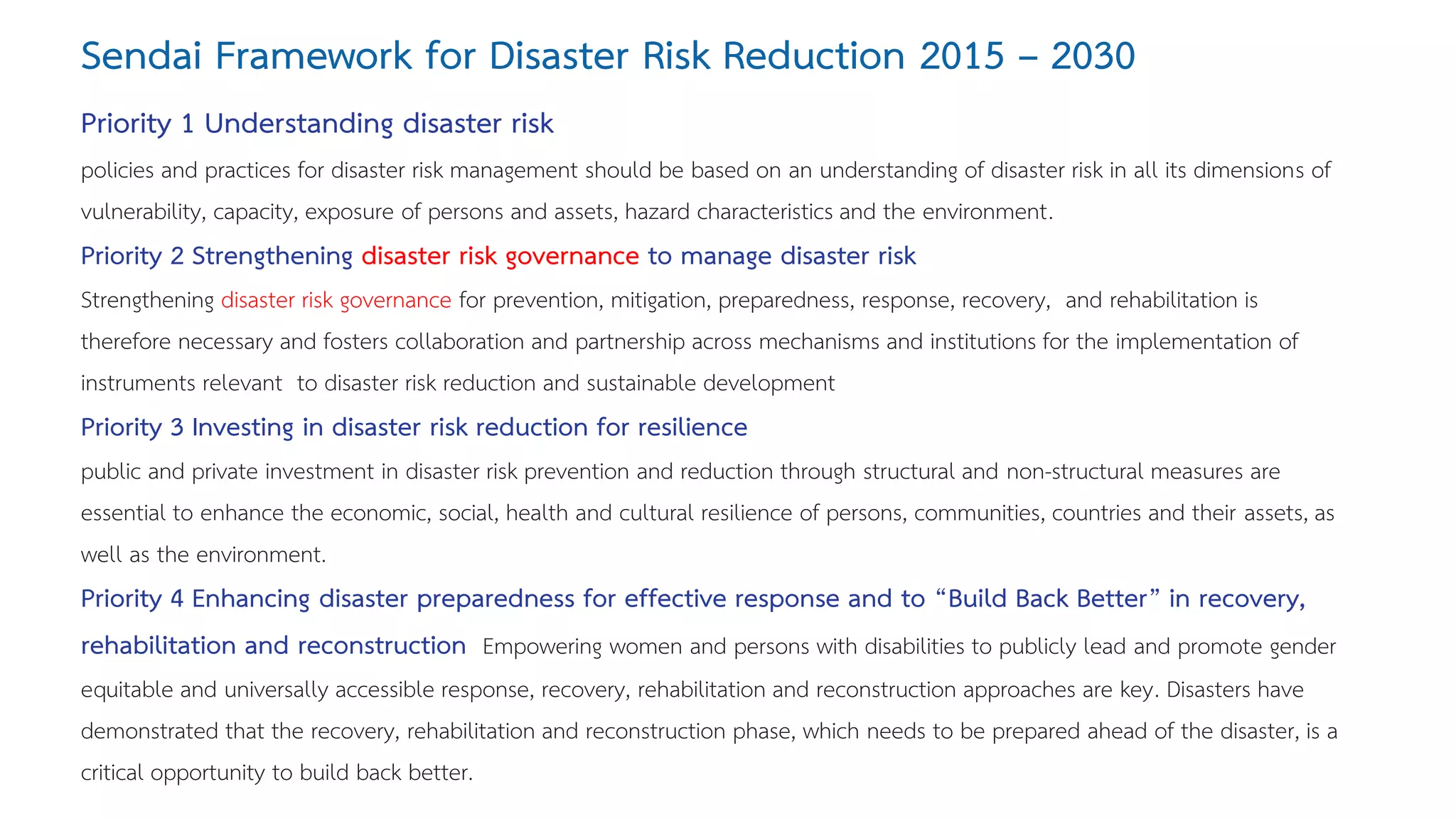
Priority 1 Understanding disaster risk
policies and practices for disaster risk management should be based on an understanding of disaster risk in all its dimensions of
vulnerability, capacity, exposure of persons and assets, hazard characteristics and the environment.
Priority 2 Strengthening disaster risk governance to manage disaster risk
Strengthening disaster risk governance for prevention, mitigation, preparedness, response, recovery, and rehabilitation is
therefore necessary and fosters collaboration and partnership across mechanisms and institutions for the implementation of
instruments relevant to disaster risk reduction and sustainable development
Priority 3 Investing in disaster risk reduction for resilience
public and private investment in disaster risk prevention and reduction through structural and non-structural measures are
essential to enhance the economic, social, health and cultural resilience of persons, communities, countries and their assets, as
well as the environment.
Priority 4 Enhancing disaster preparedness for effective response and to “Build Back Better” in recovery,
rehabilitation and reconstruction Empowering women and persons with disabilities to publicly lead and promote gender
equitable and universally accessible response, recovery, rehabilitation and reconstruction approaches are key. Disasters have
demonstrated that the recovery, rehabilitation and reconstruction phase, which needs to be prepared ahead of the disaster, is a
critical opportunity to build back better.
Sendai Framework for Disaster Risk Reduction 2015 – 2030
Disaster Governance
1) Structural change – the power distribution is crucial for the emergence.
There should be less command and control in the system, and more trust and respect among the team members as well as the respect in
their own autonomy. Self-organization building to empower the internal members to be strong and ready to share information.
2) Giving autonomy to the locality and community.
The community should also organize their risk management with the CBDRM, the operation team, the support network from the civil
society, and the ability to raise resource and accept the external aid systematically.
3) The leaders might enhances their learning and adaptability.
There should be the leader‘s capabilities development, so that they could be responsible and decide flexibility according to the situation.
They would be trustworthy, visionary, able to initiate self-organization.
4) Inter-organization coordination
They would be equipped with enough information to make a decision, and they could feedback the progress in aiding in real-time. Then
the resources sharing would become more flexible.
5) Regulations enactment
The provincial unit should emphasis on the development and enactment. The process of authorizing the building permit application should
stricter and rely more on the local building control regulations.
GOVERNMENTAL EMERGENCY MANAGEMENT STRUCTURES
This section will define and detail the various components of emergency management systems that exist in most countries
of the world. Although certain factors, including wealth, technical expertise, government type, and specific risk profile,
contribute to defining how each agency is organized and equipped, their fundamental missions are almost identical. These
agencies include:
 Fire departments
 Law enforcement agencies
 Emergency management (civil protection) agencies ( ปภ.)
 Emergency medical services (สพฉ.)
 The military
REGIONALLY BASED STRUCTURES
LOCALLY BASED STRUCTURES
Nobody knows a community’s needs, capacities,
and risks as well as the community members themselves.
where fires and other accidents rarely occur, it might not make sense to
have a fully equipped fire department idly waiting for weeks on end; even
in developed countries, rural communities may have no dedicated
emergency services of their own. Locally based response agencies may
involve several or all of the following:
• Fire department
• Police department
• Emergency medical services
• Office of emergency management
• Emergency call center
Countries may be subdivided into a whole range of
administrative and political divisions, including counties,
parishes, cantons, territories, districts, provinces, and states.
Regional governments within these systems have broad
discretionary power to make laws, spend resources, and
impose restrictions or requirements on communities.
Functions commonly assumed by these regional offices include:
• Setting standards for emergency management based upon recognized
needs within the region, and monitoring adherence to those standards
• Providing grants for funding projects that enhance local agency
response, mitigation, preparedness and/or recovery capacity
• Establishing programs that address the training and other technical
assistance needs of local agencies, including developing regionally based
training academies
• Maintaining specialized teams of responders or specialized equipment
that is deployable throughout the administrative region in times of need
NATIONALLY BASED STRUCTURES
national government emergency management agencies are the best
placed to:
• Provide emergency management priorities, standards, direction, and
goals to guide local emergency managers
• Provide training and expertise in the field of emergency management
• Provide funding to support mitigation, preparedness, response, and
recovery
• Provide technical support, in the form of imagery, information,
assessment, early warning, and engineering, for example
• Assist in the coordination and facilitation of external assistance,
whether from within or outside of the country
• Organize and facilitate hazard-based insurance programs that may
not be offered by private insurance providers
• Provide specialized assets, which could include urban search and
rescue (USAR) teams; hazardous materials detection, containment,
cleanup, and decontamination; heavy lifting and debris removal
equipment; and infrastructure repair teams and equipment
TYPES OF NATIONAL GOVERNMENT AGENCIES INVOLVED IN INTERNATIONAL DISASTER MANAGEMENT
OVERSEAS DIPLOMATIC MISSIONS (EMBASSIES AND CONSULATES)
Often, a donor country’s first contact with an affected country is through their embassy in that country. Sometimes the embassies or
consulates are directly affected by the consequences of a disaster
INTERNATIONAL DEVELOPMENT AGENCIES
Development agencies have several options to help poor nations decrease their hazard risk. These options fall primarily under the emergency
management functions of mitigation, preparedness, and recovery:
• Projects addressing issues that are not disaster related per se but include the conditions that a full hazard assessment be performed and the
project design fully address disaster resilience enhancement based on the assessment’s findings
• Funding for projects that directly address specific mitigation and preparedness needs, such as developing early warning systems, strengthening
building stock and infrastructure, and educating the public about actions to reduce their personal risk
• Technical assistance and funding to national and local governments to help develop disaster management frameworks and increased capacity
• Post-disaster recovery assistance requiring that any reconstruction must directly address hazardrisk reduction
Examples of international development agencies that incorporate disaster management into their development activities include:
• United States Agency for International Development (USAID) www.usaid.gov
• British Department for International Development (DFID) www.dfid.gov.uk/
• Canada International Development Agency (CIDA) www.acdi-cida.gc.ca/index-e.htm
• Australian Agency for International Development (AusAID) http://aid.dfat.gov.au/Pages/home.aspx
• Swedish International Development Cooperation Agency (SIDA) www.sida.se/
• New Zealand International Aid and Development Agency (NZAID) www.nzaid.govt.nz/
OTHER GOVERNMENT AGENCIES INVOLVED IN INTERNATIONAL DISASTER MANAGEMENT
• Meteorological department - Ministry of foreign affair - Ministry of Social Development and Human Security
• Military, etc
PARTICIPANTS – NON-GOVERNMENTAL ORGANIZATIONS, INCLUDING THE PRIVATE SECTOR AND ACADEMIA
non-governmental organization (NGO), as the name implies, is an organization that isn’t affiliated with any
government—whether local, regional, national, or even international or intergovernmental, such as the UN.
NGOs are commonly defined as nonprofit, civilian-based (and staffed) organizations that
depend on outside sources of funding and materials to carry out a humanitarian-based mission.
NGOs have significantly improved the ability of national and international relief agencies to address victims’ needs, given their
diverse range of skills and supplies. Some larger NGOs, like the International Federation of Red Cross and Red Crescent Societies (IFRC), have
grown to the point that they have an established global presence similar to that of the United Nations.
The primary goal of NGOs involved in disaster management and humanitarian operations is to
reduce victims’ pain and suffering. their overarching goals can be grouped into four general goals:
1. Reduce the crude mortality rate observed among disaster victims.
2. Reduce or minimize the incidence of disease and disability while stabilizing public health conditions.
3. Assist in the reconstruction and repair of infrastructure that has been damaged or destroyed.
4. Protect displaced populations, and provide for their safe return once the emergency has passed.
Examples of areas in which NGOs focus their efforts include:
• Agriculture • Animal rescue and care • Clothing
• Community development • Coordination of NGO action • Cultural preservation
• Disarmament • Disaster mitigation, preparedness, and education • Early childhood and adult education
• Emergency response • Food provision and nutrition • Health education
• Human rights • Housing repair and reconstruction • Microfinance
• Psychological counseling • Refugee and internally displaced persons care • Safe water provision
• Sanitation • Short- and long-term medical assistance • Victim security and safety
• Immediate shelter and mass care camp administration • Peace building/conflict resolution
• Protection of the environment • Providing for the special needs of vulnerable groups (children, seniors, women)
Several issues must be addressed when responding to international disasters.
The first,
coordination, is a vital and immediate component because of the sheer numbers of
responding agencies that almost always appear. It is not uncommon in larger disasters to
see several hundred local and international NGOs, each with a particular skill or service
to offer. Successful coordination and cooperation can lead to great success and many lives
saved, but infighting, turf battles, and nonparticipation can lead to confusion and even
cause a second disaster (Pan American Health Organization, n.d.).
The UN has become widely recognized as the central coordinating body, with specialized
UN agencies handling the more specific needs associated with particular disaster
consequences.Most often, the UN capitalizes on long-standing relationships with the
Host country to form a partnership in which they establish joint control. In addition to
The UN, several organizations and associations have come up with standards of conduct,
The second issue is that of sovereignty of the state. State sovereignty is based on the
recognition of political authority characterized by territory and autonomy. Accordingly,
a foreign nation or organization cannot intercede in domestic matters without the prior
consent of the ruling government. This can be a major hurdle in CHEs that resulted from
civil war, such as the peacekeeping mission in Somalia, where no official government was
in place with which to work. Although not as commonly seen, sovereignty also has been
an issue in matters of natural and technological disasters, particularly when a nation does
not want to be viewed as weak or unable to take care of its people. Examples of such
NGOs have a critical role to play in emergency management.
• NGOs can provide additional needed resources when public resources are overwhelmed.
• NGOs can tap into alternate funding sources.
• NGOs often have more focused priorities and more specialized skill sets than governments.
• In some cases, NGOs are best positioned to provide a particular service in a disaster-
affected community.
• International NGOs work across national boundaries and are well positioned to share best
practices and leverage lessons learned.
• NGOs have the flexibility to respond quickly and dynamically.
• NGOs are often seen as impartial, which is particularly valuable in complex emergencies.
NGO OPERATIONS
FUNDING The various forms of funding that NGOs may tap into include:
• Philanthropic giving from private citizens (cash or in-kind) • Corporate ongoing or one-time support (cash or in-kind)
• Religious organizations • Civic organizations • Government contracts
• Government grants • International organization contracts • International organization grants
COORDINATION NGOs may coordinate under several different locations, mechanisms, and situations. These include, but are not limited to:
• Local/national government emergency operations center • Designated coordination websites
• Formal NGO coordination mechanisms established, maintained, by only NGOs participating in the humanitarian response
• NGO field coordination meetings (formal or informal) • Conference calls and teleconferences
• NGO-established permanent or temporary offices and operations center
• UN-established coordination mechanisms such as a UN Inter-Agency Standing Committee (IASC) or the UN Clusters
• Civil–military operations center
AID WORKER SAFETY AND SECURITY complex humanitarian emergencies and other incidents involving conflict or a breakdown in rule of law, place
themselves at increased risk to carry out their work. Attacks on aid workers, both those responding from
overseas and those who are local to the country where they are working, have increased over time.
NGO/MILITARY COOPERATION NGOs have recognized that there are valuable resources and services that only the military can offer, each of which
can be used to increase the NGO’s ability to achieve its humanitarian goals. For instance, the military is often the
only source of heavy equipment to transport response and recovery supplies and materials, as well as NGO
employees, to the affected areas.
NGO CODE OF CONDUCT
1. The humanitarian imperative comes first.
2. Aid is given regardless of the race, creed, or nationality of the recipients and without adverse
distinction of any kind.
3. Aid will not be used to further a particular political or religious standpoint.
4. We shall endeavor not to act as instruments of government foreign policy.
5. We shall respect culture and custom.
6. We shall attempt to build disaster response on local capacities.
7. Ways shall be found to involve program beneficiaries in the management of relief aid.
8. Relief aid must strive to reduce future vulnerabilities to disaster as well as meet basic needs.
9. We hold ourselves accountable to both those we seek to assist and those from whom we accept
resources.
10. In our information, publicity, and advertising activities, we shall recognize disaster victims as dignified
humans, not hopeless objects.
Core Standards: The six core standards provide a reference point for humanitarian organizations as they work to meet
all of the humanitarian actions and standards described in the handbook. They apply to each sector, and the handbook
addresses action in each sector according to these six core items. The core standards include:
• People-centred humanitarian response. People’s capacity and strategies to survive with dignity are integral to the
design and approach of humanitarian response.
• Coordination and collaboration. Humanitarian response is planned and implemented in coordination with the
relevant authorities, humanitarian agencies and civil society organizations engaged in impartial humanitarian action,
working together for maximum efficiency, coverage and effectiveness.
• Assessment. The priority needs of the disaster-affected population are identified through a systematic assessment of
the context, risks to life with dignity, and the capacity of the affected people and relevant authorities to respond.
• Design and response. The humanitarian response meets the assessed needs of the disaster affected population in
relation to context, the risks faced, and the capacity of the affected people and state to cope and recover.
• Performance, transparency, and learning. The performance of humanitarian agencies is continually examined and
communicated to stakeholders; projects are adapted in response to performance.
• Aid worker performance. Humanitarian agencies provide appropriate management, supervisory, and psychosocial
support, enabling aid workers to have the knowledge, skills, behavior, and attitudes to plan and implement an effective
humanitarian response with humanity and respect.
5 characteristics in CHEs in varying degrees of intensity
1. Civil conflict, rooted in traditional ethnic, tribal, and religious animosities
(usually accompanied by widespread atrocities).
2. Deteriorated authority of the national government such that
public services disappear and political control dissolves.
3. Mass movements of population to escape conflict or
search for food, resulting in refugees and internally displaced people (IDPs).
4. Massive dislocation of the economic system, resulting in
hyperinflation and the devaluation of the currency, major declines in gross national
product, skyrocketing unemployment, and market collapse.
5. A general decline in food security, often leading to severe
malnutrition and occasional widespread starvation.
complex humanitarian emergencies (CHEs)
Three types of emergencies
normally involve an international
humanitarian response:
• natural disasters,
• technological disasters
• complex humanitarian
emergencies
THE ROLE OF ACADEMIA
Their work has contributed to the reduction of hazard risks through a deeper understanding of the threats hazards pose
and the actions that may mitigate them. Furthermore, academia has fostered greater institutional knowledge transfer, thus
improving emergency universities are helping to create a “culture of disaster prevention”
many emergency and disaster management in universities have sought to address the issue:
• Engineering (structural mitigation design) • Geology (earthquake prediction)
• Meteorology (cyclonic storm forecasting) • Sociology (risk perception and disaster behavior)
• Medicine (mass-casualty disaster response protocols) • Public health (epidemic recognition and control)
• Political science (emergency management institutional framework design)
• Development studies (sustainability through disaster resilience)
• Computer science (hazard and disaster imagery) • Public affairs (risk and disaster communications)
THE ROLE OF THE PRIVATE SECTOR
Businesses have begun to subscribe to the self-preservation practice of business continuity planning (BCP).
BCP is defined as the process by which companies of any size design plans and procedures to ensure that their critical business
functions are maintained during emergencies or disasters
Examples of private sector organizations that often partake in disaster response efforts include:
• Hospitals (privately owned) • Ambulance companies • Private search-and-rescue teams
• Veterinarians • Private hazardous materials teams • Poison control centers
• Private utilities’ emergency response units • Private funeral businesses • News media outlets
“Guiding Principles for Public-Private Collaboration in Humanitarian Action,” which include:
1. Leverage core competencies and not just finance.
2. Identify needs and respect the culture, customs, and structures of affected communities.
3. Adhere to the codes and standards developed by the humanitarian sector.
4. Engage national and local authorities. 5. Use collaborative efforts to build local skills and resources.
6. Cover the financial costs of in-kind donations. 7. Do not use humanitarian action for commercial gain.
8. Ensure public relations activities accurately reflect the collaboration.
9. Report publicly, using clear, consistent, and transparent procedures.
10. Develop long-term and predictable partnerships.
Mitigation
involves reducing or eliminating the likelihood or the
consequences of a hazard, or both. Mitigation seeks to “treat”
the hazard such that it impacts society to a lesser degree.
Preparedness
involves equipping people who may be impacted by a disaster or who
may be able to help those impacted with the tools to increase their
chances of survival and to minimize their financial and other losses.
Response
involves taking action to reduce or eliminate the impact of disasters
that have occurred or are currently occurring, in order to prevent
further suffering, financial loss, or a combination of both. Relief is one
component of response.
Recovery
involves returning victims’ lives back to a normal state following the
impact ofdisaster consequences. The recovery phase generally begins
after the immediate response has ended, and can persist for months
or years thereafter.
Internally displaced people (IDPs).
Mass movements of population to escape conflict
or search for food, resulting in refugees
Assessment Damage and Need
What your organization will do ?
"Damage" is a direct impact on physical assets, products,
raw materials, machinery or assets.
"Loss" is something that is reduced or the product is lost
or the opportunity for production is lost. For example, loss
of income Decrease in production efficiency or increase in
cost that is an opportunity loss from the time passed.
Damage and Need Assessment : DANA
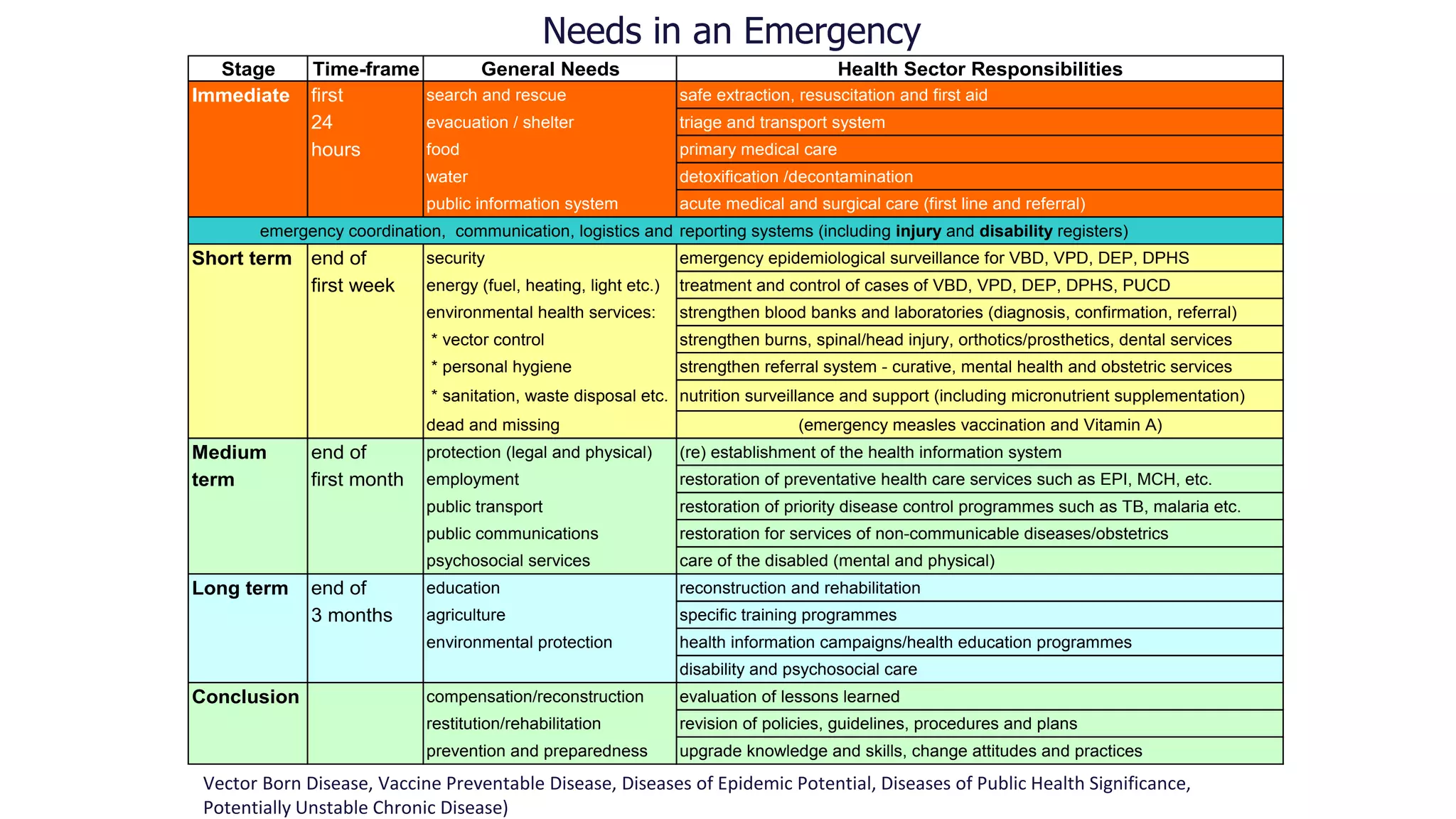
Needs in an Emergency
Stage Time-frame General Needs Health Sector Responsibilities
Immediate first search and rescue safe extraction, resuscitation and first aid
24 evacuation / shelter triage and transport system
hours food primary medical care
water detoxification /decontamination
public information system acute medical and surgical care (first line and referral)
emergency coordination, communication, logistics and reporting systems (including injury and disability registers)
Short term end of security emergency epidemiological surveillance for VBD, VPD, DEP, DPHS
first week energy (fuel, heating, light etc.) treatment and control of cases of VBD, VPD, DEP, DPHS, PUCD
environmental health services: strengthen blood banks and laboratories (diagnosis, confirmation, referral)
* vector control strengthen burns, spinal/head injury, orthotics/prosthetics, dental services
* personal hygiene strengthen referral system - curative, mental health and obstetric services
* sanitation, waste disposal etc. nutrition surveillance and support (including micronutrient supplementation)
dead and missing (emergency measles vaccination and Vitamin A)
Medium end of protection (legal and physical) (re) establishment of the health information system
term first month employment restoration of preventative health care services such as EPI, MCH, etc.
public transport restoration of priority disease control programmes such as TB, malaria etc.
public communications restoration for services of non-communicable diseases/obstetrics
psychosocial services care of the disabled (mental and physical)
Long term end of education reconstruction and rehabilitation
3 months agriculture specific training programmes
environmental protection health information campaigns/health education programmes
disability and psychosocial care
Conclusion compensation/reconstruction evaluation of lessons learned
restitution/rehabilitation revision of policies, guidelines, procedures and plans
prevention and preparedness upgrade knowledge and skills, change attitudes and practices
Vector Born Disease, Vaccine Preventable Disease, Diseases of Epidemic Potential, Diseases of Public Health Significance,
Potentially Unstable Chronic Disease)
46
 Command civil governor (Local staff), officers, volunteers, any
person
 Use of buildings, facilities, materials, equipment, tools Public
and private vehicles in the area as needed
 Use all communication tools
 Ask for help from other local authorities.
 Prohibiting entry Building
 Provide a comprehensive and fast relief for victims
The role of the local director according to
National Disaster Prevention and Mitigation Plan, 2015
47
 Providing temporary housing (Shelter) / first aid / property protection
 Organize temporary traffic regulations in disaster areas and nearby
 Block unrelated people from entering the disaster area
 Manage to maintain order
 Helping the victims / moving property when the owner requests (May
provide charitable organizations to help implement)
The role of the local director according to
National Disaster Prevention and Mitigation Plan, 2015
48
 Explore the damage that has occurred
 Make a list of victims and damaged property
 Issuing a certificate of affidavit as evidence of receiving relief
 If the victim requests the case of lost official documents (ID card,
census registration , etc) the local authorities will notify the
responsible agency for free.
The role of the local director according to
National Disaster Prevention and Mitigation Plan, 2015
Disaster Management Scale
Level Management scale Authority in charge
1 Small scale disaster District Director, Local Director and/or BMA
Assistant Director commands and controls
2 Medium scale disaster Provincial Director or BMA Director controls,
directs and commands
3 Large scale disaster Commander of National Emergency Operation
Headquarter controls, directs and commands
4 Extremely large scale
disaster
Prime Minister or assigned Deputy Prime Minister
controls, directs and commands
National Disaster Prevention and Mitigation Plan, 2015
Criteria for raising the level of violence
From level 2 to level 3
Resource
When there is a need to use resources (people, materials, equipment)
from agencies outside the province area to assist
Time
When having to spend time dealing (incident) with events from 72
hours or more
Area When there is a disaster area from 2 or more provinces
Population
When there are more than 40 percent of the population in the affected
area
Budget
When the budget is in the power of the province Not enough to cope
with the incident
Complexity
When the utility system or the main economic area has been damaged
Until causing people to not be able to live normally And the resources
available in the area are unable to cope with the event
Jurisdiction
When the National Police Commission considers it appropriate to raise
the level of danger
Color scale of disaster warning
Pair a Friend
Choose a paper
 Display TIMELINE of disaster event.
 How they deal with disaster (briefly).
 Who‘re the important actors in this event ? Why?
 What‘re the policy or social structure that
determine this disaster event ?
 What’s big problem or trigger point in this event?
 Is It worst case or best practice ? Why?
10-15 minutesPresent date : 30 April 2019
Score criteria
(10 marks)
1 2 3
Understand the operation in each
phase of disaster management
(timeline event and how to deal)
Able to display timeline
but Unable to explain
the operation on event
Able to identified the
operation in each phase,
but partially correct
Able to identified the
operation in each
phase, correctly
Understand the relation among Actor
(Who‘re the important actors in this event ? Why?)
Able to identified the
important actor in the event
But not complete
Able to identified the
important actor in the event
completely
Understand the influence factor in
disaster management
(What‘re the policy or social structure that
determine this disaster event ?)
Able to identified the
policy or social structure
but not clear
Able to identified the
policy or social structure
but not clearly.
Understand the Disaster governance
on Inter-organization coordination
(What’s big problem or trigger point in this
event?)
Able to reflect the structural
constraint among agency,
but only in partially issue
and not clear
Able to reflect the structural
constraint among agency,
but only in partially issue
Able to reflect the
structural constraint
among agency, but only
in partially issue as well

International disaster management

  • 1.
    International Disaster Management What youwill learn - To understand the events that will occur during a geological disaster - To prepare you to perform the roles, responsibilities - To understand the role of international organization in disaster management
  • 4.
    บัญชาการเหตุ จัดการผู้บาดเจ็บ DPMRC15, DPM Chaingrai’soffice launch One School One Search and Rescue Program in 65 affected school. DPMRC15, DPM Chaingrai’s office, Chaingrai’s Army and related agency had rehearsed in Provincial disaster Prevention and Mitigation Plan DPM Chaingrai’s office was improved the disaster Prevention and Mitigation Plan in sub-district level, district level and provincial level Preparednessphase 9 months later 1 year later Chiangrai civil society ‘s disaster management network is establish North Regional public health launch primary Care and mental health mobile Unit. The workshop of house reconstruction and earthquake strengthening from to local building contractor are started. Public seminar sharing lessons learned in earthquake recovery by Chiangrai civil society ‘s disaster management network. Recoveryphase 3 months later 4 days later 14 days later 1 month later Dpm Chaingrai’s office, Public Works’s office, academic institutes and Provincial administration inspect and manage the damage building data. Seismic Shaking / Electricity Black out / Telephone communications disrupted. Village leader announce to the villagers go to safety place provincial governor establish Emergency Operations Center (EOC) to coping with the earthquake at Chiangrai city hall. The hospital in the affect area evacuate the patients from high-rise building to the ground, then set up the field hospital for 3 days. Army disaster relief center of Chiangrai, dpmrc15 established Front Operation Center in the affected area. Chaingrai Public Works and Urban Planning ‘s office establish the coordination center of building inspection. Army disaster relief center of Chiangrai , dpmrc15 and Highway police responded to the Chiangmai-Chaingrai road collapse. Earthquake 6.3 Ricthers 1 hour later 2 hours later 24 hours later 48 hours later 72 hours later Emergencyphase
  • 5.
    Building Inspection andEarthquake Relief Emergency Operation Center of Chiangrai Province Front Line Operation Center (DPMRC15 Chaingrai / DPMRC 10 Lampang) at Ban Huay San Yao School, and Pan District Office mobile medical services District EOC Sub-district EOC Donate Center of Disaster Relief for Chaingrai Earthquake Army disaster relief center of Chiangrai at Mae Lao Witthayakom school Building Inspection for the earthquake Reconstruction in Chaiangrai Coordinating Center Government Agency, State enterprises Private Sector, Civil Society ,Chairty , ETC. Symbols Command Coordination
  • 6.
    the operation inemergency phase are systematics because the procedure and the personnel’s duty are provided prior follow Basic Needs aid. (Department of Disaster Prevention and Mitigation. 2010). Which the emergency support must be provide;  Frist 24 hours Food, drinking water, cloth, health, rescue, collect situation data  24 - 48 hours shelter, properties, facilities, find the lost person, body recovery, etc.  48 - 72 hours loss assessment, primary relief, pay compensate money, etc. 72 hours and long-term recovery finding victim, social welfare, job rehabilitation, housing, impact assessment, etc.
  • 7.
    MODERN DISASTER MANAGEMENT– A FOUR-PHASE APPROACH 1. Mitigation involves reducing or eliminating the likelihood or the consequences of a hazard, or both. Mitigation seeks to “treat” the hazard such that it impacts society to a lesser degree. 2. Preparedness involves equipping people who may be impacted by a disaster or who may be able to help those impacted with the tools to increase their chances of survival and to minimize their financial and other losses. 3. Response involves taking action to reduce or eliminate the impact of disasters that have occurred or are currently occurring, in order to prevent further suffering, financial loss, or a combination of both. Relief is one component of response. 4. Recovery involves returning victims’ lives back to a normal state following the impact of disaster consequences. The recovery phase generally begins after the immediate response has ended, and can persist for months or years thereafter.
  • 8.
    Strength Weakness - Broadauthority and function of the organization enough to achieve the vision in framework of Public disaster prevention and mitigation act 2007. - Uncleared role, ignored by operation level. - Centralized management authority - Lack of knowledge and skill support to Local administration organization personnel. - Lack of participation and neglected public issue communication causes conflicts. - Uncleared proactive prevention and ignore necessity that need to be done beforehand. Threat Opportunity - Thai society don’t have awareness culture. Which caused flexibility to respond the sign of changed situations. - Thai society lack of the alternative innovation. - Thai society don’t understand democracy, lack of openness and respect others. Also lack of agreement of commitment. - All sectors are policy, private sector, state enterprise, civil society and local operation level interested in public disaster. And try to improve their operation to be more flexible for disasters. - Social media have more role in severe flood in 2011. Improve Information technology to connect and more efficient for operation is important. Source: Wattakan Lapsan, 2014. SWOT Analysis of the DDPM Operation
  • 9.
  • 10.
    Response and Recovery-BasedManagement versus Prevention and Risk Reduction Based Management Response and Recovery-Based Efforts Prevention and Risk Reduction-Based Efforts • Primary focus on disaster events • Single, event-based scenarios Basic responsibility to respond to an event • Often fixed, location-specific conditions Responsibility in single authority or agency • Command and control, directed operations • Established hierarchical relationships Often focused on hardware and equipment • Dependent on specialized expertise • Urgent, immediate, and short timeframes in outlook, • planning, attention, and returns • Rapidly changing, dynamic information usage, which is often conflicting or sensitive in nature • Primary, authorized, or singular information sources; need for definitive facts • In-out or vertical flows of information • Relates to matters of public security, safety • Focus on vulnerability and risk issues • Dynamic, multiple-risk issues and development scenarios • Fundamental need to assess, monitor, and update exposure to changing conditions • Extended, changing, shared or regional, local variations • Involves multiple authorities, interests, actors • Situation-specific functions, free and open association and participation • Shifting, fluid, and tangential relationships • Dependent on related practices, abilities, and knowledge base • Focused on aligning specialized expertise with public views and priorities • Moderate and long timeframes in outlook, planning, values, and returns • Accumulated, historical, layered, updated, or comparative use of information • Open or public information; multiple, diverse, or changing sources; differing perspectives and points of view • Dispersed, lateral flows of information • Matters of public interest, investment, and safety
  • 11.
    WHAT IS INTERNATIONALDISASTER MANAGEMENT ? 1) The study of the diverse emergency and disaster management systems and structures that exist throughout the world. Damon P. Coppola, 2015 2) The study of disaster management in scenarios where the capacity of a single nation’s response mechanisms are overwhelmed. • its vulnerabilities and the root causes of such; • the perception of risk and the methods used to identify and analyze it; • the institutions, systems, and structures created to manage risk; • the statutory authorities that guide the management of risk • the mechanisms developed to respond to disaster and the response capacity of those mechanisms.
  • 14.
    Write the nameof organization or person related disaster management in local level into the post-it as much as possible Pair a friend Write the name of organization related disaster management in National or Internation level into the post-it as much as possible Let’s Classify Level and Type of these organization Local organization Provincial / Regional organization National organization International organization Govern ment NGO Private sector, etc Govern ment NGO Private sector, etc Govern ment NGO Private sector, etc Govern ment NGO Private sector, etc
  • 15.
    INTERNATIONAL DISASTER MANAGEMENTPARTICIPANTS • Victims • Local first responders • Governments of the affected countries • Governments of other countries • International organizations • International financial institutions • Regional organizations and associations • Nonprofit organizations • Private organizations—business and industry • Local and regional donors
  • 16.
    What is therole of social and policy work in disaster event? And Do you found some constraint on Inter-organization coordination ? Score criteria 1 2 3 Understand the operation in each phase of disaster management Able to identified the operation in each phase, but partially correct Able to identified the operation in each phase, correctly Understand the Disaster governance on Inter-organization coordination Able to reflect the structural constraint among agency, but only in partially issue such as only social work or policy work. Able to reflect the structural constraint among agency both social work and policy work. in some level Able to reflect the structural constraint among agency both social work and policy work. As well in all level https://forms.gle/UHYaLqRf7qyvjvHZ9
  • 17.
  • 18.
    OutcomeThe substantial reductionof disaster risk and losses in lives, livelihoods and health and in the economic, physical, social, cultural and environmental assets of persons, businesses, communities and countries Goal Prevent new and reduce existing disaster risk through the implementation of integrated and inclusive economic, structural, legal, social, health, cultural, educational, environmental, technological, political and institutional measures that prevent and reduce hazard exposure and vulnerability to disaster, increase preparedness for response and recovery, and thus strengthen resilience
  • 19.
    Priority 1 Understandingdisaster risk policies and practices for disaster risk management should be based on an understanding of disaster risk in all its dimensions of vulnerability, capacity, exposure of persons and assets, hazard characteristics and the environment. Priority 2 Strengthening disaster risk governance to manage disaster risk Strengthening disaster risk governance for prevention, mitigation, preparedness, response, recovery, and rehabilitation is therefore necessary and fosters collaboration and partnership across mechanisms and institutions for the implementation of instruments relevant to disaster risk reduction and sustainable development Priority 3 Investing in disaster risk reduction for resilience public and private investment in disaster risk prevention and reduction through structural and non-structural measures are essential to enhance the economic, social, health and cultural resilience of persons, communities, countries and their assets, as well as the environment. Priority 4 Enhancing disaster preparedness for effective response and to “Build Back Better” in recovery, rehabilitation and reconstruction Empowering women and persons with disabilities to publicly lead and promote gender equitable and universally accessible response, recovery, rehabilitation and reconstruction approaches are key. Disasters have demonstrated that the recovery, rehabilitation and reconstruction phase, which needs to be prepared ahead of the disaster, is a critical opportunity to build back better. Sendai Framework for Disaster Risk Reduction 2015 – 2030
  • 20.
    Disaster Governance 1) Structuralchange – the power distribution is crucial for the emergence. There should be less command and control in the system, and more trust and respect among the team members as well as the respect in their own autonomy. Self-organization building to empower the internal members to be strong and ready to share information. 2) Giving autonomy to the locality and community. The community should also organize their risk management with the CBDRM, the operation team, the support network from the civil society, and the ability to raise resource and accept the external aid systematically. 3) The leaders might enhances their learning and adaptability. There should be the leader‘s capabilities development, so that they could be responsible and decide flexibility according to the situation. They would be trustworthy, visionary, able to initiate self-organization. 4) Inter-organization coordination They would be equipped with enough information to make a decision, and they could feedback the progress in aiding in real-time. Then the resources sharing would become more flexible. 5) Regulations enactment The provincial unit should emphasis on the development and enactment. The process of authorizing the building permit application should stricter and rely more on the local building control regulations.
  • 21.
    GOVERNMENTAL EMERGENCY MANAGEMENTSTRUCTURES This section will define and detail the various components of emergency management systems that exist in most countries of the world. Although certain factors, including wealth, technical expertise, government type, and specific risk profile, contribute to defining how each agency is organized and equipped, their fundamental missions are almost identical. These agencies include:  Fire departments  Law enforcement agencies  Emergency management (civil protection) agencies ( ปภ.)  Emergency medical services (สพฉ.)  The military
  • 22.
    REGIONALLY BASED STRUCTURES LOCALLYBASED STRUCTURES Nobody knows a community’s needs, capacities, and risks as well as the community members themselves. where fires and other accidents rarely occur, it might not make sense to have a fully equipped fire department idly waiting for weeks on end; even in developed countries, rural communities may have no dedicated emergency services of their own. Locally based response agencies may involve several or all of the following: • Fire department • Police department • Emergency medical services • Office of emergency management • Emergency call center Countries may be subdivided into a whole range of administrative and political divisions, including counties, parishes, cantons, territories, districts, provinces, and states. Regional governments within these systems have broad discretionary power to make laws, spend resources, and impose restrictions or requirements on communities. Functions commonly assumed by these regional offices include: • Setting standards for emergency management based upon recognized needs within the region, and monitoring adherence to those standards • Providing grants for funding projects that enhance local agency response, mitigation, preparedness and/or recovery capacity • Establishing programs that address the training and other technical assistance needs of local agencies, including developing regionally based training academies • Maintaining specialized teams of responders or specialized equipment that is deployable throughout the administrative region in times of need NATIONALLY BASED STRUCTURES national government emergency management agencies are the best placed to: • Provide emergency management priorities, standards, direction, and goals to guide local emergency managers • Provide training and expertise in the field of emergency management • Provide funding to support mitigation, preparedness, response, and recovery • Provide technical support, in the form of imagery, information, assessment, early warning, and engineering, for example • Assist in the coordination and facilitation of external assistance, whether from within or outside of the country • Organize and facilitate hazard-based insurance programs that may not be offered by private insurance providers • Provide specialized assets, which could include urban search and rescue (USAR) teams; hazardous materials detection, containment, cleanup, and decontamination; heavy lifting and debris removal equipment; and infrastructure repair teams and equipment
  • 23.
    TYPES OF NATIONALGOVERNMENT AGENCIES INVOLVED IN INTERNATIONAL DISASTER MANAGEMENT OVERSEAS DIPLOMATIC MISSIONS (EMBASSIES AND CONSULATES) Often, a donor country’s first contact with an affected country is through their embassy in that country. Sometimes the embassies or consulates are directly affected by the consequences of a disaster INTERNATIONAL DEVELOPMENT AGENCIES Development agencies have several options to help poor nations decrease their hazard risk. These options fall primarily under the emergency management functions of mitigation, preparedness, and recovery: • Projects addressing issues that are not disaster related per se but include the conditions that a full hazard assessment be performed and the project design fully address disaster resilience enhancement based on the assessment’s findings • Funding for projects that directly address specific mitigation and preparedness needs, such as developing early warning systems, strengthening building stock and infrastructure, and educating the public about actions to reduce their personal risk • Technical assistance and funding to national and local governments to help develop disaster management frameworks and increased capacity • Post-disaster recovery assistance requiring that any reconstruction must directly address hazardrisk reduction Examples of international development agencies that incorporate disaster management into their development activities include: • United States Agency for International Development (USAID) www.usaid.gov • British Department for International Development (DFID) www.dfid.gov.uk/ • Canada International Development Agency (CIDA) www.acdi-cida.gc.ca/index-e.htm • Australian Agency for International Development (AusAID) http://aid.dfat.gov.au/Pages/home.aspx • Swedish International Development Cooperation Agency (SIDA) www.sida.se/ • New Zealand International Aid and Development Agency (NZAID) www.nzaid.govt.nz/ OTHER GOVERNMENT AGENCIES INVOLVED IN INTERNATIONAL DISASTER MANAGEMENT • Meteorological department - Ministry of foreign affair - Ministry of Social Development and Human Security • Military, etc
  • 24.
    PARTICIPANTS – NON-GOVERNMENTALORGANIZATIONS, INCLUDING THE PRIVATE SECTOR AND ACADEMIA non-governmental organization (NGO), as the name implies, is an organization that isn’t affiliated with any government—whether local, regional, national, or even international or intergovernmental, such as the UN. NGOs are commonly defined as nonprofit, civilian-based (and staffed) organizations that depend on outside sources of funding and materials to carry out a humanitarian-based mission. NGOs have significantly improved the ability of national and international relief agencies to address victims’ needs, given their diverse range of skills and supplies. Some larger NGOs, like the International Federation of Red Cross and Red Crescent Societies (IFRC), have grown to the point that they have an established global presence similar to that of the United Nations. The primary goal of NGOs involved in disaster management and humanitarian operations is to reduce victims’ pain and suffering. their overarching goals can be grouped into four general goals: 1. Reduce the crude mortality rate observed among disaster victims. 2. Reduce or minimize the incidence of disease and disability while stabilizing public health conditions. 3. Assist in the reconstruction and repair of infrastructure that has been damaged or destroyed. 4. Protect displaced populations, and provide for their safe return once the emergency has passed. Examples of areas in which NGOs focus their efforts include: • Agriculture • Animal rescue and care • Clothing • Community development • Coordination of NGO action • Cultural preservation • Disarmament • Disaster mitigation, preparedness, and education • Early childhood and adult education • Emergency response • Food provision and nutrition • Health education • Human rights • Housing repair and reconstruction • Microfinance • Psychological counseling • Refugee and internally displaced persons care • Safe water provision • Sanitation • Short- and long-term medical assistance • Victim security and safety • Immediate shelter and mass care camp administration • Peace building/conflict resolution • Protection of the environment • Providing for the special needs of vulnerable groups (children, seniors, women)
  • 25.
    Several issues mustbe addressed when responding to international disasters. The first, coordination, is a vital and immediate component because of the sheer numbers of responding agencies that almost always appear. It is not uncommon in larger disasters to see several hundred local and international NGOs, each with a particular skill or service to offer. Successful coordination and cooperation can lead to great success and many lives saved, but infighting, turf battles, and nonparticipation can lead to confusion and even cause a second disaster (Pan American Health Organization, n.d.). The UN has become widely recognized as the central coordinating body, with specialized UN agencies handling the more specific needs associated with particular disaster consequences.Most often, the UN capitalizes on long-standing relationships with the Host country to form a partnership in which they establish joint control. In addition to The UN, several organizations and associations have come up with standards of conduct, The second issue is that of sovereignty of the state. State sovereignty is based on the recognition of political authority characterized by territory and autonomy. Accordingly, a foreign nation or organization cannot intercede in domestic matters without the prior consent of the ruling government. This can be a major hurdle in CHEs that resulted from civil war, such as the peacekeeping mission in Somalia, where no official government was in place with which to work. Although not as commonly seen, sovereignty also has been an issue in matters of natural and technological disasters, particularly when a nation does not want to be viewed as weak or unable to take care of its people. Examples of such
  • 26.
    NGOs have acritical role to play in emergency management. • NGOs can provide additional needed resources when public resources are overwhelmed. • NGOs can tap into alternate funding sources. • NGOs often have more focused priorities and more specialized skill sets than governments. • In some cases, NGOs are best positioned to provide a particular service in a disaster- affected community. • International NGOs work across national boundaries and are well positioned to share best practices and leverage lessons learned. • NGOs have the flexibility to respond quickly and dynamically. • NGOs are often seen as impartial, which is particularly valuable in complex emergencies.
  • 27.
    NGO OPERATIONS FUNDING Thevarious forms of funding that NGOs may tap into include: • Philanthropic giving from private citizens (cash or in-kind) • Corporate ongoing or one-time support (cash or in-kind) • Religious organizations • Civic organizations • Government contracts • Government grants • International organization contracts • International organization grants COORDINATION NGOs may coordinate under several different locations, mechanisms, and situations. These include, but are not limited to: • Local/national government emergency operations center • Designated coordination websites • Formal NGO coordination mechanisms established, maintained, by only NGOs participating in the humanitarian response • NGO field coordination meetings (formal or informal) • Conference calls and teleconferences • NGO-established permanent or temporary offices and operations center • UN-established coordination mechanisms such as a UN Inter-Agency Standing Committee (IASC) or the UN Clusters • Civil–military operations center AID WORKER SAFETY AND SECURITY complex humanitarian emergencies and other incidents involving conflict or a breakdown in rule of law, place themselves at increased risk to carry out their work. Attacks on aid workers, both those responding from overseas and those who are local to the country where they are working, have increased over time. NGO/MILITARY COOPERATION NGOs have recognized that there are valuable resources and services that only the military can offer, each of which can be used to increase the NGO’s ability to achieve its humanitarian goals. For instance, the military is often the only source of heavy equipment to transport response and recovery supplies and materials, as well as NGO employees, to the affected areas.
  • 28.
    NGO CODE OFCONDUCT 1. The humanitarian imperative comes first. 2. Aid is given regardless of the race, creed, or nationality of the recipients and without adverse distinction of any kind. 3. Aid will not be used to further a particular political or religious standpoint. 4. We shall endeavor not to act as instruments of government foreign policy. 5. We shall respect culture and custom. 6. We shall attempt to build disaster response on local capacities. 7. Ways shall be found to involve program beneficiaries in the management of relief aid. 8. Relief aid must strive to reduce future vulnerabilities to disaster as well as meet basic needs. 9. We hold ourselves accountable to both those we seek to assist and those from whom we accept resources. 10. In our information, publicity, and advertising activities, we shall recognize disaster victims as dignified humans, not hopeless objects.
  • 29.
    Core Standards: Thesix core standards provide a reference point for humanitarian organizations as they work to meet all of the humanitarian actions and standards described in the handbook. They apply to each sector, and the handbook addresses action in each sector according to these six core items. The core standards include: • People-centred humanitarian response. People’s capacity and strategies to survive with dignity are integral to the design and approach of humanitarian response. • Coordination and collaboration. Humanitarian response is planned and implemented in coordination with the relevant authorities, humanitarian agencies and civil society organizations engaged in impartial humanitarian action, working together for maximum efficiency, coverage and effectiveness. • Assessment. The priority needs of the disaster-affected population are identified through a systematic assessment of the context, risks to life with dignity, and the capacity of the affected people and relevant authorities to respond. • Design and response. The humanitarian response meets the assessed needs of the disaster affected population in relation to context, the risks faced, and the capacity of the affected people and state to cope and recover. • Performance, transparency, and learning. The performance of humanitarian agencies is continually examined and communicated to stakeholders; projects are adapted in response to performance. • Aid worker performance. Humanitarian agencies provide appropriate management, supervisory, and psychosocial support, enabling aid workers to have the knowledge, skills, behavior, and attitudes to plan and implement an effective humanitarian response with humanity and respect.
  • 32.
    5 characteristics inCHEs in varying degrees of intensity 1. Civil conflict, rooted in traditional ethnic, tribal, and religious animosities (usually accompanied by widespread atrocities). 2. Deteriorated authority of the national government such that public services disappear and political control dissolves. 3. Mass movements of population to escape conflict or search for food, resulting in refugees and internally displaced people (IDPs). 4. Massive dislocation of the economic system, resulting in hyperinflation and the devaluation of the currency, major declines in gross national product, skyrocketing unemployment, and market collapse. 5. A general decline in food security, often leading to severe malnutrition and occasional widespread starvation. complex humanitarian emergencies (CHEs) Three types of emergencies normally involve an international humanitarian response: • natural disasters, • technological disasters • complex humanitarian emergencies
  • 33.
    THE ROLE OFACADEMIA Their work has contributed to the reduction of hazard risks through a deeper understanding of the threats hazards pose and the actions that may mitigate them. Furthermore, academia has fostered greater institutional knowledge transfer, thus improving emergency universities are helping to create a “culture of disaster prevention” many emergency and disaster management in universities have sought to address the issue: • Engineering (structural mitigation design) • Geology (earthquake prediction) • Meteorology (cyclonic storm forecasting) • Sociology (risk perception and disaster behavior) • Medicine (mass-casualty disaster response protocols) • Public health (epidemic recognition and control) • Political science (emergency management institutional framework design) • Development studies (sustainability through disaster resilience) • Computer science (hazard and disaster imagery) • Public affairs (risk and disaster communications)
  • 34.
    THE ROLE OFTHE PRIVATE SECTOR Businesses have begun to subscribe to the self-preservation practice of business continuity planning (BCP). BCP is defined as the process by which companies of any size design plans and procedures to ensure that their critical business functions are maintained during emergencies or disasters Examples of private sector organizations that often partake in disaster response efforts include: • Hospitals (privately owned) • Ambulance companies • Private search-and-rescue teams • Veterinarians • Private hazardous materials teams • Poison control centers • Private utilities’ emergency response units • Private funeral businesses • News media outlets “Guiding Principles for Public-Private Collaboration in Humanitarian Action,” which include: 1. Leverage core competencies and not just finance. 2. Identify needs and respect the culture, customs, and structures of affected communities. 3. Adhere to the codes and standards developed by the humanitarian sector. 4. Engage national and local authorities. 5. Use collaborative efforts to build local skills and resources. 6. Cover the financial costs of in-kind donations. 7. Do not use humanitarian action for commercial gain. 8. Ensure public relations activities accurately reflect the collaboration. 9. Report publicly, using clear, consistent, and transparent procedures. 10. Develop long-term and predictable partnerships.
  • 35.
    Mitigation involves reducing oreliminating the likelihood or the consequences of a hazard, or both. Mitigation seeks to “treat” the hazard such that it impacts society to a lesser degree.
  • 36.
    Preparedness involves equipping peoplewho may be impacted by a disaster or who may be able to help those impacted with the tools to increase their chances of survival and to minimize their financial and other losses.
  • 37.
    Response involves taking actionto reduce or eliminate the impact of disasters that have occurred or are currently occurring, in order to prevent further suffering, financial loss, or a combination of both. Relief is one component of response.
  • 38.
    Recovery involves returning victims’lives back to a normal state following the impact ofdisaster consequences. The recovery phase generally begins after the immediate response has ended, and can persist for months or years thereafter.
  • 39.
    Internally displaced people(IDPs). Mass movements of population to escape conflict or search for food, resulting in refugees
  • 40.
    Assessment Damage andNeed What your organization will do ?
  • 41.
    "Damage" is adirect impact on physical assets, products, raw materials, machinery or assets. "Loss" is something that is reduced or the product is lost or the opportunity for production is lost. For example, loss of income Decrease in production efficiency or increase in cost that is an opportunity loss from the time passed. Damage and Need Assessment : DANA
  • 42.
    Needs in anEmergency Stage Time-frame General Needs Health Sector Responsibilities Immediate first search and rescue safe extraction, resuscitation and first aid 24 evacuation / shelter triage and transport system hours food primary medical care water detoxification /decontamination public information system acute medical and surgical care (first line and referral) emergency coordination, communication, logistics and reporting systems (including injury and disability registers) Short term end of security emergency epidemiological surveillance for VBD, VPD, DEP, DPHS first week energy (fuel, heating, light etc.) treatment and control of cases of VBD, VPD, DEP, DPHS, PUCD environmental health services: strengthen blood banks and laboratories (diagnosis, confirmation, referral) * vector control strengthen burns, spinal/head injury, orthotics/prosthetics, dental services * personal hygiene strengthen referral system - curative, mental health and obstetric services * sanitation, waste disposal etc. nutrition surveillance and support (including micronutrient supplementation) dead and missing (emergency measles vaccination and Vitamin A) Medium end of protection (legal and physical) (re) establishment of the health information system term first month employment restoration of preventative health care services such as EPI, MCH, etc. public transport restoration of priority disease control programmes such as TB, malaria etc. public communications restoration for services of non-communicable diseases/obstetrics psychosocial services care of the disabled (mental and physical) Long term end of education reconstruction and rehabilitation 3 months agriculture specific training programmes environmental protection health information campaigns/health education programmes disability and psychosocial care Conclusion compensation/reconstruction evaluation of lessons learned restitution/rehabilitation revision of policies, guidelines, procedures and plans prevention and preparedness upgrade knowledge and skills, change attitudes and practices Vector Born Disease, Vaccine Preventable Disease, Diseases of Epidemic Potential, Diseases of Public Health Significance, Potentially Unstable Chronic Disease)
  • 46.
    46  Command civilgovernor (Local staff), officers, volunteers, any person  Use of buildings, facilities, materials, equipment, tools Public and private vehicles in the area as needed  Use all communication tools  Ask for help from other local authorities.  Prohibiting entry Building  Provide a comprehensive and fast relief for victims The role of the local director according to National Disaster Prevention and Mitigation Plan, 2015
  • 47.
    47  Providing temporaryhousing (Shelter) / first aid / property protection  Organize temporary traffic regulations in disaster areas and nearby  Block unrelated people from entering the disaster area  Manage to maintain order  Helping the victims / moving property when the owner requests (May provide charitable organizations to help implement) The role of the local director according to National Disaster Prevention and Mitigation Plan, 2015
  • 48.
    48  Explore thedamage that has occurred  Make a list of victims and damaged property  Issuing a certificate of affidavit as evidence of receiving relief  If the victim requests the case of lost official documents (ID card, census registration , etc) the local authorities will notify the responsible agency for free. The role of the local director according to National Disaster Prevention and Mitigation Plan, 2015
  • 49.
    Disaster Management Scale LevelManagement scale Authority in charge 1 Small scale disaster District Director, Local Director and/or BMA Assistant Director commands and controls 2 Medium scale disaster Provincial Director or BMA Director controls, directs and commands 3 Large scale disaster Commander of National Emergency Operation Headquarter controls, directs and commands 4 Extremely large scale disaster Prime Minister or assigned Deputy Prime Minister controls, directs and commands National Disaster Prevention and Mitigation Plan, 2015
  • 51.
    Criteria for raisingthe level of violence From level 2 to level 3 Resource When there is a need to use resources (people, materials, equipment) from agencies outside the province area to assist Time When having to spend time dealing (incident) with events from 72 hours or more Area When there is a disaster area from 2 or more provinces Population When there are more than 40 percent of the population in the affected area Budget When the budget is in the power of the province Not enough to cope with the incident Complexity When the utility system or the main economic area has been damaged Until causing people to not be able to live normally And the resources available in the area are unable to cope with the event Jurisdiction When the National Police Commission considers it appropriate to raise the level of danger
  • 52.
    Color scale ofdisaster warning
  • 53.
  • 54.
     Display TIMELINEof disaster event.  How they deal with disaster (briefly).  Who‘re the important actors in this event ? Why?  What‘re the policy or social structure that determine this disaster event ?  What’s big problem or trigger point in this event?  Is It worst case or best practice ? Why? 10-15 minutesPresent date : 30 April 2019
  • 55.
    Score criteria (10 marks) 12 3 Understand the operation in each phase of disaster management (timeline event and how to deal) Able to display timeline but Unable to explain the operation on event Able to identified the operation in each phase, but partially correct Able to identified the operation in each phase, correctly Understand the relation among Actor (Who‘re the important actors in this event ? Why?) Able to identified the important actor in the event But not complete Able to identified the important actor in the event completely Understand the influence factor in disaster management (What‘re the policy or social structure that determine this disaster event ?) Able to identified the policy or social structure but not clear Able to identified the policy or social structure but not clearly. Understand the Disaster governance on Inter-organization coordination (What’s big problem or trigger point in this event?) Able to reflect the structural constraint among agency, but only in partially issue and not clear Able to reflect the structural constraint among agency, but only in partially issue Able to reflect the structural constraint among agency, but only in partially issue as well