Dr Fayaz A. Malla
Assistant Professor, Environmental Sciences
GDC Pulwama
Higher Education Department, Govt. of J&K
Email: nami.fayaz@gmail.com
Disaster management is an applied science which
seeks by systematic observation and analysis of
disasters to improve measures relating to prevention,
mitigation, preparedness, emergency, response and
recovery.
A disaster is a situation in which the community is incapable of
coping.
It is a natural or human-caused event which causes intense negative
impacts on people, goods, services and/or the environment,
exceeding the affected community’s capability to respond;
therefore the community seeks the assistance of government and
international agencies
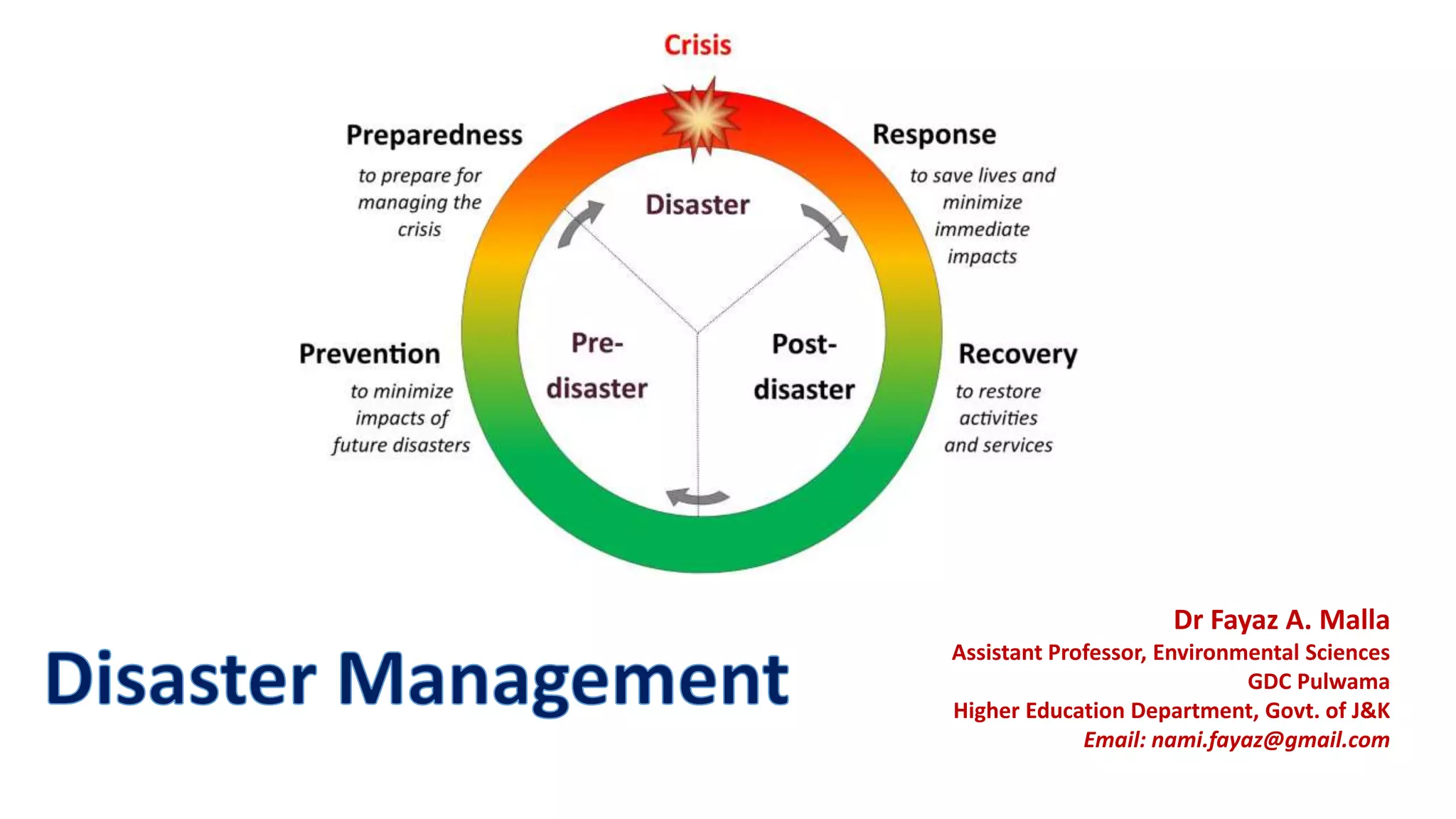
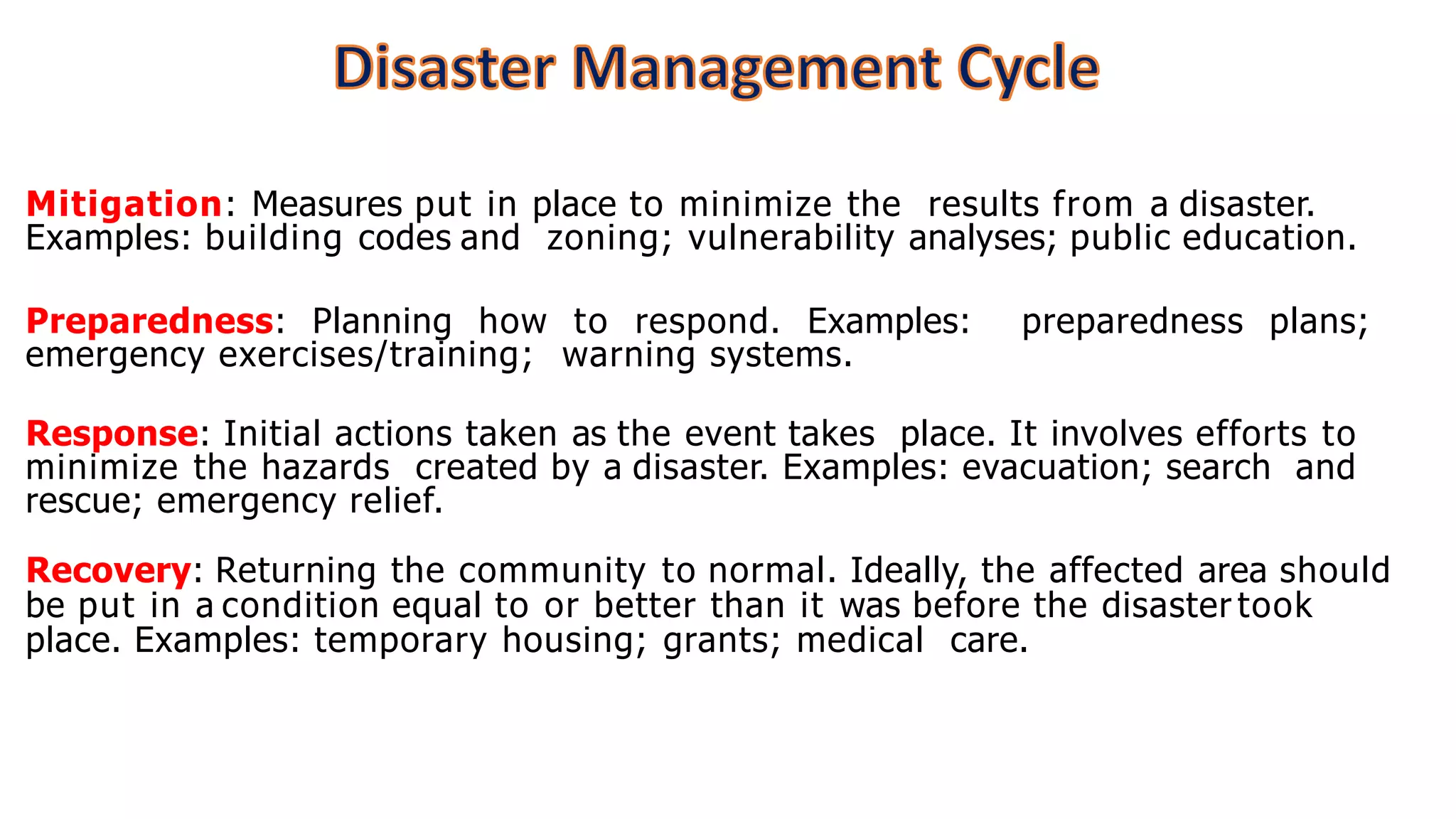
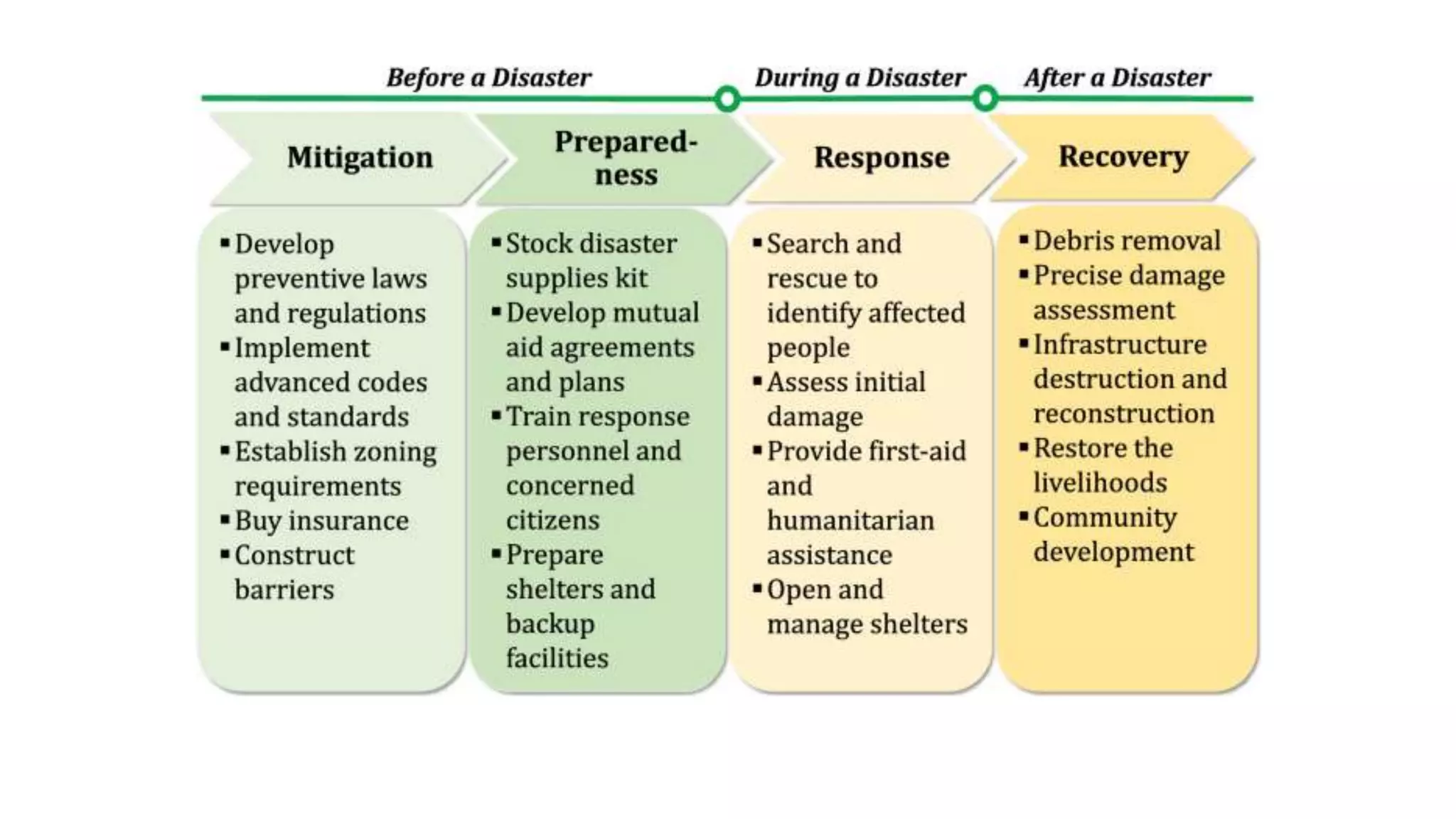
Mitigation: Measures put in place to minimize the results from a disaster.
Examples: building codes and zoning; vulnerability analyses; public education.
Preparedness: Planning how to respond. Examples: preparedness plans;
emergency exercises/training; warning systems.
Response: Initial actions taken as the event takes place. It involves efforts to
minimize the hazards created by a disaster. Examples: evacuation; search and
rescue; emergency relief.
Recovery: Returning the community to normal. Ideally, the affected area should
be put in a condition equal to or better than it was before the disaster took
place. Examples: temporary housing; grants; medical care.
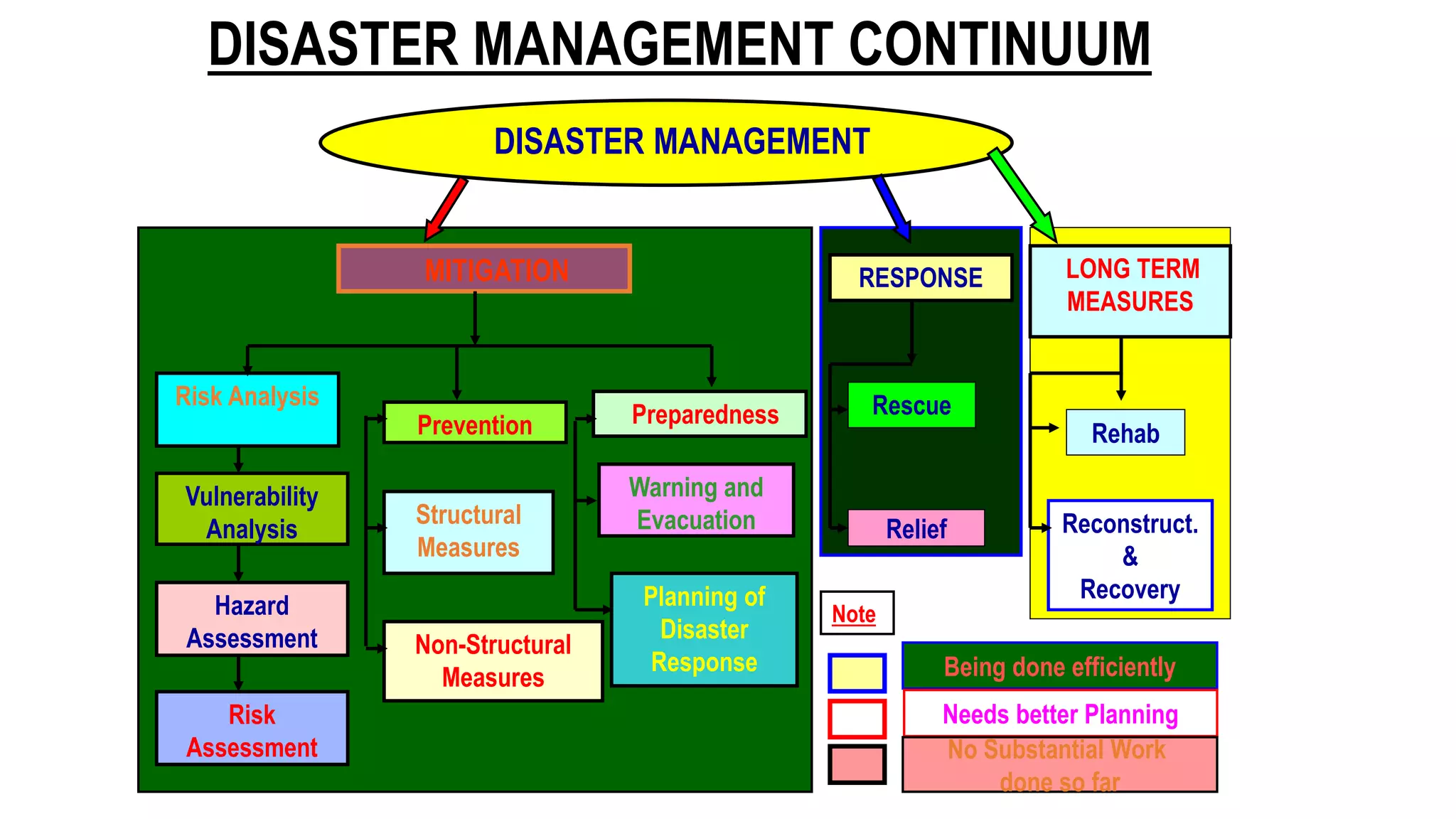
Prevention
Rescue
Structural
Measures
Warning and
Evacuation
Non-Structural
Measures
Planning of
Disaster
Response
Reconstruct.
&
Recovery
Risk Analysis
DISASTER MANAGEMENT
MITIGATION RESPONSE
Risk
Assessment
Preparedness
Hazard
Assessment
Vulnerability
Analysis Relief
Rehab
LONG TERM
MEASURES
Being done efficiently
Needs better Planning
No Substantial Work
done so far
Note
DISASTER MANAGEMENT CONTINUUM
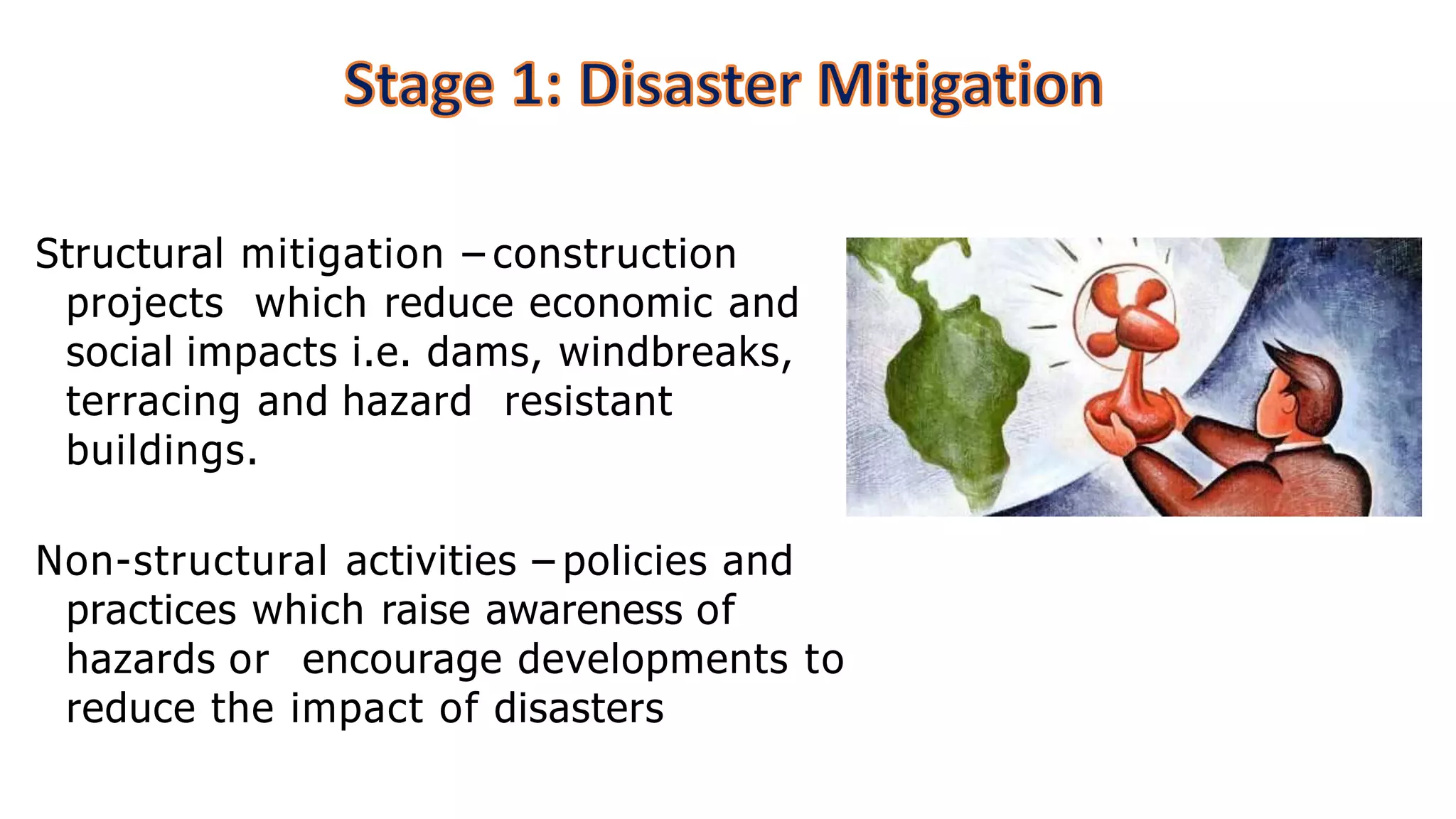
Structural mitigation – construction
projects which reduce economic and
social impacts i.e. dams, windbreaks,
terracing and hazard resistant
buildings.
Non-structural activities – policies and
practices which raise awareness of
hazards or encourage developments to
reduce the impact of disasters
Reviewing building codes.
Vulnerability analysis updates.
Zoning and land-use management and planning.
Reviewing of building use regulations and safety codes.
Implementing preventative health measures
Political intervention and commitment
Public awareness
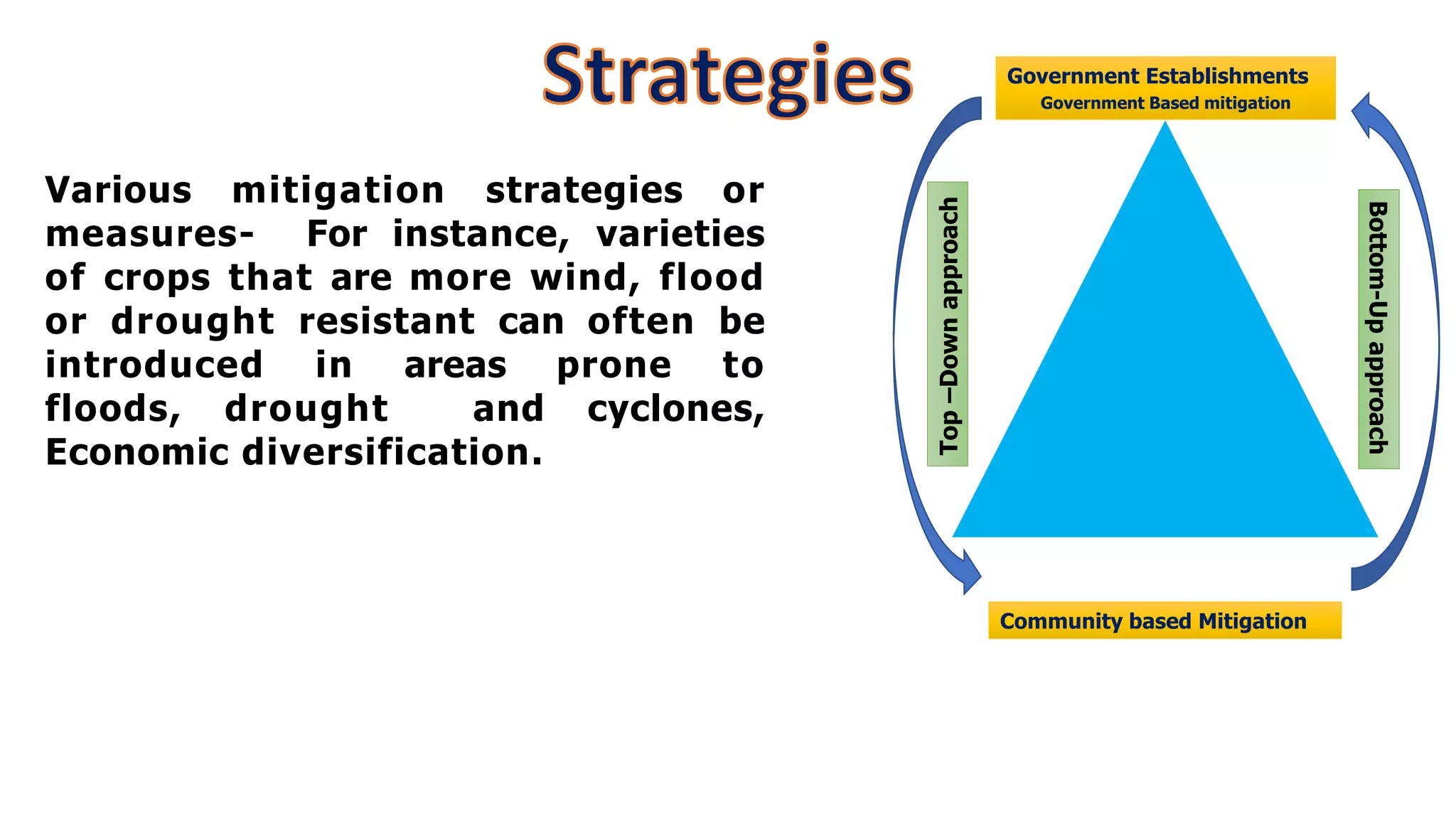
Various mitigation strategies or
measures- For instance, varieties
of crops that are more wind, flood
or drought resistant can often be
introduced in areas prone to
floods, drought and cyclones,
Economic diversification.
Community based Mitigation
Government Establishments
Government Based mitigation
Top
–Down
approach
Bottom-Up
approach
Investment in infrastructure to support sustainable socioeconomic
development
Investment in infrastructure for reconstruction and recovery.
i. A backup generator is available in case of power
failure and that a battery-operated radio .
ii. A backup copy of all critical information
iii. The preliminary design should take into consideration the
prevalent hazards and methods to avoid or to minimize the
effects of the extreme natural events.
iv. Strengthening vulnerable areas such as roofs,
exterior doors, windows, and garage doors
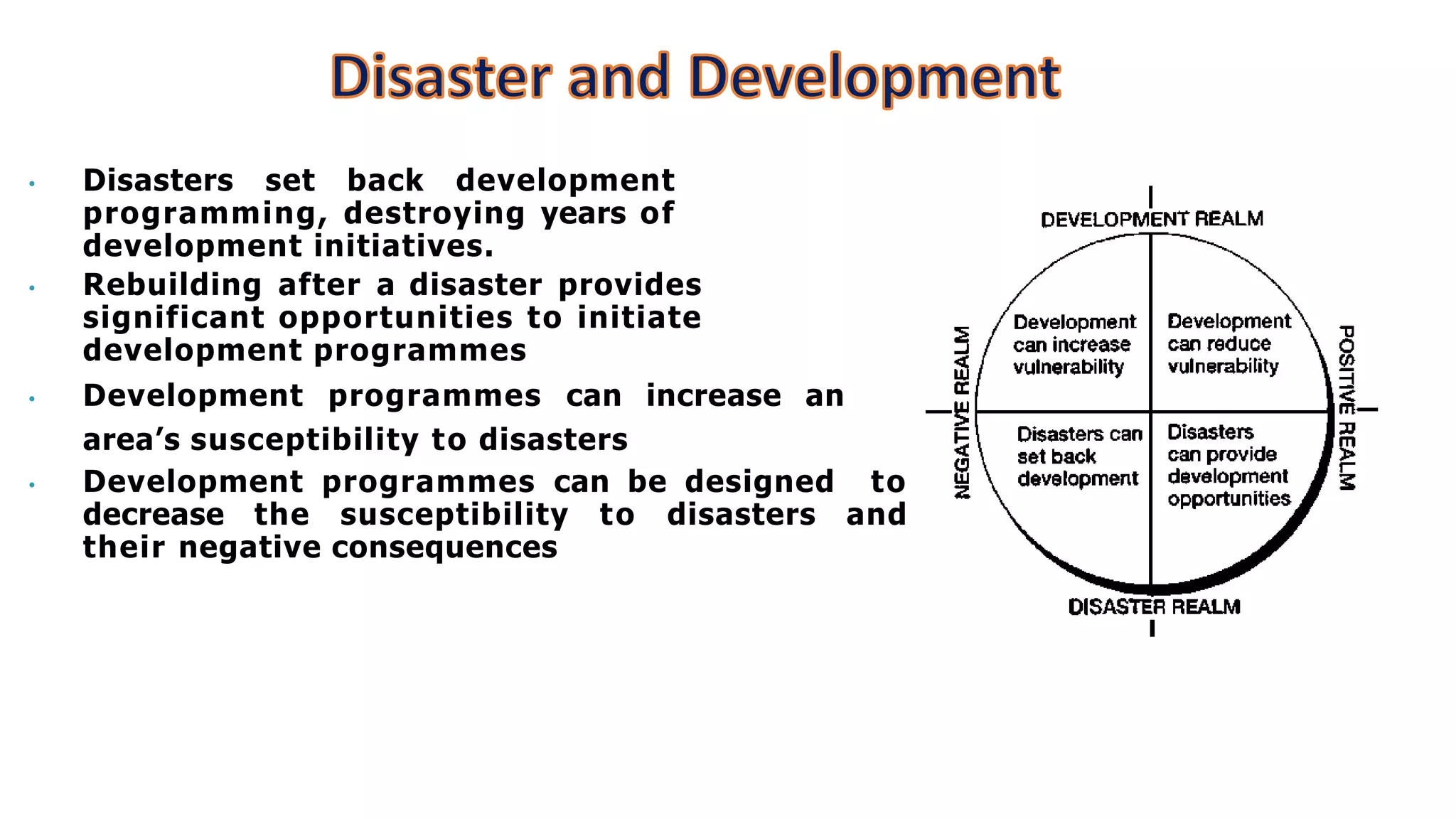
• Disasters set back development
programming, destroying years of
development initiatives.
• Rebuilding after a disaster provides
significant opportunities to initiate
development programmes
• Development programmes can increase an
area’s susceptibility to disasters
• Development programmes can be designed to
decrease the susceptibility to disasters and
their negative consequences
• Partnership-close collaboration among donors,
governments, communities, nongovernmental
organizations, the private sector, and
universities
• Flexibility-. Development agencies must be
efficient and flexible; adaptable to local
environments and capable of adjusting to
changing conditions and seizing
opportunities when they arise.
• Selectivity-resources are the public asset that
must be invested prudently to achieve
maximum impact.
Preparedness measures include:
 Preparedness plans
 Emergency exercises/training
 Warning systems
 Emergency communications systems
 Evacuations plans and training
 Resource inventories Emergency
 Personnel/contact list.
 Mutual aid agreements
 Public information/education
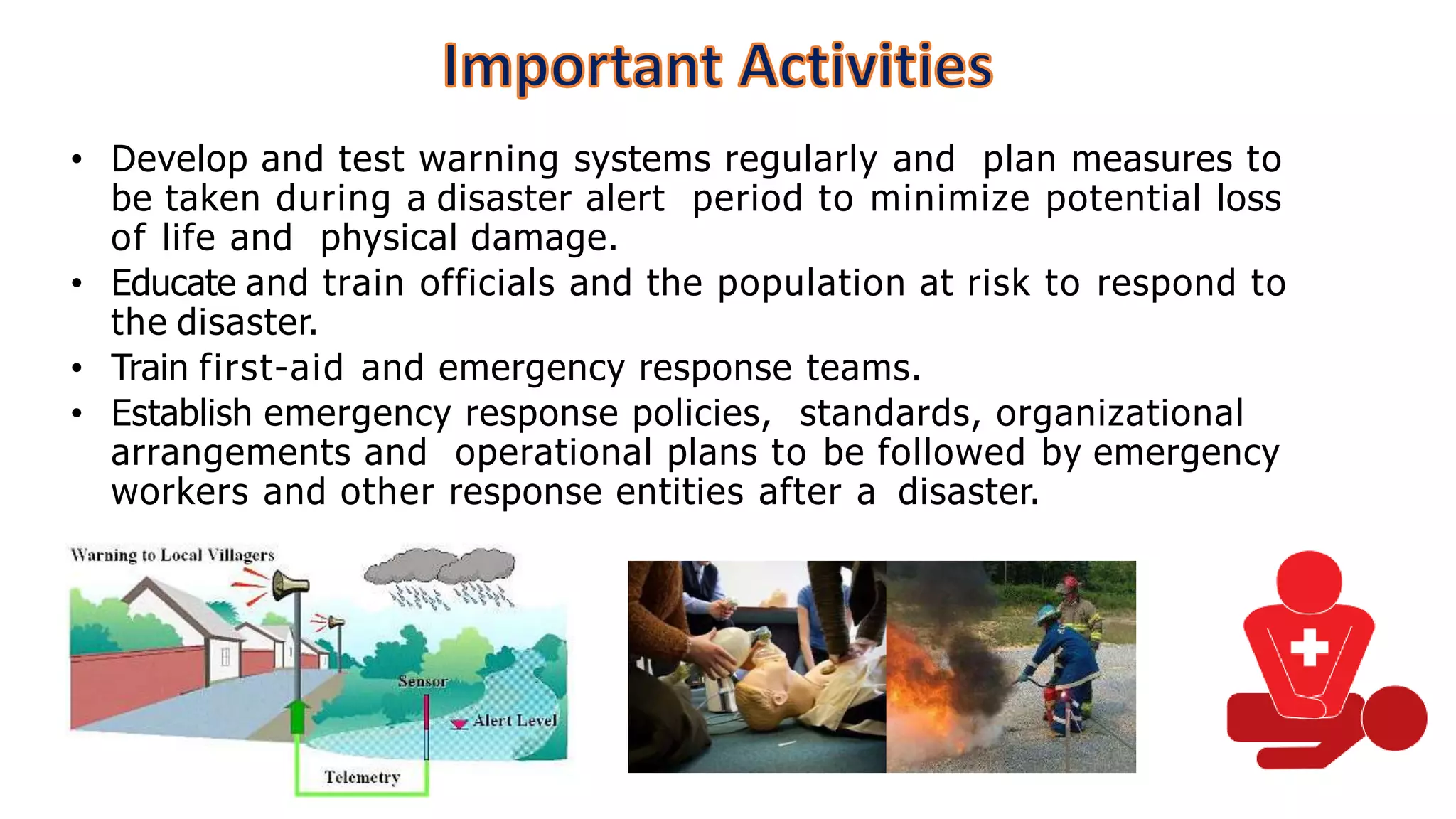
• Develop and test warning systems regularly and plan measures to
be taken during a disaster alert period to minimize potential loss
of life and physical damage.
• Educate and train officials and the population at risk to respond to
the disaster.
• Train first-aid and emergency response teams.
• Establish emergency response policies, standards, organizational
arrangements and operational plans to be followed by emergency
workers and other response entities after a disaster.
• It forms the action plan to be
implemented before, during and after
disasters.
• The IFRCRCS (International Federation of
Red Cross and Red Crescent Societies)
defines risk reduction as physical measures
to reduce the vulnerability and exposure
of infrastructure to natural hazards as well
and to provide coping and adaptive
infrastructure in case of a disaster event.
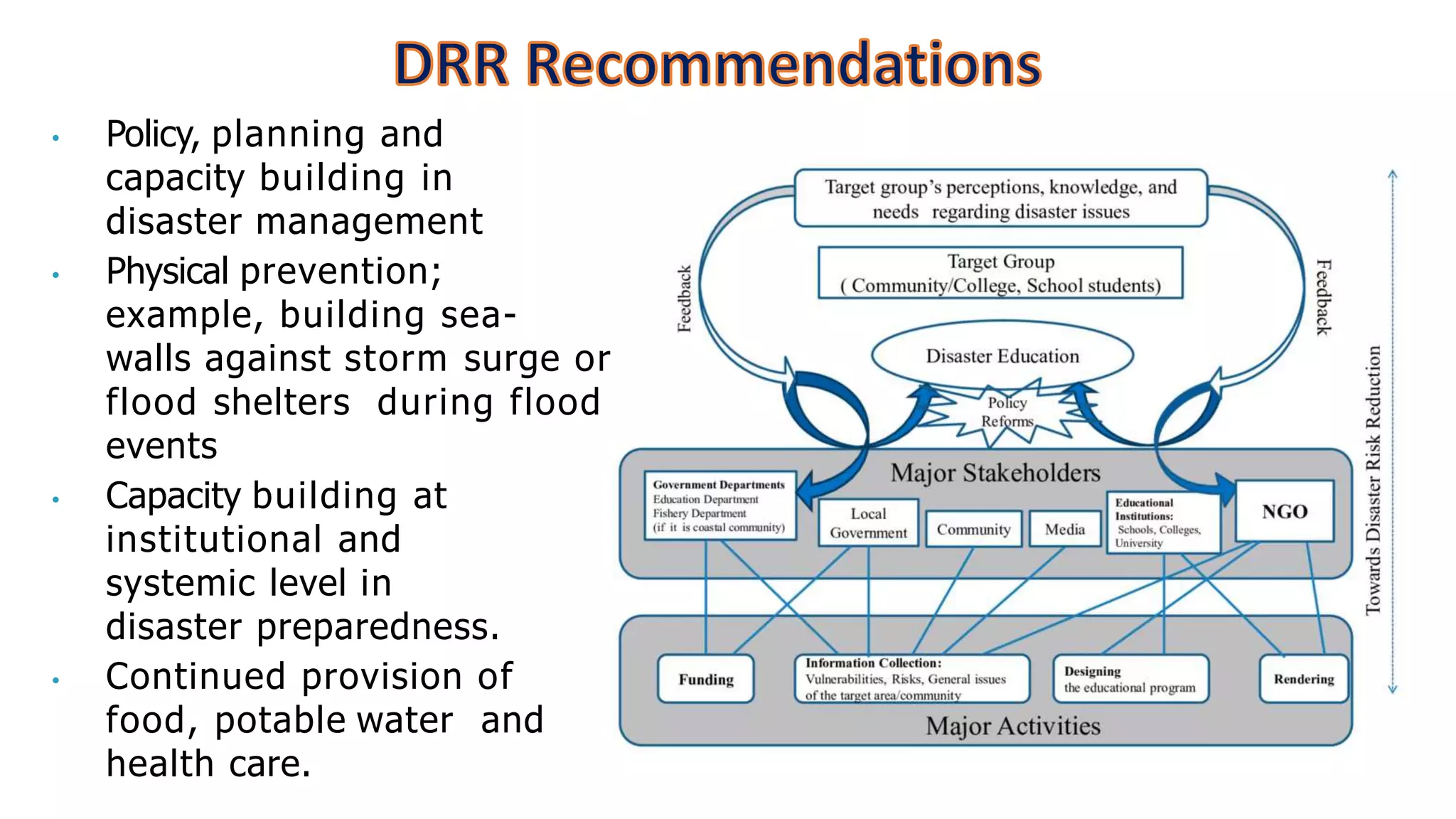
• Policy, planning and
capacity building in
disaster management
• Physical prevention;
example, building sea-
walls against storm surge or
flood shelters during flood
events
• Capacity building at
institutional and
systemic level in
disaster preparedness.
• Continued provision of
food, potable water and
health care.
• EOPallows the community to respond
to threats.
• Engages responders in the short-
term recovery
• Must be flexible to be valuable in real
and potential emergencies.
• It doesn’t include the administrative plan,
the mitigation strategy, the long term
recovery or the Standard Operational
procedures.
Aim of Disaster Response
 Evacuation, Migration, administrating first-aid,
transportation of affected people to hospital
 Discuss the restoration of essential services.
 Rescue work
 Ideal Command Centre
 Modern and traditional methods of response
 Evacuation, Migration, administrating first-aid, transportation of
affected people to hospital
 Discuss the restoration of essential services.
 Rescue work
 Ideal Command Centre
 Modern and traditional methods of response
 The mission of the response phase is to meet the basic needs of the people until more
permanent and sustainable solutions are formulated.
 There is growing awareness of costs associated with improper management of disasters
and hence communities and government are trying hard to improve the first responder
efforts.
 Disaster response is aimed at providing instant support to maintain life and health of the
affected population.
 There is a wide array of response activities carried out after disaster like first-aid,
transportation, shelter and food, initial repairs to damaged infrastructure.
 The level & kind of disaster response depends on a number of factors – the
scale of disaster, the nature and number of affected people and site-
specific conditions.
 Response comprises the decisions and actions taken to deal with an urgent
situation that has adversely affected life and property.
 It calls for collaboration, coordination and communication between agencies
involved in administrating rescue and relief operations.
 The main aim of response is to save and protect human life.
 The other aims of response are-
1. To guarantee the continued existence of the maximum possible number of
affected population and ensuring that they are in the best possible physical and
mental health in the circumstances.
2. To reinstate critical services and provide food, clothing and water.
3. To restore or replace demolished or damaged infrastructure.
4. To make alternate housing arrangements in camps.
5. To help in relieving suffering.
6. To protect the health and safety of responding personnel.
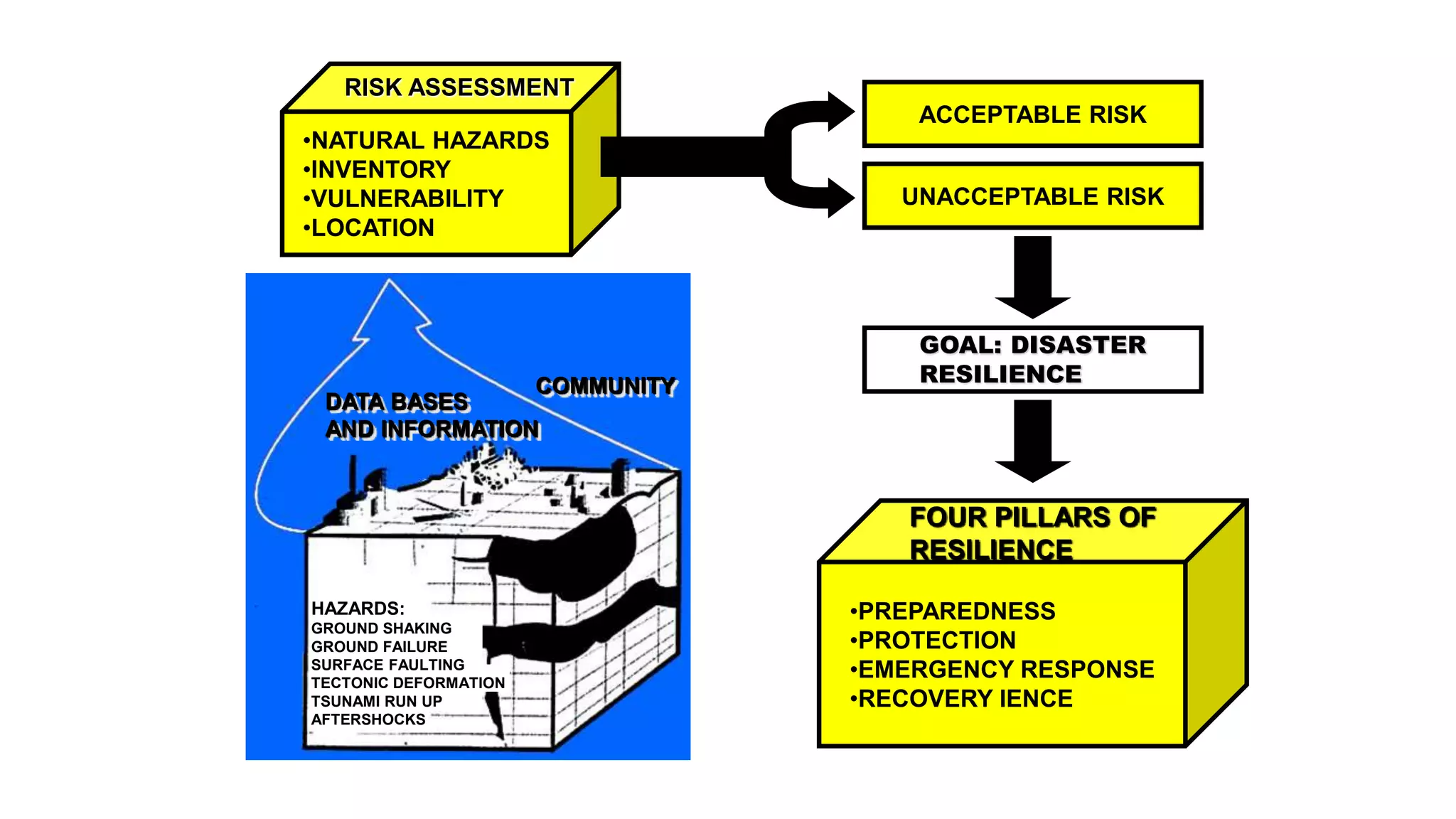
AN INTELLIGENT CITY KNOWS WHAT IS HAPPENING
AND WHAT TO DO WHEN PEOPLE, BUILDINGS AND
INFRASTRUCTURE ARE THREATENED
COMMUNITY
DATA BASES
AND INFORMATION
HAZARDS:
GROUND SHAKING
GROUND FAILURE
SURFACE FAULTING
TECTONIC DEFORMATION
TSUNAMI RUN UP
AFTERSHOCKS
•NATURAL HAZARDS
•INVENTORY
•VULNERABILITY
•LOCATION
RISK ASSESSMENT
RISK
ACCEPTABLE RISK
UNACCEPTABLE RISK
GOAL: DISASTER
RESILIENCE
•PREPAREDNESS
•PROTECTION
•EMERGENCY RESPONSE
•RECOVERY IENCE
FOUR PILLARS OF
RESILIENCE
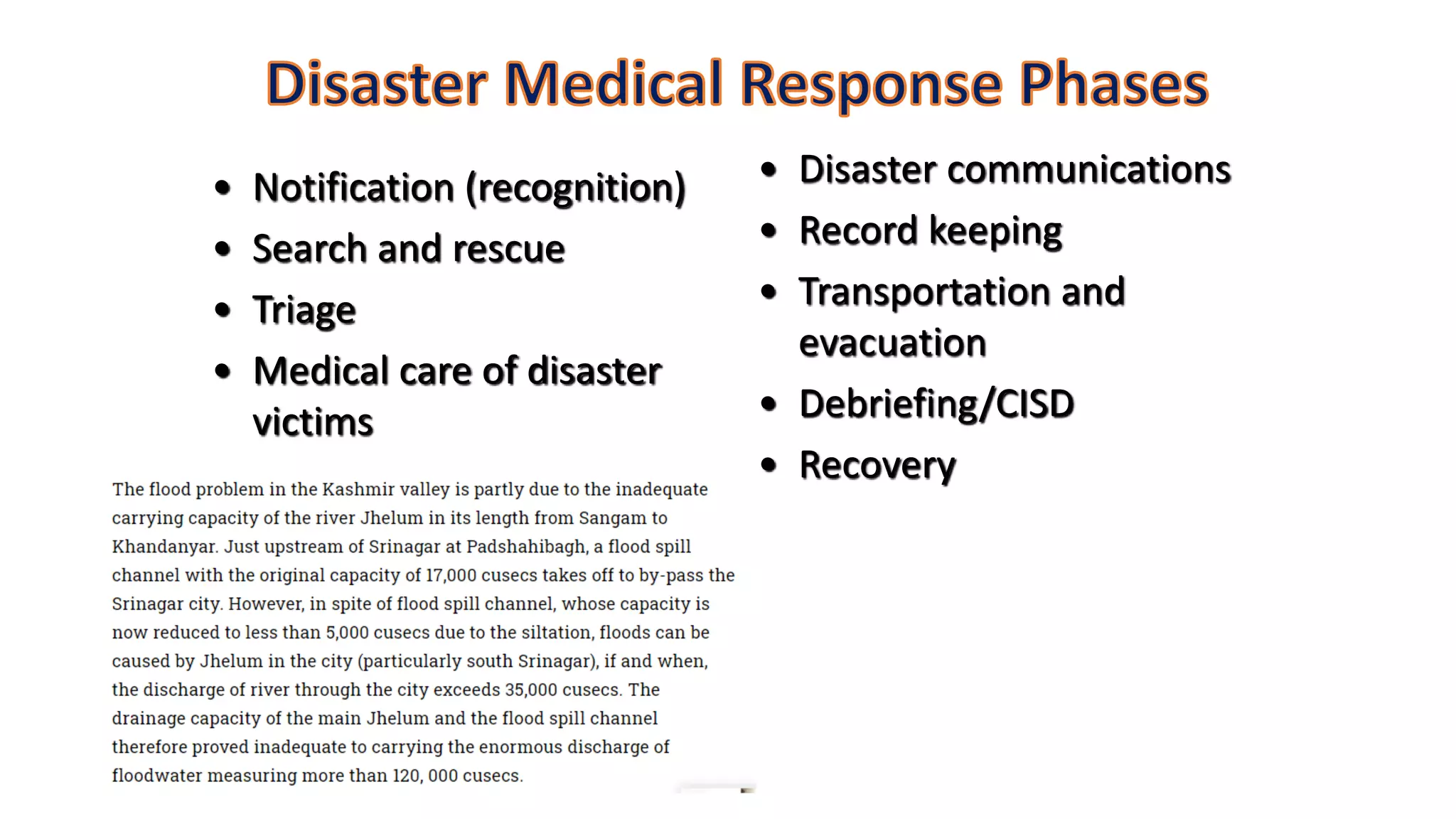
• Notification (recognition)
• Search and rescue
• Triage
• Medical care of disaster
victims
• Disaster communications
• Record keeping
• Transportation and
evacuation
• Debriefing/CISD
• Recovery
Disaster Response
The benefits and drawbacks of:
• Internal (Local) Response
• External (National or International)
Response
Disaster Response
• Local response
• most effective first 24 hour
• EMS driven
• External response
• ultimate responsibility
• may designate lead agency
• health, foreign affairs, public works, agriculture, education
Internal Response Management
Strengths
• Rapid response
• Socially and culturally appropriate
• Family and community support
• Assists in immediate recovery
• Reduces dependency
• Builds upon local response mechanisms
• Develops internal capacity
Internal Response Management
Limitations
• Limited capacity
• Limited experience and planning
• Lack of large scale sectoral ability
• Lack of coordination on large scale
• Lack of large scale funding
• Lack of monitoring
• Limited ability to address prevention and preparedness
External Response Management
Strengths
• Large scale assistance
• Expertise in disaster response
• Dedicated disaster funding
• Sector specific support
• On site organization and coordination
External Response Management
Limitations
• Duplication of services
• Draws from local capacity building
• Non-sustained funding and dependency
• Culturally and socially problematic
• Lack of standardization of NGO response
• Difficult to coordinate and monitor
• Unrealistic expectations of donor assistance
• Local partners overloaded
• Program is poorly conceptualized
Control Process and Measurement
 Controlling is a systematic efforts by which it is ensured that plans
are strictly followed and actual performance is measured and
compared with that standard performance.
 At the planning level, the tasks and roles are clearly stated and
responders are made aware of their responsibilities.
 This helps them to control their behavior and priorities their tasks.
Control Process and Measurement
 The control process is a three step process-
1. Setting performance standards.
2. Measuring actual performance.
3. Comparing actual performance with standards.
Security Issues
 It is vital to ensure the security of the most vulnerable
population that is women, children and the elderly.
 Generally, it is seen that security is not always a priority issue
after a disaster because rescue and relief operations are
considered paramount.
 Along with police, military personnel are also deployed to
respond to a disaster.
Security Issues
vulnerabilities of the
physical security and
disaster-affected areas
 Given the state of
affected community,
public order in the
should be established.
 It helps prevent the public order from turning
into an undesirable state of panic and chaos.
Evacuation and Migration
 Evacuation involves the relocation of individuals and
members of the affected community from risk-zone to a
safer location.
 Evacuation can help individual and communities avoid
the aftermath of disasters such as building collapse,
outbreak of diseases, etc.
Evacuation and Migration
 People are reluctant to evacuate even in the most
dangerous situations because of inadequate social
or economical resources.
 The three pre-requisites ofeffective evacuation are:
1. A Plan of action and place to relocate the evacuees.
2. Clear identification of escape routes.
3. A timely and accurate warning system to inform about the exact
turn of events.
Evacuation and Migration
 Evacuation is immediate and urgent movement of people
away from the threat or actual occurrence of a rapid onset
of a disaster.
 This type of migration is temporary in nature and after the
crisis is over the families return to their homes.
Administering First-Aid
 The process of addressing the needs of a
is physically injured or is
distressed is referred to as
person who
psychologically
first-aid.
 Though first-aid is not substitute for
professional medical help, but still it can make
a difference between life and death.
Administering First-Aid
 When addressing the first-aid after disasters, there are certain
aspects that need to be taken care of –
1. Check the surroundings.
2. Seek help whenever necessary.
3. Remain with the victim.
4. Stay Calm.
5. Determine responsiveness.
6. Help to stop bleeding first.
7. Psychological support.
Administering First-Aid
 Training in first-aid should be made
compulsory at School and College level.
 The kind of first-aid differs according to the
nature of disaster.
 First-aid training must be packaged in a way
that ‘clearly outlines its aims, mechanism,
when it is used, where it can be applied and
who benefits from its use, who can deliver it’.
Mobilization and Restoration of Essential
Services
 To ensure effective command and control of an
emergency situation, it is crucial that essential services
are organized.
1. Telephone Lines
2. Electricity and power supply
3. Drinking water supply & non-perishable food
4. Alternate roads
Search and rescue Work
 Disaster response activities begin with the detection
of the crisis and end with the normalization of the
situation following impact.
 The response activities entail triggering search and
rescue mechanism to find the injured, providing
emergency medical care and transferring them to
safe places.
Search and rescue Work
 The response phase differs from other phases of
disaster management in the sense that there are two
important aspects namely, uncertainty and urgency.
 The emergency response actions should be well
coordinated with disaster recovery as they form the
foundation for carrying out recovery activities.
Modern and Traditional Methods of Response
 The responses to disasters may utilize a mix
of methods from traditional to modern.
 The situation and nature of the affected
population play a decisive role in choosing an
effective response mechanism.
 Traditional methods of response have been
used since long and they are the most
common and practical methods of response.
Modern and Traditional Methods of Response
 They entail assistant provided in the form of
food, shelter materials, blankets, etc.
 Money is also provided so that affected people
can buy things according to their needs.
 Charitable organizations offer help to
communities that have suffered a disaster.
 New technologies can be very useful and
powerful in disaster response.
Modern and Traditional Methods of Response
 These basically form the basis of the modern
methods of disaster response.
 Mobile phones can act as warning devices.
 SMS provided by operators can prove to be
useful medium to send warning signals of
immediate threat.
 GPS for tracing location of victims.
Modern and Traditional Methods of Response
 The disaster management team also uses the potential
of mapping technologies, such as geographic
information system (GIS), remote sensing (satellite
imagery) and global positioning system (GPS), to aid
emergency response operations.
Modern and Traditional Methods of Response
1. Remote Sensing: the scanning of the earth by satellite or
high-flying aircraft in order to obtain information about it.
1. Visible and Reflective Infrared remote sensing.
2. Thermal Infrared Remote sensing.
3. Microwave Remote sensing.
2. GIS – GIS is a system that collects, displays, manages
and analyzes geographic information.
3. Other Methods – Social Media & Social networking.
A Model of an Ideal Command Centre
 Incident command center is a standardized, on-
scene, all-hazard incident management concept.
 The primary role of this center is the coordination of
efforts for effective and efficient management of
incident.
 When any disastrous event occurs, they first identify
and assess the situation.
A Model of an Ideal Command Centre
 The functions of an Incident Command Centre are:
1. Development of objectives.
2. Preparation of Incident Action Plan to meet
incident objectives, collection and evaluation of
information.
A Model of an Ideal Command Centre
 The functions of an Incident Command Centre
are:
3. Maintenance of resource status and incident
documentation.
4. Providing logistics support to meet
operational objectives.
5. Financial administration to monitor costs,
accounting, procurement and cost analysis.
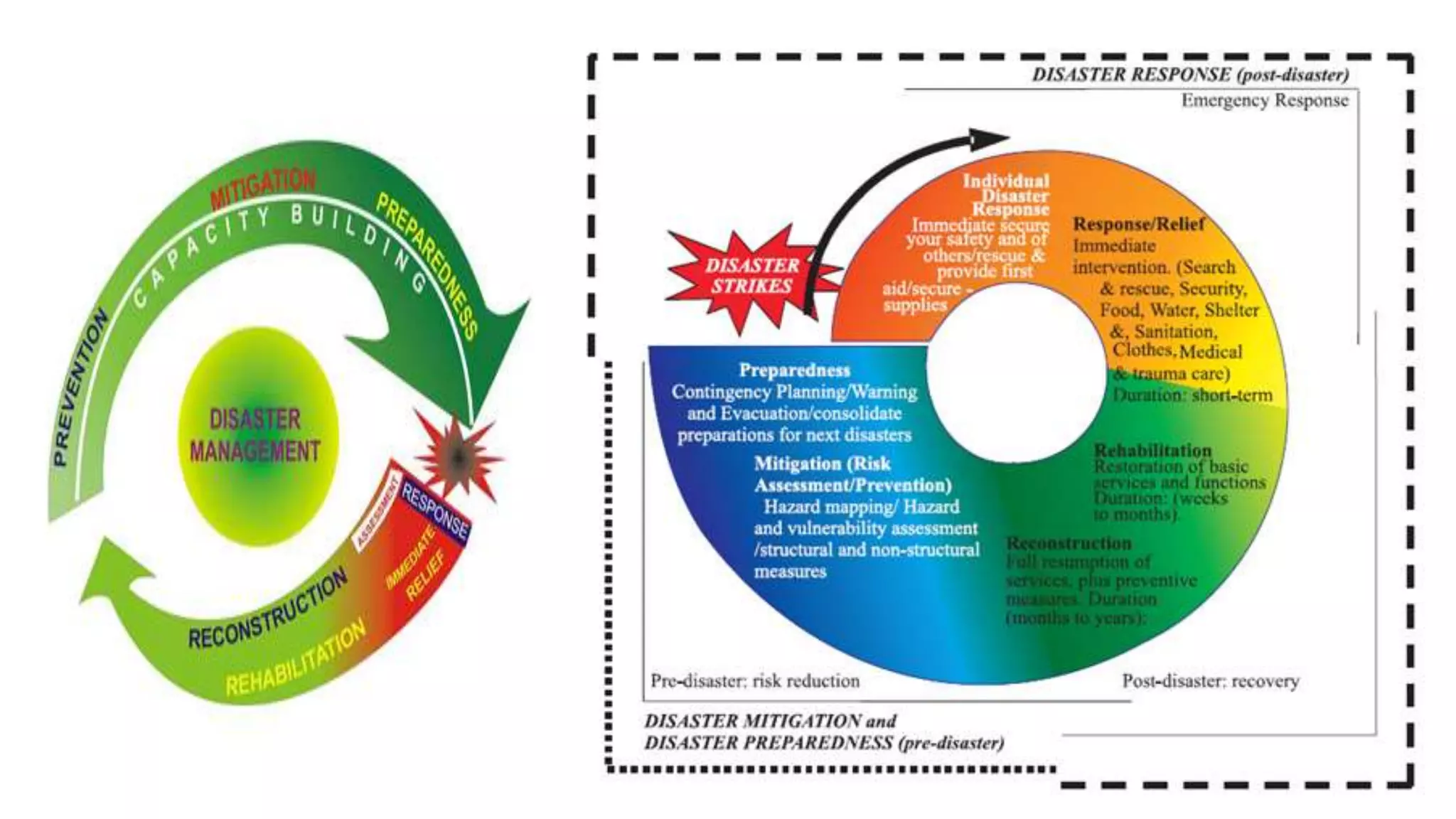
Disaster management cycle

Disaster management cycle

  • 1.
    Dr Fayaz A.Malla Assistant Professor, Environmental Sciences GDC Pulwama Higher Education Department, Govt. of J&K Email: nami.fayaz@gmail.com
  • 2.
    Disaster management isan applied science which seeks by systematic observation and analysis of disasters to improve measures relating to prevention, mitigation, preparedness, emergency, response and recovery.
  • 3.
    A disaster isa situation in which the community is incapable of coping. It is a natural or human-caused event which causes intense negative impacts on people, goods, services and/or the environment, exceeding the affected community’s capability to respond; therefore the community seeks the assistance of government and international agencies
  • 4.
    Mitigation: Measures putin place to minimize the results from a disaster. Examples: building codes and zoning; vulnerability analyses; public education. Preparedness: Planning how to respond. Examples: preparedness plans; emergency exercises/training; warning systems. Response: Initial actions taken as the event takes place. It involves efforts to minimize the hazards created by a disaster. Examples: evacuation; search and rescue; emergency relief. Recovery: Returning the community to normal. Ideally, the affected area should be put in a condition equal to or better than it was before the disaster took place. Examples: temporary housing; grants; medical care.
  • 6.
    Prevention Rescue Structural Measures Warning and Evacuation Non-Structural Measures Planning of Disaster Response Reconstruct. & Recovery RiskAnalysis DISASTER MANAGEMENT MITIGATION RESPONSE Risk Assessment Preparedness Hazard Assessment Vulnerability Analysis Relief Rehab LONG TERM MEASURES Being done efficiently Needs better Planning No Substantial Work done so far Note DISASTER MANAGEMENT CONTINUUM
  • 8.
    Structural mitigation –construction projects which reduce economic and social impacts i.e. dams, windbreaks, terracing and hazard resistant buildings. Non-structural activities – policies and practices which raise awareness of hazards or encourage developments to reduce the impact of disasters
  • 10.
    Reviewing building codes. Vulnerabilityanalysis updates. Zoning and land-use management and planning. Reviewing of building use regulations and safety codes. Implementing preventative health measures Political intervention and commitment Public awareness
  • 11.
    Various mitigation strategiesor measures- For instance, varieties of crops that are more wind, flood or drought resistant can often be introduced in areas prone to floods, drought and cyclones, Economic diversification. Community based Mitigation Government Establishments Government Based mitigation Top –Down approach Bottom-Up approach
  • 12.
    Investment in infrastructureto support sustainable socioeconomic development Investment in infrastructure for reconstruction and recovery. i. A backup generator is available in case of power failure and that a battery-operated radio . ii. A backup copy of all critical information iii. The preliminary design should take into consideration the prevalent hazards and methods to avoid or to minimize the effects of the extreme natural events. iv. Strengthening vulnerable areas such as roofs, exterior doors, windows, and garage doors
  • 13.
    • Disasters setback development programming, destroying years of development initiatives. • Rebuilding after a disaster provides significant opportunities to initiate development programmes • Development programmes can increase an area’s susceptibility to disasters • Development programmes can be designed to decrease the susceptibility to disasters and their negative consequences
  • 14.
    • Partnership-close collaborationamong donors, governments, communities, nongovernmental organizations, the private sector, and universities • Flexibility-. Development agencies must be efficient and flexible; adaptable to local environments and capable of adjusting to changing conditions and seizing opportunities when they arise. • Selectivity-resources are the public asset that must be invested prudently to achieve maximum impact.
  • 15.
    Preparedness measures include: Preparedness plans  Emergency exercises/training  Warning systems  Emergency communications systems  Evacuations plans and training  Resource inventories Emergency  Personnel/contact list.  Mutual aid agreements  Public information/education
  • 16.
    • Develop andtest warning systems regularly and plan measures to be taken during a disaster alert period to minimize potential loss of life and physical damage. • Educate and train officials and the population at risk to respond to the disaster. • Train first-aid and emergency response teams. • Establish emergency response policies, standards, organizational arrangements and operational plans to be followed by emergency workers and other response entities after a disaster.
  • 17.
    • It formsthe action plan to be implemented before, during and after disasters. • The IFRCRCS (International Federation of Red Cross and Red Crescent Societies) defines risk reduction as physical measures to reduce the vulnerability and exposure of infrastructure to natural hazards as well and to provide coping and adaptive infrastructure in case of a disaster event.
  • 18.
    • Policy, planningand capacity building in disaster management • Physical prevention; example, building sea- walls against storm surge or flood shelters during flood events • Capacity building at institutional and systemic level in disaster preparedness. • Continued provision of food, potable water and health care.
  • 19.
    • EOPallows thecommunity to respond to threats. • Engages responders in the short- term recovery • Must be flexible to be valuable in real and potential emergencies. • It doesn’t include the administrative plan, the mitigation strategy, the long term recovery or the Standard Operational procedures.
  • 20.
    Aim of DisasterResponse  Evacuation, Migration, administrating first-aid, transportation of affected people to hospital  Discuss the restoration of essential services.  Rescue work  Ideal Command Centre  Modern and traditional methods of response
  • 21.
     Evacuation, Migration,administrating first-aid, transportation of affected people to hospital  Discuss the restoration of essential services.  Rescue work  Ideal Command Centre  Modern and traditional methods of response
  • 22.
     The missionof the response phase is to meet the basic needs of the people until more permanent and sustainable solutions are formulated.  There is growing awareness of costs associated with improper management of disasters and hence communities and government are trying hard to improve the first responder efforts.  Disaster response is aimed at providing instant support to maintain life and health of the affected population.  There is a wide array of response activities carried out after disaster like first-aid, transportation, shelter and food, initial repairs to damaged infrastructure.
  • 23.
     The level& kind of disaster response depends on a number of factors – the scale of disaster, the nature and number of affected people and site- specific conditions.  Response comprises the decisions and actions taken to deal with an urgent situation that has adversely affected life and property.  It calls for collaboration, coordination and communication between agencies involved in administrating rescue and relief operations.  The main aim of response is to save and protect human life.
  • 24.
     The otheraims of response are- 1. To guarantee the continued existence of the maximum possible number of affected population and ensuring that they are in the best possible physical and mental health in the circumstances. 2. To reinstate critical services and provide food, clothing and water. 3. To restore or replace demolished or damaged infrastructure. 4. To make alternate housing arrangements in camps. 5. To help in relieving suffering. 6. To protect the health and safety of responding personnel.
  • 25.
    AN INTELLIGENT CITYKNOWS WHAT IS HAPPENING AND WHAT TO DO WHEN PEOPLE, BUILDINGS AND INFRASTRUCTURE ARE THREATENED
  • 26.
    COMMUNITY DATA BASES AND INFORMATION HAZARDS: GROUNDSHAKING GROUND FAILURE SURFACE FAULTING TECTONIC DEFORMATION TSUNAMI RUN UP AFTERSHOCKS •NATURAL HAZARDS •INVENTORY •VULNERABILITY •LOCATION RISK ASSESSMENT RISK ACCEPTABLE RISK UNACCEPTABLE RISK GOAL: DISASTER RESILIENCE •PREPAREDNESS •PROTECTION •EMERGENCY RESPONSE •RECOVERY IENCE FOUR PILLARS OF RESILIENCE
  • 27.
    • Notification (recognition) •Search and rescue • Triage • Medical care of disaster victims • Disaster communications • Record keeping • Transportation and evacuation • Debriefing/CISD • Recovery
  • 28.
    Disaster Response The benefitsand drawbacks of: • Internal (Local) Response • External (National or International) Response
  • 29.
    Disaster Response • Localresponse • most effective first 24 hour • EMS driven • External response • ultimate responsibility • may designate lead agency • health, foreign affairs, public works, agriculture, education
  • 30.
    Internal Response Management Strengths •Rapid response • Socially and culturally appropriate • Family and community support • Assists in immediate recovery • Reduces dependency • Builds upon local response mechanisms • Develops internal capacity
  • 31.
    Internal Response Management Limitations •Limited capacity • Limited experience and planning • Lack of large scale sectoral ability • Lack of coordination on large scale • Lack of large scale funding • Lack of monitoring • Limited ability to address prevention and preparedness
  • 32.
    External Response Management Strengths •Large scale assistance • Expertise in disaster response • Dedicated disaster funding • Sector specific support • On site organization and coordination
  • 33.
    External Response Management Limitations •Duplication of services • Draws from local capacity building • Non-sustained funding and dependency • Culturally and socially problematic • Lack of standardization of NGO response • Difficult to coordinate and monitor • Unrealistic expectations of donor assistance • Local partners overloaded • Program is poorly conceptualized
  • 34.
    Control Process andMeasurement  Controlling is a systematic efforts by which it is ensured that plans are strictly followed and actual performance is measured and compared with that standard performance.  At the planning level, the tasks and roles are clearly stated and responders are made aware of their responsibilities.  This helps them to control their behavior and priorities their tasks.
  • 35.
    Control Process andMeasurement  The control process is a three step process- 1. Setting performance standards. 2. Measuring actual performance. 3. Comparing actual performance with standards.
  • 36.
    Security Issues  Itis vital to ensure the security of the most vulnerable population that is women, children and the elderly.  Generally, it is seen that security is not always a priority issue after a disaster because rescue and relief operations are considered paramount.  Along with police, military personnel are also deployed to respond to a disaster.
  • 37.
    Security Issues vulnerabilities ofthe physical security and disaster-affected areas  Given the state of affected community, public order in the should be established.  It helps prevent the public order from turning into an undesirable state of panic and chaos.
  • 38.
    Evacuation and Migration Evacuation involves the relocation of individuals and members of the affected community from risk-zone to a safer location.  Evacuation can help individual and communities avoid the aftermath of disasters such as building collapse, outbreak of diseases, etc.
  • 39.
    Evacuation and Migration People are reluctant to evacuate even in the most dangerous situations because of inadequate social or economical resources.  The three pre-requisites ofeffective evacuation are: 1. A Plan of action and place to relocate the evacuees. 2. Clear identification of escape routes. 3. A timely and accurate warning system to inform about the exact turn of events.
  • 40.
    Evacuation and Migration Evacuation is immediate and urgent movement of people away from the threat or actual occurrence of a rapid onset of a disaster.  This type of migration is temporary in nature and after the crisis is over the families return to their homes.
  • 41.
    Administering First-Aid  Theprocess of addressing the needs of a is physically injured or is distressed is referred to as person who psychologically first-aid.  Though first-aid is not substitute for professional medical help, but still it can make a difference between life and death.
  • 42.
    Administering First-Aid  Whenaddressing the first-aid after disasters, there are certain aspects that need to be taken care of – 1. Check the surroundings. 2. Seek help whenever necessary. 3. Remain with the victim. 4. Stay Calm. 5. Determine responsiveness. 6. Help to stop bleeding first. 7. Psychological support.
  • 43.
    Administering First-Aid  Trainingin first-aid should be made compulsory at School and College level.  The kind of first-aid differs according to the nature of disaster.  First-aid training must be packaged in a way that ‘clearly outlines its aims, mechanism, when it is used, where it can be applied and who benefits from its use, who can deliver it’.
  • 44.
    Mobilization and Restorationof Essential Services  To ensure effective command and control of an emergency situation, it is crucial that essential services are organized. 1. Telephone Lines 2. Electricity and power supply 3. Drinking water supply & non-perishable food 4. Alternate roads
  • 45.
    Search and rescueWork  Disaster response activities begin with the detection of the crisis and end with the normalization of the situation following impact.  The response activities entail triggering search and rescue mechanism to find the injured, providing emergency medical care and transferring them to safe places.
  • 46.
    Search and rescueWork  The response phase differs from other phases of disaster management in the sense that there are two important aspects namely, uncertainty and urgency.  The emergency response actions should be well coordinated with disaster recovery as they form the foundation for carrying out recovery activities.
  • 47.
    Modern and TraditionalMethods of Response  The responses to disasters may utilize a mix of methods from traditional to modern.  The situation and nature of the affected population play a decisive role in choosing an effective response mechanism.  Traditional methods of response have been used since long and they are the most common and practical methods of response.
  • 48.
    Modern and TraditionalMethods of Response  They entail assistant provided in the form of food, shelter materials, blankets, etc.  Money is also provided so that affected people can buy things according to their needs.  Charitable organizations offer help to communities that have suffered a disaster.  New technologies can be very useful and powerful in disaster response.
  • 49.
    Modern and TraditionalMethods of Response  These basically form the basis of the modern methods of disaster response.  Mobile phones can act as warning devices.  SMS provided by operators can prove to be useful medium to send warning signals of immediate threat.  GPS for tracing location of victims.
  • 50.
    Modern and TraditionalMethods of Response  The disaster management team also uses the potential of mapping technologies, such as geographic information system (GIS), remote sensing (satellite imagery) and global positioning system (GPS), to aid emergency response operations.
  • 51.
    Modern and TraditionalMethods of Response 1. Remote Sensing: the scanning of the earth by satellite or high-flying aircraft in order to obtain information about it. 1. Visible and Reflective Infrared remote sensing. 2. Thermal Infrared Remote sensing. 3. Microwave Remote sensing. 2. GIS – GIS is a system that collects, displays, manages and analyzes geographic information. 3. Other Methods – Social Media & Social networking.
  • 52.
    A Model ofan Ideal Command Centre  Incident command center is a standardized, on- scene, all-hazard incident management concept.  The primary role of this center is the coordination of efforts for effective and efficient management of incident.  When any disastrous event occurs, they first identify and assess the situation.
  • 53.
    A Model ofan Ideal Command Centre  The functions of an Incident Command Centre are: 1. Development of objectives. 2. Preparation of Incident Action Plan to meet incident objectives, collection and evaluation of information.
  • 54.
    A Model ofan Ideal Command Centre  The functions of an Incident Command Centre are: 3. Maintenance of resource status and incident documentation. 4. Providing logistics support to meet operational objectives. 5. Financial administration to monitor costs, accounting, procurement and cost analysis.