
 LT. KOL. UNGKU AZLY BIN UNGKU ZAHAR
Doktor Falsafah (Pengurusan Sumber)
Sem 5 Sesi 2013/2014
Penyelia Utama:
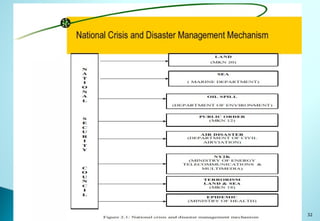
 PROF. DR. JEGA ULI
Penyelia Bersama:
 PROF. DR. FAKHRU’L-RAZI BIN AHMADUN (UPM)
 PROF. MADYA DR. AINI BTE MAT SAID (UPM)
 MEJ. JEN. PROF. DATO’ DR. MOHD ZIN B. BIDIN
1
Kolokium Siswazah UPNM
30 OKTOBER 2013
“DISASTER MANAGEMENT IN
MALAYSIA: STRUCTURE,
COLLABORATION INTER-
AGENCIES AND EMERGENCY
RESPONSE PERFORMANCE”
2
 BACKGROUND OF THE RESEARCH
 PROBLEM STATEMENT
 SIGNIFICANCE OF THE STUDY
 OBJECTIVES OF THE RESEARCH
 LITERATURE REVIEW
 CONCEPTUAL FRAMEWORK
 RESEARCH DESIGN
2
4
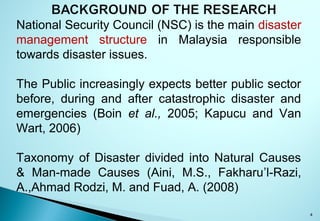
National Security Council (NSC) is the main disaster
management structure in Malaysia responsible
towards disaster issues.
The Public increasingly expects better public sector
before, during and after catastrophic disaster and
emergencies (Boin et al., 2005; Kapucu and Van
Wart, 2006)
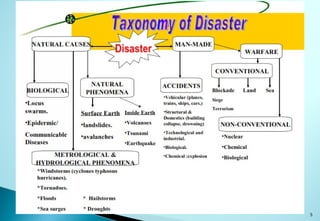
Taxonomy of Disaster divided into Natural Causes
& Man-made Causes (Aini, M.S., Fakharu’l-Razi,
A.,Ahmad Rodzi, M. and Fuad, A. (2008)
5
6
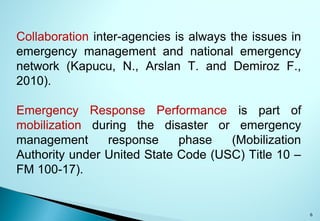
Collaboration inter-agencies is always the issues in
emergency management and national emergency
network (Kapucu, N., Arslan T. and Demiroz F.,
2010).
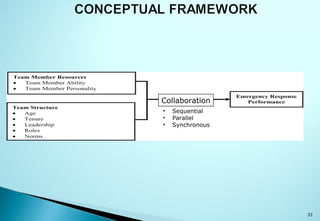
Emergency Response Performance is part of
mobilization during the disaster or emergency
management response phase (Mobilization
Authority under United State Code (USC) Title 10 –
FM 100-17).
7
8
Effective Disaster Management requires strong
structure that interdependent members to enhance
performance (Ford, J.K. and Schmidt, A.M. (2000)
According to Coleman (2005) Disaster Management
comprises three phase i.e. planning, response &
recovery.
Factors determine the success of operation i.e.
resources, system & personnel.
9
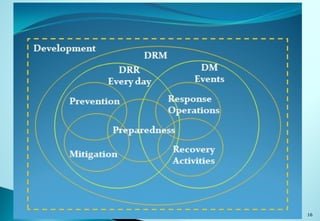
NSC responsible in Prevention, Mitigation, preparedness,
response & recovery of Malaysia DM. The activities from plans,
procedures, resources, training, disaster drill, execution &
recovery as well as rehabilitation plan.
The most crucial phase in DM is response phase, in this phase
the goal is to save live & property (Doyle, 1996; Ford & Schmidt,
2000; Kelly, 1995; Ramachandran, 1999; Tierney et al., 2001).
Generally disaster response level are local council, state,
national, and international levels of emergency response
and law enforcement.
The area that has received less emphasis (research gap) within
the study in Malaysia DM context is the revision of the structure,
collaboration & response performance addressing disaster
issues ((Kapucu, N., Arslan T. and Demiroz F., 2010;
Subramaniam, C., Ali, H., and Faridahwati, M.S., 2010)
Examination of the literature reveals that many disaster have been
studied in the developed nation but relatively few were from the
developing country like Malaysia.
It is observed that majorities of the studies focuses on the
geographical factor, technological factor and the socio-technical of
the disaster.
Therefore less emphasis on the studied in Social Sciences that
lead to the structure, collaboration and response performance in
address the disaster issues according to command, control &
coordination.
15
1. To identify the current type of DM collaborations and response
performance (mobilization) in Malaysia.
2. To evaluate effectiveness of the existing programs from NSC
structure at all level (state & federal) in DM community that
aims to achieve optimum emergency response performance
through disaster report.
3. To determine the best structure and practices of emergency
response performance based on Federal Emergency
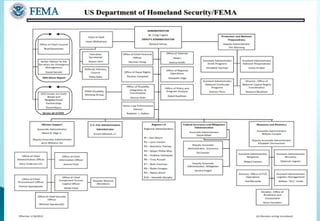
Management Agency (FEMA), Emergency Management
Australia (EMA) & Japan International Coordination Agency
(JICA).
4. To propose an integrated Disaster Management framework for
the NSC.
15
The study is intended to advance a better theoretical
understanding and the practitioner solution on the knowledge
contribution for the field of disaster management among the
security agencies as well as the population. The policies of national
security directive will be looked into in order to improve as well as
to add more comprehensive security value to the best practice.
The structure will be used to identify the real issues in DM/EM for
future improvement.
15
The study will focus from the view of the players involved in the
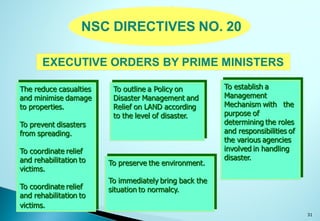
various incident either natural disaster (NSC Directive No. 20) or
man made disaster (NSC Directive No. 21). Qualitative data will be
gather from the observation, experimental, reports and interviews
then translated into instruments (using adopt and adapt concept
from the established tool by Enrico L. Quarantelli and Thomas E.
Drabek). Quantitative data will be collected from the security
agencies respondents (identified through non probability sampling
technic that is the purposive sampling snowball effect).
Nevertheless the study will identify the professional views on
disaster/emergency management practices and disaster
management hands-on approach.
Consideration from best practices i.e. FEMA, EMA & JICA will be
included.
15
14
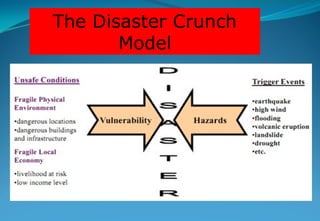
The Disaster Crunch
Model
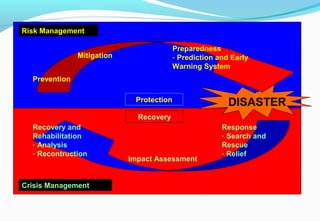
Risk Management
Crisis Management
DISASTER
Prevention
Mitigation
Preparedness
- Prediction and Early
Warning System
Protection
Response
- Search and
Rescue
- Relief
Recovery and
Rehabilitation
- Analysis
- Recontruction
Recovery
Impact Assessment
16
 Social workers respond to domestic and international
crises.
 A disaster is an unforeseen and often sudden event
that causes great damage, destruction and human
suffering (FEMA).
 Disasters are often caused by nature or may have
human origins.
 Disasters often destroy homelands and displace people.
 A disaster has the potential of permanently damaging
ecological systems; irreparable damage to a sustainable
environment.
 Examples of man-made disasters are: wars, civil
disturbances and acts of genocide. A combination of
human error and “nature” are explosions, fires, accidents
involving hazardous materials, drought
(poor farming practices), transportation incidents (air, sea,
rail auto), nuclear accidents.
 A disaster becomes a public tragedy when it focuses
national or international attention and mourning.
 A public tragedy elicits a societal response and
collective action.
 Disasters reflect the quality of adaptability and
resiliency between people and their communities.
 Disasters have municipal, regional, national, and
international levels of emergency response and law
enforcement.
 Disasters require immediate response and long term
recovery.
 Social workers are employed by governmental and non-
governmental organizations. They work with displaced
persons and political refugees. Some work to rebuild local
communities affected by disasters and others work in
international organizations or ministries.
21
Organizational structure
Several researchers have hypothesized that variation in
organizational performance can be explained by
differences in organizational structure (Cohen and
Bailey, 1997; Gladstein, 1984; Hackman, 1987; Manz,
1992; Stewart and Barrick, 2000; Wageman, 1995).
Organizational structure shapes the behavior of
members and makes it a possible determinant in
explaining and predicting organizational performance
(Robbins, 1993). According to Greenberg and Baron
(1997), organizational structure keeps the
organizational members together so they can function
as a unit
22
Major Elements in DM Framework
DM Collaboration
Collaboration of DM authority, leadership, and resources are shared among
organizations (Mandell and Keast, 2007). The question is whether a pure
collaborative structure or a combination of hierarchical command and
control systems and collaborative networks should be implemented for
effective DM as Moynihan (2008) and Waugh and Streib (2006) offers a
combination could be more successful. A praise of bureaucracies comes from
McGuire and Agranoff (2007)
23
Major Elements in DM Framework
Disaster Response Performance
Robbin’s (1993) general model of group behavior can
be enhanced & explained emergency responders’
performance work as a team rather than as a single
individual since members in a particular team has
specific & distinct roles to play during cases of
emergency (Baldwin, 1994). According to Hackman
(1987) mobilization and group synergy is a result of
group outcome that may be quite different from those
that would be obtained by simply adding up the
contribution of individual members.
24
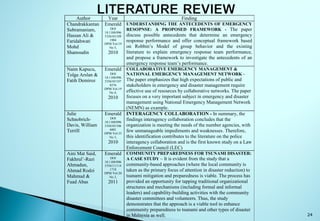
Author Year Finding
Chandrakkantan
Subramaniam,
Hassan Ali &
Faridahwati
Mohd
Shamsudin
Emerald
DOI
10.1108/096
5356101109
1904
DPM Vol.19
No 5,
2010
UNDERSTANDING THE ANTECEDENTS OF EMERGENCY
RESOPNSE: A PROPOSED FRAMEWORK - The paper
discuss possible antecedents that determine an emergency
response performance and offer conceptual framework based
on Robbin’s Model of group behavior and the existing
literature to explain emergency response team performance,
and propose a framework to investigate the antecedents of an
emergency response team’s performance.
Naim Kapucu,
Tolga Arslan &
Fatih Demiroz
Emerald
DOI
10.1108/096
5356101107
0376
DPM Vol.19
No 4,
2010
COLLABORATIVE EMERGENCY MANAGEMENT &
NATIONAL EMERGENCY MANAGEMENT NETWORK -
The paper emphasizes that high expectations of public and
stakeholders in emergency and disaster management require
effective use of resources by collaborative networks. The paper
focuses on a very important subject in emergency and disaster
management using National Emergency Management Network
(NEMN) as example.
Julie
Schnobrich-
Davis, William
Terrill
Emerald
DOI
10.1108/096
5356101106
6881
DPM Vol.33
No 3,
2010
INTERAGENCY COLLABORATION - In summary, the
findings interagency collaboration concludes that the
organization is meeting the needs of the number agencies, with
few unmanageable impediments and weaknesses. Therefore,
this identification contributes to the literature on the police
interagency collaboration and is the first known study on a Law
Enforcement Council (LEC)
Aini Mat Said,
Fakhrul’-Razi
Ahmadun,
Ahmad Rodzi
Mahmud &
Fuad Abas
Emerald
DOI
10.1108/096
5356111114
1718
DPM Vol.20
No 3,
2011
COMMUNITY PREPAREDNESS FOR TSUNAMI DISASTER:
A CASE STUDY – It is evident from the study that a
community-based approaches (where the local community is
taken as the primary focus of attention in disaster reduction) to
tsunami mitigation and preparedness is viable. The process has
provided an opportunity for tapping traditional organizational
structures and mechanisms (including formal and informal
leaders) and capability-building activities with the community
disaster committees and volunteers. Thus, the study
demonstrates that the approach is a viable tool to enhance
community preparedness to tsunami and other types of disaster
in Malaysia as well.
25
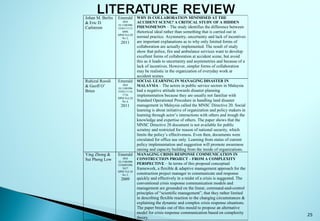
Johan M. Berlin
& Eric D.
Carlstrom
Emerald
DOI
10.1108/096
5356111112
6094
DPM Vol.20
No 2,
2011
WHY IS COLLABORATION MINIMISED AT THE
ACCIDENT SCENE? A CRITICAL STUDY OF A HIDDEN
PHENOMENON – The study identifies the difference between
rhetorical ideal rather than something that is carried out in
normal practice. Asymmetry, uncertainty and lack of incentives
are important explanations as to why only limited forms of
collaboration are actually implemented. The result of study
show that police, fire and ambulance services want to develop
excellent forms of collaboration at accident scene, but avoid
this as it leads to uncertainty and asymmetries and because of a
lack of incentives. However, simpler forms of collaboration
may be realistic in the organization of everyday work at
accident scenes.
Ruhizal Roosli
& Geoff O’
Brien
Emerald
DOI
10.1108/096
5356111116
1716
DPM Vol.20
No 4,
2011
SOCIAL LEARNING IN MANAGING DISASTER IN
MALAYSIA – The actors in public service sectors in Malaysia
had a negative attitude towards disaster planning
implementation because they are usually not familiar with
Standard Operational Procedure in handling land disaster
management in Malaysia called the MNSC Directive 20. Social
learning is about initiative of organization and policy makers in
learning through actor’s interactions with others and trough the
knowledge and expertise of others. The paper shows that the
MNSC Directive 20 document is not available for public
scrutiny and restricted for reason of national security, which
limits the policy’s effectiveness. Even then, documents were
circulated for office use only. Learning from status of current
policy implementation and suggestion will promote awareness
raising and capacity building from the inside of organizations.
Ying Zhong &
Sui Pheng Low
Emerald
DOI
10.1108/096
5356091096
5637
DPM Vol.18
No 3,
2009
MANAGING CRISIS RESPONSE COMMUNICATION IN
CONSTRUCTION PROJECT – FROM A COMPLEXITY
PERSPECTIVE – In terms of this proposal conceptual
framework, a flexible & adaptive management approach for the
construction project manager to communicate and response
quickly and effectively in a midst of a crisis is suggested. The
conventional crisis response communication models and
management are grounded on the linear, command-and-control
principles of “scientific management”, that they rather limited
in describing flexible reaction to the changing circumstances &
explaining the dynamic and complex crisis response situations.
The paper breaks out of this mould to propose an alternative
model for crisis response communication based on complexity
theory.
26
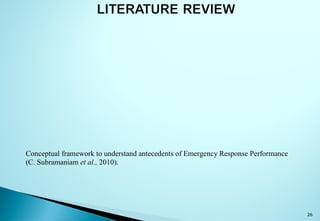
Conceptual framework to understand antecedents of Emergency Response Performance
(C. Subramaniam et al., 2010).
27
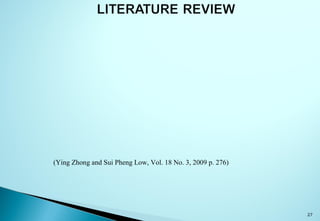
(Ying Zhong and Sui Pheng Low, Vol. 18 No. 3, 2009 p. 276)
28
LAMPIRAN B1
BAHAGIAN KORPORAT DAN DASAR (BKD)
EN. MOHD ZAKARIA B IBRAHIM
PTD M52
BAHAGIAN KOMUNIKASI STRATEGIK (BKS)
EN. RADZALI BIN SHAHBUDIN
PTD JUSA C
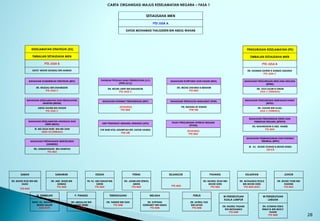
CARTA ORGANISASI MAJLIS KESELAMATAN NEGARA – FASA 1
SETIAUSAHA MKN
PTD JUSA A
DATUK MOHAMAD THAJUDEEN BIN ABDUL WAHAB
PENGURUSAN KESELAMATAN (PK)
TIMBALAN SETIAUSAHA MKN
PTD JUSA B
EN. HASNAN ZAHEDI B AHMAD ZAKARIA
PTD JUSA C
KESELAMATAN STRATEGIK (KS)
TIMBALAN SETIAUSAHA MKN
PTD JUSA B
DATO’ MOHD GHAZALI BIN AHMAD
SABAH
EN. MOHD ROZI BIN MD.
SAAD
PTD M54
SARAWAK
EN. ABD. RAKIB BIN
AHMAD
PTD M54
KEDAH
TN. HJ. ABU BAKAR BIN
SUDIN
PTD M52
PERAK
EN. JASIMI BIN ZENIOL
ABDIN
PTD M52
SELANGOR
PTD M52
PAHANG
EN. BADRUL SHAH BIN
MOHD IDRIS
PTD M52
JOHOR
EN. MOHD YUSRI BIN
HASHIM
PTD M52
N. SEMBILAN
DATO’ HJ. SUHAIMI BIN
MOHD SALLEH
M54 (KUP)
P. PINANG
EN. ABDULLAH BIN
DAUD (M48)
PTD M52
TERENGGANU
EN. TARMIZI BIN DAN
PTD M48
MELAKA
EN. SOPHIAN
ISSWANDY BIN ISMAIL
PTD M48
W.PERSEKUTUAN
KUALA LUMPUR
EN. NAZRUL FAZAMI
BIN MOHAMAD
PTD M48
KELANTAN
EN. MOHAMAD ROSLE
BIN MOHD IDRIS
PTD M54 (KUP)
PERLIS
EN. SAFRUL FAIZ
BIN SATAR
PTD M48
UNIT PENASIHAT UNDANG-UNDANG (UPU)
CIK RABI’ATUL ADUWIYAH BTE. DATUK HAMZA
PUU L48
BAHAGIAN PENGURUSAN BENCANA NEGARA
(BPBN)
EN. OGU SALIM B OMAR
JUSA C (TERBUKA)
PASUKAN PETUGAS KHAS PERSEKUTUAN (S/L)
(PPKP (S/L))
EN. MOHD ARIFF BIN BAHAROM
PTD JUSA C
BAHAGIAN KHIDMAT PENGURUSAN (BKP)
(KOSONG)
PTD M54
BAHAGIAN TEKNOLOGI MAKLUMAT (BTM)
PN. RUZANA BT ASNAN
PTM F48
BAHAGIAN PERTAHANAN MENYELURUH
(HANRUH)
EN. ZAMAKHSHARI BIN HANIPAH
PTD M52
PUSAT PENGURUSAN OPERASI NEGARA
(PPON)
(KOSONG)
PTD M52
BAHAGIAN PENGURUSAN KRISIS DAN
PERISIKAN NEGARA (BPKPN)
EN. BAHARUDDIN B ABD. HAMID
PTD M54
BAHAGIAN PENGURUSAN SEMPADAN DARAT
(BPSD)
EN. ZAHARI BIN ALIAS
JUSA C (TERBUKA)
BAHAGIAN KESELAMATAN DAN KEDAULATAN
MARITIM (BKKM)
ABDUL RAHIM BIN HUSSIN
PTD JUSA C
BAHAGIAN KESELAMATAN ANGKASA DAN
SIBER (BKAS)
IR. MD SHAH NURI BIN MD ZAIN
GRED 54 (TERBUKA)
BAHAGIAN PEMBANGUNAN DAN KHIDMAT
TEKNIKAL (BPKT)
IR. HJ. MOHD ZOHADI B MOHD RAMLI
J54 E/E
W.PERSEKUTUAN
LABUAN
EN. ICHWAN FISKA
RIMAYA BIN MUSLY
TAHAR
PTD M44
29
30
31
32
33
Collaboration
• Sequential
• Parallel
• Synchronous
34
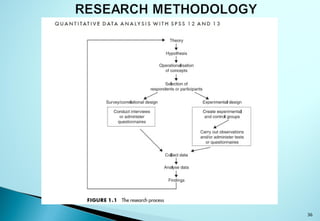
The study utilized a multi-strategy research design that employed both quantitative
& qualitative research methods in parallel. It involves making decision about which
kinds of research question are best answered using a quantitative research method
& which by qualitative research method (Bryman, 2000)
The Multi-strategy research approach will undertake Triangulation &
complementary of the findings. Triangulation refers to the use of quantitative
research to substantiate qualitative research findings or vice versa &
complementarity it the utilization of both methods in order that different aspects of
an investigation can be merged (Hammersley, 1996)
Case Study method – Sharan B. Merriam (2009)
Survey in Social Research – David De Vaus (2002)
Quantitative method – Bryman, (2005)
Educational Research – John W. Creswell (2012)
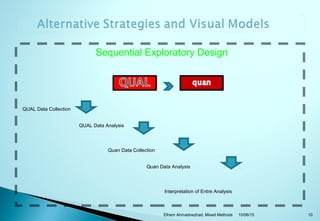
Sequential Exploratory Design
QUAL Data Collection
QUAL Data Analysis
Quan Data Collection
Quan Data Analysis
Interpretation of Entre Analysis
10/06/15 10Elham Ahmadnezhad. Mixed Methods
36
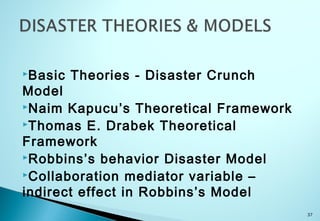
Basic Theories - Disaster Crunch
Model
Naim Kapucu’s Theoretical Framework
Thomas E. Drabek Theoretical
Framework
Robbins’s behavior Disaster Model
Collaboration mediator variable –
indirect effect in Robbins’s Model
37
38
39
40
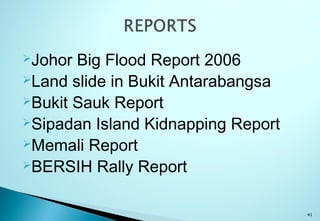
Johor Big Flood Report 2006
Land slide in Bukit Antarabangsa
Bukit Sauk Report
Sipadan Island Kidnapping Report
Memali Report
BERSIH Rally Report
41
42
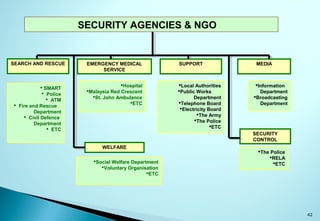
SEARCH AND RESCUE SUPPORT
WELFARE
MEDIAEMERGENCY MEDICAL
SERVICE
 SMART
 Police
 ATM
 Fire and Rescue
Department
 Civil Defence
Department
 ETC
Hospital
Malaysia Red Crescent
St. John Ambulance
ETC
Information
Department
Broadcasting
Department
Local Authorities
Public Works
Department
Telephone Board
Electricity Board
The Army
The Police
ETC
Social Welfare Department
Voluntary Organisation
ETC
SECURITY
CONTROL
The Police
RELA
ETC
SECURITY AGENCIES & NGO
43
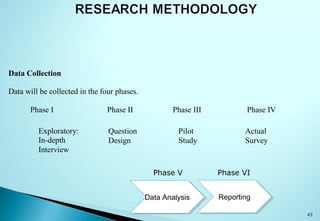
Data Collection
Data will be collected in the four phases.
Phase I Phase II Phase III Phase IV
Exploratory:
In-depth
Interview
Question
Design
Pilot
Study
Actual
Survey
ReportingReportingData AnalysisData Analysis
Phase V Phase VI
44

Disaster Management Structure, Collaboration & Response Performance in Malaysian Perspective

  • 1.
     LT. KOL.UNGKU AZLY BIN UNGKU ZAHAR Doktor Falsafah (Pengurusan Sumber) Sem 5 Sesi 2013/2014 Penyelia Utama:  PROF. DR. JEGA ULI Penyelia Bersama:  PROF. DR. FAKHRU’L-RAZI BIN AHMADUN (UPM)  PROF. MADYA DR. AINI BTE MAT SAID (UPM)  MEJ. JEN. PROF. DATO’ DR. MOHD ZIN B. BIDIN 1 Kolokium Siswazah UPNM 30 OKTOBER 2013
  • 2.
    “DISASTER MANAGEMENT IN MALAYSIA:STRUCTURE, COLLABORATION INTER- AGENCIES AND EMERGENCY RESPONSE PERFORMANCE” 2
  • 3.
     BACKGROUND OFTHE RESEARCH  PROBLEM STATEMENT  SIGNIFICANCE OF THE STUDY  OBJECTIVES OF THE RESEARCH  LITERATURE REVIEW  CONCEPTUAL FRAMEWORK  RESEARCH DESIGN 2
  • 4.
    4 National Security Council(NSC) is the main disaster management structure in Malaysia responsible towards disaster issues. The Public increasingly expects better public sector before, during and after catastrophic disaster and emergencies (Boin et al., 2005; Kapucu and Van Wart, 2006) Taxonomy of Disaster divided into Natural Causes & Man-made Causes (Aini, M.S., Fakharu’l-Razi, A.,Ahmad Rodzi, M. and Fuad, A. (2008)
  • 5.
  • 6.
    6 Collaboration inter-agencies isalways the issues in emergency management and national emergency network (Kapucu, N., Arslan T. and Demiroz F., 2010). Emergency Response Performance is part of mobilization during the disaster or emergency management response phase (Mobilization Authority under United State Code (USC) Title 10 – FM 100-17).
  • 7.
  • 8.
    8 Effective Disaster Managementrequires strong structure that interdependent members to enhance performance (Ford, J.K. and Schmidt, A.M. (2000) According to Coleman (2005) Disaster Management comprises three phase i.e. planning, response & recovery. Factors determine the success of operation i.e. resources, system & personnel.
  • 9.
    9 NSC responsible inPrevention, Mitigation, preparedness, response & recovery of Malaysia DM. The activities from plans, procedures, resources, training, disaster drill, execution & recovery as well as rehabilitation plan. The most crucial phase in DM is response phase, in this phase the goal is to save live & property (Doyle, 1996; Ford & Schmidt, 2000; Kelly, 1995; Ramachandran, 1999; Tierney et al., 2001). Generally disaster response level are local council, state, national, and international levels of emergency response and law enforcement. The area that has received less emphasis (research gap) within the study in Malaysia DM context is the revision of the structure, collaboration & response performance addressing disaster issues ((Kapucu, N., Arslan T. and Demiroz F., 2010; Subramaniam, C., Ali, H., and Faridahwati, M.S., 2010)
  • 10.
    Examination of theliterature reveals that many disaster have been studied in the developed nation but relatively few were from the developing country like Malaysia. It is observed that majorities of the studies focuses on the geographical factor, technological factor and the socio-technical of the disaster. Therefore less emphasis on the studied in Social Sciences that lead to the structure, collaboration and response performance in address the disaster issues according to command, control & coordination. 15
  • 11.
    1. To identifythe current type of DM collaborations and response performance (mobilization) in Malaysia. 2. To evaluate effectiveness of the existing programs from NSC structure at all level (state & federal) in DM community that aims to achieve optimum emergency response performance through disaster report. 3. To determine the best structure and practices of emergency response performance based on Federal Emergency Management Agency (FEMA), Emergency Management Australia (EMA) & Japan International Coordination Agency (JICA). 4. To propose an integrated Disaster Management framework for the NSC. 15
  • 12.
    The study isintended to advance a better theoretical understanding and the practitioner solution on the knowledge contribution for the field of disaster management among the security agencies as well as the population. The policies of national security directive will be looked into in order to improve as well as to add more comprehensive security value to the best practice. The structure will be used to identify the real issues in DM/EM for future improvement. 15
  • 13.
    The study willfocus from the view of the players involved in the various incident either natural disaster (NSC Directive No. 20) or man made disaster (NSC Directive No. 21). Qualitative data will be gather from the observation, experimental, reports and interviews then translated into instruments (using adopt and adapt concept from the established tool by Enrico L. Quarantelli and Thomas E. Drabek). Quantitative data will be collected from the security agencies respondents (identified through non probability sampling technic that is the purposive sampling snowball effect). Nevertheless the study will identify the professional views on disaster/emergency management practices and disaster management hands-on approach. Consideration from best practices i.e. FEMA, EMA & JICA will be included. 15
  • 14.
  • 15.
    Risk Management Crisis Management DISASTER Prevention Mitigation Preparedness -Prediction and Early Warning System Protection Response - Search and Rescue - Relief Recovery and Rehabilitation - Analysis - Recontruction Recovery Impact Assessment
  • 16.
  • 17.
     Social workersrespond to domestic and international crises.  A disaster is an unforeseen and often sudden event that causes great damage, destruction and human suffering (FEMA).  Disasters are often caused by nature or may have human origins.
  • 18.
     Disasters oftendestroy homelands and displace people.  A disaster has the potential of permanently damaging ecological systems; irreparable damage to a sustainable environment.  Examples of man-made disasters are: wars, civil disturbances and acts of genocide. A combination of human error and “nature” are explosions, fires, accidents involving hazardous materials, drought (poor farming practices), transportation incidents (air, sea, rail auto), nuclear accidents.
  • 19.
     A disasterbecomes a public tragedy when it focuses national or international attention and mourning.  A public tragedy elicits a societal response and collective action.  Disasters reflect the quality of adaptability and resiliency between people and their communities.
  • 20.
     Disasters havemunicipal, regional, national, and international levels of emergency response and law enforcement.  Disasters require immediate response and long term recovery.  Social workers are employed by governmental and non- governmental organizations. They work with displaced persons and political refugees. Some work to rebuild local communities affected by disasters and others work in international organizations or ministries.
  • 21.
    21 Organizational structure Several researchershave hypothesized that variation in organizational performance can be explained by differences in organizational structure (Cohen and Bailey, 1997; Gladstein, 1984; Hackman, 1987; Manz, 1992; Stewart and Barrick, 2000; Wageman, 1995). Organizational structure shapes the behavior of members and makes it a possible determinant in explaining and predicting organizational performance (Robbins, 1993). According to Greenberg and Baron (1997), organizational structure keeps the organizational members together so they can function as a unit
  • 22.
    22 Major Elements inDM Framework DM Collaboration Collaboration of DM authority, leadership, and resources are shared among organizations (Mandell and Keast, 2007). The question is whether a pure collaborative structure or a combination of hierarchical command and control systems and collaborative networks should be implemented for effective DM as Moynihan (2008) and Waugh and Streib (2006) offers a combination could be more successful. A praise of bureaucracies comes from McGuire and Agranoff (2007)
  • 23.
    23 Major Elements inDM Framework Disaster Response Performance Robbin’s (1993) general model of group behavior can be enhanced & explained emergency responders’ performance work as a team rather than as a single individual since members in a particular team has specific & distinct roles to play during cases of emergency (Baldwin, 1994). According to Hackman (1987) mobilization and group synergy is a result of group outcome that may be quite different from those that would be obtained by simply adding up the contribution of individual members.
  • 24.
    24 Author Year Finding Chandrakkantan Subramaniam, HassanAli & Faridahwati Mohd Shamsudin Emerald DOI 10.1108/096 5356101109 1904 DPM Vol.19 No 5, 2010 UNDERSTANDING THE ANTECEDENTS OF EMERGENCY RESOPNSE: A PROPOSED FRAMEWORK - The paper discuss possible antecedents that determine an emergency response performance and offer conceptual framework based on Robbin’s Model of group behavior and the existing literature to explain emergency response team performance, and propose a framework to investigate the antecedents of an emergency response team’s performance. Naim Kapucu, Tolga Arslan & Fatih Demiroz Emerald DOI 10.1108/096 5356101107 0376 DPM Vol.19 No 4, 2010 COLLABORATIVE EMERGENCY MANAGEMENT & NATIONAL EMERGENCY MANAGEMENT NETWORK - The paper emphasizes that high expectations of public and stakeholders in emergency and disaster management require effective use of resources by collaborative networks. The paper focuses on a very important subject in emergency and disaster management using National Emergency Management Network (NEMN) as example. Julie Schnobrich- Davis, William Terrill Emerald DOI 10.1108/096 5356101106 6881 DPM Vol.33 No 3, 2010 INTERAGENCY COLLABORATION - In summary, the findings interagency collaboration concludes that the organization is meeting the needs of the number agencies, with few unmanageable impediments and weaknesses. Therefore, this identification contributes to the literature on the police interagency collaboration and is the first known study on a Law Enforcement Council (LEC) Aini Mat Said, Fakhrul’-Razi Ahmadun, Ahmad Rodzi Mahmud & Fuad Abas Emerald DOI 10.1108/096 5356111114 1718 DPM Vol.20 No 3, 2011 COMMUNITY PREPAREDNESS FOR TSUNAMI DISASTER: A CASE STUDY – It is evident from the study that a community-based approaches (where the local community is taken as the primary focus of attention in disaster reduction) to tsunami mitigation and preparedness is viable. The process has provided an opportunity for tapping traditional organizational structures and mechanisms (including formal and informal leaders) and capability-building activities with the community disaster committees and volunteers. Thus, the study demonstrates that the approach is a viable tool to enhance community preparedness to tsunami and other types of disaster in Malaysia as well.
  • 25.
    25 Johan M. Berlin &Eric D. Carlstrom Emerald DOI 10.1108/096 5356111112 6094 DPM Vol.20 No 2, 2011 WHY IS COLLABORATION MINIMISED AT THE ACCIDENT SCENE? A CRITICAL STUDY OF A HIDDEN PHENOMENON – The study identifies the difference between rhetorical ideal rather than something that is carried out in normal practice. Asymmetry, uncertainty and lack of incentives are important explanations as to why only limited forms of collaboration are actually implemented. The result of study show that police, fire and ambulance services want to develop excellent forms of collaboration at accident scene, but avoid this as it leads to uncertainty and asymmetries and because of a lack of incentives. However, simpler forms of collaboration may be realistic in the organization of everyday work at accident scenes. Ruhizal Roosli & Geoff O’ Brien Emerald DOI 10.1108/096 5356111116 1716 DPM Vol.20 No 4, 2011 SOCIAL LEARNING IN MANAGING DISASTER IN MALAYSIA – The actors in public service sectors in Malaysia had a negative attitude towards disaster planning implementation because they are usually not familiar with Standard Operational Procedure in handling land disaster management in Malaysia called the MNSC Directive 20. Social learning is about initiative of organization and policy makers in learning through actor’s interactions with others and trough the knowledge and expertise of others. The paper shows that the MNSC Directive 20 document is not available for public scrutiny and restricted for reason of national security, which limits the policy’s effectiveness. Even then, documents were circulated for office use only. Learning from status of current policy implementation and suggestion will promote awareness raising and capacity building from the inside of organizations. Ying Zhong & Sui Pheng Low Emerald DOI 10.1108/096 5356091096 5637 DPM Vol.18 No 3, 2009 MANAGING CRISIS RESPONSE COMMUNICATION IN CONSTRUCTION PROJECT – FROM A COMPLEXITY PERSPECTIVE – In terms of this proposal conceptual framework, a flexible & adaptive management approach for the construction project manager to communicate and response quickly and effectively in a midst of a crisis is suggested. The conventional crisis response communication models and management are grounded on the linear, command-and-control principles of “scientific management”, that they rather limited in describing flexible reaction to the changing circumstances & explaining the dynamic and complex crisis response situations. The paper breaks out of this mould to propose an alternative model for crisis response communication based on complexity theory.
  • 26.
    26 Conceptual framework tounderstand antecedents of Emergency Response Performance (C. Subramaniam et al., 2010).
  • 27.
    27 (Ying Zhong andSui Pheng Low, Vol. 18 No. 3, 2009 p. 276)
  • 28.
    28 LAMPIRAN B1 BAHAGIAN KORPORATDAN DASAR (BKD) EN. MOHD ZAKARIA B IBRAHIM PTD M52 BAHAGIAN KOMUNIKASI STRATEGIK (BKS) EN. RADZALI BIN SHAHBUDIN PTD JUSA C CARTA ORGANISASI MAJLIS KESELAMATAN NEGARA – FASA 1 SETIAUSAHA MKN PTD JUSA A DATUK MOHAMAD THAJUDEEN BIN ABDUL WAHAB PENGURUSAN KESELAMATAN (PK) TIMBALAN SETIAUSAHA MKN PTD JUSA B EN. HASNAN ZAHEDI B AHMAD ZAKARIA PTD JUSA C KESELAMATAN STRATEGIK (KS) TIMBALAN SETIAUSAHA MKN PTD JUSA B DATO’ MOHD GHAZALI BIN AHMAD SABAH EN. MOHD ROZI BIN MD. SAAD PTD M54 SARAWAK EN. ABD. RAKIB BIN AHMAD PTD M54 KEDAH TN. HJ. ABU BAKAR BIN SUDIN PTD M52 PERAK EN. JASIMI BIN ZENIOL ABDIN PTD M52 SELANGOR PTD M52 PAHANG EN. BADRUL SHAH BIN MOHD IDRIS PTD M52 JOHOR EN. MOHD YUSRI BIN HASHIM PTD M52 N. SEMBILAN DATO’ HJ. SUHAIMI BIN MOHD SALLEH M54 (KUP) P. PINANG EN. ABDULLAH BIN DAUD (M48) PTD M52 TERENGGANU EN. TARMIZI BIN DAN PTD M48 MELAKA EN. SOPHIAN ISSWANDY BIN ISMAIL PTD M48 W.PERSEKUTUAN KUALA LUMPUR EN. NAZRUL FAZAMI BIN MOHAMAD PTD M48 KELANTAN EN. MOHAMAD ROSLE BIN MOHD IDRIS PTD M54 (KUP) PERLIS EN. SAFRUL FAIZ BIN SATAR PTD M48 UNIT PENASIHAT UNDANG-UNDANG (UPU) CIK RABI’ATUL ADUWIYAH BTE. DATUK HAMZA PUU L48 BAHAGIAN PENGURUSAN BENCANA NEGARA (BPBN) EN. OGU SALIM B OMAR JUSA C (TERBUKA) PASUKAN PETUGAS KHAS PERSEKUTUAN (S/L) (PPKP (S/L)) EN. MOHD ARIFF BIN BAHAROM PTD JUSA C BAHAGIAN KHIDMAT PENGURUSAN (BKP) (KOSONG) PTD M54 BAHAGIAN TEKNOLOGI MAKLUMAT (BTM) PN. RUZANA BT ASNAN PTM F48 BAHAGIAN PERTAHANAN MENYELURUH (HANRUH) EN. ZAMAKHSHARI BIN HANIPAH PTD M52 PUSAT PENGURUSAN OPERASI NEGARA (PPON) (KOSONG) PTD M52 BAHAGIAN PENGURUSAN KRISIS DAN PERISIKAN NEGARA (BPKPN) EN. BAHARUDDIN B ABD. HAMID PTD M54 BAHAGIAN PENGURUSAN SEMPADAN DARAT (BPSD) EN. ZAHARI BIN ALIAS JUSA C (TERBUKA) BAHAGIAN KESELAMATAN DAN KEDAULATAN MARITIM (BKKM) ABDUL RAHIM BIN HUSSIN PTD JUSA C BAHAGIAN KESELAMATAN ANGKASA DAN SIBER (BKAS) IR. MD SHAH NURI BIN MD ZAIN GRED 54 (TERBUKA) BAHAGIAN PEMBANGUNAN DAN KHIDMAT TEKNIKAL (BPKT) IR. HJ. MOHD ZOHADI B MOHD RAMLI J54 E/E W.PERSEKUTUAN LABUAN EN. ICHWAN FISKA RIMAYA BIN MUSLY TAHAR PTD M44
  • 29.
  • 30.
  • 31.
  • 32.
  • 33.
  • 34.
    34 The study utilizeda multi-strategy research design that employed both quantitative & qualitative research methods in parallel. It involves making decision about which kinds of research question are best answered using a quantitative research method & which by qualitative research method (Bryman, 2000) The Multi-strategy research approach will undertake Triangulation & complementary of the findings. Triangulation refers to the use of quantitative research to substantiate qualitative research findings or vice versa & complementarity it the utilization of both methods in order that different aspects of an investigation can be merged (Hammersley, 1996) Case Study method – Sharan B. Merriam (2009) Survey in Social Research – David De Vaus (2002) Quantitative method – Bryman, (2005) Educational Research – John W. Creswell (2012)
  • 35.
    Sequential Exploratory Design QUALData Collection QUAL Data Analysis Quan Data Collection Quan Data Analysis Interpretation of Entre Analysis 10/06/15 10Elham Ahmadnezhad. Mixed Methods
  • 36.
  • 37.
    Basic Theories -Disaster Crunch Model Naim Kapucu’s Theoretical Framework Thomas E. Drabek Theoretical Framework Robbins’s behavior Disaster Model Collaboration mediator variable – indirect effect in Robbins’s Model 37
  • 38.
  • 39.
  • 40.
  • 41.
    Johor Big FloodReport 2006 Land slide in Bukit Antarabangsa Bukit Sauk Report Sipadan Island Kidnapping Report Memali Report BERSIH Rally Report 41
  • 42.
    42 SEARCH AND RESCUESUPPORT WELFARE MEDIAEMERGENCY MEDICAL SERVICE  SMART  Police  ATM  Fire and Rescue Department  Civil Defence Department  ETC Hospital Malaysia Red Crescent St. John Ambulance ETC Information Department Broadcasting Department Local Authorities Public Works Department Telephone Board Electricity Board The Army The Police ETC Social Welfare Department Voluntary Organisation ETC SECURITY CONTROL The Police RELA ETC SECURITY AGENCIES & NGO
  • 43.
    43 Data Collection Data willbe collected in the four phases. Phase I Phase II Phase III Phase IV Exploratory: In-depth Interview Question Design Pilot Study Actual Survey ReportingReportingData AnalysisData Analysis Phase V Phase VI
  • 44.