DISASTER
MANAGEMENT
PRINCIPLES
JAMES WINTON
MAY 2016
DISASTER
MANAGEMENT
Provide a framework of how disasters are managed
• Pre-hospital
• In Hospital
MIMMS approach
SCGH Emergency Department disaster plan
2015 ASM: Victims & Responders; Christchurch Earthquake
— Prof. Mike Ardagh
WHAT IS A DISASTER?
Disaster
• Event
• Threat actual or potential
• Extraordinary resources
• Coordination across services
Classified by type
• Trauma vs Medical
• Natural vs Man-made
• Simple vs compound
• Compensated vs uncompensated
DISASTERS IN
AUSTALIA
NATURAL
• Bushfires
• Cyclones
• Floods
• Drought
• Earthquake
• Heat wave
MAN MADE
• Granville train
• Westgate bridge
• Kemspey bus
• Port Arthur
• Childers fire
• Eureka stockade
• Maritime
• Air accidents
DISASTER
MANAGEMENT IN WA
Governing body – DPMU
• All hazards approach
• Comprehensive approach (Prevention, Preparedness,
Response, Recovery)
• All agencies (integrated) approach
• Graduated response
• Community risk management
• Prepared community
PHASES OF A MAJOR
INCIDENT
Preparation
Response
Recovery
Both prehosptal and in hospital follow these phases
A major incident in Perth may involve hospital based team as
part of the coodinated prehospital response
MIMMS course provides an approach to prehospital
management
PRE-HOSPITAL
RESPONSE
SERVICES INVOLVED
Ambulance service
Police service
Fire services
Urban search and rescue teams
Local authorities – emergency services
Health
Organisation and coordination are crucial
All hazards
All service
PREPARATION FOR
THE SCENE
Personal equipment
• Clothing/phone/torch/camera/map/rations
Medical equipment
• Triage/First aid/advance life support/specialist
equipment/transport equipment
Communication equipment
• Radio/phone/other methods – runners, media, loud hailer
SCENE MANAGEMENT
C – Command and control
S – Safety
C – Communication
A – Assessment
T – Triage
T – Treatment
T – Transport
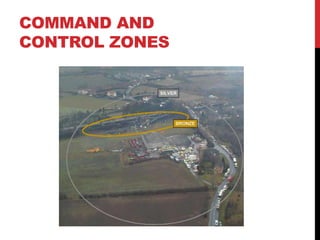
COMMAND AND
CONTROL ZONES
Casualty clearing post (CCP)
• Safe
• Large
• Sheltered
• Acessible
SCENE SET UP
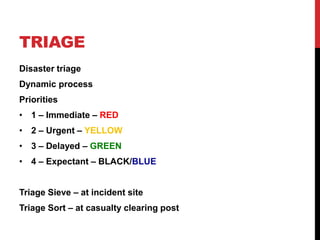
TRIAGE
Disaster triage
Dynamic process
Priorities
• 1 – Immediate – RED
• 2 – Urgent – YELLOW
• 3 – Delayed – GREEN
• 4 – Expectant – BLACK/BLUE
Triage Sieve – at incident site
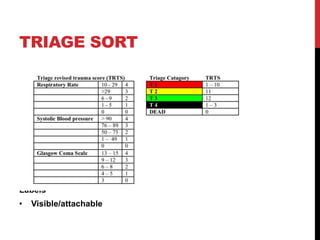
Triage Sort – at casualty clearing post
TRIAGE SIEVE
WALKING Priority 3 (Delayed)
DEADBREATHING
When Airway opened
RESPIRATORY RATE PRIORITY 1
(Immediate)
PRIORITY 2 (Urgent)CAPILLARY REFILL
Yes
No
No
Yes
< 10 or >29
10 - 29
< 2 sec
> 2 sec
TRIAGE SORT
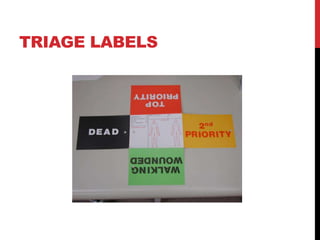
Labels
• Visible/attachable
TRIAGE LABELS
TREATMENT
What can be done
What should be done
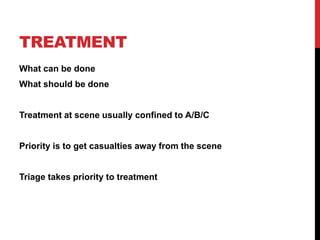
Treatment at scene usually confined to A/B/C
Priority is to get casualties away from the scene
Triage takes priority to treatment
TRANSFER
Organisation is imperative
Treatment impacts on ability to transport
Destination considerations
Method of transport
HOSPITAL
RESPONSE
HOSPITAL PLAN
SCGH response to an external disaster is “Code Brown”
Each area has its specific subplan
Do you know where it is?
Details of the contents are available elsewhere
PREPARATION
Have a plan
Test the plan
• Locally
• Regionaly
• All agencies
• DPMU
• Hospital
• Emergotrain
• Meetings
NOTIFICATION
May come from different sources
• Ambulance
• Media
• Self presenters
• Hospital Emergency Control Group (ECG)
• DPMU – on call duty officer
• WebEOC
• Many theories and stories on how patients present
PREPARATION
Surge capacity
• Clearing the ED
• Clearing the hospital
Tiered response
Department layout
• Locations
• Resources
Clerical involvement
SCGH ED Mass Casualty layout
RESPONSE
Staff allocated to triage prioritites
Each priority has a team leader which liases with duty
consultant
Other staff may be utilised
• Duty surgeon
• Duty intensivist
• Duty radiologist
• Limit Xrays
• Limit operative treatment
• “Damage control”
RECOVERY
Potentially huge undertaking
Resumption of normal function
Restocking
Debriefing
Reviewing
Preparation
Hours to days to weeks
DISASTER MANAGEMENT
PRINCIPLES
Planning
Preparation
Practice
Prehospital response
Hospital response
MIMMS – www.mimms.org.au
HMIMMS
Thanks to Dr Roger Swift FACEM SCGH ED

Disaster management principles

Editor's Notes

  • #3 Definitions Prehospital management – won’t cover specifics of individual roles Hospital management Structure Tools Preparation
  • #4 Definitions vary An event- actual or imminent which endangers or threatens to endanger life property or the environment and which is beyond the resources of a single organisation to manage or requires the coordination of a number of different emergency manangement activities MIMMS – incident where the location, number, severity or type of live casualties requires extraordinary resources – disrupts the health service or posesses a serious threat to the health of the community
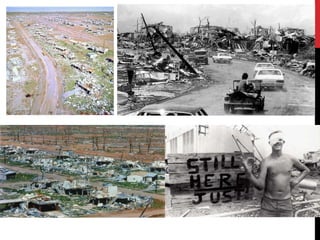
  • #5 Bushfine ash Wednesday vic and SA 1983 75 deaths Black Saturday 2009 173 deaths Cyclone tracy 1974 – 71 deaths Queensland floods 2010/2011 40 dead Newcastle earthquake 1989 Newcastle earthquake – 5.6 on Richter scale 13 people died and 160 injured Heat wave 2009 vic and SA – 350 deaths Granville, 1977 a crowded commuter train speed limit The bridge collapsed onto the train killing 83 of the passengers and injuring more than 200 others. Westgate bridge 1970 – 35 died during construction Kempsey bus crash 35 people two tourist busses collided head on Port Arthur 1996 shooting 35 people Eureka stockade 28 people riot and insurrection 1854 Maritime multiple deaths mostly prior to 1950 Air accidents mulitple in the early period of aviation
  • #6 Cyclone tracy Christmas 1974 - 71 people killed 41000 people homeless – 80 of all houses destroyed
  • #8 Failing to plan is planning to fail There are multiple examples of where good systems and planning result in positive outcomes and lives saved and where poor planning (or lack of planning and preparation results in greater morbidity and mortality There are reasons that there are higher death tolls for natural disasters in developing countries – lack of systems infrastructure and resources are key factors as well as lack of trained personnel to deal with the events The response as I’ll outline is pretty well described and formuleic – which is exatly what you need in this kind of situation.These are rare events. It may not ever happen but if it does – you want to know what to do about it.
  • #10 This is something that is foreign to us in australia – it is nto ausual thinkg that medical teams attend a scene of a disaster but nevertheless is a role that if anyone will perform as part of their job it is us – emergency physicians
  • #11 Roles of first responder – ambulance police fire - all have their own roles and objectives on arrival to the scene – I’m not going to go into that because it’s not our thing but the point is any medical assistance at the scene will be delayed, organised and authorised but whoever is in command and controlling the scene For example ambulance set up the scene – location designated areas etc Police are involved in care and control of uninjured limiting public access supervising volunteers handling the media etc
  • #13 Air time is valuable – if you have nothing to say – stay off the air
  • #14 Command is vertical transmission of authority within each service. Control is the horizontal transmission of authority across a service One service will have overall control – it will not be health – unless it is a medical disaster for example Incident commander, forward incident commander Incident control will be given to the controlling agency – combat agency – manmade incident police bushfire – rural bushfire servce – flood state emergency serviec Lots in MIMMS about chain of command and correct communication techniques
  • #15 Bronze silver and Gold Zones Forward command Post Primary Triage area Safe holding area Casualty Clearing Post
  • #16 Bronze silver and Gold Zones Forward command Post Primary Triage area Safe holding area Casualty Clearing Post
  • #18 From french verb trier – to separate, sift, select, Napoloenic wars and then WWI More like the historical meaning rather than our current usually interpretation as in the ATS – australian triage scale Two standard/usual methods – there may be a possible primary triage by the first responders which is really just a first looks
  • #19 If you can walk – you are green If you are not breathing and simple airway manourves don’t fix the problem you are dead Cap refill is used as a circulatory measure – ask em Y??? – reduced in normal in extreme conditions Cap refil takes 7 seconds – to get a very rough estimate of pulse it takes 15 seconds
  • #20 A bit more complicated and a bit more time consuming still allocated casualties to the same 3 categories More Physiological rather than anatomical Studies in military setting have shoew that this type of triage can be carried out quickly and reliably by non medical personel after a very short period of training Modification for children – they cant walk and have different vital sign ranges – in general people want to save kids and so
  • #21 Visible Accessible Attachable Have room for notes
  • #22 If too little is done – people will die If too much is done – people will die A/B/C – chin lift jaw thrust/manual inline stabilisation/mouth to mouth/bag valve mask ventilation/chest decompression/iv access/defibrillation/CPR generally not because someone requiring CPR is usually not breathing and so won’t get treated. Everyones instinct as human beings is to help people every body from the police and ambulance officer to the senior doctor feels the personal need to treat people rather than to triage or manage the patient flow
  • #23 AGAIN organisation is crucial You can’t do anything well the first time without having planned it. If you practice or rehearse something you will most likely do a better job than is you come into it cold For example Intubated patients huge resources – you want to do the minimum that will keep the patient alive and get them away from the scene Destination the right patient to the right place at the right time Method of transport – ambulance chopper bus or even rail
  • #25 Real life example coming up - so I don’t need to say too much but I just want to provide an outline that you can draw on Think about what it would be like if you were there in Chirstchurch how you’d be thinking/feeling and what you’d be doing. It’s easy to be passive with this stuff – because the likelihood is it will never happen to you. Its hard to engage with it when you know its unlikely to happen. But some of us have to because when it does happen – someone needs to step up an know what they’re doing. I don’t think it matte how clever you are I don’t think this s one of those things you can wing it on and get away with it.
  • #26 To talk through our code brown procedure would take hour and to use a wheelerism :to be honest, at the end of the day, with all due respect it would be pretty boring – so I just basically what to go through four stages of the hospital response The first stage is preparation – which is kind of a little bit what we are doing now Preparation Notification Response Recovery
  • #27 Meetings – death by meeting – while people die Emergo train is really good – get involved if you have the chance – it’s kind of fun and you learn things
  • #28 When I say stories I mean case reports because that’s the best that evidence can throw up when it comes to disaster management The first hour and then the 2-4 hours and then the following X hours But again I’m going to defer to professor Ardagh because he’s going to tell you how it happened in his ED which is an awesome story
  • #29 Clerical involvement depends on the expected number of casualties – paper cards numbers Each patient gets a specific identifying number which is used to manage them through the incident and it is only linked to theor other records after the fact
  • #31 We have talked about the disaster triage Remember to use frequent re-triage Treatment principles are to do the greatest good for the greatest number which doesn’t mean sbboptimal treatment but may mean that only minimum intervention is performed to stabilise the patient and move them on do the next one can be dealth with may mean
  • #32 Depending on what it is Ongoing taking a long period of time Rosters time off Debreifing – could be a huge task in circumstances were particularly traumatic – burns or children casualties involves Making plans to improve on performance and learn from what happened as well Circling around again to preparation