Gamified Disaster Education:
Sirinon Suwanmolee
From experience to activities
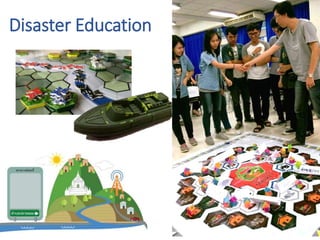
Disaster Education
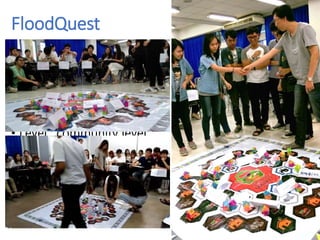
FloodQuest
• Knowledge : risk
management
• Attitude : sharing
• Practice : monitor water
situation
• Level : community level
AlarmSlide
• Knowledge : Science of landslide
/ risk perception /evacuation
• Attitude : safety first
• Practice : monitor Geological
hazard
• Level : Individual level
Disaster Education
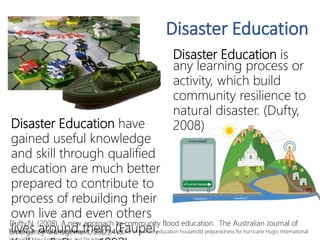
Disaster Education is
any learning process or
activity, which build
community resilience to
natural disaster. (Dufty,
2008)
Dufty,N. (2008). A new approach to community flood education. The Australian Journal of
Emergency Management, 23(2),4-8.
Disaster Education have
gained useful knowledge
and skill through qualified
education are much better
prepared to contribute to
process of rebuilding their
own live and even others
lives around them (Faupel,Faupel, C. E., Kelley, S. P., & Petee, T. (1992). The impact of disaster education household preparedness for hurricane Hugo. International
Lack of the “tool” and “How to”
- It hard to find the content about “How to survive” (self-
organize) in Thai context
- It hard to find the easy tool to learn about the way to
coping with disaster in
individual level and the overview of disaster
Disaster Education in Thailand
Lack of knowledge
management
It must have knowledge mapping more than
meaning and effect of the disaster such as the
categories or level of management from
individual (self-organize)  community
subdistrict provincial national
Lack of local context integrated in
the course
People did’t know the relationship amog
Agent & Structure in disaster management,
Less Scenario planning and experience
linking in local context not often applied to
the course. It‘s not induce the learner
understand the relationship among actors.
Less Disaster Education
in Compulsory education
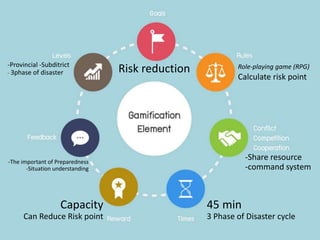
GAMIFICATION IS ABOUT ENGAGEMENT
Gamification is the process of taking
something that already exists example
science knowledge, skill to survive,
disaster risk reduction, community
based disaster management – and
integrating game mechanics into it to
motivate participation and engagement
among the learner.
-Share resource
-command system
Risk reduction-Provincial -Subditrict
- 3phase of disaster
-The important of Preparedness
-Situation understanding
Capacity
Can Reduce Risk point
45 min
3 Phase of Disaster cycle
Calculate risk point
Role-playing game (RPG)
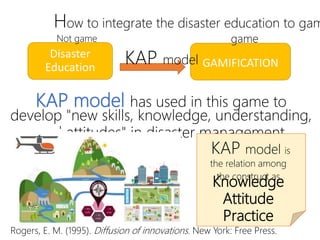
KAP model has used in this game to
develop "new skills, knowledge, understanding,
and attitudes" in disaster management
Rogers, E. M. (1995). Diffusion of innovations. New York: Free Press.
Knowledge
Attitude
Practice
KAP model is
the relation among
the construct as
How to integrate the disaster education to gam
GAMIFICATION
Disaster
Education
KAP model
Not game game
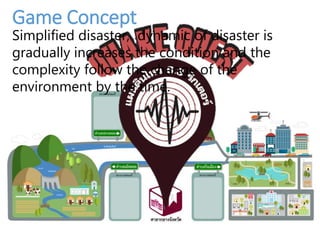
Game Concept
Simplified disaster, dynamic of disaster is
gradually increases the condition and the
complexity follow the change of the
environment by the time.
Knowledge
AttitudePractice
collaborati
on
disaster
characteristic
Resource
allocate
disaster
management
Knowled
ge
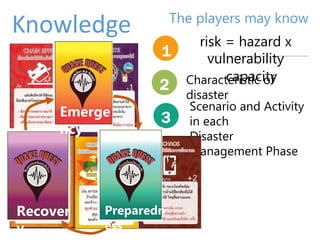
Knowledge The players may know
risk = hazard x
vulnerability
capacity
1
2 Characteristic of
disaster
3
Scenario and Activity
in each
Disaster
management Phase
Emerge
ncy
Recover
y
Preparedn
ess
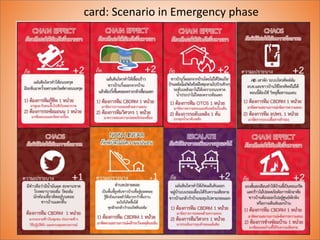
card: Scenario in Emergency phase
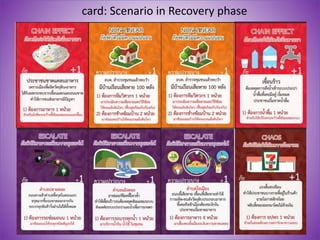
card: Scenario in Recovery phase
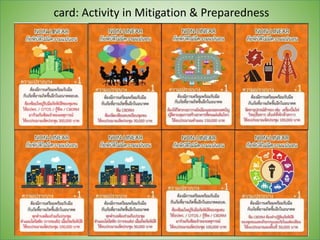
card: Activity in Mitigation & Preparedness
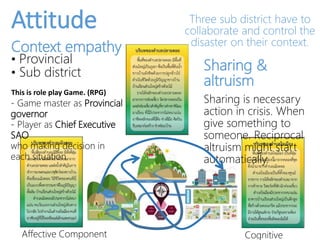
Attitude
Attitude
Context empathy
• Provincial
• Sub district
This is role play Game. (RPG)
- Game master as Provincial
governor
- Player as Chief Executive
SAO
who making decision in
each situation.
CognitiveAffective Component
Three sub district have to
collaborate and control the
disaster on their context.
Sharing &
altruism
Sharing is necessary
action in crisis. When
give something to
someone. Reciprocal
altruism might start
automatically.
Attitude
Collaboration
In disaster affected area,
all community must face
the chaos. Thus the
public sector should
improved administrations
mode from command
and control become
adaptive managements
in collaboration system.
attitude Component
Attitude
Resource allocate
• Manage the Budget
• Prepared resource
before disaster
Sharing
• Negotiate / making
decision
• tentative solving
Behavioral Component
Practice
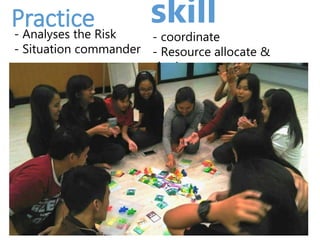
Practice- Analyses the Risk
- Situation commander
skill
- coordinate
- Resource allocate &
sharing
Summary &
Finding• Game is a funny tool of learning, It have to develop fit
for target group.
• Facilitator have an important role to activate the
player adjust their attitude.
• Lesson learn and self assessment must linking to
explain the reason of the act.
Player behavior
- Some team focus on the resource collecting
more than risk reduction
- Some team didn't share resource because if allow
other SAO borrow the
resource, It mean they loss their resource in this
Presentation Paper

Disaster education game

  • 1.
    Gamified Disaster Education: SirinonSuwanmolee From experience to activities
  • 2.
  • 3.
    FloodQuest • Knowledge :risk management • Attitude : sharing • Practice : monitor water situation • Level : community level
  • 4.
    AlarmSlide • Knowledge :Science of landslide / risk perception /evacuation • Attitude : safety first • Practice : monitor Geological hazard • Level : Individual level
  • 5.
    Disaster Education Disaster Educationis any learning process or activity, which build community resilience to natural disaster. (Dufty, 2008) Dufty,N. (2008). A new approach to community flood education. The Australian Journal of Emergency Management, 23(2),4-8. Disaster Education have gained useful knowledge and skill through qualified education are much better prepared to contribute to process of rebuilding their own live and even others lives around them (Faupel,Faupel, C. E., Kelley, S. P., & Petee, T. (1992). The impact of disaster education household preparedness for hurricane Hugo. International
  • 6.
    Lack of the“tool” and “How to” - It hard to find the content about “How to survive” (self- organize) in Thai context - It hard to find the easy tool to learn about the way to coping with disaster in individual level and the overview of disaster Disaster Education in Thailand Lack of knowledge management It must have knowledge mapping more than meaning and effect of the disaster such as the categories or level of management from individual (self-organize)  community subdistrict provincial national Lack of local context integrated in the course People did’t know the relationship amog Agent & Structure in disaster management, Less Scenario planning and experience linking in local context not often applied to the course. It‘s not induce the learner understand the relationship among actors. Less Disaster Education in Compulsory education
  • 7.
    GAMIFICATION IS ABOUTENGAGEMENT Gamification is the process of taking something that already exists example science knowledge, skill to survive, disaster risk reduction, community based disaster management – and integrating game mechanics into it to motivate participation and engagement among the learner. -Share resource -command system Risk reduction-Provincial -Subditrict - 3phase of disaster -The important of Preparedness -Situation understanding Capacity Can Reduce Risk point 45 min 3 Phase of Disaster cycle Calculate risk point Role-playing game (RPG)
  • 8.
    KAP model hasused in this game to develop "new skills, knowledge, understanding, and attitudes" in disaster management Rogers, E. M. (1995). Diffusion of innovations. New York: Free Press. Knowledge Attitude Practice KAP model is the relation among the construct as How to integrate the disaster education to gam GAMIFICATION Disaster Education KAP model Not game game
  • 9.
    Game Concept Simplified disaster,dynamic of disaster is gradually increases the condition and the complexity follow the change of the environment by the time.
  • 10.
  • 11.
  • 12.
    Knowledge The playersmay know risk = hazard x vulnerability capacity 1 2 Characteristic of disaster 3 Scenario and Activity in each Disaster management Phase Emerge ncy Recover y Preparedn ess
  • 13.
    card: Scenario inEmergency phase
  • 14.
    card: Scenario inRecovery phase
  • 15.
    card: Activity inMitigation & Preparedness
  • 16.
  • 17.
    Attitude Context empathy • Provincial •Sub district This is role play Game. (RPG) - Game master as Provincial governor - Player as Chief Executive SAO who making decision in each situation. CognitiveAffective Component Three sub district have to collaborate and control the disaster on their context. Sharing & altruism Sharing is necessary action in crisis. When give something to someone. Reciprocal altruism might start automatically.
  • 18.
    Attitude Collaboration In disaster affectedarea, all community must face the chaos. Thus the public sector should improved administrations mode from command and control become adaptive managements in collaboration system. attitude Component
  • 19.
    Attitude Resource allocate • Managethe Budget • Prepared resource before disaster Sharing • Negotiate / making decision • tentative solving Behavioral Component
  • 20.
  • 21.
    Practice- Analyses theRisk - Situation commander skill - coordinate - Resource allocate & sharing
  • 22.
    Summary & Finding• Gameis a funny tool of learning, It have to develop fit for target group. • Facilitator have an important role to activate the player adjust their attitude. • Lesson learn and self assessment must linking to explain the reason of the act. Player behavior - Some team focus on the resource collecting more than risk reduction - Some team didn't share resource because if allow other SAO borrow the resource, It mean they loss their resource in this
  • 24.

Editor's Notes

  • #8 the goal behind gamification is “fun.” Through the engagement (ประสบการณ์ร่วม) to the player
  • #9 The information and the rules in this game were identified as the knowledge. Attitudes is a set of initial in fluences the comprises of several believes related to actions the are formed around situation. Practice refers to actions because the existence of belief in themselves are drived the actions.