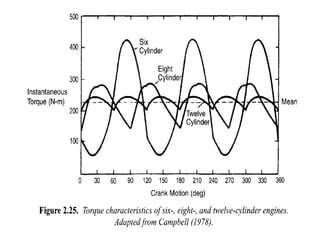
Engine Performance
Prof. (Dr.) MP Poonia
Director, NITTTR
Chandigarh (India)
Purpose of an engine
Converts the heat of burning fuel into
useful energy
Let's take a look at how the engine was
invented.
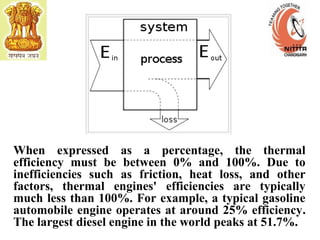
When expressed as a percentage, the thermal
efficiency must be between 0% and 100%. Due to
inefficiencies such as friction, heat loss, and other
factors, thermal engines' efficiencies are typically
much less than 100%. For example, a typical gasoline
automobile engine operates at around 25% efficiency.
The largest diesel engine in the world peaks at 51.7%.
Otto’s practical internal combustion
engine is used to power automobiles,
motorcycles and motorboats. Also, the
Diesel engine is a form of internal
combustion engine, which employs a
four-stroke cycle that is similar to
Otto’s. Nikolaus August Otto died on
January 26, 1891.
Basic Terminology
•Bore & Stroke
•Engine Displacement
•Compression Ratio
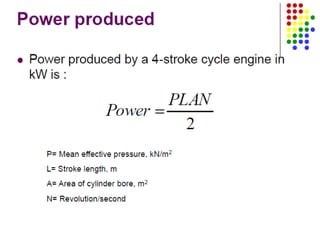
•Power
•Torque
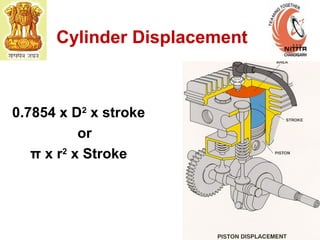
Stroke
•Distance
TDC-BDC
•Distance piston travels
up or down
Figure 3 : Engine Terminology
Cylinder Displacement
0.7854 x D2
x stroke
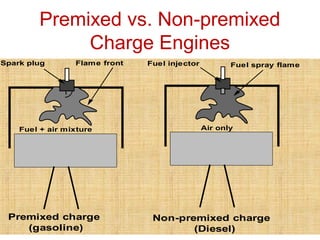
or
π x r2
x Stroke
15
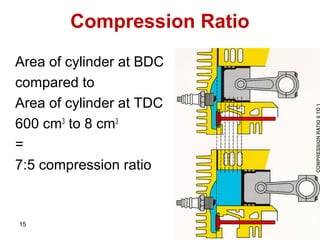
Compression Ratio
Area of cylinder at BDC
compared to
Area of cylinder at TDC
600 cm3
to 8 cm3
=
7:5 compression ratio
16
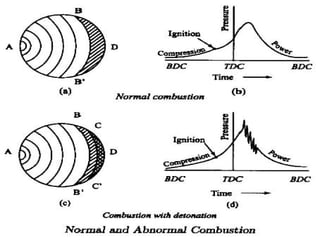
Kinds of Horsepower
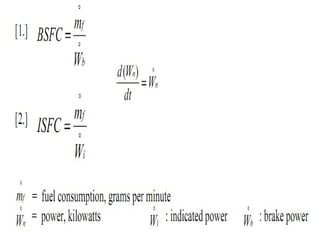
• Brake Horsepower
• Indicated Horsepower
• Frictional Horsepower
• Rated Horsepower
• Corrected Horsepower
17
Corrected Horsepower
• corrected for elevation (sea level)
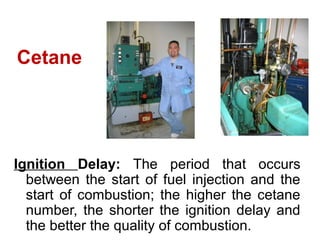
• corrected for temperature
• barometric pressure
• quality of fuel
• humidity
Efficiency
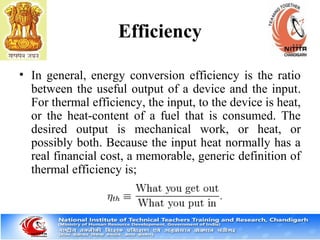
• In general, energy conversion efficiency is the ratio
between the useful output of a device and the input.
For thermal efficiency, the input, to the device is heat,
or the heat-content of a fuel that is consumed. The
desired output is mechanical work, or heat, or
possibly both. Because the input heat normally has a
real financial cost, a memorable, generic definition of
thermal efficiency is;
Mechanical Efficiency
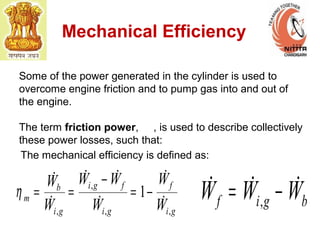
Some of the power generated in the cylinder is used to
overcome engine friction and to pump gas into and out of
the engine.
The term friction power, , is used to describe collectively
these power losses, such that:
gi
f
gi
fgi
gi
b
m
W
W
W
WW
W
W
,,
,
,
1






−=
−
==η
.
The mechanical efficiency is defined as:
bgif WWW  −= ,
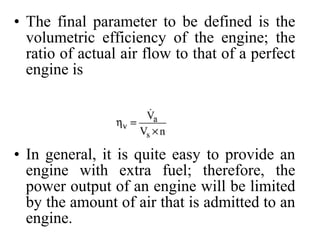
• The final parameter to be defined is the
volumetric efficiency of the engine; the
ratio of actual air flow to that of a perfect
engine is
• In general, it is quite easy to provide an
engine with extra fuel; therefore, the
power output of an engine will be limited
by the amount of air that is admitted to an
engine.
How about gasoline?
• Gasoline is a product obtained by refining
crude oil (petroleum) obtained from wells
drilled into the earth.
• The crude oil is treated in various ways to
produce gasoline
• Since gasoline is a mixture of carbon and
hydrogen atoms, it is termed a
hydrocarbon
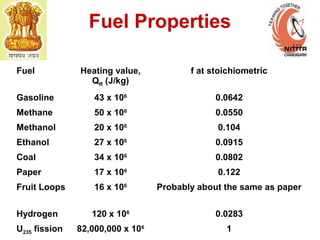
Fuel Properties
Fuel Heating value,
QR (J/kg)
f at stoichiometric
Gasoline 43 x 106
0.0642
Methane 50 x 106
0.0550
Methanol 20 x 106
0.104
Ethanol 27 x 106
0.0915
Coal 34 x 106
0.0802
Paper 17 x 106
0.122
Fruit Loops 16 x 106
Probably about the same as paper
Hydrogen 120 x 106
0.0283
U235 fission 82,000,000 x 106
1
Fuel Requirements
• Gasoline is a mixture of hydrocarbons (with 4 to
approximately 12 carbon atoms) ,SIT 450 o
C
• Diesel fuel is a mixture of higher molar mass
hydrocarbons (typically 12 to 22 carbon atoms), SIT
200 o
C.
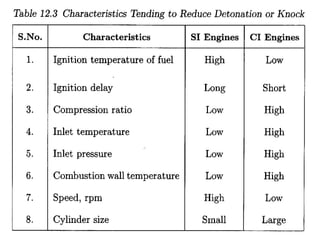
• Fuels for spark ignition engines should vaporize
readily and be resistant to self-ignition, as indicated
by a high octane rating.
• Fuels for compression ignition engines should self-
ignite readily, as indicated by a high cetane number.
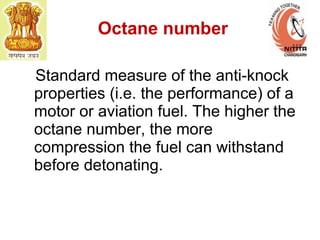
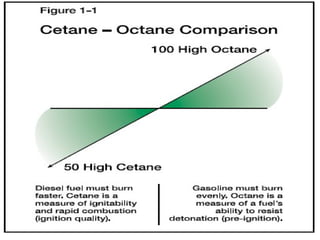
Octane number
Standard measure of the anti-knock
properties (i.e. the performance) of a
motor or aviation fuel. The higher the
octane number, the more
compression the fuel can withstand
before detonating.
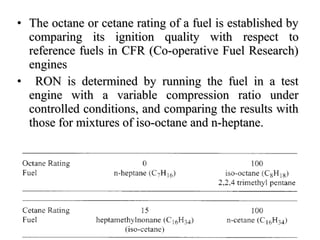
• The octane or cetane rating of a fuel is established byThe octane or cetane rating of a fuel is established by
comparing its ignition quality withcomparing its ignition quality with respect torespect to
reference fuels in CFR (Co-operative Fuel Research)reference fuels in CFR (Co-operative Fuel Research)
enginesengines
• RON is determined by running the fuel in a testRON is determined by running the fuel in a test
engine with a variable compression ratio underengine with a variable compression ratio under
controlled conditions, and comparing the results withcontrolled conditions, and comparing the results with
those for mixtures of iso-octane and n-heptane.those for mixtures of iso-octane and n-heptane.
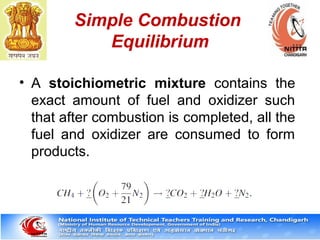
Simple Combustion
Equilibrium
• A stoichiometric mixture contains the
exact amount of fuel and oxidizer such
that after combustion is completed, all the
fuel and oxidizer are consumed to form
products.
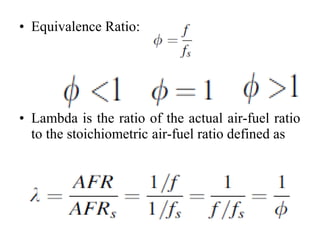
• Equivalence Ratio:
• Lambda is the ratio of the actual air-fuel ratio
to the stoichiometric air-fuel ratio defined as
Methods of Quantifying Fuel and Air
Content
of Combustible Mixtures
• If less air than the stoichiometric amount is
used, the mixture is described as fuel rich.
• If excess air is used, the mixture is described as
fuel lean.
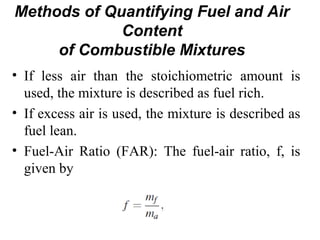
• Fuel-Air Ratio (FAR): The fuel-air ratio, f, is
given by
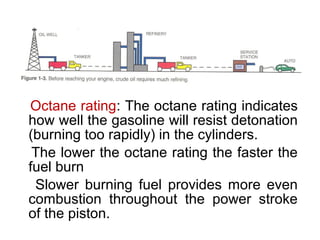
Octane rating: The octane rating indicates
how well the gasoline will resist detonation
(burning too rapidly) in the cylinders.
The lower the octane rating the faster the
fuel burn
Slower burning fuel provides more even
combustion throughout the power stroke
of the piston.
Unleaded gasoline
All gasoline sold today is unleaded.
Unleaded gasoline contains no tetraethyl
lead.
Tetraethyl lead quickly destroys catalytic
converters.
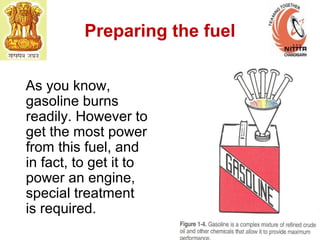
Preparing the fuel
As you know,
gasoline burns
readily. However to
get the most power
from this fuel, and
in fact, to get it to
power an engine,
special treatment
is required.
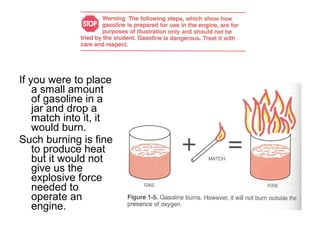
If you were to place
a small amount
of gasoline in a
jar and drop a
match into it, it
would burn.
Such burning is fine
to produce heat
but it would not
give us the
explosive force
needed to
operate an
engine.
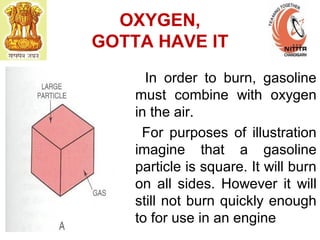
OXYGEN,
GOTTA HAVE IT
In order to burn, gasoline
must combine with oxygen
in the air.
For purposes of illustration
imagine that a gasoline
particle is square. It will burn
on all sides. However it will
still not burn quickly enough
to for use in an engine
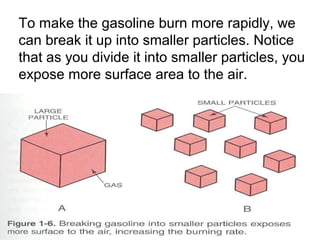
To make the gasoline burn more rapidly, we
can break it up into smaller particles. Notice
that as you divide it into smaller particles, you
expose more surface area to the air.
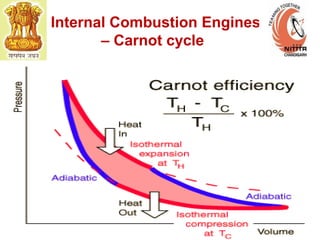
Internal Combustion Engines
– Carnot cycle
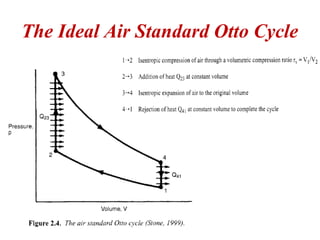
The Ideal Air Standard Otto Cycle
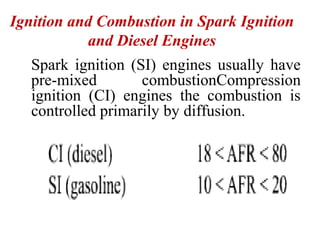
Ignition and Combustion in Spark Ignition
and Diesel Engines
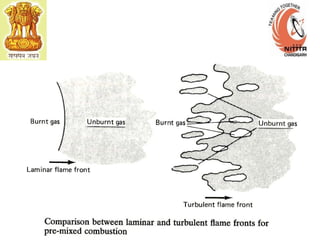
Spark ignition (SI) engines usually have
pre-mixed combustionCompression
ignition (CI) engines the combustion is
controlled primarily by diffusion.
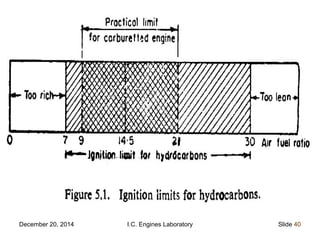
December 20, 2014 I.C. Engines Laboratory Slide 40
Premixed vs. Non-premixed
Charge Engines
Flame front Fuel spray flame
Premixed charge
(gasoline)
Non-premixed charge
(Diesel)
Spark plug Fuel injector
Fuel + air mixture Air only
I.C. Engines Laboratory
December 20, 2014 I.C. Engines Laboratory Slide 45
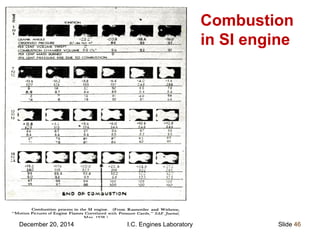
December 20, 2014 I.C. Engines Laboratory Slide 46
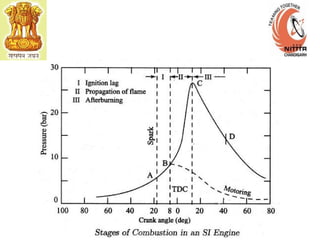
Combustion
in SI engine
I.C. Engines Laboratory
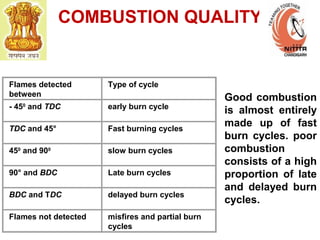
Flames detected
between
Type of cycle
- 450
and TDC early burn cycle
TDC and 45° Fast burning cycles
450
and 900
slow burn cycles
90° and BDC Late burn cycles
BDC and TDC delayed burn cycles
Flames not detected misfires and partial burn
cycles
Good combustion
is almost entirely
made up of fast
burn cycles. poor
combustion
consists of a high
proportion of late
and delayed burn
cycles.
COMBUSTION QUALITY
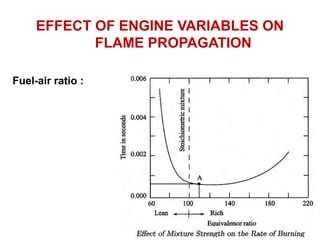
EFFECT OF ENGINE VARIABLES ON
FLAME PROPAGATION
Fuel-air ratio :
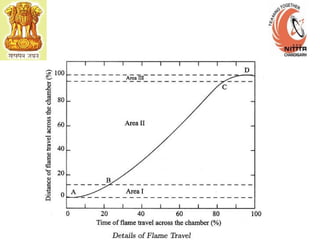
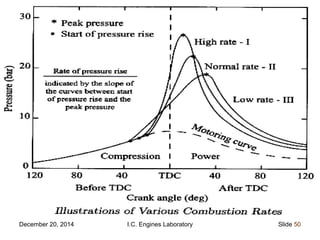
December 20, 2014 I.C. Engines Laboratory Slide 50
December 20, 2014 I.C. Engines Laboratory Slide 51
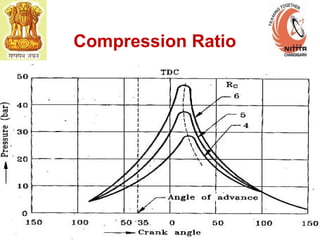
Compression Ratio
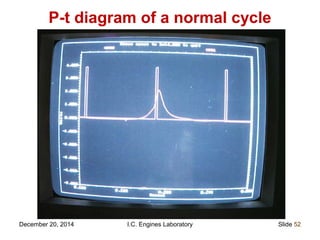
December 20, 2014 I.C. Engines Laboratory Slide 52
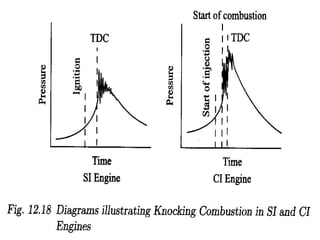
P-t diagram of a normal cycle
December 20, 2014 I.C. Engines Laboratory Slide 53
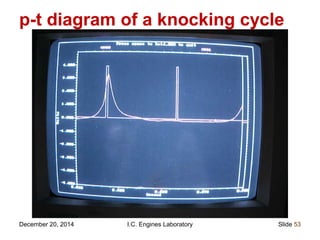
p-t diagram of a knocking cycle
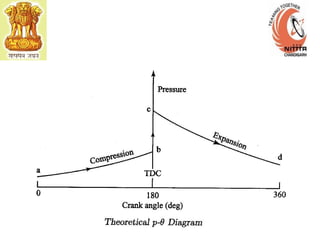
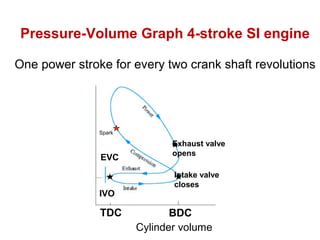
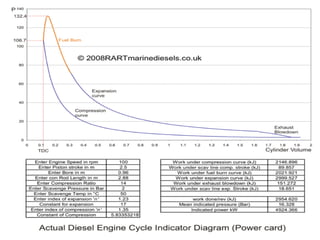
Pressure-Volume Graph 4-stroke SI engine
One power stroke for every two crank shaft revolutions
1 atm
Spark
TDC
Cylinder volume
BDC
P
Exhaust valve
opens
Intake valve
closes
EVC
IVO
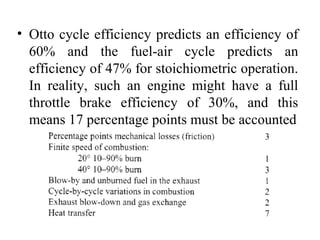
• Otto cycle efficiency predicts an efficiency of
60% and the fuel-air cycle predicts an
efficiency of 47% for stoichiometric operation.
In reality, such an engine might have a full
throttle brake efficiency of 30%, and this
means 17 percentage points must be accounted
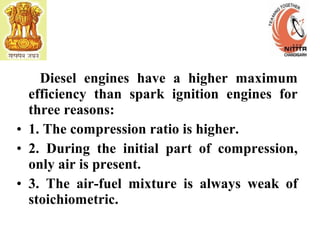
Diesel engines have a higher maximum
efficiency than spark ignition engines for
three reasons:
• 1. The compression ratio is higher.
• 2. During the initial part of compression,
only air is present.
• 3. The air-fuel mixture is always weak of
stoichiometric.
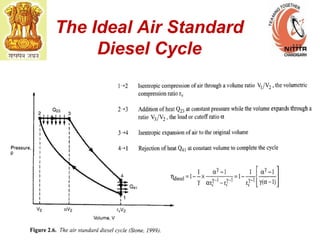
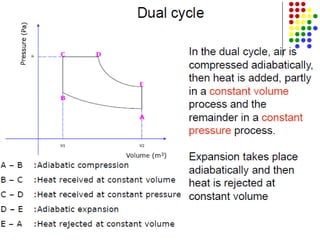
The Ideal Air Standard
Diesel Cycle
What is Diesel Fuel?
Various Petroleum Components:
• Paraffins
• Isoparaffins
• Napthenes
• Olefins
• Aromatic Hydrocarbons
Cetane Number
CN is a measurement of the combustion
quality of diesel fuel during compression
ignition.
Cetane Number
• Measures readiness of fuel to auto-ignite.
• High cetane means the fuel ignite quickly
• Most fuels have cetane numbers between 40
and 60.
• ASTM requires a minimum cetane number of
40
• Premium Diesel fuel typically has a cetane of
47
Cetane
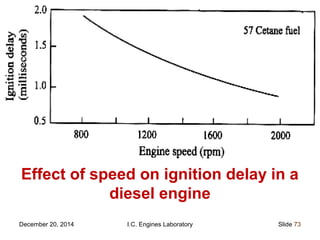
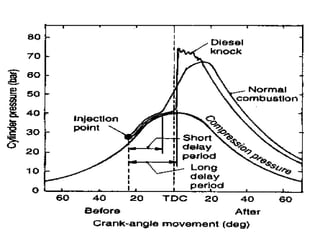
Ignition Delay: The period that occurs
between the start of fuel injection and the
start of combustion; the higher the cetane
number, the shorter the ignition delay and
the better the quality of combustion.
Cetane
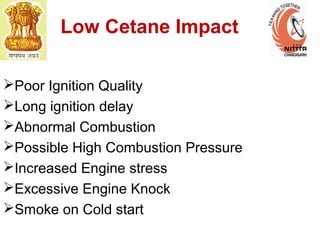
Low Cetane Impact
Poor Ignition Quality
Long ignition delay
Abnormal Combustion
Possible High Combustion Pressure
Increased Engine stress
Excessive Engine Knock
Smoke on Cold start
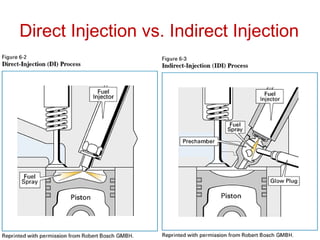
Direct Injection vs. Indirect Injection
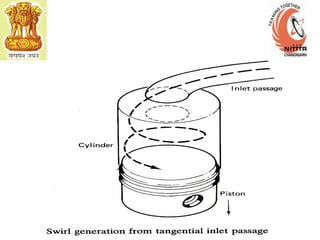
Swirl :
• The orderly motion of the air particularly parallel to the axis
of the engine.
• Very much required for diesel engines.
Squish/Squash :
• The radial inward motion of the air-fuel mixture towards
(squish) and away from the axis of the engine (squash).
• Very much required for the diesel engines.
Turbulence :
• Random mixing of the burned and unburned gases
December 20, 2014 I.C. Engines Laboratory Slide 69
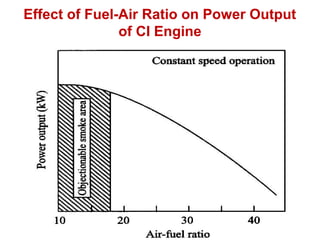
Effect of Fuel-Air Ratio on Power Output
of CI Engine
December 20, 2014 I.C. Engines Laboratory Slide 70
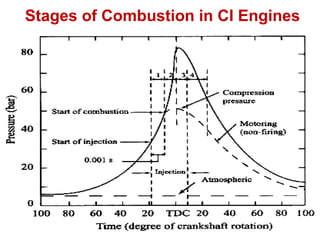
Stages of Combustion in CI Engines
December 20, 2014 I.C. Engines Laboratory Slide 71
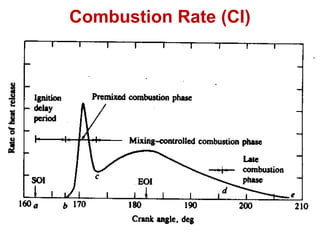
Combustion Rate (CI)
December 20, 2014 I.C. Engines Laboratory Slide 72
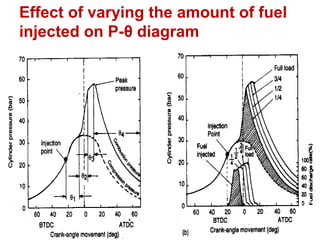
Effect of varying the amount of fuel
injected on P-θ diagram
December 20, 2014 I.C. Engines Laboratory Slide 73
Effect of speed on ignition delay in a
diesel engine
December 20, 2014 I.C. Engines Laboratory Slide 74
December 20, 2014 I.C. Engines Laboratory Slide 75
December 20, 2014 I.C. Engines Laboratory Slide 76
December 20, 2014 I.C. Engines Laboratory Slide 80
CI Engine Combustion
Chambers
• Open Chamber or DI engine
• Divided Chamber or IDI engine
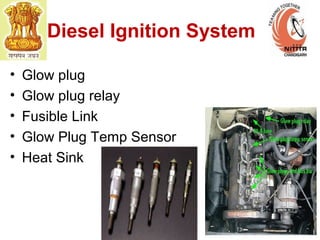
Diesel Ignition System
• Glow plug
• Glow plug relay
• Fusible Link
• Glow Plug Temp Sensor
• Heat Sink
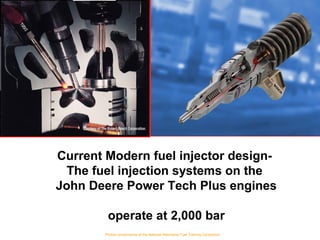
Current Modern fuel injector design-
The fuel injection systems on the
John Deere Power Tech Plus engines
operate at 2,000 bar
Photos compliments of the National Alternative Fuel Training Consortium
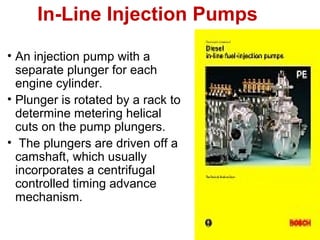
In-Line Injection Pumps
• An injection pump with a
separate plunger for each
engine cylinder.
• Plunger is rotated by a rack to
determine metering helical
cuts on the pump plungers.
• The plungers are driven off a
camshaft, which usually
incorporates a centrifugal
controlled timing advance
mechanism.
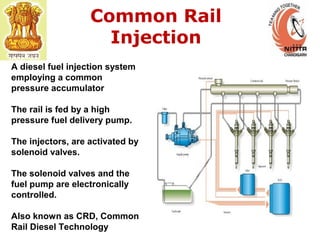
A diesel fuel injection system
employing a common
pressure accumulator
The rail is fed by a high
pressure fuel delivery pump.
The injectors, are activated by
solenoid valves.
The solenoid valves and the
fuel pump are electronically
controlled.
Also known as CRD, Common
Rail Diesel Technology
Common Rail
Injection
• ic engines fdpIC Engines Videos
• Video not found
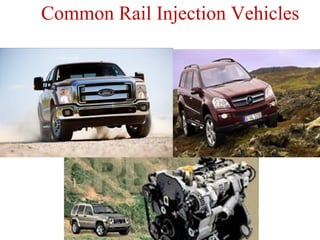
Common Rail Injection Vehicles
Advantages of DI Engines
 Fuels of poorer ignition quality can be used.
 Single-hole injection nozzles and moderate
injection pressures can be used and can
tolerate greater degrees of nozzle fouling.
 Higher fuel-air ratios can be used without
smoke.
Disadvantages of IDI
Engines
 More expensive cylinder construction.
 More difficult cold starting because of greater
heat loss through the throat.
 Poorer fuel economy due to greater heat
losses and pressure losses through the throat,
which result in lower thermal efficiency and
higher pumping loss.
tungal/presentations/ad2012
89

internal combustion engines are discussed including combustion behaviour

  • 1.
    Engine Performance Prof. (Dr.)MP Poonia Director, NITTTR Chandigarh (India)
  • 2.
    Purpose of anengine Converts the heat of burning fuel into useful energy Let's take a look at how the engine was invented.
  • 3.
    When expressed asa percentage, the thermal efficiency must be between 0% and 100%. Due to inefficiencies such as friction, heat loss, and other factors, thermal engines' efficiencies are typically much less than 100%. For example, a typical gasoline automobile engine operates at around 25% efficiency. The largest diesel engine in the world peaks at 51.7%.
  • 4.
    Otto’s practical internalcombustion engine is used to power automobiles, motorcycles and motorboats. Also, the Diesel engine is a form of internal combustion engine, which employs a four-stroke cycle that is similar to Otto’s. Nikolaus August Otto died on January 26, 1891.
  • 5.
    Basic Terminology •Bore &Stroke •Engine Displacement •Compression Ratio •Power •Torque
  • 10.
  • 11.
    Figure 3 :Engine Terminology
  • 14.
    Cylinder Displacement 0.7854 xD2 x stroke or π x r2 x Stroke
  • 15.
    15 Compression Ratio Area ofcylinder at BDC compared to Area of cylinder at TDC 600 cm3 to 8 cm3 = 7:5 compression ratio
  • 16.
    16 Kinds of Horsepower •Brake Horsepower • Indicated Horsepower • Frictional Horsepower • Rated Horsepower • Corrected Horsepower
  • 17.
    17 Corrected Horsepower • correctedfor elevation (sea level) • corrected for temperature • barometric pressure • quality of fuel • humidity
  • 18.
    Efficiency • In general,energy conversion efficiency is the ratio between the useful output of a device and the input. For thermal efficiency, the input, to the device is heat, or the heat-content of a fuel that is consumed. The desired output is mechanical work, or heat, or possibly both. Because the input heat normally has a real financial cost, a memorable, generic definition of thermal efficiency is;
  • 20.
    Mechanical Efficiency Some ofthe power generated in the cylinder is used to overcome engine friction and to pump gas into and out of the engine. The term friction power, , is used to describe collectively these power losses, such that: gi f gi fgi gi b m W W W WW W W ,, , , 1       −= − ==η . The mechanical efficiency is defined as: bgif WWW  −= ,
  • 21.
    • The finalparameter to be defined is the volumetric efficiency of the engine; the ratio of actual air flow to that of a perfect engine is • In general, it is quite easy to provide an engine with extra fuel; therefore, the power output of an engine will be limited by the amount of air that is admitted to an engine.
  • 23.
    How about gasoline? •Gasoline is a product obtained by refining crude oil (petroleum) obtained from wells drilled into the earth. • The crude oil is treated in various ways to produce gasoline • Since gasoline is a mixture of carbon and hydrogen atoms, it is termed a hydrocarbon
  • 24.
    Fuel Properties Fuel Heatingvalue, QR (J/kg) f at stoichiometric Gasoline 43 x 106 0.0642 Methane 50 x 106 0.0550 Methanol 20 x 106 0.104 Ethanol 27 x 106 0.0915 Coal 34 x 106 0.0802 Paper 17 x 106 0.122 Fruit Loops 16 x 106 Probably about the same as paper Hydrogen 120 x 106 0.0283 U235 fission 82,000,000 x 106 1
  • 25.
    Fuel Requirements • Gasolineis a mixture of hydrocarbons (with 4 to approximately 12 carbon atoms) ,SIT 450 o C • Diesel fuel is a mixture of higher molar mass hydrocarbons (typically 12 to 22 carbon atoms), SIT 200 o C. • Fuels for spark ignition engines should vaporize readily and be resistant to self-ignition, as indicated by a high octane rating. • Fuels for compression ignition engines should self- ignite readily, as indicated by a high cetane number.
  • 26.
    Octane number Standard measureof the anti-knock properties (i.e. the performance) of a motor or aviation fuel. The higher the octane number, the more compression the fuel can withstand before detonating.
  • 27.
    • The octaneor cetane rating of a fuel is established byThe octane or cetane rating of a fuel is established by comparing its ignition quality withcomparing its ignition quality with respect torespect to reference fuels in CFR (Co-operative Fuel Research)reference fuels in CFR (Co-operative Fuel Research) enginesengines • RON is determined by running the fuel in a testRON is determined by running the fuel in a test engine with a variable compression ratio underengine with a variable compression ratio under controlled conditions, and comparing the results withcontrolled conditions, and comparing the results with those for mixtures of iso-octane and n-heptane.those for mixtures of iso-octane and n-heptane.
  • 28.
    Simple Combustion Equilibrium • Astoichiometric mixture contains the exact amount of fuel and oxidizer such that after combustion is completed, all the fuel and oxidizer are consumed to form products.
  • 29.
    • Equivalence Ratio: •Lambda is the ratio of the actual air-fuel ratio to the stoichiometric air-fuel ratio defined as
  • 30.
    Methods of QuantifyingFuel and Air Content of Combustible Mixtures • If less air than the stoichiometric amount is used, the mixture is described as fuel rich. • If excess air is used, the mixture is described as fuel lean. • Fuel-Air Ratio (FAR): The fuel-air ratio, f, is given by
  • 31.
    Octane rating: Theoctane rating indicates how well the gasoline will resist detonation (burning too rapidly) in the cylinders. The lower the octane rating the faster the fuel burn Slower burning fuel provides more even combustion throughout the power stroke of the piston.
  • 32.
    Unleaded gasoline All gasolinesold today is unleaded. Unleaded gasoline contains no tetraethyl lead. Tetraethyl lead quickly destroys catalytic converters.
  • 33.
    Preparing the fuel Asyou know, gasoline burns readily. However to get the most power from this fuel, and in fact, to get it to power an engine, special treatment is required.
  • 34.
    If you wereto place a small amount of gasoline in a jar and drop a match into it, it would burn. Such burning is fine to produce heat but it would not give us the explosive force needed to operate an engine.
  • 35.
    OXYGEN, GOTTA HAVE IT Inorder to burn, gasoline must combine with oxygen in the air. For purposes of illustration imagine that a gasoline particle is square. It will burn on all sides. However it will still not burn quickly enough to for use in an engine
  • 36.
    To make thegasoline burn more rapidly, we can break it up into smaller particles. Notice that as you divide it into smaller particles, you expose more surface area to the air.
  • 37.
  • 38.
    The Ideal AirStandard Otto Cycle
  • 39.
    Ignition and Combustionin Spark Ignition and Diesel Engines Spark ignition (SI) engines usually have pre-mixed combustionCompression ignition (CI) engines the combustion is controlled primarily by diffusion.
  • 40.
    December 20, 2014I.C. Engines Laboratory Slide 40
  • 41.
    Premixed vs. Non-premixed ChargeEngines Flame front Fuel spray flame Premixed charge (gasoline) Non-premixed charge (Diesel) Spark plug Fuel injector Fuel + air mixture Air only
  • 43.
  • 45.
    December 20, 2014I.C. Engines Laboratory Slide 45
  • 46.
    December 20, 2014I.C. Engines Laboratory Slide 46 Combustion in SI engine
  • 47.
  • 48.
    Flames detected between Type ofcycle - 450 and TDC early burn cycle TDC and 45° Fast burning cycles 450 and 900 slow burn cycles 90° and BDC Late burn cycles BDC and TDC delayed burn cycles Flames not detected misfires and partial burn cycles Good combustion is almost entirely made up of fast burn cycles. poor combustion consists of a high proportion of late and delayed burn cycles. COMBUSTION QUALITY
  • 49.
    EFFECT OF ENGINEVARIABLES ON FLAME PROPAGATION Fuel-air ratio :
  • 50.
    December 20, 2014I.C. Engines Laboratory Slide 50
  • 51.
    December 20, 2014I.C. Engines Laboratory Slide 51 Compression Ratio
  • 52.
    December 20, 2014I.C. Engines Laboratory Slide 52 P-t diagram of a normal cycle
  • 53.
    December 20, 2014I.C. Engines Laboratory Slide 53 p-t diagram of a knocking cycle
  • 54.
    Pressure-Volume Graph 4-strokeSI engine One power stroke for every two crank shaft revolutions 1 atm Spark TDC Cylinder volume BDC P Exhaust valve opens Intake valve closes EVC IVO
  • 55.
    • Otto cycleefficiency predicts an efficiency of 60% and the fuel-air cycle predicts an efficiency of 47% for stoichiometric operation. In reality, such an engine might have a full throttle brake efficiency of 30%, and this means 17 percentage points must be accounted
  • 56.
    Diesel engines havea higher maximum efficiency than spark ignition engines for three reasons: • 1. The compression ratio is higher. • 2. During the initial part of compression, only air is present. • 3. The air-fuel mixture is always weak of stoichiometric.
  • 57.
    The Ideal AirStandard Diesel Cycle
  • 58.
    What is DieselFuel? Various Petroleum Components: • Paraffins • Isoparaffins • Napthenes • Olefins • Aromatic Hydrocarbons
  • 59.
    Cetane Number CN isa measurement of the combustion quality of diesel fuel during compression ignition.
  • 60.
    Cetane Number • Measuresreadiness of fuel to auto-ignite. • High cetane means the fuel ignite quickly • Most fuels have cetane numbers between 40 and 60. • ASTM requires a minimum cetane number of 40 • Premium Diesel fuel typically has a cetane of 47
  • 61.
    Cetane Ignition Delay: Theperiod that occurs between the start of fuel injection and the start of combustion; the higher the cetane number, the shorter the ignition delay and the better the quality of combustion. Cetane
  • 63.
    Low Cetane Impact PoorIgnition Quality Long ignition delay Abnormal Combustion Possible High Combustion Pressure Increased Engine stress Excessive Engine Knock Smoke on Cold start
  • 65.
    Direct Injection vs.Indirect Injection
  • 68.
    Swirl : • Theorderly motion of the air particularly parallel to the axis of the engine. • Very much required for diesel engines. Squish/Squash : • The radial inward motion of the air-fuel mixture towards (squish) and away from the axis of the engine (squash). • Very much required for the diesel engines. Turbulence : • Random mixing of the burned and unburned gases
  • 69.
    December 20, 2014I.C. Engines Laboratory Slide 69 Effect of Fuel-Air Ratio on Power Output of CI Engine
  • 70.
    December 20, 2014I.C. Engines Laboratory Slide 70 Stages of Combustion in CI Engines
  • 71.
    December 20, 2014I.C. Engines Laboratory Slide 71 Combustion Rate (CI)
  • 72.
    December 20, 2014I.C. Engines Laboratory Slide 72 Effect of varying the amount of fuel injected on P-θ diagram
  • 73.
    December 20, 2014I.C. Engines Laboratory Slide 73 Effect of speed on ignition delay in a diesel engine
  • 74.
    December 20, 2014I.C. Engines Laboratory Slide 74
  • 75.
    December 20, 2014I.C. Engines Laboratory Slide 75
  • 76.
    December 20, 2014I.C. Engines Laboratory Slide 76
  • 80.
    December 20, 2014I.C. Engines Laboratory Slide 80 CI Engine Combustion Chambers • Open Chamber or DI engine • Divided Chamber or IDI engine
  • 81.
    Diesel Ignition System •Glow plug • Glow plug relay • Fusible Link • Glow Plug Temp Sensor • Heat Sink
  • 82.
    Current Modern fuelinjector design- The fuel injection systems on the John Deere Power Tech Plus engines operate at 2,000 bar Photos compliments of the National Alternative Fuel Training Consortium
  • 83.
    In-Line Injection Pumps •An injection pump with a separate plunger for each engine cylinder. • Plunger is rotated by a rack to determine metering helical cuts on the pump plungers. • The plungers are driven off a camshaft, which usually incorporates a centrifugal controlled timing advance mechanism.
  • 84.
    A diesel fuelinjection system employing a common pressure accumulator The rail is fed by a high pressure fuel delivery pump. The injectors, are activated by solenoid valves. The solenoid valves and the fuel pump are electronically controlled. Also known as CRD, Common Rail Diesel Technology Common Rail Injection
  • 85.
    • ic enginesfdpIC Engines Videos • Video not found
  • 86.
  • 87.
    Advantages of DIEngines  Fuels of poorer ignition quality can be used.  Single-hole injection nozzles and moderate injection pressures can be used and can tolerate greater degrees of nozzle fouling.  Higher fuel-air ratios can be used without smoke.
  • 88.
    Disadvantages of IDI Engines More expensive cylinder construction.  More difficult cold starting because of greater heat loss through the throat.  Poorer fuel economy due to greater heat losses and pressure losses through the throat, which result in lower thermal efficiency and higher pumping loss.
  • 89.

Editor's Notes

  • #64 Low cetane number fuels are slow to ignite and then burn too rapidly, leading to high rates of pressure rise. These poor combustion characteristics can give rise to excessive engine noise and vibration, increased exhaust emissions and reduced vehicle performance, with increased engine stress specifically on the piston & cylinder
  • #82 Take care with some newer glow plugs not to touch the ceramic electrode, Oil residue may can premature damage Don’t test new CDI 2.8l glow plugs with 12 volts- they are 7 volts
  • #85 2.8L Jeep Liberty 24,000 PSI Multi pilot fuel injection- 1 or 2 before main injection