Prepared By :- Nikhil Italiya
A Presentation on
Engine Emissions and their
control
Emission of Pollutants from S.I. Engines
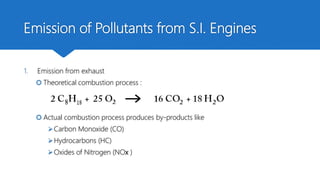
1. Emission from exhaust
 Theoretical combustion process :
 Actual combustion process produces by-products like
Carbon Monoxide (CO)
Hydrocarbons (HC)
Oxides of Nitrogen (NOx )
Emission of Pollutants from S.I. Engines
2. Evaporation of Gasoline
 By Fuel tank
 Gasoline (HC) escapes to atmosphere while being filled into fuel tanks.
 Through vent plug of the fuel tank which is open to atmosphere for breathing.
 From Carburetor
 Float chamber of carburetor is vented to atmosphere from where gasoline escapes.
 When engine has run for sometime at load and stopped, due to high engine temperature at
this time gasoline boils in carburetor and escapes to atmosphere. This is called “Hot Soaking”.
 Crankcase blow-by
 Leakage of combustion gases to engine crankcase due to gap between cylinder and piston
rings (due to wear ) is called blow-by.
Emission of Pollutants from C.I. Engines
 Carbon Monoxide (CO)
 Hydrocarbons (HC)
 Oxides of Nitrogen (NOx )
 Aldehydes and other emissions
 H2S and SO2 gases are formed on burning of Sulphur present in diesel.
 Ash dust, H2SO4 are also produced.
 Smoke and particulate
 White smoke is caused by liquid droplets of lubricating oil and fuel oil.
 Black smoke represents the incomplete combustion of fuel.
Causes of Air Pollutants in Automobiles
 Carbon Monoxide (CO)
 Basic reason for production of CO is incomplete combustion.
 Initially CO is formed, which gets converted to CO2 on further oxidation, but conversion from CO to CO2 is
slow.
 Uneven combustion due to uneven distribution of fuel in combustion chamber.
 Flame does not reach in quenching to burn fuel.
 Hydrocarbons (HC)
 Incorrect Air-Fuel Ratio
 Low compression
 Quenching
 Valve overlapping
 Surface to Volume ratio
Causes of Air Pollutants in Automobiles
 Oxides of Nitrogen (NOX)
 Maximum NOX in exhaust is nitric oxide (NO), which further combine with O2 and forms NO2 which is very
poisonous gas.
 Air – Fuel ratio
 Combustion temperature
 Ignition timing
 Driving Conditions
 Normal Running Speed
 Acceleration
 Deceleration
 Heavy Load
Pollution Control Systems in automobiles
 Two main approaches
1. Change / Modification in Engine Design
2. Treatment of Exhaust Gases
 Pollution control device
 Positive Crankcase Ventilation (PCV) system
 Catalytic Converter
 Exhaust Gases Recirculation (EGR) System
 Fuel Evaporative Emission Control (EVAP) System
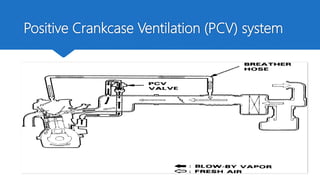
Positive Crankcase Ventilation (PCV) system
 Due to wear, gap between piston rings and cylinder is created and unburnt air-fuel
mixture from combustion chamber leaks out to crankcase from this gap.(Called blow-
by action)
 Major portion of these blow-by gases in crankcase is the HC (unburnt fuel).These blow-
by gases are released to atmosphere through a pipe from the crankcase called
breather.
 These blow-by gases are recirculated to combustion chamber for burning by
connecting crankcase (breather) to intake manifold through a pipe and valve
combination.
Positive Crankcase Ventilation (PCV) system
Catalytic converter
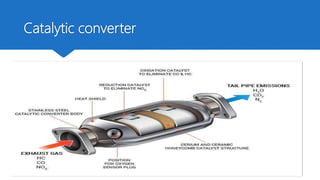
 It chemically treats the pollutants and convert them into harmless gases like CO to CO2, HC to
H2O and splitting of NO to N2 and O2.
 A catalyst material which promotes chemical change without entering into chemical reaction.
 Materials are used as catalyst are Platinum, Palladium, Rhodium, Irridium etc.
 General chemical reaction of conversion of CO to CO2 and HC to H2O place at temperatures of
500° C to 600° C, But occurs at 300° C to 325° C in the presence of catalyst.
 Platinum and Palladium are good catalyst for conversion of CO and HC and Rhodium is used for
reduction of NOx
Catalytic converter
Exhaust Gases Recirculation (EGR) system
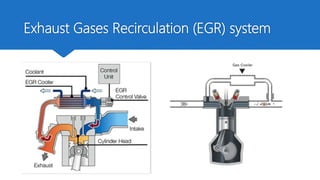
 EGR is used to reduce the production of Nox.
 NOx is produced by the combustion of N2 and O2 of the air at higher temperature beyond 1100°
C in the combustion chamber of the engine.
 Temperature in combustion chamber rises to maximum when complete combustion takes place
during acceleration of engine or heavy loading.
 Exhaust gases contain mainly H2O vapour and CO2, these further do not react with O2 hence EGR
circulates exhaust gases (at lower temp.) to combustion chamber through inlet manifold in order
to keep the peak temperature low.
Exhaust Gases Recirculation (EGR) system
Fuel Evaporative Emission Control (EVAP) System
 Gasoline direct escapes to atmosphere from SI engines.
 It escapes from the mouth of fuel tank while filling fuel and from float chamber of the
carburetor, which is vented to atmosphere.
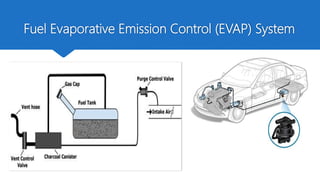
 To arrest the escape of evaporating gasoline from fuel tank and float chamber of
carburetor, they are connected by means of tubing to a chamber filled with charcoal
where it is absorbed.
 When engine runs, the collected gasoline is sucked back by carburetor and sent to
combustion chamber for burning.
Fuel Evaporative Emission Control (EVAP) System
Control of smoke
 Derating and maintenance
 Smoke suppressing additives
 Fumigation
 Catalytic converters
Control of Diesel Odour
 The presence of aldehydes in exhaust are mainly responsible for pungent odour.
 These are irritating to eyes and nose.
 So far no odour control system have been developed which can control diesel odour
successfully.
Measurement of HC Concentration
 Pollutants are measured in gm/kWh or gm/km.
 When HC is heated in hydrogen flame, the high flame temperature generates ions.
 Concentration of ions thus generated is proportional to the HC present in the sample.
 Concentration of ions produces current in an electric circuit which is calibrated to
indicate correct value of HC on meter scale.
Measurement of CO concentration
By Non-dispersive Infra-red (NDIR) Analyzer
 When infra-red light is passed through exhaust sample containing CO, CO2, H2O, NOx and other
gases, IR light of specific wavelength is absorbed by each gas.
 The amount of absorption of particular wavelength is proportional to the concentration of CO.
 The CO absorption band is 4.5 to 5.0 microns (𝜇m) while for CO2 absorption band is between 4
to 4.5 microns.
 The unabsorbed portion of this specific wavelength reaches the sensor and value is indicated on
meter/scale.
Measurement of Nox Concentration
 NOx at high temperature gets converted to NO.
 When NO is brought in contact with ozone (O3), chemical reaction takes place and light of
particular wavelength is emitted.
 The amount of light emmited from reaction is proportional to the concentration of NO.
 Light thus emitted is amplified and measured to give concentration of NOx presrnt in exhaust.
 The equipment is called NOx – chemical analyser.
Measurement of Smoke
Mainly two types of smoke meter for measure the smoke density.
1. Filter darkening type smoke meter
 Prominent manufactures of smoke meter namely Bosch, Hartridge, Von brand etc. are measuring devices
to measure soot density (gm/m3).
2. Light extinction type
 These type of smoke meters can be used for continuous measurement of smoke whereas the filter
darkening type can be used for measurement of smoke under steady state conditions only.
 The Hartridge and UTAC are the smoke meters of light extinction type.
Emission Norms
 Emission norms are the maximum prescribed level of CO, HC and NOx set by the
government, which a vehicle is permitted to emit from its exhaust while running.
 All the vehicle manufactures are required to ensure that their vehicles do not exceed
the permissible limits of pollutants in exhaust as laid down.
Euro Norms
 Euro norms are the permissible emission levels for both petrol and diesel vehicles,
which have been implemented in European countries.
 Euro I norms were implemented from year 1992 and five such norms(Euro I to Euro V)
planned for implementation in phase manner up to the year 2008.
Indian (Bharat) Norms
 Emission norms for our country were worked out and implemented with effect from the 1992.
 As per Supreme Court Ruling, EURO I norms were implemented in Delhi from 1 June 1999 as
notified by Govt. of India through Motor Vehicles Regulations (MVR).
 These norms were known as INDIA 2000 (Bharat – I) norms and were extended to all metros
subsequently.
 EURO II were implemented from the year 2002 known as Bharat II norms.
Testing and Certification Authorities of Pollution Norms
for Automobiles
 Automobiles are required to be tested for mass emission tests at manufacturing stage
and certification has to be done for emission levels within prescribed limits set by the
Government of India by one of the following agencies in India :
1. Indian Institute of Petroleum (IIP), Dehradun.
2. Automotive Research Association of India (ARAI), Pune.
3. Vehicle Research and Development Establishment (VRDE), Ahmednagar
(Maharashtra).
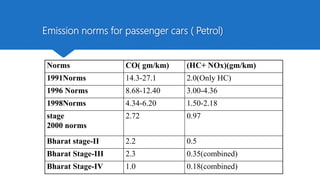
Emission norms for passenger cars ( Petrol)
Norms CO( gm/km) (HC+ NOx)(gm/km)
1991Norms 14.3-27.1 2.0(Only HC)
1996 Norms 8.68-12.40 3.00-4.36
1998Norms 4.34-6.20 1.50-2.18
stage
2000 norms
2.72 0.97
Bharat stage-II 2.2 0.5
Bharat Stage-III 2.3 0.35(combined)
Bharat Stage-IV 1.0 0.18(combined)
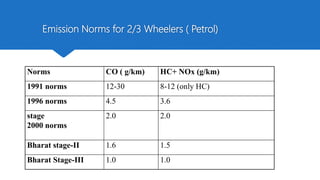
Emission Norms for 2/3 Wheelers ( Petrol)
Norms CO ( g/km) HC+ NOx (g/km)
1991 norms 12-30 8-12 (only HC)
1996 norms 4.5 3.6
stage
2000 norms
2.0 2.0
Bharat stage-II 1.6 1.5
Bharat Stage-III 1.0 1.0
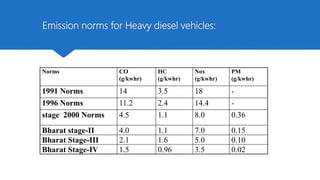
Emission norms for Heavy diesel vehicles:
Norms CO
(g/kwhr)
HC
(g/kwhr)
Nox
(g/kwhr)
PM
(g/kwhr)
1991 Norms 14 3.5 18 -
1996 Norms 11.2 2.4 14.4 -
stage 2000 Norms 4.5 1.1 8.0 0.36
Bharat stage-II 4.0 1.1 7.0 0.15
Bharat Stage-III 2.1 1.6 5.0 0.10
Bharat Stage-IV 1.5 0.96 3.5 0.02
Engine emission and their control

Engine emission and their control

  • 1.
    Prepared By :-Nikhil Italiya A Presentation on Engine Emissions and their control
  • 2.
    Emission of Pollutantsfrom S.I. Engines 1. Emission from exhaust  Theoretical combustion process :  Actual combustion process produces by-products like Carbon Monoxide (CO) Hydrocarbons (HC) Oxides of Nitrogen (NOx )
  • 3.
    Emission of Pollutantsfrom S.I. Engines 2. Evaporation of Gasoline  By Fuel tank  Gasoline (HC) escapes to atmosphere while being filled into fuel tanks.  Through vent plug of the fuel tank which is open to atmosphere for breathing.  From Carburetor  Float chamber of carburetor is vented to atmosphere from where gasoline escapes.  When engine has run for sometime at load and stopped, due to high engine temperature at this time gasoline boils in carburetor and escapes to atmosphere. This is called “Hot Soaking”.  Crankcase blow-by  Leakage of combustion gases to engine crankcase due to gap between cylinder and piston rings (due to wear ) is called blow-by.
  • 4.
    Emission of Pollutantsfrom C.I. Engines  Carbon Monoxide (CO)  Hydrocarbons (HC)  Oxides of Nitrogen (NOx )  Aldehydes and other emissions  H2S and SO2 gases are formed on burning of Sulphur present in diesel.  Ash dust, H2SO4 are also produced.  Smoke and particulate  White smoke is caused by liquid droplets of lubricating oil and fuel oil.  Black smoke represents the incomplete combustion of fuel.
  • 5.
    Causes of AirPollutants in Automobiles  Carbon Monoxide (CO)  Basic reason for production of CO is incomplete combustion.  Initially CO is formed, which gets converted to CO2 on further oxidation, but conversion from CO to CO2 is slow.  Uneven combustion due to uneven distribution of fuel in combustion chamber.  Flame does not reach in quenching to burn fuel.  Hydrocarbons (HC)  Incorrect Air-Fuel Ratio  Low compression  Quenching  Valve overlapping  Surface to Volume ratio
  • 6.
    Causes of AirPollutants in Automobiles  Oxides of Nitrogen (NOX)  Maximum NOX in exhaust is nitric oxide (NO), which further combine with O2 and forms NO2 which is very poisonous gas.  Air – Fuel ratio  Combustion temperature  Ignition timing  Driving Conditions  Normal Running Speed  Acceleration  Deceleration  Heavy Load
  • 7.
    Pollution Control Systemsin automobiles  Two main approaches 1. Change / Modification in Engine Design 2. Treatment of Exhaust Gases  Pollution control device  Positive Crankcase Ventilation (PCV) system  Catalytic Converter  Exhaust Gases Recirculation (EGR) System  Fuel Evaporative Emission Control (EVAP) System
  • 8.
    Positive Crankcase Ventilation(PCV) system  Due to wear, gap between piston rings and cylinder is created and unburnt air-fuel mixture from combustion chamber leaks out to crankcase from this gap.(Called blow- by action)  Major portion of these blow-by gases in crankcase is the HC (unburnt fuel).These blow- by gases are released to atmosphere through a pipe from the crankcase called breather.  These blow-by gases are recirculated to combustion chamber for burning by connecting crankcase (breather) to intake manifold through a pipe and valve combination.
  • 9.
  • 10.
    Catalytic converter  Itchemically treats the pollutants and convert them into harmless gases like CO to CO2, HC to H2O and splitting of NO to N2 and O2.  A catalyst material which promotes chemical change without entering into chemical reaction.  Materials are used as catalyst are Platinum, Palladium, Rhodium, Irridium etc.  General chemical reaction of conversion of CO to CO2 and HC to H2O place at temperatures of 500° C to 600° C, But occurs at 300° C to 325° C in the presence of catalyst.  Platinum and Palladium are good catalyst for conversion of CO and HC and Rhodium is used for reduction of NOx
  • 11.
  • 12.
    Exhaust Gases Recirculation(EGR) system  EGR is used to reduce the production of Nox.  NOx is produced by the combustion of N2 and O2 of the air at higher temperature beyond 1100° C in the combustion chamber of the engine.  Temperature in combustion chamber rises to maximum when complete combustion takes place during acceleration of engine or heavy loading.  Exhaust gases contain mainly H2O vapour and CO2, these further do not react with O2 hence EGR circulates exhaust gases (at lower temp.) to combustion chamber through inlet manifold in order to keep the peak temperature low.
  • 13.
  • 14.
    Fuel Evaporative EmissionControl (EVAP) System  Gasoline direct escapes to atmosphere from SI engines.  It escapes from the mouth of fuel tank while filling fuel and from float chamber of the carburetor, which is vented to atmosphere.  To arrest the escape of evaporating gasoline from fuel tank and float chamber of carburetor, they are connected by means of tubing to a chamber filled with charcoal where it is absorbed.  When engine runs, the collected gasoline is sucked back by carburetor and sent to combustion chamber for burning.
  • 15.
    Fuel Evaporative EmissionControl (EVAP) System
  • 16.
    Control of smoke Derating and maintenance  Smoke suppressing additives  Fumigation  Catalytic converters
  • 17.
    Control of DieselOdour  The presence of aldehydes in exhaust are mainly responsible for pungent odour.  These are irritating to eyes and nose.  So far no odour control system have been developed which can control diesel odour successfully.
  • 18.
    Measurement of HCConcentration  Pollutants are measured in gm/kWh or gm/km.  When HC is heated in hydrogen flame, the high flame temperature generates ions.  Concentration of ions thus generated is proportional to the HC present in the sample.  Concentration of ions produces current in an electric circuit which is calibrated to indicate correct value of HC on meter scale.
  • 19.
    Measurement of COconcentration By Non-dispersive Infra-red (NDIR) Analyzer  When infra-red light is passed through exhaust sample containing CO, CO2, H2O, NOx and other gases, IR light of specific wavelength is absorbed by each gas.  The amount of absorption of particular wavelength is proportional to the concentration of CO.  The CO absorption band is 4.5 to 5.0 microns (𝜇m) while for CO2 absorption band is between 4 to 4.5 microns.  The unabsorbed portion of this specific wavelength reaches the sensor and value is indicated on meter/scale.
  • 20.
    Measurement of NoxConcentration  NOx at high temperature gets converted to NO.  When NO is brought in contact with ozone (O3), chemical reaction takes place and light of particular wavelength is emitted.  The amount of light emmited from reaction is proportional to the concentration of NO.  Light thus emitted is amplified and measured to give concentration of NOx presrnt in exhaust.  The equipment is called NOx – chemical analyser.
  • 21.
    Measurement of Smoke Mainlytwo types of smoke meter for measure the smoke density. 1. Filter darkening type smoke meter  Prominent manufactures of smoke meter namely Bosch, Hartridge, Von brand etc. are measuring devices to measure soot density (gm/m3). 2. Light extinction type  These type of smoke meters can be used for continuous measurement of smoke whereas the filter darkening type can be used for measurement of smoke under steady state conditions only.  The Hartridge and UTAC are the smoke meters of light extinction type.
  • 22.
    Emission Norms  Emissionnorms are the maximum prescribed level of CO, HC and NOx set by the government, which a vehicle is permitted to emit from its exhaust while running.  All the vehicle manufactures are required to ensure that their vehicles do not exceed the permissible limits of pollutants in exhaust as laid down.
  • 23.
    Euro Norms  Euronorms are the permissible emission levels for both petrol and diesel vehicles, which have been implemented in European countries.  Euro I norms were implemented from year 1992 and five such norms(Euro I to Euro V) planned for implementation in phase manner up to the year 2008.
  • 24.
    Indian (Bharat) Norms Emission norms for our country were worked out and implemented with effect from the 1992.  As per Supreme Court Ruling, EURO I norms were implemented in Delhi from 1 June 1999 as notified by Govt. of India through Motor Vehicles Regulations (MVR).  These norms were known as INDIA 2000 (Bharat – I) norms and were extended to all metros subsequently.  EURO II were implemented from the year 2002 known as Bharat II norms.
  • 25.
    Testing and CertificationAuthorities of Pollution Norms for Automobiles  Automobiles are required to be tested for mass emission tests at manufacturing stage and certification has to be done for emission levels within prescribed limits set by the Government of India by one of the following agencies in India : 1. Indian Institute of Petroleum (IIP), Dehradun. 2. Automotive Research Association of India (ARAI), Pune. 3. Vehicle Research and Development Establishment (VRDE), Ahmednagar (Maharashtra).
  • 26.
    Emission norms forpassenger cars ( Petrol) Norms CO( gm/km) (HC+ NOx)(gm/km) 1991Norms 14.3-27.1 2.0(Only HC) 1996 Norms 8.68-12.40 3.00-4.36 1998Norms 4.34-6.20 1.50-2.18 stage 2000 norms 2.72 0.97 Bharat stage-II 2.2 0.5 Bharat Stage-III 2.3 0.35(combined) Bharat Stage-IV 1.0 0.18(combined)
  • 27.
    Emission Norms for2/3 Wheelers ( Petrol) Norms CO ( g/km) HC+ NOx (g/km) 1991 norms 12-30 8-12 (only HC) 1996 norms 4.5 3.6 stage 2000 norms 2.0 2.0 Bharat stage-II 1.6 1.5 Bharat Stage-III 1.0 1.0
  • 28.
    Emission norms forHeavy diesel vehicles: Norms CO (g/kwhr) HC (g/kwhr) Nox (g/kwhr) PM (g/kwhr) 1991 Norms 14 3.5 18 - 1996 Norms 11.2 2.4 14.4 - stage 2000 Norms 4.5 1.1 8.0 0.36 Bharat stage-II 4.0 1.1 7.0 0.15 Bharat Stage-III 2.1 1.6 5.0 0.10 Bharat Stage-IV 1.5 0.96 3.5 0.02