University of Engineering and Technology
Lahore, Pakistan
by
Temoor Hassan
Pakistan
Lahore
DR. Muhammad Mahmood Aslam Bhutta Lahore ,Pakistan
Auto-Ignition/self ignition temperature
If the temperature of an air-fuel mixture is raised high enough, the mixture
will self ignite without the need of a spark plug or other external igniter. The
temperature above which this occurs is called the self-ignition temperature
(SIT) .
This is also called Self-Ignition / Pre-Ignition
Ignition Temperature
The lowest temperature which allows self ignition of a fuel in an open vessel
is called ignition temperature (around 200° C for gasoline and diesel fuel).
DR. Muhammad Mahmood Aslam Bhutta Lahore ,Pakistan
Flash Point
The lowest temperature which allows ignition of a fuel in an open vessel by
foreign ignition (match). Measures the temperature at which the vapors
above the liquid can be ignited.
• Primarily used to determine whether a liquid is flammable or combustible
• DOT and OSHA say that any liquid with a flash point below 100 F is
flammable.
The flash point for gasoline and methanol is around room temperature, for
diesel fuel above 50° C.
Ignition Quality
In order to ignite a fuel, there must be a sufficient amount of oxygen (air)
available. The air ratio has to be within the ignition limits. Ignition quality of
compression ignition fuels is defined by its cetane number. Ignition quality of
spark ignition fuels is defined by its octane number.
DR. Muhammad Mahmood Aslam Bhutta Lahore ,Pakistan
Fuel Properties
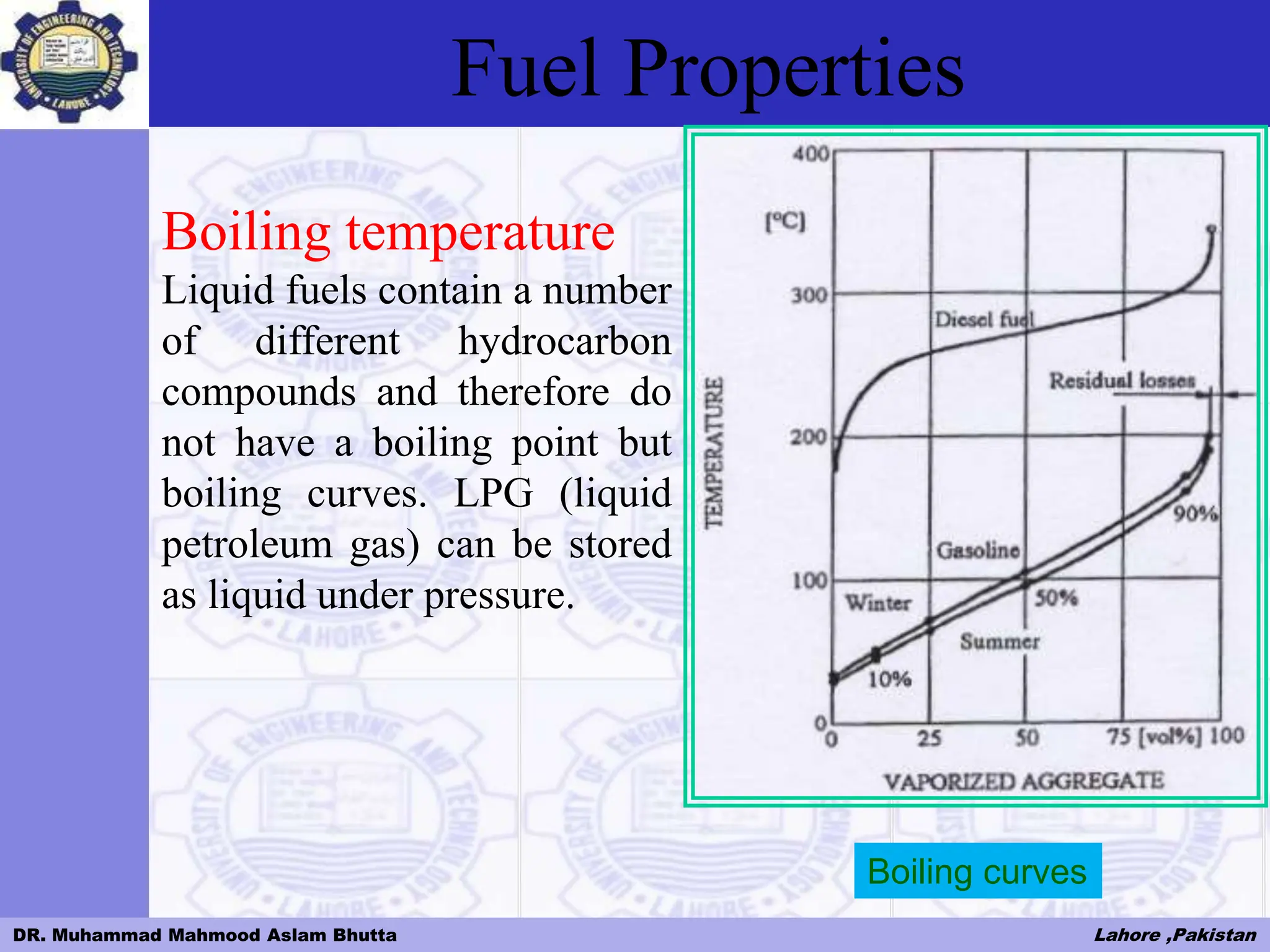
Boiling temperature
Liquid fuels contain a number
of different hydrocarbon
compounds and therefore do
not have a boiling point but
boiling curves. LPG (liquid
petroleum gas) can be stored
as liquid under pressure.
Boiling curves
DR. Muhammad Mahmood Aslam Bhutta Lahore ,Pakistan
Flame development angle
The crank angle interval between the spark
discharge and the time when a small but
significant fraction of the cylinder mass has
burned or fuel chemical energy has been
released. Usually this fraction is 10 percent.
This angle is sometimes called the ignition
delay. Since the flame starts to propagate
outward immediately following the spark
discharge there is no delay
Page 389
d


DR. Muhammad Mahmood Aslam Bhutta Lahore ,Pakistan
Octane Rating
Spark ignition engines should have a low ignition
performance to avoid self ignition of certain parts of
the charge. Which leads to steep increases in
temperature and pressure (knocking), it can damage
the engine. Knocking resistance in gasoline is defined
by the octane number.
This is the percentage of iso-octane in a mixture of iso-
octane (knock resisting, Octane Number -100) and n-
heptane (high ignition quality, Octane Number -0) that
has the same knocking characteristics in a standardized
reference engine.
DR. Muhammad Mahmood Aslam Bhutta Lahore ,Pakistan
Variable Compression Ratio Engine
DR. Muhammad Mahmood Aslam Bhutta Lahore ,Pakistan
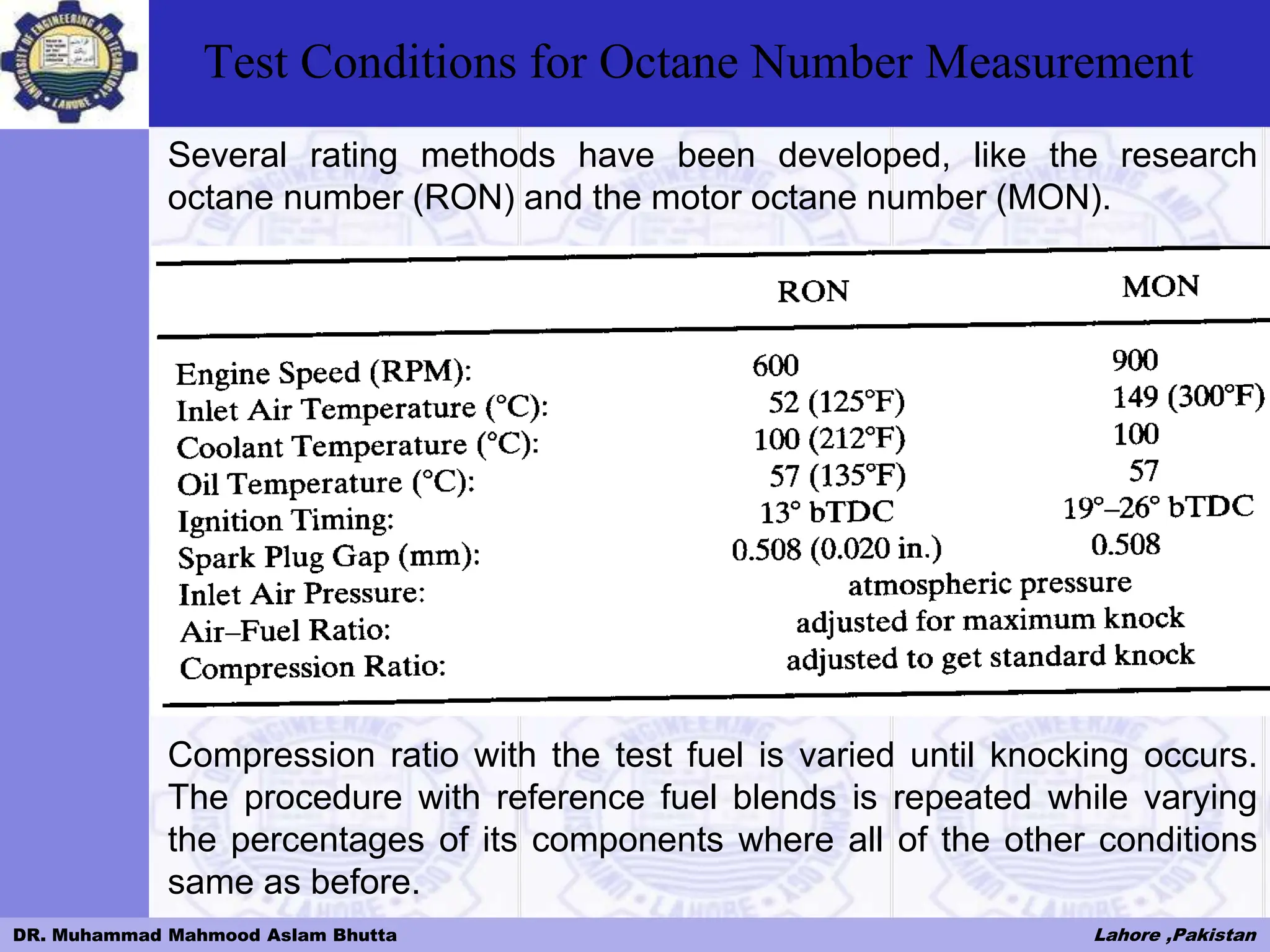
Test Conditions for Octane Number Measurement
Compression ratio with the test fuel is varied until knocking occurs.
The procedure with reference fuel blends is repeated while varying
the percentages of its components where all of the other conditions
same as before.
Several rating methods have been developed, like the research
octane number (RON) and the motor octane number (MON).
DR. Muhammad Mahmood Aslam Bhutta Lahore ,Pakistan
Improving Octane number
High Octane Number can be obtained by adding of tetraethyl
lead to the fuel. Due to environmental considerations and
because of the catalytic converters, lead is not recommended
any more.
DR. Muhammad Mahmood Aslam Bhutta Lahore ,Pakistan
To determine the cetane number the operating conditions, and test procedure
are specified by ASTM Method D 613.37
•Engine speed 900 rev/min
•Coolant temperature 100 C
•Intake air temperature 65.6 C (150 F)
•Injection timing 13 BTC
•Injection pressure MPa (1500 lb/in2)
Cetane numbers are established by comparing the test fuel to blend of two
standard reference fuels. The fuel component n-cetane (hexadecane), C16H34
is given the cetane number value of 100, while heptamethylnonane (HMN)
C12H34 is given the value of 15. The cetane number (CN) of other fuels is
then obtained by comparing the ID of that fuel to the ID of a mixture blend of
the two reference fuels with.
CN of fuel = (percent of n-cetane) + (0.15)(percent of HMN)
DR. Muhammad Mahmood Aslam Bhutta Lahore ,Pakistan
A standardized single-cylinder, variable compression ratio engine with
special loading and accessory equipment and instrumentation is used. This CI
test engine has the capability of having the compression ratio changed as it
operates. Fuel being rated is injected and the compression ratio is then varied
until combustion starts at TDC, giving an IGNITION DELAY of 13° of
engine rotation.
Without changing the compression ratio, the test fuel is replaced with a blend
of the two reference fuels. Using two fuel tanks and two flow controls, the
blend of the fuels is varied until combustion is again obtained at TDC, an ID
of 13°. When the compression ratio required by the actual fuel is bracketed
by two reference fuel blends, the cetane number of the fuel can be
determined as in between the cetane numbers of the two blends.
Measures the readiness of a fuel to auto-ignite.
High cetane means the fuel will ignite quickly at the conditions in the
engine (does not mean the fuel is highly flammable or explosive).
Most fuels have cetane numbers between 40 and 60.
ASTM D 6751 Biodiesel spec. it has a minimum cetane number of 47
DR. Muhammad Mahmood Aslam Bhutta Lahore ,Pakistan
Difficulties
The difficulties of this method are
1. Requiring a costly test engine
2. The determination of precise moment when combustion
starts.
3. The very slow rise in pressure at the start of combustion.
Cetane improvers.
Typical compounds used are
1. Alkyl nitrates
2. Ether nitrates
3. Dinitrates of polyethylene glycols,
4. Due to low cost and ease of handling, alkyl nitrates are the most
ideally used as cetane improvers.
DR. Muhammad Mahmood Aslam Bhutta Lahore ,Pakistan
Engine conditions affecting octane number
requirement
DR. Muhammad Mahmood Aslam Bhutta Lahore ,Pakistan
Knock
The noise associated with auto ignition of a portion of the fuel-
air mixture ahead of the advancing flame front. it is the
spontaneous ignition and the resulting very rapid reaction of a
portion or all of the fuel-air mixture.
DR. Muhammad Mahmood Aslam Bhutta Lahore ,Pakistan
• Controllable knocking
• Uncontrollable knocking
DR. Muhammad Mahmood Aslam Bhutta Lahore ,Pakistan
The engine can be damaged by knock in different ways: piston ring stick-
ing; breakage of the piston rings ; failure of the cylinder head gasket;
cylinder head erosion; piston crown and top erosion; piston melting and
holing. Examples of component damage due to pre ignition and knock are
shown below
DR. Muhammad Mahmood Aslam Bhutta Lahore ,Pakistan
Failure Of The Cylinder Head Gasket
DR. Muhammad Mahmood Aslam Bhutta Lahore ,Pakistan
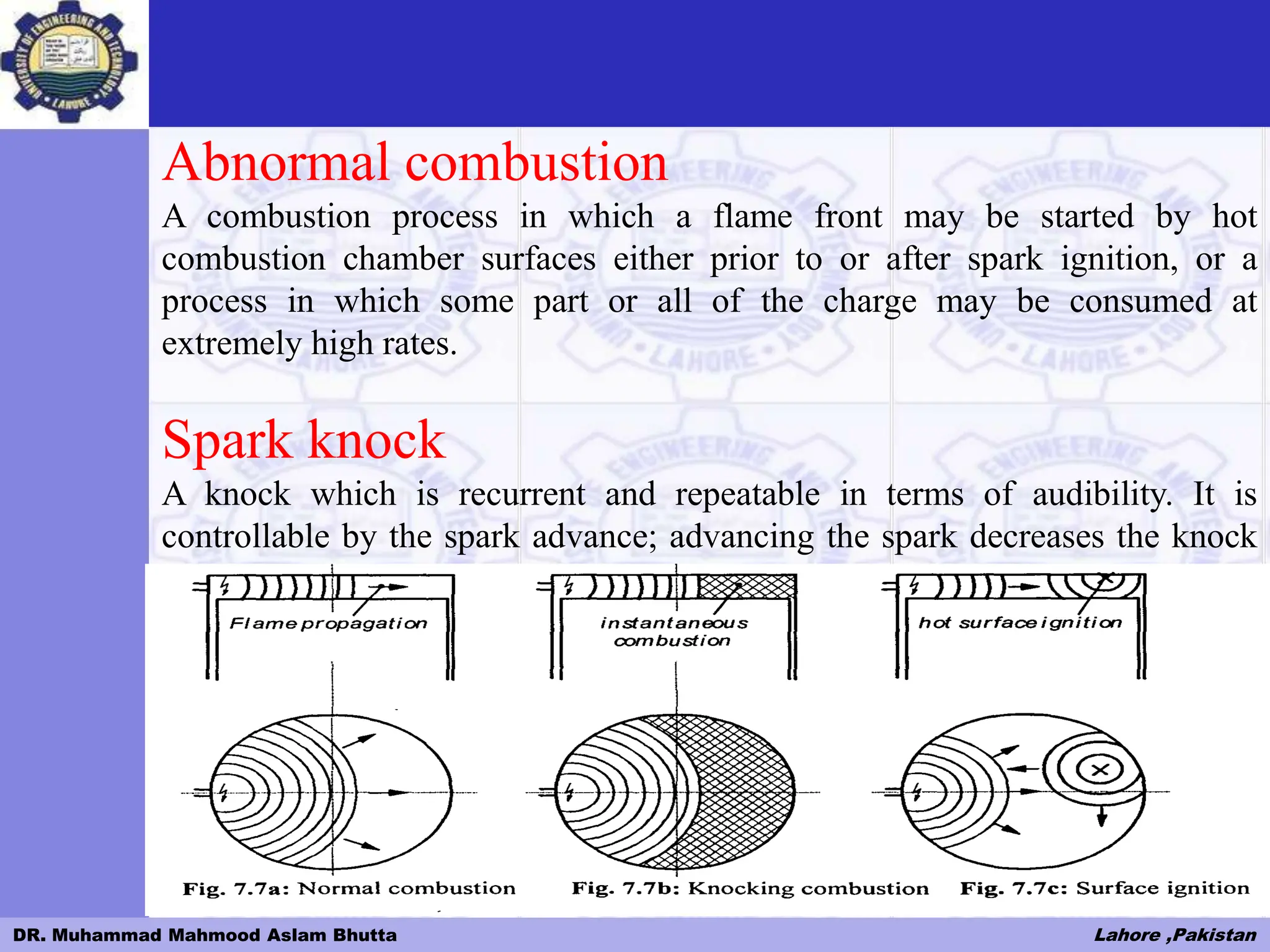
Abnormal combustion
A combustion process in which a flame front may be started by hot
combustion chamber surfaces either prior to or after spark ignition, or a
process in which some part or all of the charge may be consumed at
extremely high rates.
Spark knock
A knock which is recurrent and repeatable in terms of audibility. It is
controllable by the spark advance; advancing the spark decreases the knock
intensity and retarding the spark reduces the intensity
DR. Muhammad Mahmood Aslam Bhutta Lahore ,Pakistan
Surface Ignition
hot spots-combustion chamber deposits
Surface ignition is ignition of the fuel-air charge by any hot surface other
than the spark discharge prior to the arrival of the normal flame front. It may
occur before the spark ignites the charge (Pre ignition) or after normal
ignition (post ignition).
Non knocking Surface Ignition
Surface ignition which does not result in knock.
DR. Muhammad Mahmood Aslam Bhutta Lahore ,Pakistan
Types of knocking
Knocking Surface Ignition
Knock which has been preceded by surface ignition. It is not
controllable by spark advance.
Run-On
Continuation of engine firing after the electrical ignition is shut-off
Run Away Surface Ignition
Surface ignition which occurs earlier and earlier in the cycle. It can
lead to the serious overheating and structural damage to the engine
Wild Ping
Knocking surface ignition characterized by one or more erratic
sharp cracks. It is probably the result of early surface ignition from
deposit particles.
Rumble
A low-pitched thudding noise accompanied by engine roughness.
Probably caused by the high rates of pressure rise associated with
very early ignition or multiple surface ignition
DR. Muhammad Mahmood Aslam Bhutta Lahore ,Pakistan
Measures to Avoid knocking
• The use of a fuel with higher octane number.
• The addition of octane-increasing additives in the
fuel
• Ignition Timing Retardation .
• Use of a spark plug of colder heat range, in cases,
where the spark plug insulator has become a source
of pre-ignition leading to knock.
• Reduction of charge temperature e.g. through fuel
evaporation in side the cylinder (GDI)
• Anti knock combustion chamber design.
DR. Muhammad Mahmood Aslam Bhutta Lahore ,Pakistan
Thank You

IC Engines Fuel properties and notes rcet.pptx

  • 1.
    University of Engineeringand Technology Lahore, Pakistan by Temoor Hassan Pakistan Lahore
  • 2.
    DR. Muhammad MahmoodAslam Bhutta Lahore ,Pakistan Auto-Ignition/self ignition temperature If the temperature of an air-fuel mixture is raised high enough, the mixture will self ignite without the need of a spark plug or other external igniter. The temperature above which this occurs is called the self-ignition temperature (SIT) . This is also called Self-Ignition / Pre-Ignition Ignition Temperature The lowest temperature which allows self ignition of a fuel in an open vessel is called ignition temperature (around 200° C for gasoline and diesel fuel).
  • 3.
    DR. Muhammad MahmoodAslam Bhutta Lahore ,Pakistan Flash Point The lowest temperature which allows ignition of a fuel in an open vessel by foreign ignition (match). Measures the temperature at which the vapors above the liquid can be ignited. • Primarily used to determine whether a liquid is flammable or combustible • DOT and OSHA say that any liquid with a flash point below 100 F is flammable. The flash point for gasoline and methanol is around room temperature, for diesel fuel above 50° C. Ignition Quality In order to ignite a fuel, there must be a sufficient amount of oxygen (air) available. The air ratio has to be within the ignition limits. Ignition quality of compression ignition fuels is defined by its cetane number. Ignition quality of spark ignition fuels is defined by its octane number.
  • 4.
    DR. Muhammad MahmoodAslam Bhutta Lahore ,Pakistan Fuel Properties Boiling temperature Liquid fuels contain a number of different hydrocarbon compounds and therefore do not have a boiling point but boiling curves. LPG (liquid petroleum gas) can be stored as liquid under pressure. Boiling curves
  • 5.
    DR. Muhammad MahmoodAslam Bhutta Lahore ,Pakistan Flame development angle The crank angle interval between the spark discharge and the time when a small but significant fraction of the cylinder mass has burned or fuel chemical energy has been released. Usually this fraction is 10 percent. This angle is sometimes called the ignition delay. Since the flame starts to propagate outward immediately following the spark discharge there is no delay Page 389 d  
  • 6.
    DR. Muhammad MahmoodAslam Bhutta Lahore ,Pakistan Octane Rating Spark ignition engines should have a low ignition performance to avoid self ignition of certain parts of the charge. Which leads to steep increases in temperature and pressure (knocking), it can damage the engine. Knocking resistance in gasoline is defined by the octane number. This is the percentage of iso-octane in a mixture of iso- octane (knock resisting, Octane Number -100) and n- heptane (high ignition quality, Octane Number -0) that has the same knocking characteristics in a standardized reference engine.
  • 7.
    DR. Muhammad MahmoodAslam Bhutta Lahore ,Pakistan Variable Compression Ratio Engine
  • 8.
    DR. Muhammad MahmoodAslam Bhutta Lahore ,Pakistan Test Conditions for Octane Number Measurement Compression ratio with the test fuel is varied until knocking occurs. The procedure with reference fuel blends is repeated while varying the percentages of its components where all of the other conditions same as before. Several rating methods have been developed, like the research octane number (RON) and the motor octane number (MON).
  • 9.
    DR. Muhammad MahmoodAslam Bhutta Lahore ,Pakistan Improving Octane number High Octane Number can be obtained by adding of tetraethyl lead to the fuel. Due to environmental considerations and because of the catalytic converters, lead is not recommended any more.
  • 10.
    DR. Muhammad MahmoodAslam Bhutta Lahore ,Pakistan To determine the cetane number the operating conditions, and test procedure are specified by ASTM Method D 613.37 •Engine speed 900 rev/min •Coolant temperature 100 C •Intake air temperature 65.6 C (150 F) •Injection timing 13 BTC •Injection pressure MPa (1500 lb/in2) Cetane numbers are established by comparing the test fuel to blend of two standard reference fuels. The fuel component n-cetane (hexadecane), C16H34 is given the cetane number value of 100, while heptamethylnonane (HMN) C12H34 is given the value of 15. The cetane number (CN) of other fuels is then obtained by comparing the ID of that fuel to the ID of a mixture blend of the two reference fuels with. CN of fuel = (percent of n-cetane) + (0.15)(percent of HMN)
  • 11.
    DR. Muhammad MahmoodAslam Bhutta Lahore ,Pakistan A standardized single-cylinder, variable compression ratio engine with special loading and accessory equipment and instrumentation is used. This CI test engine has the capability of having the compression ratio changed as it operates. Fuel being rated is injected and the compression ratio is then varied until combustion starts at TDC, giving an IGNITION DELAY of 13° of engine rotation. Without changing the compression ratio, the test fuel is replaced with a blend of the two reference fuels. Using two fuel tanks and two flow controls, the blend of the fuels is varied until combustion is again obtained at TDC, an ID of 13°. When the compression ratio required by the actual fuel is bracketed by two reference fuel blends, the cetane number of the fuel can be determined as in between the cetane numbers of the two blends. Measures the readiness of a fuel to auto-ignite. High cetane means the fuel will ignite quickly at the conditions in the engine (does not mean the fuel is highly flammable or explosive). Most fuels have cetane numbers between 40 and 60. ASTM D 6751 Biodiesel spec. it has a minimum cetane number of 47
  • 12.
    DR. Muhammad MahmoodAslam Bhutta Lahore ,Pakistan Difficulties The difficulties of this method are 1. Requiring a costly test engine 2. The determination of precise moment when combustion starts. 3. The very slow rise in pressure at the start of combustion. Cetane improvers. Typical compounds used are 1. Alkyl nitrates 2. Ether nitrates 3. Dinitrates of polyethylene glycols, 4. Due to low cost and ease of handling, alkyl nitrates are the most ideally used as cetane improvers.
  • 13.
    DR. Muhammad MahmoodAslam Bhutta Lahore ,Pakistan Engine conditions affecting octane number requirement
  • 14.
    DR. Muhammad MahmoodAslam Bhutta Lahore ,Pakistan Knock The noise associated with auto ignition of a portion of the fuel- air mixture ahead of the advancing flame front. it is the spontaneous ignition and the resulting very rapid reaction of a portion or all of the fuel-air mixture.
  • 15.
    DR. Muhammad MahmoodAslam Bhutta Lahore ,Pakistan • Controllable knocking • Uncontrollable knocking
  • 16.
    DR. Muhammad MahmoodAslam Bhutta Lahore ,Pakistan The engine can be damaged by knock in different ways: piston ring stick- ing; breakage of the piston rings ; failure of the cylinder head gasket; cylinder head erosion; piston crown and top erosion; piston melting and holing. Examples of component damage due to pre ignition and knock are shown below
  • 17.
    DR. Muhammad MahmoodAslam Bhutta Lahore ,Pakistan
  • 18.
    DR. Muhammad MahmoodAslam Bhutta Lahore ,Pakistan
  • 19.
    DR. Muhammad MahmoodAslam Bhutta Lahore ,Pakistan
  • 20.
    DR. Muhammad MahmoodAslam Bhutta Lahore ,Pakistan Failure Of The Cylinder Head Gasket
  • 21.
    DR. Muhammad MahmoodAslam Bhutta Lahore ,Pakistan
  • 22.
    DR. Muhammad MahmoodAslam Bhutta Lahore ,Pakistan Abnormal combustion A combustion process in which a flame front may be started by hot combustion chamber surfaces either prior to or after spark ignition, or a process in which some part or all of the charge may be consumed at extremely high rates. Spark knock A knock which is recurrent and repeatable in terms of audibility. It is controllable by the spark advance; advancing the spark decreases the knock intensity and retarding the spark reduces the intensity
  • 23.
    DR. Muhammad MahmoodAslam Bhutta Lahore ,Pakistan Surface Ignition hot spots-combustion chamber deposits Surface ignition is ignition of the fuel-air charge by any hot surface other than the spark discharge prior to the arrival of the normal flame front. It may occur before the spark ignites the charge (Pre ignition) or after normal ignition (post ignition). Non knocking Surface Ignition Surface ignition which does not result in knock.
  • 24.
    DR. Muhammad MahmoodAslam Bhutta Lahore ,Pakistan Types of knocking Knocking Surface Ignition Knock which has been preceded by surface ignition. It is not controllable by spark advance. Run-On Continuation of engine firing after the electrical ignition is shut-off Run Away Surface Ignition Surface ignition which occurs earlier and earlier in the cycle. It can lead to the serious overheating and structural damage to the engine Wild Ping Knocking surface ignition characterized by one or more erratic sharp cracks. It is probably the result of early surface ignition from deposit particles. Rumble A low-pitched thudding noise accompanied by engine roughness. Probably caused by the high rates of pressure rise associated with very early ignition or multiple surface ignition
  • 25.
    DR. Muhammad MahmoodAslam Bhutta Lahore ,Pakistan Measures to Avoid knocking • The use of a fuel with higher octane number. • The addition of octane-increasing additives in the fuel • Ignition Timing Retardation . • Use of a spark plug of colder heat range, in cases, where the spark plug insulator has become a source of pre-ignition leading to knock. • Reduction of charge temperature e.g. through fuel evaporation in side the cylinder (GDI) • Anti knock combustion chamber design.
  • 26.
    DR. Muhammad MahmoodAslam Bhutta Lahore ,Pakistan Thank You