Chemistry Group Activity:
•Group Members
• Anurag Kumar - 20BCE11012
• Anant Dubey - 20BCE11037
• Vinay Gupta - 20BCE11053
• Aviral Srivastava - 20BCE11027
• Tanesh Parsavdiya - 20BCE10998
Knock
Fundamentals
‘limitations and issues’
Definitions
• Knock is metallic sound caused by spontaneous ignition of end gas.
• Occurs during compression stroke mostly in SI engine and expansion
stroke in CI engines
• Results in pressure fluctuations in cylinder and increases temperature
• Surface ignition is caused due to hot spots in chamber
• Overheated valve, spark plug, glowing combustion chamber deposits
• Pre-ignition and post-ignition
Definitions contd…
• Acceleration knock produces more sound but can not cause damage
due to short duration
• Constant speed knock can cause drastic damage
1. pre-ignition
2. Runway knock
Origin of knock
• Auto ignition of end gas, depends strongly on chemical composition of end-
gas mixture.
• If the flame burns all the fresh gas before auto-ignition in the end-gas can
occur then knock is avoided.
• Knock is a potential problem when the burn time is long.
• Theory of auto-ignition
fuel oxidization occurs during compression of A/F mixture
• Theory of detonation
advancing flame velocity to consume end gas is much higher
Limiting parameters for knocks
• end-gas temperature
• time available before flame arrival
• Compression ratio
• Spark timing
• Engine speed
• Delay period
• Inlet pressure and temperature, coolant temperature, fuel/air ratio
Fuel factor and knock scale for SI engines
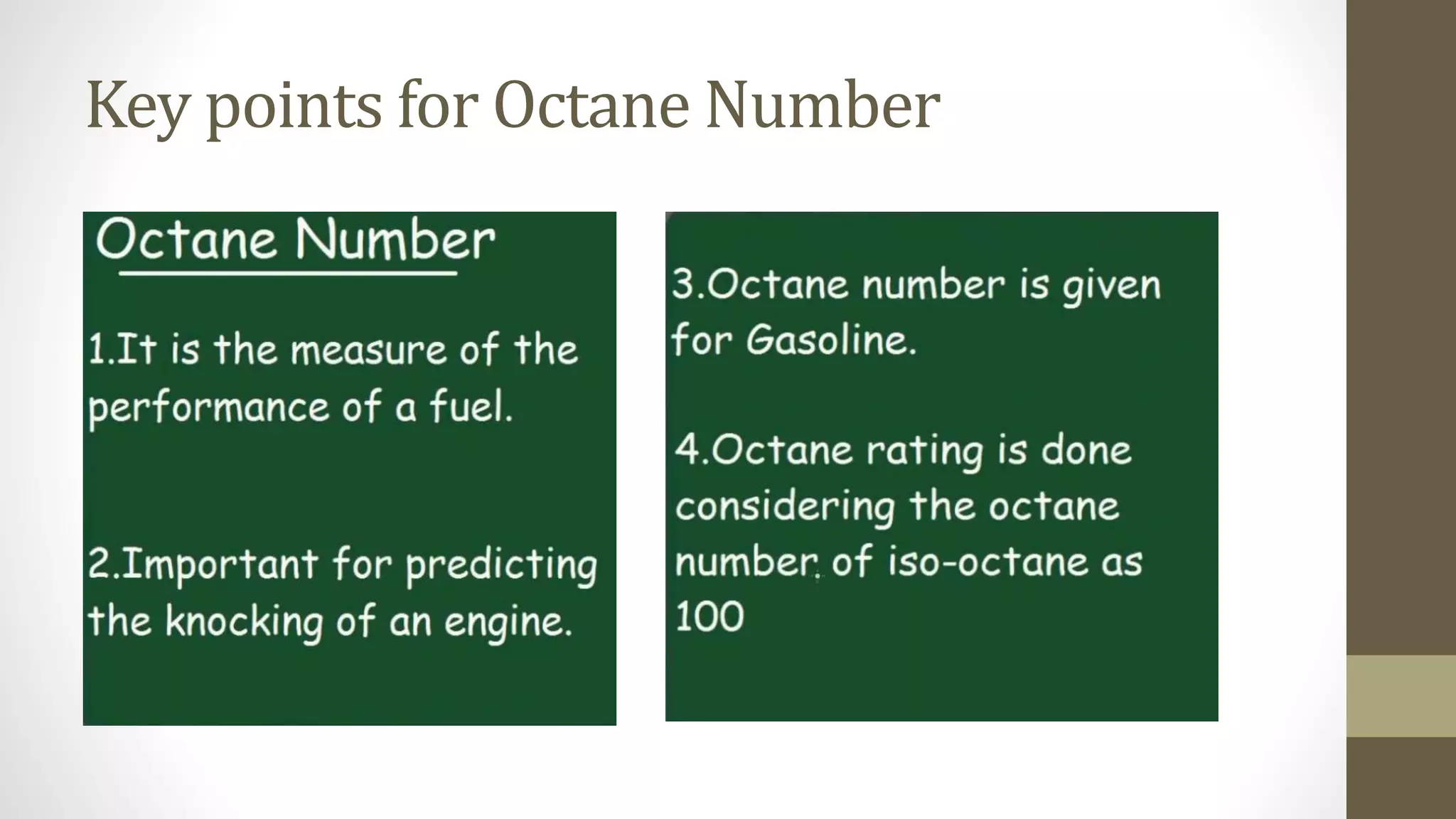
• Octane number ON is measure of resistance to knocking.
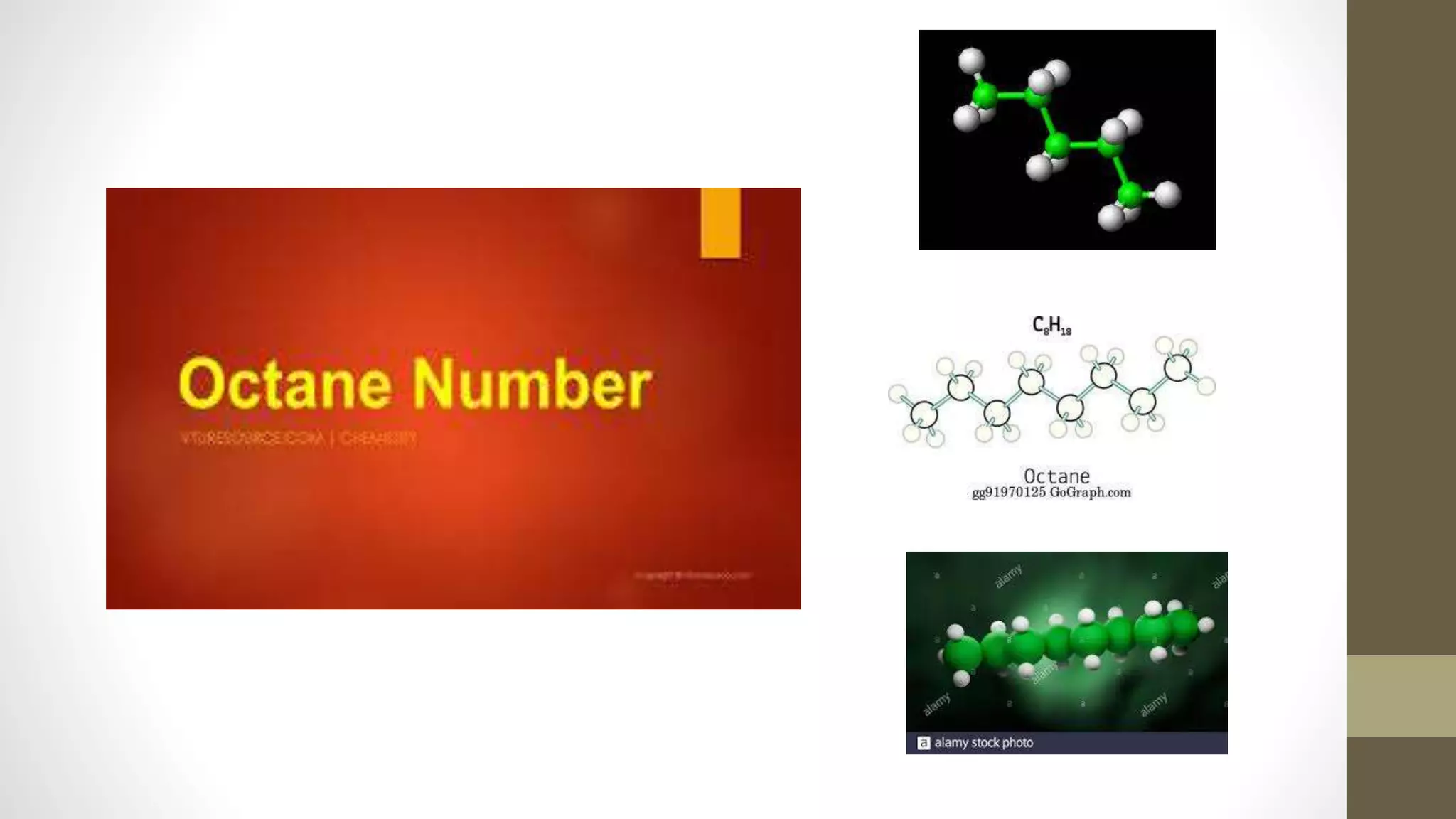
• Normal heptane (n-C7H16) has an octane value of zero and isooctane
(C8H18) has a value of 100.
• The higher the octane number, the higher the resistance to knock.
• Blends of these two hydrocarbons define the knock resistance of
intermediate octane numbers: e.g., a blend of 10%
n-heptane and 90% isooctane has an octane number of 90.
Fuel factor and knock scale for CI engines
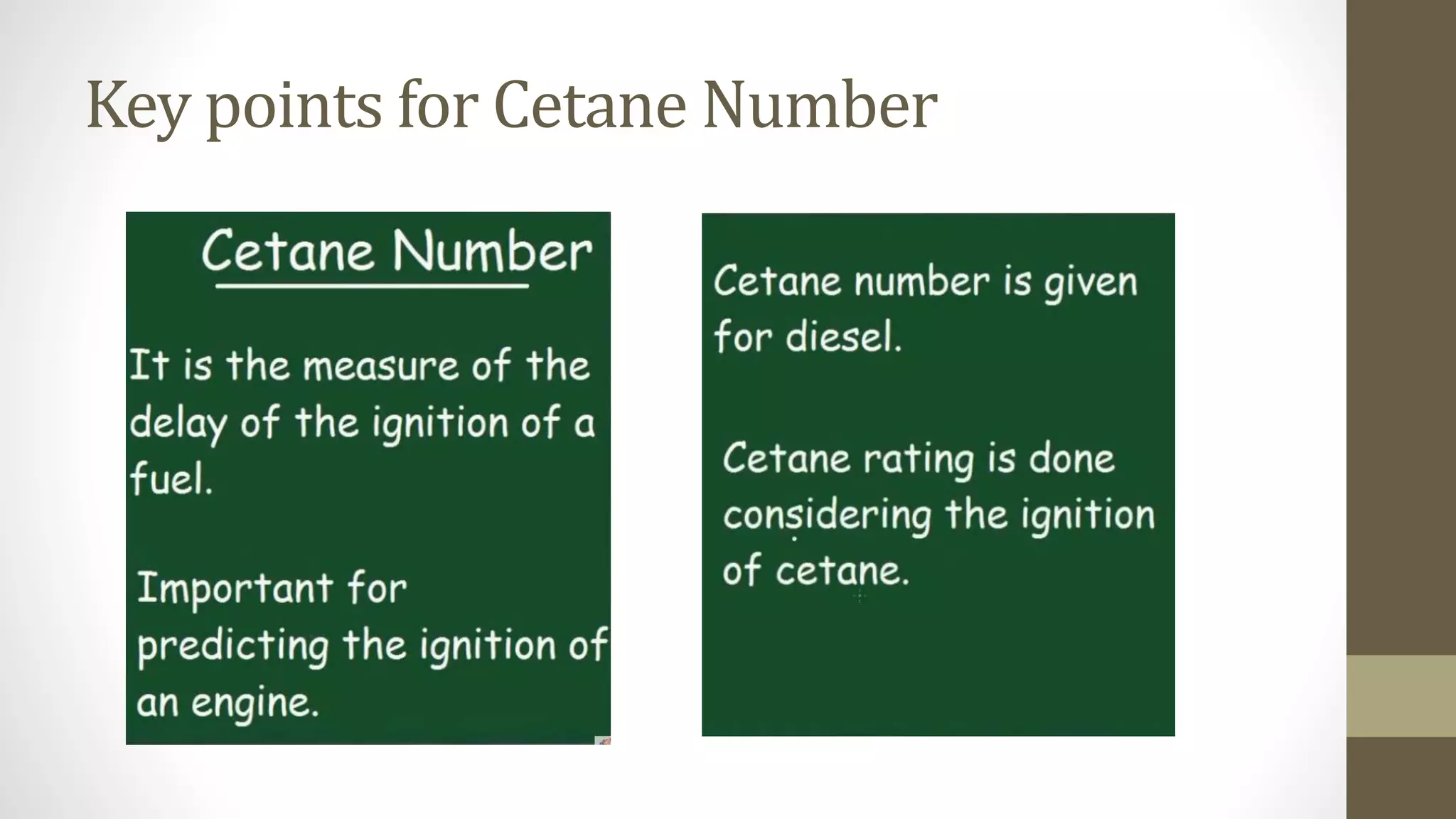
• Ignition quality of a fuel cetane number CN.
• For high cetane fuels ignition delay is short so very little fuel is injected before autoignition.
• Cetane (n-hexadecane, C16H34) has a value of 100.
• In the original procedures -methylnaphtalene (C11H10) with a cetane number of zero
represented the bottom of the scale.
• This has since been replaced by heptamethylnonane, (HMN) has a cetane number of
15, which is a more stable compound.
• The higher the CN the better the ignition quality, i.e., shorter ignition delay.
• The cetane number is given by:
CN = (% hexadecane) + 0.15 (% HMN)
Knock measurement [sensors]
• Optical probes and Ionization detectors can
be used
• Piezoelectric pressure transducer is used
mostly
• Generate a voltage when vibration is applied
to them utilizing the piezoelectric effect and it
is proportional to the acceleration
• Due to the vibration, a counter weight inside
the sensor is applying pressure on the piezo
element, this pressure creates an electric
charge in the piezo element which is the
output signal of the sensor.
Knock damages
• Piston ring sticking breakage
• Cylinder head gasket
• Cylinder head erosion
• Piston crown erosion
• Piston melting and holing
1. Provide adequate cooling to the engine
2. Use intercooler on turbo-charged engines
3. Use high octane and cetane gasoline and diesel
4. Anti-knock gasoline additives
5. Fuel enrichment under severe condition
6.Use knock sensor to control spark retard so as to operate close to
engine knock limit
7. Fast combustion system
8. Gasoline direct injection
Knock control strategies
FUELS & CETANE NO
FUELS
 Each substance which gives energy after burning is called fuel.
 Fuels are classification by sources;
a. Natural
b. Artificial
 Fuels are classification by phases;
a. Solid – coal, wood etc.
b. Liquid – petroleum products, alcohol, biofuel etc.
c. Gas – methane, buthane, hydrogen, biogas etc.
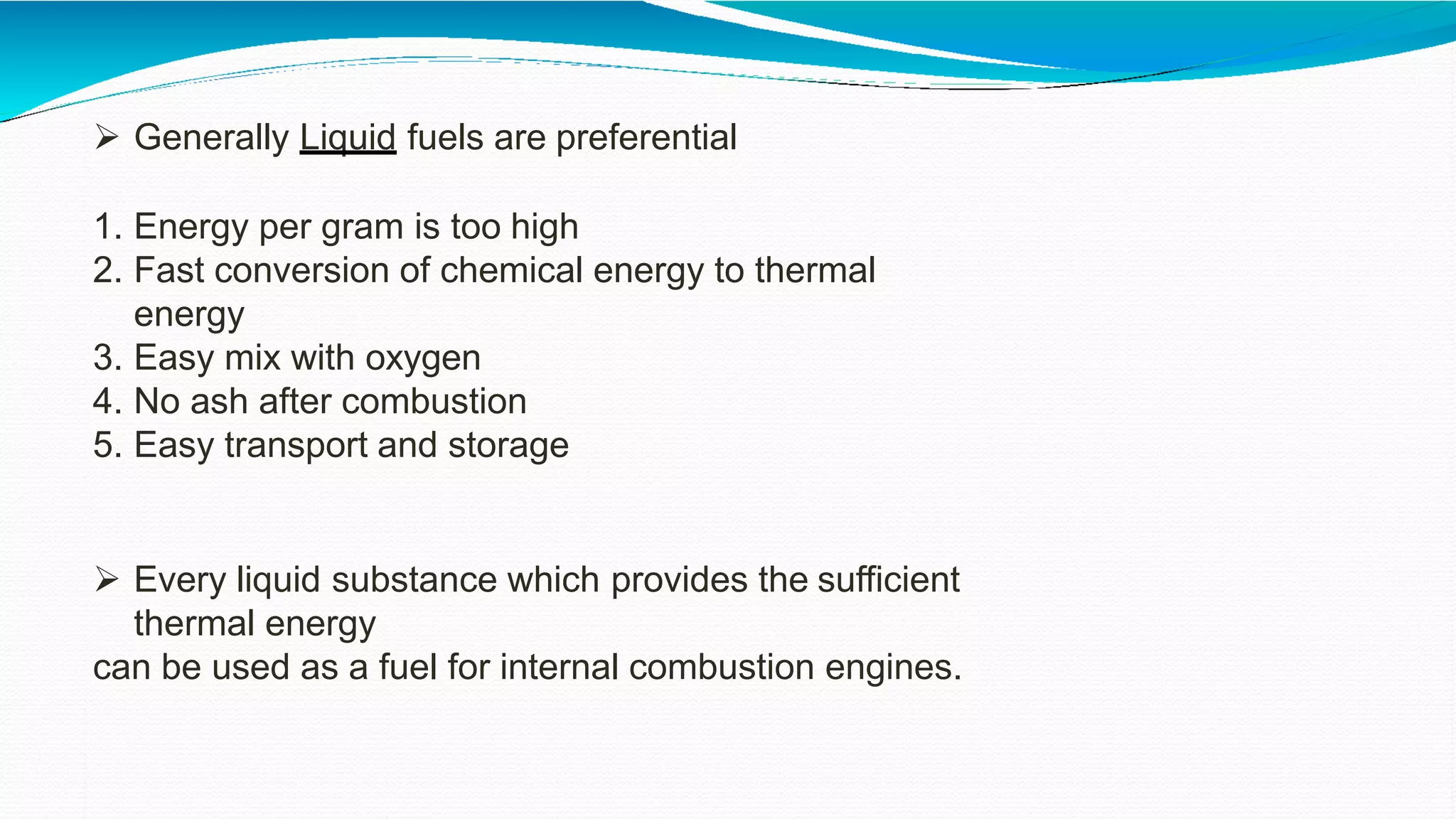
 Generally Liquid fuels are preferential
1. Energy per gram is too high
2. Fast conversion of chemical energy to thermal
energy
3. Easy mix with oxygen
4. No ash after combustion
5. Easy transport and storage
 Every liquid substance which provides the sufficient
thermal energy
can be used as a fuel for internal combustion engines.
CETANE NO.
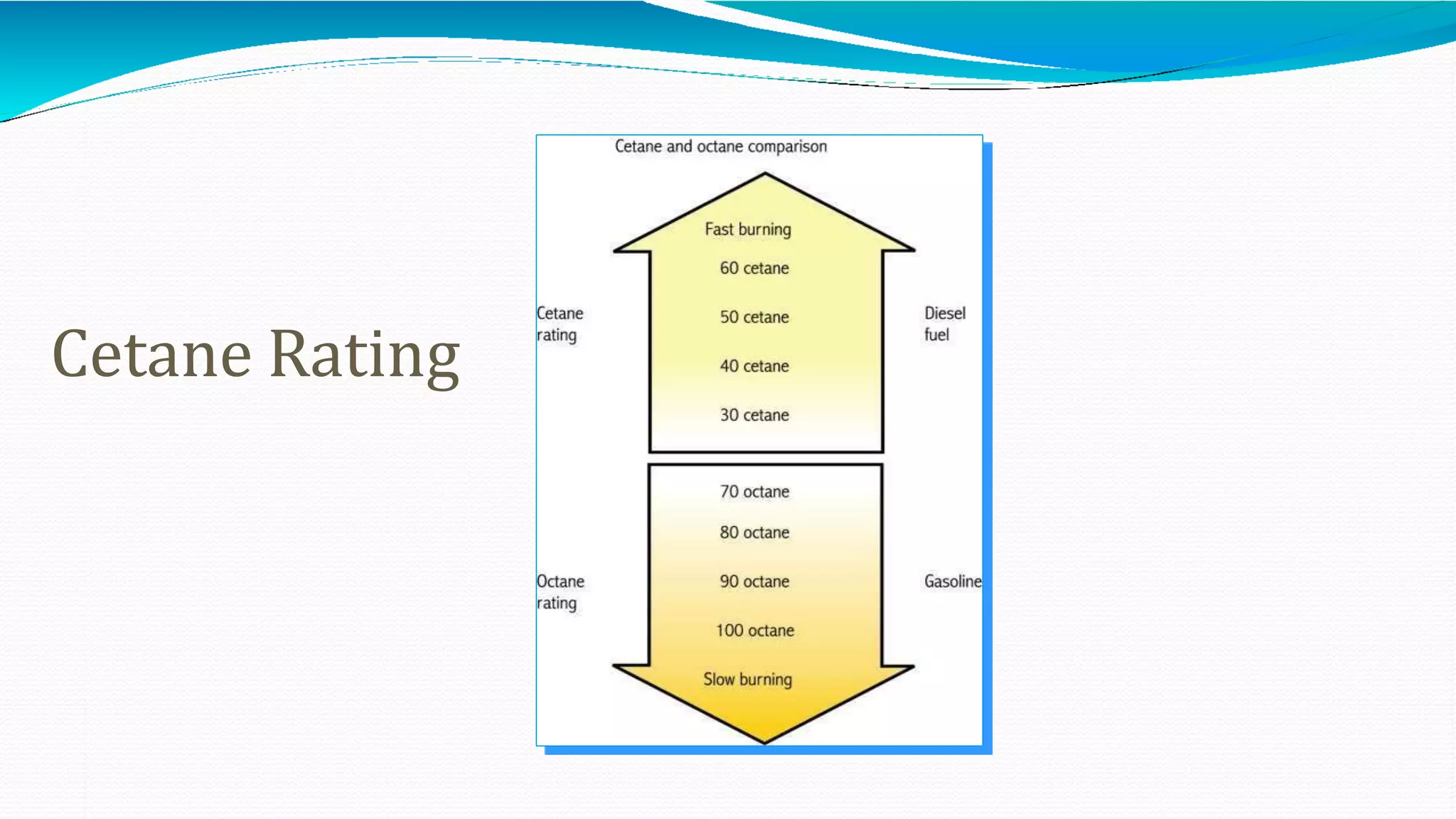
Cetane number (diesel fuel) and octane number
(gasoline) both measure the tendency of the fuel to
ignite spontaneously.
The cetane number refers to the ease with which
desel fuel ignites easily at a relatively low temperature.
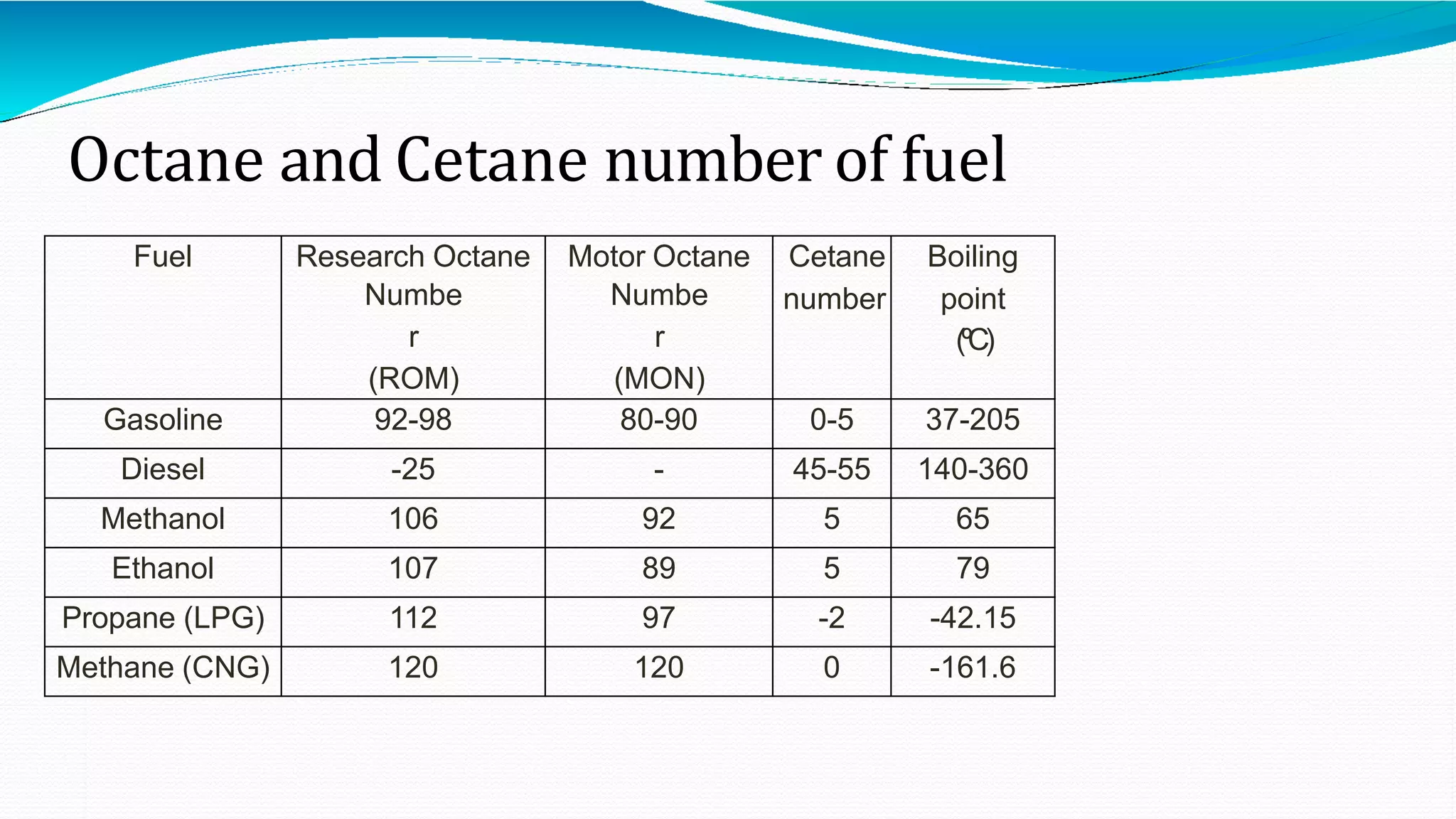
Fuel Research Octane
Numbe
r
(ROM)
Motor Octane
Numbe
r
(MON)
Cetane
number
Boiling
point
(ºC)
Gasoline 92-98 80-90 0-5 37-205
Diesel -25 - 45-55 140-360
Methanol 106 92 5 65
Ethanol 107 89 5 79
Propane (LPG) 112 97 -2 -42.15
Methane (CNG) 120 120 0 -161.6
Octane and Cetane number of fuel
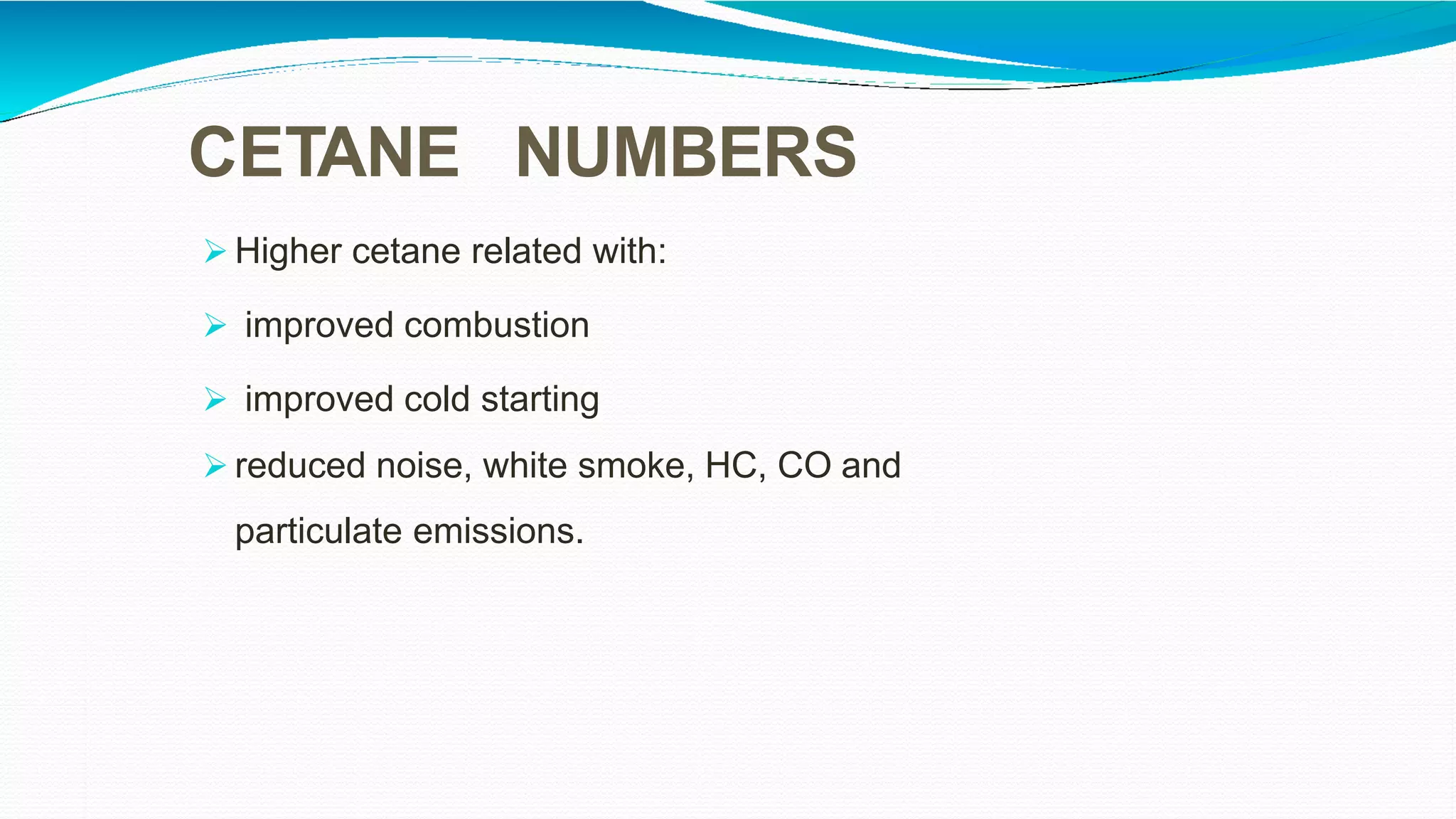
CETANE NUMBERS
 Higher cetane related with:
 improved combustion
 improved cold starting
 reduced noise, white smoke, HC, CO and
particulate emissions.
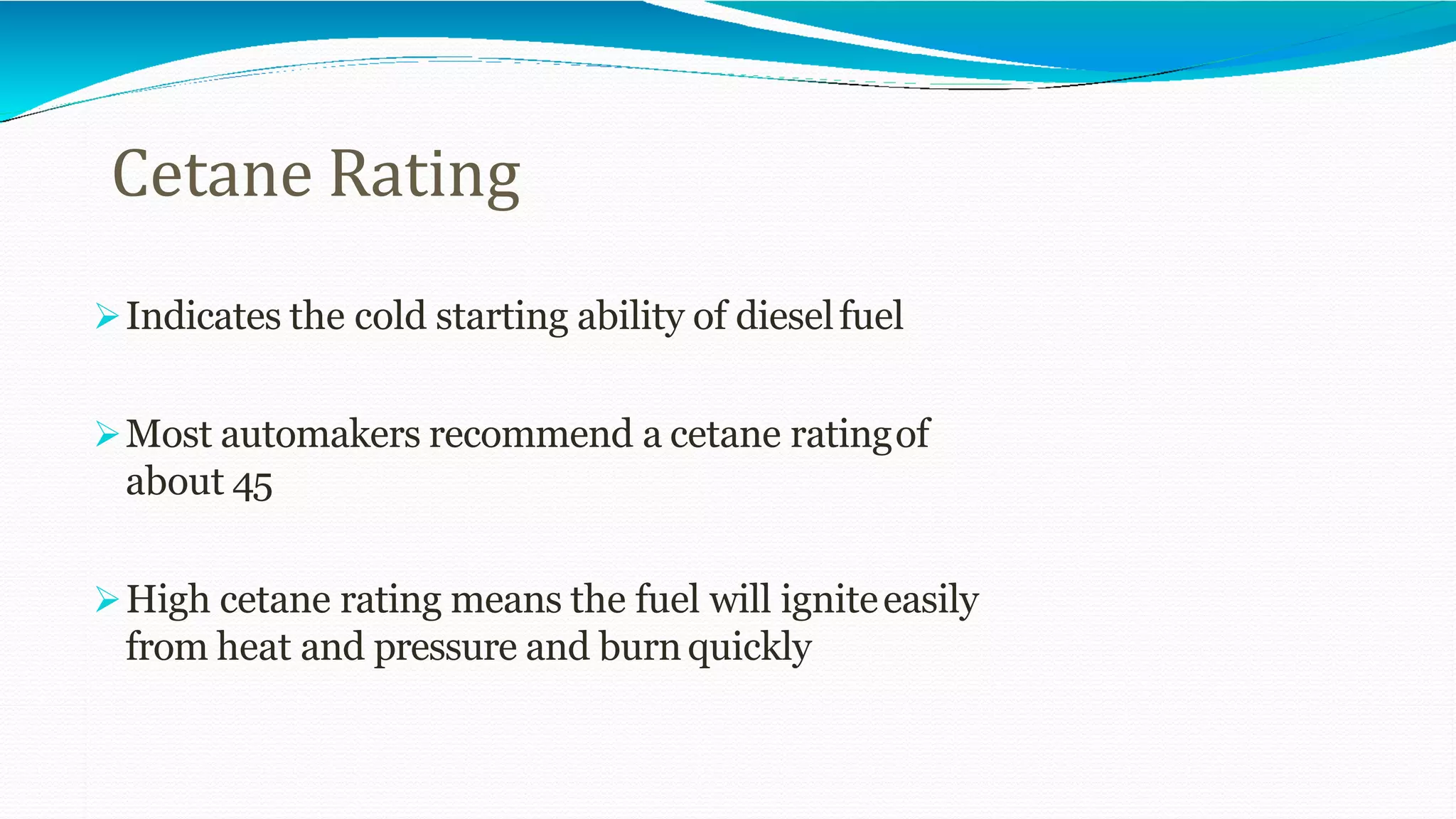
Cetane Rating
Indicates the cold starting ability of dieselfuel
Most automakers recommend a cetane ratingof
about 45
High cetane rating means the fuel will igniteeasily
from heat and pressure and burn quickly
Cetane Rating
Fuel Ignition Quality
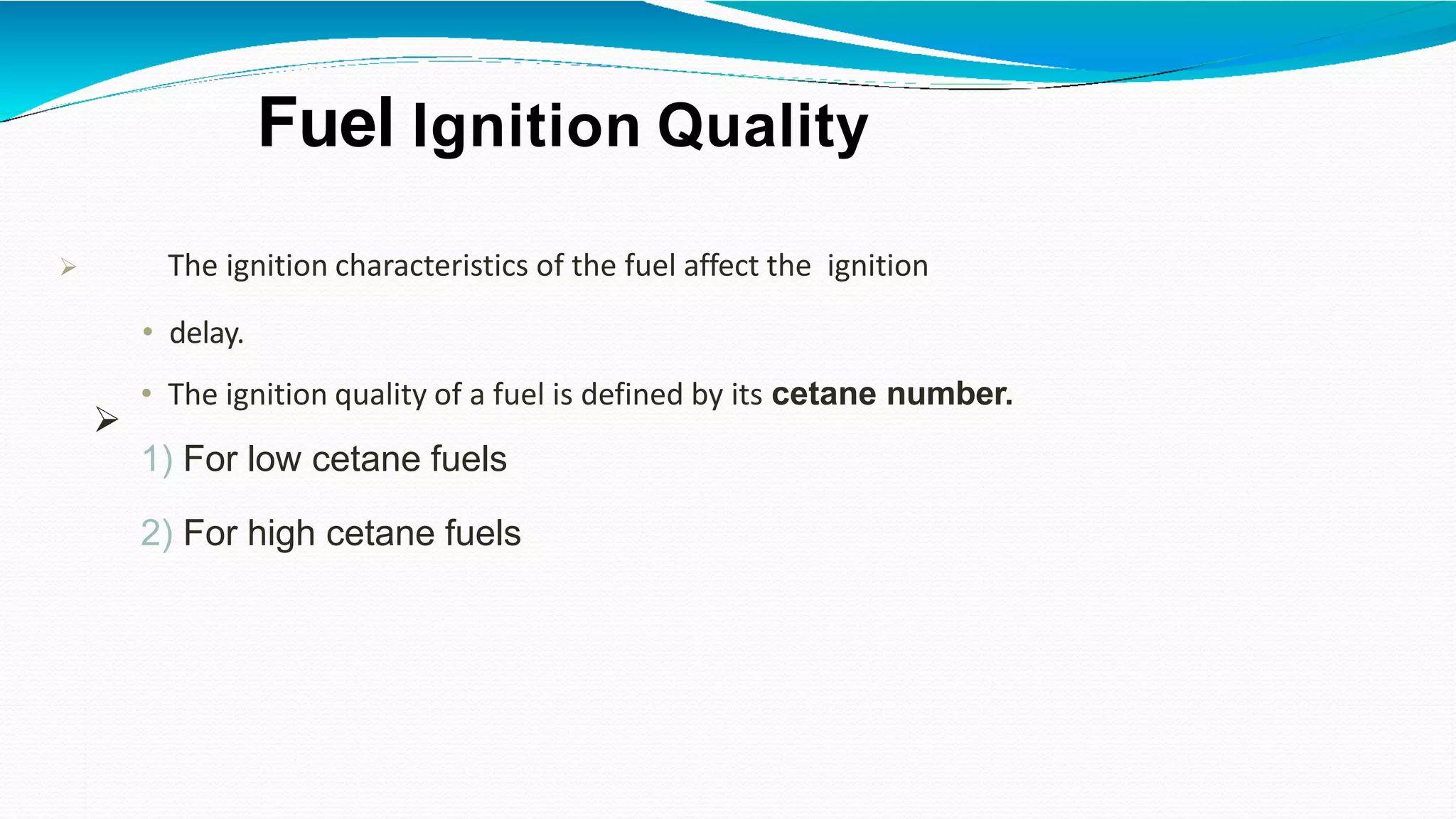
 The ignition characteristics of the fuel affect the ignition
• delay.
• The ignition quality of a fuel is defined by its cetane number.
1) For low cetane fuels
2) For high cetane fuels

Key points for Cetane Number
OCTANE NUMBER
INTRODUCTION
o It’
s astandard measure of the performance of an engine. The higher the
octane number
,the more compression the fuel can withstand before
detonating (igniting).
o This number can be counted by representingwith a mixture of 2,2,4-
trimethylpentane(iso- octane)which hashigh resistance from early ignition
and n-heptane which havefast detonation.
o For example 90octane means that the fuel has the sameknocking
characteristics asa mixtureof 90%iso-octane and 1
0
%n-heptane.
o The fistscientist who made that definition andput the standards was
Marker Russell.
WHY DO WE CAREABOUT
OCTANE NO. ?
o octane ratingsmeasurea fuel's ability to resistthe
spontaneous ignition.
o Sothe higher octane rating meansthat your car will burn
slower
.
o Inaddition that every single engine hasa specific octane
number and when it usea lower number the engine can be
damaged for a short term.
OCTANE RATING METHOD
RON Method
MON Method
OCTANE ENGINESYSTEM
OCTANE RATINGMETHOD
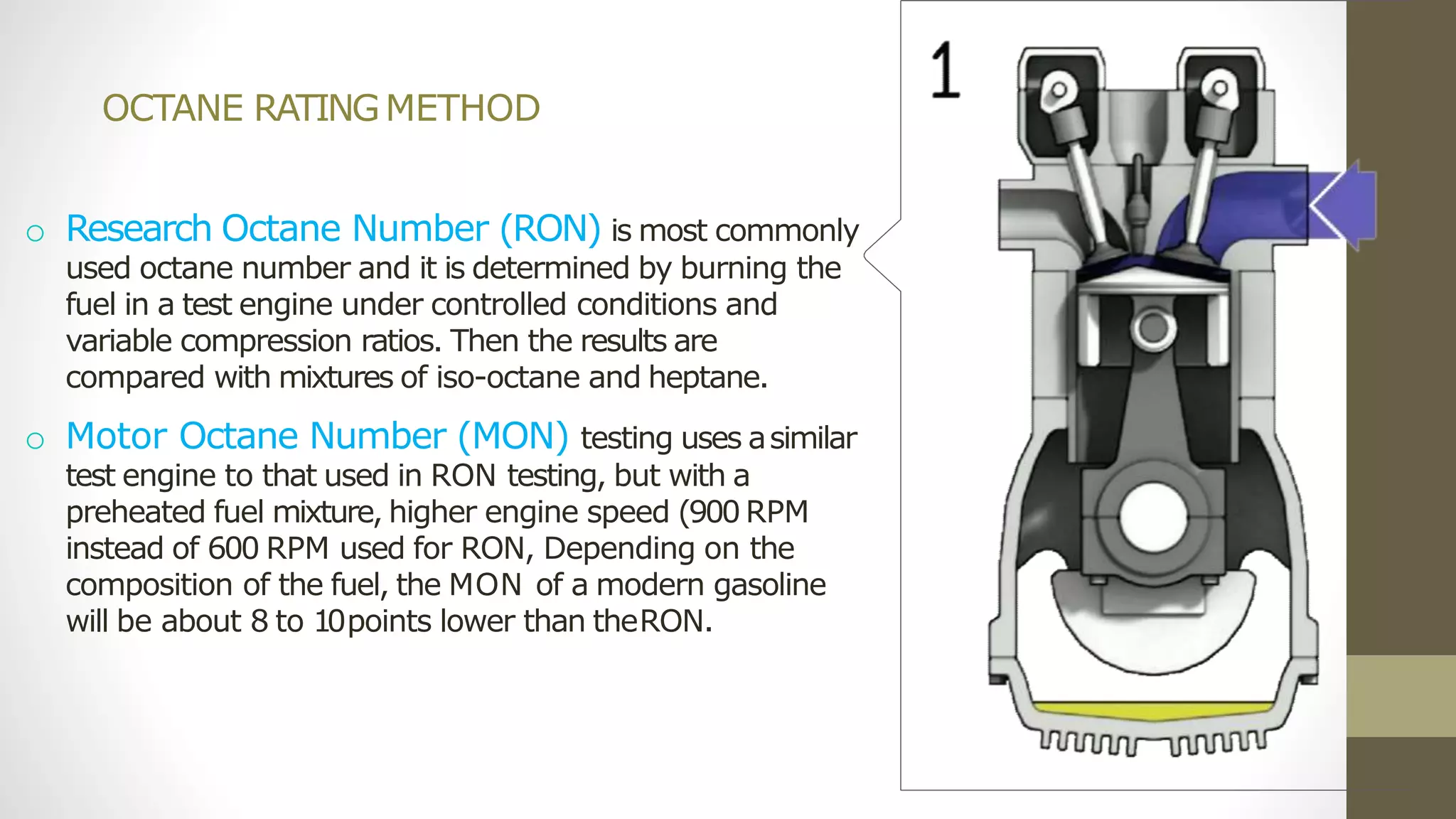
o Research Octane Number (RON) is most commonly
used octane number and it is determined by burning the
fuel in a test engine under controlled conditions and
variable compression ratios. Then the results are
compared with mixtures of iso-octane and heptane.
o Motor Octane Number (MON) testing uses asimilar
test engine to that used in RON testing, but with a
preheated fuel mixture, higher engine speed (900 RPM
instead of 600 RPM used for RON, Depending on the
composition of the fuel, the MON of a modern gasoline
will be about 8 to 10points lower than theRON.
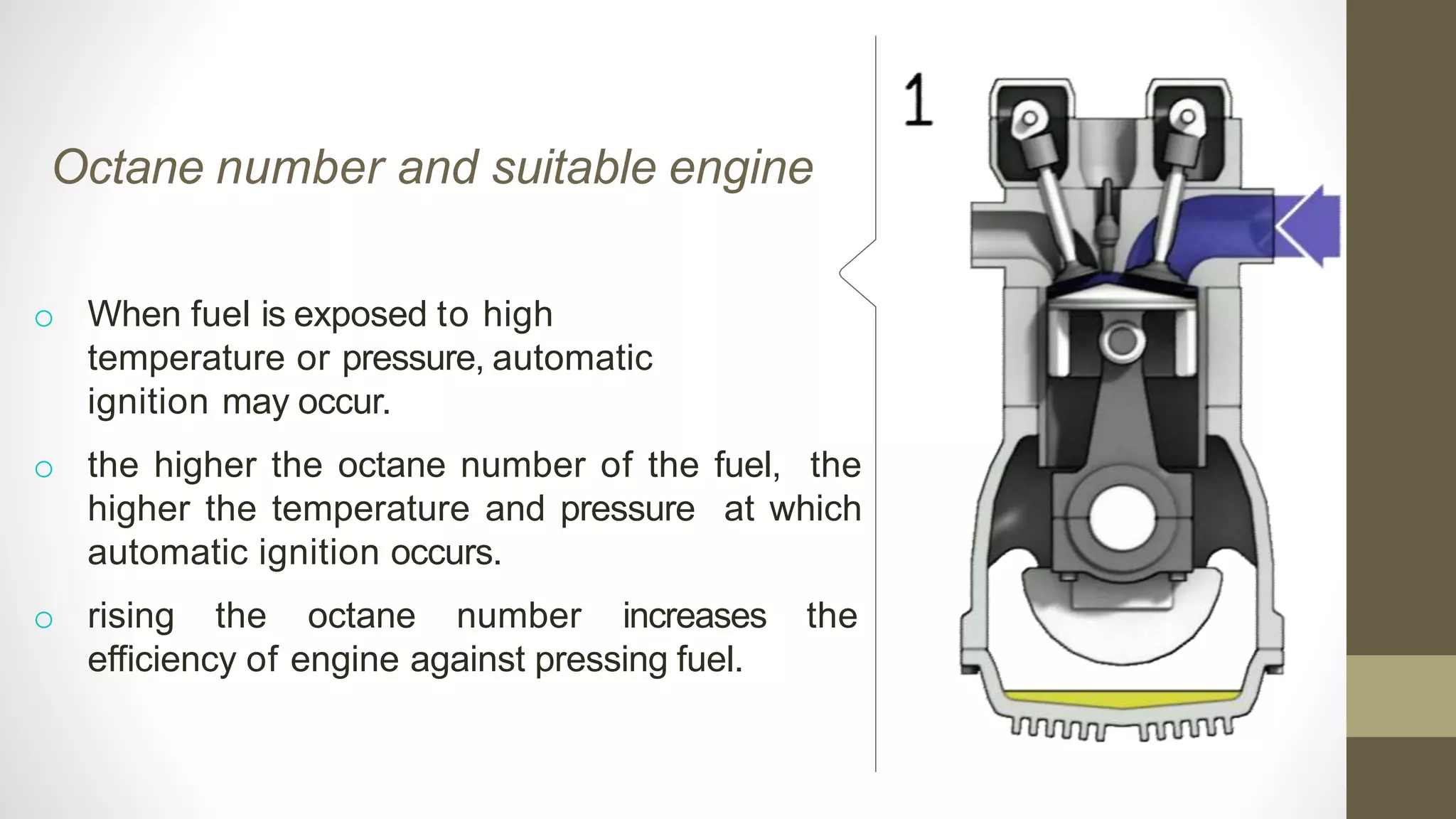
Octane number and suitable engine
o When fuel is exposed to high
temperature or pressure, automatic
ignition may occur.
o the higher the octane number of the fuel, the
higher the temperature and pressure at which
automatic ignition occurs.
o rising the octane number increases the
efficiency of engine against pressing fuel.
IMPROVING OCTANE NUMBER
How to
improve it
decreasing
factors
Decreasing Factors
o Octane number decreases when increasing
carbon chain length.
o Normal Paraffin have low Octane number as the
molecular weight increases.
o Some impurities such as lead and sulfur can
decrease the Octane rate.
How to improve it.
o There is an improving and reforming unit in
every refinery processing company and its
mission is to improve the quality of the product
(specially fuel products).
1. By putting some additives into the fuel which
discourage auto ignition such as : Aromatics,
organometals and oxygenates.
2. By some treating and reforming processes that
changes the properties of the fuel like: catalytic
reforming, cracking, isomiration and alkylation.
Key points for Octane Number
LATESTUPDATES
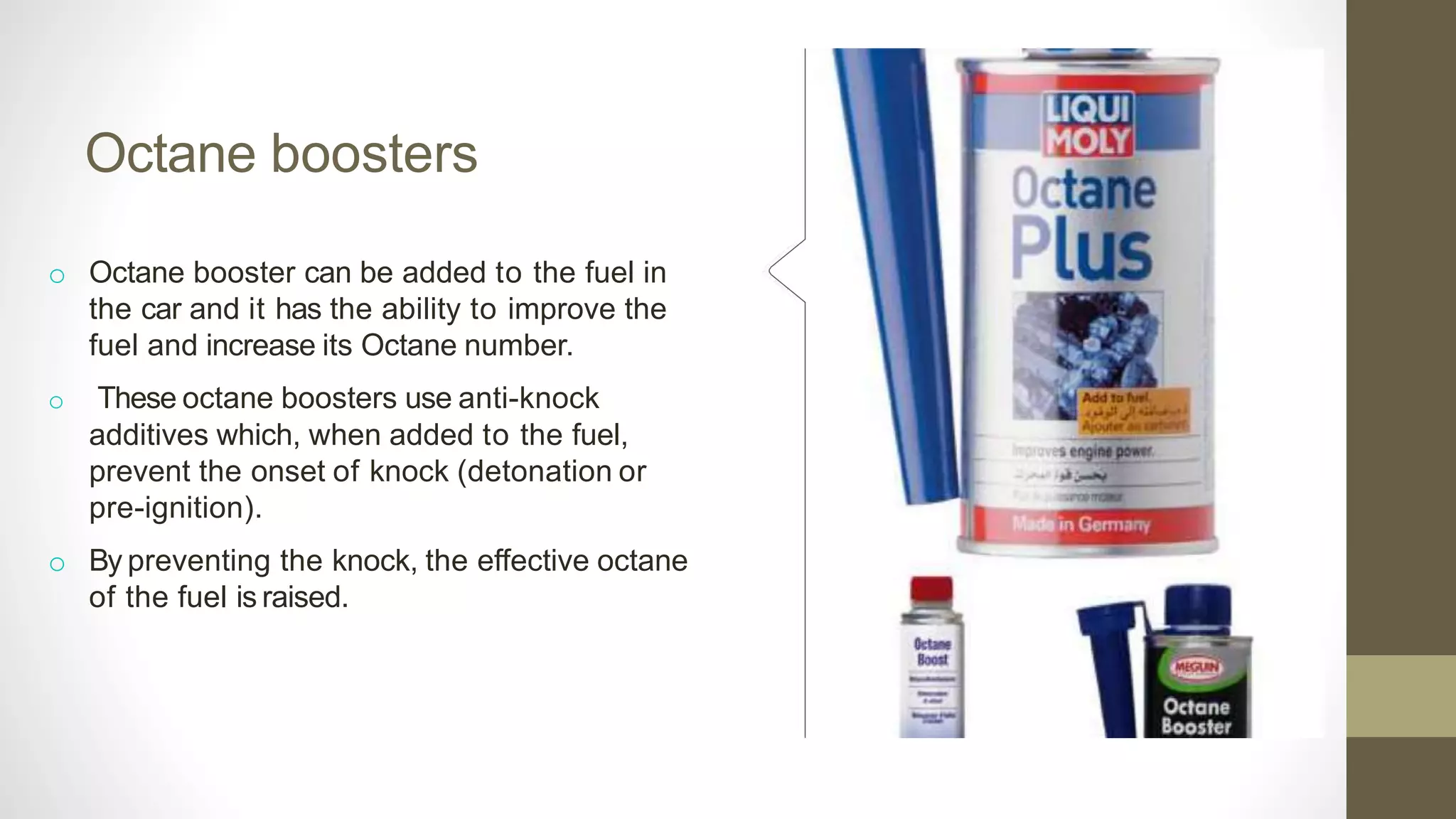
Octane boosters
o Octane booster can be added to the fuel in
the car and it has the ability to improve the
fuel and increase its Octane number.
o These octane boosters use anti-knock
additives which, when added to the fuel,
prevent the onset of knock (detonation or
pre-ignition).
o By preventing the knock, the effective octane
of the fuel is raised.
SHELLV-POWER
o Shell's Friction Modification Technology, or
lube, helps the engine turn more freely. Less
friction means less wasted energy and more
power from the fuel can be transmitted to the
wheels. Also, whereas ordinary unleaded fuels
have a research octane number of 95 RON,
V-Power Nitro+ is rated at 99 RON.
o Shell says it'll work in anything, old or new. It
can help maintain the performance levels of a
new car and help restore lost performance to
older motors.
REFERENCES
http://www.richardwheeler.net/
http://www.automotive.com/.
"Octane Explanation". runyard.org.
http://www.fuelexpert.co.za/
https://recombu.com
http://www.shell.us/motorist/shell-fuels.html
THANK YOU

Knocking , cetane and octane numer

  • 1.
    Chemistry Group Activity: •GroupMembers • Anurag Kumar - 20BCE11012 • Anant Dubey - 20BCE11037 • Vinay Gupta - 20BCE11053 • Aviral Srivastava - 20BCE11027 • Tanesh Parsavdiya - 20BCE10998
  • 2.
  • 3.
    Definitions • Knock ismetallic sound caused by spontaneous ignition of end gas. • Occurs during compression stroke mostly in SI engine and expansion stroke in CI engines • Results in pressure fluctuations in cylinder and increases temperature • Surface ignition is caused due to hot spots in chamber • Overheated valve, spark plug, glowing combustion chamber deposits • Pre-ignition and post-ignition
  • 4.
    Definitions contd… • Accelerationknock produces more sound but can not cause damage due to short duration • Constant speed knock can cause drastic damage 1. pre-ignition 2. Runway knock
  • 5.
    Origin of knock •Auto ignition of end gas, depends strongly on chemical composition of end- gas mixture. • If the flame burns all the fresh gas before auto-ignition in the end-gas can occur then knock is avoided. • Knock is a potential problem when the burn time is long. • Theory of auto-ignition fuel oxidization occurs during compression of A/F mixture • Theory of detonation advancing flame velocity to consume end gas is much higher
  • 6.
    Limiting parameters forknocks • end-gas temperature • time available before flame arrival • Compression ratio • Spark timing • Engine speed • Delay period • Inlet pressure and temperature, coolant temperature, fuel/air ratio
  • 7.
    Fuel factor andknock scale for SI engines • Octane number ON is measure of resistance to knocking. • Normal heptane (n-C7H16) has an octane value of zero and isooctane (C8H18) has a value of 100. • The higher the octane number, the higher the resistance to knock. • Blends of these two hydrocarbons define the knock resistance of intermediate octane numbers: e.g., a blend of 10% n-heptane and 90% isooctane has an octane number of 90.
  • 8.
    Fuel factor andknock scale for CI engines • Ignition quality of a fuel cetane number CN. • For high cetane fuels ignition delay is short so very little fuel is injected before autoignition. • Cetane (n-hexadecane, C16H34) has a value of 100. • In the original procedures -methylnaphtalene (C11H10) with a cetane number of zero represented the bottom of the scale. • This has since been replaced by heptamethylnonane, (HMN) has a cetane number of 15, which is a more stable compound. • The higher the CN the better the ignition quality, i.e., shorter ignition delay. • The cetane number is given by: CN = (% hexadecane) + 0.15 (% HMN)
  • 9.
    Knock measurement [sensors] •Optical probes and Ionization detectors can be used • Piezoelectric pressure transducer is used mostly • Generate a voltage when vibration is applied to them utilizing the piezoelectric effect and it is proportional to the acceleration • Due to the vibration, a counter weight inside the sensor is applying pressure on the piezo element, this pressure creates an electric charge in the piezo element which is the output signal of the sensor.
  • 10.
    Knock damages • Pistonring sticking breakage • Cylinder head gasket • Cylinder head erosion • Piston crown erosion • Piston melting and holing
  • 11.
    1. Provide adequatecooling to the engine 2. Use intercooler on turbo-charged engines 3. Use high octane and cetane gasoline and diesel 4. Anti-knock gasoline additives 5. Fuel enrichment under severe condition 6.Use knock sensor to control spark retard so as to operate close to engine knock limit 7. Fast combustion system 8. Gasoline direct injection Knock control strategies
  • 12.
  • 13.
    FUELS  Each substancewhich gives energy after burning is called fuel.  Fuels are classification by sources; a. Natural b. Artificial  Fuels are classification by phases; a. Solid – coal, wood etc. b. Liquid – petroleum products, alcohol, biofuel etc. c. Gas – methane, buthane, hydrogen, biogas etc.
  • 14.
     Generally Liquidfuels are preferential 1. Energy per gram is too high 2. Fast conversion of chemical energy to thermal energy 3. Easy mix with oxygen 4. No ash after combustion 5. Easy transport and storage  Every liquid substance which provides the sufficient thermal energy can be used as a fuel for internal combustion engines.
  • 15.
    CETANE NO. Cetane number(diesel fuel) and octane number (gasoline) both measure the tendency of the fuel to ignite spontaneously. The cetane number refers to the ease with which desel fuel ignites easily at a relatively low temperature.
  • 16.
    Fuel Research Octane Numbe r (ROM) MotorOctane Numbe r (MON) Cetane number Boiling point (ºC) Gasoline 92-98 80-90 0-5 37-205 Diesel -25 - 45-55 140-360 Methanol 106 92 5 65 Ethanol 107 89 5 79 Propane (LPG) 112 97 -2 -42.15 Methane (CNG) 120 120 0 -161.6 Octane and Cetane number of fuel
  • 17.
    CETANE NUMBERS  Highercetane related with:  improved combustion  improved cold starting  reduced noise, white smoke, HC, CO and particulate emissions.
  • 18.
    Cetane Rating Indicates thecold starting ability of dieselfuel Most automakers recommend a cetane ratingof about 45 High cetane rating means the fuel will igniteeasily from heat and pressure and burn quickly
  • 19.
  • 20.
    Fuel Ignition Quality The ignition characteristics of the fuel affect the ignition • delay. • The ignition quality of a fuel is defined by its cetane number. 1) For low cetane fuels 2) For high cetane fuels 
  • 21.
    Key points forCetane Number
  • 22.
  • 23.
    INTRODUCTION o It’ s astandardmeasure of the performance of an engine. The higher the octane number ,the more compression the fuel can withstand before detonating (igniting). o This number can be counted by representingwith a mixture of 2,2,4- trimethylpentane(iso- octane)which hashigh resistance from early ignition and n-heptane which havefast detonation. o For example 90octane means that the fuel has the sameknocking characteristics asa mixtureof 90%iso-octane and 1 0 %n-heptane. o The fistscientist who made that definition andput the standards was Marker Russell.
  • 24.
    WHY DO WECAREABOUT OCTANE NO. ? o octane ratingsmeasurea fuel's ability to resistthe spontaneous ignition. o Sothe higher octane rating meansthat your car will burn slower . o Inaddition that every single engine hasa specific octane number and when it usea lower number the engine can be damaged for a short term.
  • 25.
    OCTANE RATING METHOD RONMethod MON Method OCTANE ENGINESYSTEM
  • 26.
    OCTANE RATINGMETHOD o ResearchOctane Number (RON) is most commonly used octane number and it is determined by burning the fuel in a test engine under controlled conditions and variable compression ratios. Then the results are compared with mixtures of iso-octane and heptane. o Motor Octane Number (MON) testing uses asimilar test engine to that used in RON testing, but with a preheated fuel mixture, higher engine speed (900 RPM instead of 600 RPM used for RON, Depending on the composition of the fuel, the MON of a modern gasoline will be about 8 to 10points lower than theRON.
  • 27.
    Octane number andsuitable engine o When fuel is exposed to high temperature or pressure, automatic ignition may occur. o the higher the octane number of the fuel, the higher the temperature and pressure at which automatic ignition occurs. o rising the octane number increases the efficiency of engine against pressing fuel.
  • 29.
    IMPROVING OCTANE NUMBER Howto improve it decreasing factors
  • 30.
    Decreasing Factors o Octanenumber decreases when increasing carbon chain length. o Normal Paraffin have low Octane number as the molecular weight increases. o Some impurities such as lead and sulfur can decrease the Octane rate.
  • 31.
    How to improveit. o There is an improving and reforming unit in every refinery processing company and its mission is to improve the quality of the product (specially fuel products). 1. By putting some additives into the fuel which discourage auto ignition such as : Aromatics, organometals and oxygenates. 2. By some treating and reforming processes that changes the properties of the fuel like: catalytic reforming, cracking, isomiration and alkylation.
  • 32.
    Key points forOctane Number
  • 33.
  • 34.
    Octane boosters o Octanebooster can be added to the fuel in the car and it has the ability to improve the fuel and increase its Octane number. o These octane boosters use anti-knock additives which, when added to the fuel, prevent the onset of knock (detonation or pre-ignition). o By preventing the knock, the effective octane of the fuel is raised.
  • 35.
    SHELLV-POWER o Shell's FrictionModification Technology, or lube, helps the engine turn more freely. Less friction means less wasted energy and more power from the fuel can be transmitted to the wheels. Also, whereas ordinary unleaded fuels have a research octane number of 95 RON, V-Power Nitro+ is rated at 99 RON. o Shell says it'll work in anything, old or new. It can help maintain the performance levels of a new car and help restore lost performance to older motors.
  • 36.
  • 37.