AICTE Quality Initiatives
in
Technical Education
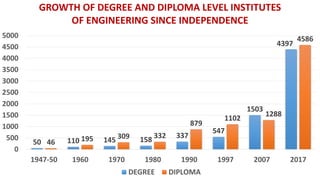
50 110 145 158
337
547
1503
4397
46 195 309 332
879
1102
1288
4586
0
500
1000
1500
2000
2500
3000
3500
4000
4500
5000
1947-50 1960 1970 1980 1990 1997 2007 2017
GROWTH OF DEGREE AND DIPLOMA LEVEL INSTITUTES
OF ENGINEERING SINCE INDEPENDENCE
DEGREE DIPLOMA
3700 16000 18200 28500 66600
130949
583333
1581372
4200 26500 43500 49200
122000
184648 300501
1262902
0
200000
400000
600000
800000
1000000
1200000
1400000
1600000
1800000
1947-50 1960 1970 1980 1990 1997 2007 2017
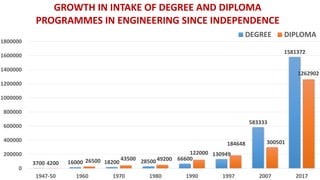
GROWTH IN INTAKE OF DEGREE AND DIPLOMA
PROGRAMMES IN ENGINEERING SINCE INDEPENDENCE
DEGREE DIPLOMA
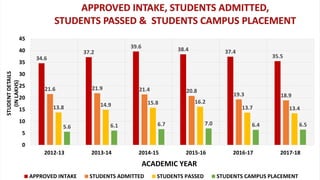
34.6
37.2
39.6 38.4 37.4
35.5
21.6 21.9 21.4 20.8
19.3 18.9
13.8 14.9 15.8 16.2
13.7 13.4
5.6 6.1 6.7 7.0 6.4 6.5
0
5
10
15
20
25
30
35
40
45
2012-13 2013-14 2014-15 2015-16 2016-17 2017-18
STUDENTDETAILS
(INLAKHS)
ACADEMIC YEAR
APPROVED INTAKE STUDENTS ADMITTED STUDENTS PASSED STUDENTS CAMPUS PLACEMENT
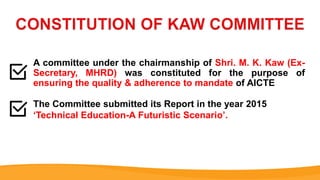
A committee under the chairmanship of Shri. M. K. Kaw (Ex-
Secretary, MHRD) was constituted for the purpose of
ensuring the quality & adherence to mandate of AICTE
The Committee submitted its Report in the year 2015
‘Technical Education-A Futuristic Scenario’.
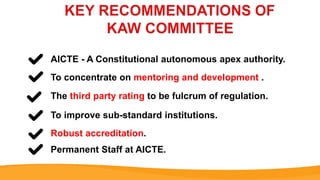
AICTE - A Constitutional autonomous apex authority.
To concentrate on mentoring and development .
The third party rating to be fulcrum of regulation.
To improve sub-standard institutions.
Robust accreditation.
Permanent Staff at AICTE.
Kaw committee recommendations
Autonomy to all colleges in phased manner .
Quantum Jump in Allocation of Funds .
Distance and Life Long Education.
Vocational Education.
To focus on Research and Innovation.
AICTE discussed the issue of quality in the meeting
of council held in the month of March 2017.
Council suggested various measures to bring
Quality in technical education.
AICTE immediately started working on these
suggestions.
AICTE Quality Initiatives in Technical Education
Revision of Curriculum
Teacher Training
Mandatory Induction program for students
Promoting Innovation/start-ups
Internship Policy
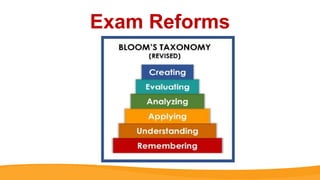
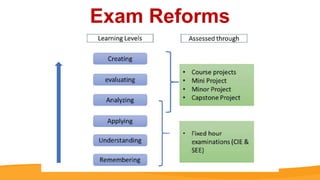
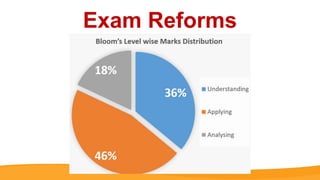
Exam Reforms
Mandatory accreditation
Perspective Plan
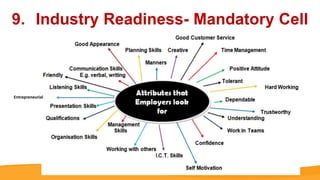
Industry Readiness- Mandatory Cell
Selection of students [NEETI]
Revision of Curriculum
1
DETAIL OF CREDITS OF UG COURSES
S.No Course Credits
1 Humanities and Social Sciences including Management 12
2 Basic Sciences 25
3 Engineering Sciences including workshop, drawing, basics of
electrical/mechanical/computer etc
24
4 Professional core subjects 48
5 Professional Subjects- Electives relevant to chosen
specialization/branch
18
6 Open subjects – Electives from other technical and /or emerging
subjects
18
7 Project work, seminar and internship in industry or elsewhere 15
8 Mandatory Courses
[Induction training, Indian Constitution, Essence of Indian
Traditional Knowledge]
(non-credit)
Total 160
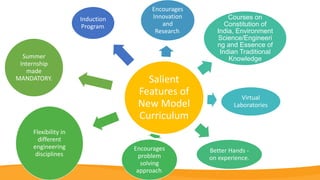
Salient
Features of
New Model
Curriculum
Induction
Program.
Encourages
Innovation
and
Research.
Virtual
Laboratories
Courses on
Constitution of
India, Environment
Science/Engineeri
ng and Essence of
Indian Traditional
Knowledge
Better Hands -
on experience.
Encourages
problem
solving
approach.
Flexibility in
different
engineering
disciplines.
Summer
Internship
made
MANDATORY.
Teacher Training
2
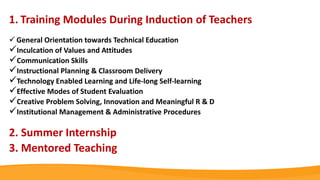
1. Training Modules During Induction of Teachers
 General Orientation towards Technical Education
Inculcation of Values and Attitudes
Communication Skills
Instructional Planning & Classroom Delivery
Technology Enabled Learning and Life-long Self-learning
Effective Modes of Student Evaluation
Creative Problem Solving, Innovation and Meaningful R & D
Institutional Management & Administrative Procedures
2. Summer Internship
3. Mentored Teaching
Mandatory Induction program
for students
3
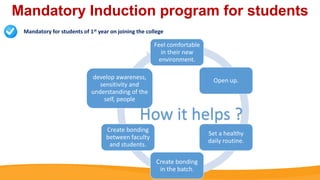
Mandatory Induction program for students
Mandatory for students of 1st year on joining the college
Feel comfortable
in their new
environment.
Open up.
Set a healthy
daily routine.
Create bonding
in the batch.
Create bonding
between faculty
and students.
develop awareness,
sensitivity and
understanding of the
self, people
How it helps ?
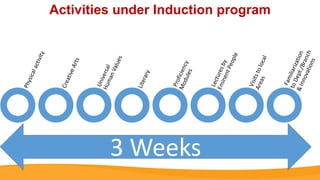
Activities under Induction program
3 Weeks
Promoting Innovation/start-ups
4
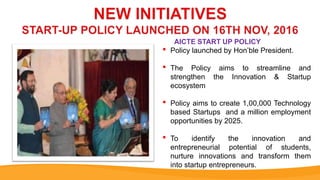
AICTE START UP POLICY
• Policy launched by Hon’ble President.
• The Policy aims to streamline and
strengthen the Innovation & Startup
ecosystem
• Policy aims to create 1,00,000 Technology
based Startups and a million employment
opportunities by 2025.
• To identify the innovation and
entrepreneurial potential of students,
nurture innovations and transform them
into startup entrepreneurs.
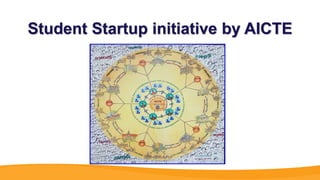
Student Startup initiative by AICTE
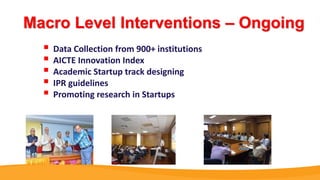
Macro Level Interventions – Ongoing
 Data Collection from 900+ institutions
 AICTE Innovation Index
 Academic Startup track designing
 IPR guidelines
 Promoting research in Startups
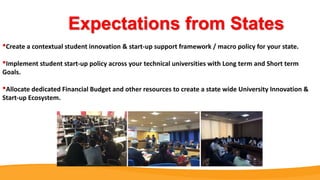
Expectations from States
•Create a contextual student innovation & start-up support framework / macro policy for your state.
•Implement student start-up policy across your technical universities with Long term and Short term
Goals.
•Allocate dedicated Financial Budget and other resources to create a state wide University Innovation &
Start-up Ecosystem.
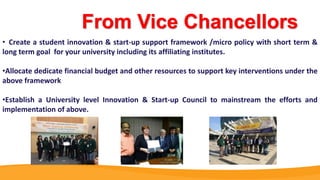
From Vice Chancellors
• Create a student innovation & start-up support framework /micro policy with short term &
long term goal for your university including its affiliating institutes.
•Allocate dedicate financial budget and other resources to support key interventions under the
above framework
•Establish a University level Innovation & Start-up Council to mainstream the efforts and
implementation of above.
Innovation cell
i) To encourage ideation, creativity amongst school and college students.
ii) Tweaking of India’s education system to make it more suited to foster
innovation-based economy.
iii)To Create mechanism to harness India’s ability as a services-led economy for
building knowledge-based and innovation-driven economy.
iv)To facilitate commercialization of celebrated incremental and frugal innovations
v) To promote ‘Think in India’ philosophy.
vi)Invest and Reward IP creation.
Aim
Internship Policy
5
AICTE ACTIVITY POINT PROGRAMME
• AICTE recommends 1000 hours Activity Programme for each B.Tech student.
Where total 600-700 hours should be for internship requirements and rest 300-
400 hrs should be aliened for Community service & allied activities.
• Similarly, 700 hours Activity Programme is proposed for diploma student, where
450- 500 hrs are for internship activities and 200-250 hrs for Community service
& allied activities.
• Budget – each institute to allocate 1 % of their total budget for these activities
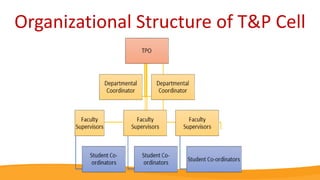
Organizational Structure of T&P Cell
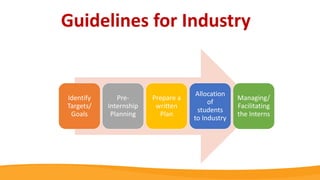
Guidelines for Industry
Identify
Targets/
Goals
Pre-
Internship
Planning
Prepare a
written
Plan
Allocation
of
students
to Industry
Managing/
Facilitating
the Interns
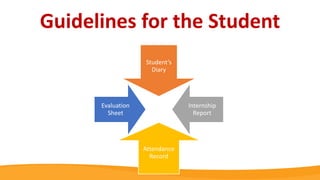
Guidelines for the Student
Student’s
Diary
Internship
Report
Attendance
Record
Evaluation
Sheet
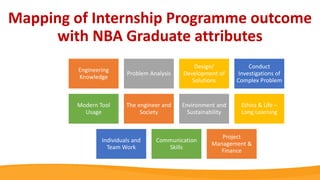
Mapping of Internship Programme outcome
with NBA Graduate attributes
Engineering
Knowledge
Problem Analysis
Design/
Development of
Solutions
Conduct
Investigations of
Complex Problem
Modern Tool
Usage
The engineer and
Society
Environment and
Sustainability
Ethics & Life –
Long Learning
Individuals and
Team Work
Communication
Skills
Project
Management &
Finance
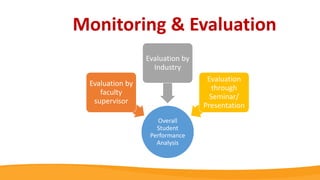
Monitoring & Evaluation
Overall
Student
Performance
Analysis
Evaluation by
faculty
supervisor
Evaluation by
Industry
Evaluation
through
Seminar/
Presentation
Exam Reforms
6
Exam Reforms
Exam Reforms
Exam Reforms
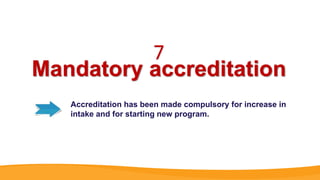
Mandatory accreditation
Accreditation has been made compulsory for increase in
intake and for starting new program.
7
Perspective Plan
8
Perspective Plan
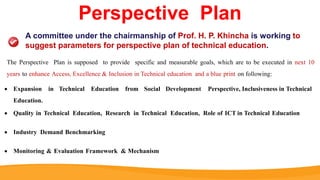
A committee under the chairmanship of Prof. H. P. Khincha is working to
suggest parameters for perspective plan of technical education.
The Perspective Plan is supposed to provide specific and measurable goals, which are to be executed in next 10
years to enhance Access, Excellence & Inclusion in Technical education and a blue print on following:
 Expansion in Technical Education from Social Development Perspective, Inclusiveness in Technical
Education.
 Quality in Technical Education, Research in Technical Education, Role of ICT in Technical Education
 Industry Demand Benchmarking
 Monitoring & Evaluation Framework & Mechanism
9. Industry Readiness- Mandatory Cell
Entrepreneurial
10.Selection of students [NEETI]
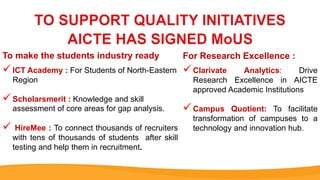
ICT Academy : For Students of North-Eastern
Region
Scholarsmerit : Knowledge and skill
assessment of core areas for gap analysis.
 HireMee : To connect thousands of recruiters
with tens of thousands of students after skill
testing and help them in recruitment.
To make the students industry ready
Clarivate Analytics: Drive
Research Excellence in AICTE
approved Academic Institutions
Campus Quotient: To facilitate
transformation of campuses to a
technology and innovation hub.
For Research Excellence :
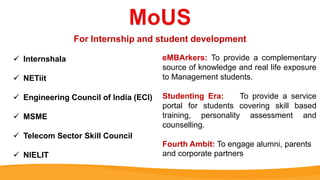
 Internshala
 NETiit
 Engineering Council of India (ECI)
 MSME
 Telecom Sector Skill Council
 NIELIT
For Internship and student development
eMBArkers: To provide a complementary
source of knowledge and real life exposure
to Management students.
Studenting Era: To provide a service
portal for students covering skill based
training, personality assessment and
counselling.
Fourth Ambit: To engage alumni, parents
and corporate partners
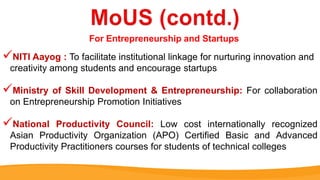
NITI Aayog : To facilitate institutional linkage for nurturing innovation and
creativity among students and encourage startups
Ministry of Skill Development & Entrepreneurship: For collaboration
on Entrepreneurship Promotion Initiatives
National Productivity Council: Low cost internationally recognized
Asian Productivity Organization (APO) Certified Basic and Advanced
Productivity Practitioners courses for students of technical colleges
For Entrepreneurship and Startups
Self-disclosure [only 5% of institutions are inspected]
Adjunct Faculty Scheme
National Employability Enhancement Mission [NEEM]
PMSSS for J & K students [ Around 3600 Students Getting Free Education]
National Doctoral Fellowship
UKIERI [Leadership Development Program]
Progressive use of Hindi
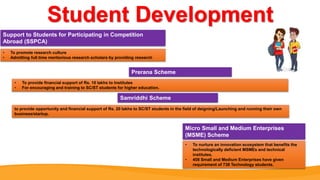
Student Development
• To promote research culture
• Admitting full time meritorious research scholars by providing research
• To provide financial support of Rs. 10 lakhs to Institutes
• For encouraging and training to SC/ST students for higher education.
to provide opportunity and financial support of Rs. 20 lakhs to SC/ST students in the field of deigning/Launching and running their own
business/startup.
Support to Students for Participating in Competition
Abroad (SSPCA)
Prerana Scheme
Samriddhi Scheme
Micro Small and Medium Enterprises
(MSME) Scheme
• To nurture an innovation ecosystem that benefits the
technologically deficient MSMEs and technical
institutes.
• 408 Small and Medium Enterprises have given
requirement of 738 Technology students.
PG Scholarship
Pragati Scholarship
Saksham Scholarship Scheme
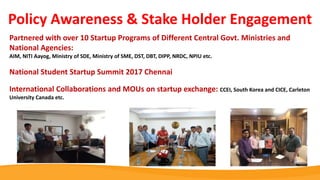
Partnered with over 10 Startup Programs of Different Central Govt. Ministries and
National Agencies:
AIM, NITI Aayog, Ministry of SDE, Ministry of SME, DST, DBT, DIPP, NRDC, NPIU etc.
National Student Startup Summit 2017 Chennai
International Collaborations and MOUs on startup exchange: CCEI, South Korea and CICE, Carleton
University Canada etc.
Policy Awareness & Stake Holder Engagement
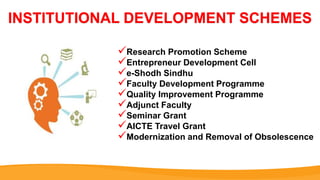
Research Promotion Scheme
Entrepreneur Development Cell
e-Shodh Sindhu
Faculty Development Programme
Quality Improvement Programme
Adjunct Faculty
Seminar Grant
AICTE Travel Grant
Modernization and Removal of Obsolescence
INSTITUTIONAL DEVELOPMENT SCHEMES
Margdarshan
Unnat Bharat Abhiyan
Hostels for SC/ST Students
Skill and Personality Development
Centre for SC/ST Students .
Institutional Development
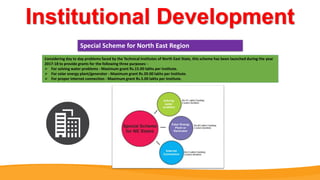
Considering day to day problems faced by the Technical Institutes of North East State, this scheme has been launched during the year
2017-18 to provide grants for the following three purposes: -
 For solving water problems - Maximum grant Rs.15.00 lakhs per Institute.
 For solar energy plant/generator - Maximum grant Rs.20.00 lakhs per Institute.
 For proper internet connection - Maximum grant Rs.5.00 lakhs per Institute.
Special Scheme for North East Region
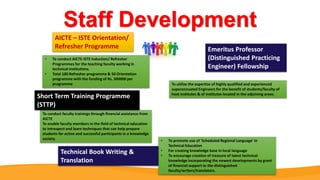
Staff Development
• To conduct AICTE-ISTE Induction/ Refresher
Programmes for the teaching faculty working in
technical institutions.
• Total 100 Refresher programme & 50 Orientation
programme with the funding of Rs. 300000 per
programme To utilize the expertise of highly qualified and experienced
superannuated Engineers for the benefit of students/faculty of
host institutes & of institutes located in the adjoining areas.
To conduct faculty trainings through financial assistance from
AICTE
To enable faculty members in the field of technical education
to introspect and learn techniques that can help prepare
students for active and successful participants in a knowledge
society. • To promote use of 'Scheduled Regional Language' in
Technical Education
• For creating knowledge base in local language
• To encourage creation of treasure of latest technical
knowledge incorporating the newest developments by grant
of financial support to the distinguished
faculty/writers/translators.
AICTE – ISTE Orientation/
Refresher Programme Emeritus Professor
(Distinguished Practicing
Engineer) Fellowship
Short Term Training Programme
(STTP)
Technical Book Writing &
Translation
Grievance Redressal
For the purpose of redressal of grievances of the students, parents and others in
respect of all AICTE approved institutions and as per the AICTE (Establishment of
Mechanism for Grievance Redressal) Regulations, 2012, all the Affiliating Universities
are required to appoint:
 Grievance Redressal Committee (GRC) in each AICTE approved Technical
Institutions;
• (The Vice Chancellor of the affiliating university shall constitute a grievance redressal committee consisting of five
members for an individual Technical Institution or a group of Technical Institutions, keeping in view of the location of
the Technical Institution (s) concerned)
 OMBUDSMAN (as per clause 3 of the AICTE Regulations 2012).
• (The Ombudsman shall be a person who has been a judge not below the rank of a District Judge or a Retired
Professor who has at least 10 years of experience)
 8053 complaints redressed through CPGRAM portal by AICTE.
Thank You

Aicte2

  • 1.
  • 2.
    50 110 145158 337 547 1503 4397 46 195 309 332 879 1102 1288 4586 0 500 1000 1500 2000 2500 3000 3500 4000 4500 5000 1947-50 1960 1970 1980 1990 1997 2007 2017 GROWTH OF DEGREE AND DIPLOMA LEVEL INSTITUTES OF ENGINEERING SINCE INDEPENDENCE DEGREE DIPLOMA
  • 3.
    3700 16000 1820028500 66600 130949 583333 1581372 4200 26500 43500 49200 122000 184648 300501 1262902 0 200000 400000 600000 800000 1000000 1200000 1400000 1600000 1800000 1947-50 1960 1970 1980 1990 1997 2007 2017 GROWTH IN INTAKE OF DEGREE AND DIPLOMA PROGRAMMES IN ENGINEERING SINCE INDEPENDENCE DEGREE DIPLOMA
  • 4.
    34.6 37.2 39.6 38.4 37.4 35.5 21.621.9 21.4 20.8 19.3 18.9 13.8 14.9 15.8 16.2 13.7 13.4 5.6 6.1 6.7 7.0 6.4 6.5 0 5 10 15 20 25 30 35 40 45 2012-13 2013-14 2014-15 2015-16 2016-17 2017-18 STUDENTDETAILS (INLAKHS) ACADEMIC YEAR APPROVED INTAKE STUDENTS ADMITTED STUDENTS PASSED STUDENTS CAMPUS PLACEMENT
  • 5.
    A committee underthe chairmanship of Shri. M. K. Kaw (Ex- Secretary, MHRD) was constituted for the purpose of ensuring the quality & adherence to mandate of AICTE The Committee submitted its Report in the year 2015 ‘Technical Education-A Futuristic Scenario’.
  • 6.
    AICTE - AConstitutional autonomous apex authority. To concentrate on mentoring and development . The third party rating to be fulcrum of regulation. To improve sub-standard institutions. Robust accreditation. Permanent Staff at AICTE.
  • 7.
    Kaw committee recommendations Autonomyto all colleges in phased manner . Quantum Jump in Allocation of Funds . Distance and Life Long Education. Vocational Education. To focus on Research and Innovation.
  • 8.
    AICTE discussed theissue of quality in the meeting of council held in the month of March 2017. Council suggested various measures to bring Quality in technical education. AICTE immediately started working on these suggestions.
  • 9.
    AICTE Quality Initiativesin Technical Education Revision of Curriculum Teacher Training Mandatory Induction program for students Promoting Innovation/start-ups Internship Policy Exam Reforms Mandatory accreditation Perspective Plan Industry Readiness- Mandatory Cell Selection of students [NEETI]
  • 10.
  • 11.
    DETAIL OF CREDITSOF UG COURSES S.No Course Credits 1 Humanities and Social Sciences including Management 12 2 Basic Sciences 25 3 Engineering Sciences including workshop, drawing, basics of electrical/mechanical/computer etc 24 4 Professional core subjects 48 5 Professional Subjects- Electives relevant to chosen specialization/branch 18 6 Open subjects – Electives from other technical and /or emerging subjects 18 7 Project work, seminar and internship in industry or elsewhere 15 8 Mandatory Courses [Induction training, Indian Constitution, Essence of Indian Traditional Knowledge] (non-credit) Total 160
  • 12.
    Salient Features of New Model Curriculum Induction Program. Encourages Innovation and Research. Virtual Laboratories Courseson Constitution of India, Environment Science/Engineeri ng and Essence of Indian Traditional Knowledge Better Hands - on experience. Encourages problem solving approach. Flexibility in different engineering disciplines. Summer Internship made MANDATORY.
  • 13.
  • 14.
    1. Training ModulesDuring Induction of Teachers  General Orientation towards Technical Education Inculcation of Values and Attitudes Communication Skills Instructional Planning & Classroom Delivery Technology Enabled Learning and Life-long Self-learning Effective Modes of Student Evaluation Creative Problem Solving, Innovation and Meaningful R & D Institutional Management & Administrative Procedures 2. Summer Internship 3. Mentored Teaching
  • 15.
  • 16.
    Mandatory Induction programfor students Mandatory for students of 1st year on joining the college Feel comfortable in their new environment. Open up. Set a healthy daily routine. Create bonding in the batch. Create bonding between faculty and students. develop awareness, sensitivity and understanding of the self, people How it helps ?
  • 17.
  • 18.
  • 19.
    AICTE START UPPOLICY • Policy launched by Hon’ble President. • The Policy aims to streamline and strengthen the Innovation & Startup ecosystem • Policy aims to create 1,00,000 Technology based Startups and a million employment opportunities by 2025. • To identify the innovation and entrepreneurial potential of students, nurture innovations and transform them into startup entrepreneurs.
  • 20.
  • 21.
    Macro Level Interventions– Ongoing  Data Collection from 900+ institutions  AICTE Innovation Index  Academic Startup track designing  IPR guidelines  Promoting research in Startups
  • 22.
    Expectations from States •Createa contextual student innovation & start-up support framework / macro policy for your state. •Implement student start-up policy across your technical universities with Long term and Short term Goals. •Allocate dedicated Financial Budget and other resources to create a state wide University Innovation & Start-up Ecosystem.
  • 23.
    From Vice Chancellors •Create a student innovation & start-up support framework /micro policy with short term & long term goal for your university including its affiliating institutes. •Allocate dedicate financial budget and other resources to support key interventions under the above framework •Establish a University level Innovation & Start-up Council to mainstream the efforts and implementation of above.
  • 24.
    Innovation cell i) Toencourage ideation, creativity amongst school and college students. ii) Tweaking of India’s education system to make it more suited to foster innovation-based economy. iii)To Create mechanism to harness India’s ability as a services-led economy for building knowledge-based and innovation-driven economy. iv)To facilitate commercialization of celebrated incremental and frugal innovations v) To promote ‘Think in India’ philosophy. vi)Invest and Reward IP creation. Aim
  • 25.
  • 26.
    AICTE ACTIVITY POINTPROGRAMME • AICTE recommends 1000 hours Activity Programme for each B.Tech student. Where total 600-700 hours should be for internship requirements and rest 300- 400 hrs should be aliened for Community service & allied activities. • Similarly, 700 hours Activity Programme is proposed for diploma student, where 450- 500 hrs are for internship activities and 200-250 hrs for Community service & allied activities. • Budget – each institute to allocate 1 % of their total budget for these activities
  • 27.
  • 28.
    Guidelines for Industry Identify Targets/ Goals Pre- Internship Planning Preparea written Plan Allocation of students to Industry Managing/ Facilitating the Interns
  • 29.
    Guidelines for theStudent Student’s Diary Internship Report Attendance Record Evaluation Sheet
  • 30.
    Mapping of InternshipProgramme outcome with NBA Graduate attributes Engineering Knowledge Problem Analysis Design/ Development of Solutions Conduct Investigations of Complex Problem Modern Tool Usage The engineer and Society Environment and Sustainability Ethics & Life – Long Learning Individuals and Team Work Communication Skills Project Management & Finance
  • 31.
    Monitoring & Evaluation Overall Student Performance Analysis Evaluationby faculty supervisor Evaluation by Industry Evaluation through Seminar/ Presentation
  • 32.
  • 33.
  • 34.
  • 35.
  • 36.
    Mandatory accreditation Accreditation hasbeen made compulsory for increase in intake and for starting new program. 7
  • 37.
  • 38.
    Perspective Plan A committeeunder the chairmanship of Prof. H. P. Khincha is working to suggest parameters for perspective plan of technical education. The Perspective Plan is supposed to provide specific and measurable goals, which are to be executed in next 10 years to enhance Access, Excellence & Inclusion in Technical education and a blue print on following:  Expansion in Technical Education from Social Development Perspective, Inclusiveness in Technical Education.  Quality in Technical Education, Research in Technical Education, Role of ICT in Technical Education  Industry Demand Benchmarking  Monitoring & Evaluation Framework & Mechanism
  • 39.
    9. Industry Readiness-Mandatory Cell Entrepreneurial
  • 40.
  • 41.
    ICT Academy :For Students of North-Eastern Region Scholarsmerit : Knowledge and skill assessment of core areas for gap analysis.  HireMee : To connect thousands of recruiters with tens of thousands of students after skill testing and help them in recruitment. To make the students industry ready Clarivate Analytics: Drive Research Excellence in AICTE approved Academic Institutions Campus Quotient: To facilitate transformation of campuses to a technology and innovation hub. For Research Excellence :
  • 42.
     Internshala  NETiit Engineering Council of India (ECI)  MSME  Telecom Sector Skill Council  NIELIT For Internship and student development eMBArkers: To provide a complementary source of knowledge and real life exposure to Management students. Studenting Era: To provide a service portal for students covering skill based training, personality assessment and counselling. Fourth Ambit: To engage alumni, parents and corporate partners
  • 43.
    NITI Aayog :To facilitate institutional linkage for nurturing innovation and creativity among students and encourage startups Ministry of Skill Development & Entrepreneurship: For collaboration on Entrepreneurship Promotion Initiatives National Productivity Council: Low cost internationally recognized Asian Productivity Organization (APO) Certified Basic and Advanced Productivity Practitioners courses for students of technical colleges For Entrepreneurship and Startups
  • 45.
    Self-disclosure [only 5%of institutions are inspected] Adjunct Faculty Scheme National Employability Enhancement Mission [NEEM] PMSSS for J & K students [ Around 3600 Students Getting Free Education] National Doctoral Fellowship UKIERI [Leadership Development Program] Progressive use of Hindi
  • 46.
    Student Development • Topromote research culture • Admitting full time meritorious research scholars by providing research • To provide financial support of Rs. 10 lakhs to Institutes • For encouraging and training to SC/ST students for higher education. to provide opportunity and financial support of Rs. 20 lakhs to SC/ST students in the field of deigning/Launching and running their own business/startup. Support to Students for Participating in Competition Abroad (SSPCA) Prerana Scheme Samriddhi Scheme Micro Small and Medium Enterprises (MSME) Scheme • To nurture an innovation ecosystem that benefits the technologically deficient MSMEs and technical institutes. • 408 Small and Medium Enterprises have given requirement of 738 Technology students.
  • 47.
  • 48.
    Partnered with over10 Startup Programs of Different Central Govt. Ministries and National Agencies: AIM, NITI Aayog, Ministry of SDE, Ministry of SME, DST, DBT, DIPP, NRDC, NPIU etc. National Student Startup Summit 2017 Chennai International Collaborations and MOUs on startup exchange: CCEI, South Korea and CICE, Carleton University Canada etc. Policy Awareness & Stake Holder Engagement
  • 49.
    Research Promotion Scheme EntrepreneurDevelopment Cell e-Shodh Sindhu Faculty Development Programme Quality Improvement Programme Adjunct Faculty Seminar Grant AICTE Travel Grant Modernization and Removal of Obsolescence INSTITUTIONAL DEVELOPMENT SCHEMES
  • 50.
    Margdarshan Unnat Bharat Abhiyan Hostelsfor SC/ST Students Skill and Personality Development Centre for SC/ST Students .
  • 51.
    Institutional Development Considering dayto day problems faced by the Technical Institutes of North East State, this scheme has been launched during the year 2017-18 to provide grants for the following three purposes: -  For solving water problems - Maximum grant Rs.15.00 lakhs per Institute.  For solar energy plant/generator - Maximum grant Rs.20.00 lakhs per Institute.  For proper internet connection - Maximum grant Rs.5.00 lakhs per Institute. Special Scheme for North East Region
  • 52.
    Staff Development • Toconduct AICTE-ISTE Induction/ Refresher Programmes for the teaching faculty working in technical institutions. • Total 100 Refresher programme & 50 Orientation programme with the funding of Rs. 300000 per programme To utilize the expertise of highly qualified and experienced superannuated Engineers for the benefit of students/faculty of host institutes & of institutes located in the adjoining areas. To conduct faculty trainings through financial assistance from AICTE To enable faculty members in the field of technical education to introspect and learn techniques that can help prepare students for active and successful participants in a knowledge society. • To promote use of 'Scheduled Regional Language' in Technical Education • For creating knowledge base in local language • To encourage creation of treasure of latest technical knowledge incorporating the newest developments by grant of financial support to the distinguished faculty/writers/translators. AICTE – ISTE Orientation/ Refresher Programme Emeritus Professor (Distinguished Practicing Engineer) Fellowship Short Term Training Programme (STTP) Technical Book Writing & Translation
  • 53.
    Grievance Redressal For thepurpose of redressal of grievances of the students, parents and others in respect of all AICTE approved institutions and as per the AICTE (Establishment of Mechanism for Grievance Redressal) Regulations, 2012, all the Affiliating Universities are required to appoint:  Grievance Redressal Committee (GRC) in each AICTE approved Technical Institutions; • (The Vice Chancellor of the affiliating university shall constitute a grievance redressal committee consisting of five members for an individual Technical Institution or a group of Technical Institutions, keeping in view of the location of the Technical Institution (s) concerned)  OMBUDSMAN (as per clause 3 of the AICTE Regulations 2012). • (The Ombudsman shall be a person who has been a judge not below the rank of a District Judge or a Retired Professor who has at least 10 years of experience)  8053 complaints redressed through CPGRAM portal by AICTE.
  • 54.