MENTAL
RETARDATION
Docilbar, Lirah & Alcantara, Reenzy Jane
BTLED 2
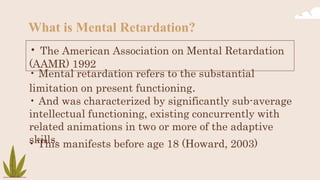
What is Mental Retardation?
• The American Association on Mental Retardation
(AAMR) 1992
• Mental retardation refers to the substantial
limitation on present functioning.
• And was characterized by significantly sub-average
intellectual functioning, existing concurrently with
related animations in two or more of the adaptive
skills.
• This manifests before age 18 (Howard, 2003)
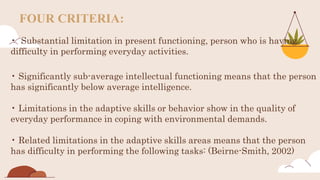
FOUR CRITERIA:
• Substantial limitation in present functioning, person who is having
difficulty in performing everyday activities.
• Significantly sub-average intellectual functioning means that the person
has significantly below average intelligence.
• Limitations in the adaptive skills or behavior show in the quality of
everyday performance in coping with environmental demands.
• Related limitations in the adaptive skills areas means that the person
has difficulty in performing the following tasks: (Beirne-Smith, 2002)
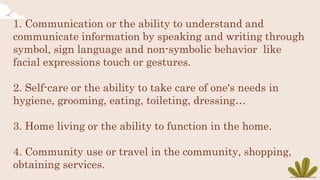
1. Communication or the ability to understand and
communicate information by speaking and writing through
symbol, sign language and non-symbolic behavior like
facial expressions touch or gestures.
2. Self-care or the ability to take care of one's needs in
hygiene, grooming, eating, toileting, dressing…
3. Home living or the ability to function in the home.
4. Community use or travel in the community, shopping,
obtaining services.
5. Special skills in initiating and terminating interactions, convert
responding to social cues, recognizing feelings.
6. Self-direction in making choices, following schedule, completing
required tasks, seeking assistance.
7. Health and safety such as maintaining own health, identify and
preventing illness, first aid and sexuality, physical fitness.
8. Functional academics or learning the basic skills taught in school.
9. Leisure such as recreational activities
10. Work or employment
Heward (2003) cites five essential assumptions in using the
AAMR definition:
1. The existence of limitations in adaptive skills occurs within the context of
community environments typical of the individual's age peers and is indexed
to the person's individualized needs for supports.
2. . Valid assessment considers cultural and linguistic diversity, as well as
differences in communication, sensory, motor, and behavioral factors
3. Specific adaptive limitations often coexist with strengths in other adap- tive
skills or other personal capabilities.
4. The purpose of describing limitations often coexist with strengths.
5. With appropriate supports over a sustained period, the life-functioning of
the person with mental retardation will generally improve.
Classification of Mental
Retardation
1. mild MR with IQ scores from 55 to 7
2. moderate MR with IQ scores from 40 to 5
3. severe MR with IQ scores from 25 to 39, and
4. 4. profound MR with IQ scores below 25.
Current books in special education use two
classifications:
1. the milder forms of mental retardation, and
2. 2. the more severe forms of mental retardation that
cluster the moder- ate, severe and profound
types.The classifications "educable mental
retardation" (EMR) and "trainable mental
retardation" (TMR) are no longer used.
The four categories of mental retardation according to
the intensity of needed supports are: (Wehmeyer, 2002)
1. Intermittent supports are on "as needed" basis, that is, the person needs help
only at certain periods of time and not all the time.
2. Limited supports are required consistently, though not on a daily basis.
3. Extensive supports are needed on a regular basis; daily supports are required
in some environments, for example, daily home tasks.
4. 4. Pervasive supports are daily extensive supports, perhaps of a life
Incidence and Prevalence
According to the AAMR 1973 definition, mental
retardation can occur in 3% of a given population.
Only about 15% of these children have greater than
mild disabilities.
Due to complications during pregnancy, birth and
infancy, concomitant conditions associated with
mental retardation may occur such as Down
Syndrome, physical handicaps, speech impairment,
visual impairment, hearing defects, epilepsy, and
others.
Causes of Mental Retardation
• There are more than 250 identified causes of mental retardation.
The AAMR classifies the causes or etiological factors based on time of
onset, categorized as prenatal or biological (occurring before birth),
perinatal (occurring during birth, and postnatal and environmental
(occurring shortly after birth) (Ad Hoc Committee on Definitions and
Terminology, 1992, cited in Heward, 2003).
• Biological, Environmental, and Pre-natal Causes
Biological
• The term syndrome refers to a number of symptoms or
characteristics that occur together and provide the defining
features of a given disease or condition.
Environmental Causes
•
• The environmental causes are traced to a psychological
disadvantage which is a combination of a poor social and cultural
environments early in the child’s life.
Factors that contributing:
The factors are found to contribute to environmentally caused
mental retardation (Greenspan, et al. 1994):
1. limited parenting practices that produce low rates of
vocabulary growth in early childhood;
2. Instructional practices in high school and adolescence that
produce low rates of academic engagement during the school
years;
3. Lower rates of academic achievement and early school
failure and early school dropout; and
4. Parenthood and continuance of the progression into the next
generation.
Pre-natal Causes
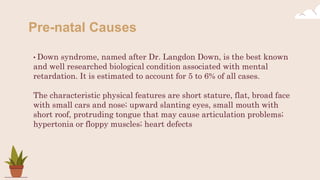
• Down syndrome, named after Dr. Langdon Down, is the best known
and well researched biological condition associated with mental
retardation. It is estimated to account for 5 to 6% of all cases.
The characteristic physical features are short stature, flat, broad face
with small cars and nose; upward slanting eyes, small mouth with
short roof, protruding tongue that may cause articulation problems;
hypertonia or floppy muscles; heart defects
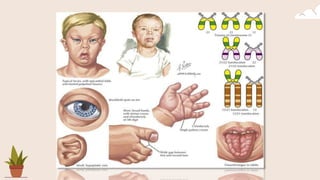
● Klinefelter syndrome, males receive an extra X chromosome. Sterility,
underdevelopment of male sex organs, acquisition of female secondary sex
characteristics are common. Males with XXY sex chromosomes instead of the
normal XY often have problems with social skills, auditory perception, language,
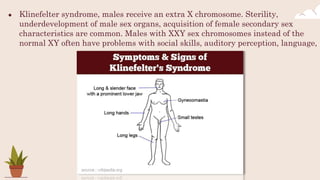
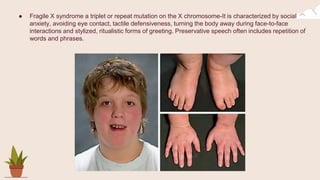
● Fragile X syndrome a triplet or repeat mutation on the X chromosome-It is characterized by social
anxiety, avoiding eye contact, tactile defensiveness, turning the body away during face-to-face
interactions and stylized, ritualistic forms of greeting. Preservative speech often includes repetition of
words and phrases.
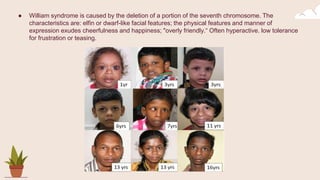
● William syndrome is caused by the deletion of a portion of the seventh chromosome. The
characteristics are: elfin or dwarf-like facial features; the physical features and manner of
expression exudes cheerfulness and happiness; "overly friendly.“ Often hyperactive. low tolerance
for frustration or teasing.
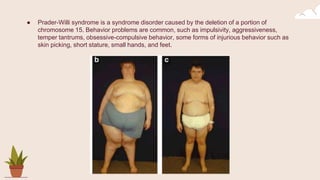
● Prader-Willi syndrome is a syndrome disorder caused by the deletion of a portion of
chromosome 15. Behavior problems are common, such as impulsivity, aggressiveness,
temper tantrums, obsessive-compulsive behavior, some forms of injurious behavior such as
skin picking, short stature, small hands, and feet.
• DEGENERATIVE DISORDERS
such as Rett syndrome, Humington's Disease,and Parkinson's
Disease.
• SEIZURE DISORDERS
Epilepsy, Toxic-Metabolic Disorder such asReye's
Syndrome and Mercury Poisoning.
• MALNUTRITON
Lack of protein and calories
• ENVIRONMENTAL DEPRIVATION
such as psychosocial disadvantage, chil abuse and neglect, chronic
social/sensory deprivation; and
• HYPOCONNECTION SYNDROME
CULTURAL FAMILIAL RETARDATION
Though there are specific and known
causes in some cases of mild mental
retardation, typically it is thought to
be cultural/ familial. The condition
results from the lack of adequate
stimulation during infancy and early
childhood.
There are deficits in cognitive functioning
that are associated with poor memory,
slow learning rates, attention problems,
difficulty at generalizing what has been
learned and lack of motivation.
LEARNING BEHAVIOR CHARACTERISTICS
DEFICITS IN IN COGNITIVE FUNCTIONING
• SUB-AVERAGE INTELLECTUAL SKILLS
The first defining characteristic of persons with
mental retardation is below average mental
ability as measured by standardized tests.
• LOW ACADEMIC ACHIEVEMENT
Due to sub-average intellectual function- ing,
persons with mental retardation are likely to be
slower in reaching levels of academic
achievement equal to their peers.
• DIFFICULTY IN ATTENDING TO TASK
These attention problems contribute to the
development of concomitant problems such as
difficulties in remembering and generalizing newly
learned lessons and skills.
DEFICITS IN MEMORY
• DIFFICULTY WITH THE GENERALIZATION OF
SKILLS
Students with mental retardation often have
trouble in transferring their new knowledge and
skills into settings or situa- tions that differ from
the context in which they first learned those
skills.
• LOW MOTIVATION
Some students show lack of interest in learning
their lessons.
• DEFICIT IN ADAPTIVE BEHAVIOR
Due to the fact that adaptation to one's social and
physical eenvironment requires intellectual ability,
persons with mental retardation are
strate significant deficits in adaptive behavior.
• SELF-CARE AND DAILY LIVING
SKILLS
They are often taught basic self-care skills
deliberately which normal individuals learn by
absorption and imitation.
• SOCIAL DEVELOPMENT
Limited cognitive processing skills, poor languag
development, and unusual or inappropriate
behaviors can seriously impede inter action with
others. Thus, making friends and sustaining personal
relationships a difficult for persons with mental
retardation.
• BEHAVIORAL EXCESSES AND
CHALLENGING BEHAVIORAL
Compared to children without disabilities, students
with mental retardation are more prone to inappro
priate behavior.
• PSYCHOLOGICAL CHARACTERISTICS
As in the case of speech and language
problems, mentally retarded persons have
slower psychological development and
are likely to have some forms of
associated physical problems.
• POSITIVE CHARACTERISTICS
Like everyone else, persons with mental
retar dation have their unique
characteristics. While they may have
negative attributes like those described
earlier, many of them have positive
characteristics like friend- liness and
kindness.
MODELS OF ASSESSMENT ( RICHEY AND WHEELER ,2000)
• TRADITIONAL ASSESSMENT
In the traditional assessment model, the parents
fill in a pre-referral form about the family history
and the developmental history of the child. Then
the child and parents are referred to a team of
clinical practitioners for thorough evaluation of the
child's intellectual, socio-emotional and physical
development, health condition and other
significant information.
TEAM-BASED ASSESSMENT
Because children with mental retardation
often have other problems, in necessary to
involve a team of practitioners from different
areas like the specian the traditional model of
assessment.
• MULTIDISCIPLINARY ASSESSMENT
TEAM-BASED ASSESSMENT
ALSO DDESCRIBE AS:
• INTERDISCIPLINARY ASSESSMENT
• TRANSDISCIPLINARY ASSESSMENT
ACTIVITY-BASES ASSESSMENT
COGNITIVE / DEVELOPMENTAL ASSESSMENT TOOLS
Some of the commonly used assessment tools for
measuring the mental ability of children with mental
retardationan are:
The Differential Ability Scales (DAS), Wechsler
Preschool and Primary Scale of Intelligence-
Revised (WPPSI R), Wechsler Intelligence Scale
for Children-III (WISC-III) and the Stanford Binet:
Fourth Edition. (Beirne-Smith et al., 2002)
ADAPTIVE BEHAVIORAL ASSESSMENT TOOLS
Adaptive behavior is an important and
necessary part of the definition and
diagnosis of mental retardation.
EDUCATIONAL PROGRAMS
• EARLY INTERVENTION
The provision of an early intervention program to children with
develop mental delays disabilities has gained wide acceptance in
the past decades. The child with mental retardation benefits from
an early intervention program. The skills that are normally learned
during early childhood are taught at a time when the child is still
young and more malleable than when he or she would have
grown older and less flexible.
RATIONALE FOR EARLY INTERVENTION
• During intervention secondary disabilities that would have gone unnoticed can be
observed.
• Early intervention services can prevent the occurrence of secondary disabilities.
• Early intervention services lessen the chances for placement in a residential school
since a child with the basic self-care and daily living skills has a good chance of
qualifying for placement in a special education program in regular school.
• As the family gains information about the disability the members learn how to offer
support and fulfill the child’s, for acceptance, love and belongingness very much like the
ways they behave wards the normal children in the family.
• Early intervention s hasten the child’s acquisition of the desirable learning and behavior
characterics for the attainment of his or her potential despite the presence of the
disability
MODELS OF EARLY INTERVENTION
• Home- based Instruction Program
The Philippine Association for the Retarded (PAR) composed
of special education specialists, parents and medical
practitioners initiated the development the Home-Based
Instruction Program for Children with Mental Retardation
1970s.
MODELS OF EARLY INTERVENTION
• Head Start Program
The Head Start Program in Manila City Schools
Division addresses school education for the socially
and economically deprived children who are four to six
years old. The program operates on the principle of
early intervention as a preventive measure against
behavior problems among young children may lead
ultimately to juvenile delinquency. The participants are
children siblings of youth offenders, slum dwellers,
street children and others of pre- school age.
• Community Based Rehabilitation (CBR) Programs
MODELS OF EARLY INTERVENTION
The World Health Organization (WHO, 1984)
defines community-based rehabilitation as
measures taken at the community level that
use and build on resources of the community
to assist in the rehabilitation of those who
need assistance including the disabled and
handicapped persons, their families and
community as a whole.
MODELS OF EARLY INTERVENTION
• URBAN BASIS PROGRAM
Children with disabilities who are not receiving
special education services were placed in the
program. Twenty to thirty parents were trained
yearly to implement early intervention at home as a
means of minimizing the effects of the disabilities
and increasing the children's readiness and
response to rehabilitation programs.
THE CURRICULUM
Students with mental retardation need a functional
curriculum that will them on the life skills which are
essentially the adaptive behavior skills. The goal and
direction of a functional curriculum is towards self-
direction and regu- lation and the ability to select
appropriate options in everyday life at home, in school
and in the community.
EDUCATIONAL APPROACH
COGNITIVE CURRICULUM FOR YOUNG CHILDREN ( CCYC )
Estimates of a child's maximum learning potential are
derived from his zone of proximal development that is
deter- mined by comparing the child's actual level of
performance to his performance under the teacher's direct
supervision.
INSTRUMENTAL ENRICHMENT PROGRAM
Instrumental Enrichment program wherein the child is
trained to develop a sense of intentionality and a
feeling of competence as a result of structured
mediated learning environments.91
MONTESSORI METHOD
The Montessori Method on the other hand, aims to develop
the child's sense of self mastery, mastery of the environment
and independence by focusing on his or her perceptual and
conceptual development as well as in the acquisition of skills
in self-care and daily living activities.
YPSILANTE PERRY PRE-SCHOOL PROJECT
Ypsilante Perry Preschool Project were derived from Piaget's
cognitive development theory. The cognitively oriented
curriculum is used in teaching disadvantaged children with
mild retardation who are three to four years old.
PORTAGE PROJECT
The Portage Project uses the precision teaching model
to deliver a home. based curriculum in language, self-
help skills, cognition, motor skills and socialization. The
parents are trained to teach their children using behavior
modification procedures.
CAROLINA’ S ABCEDARIAN PROJECT
The Carolina's Abcedarian Project includes parent training,
social work services, nutritional supplement, medical care and
transportation. Its curriculum is designed around the interaction
of consumer opinions or the goals that parents have for their
children, Piaget's developmental theory, developmental facts
(language, motor, socio-emotional, and cognitive/perceptive),
adaptive sets (winning strategies that generate age-appropriate
success) and high risked indicators (Hickson et al., 1995).
METHODS OF INSTRUCTION
• APPLIED BEHAVIORAL ANALYSIS (ABA)
• TASK ANALYSIS
• ACTIVE STUDENT RESPONSE (ASR)
Applied Behavioral Analysis (ABA) which is derived from the theory and principles of
behavior modification and the effect of the environment on the learning process.
Task analysis is the process of breaking down complex or multiple skills into smaller,
easier-to-learn subtasks. Direct and frequent measurement of the increments of
learning is done to keep track of the effects of instruction and to introduce needed
changes whenever necessary.
Active Student Response (ASR) or the observable response made to an instructional
antecedent is correlated to student achievement. Systematic feedback through
positive reinforcement is employed whenever needed by rewarding the student's
correct responses with simple positive comments, gestures or facial expressions.
SUGGESTIONS FOR THE SPECIAL EDUCATION TEACHERS AND THE REGULAR TEACHER IN
WHISE CLASES STUDENTS WITH MENTAL RETARDATION ARE MAINSTREAMED.
• Together, study the student's IEP and agree on the teachers' roles and responsibilities
to make inclusive education and mainstreaming work.
• Set regular meetings with each other, with the students or their families to assess how
effective the program is going and what else needs to be done.
• Encourage acceptance of the student by the classmates by setting an example and
giving the student the chance to show that he or she is morelike the others than
different.
• Use instructional procedures that will be of benefit to the student, such as
demonstrating the more complex and difficult tasks, and providing multiple opportunities
for practice.
• When teaching abstract concepts, provide multiple concrete examples.
• Supplement verbal instructions with demonstrations whenever possible.
• Assign a peer tutor to assist the student during independent activities.
• Vary the tasks in drills and practice activities.
• Encourage the use of computer-Based tutorials and other appropriate computer-based
materials.
• In class lectures, utilize the lecture-pause technique. Have a volunteer tape-record reading
assignments if the student is unable to read.
• Use cooperative learning strategies involving heterogeneous groups of students.
• Use multilayered activities involving flexible learning objectives to accommodate the needs
of students with diverse abilities.
• Pair students with mental retardation with non-disabled classmates who have similar
interests.
• Encourage regular students to assist the students with mental retardationas they participate
in class activities.
THANK YOU 😊

Mental Retardation.pptx

  • 1.
    MENTAL RETARDATION Docilbar, Lirah &Alcantara, Reenzy Jane BTLED 2
  • 2.
    What is MentalRetardation? • The American Association on Mental Retardation (AAMR) 1992 • Mental retardation refers to the substantial limitation on present functioning. • And was characterized by significantly sub-average intellectual functioning, existing concurrently with related animations in two or more of the adaptive skills. • This manifests before age 18 (Howard, 2003)
  • 4.
    FOUR CRITERIA: • Substantiallimitation in present functioning, person who is having difficulty in performing everyday activities. • Significantly sub-average intellectual functioning means that the person has significantly below average intelligence. • Limitations in the adaptive skills or behavior show in the quality of everyday performance in coping with environmental demands. • Related limitations in the adaptive skills areas means that the person has difficulty in performing the following tasks: (Beirne-Smith, 2002)
  • 5.
    1. Communication orthe ability to understand and communicate information by speaking and writing through symbol, sign language and non-symbolic behavior like facial expressions touch or gestures. 2. Self-care or the ability to take care of one's needs in hygiene, grooming, eating, toileting, dressing… 3. Home living or the ability to function in the home. 4. Community use or travel in the community, shopping, obtaining services.
  • 6.
    5. Special skillsin initiating and terminating interactions, convert responding to social cues, recognizing feelings. 6. Self-direction in making choices, following schedule, completing required tasks, seeking assistance. 7. Health and safety such as maintaining own health, identify and preventing illness, first aid and sexuality, physical fitness. 8. Functional academics or learning the basic skills taught in school. 9. Leisure such as recreational activities 10. Work or employment
  • 7.
    Heward (2003) citesfive essential assumptions in using the AAMR definition: 1. The existence of limitations in adaptive skills occurs within the context of community environments typical of the individual's age peers and is indexed to the person's individualized needs for supports. 2. . Valid assessment considers cultural and linguistic diversity, as well as differences in communication, sensory, motor, and behavioral factors 3. Specific adaptive limitations often coexist with strengths in other adap- tive skills or other personal capabilities. 4. The purpose of describing limitations often coexist with strengths. 5. With appropriate supports over a sustained period, the life-functioning of the person with mental retardation will generally improve.
  • 8.
  • 9.
    1. mild MRwith IQ scores from 55 to 7 2. moderate MR with IQ scores from 40 to 5 3. severe MR with IQ scores from 25 to 39, and 4. 4. profound MR with IQ scores below 25.
  • 10.
    Current books inspecial education use two classifications: 1. the milder forms of mental retardation, and 2. 2. the more severe forms of mental retardation that cluster the moder- ate, severe and profound types.The classifications "educable mental retardation" (EMR) and "trainable mental retardation" (TMR) are no longer used.
  • 11.
    The four categoriesof mental retardation according to the intensity of needed supports are: (Wehmeyer, 2002) 1. Intermittent supports are on "as needed" basis, that is, the person needs help only at certain periods of time and not all the time. 2. Limited supports are required consistently, though not on a daily basis. 3. Extensive supports are needed on a regular basis; daily supports are required in some environments, for example, daily home tasks. 4. 4. Pervasive supports are daily extensive supports, perhaps of a life
  • 12.
    Incidence and Prevalence Accordingto the AAMR 1973 definition, mental retardation can occur in 3% of a given population. Only about 15% of these children have greater than mild disabilities. Due to complications during pregnancy, birth and infancy, concomitant conditions associated with mental retardation may occur such as Down Syndrome, physical handicaps, speech impairment, visual impairment, hearing defects, epilepsy, and others.
  • 13.
    Causes of MentalRetardation • There are more than 250 identified causes of mental retardation. The AAMR classifies the causes or etiological factors based on time of onset, categorized as prenatal or biological (occurring before birth), perinatal (occurring during birth, and postnatal and environmental (occurring shortly after birth) (Ad Hoc Committee on Definitions and Terminology, 1992, cited in Heward, 2003). • Biological, Environmental, and Pre-natal Causes
  • 14.
    Biological • The termsyndrome refers to a number of symptoms or characteristics that occur together and provide the defining features of a given disease or condition. Environmental Causes • • The environmental causes are traced to a psychological disadvantage which is a combination of a poor social and cultural environments early in the child’s life.
  • 15.
    Factors that contributing: Thefactors are found to contribute to environmentally caused mental retardation (Greenspan, et al. 1994): 1. limited parenting practices that produce low rates of vocabulary growth in early childhood; 2. Instructional practices in high school and adolescence that produce low rates of academic engagement during the school years; 3. Lower rates of academic achievement and early school failure and early school dropout; and 4. Parenthood and continuance of the progression into the next generation.
  • 16.
    Pre-natal Causes • Downsyndrome, named after Dr. Langdon Down, is the best known and well researched biological condition associated with mental retardation. It is estimated to account for 5 to 6% of all cases. The characteristic physical features are short stature, flat, broad face with small cars and nose; upward slanting eyes, small mouth with short roof, protruding tongue that may cause articulation problems; hypertonia or floppy muscles; heart defects
  • 18.
    ● Klinefelter syndrome,males receive an extra X chromosome. Sterility, underdevelopment of male sex organs, acquisition of female secondary sex characteristics are common. Males with XXY sex chromosomes instead of the normal XY often have problems with social skills, auditory perception, language,
  • 19.
    ● Fragile Xsyndrome a triplet or repeat mutation on the X chromosome-It is characterized by social anxiety, avoiding eye contact, tactile defensiveness, turning the body away during face-to-face interactions and stylized, ritualistic forms of greeting. Preservative speech often includes repetition of words and phrases.
  • 20.
    ● William syndromeis caused by the deletion of a portion of the seventh chromosome. The characteristics are: elfin or dwarf-like facial features; the physical features and manner of expression exudes cheerfulness and happiness; "overly friendly.“ Often hyperactive. low tolerance for frustration or teasing.
  • 21.
    ● Prader-Willi syndromeis a syndrome disorder caused by the deletion of a portion of chromosome 15. Behavior problems are common, such as impulsivity, aggressiveness, temper tantrums, obsessive-compulsive behavior, some forms of injurious behavior such as skin picking, short stature, small hands, and feet.
  • 22.
    • DEGENERATIVE DISORDERS suchas Rett syndrome, Humington's Disease,and Parkinson's Disease. • SEIZURE DISORDERS Epilepsy, Toxic-Metabolic Disorder such asReye's Syndrome and Mercury Poisoning.
  • 23.
    • MALNUTRITON Lack ofprotein and calories • ENVIRONMENTAL DEPRIVATION such as psychosocial disadvantage, chil abuse and neglect, chronic social/sensory deprivation; and • HYPOCONNECTION SYNDROME
  • 24.
    CULTURAL FAMILIAL RETARDATION Thoughthere are specific and known causes in some cases of mild mental retardation, typically it is thought to be cultural/ familial. The condition results from the lack of adequate stimulation during infancy and early childhood.
  • 25.
    There are deficitsin cognitive functioning that are associated with poor memory, slow learning rates, attention problems, difficulty at generalizing what has been learned and lack of motivation. LEARNING BEHAVIOR CHARACTERISTICS
  • 26.
    DEFICITS IN INCOGNITIVE FUNCTIONING • SUB-AVERAGE INTELLECTUAL SKILLS The first defining characteristic of persons with mental retardation is below average mental ability as measured by standardized tests.
  • 27.
    • LOW ACADEMICACHIEVEMENT Due to sub-average intellectual function- ing, persons with mental retardation are likely to be slower in reaching levels of academic achievement equal to their peers. • DIFFICULTY IN ATTENDING TO TASK These attention problems contribute to the development of concomitant problems such as difficulties in remembering and generalizing newly learned lessons and skills.
  • 28.
    DEFICITS IN MEMORY •DIFFICULTY WITH THE GENERALIZATION OF SKILLS Students with mental retardation often have trouble in transferring their new knowledge and skills into settings or situa- tions that differ from the context in which they first learned those skills.
  • 29.
    • LOW MOTIVATION Somestudents show lack of interest in learning their lessons. • DEFICIT IN ADAPTIVE BEHAVIOR Due to the fact that adaptation to one's social and physical eenvironment requires intellectual ability, persons with mental retardation are strate significant deficits in adaptive behavior.
  • 30.
    • SELF-CARE ANDDAILY LIVING SKILLS They are often taught basic self-care skills deliberately which normal individuals learn by absorption and imitation.
  • 31.
    • SOCIAL DEVELOPMENT Limitedcognitive processing skills, poor languag development, and unusual or inappropriate behaviors can seriously impede inter action with others. Thus, making friends and sustaining personal relationships a difficult for persons with mental retardation.
  • 32.
    • BEHAVIORAL EXCESSESAND CHALLENGING BEHAVIORAL Compared to children without disabilities, students with mental retardation are more prone to inappro priate behavior.
  • 33.
    • PSYCHOLOGICAL CHARACTERISTICS Asin the case of speech and language problems, mentally retarded persons have slower psychological development and are likely to have some forms of associated physical problems.
  • 34.
    • POSITIVE CHARACTERISTICS Likeeveryone else, persons with mental retar dation have their unique characteristics. While they may have negative attributes like those described earlier, many of them have positive characteristics like friend- liness and kindness.
  • 35.
    MODELS OF ASSESSMENT( RICHEY AND WHEELER ,2000) • TRADITIONAL ASSESSMENT In the traditional assessment model, the parents fill in a pre-referral form about the family history and the developmental history of the child. Then the child and parents are referred to a team of clinical practitioners for thorough evaluation of the child's intellectual, socio-emotional and physical development, health condition and other significant information.
  • 36.
    TEAM-BASED ASSESSMENT Because childrenwith mental retardation often have other problems, in necessary to involve a team of practitioners from different areas like the specian the traditional model of assessment.
  • 37.
    • MULTIDISCIPLINARY ASSESSMENT TEAM-BASEDASSESSMENT ALSO DDESCRIBE AS: • INTERDISCIPLINARY ASSESSMENT • TRANSDISCIPLINARY ASSESSMENT
  • 38.
  • 39.
    COGNITIVE / DEVELOPMENTALASSESSMENT TOOLS Some of the commonly used assessment tools for measuring the mental ability of children with mental retardationan are: The Differential Ability Scales (DAS), Wechsler Preschool and Primary Scale of Intelligence- Revised (WPPSI R), Wechsler Intelligence Scale for Children-III (WISC-III) and the Stanford Binet: Fourth Edition. (Beirne-Smith et al., 2002)
  • 40.
    ADAPTIVE BEHAVIORAL ASSESSMENTTOOLS Adaptive behavior is an important and necessary part of the definition and diagnosis of mental retardation.
  • 41.
    EDUCATIONAL PROGRAMS • EARLYINTERVENTION The provision of an early intervention program to children with develop mental delays disabilities has gained wide acceptance in the past decades. The child with mental retardation benefits from an early intervention program. The skills that are normally learned during early childhood are taught at a time when the child is still young and more malleable than when he or she would have grown older and less flexible.
  • 42.
    RATIONALE FOR EARLYINTERVENTION • During intervention secondary disabilities that would have gone unnoticed can be observed. • Early intervention services can prevent the occurrence of secondary disabilities. • Early intervention services lessen the chances for placement in a residential school since a child with the basic self-care and daily living skills has a good chance of qualifying for placement in a special education program in regular school. • As the family gains information about the disability the members learn how to offer support and fulfill the child’s, for acceptance, love and belongingness very much like the ways they behave wards the normal children in the family. • Early intervention s hasten the child’s acquisition of the desirable learning and behavior characterics for the attainment of his or her potential despite the presence of the disability
  • 43.
    MODELS OF EARLYINTERVENTION • Home- based Instruction Program The Philippine Association for the Retarded (PAR) composed of special education specialists, parents and medical practitioners initiated the development the Home-Based Instruction Program for Children with Mental Retardation 1970s.
  • 44.
    MODELS OF EARLYINTERVENTION • Head Start Program The Head Start Program in Manila City Schools Division addresses school education for the socially and economically deprived children who are four to six years old. The program operates on the principle of early intervention as a preventive measure against behavior problems among young children may lead ultimately to juvenile delinquency. The participants are children siblings of youth offenders, slum dwellers, street children and others of pre- school age.
  • 45.
    • Community BasedRehabilitation (CBR) Programs MODELS OF EARLY INTERVENTION The World Health Organization (WHO, 1984) defines community-based rehabilitation as measures taken at the community level that use and build on resources of the community to assist in the rehabilitation of those who need assistance including the disabled and handicapped persons, their families and community as a whole.
  • 46.
    MODELS OF EARLYINTERVENTION • URBAN BASIS PROGRAM Children with disabilities who are not receiving special education services were placed in the program. Twenty to thirty parents were trained yearly to implement early intervention at home as a means of minimizing the effects of the disabilities and increasing the children's readiness and response to rehabilitation programs.
  • 47.
    THE CURRICULUM Students withmental retardation need a functional curriculum that will them on the life skills which are essentially the adaptive behavior skills. The goal and direction of a functional curriculum is towards self- direction and regu- lation and the ability to select appropriate options in everyday life at home, in school and in the community. EDUCATIONAL APPROACH
  • 48.
    COGNITIVE CURRICULUM FORYOUNG CHILDREN ( CCYC ) Estimates of a child's maximum learning potential are derived from his zone of proximal development that is deter- mined by comparing the child's actual level of performance to his performance under the teacher's direct supervision.
  • 49.
    INSTRUMENTAL ENRICHMENT PROGRAM InstrumentalEnrichment program wherein the child is trained to develop a sense of intentionality and a feeling of competence as a result of structured mediated learning environments.91
  • 50.
    MONTESSORI METHOD The MontessoriMethod on the other hand, aims to develop the child's sense of self mastery, mastery of the environment and independence by focusing on his or her perceptual and conceptual development as well as in the acquisition of skills in self-care and daily living activities.
  • 51.
    YPSILANTE PERRY PRE-SCHOOLPROJECT Ypsilante Perry Preschool Project were derived from Piaget's cognitive development theory. The cognitively oriented curriculum is used in teaching disadvantaged children with mild retardation who are three to four years old.
  • 52.
    PORTAGE PROJECT The PortageProject uses the precision teaching model to deliver a home. based curriculum in language, self- help skills, cognition, motor skills and socialization. The parents are trained to teach their children using behavior modification procedures.
  • 53.
    CAROLINA’ S ABCEDARIANPROJECT The Carolina's Abcedarian Project includes parent training, social work services, nutritional supplement, medical care and transportation. Its curriculum is designed around the interaction of consumer opinions or the goals that parents have for their children, Piaget's developmental theory, developmental facts (language, motor, socio-emotional, and cognitive/perceptive), adaptive sets (winning strategies that generate age-appropriate success) and high risked indicators (Hickson et al., 1995).
  • 54.
    METHODS OF INSTRUCTION •APPLIED BEHAVIORAL ANALYSIS (ABA) • TASK ANALYSIS • ACTIVE STUDENT RESPONSE (ASR) Applied Behavioral Analysis (ABA) which is derived from the theory and principles of behavior modification and the effect of the environment on the learning process. Task analysis is the process of breaking down complex or multiple skills into smaller, easier-to-learn subtasks. Direct and frequent measurement of the increments of learning is done to keep track of the effects of instruction and to introduce needed changes whenever necessary. Active Student Response (ASR) or the observable response made to an instructional antecedent is correlated to student achievement. Systematic feedback through positive reinforcement is employed whenever needed by rewarding the student's correct responses with simple positive comments, gestures or facial expressions.
  • 55.
    SUGGESTIONS FOR THESPECIAL EDUCATION TEACHERS AND THE REGULAR TEACHER IN WHISE CLASES STUDENTS WITH MENTAL RETARDATION ARE MAINSTREAMED. • Together, study the student's IEP and agree on the teachers' roles and responsibilities to make inclusive education and mainstreaming work. • Set regular meetings with each other, with the students or their families to assess how effective the program is going and what else needs to be done. • Encourage acceptance of the student by the classmates by setting an example and giving the student the chance to show that he or she is morelike the others than different. • Use instructional procedures that will be of benefit to the student, such as demonstrating the more complex and difficult tasks, and providing multiple opportunities for practice. • When teaching abstract concepts, provide multiple concrete examples.
  • 56.
    • Supplement verbalinstructions with demonstrations whenever possible. • Assign a peer tutor to assist the student during independent activities. • Vary the tasks in drills and practice activities. • Encourage the use of computer-Based tutorials and other appropriate computer-based materials. • In class lectures, utilize the lecture-pause technique. Have a volunteer tape-record reading assignments if the student is unable to read. • Use cooperative learning strategies involving heterogeneous groups of students. • Use multilayered activities involving flexible learning objectives to accommodate the needs of students with diverse abilities. • Pair students with mental retardation with non-disabled classmates who have similar interests. • Encourage regular students to assist the students with mental retardationas they participate in class activities.
  • 57.