BEHAVIOR THERAPY
PRESENTED BY:
MS. MONIKA KANWAR
NURSING TUTOR
M.SC. (N) [MENTAL HEALTH NURSING]
INTRODUCTION
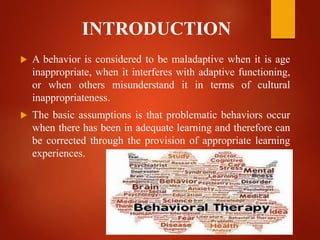
 A behavior is considered to be maladaptive when it is age
inappropriate, when it interferes with adaptive functioning,
or when others misunderstand it in terms of cultural
inappropriateness.
 The basic assumptions is that problematic behaviors occur
when there has been in adequate learning and therefore can
be corrected through the provision of appropriate learning
experiences.
CONTD….
 The principles of behavior therapy as we know it today
are based on the early studies of Classical Conditioning
by Pavlov (1927) and Operant Conditioning by Skinner
(1938).
 Behavioral therapy is an umbrella term for types of
therapy that treat mental health disorders. Behavioral
therapy can vary substantially from disorder to disorder.
This form of therapy seeks to identify and help change
potentially self-destructive or unhealthy behaviors. It is
also called as behavior modification.
CONTD….
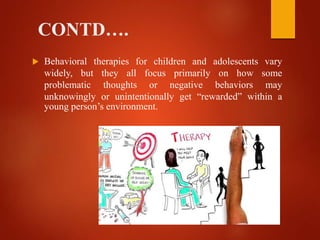
 Behavioral therapies for children and adolescents vary
widely, but they all focus primarily on how some
problematic thoughts or negative behaviors may
unknowingly or unintentionally get “rewarded” within a
young person’s environment.
DEFINITION
 THERAPY: Therapy (Psychotherapy) is the process of working with
licensed therapist to develop positive thinking and coping skills and
treat mental health issues such as mental illness and trauma.
 BEHAVIORAL THERAPY: It is a form of Psychotherapy, the goal
of which is to modify maladaptive behavior patterns by reinforcing
more adaptive behavior.
OR
Behavior therapy is a type of psychotherapy which is based on theories
of learning, and aims at modifying maladaptive behavior and
substituting it with adaptive behavior.
CONTD….
Behavior therapy is a form of treatment that tries to change
someone’s behaviour rather than treat the cause of it.
OR
Behavior therapy is the attempt to alter human behavior and
emotions in a beneficial way according to the laws of modern
learning theory.
ACCORDING TO EYSENCK’S
PRINCIPLES OF
BEHAVIORAL THERAPY
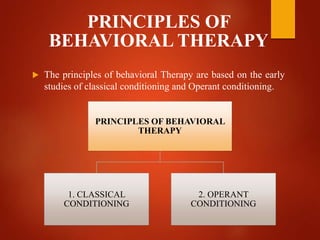
 The principles of behavioral Therapy are based on the early
studies of classical conditioning and Operant conditioning.
PRINCIPLES OF BEHAVIORAL
THERAPY
1. CLASSICAL
CONDITIONING
2. OPERANT
CONDITIONING
CONTD…..
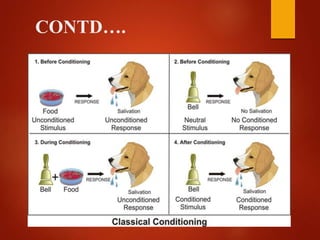
1. THEORY OF CLASSICAL CONDITIONING:
 Classical conditioning is a process of learning and was introduced
by the Russian Psychologist Pavlov.
 It is a term used to describe learning which has been acquired
through experience.
 Theory of Classical Conditioning involves learning by association
and is usually the cause of most phobias.
 During his experiments, Pavlov hoped to leran more about the
digestive process, he inadvertently discovered that organisms can
learn to respond in specific ways if they are conditioned to do so.
 It refers to a learning procedure in which a biologically potent
stimulus (e.g. food) is paired with a previously neutral stimulus.
CONTD….
CONTD….
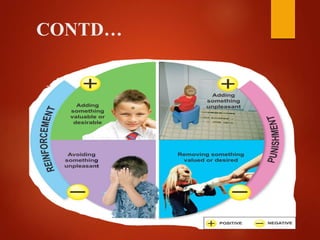
2. OPERANT CONDITIONING:
 The focus of operant conditioning differs from that of
classical conditioning.
 It was introduced by Skinner. It involves learning by
reinforcement
 It is based on the idea that an individual will choose his
behavior based on past experience of consequences of that
behavior.
CONTD…
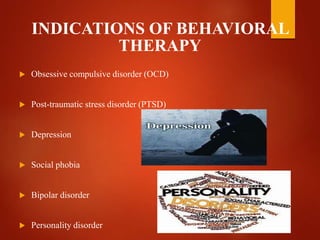
INDICATIONS OF BEHAVIORAL
THERAPY
 Obsessive compulsive disorder (OCD)
 Post-traumatic stress disorder (PTSD)
 Depression
 Social phobia
 Bipolar disorder
 Personality disorder
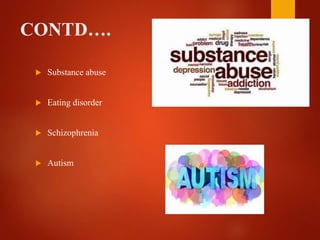
CONTD….
 Substance abuse
 Eating disorder
 Schizophrenia
 Autism
MAJOR ASSUMPTIONS OF
BEHAVIOR THERAPY
 All behavior is learned (adaptive and maladaptive).
 Human beings are passive organisms that can be conditioned
or shaped to do anything if correct responses are rewarded or
reinforced.
 Maladaptive behavior can be unlearned and replaced by
adaptive behavior if the person receives exposure to specific
stimuli and reinforcement for the desired adaptive behavior.
CONTD….
 Behavioral assessment is focused more on current behavior rather
than on historical antecedents.
 Treatment strategies are individually tailored.
Behavior therapy is a short duration therapy, therapists are easy to
train and is cost-effective. The total duration of therapy is
usually 6-8 weeks. Initial sessions are given daily, but the later
sessions are spaced out.
CONTD….
1. SHAPING: In shaping the components of a particular skill, the
behavior is reinforced step by step. The therapist starts shaping
by reinforcing, the existing behavior.
 Once it is established, therapist reinforces the responses which are
closest to the desired behavior and ignores the other responses.
 Instead of rewarding only the desired behavior, therapist reward
successive approximations of desired behavior.
 e.g. In eliciting speech from autistic child, the teacher may first
reward the child for:
(a) watching the teacher’s lips, then for
(b) making any sound in imitation of the teacher, then for
(c) Forming sounds similar to the word uttered by the teacher.
CONTD….
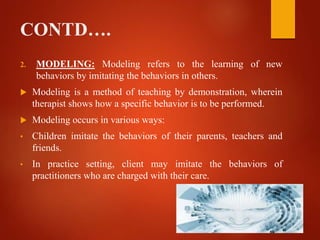
2. MODELING: Modeling refers to the learning of new
behaviors by imitating the behaviors in others.
 Modeling is a method of teaching by demonstration, wherein
therapist shows how a specific behavior is to be performed.
 Modeling occurs in various ways:
• Children imitate the behaviors of their parents, teachers and
friends.
• In practice setting, client may imitate the behaviors of
practitioners who are charged with their care.
CONTD….
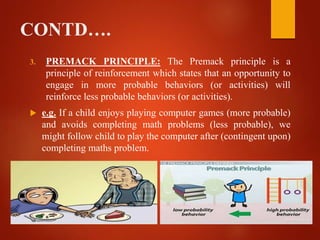
3. PREMACK PRINCIPLE: The Premack principle is a
principle of reinforcement which states that an opportunity to
engage in more probable behaviors (or activities) will
reinforce less probable behaviors (or activities).
 e.g. If a child enjoys playing computer games (more probable)
and avoids completing math problems (less probable), we
might follow child to play the computer after (contingent upon)
completing maths problem.
CONTD….
4. EXTINCTION/IGNORING: It is gradual decrease in
frequency or disappearance of response when the positive
reinforcement is withheld.
 e.g. Temper tantrum Child
The tantrum behaviors continue as long as the parent gives
attention to them but decrease and often disappear when the
parent simply leaves the child alone in the room.
CONTD….
5. CONTINGENCY CONTRACTING: It is a type of
intervention that is used to increase desirable behaviors or
decrease undesirable ones.
 A contingency contract may be entered into by a teacher and
student, a parent and child, or a therapist and client
 e.g. A parent and child enter into a contingency contract to get
the child finish his homework before dinner time, after which
he earns some TV time. Every time he satisfactorily finishes his
homework before dinner time, he gets to watch an hour of TV
after dinner. If he fails to finish his homework satisfactorily,
then instead of enjoying some TV time, he has to use that time
to finish his homework.
CONTD….
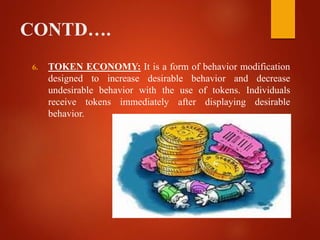
6. TOKEN ECONOMY: It is a form of behavior modification
designed to increase desirable behavior and decrease
undesirable behavior with the use of tokens. Individuals
receive tokens immediately after displaying desirable
behavior.
CONTD….
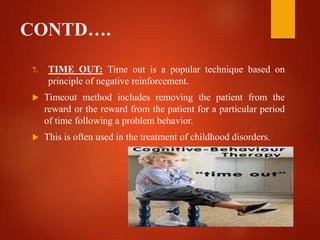
7. TIME OUT: Time out is a popular technique based on
principle of negative reinforcement.
 Timeout method includes removing the patient from the
reward or the reward from the patient for a particular period
of time following a problem behavior.
 This is often used in the treatment of childhood disorders.
CONTD….
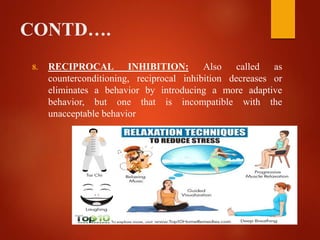
8. RECIPROCAL INHIBITION: Also called as
counterconditioning, reciprocal inhibition decreases or
eliminates a behavior by introducing a more adaptive
behavior, but one that is incompatible with the
unacceptable behavior
CONTD….
 e.g. Introduction of relaxation exercises to an
individual who is phobic. Relaxation is practiced in the
presence of anxiety so that in the time the individual is
able to manage the anxiety in the presence of phobic
stimulus by engaging in relaxation exercises.
Relaxation and anxiety are incompatible behaviors
CONTD….
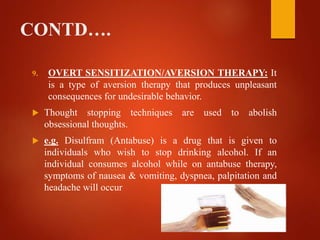
9. OVERT SENSITIZATION/AVERSION THERAPY: It
is a type of aversion therapy that produces unpleasant
consequences for undesirable behavior.
 Thought stopping techniques are used to abolish
obsessional thoughts.
 e.g. Disulfram (Antabuse) is a drug that is given to
individuals who wish to stop drinking alcohol. If an
individual consumes alcohol while on antabuse therapy,
symptoms of nausea & vomiting, dyspnea, palpitation and
headache will occur
CONTD….
10. COVERT SENSITIZATION: It relies on the individual’s
imagination, rather than on medication, to produce
unpleasant symptoms. The technique is under client’s
control and can be used whenever and wherever is required.
 It is form of behavior therapy in which an undesirable
behavior is paired with an unpleasant image in order to
eliminate that behavior.
CONTD….
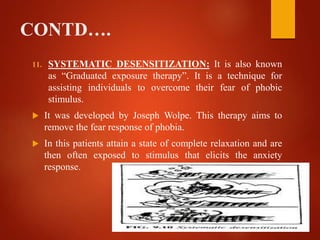
11. SYSTEMATIC DESENSITIZATION: It is also known
as “Graduated exposure therapy”. It is a technique for
assisting individuals to overcome their fear of phobic
stimulus.
 It was developed by Joseph Wolpe. This therapy aims to
remove the fear response of phobia.
 In this patients attain a state of complete relaxation and are
then often exposed to stimulus that elicits the anxiety
response.
CONTD….
The process of systematic desensitization occurs in three
steps:
 RELAXATION TRAINING: There are many methods
which can be used to induce relaxation. Some of them are
Jacobson’s progressive muscle relaxation, Hypnosis,
Meditation or Yoga, Mental Imagery and Biofeedback
 HIERARCHY CONSTRUCTION: Here the patient is
asked to list all the conditions which provoke anxiety. Then
he is asked to list them in a descending order of anxiety
provocation.
CONTD….
 DESENSITIZATION OF THE STIMULUS: This can
either be done in reality or through imagination. At first, the
lowest item in hierarchy is confronted. The patient is
advised to signal whenever anxiety is produced. With each
signal he is asked to relax. After a few trials individual is
able to control anxiety gradually.
CONTD….
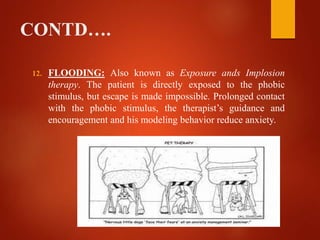
12. FLOODING: Also known as Exposure ands Implosion
therapy. The patient is directly exposed to the phobic
stimulus, but escape is made impossible. Prolonged contact
with the phobic stimulus, the therapist’s guidance and
encouragement and his modeling behavior reduce anxiety.
CONTD….
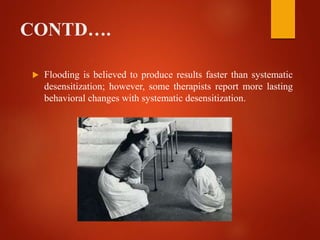
 Flooding is believed to produce results faster than systematic
desensitization; however, some therapists report more lasting
behavioral changes with systematic desensitization.
CONTD….
13. CHAINING: Chaining is used when a person fails to
perform a task. The complex task is broken into a number
of small steps and each step is taught to the patient.
 In forward Chaining, one starts with the first step, goes on to
the second step, then to third and so on.
 In backward Chaining, One starts with the last step and goes
on to the next step in a backward fashion. Backward
chaining is found to be more effective in training the
mentally disableled.
CONTD….
14. RESTITUTION (OVERCORRECTION): Restitution
means restoring the disturbed situation to a state that is
much better than what it was before the occurrence of the
problem behavior.
 E.g.: If a patient passes urine in the ward he would be
required to not only clean the dirty area but also mop the
entire/larger area of the floor in the ward.
CONTD….
15. BEHAVIORAL HOMEWORK ASSIGNMENTS: The
therapist often requests that the patient complete homework
assignment between therapy sessions. These may consists of
real life behavioral experiments where patients after
encouraged to try new responses to situations discussed in
therapy sessions.
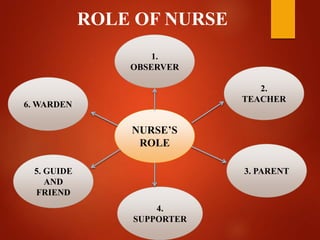
ROLE OF NURSE
NURSE’S
ROLE
1.
OBSERVER
2.
TEACHER
3. PARENT
4.
SUPPORTER
5. GUIDE
AND
FRIEND
6. WARDEN
SUMMARIZATION
 Introduction
 Definition
 Principles
 Indications
 Techniques
 Role of Nurse
Behavioral therapy

Behavioral therapy

  • 1.
    BEHAVIOR THERAPY PRESENTED BY: MS.MONIKA KANWAR NURSING TUTOR M.SC. (N) [MENTAL HEALTH NURSING]
  • 3.
    INTRODUCTION  A behavioris considered to be maladaptive when it is age inappropriate, when it interferes with adaptive functioning, or when others misunderstand it in terms of cultural inappropriateness.  The basic assumptions is that problematic behaviors occur when there has been in adequate learning and therefore can be corrected through the provision of appropriate learning experiences.
  • 4.
    CONTD….  The principlesof behavior therapy as we know it today are based on the early studies of Classical Conditioning by Pavlov (1927) and Operant Conditioning by Skinner (1938).  Behavioral therapy is an umbrella term for types of therapy that treat mental health disorders. Behavioral therapy can vary substantially from disorder to disorder. This form of therapy seeks to identify and help change potentially self-destructive or unhealthy behaviors. It is also called as behavior modification.
  • 5.
    CONTD….  Behavioral therapiesfor children and adolescents vary widely, but they all focus primarily on how some problematic thoughts or negative behaviors may unknowingly or unintentionally get “rewarded” within a young person’s environment.
  • 7.
    DEFINITION  THERAPY: Therapy(Psychotherapy) is the process of working with licensed therapist to develop positive thinking and coping skills and treat mental health issues such as mental illness and trauma.  BEHAVIORAL THERAPY: It is a form of Psychotherapy, the goal of which is to modify maladaptive behavior patterns by reinforcing more adaptive behavior. OR Behavior therapy is a type of psychotherapy which is based on theories of learning, and aims at modifying maladaptive behavior and substituting it with adaptive behavior.
  • 8.
    CONTD…. Behavior therapy isa form of treatment that tries to change someone’s behaviour rather than treat the cause of it. OR Behavior therapy is the attempt to alter human behavior and emotions in a beneficial way according to the laws of modern learning theory. ACCORDING TO EYSENCK’S
  • 10.
    PRINCIPLES OF BEHAVIORAL THERAPY The principles of behavioral Therapy are based on the early studies of classical conditioning and Operant conditioning. PRINCIPLES OF BEHAVIORAL THERAPY 1. CLASSICAL CONDITIONING 2. OPERANT CONDITIONING
  • 11.
    CONTD….. 1. THEORY OFCLASSICAL CONDITIONING:  Classical conditioning is a process of learning and was introduced by the Russian Psychologist Pavlov.  It is a term used to describe learning which has been acquired through experience.  Theory of Classical Conditioning involves learning by association and is usually the cause of most phobias.  During his experiments, Pavlov hoped to leran more about the digestive process, he inadvertently discovered that organisms can learn to respond in specific ways if they are conditioned to do so.  It refers to a learning procedure in which a biologically potent stimulus (e.g. food) is paired with a previously neutral stimulus.
  • 12.
  • 13.
    CONTD…. 2. OPERANT CONDITIONING: The focus of operant conditioning differs from that of classical conditioning.  It was introduced by Skinner. It involves learning by reinforcement  It is based on the idea that an individual will choose his behavior based on past experience of consequences of that behavior.
  • 14.
  • 16.
    INDICATIONS OF BEHAVIORAL THERAPY Obsessive compulsive disorder (OCD)  Post-traumatic stress disorder (PTSD)  Depression  Social phobia  Bipolar disorder  Personality disorder
  • 17.
    CONTD….  Substance abuse Eating disorder  Schizophrenia  Autism
  • 19.
    MAJOR ASSUMPTIONS OF BEHAVIORTHERAPY  All behavior is learned (adaptive and maladaptive).  Human beings are passive organisms that can be conditioned or shaped to do anything if correct responses are rewarded or reinforced.  Maladaptive behavior can be unlearned and replaced by adaptive behavior if the person receives exposure to specific stimuli and reinforcement for the desired adaptive behavior.
  • 20.
    CONTD….  Behavioral assessmentis focused more on current behavior rather than on historical antecedents.  Treatment strategies are individually tailored. Behavior therapy is a short duration therapy, therapists are easy to train and is cost-effective. The total duration of therapy is usually 6-8 weeks. Initial sessions are given daily, but the later sessions are spaced out.
  • 22.
    CONTD…. 1. SHAPING: Inshaping the components of a particular skill, the behavior is reinforced step by step. The therapist starts shaping by reinforcing, the existing behavior.  Once it is established, therapist reinforces the responses which are closest to the desired behavior and ignores the other responses.  Instead of rewarding only the desired behavior, therapist reward successive approximations of desired behavior.  e.g. In eliciting speech from autistic child, the teacher may first reward the child for: (a) watching the teacher’s lips, then for (b) making any sound in imitation of the teacher, then for (c) Forming sounds similar to the word uttered by the teacher.
  • 23.
    CONTD…. 2. MODELING: Modelingrefers to the learning of new behaviors by imitating the behaviors in others.  Modeling is a method of teaching by demonstration, wherein therapist shows how a specific behavior is to be performed.  Modeling occurs in various ways: • Children imitate the behaviors of their parents, teachers and friends. • In practice setting, client may imitate the behaviors of practitioners who are charged with their care.
  • 24.
    CONTD…. 3. PREMACK PRINCIPLE:The Premack principle is a principle of reinforcement which states that an opportunity to engage in more probable behaviors (or activities) will reinforce less probable behaviors (or activities).  e.g. If a child enjoys playing computer games (more probable) and avoids completing math problems (less probable), we might follow child to play the computer after (contingent upon) completing maths problem.
  • 25.
    CONTD…. 4. EXTINCTION/IGNORING: Itis gradual decrease in frequency or disappearance of response when the positive reinforcement is withheld.  e.g. Temper tantrum Child The tantrum behaviors continue as long as the parent gives attention to them but decrease and often disappear when the parent simply leaves the child alone in the room.
  • 26.
    CONTD…. 5. CONTINGENCY CONTRACTING:It is a type of intervention that is used to increase desirable behaviors or decrease undesirable ones.  A contingency contract may be entered into by a teacher and student, a parent and child, or a therapist and client  e.g. A parent and child enter into a contingency contract to get the child finish his homework before dinner time, after which he earns some TV time. Every time he satisfactorily finishes his homework before dinner time, he gets to watch an hour of TV after dinner. If he fails to finish his homework satisfactorily, then instead of enjoying some TV time, he has to use that time to finish his homework.
  • 27.
    CONTD…. 6. TOKEN ECONOMY:It is a form of behavior modification designed to increase desirable behavior and decrease undesirable behavior with the use of tokens. Individuals receive tokens immediately after displaying desirable behavior.
  • 28.
    CONTD…. 7. TIME OUT:Time out is a popular technique based on principle of negative reinforcement.  Timeout method includes removing the patient from the reward or the reward from the patient for a particular period of time following a problem behavior.  This is often used in the treatment of childhood disorders.
  • 29.
    CONTD…. 8. RECIPROCAL INHIBITION:Also called as counterconditioning, reciprocal inhibition decreases or eliminates a behavior by introducing a more adaptive behavior, but one that is incompatible with the unacceptable behavior
  • 30.
    CONTD….  e.g. Introductionof relaxation exercises to an individual who is phobic. Relaxation is practiced in the presence of anxiety so that in the time the individual is able to manage the anxiety in the presence of phobic stimulus by engaging in relaxation exercises. Relaxation and anxiety are incompatible behaviors
  • 31.
    CONTD…. 9. OVERT SENSITIZATION/AVERSIONTHERAPY: It is a type of aversion therapy that produces unpleasant consequences for undesirable behavior.  Thought stopping techniques are used to abolish obsessional thoughts.  e.g. Disulfram (Antabuse) is a drug that is given to individuals who wish to stop drinking alcohol. If an individual consumes alcohol while on antabuse therapy, symptoms of nausea & vomiting, dyspnea, palpitation and headache will occur
  • 32.
    CONTD…. 10. COVERT SENSITIZATION:It relies on the individual’s imagination, rather than on medication, to produce unpleasant symptoms. The technique is under client’s control and can be used whenever and wherever is required.  It is form of behavior therapy in which an undesirable behavior is paired with an unpleasant image in order to eliminate that behavior.
  • 33.
    CONTD…. 11. SYSTEMATIC DESENSITIZATION:It is also known as “Graduated exposure therapy”. It is a technique for assisting individuals to overcome their fear of phobic stimulus.  It was developed by Joseph Wolpe. This therapy aims to remove the fear response of phobia.  In this patients attain a state of complete relaxation and are then often exposed to stimulus that elicits the anxiety response.
  • 34.
    CONTD…. The process ofsystematic desensitization occurs in three steps:  RELAXATION TRAINING: There are many methods which can be used to induce relaxation. Some of them are Jacobson’s progressive muscle relaxation, Hypnosis, Meditation or Yoga, Mental Imagery and Biofeedback  HIERARCHY CONSTRUCTION: Here the patient is asked to list all the conditions which provoke anxiety. Then he is asked to list them in a descending order of anxiety provocation.
  • 35.
    CONTD….  DESENSITIZATION OFTHE STIMULUS: This can either be done in reality or through imagination. At first, the lowest item in hierarchy is confronted. The patient is advised to signal whenever anxiety is produced. With each signal he is asked to relax. After a few trials individual is able to control anxiety gradually.
  • 36.
    CONTD…. 12. FLOODING: Alsoknown as Exposure ands Implosion therapy. The patient is directly exposed to the phobic stimulus, but escape is made impossible. Prolonged contact with the phobic stimulus, the therapist’s guidance and encouragement and his modeling behavior reduce anxiety.
  • 37.
    CONTD….  Flooding isbelieved to produce results faster than systematic desensitization; however, some therapists report more lasting behavioral changes with systematic desensitization.
  • 38.
    CONTD…. 13. CHAINING: Chainingis used when a person fails to perform a task. The complex task is broken into a number of small steps and each step is taught to the patient.  In forward Chaining, one starts with the first step, goes on to the second step, then to third and so on.  In backward Chaining, One starts with the last step and goes on to the next step in a backward fashion. Backward chaining is found to be more effective in training the mentally disableled.
  • 39.
    CONTD…. 14. RESTITUTION (OVERCORRECTION):Restitution means restoring the disturbed situation to a state that is much better than what it was before the occurrence of the problem behavior.  E.g.: If a patient passes urine in the ward he would be required to not only clean the dirty area but also mop the entire/larger area of the floor in the ward.
  • 40.
    CONTD…. 15. BEHAVIORAL HOMEWORKASSIGNMENTS: The therapist often requests that the patient complete homework assignment between therapy sessions. These may consists of real life behavioral experiments where patients after encouraged to try new responses to situations discussed in therapy sessions.
  • 42.
    ROLE OF NURSE NURSE’S ROLE 1. OBSERVER 2. TEACHER 3.PARENT 4. SUPPORTER 5. GUIDE AND FRIEND 6. WARDEN
  • 44.
    SUMMARIZATION  Introduction  Definition Principles  Indications  Techniques  Role of Nurse