INTRODUCTION
• ADHD ismarked by an ongoing pattern of inattention
and/or hyperactivity-impulsivity that interferes with
functioning or development.
• People with ADHD experience an ongoing pattern of
following types of symptoms:
- Inattention
- Hyperactivity
- Impulsivity
3.
CONTD….
• Inattention: Meansa person may have difficulty staying
on task, sustaining focus, and staying organized, and these
problems are not due to defiance or lack of
comprehension.
• Hyperactivity: Means a person may seem to move about
constantly, including in situations when it is not
appropriate, or excessively fidgets, taps, or talks. In
adults, hyperactivity may mean extreme restlessness or
talking too much
4.
CONTD….
• Impulsivity: Meansa person may act without thinking
or have difficulty with self-control. Impulsivity could
also include a desire for immediate rewards or the
inability to delay gratification.
- An impulsive person may interrupt others or make
important decisions without considering long-terms
consequences.
5.
DEFINITION
• ADHD describeschildren who display persistent age-
inappropriate symptoms of inattention, hyperactivity
and impulsivity that are sufficient to cause impairment
in major life activities.
American Psychiatric Association (APA), 2000
6.
ADHD AS PERICD10 AND
DSM-V
ASPECTS ICD-10 DSM-V
Age of Onset 7 years 12 years
Term Hyperkinetic
Disorder
ADHD
Prevalence 2% 4%
7.
PREVALENCE
• In 2025,it’s estimated that 404 million adults have
ADHD globally.
• It is estimated that 16.13 million adults have
ADHD in the US.
• In India, the prevalence of ADHD among children
is estimated to range from 4.7% to 29.2%,
according to studies conducted in various region.
8.
CHARACTERISTICS
• Neurobiological disorder
•Marked by
developmentally
inappropriate inattention,
impulsiveness and in some
cases hyperactivity.
• May progress to conduct
disorder
CONTD….
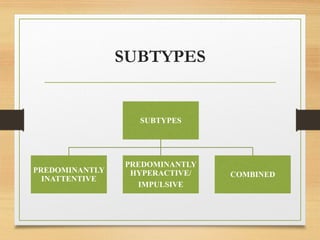
1. Predominantly inattentive:The majority of symptoms
fall under inattention.
2. Predominantly hyperactive/ Impulsive: The majority of
symptoms are hyperactive and impulsive.
3. Combined: This is a mix of inattentive symptoms and
hyperactive/impulsive symptoms.
11.
ETIOLOGY
Brain injuries, nutrition,
environmentaland social factors
might contribute to ADHD.
• Genetic theory: Studies of
twins shows that ADHD
often runs in families. It was
revealed that certain gene
have thinner brain tissue in
the areas of the brain
associated with inattention.
12.
CONTD….
• Role ofneurotransmitters: The major neurotransmitters
implicated in the pathophysiology of ADHD are
dopamine, norepinephrine, and possibly serotonin.
Dopamine and norepinephrine appear to be depleted in
ADHD.
- Serotonin in ADHD has been studied less extensively,
but recent evidence suggests that it is also reduced in
children with ADHD.
13.
CONTD….
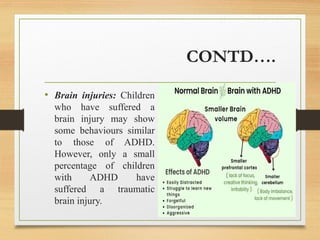
• Brain injuries:Children
who have suffered a
brain injury may show
some behaviours similar
to those of ADHD.
However, only a small
percentage of children
with ADHD have
suffered a traumatic
brain injury.
14.
CONTD….
• Maternal factors:Cigarette
smoking and alcohol use
during pregnancy is
associated with ADHD.
• Environmental factors:
Pre-schoolers who are
exposed to high levels of
lead have higher risk of
developing ADHD
15.
CONTD….
• Psychosocial factors:Family
dysfunction, inadequacies in
the educational system and
violence and emotional
abuse.
• Other factors: Toxins in the
environment, sensory
integration dysfunction and
low arousal.
16.
CONTD….
Pesticide exposure isstrongly associated with an increased
risk of ADHD among children. Studies found that higher
rates of ADHD diagnosis among children exposed to
higher levels of organophosphate pesticides. Risk of
ADHD related to the length of time the children spent in
an orphanage, especially if they were neglected or abused.
17.
RISK FACTORS FORADHD
• In utero drug exposure
• Birth complications
• Low birth weight
• Lead poisoning
18.
SYMPTOMS
• The primaryfeature of
ADHD include
inattention and
hyperactive-impulsive
behavior. ADHD
symptoms start before
age 12, and in some
children, they’re
noticeable as early as 3
years of age.
19.
CONTD….
1. Inattention: Achild who shows a pattern of inattention
may often:
• Fail to pay close attention to make details or make
careless mistakes in schoolwork.
• Have trouble saying focused in tasks or play.
• Appear not to listen, even when spoken to directly.
• Have trouble organizing tasks and activities
20.
CONTD….
• Have difficultyfollowing through on instructions and
fail to finish schoolwork or chores.
• Avoid or dislike tasks that require focused mental effort,
such as homework.
• Lose items needed for tasks or activities, for example
toys, school assignments, pencils.
• Be easily distracted
• Forget to do some daily activities, such as forgetting to
do chores.
21.
CONTD….
2. Predominantly Hyperactive-Impulsive:A child who
shows a pattern of hyperactive and impulsive
symptoms may often:
• Fidget with or tap his or her hands or feet or squirm in
the seat
• Have difficulty staying seated in the classroom or in
other situations
• Be on the go, in constant motion
22.
CONTD….
• Run aroundor climb in situations when it’s not
appropriate
• Have trouble playing or doing an activity quietly
• Talk too much
• Blurt out answers, interrupting the questioner
• Have difficulty waiting for his/her turn
• Interrupt or intrude on others conversations, games or
activities.
23.
CONTD….
3. Primarily ofImpulsivity:
• Impatient
• Having strong irresistible
emotions
• Act without regard for
consequences
• Have difficulty in waiting
for things
DIAGNOSIS
• Complete medicalevaluation, with emphasis on a
neurologic examination, hearing and vision.
• A psychiatric evaluation to assess intellectual ability,
academic achievement, and potential learning disorder
problem.
• Detailed prenatal history and early developmental history.
• Direct observation, teacher’s school report (often the most
reliable), parent’s report
• Conner’s rating scale: Used to assess the severity of
ADHD
26.
MANAGEMENT
• Methods oftreatment often involve combination of
behavior modification.
• Life-style changes and counselling followed by
medication. Medications have atleast some effect in
about 80% of people.
27.
CONTD….
PHARMACOTHERAPY:
• Stimulant (Mostcommonly used): Stimulants such as
methylphenidate {Ritalin} (5-60 mg/day) and Dextro-
amphetamines {Dexedrine} (2.5-20 mg/day) are the
most common type of medications used for treating
ADHD
• Other medications: Nonstimulant (Atomoxetine),
antidepressants, antihypertensive, mood stabilizers and
neuroleptic drugs.
28.
CONTD….
Atomoxetine is adrug of choice if ADHD is comorbid with
Tourette syndrome. Amoxetine and Methylphenidate may
cause priapism (Prolonged painful penile erection) in
males. Methylphenidate also cause weight loss in children
so growth/development has to be monitored regularly.
29.
CONTD….
PSYCHOSOCIAL THERAPY:
It isrecommended first line in
those who have mild symptoms
and in preschool-aged children.
Psychological therapies used
include:
• Psychoeducational input:
Focus on managing inattentive
and hyperactive-impulsive
behavior.
30.
CONTD….
• Behavior therapy:Behavior
therapy aims to help a child
change his/her behavior. It
might include practical
assistance, such as help
organizing tasks or completing
schoolwork or working
through emotionally difficult
events. Behavioral therapy
also teaches a child how to
monitor his/her own behavior.
31.
CONTD….
• Cognitive behavioral
therapy(CBT): Learning
to give oneself praise or
rewards for acting in a
desired way, such as
controlling anger or
thinking before acting
are the goals of
Cognitive behavioral
therapy
32.
CONTD….
• Interpersonal Psychotherapy(IPT): Helps child to
develop new skills, attitudes and teaches them how to
relate more effectively with the family members,
teachers and peers.
• Family Therapy: Therapist can help family members to
find better ways to handle disruptive behaviors and to
encourage behavior change.
33.
CONTD….
• Support Groups:This
helps the parents and
families to connect with
others who have similar
problems and concerns.
Groups often meet
regularly to exchange
information about
recommended specialists,
strategies and to talk with
experts.
34.
CONTD….
• School based
interventions:It is crucial
for teachers, parents and
students to be fully aware
of the child’s disorders and
the effective management
strategies. It also focuses
on enhancement of home-
school communication
35.
CONTD….
• Parenting skillstraining: Mental health professionals
help the child and parents to develop new skills,
attitudes and ways of relating to each other.
- Parenting skills training helps parents learn how to use a
system of rewards and consequences to change a child’s
behavior.