CONDUCT DISORDERS
PRESENTED BY:
MS. MONIKA KANWAR
M.Sc. (N) MENTAL HEALTH NURSING
INTRODUCTION
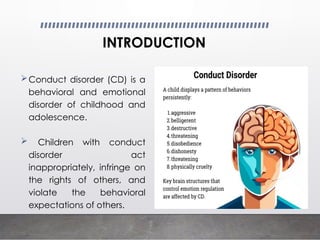
Conduct disorder (CD) is a
behavioral and emotional
disorder of childhood and
adolescence.
 Children with conduct
disorder act
inappropriately, infringe on
the rights of others, and
violate the behavioral
expectations of others.
CONTD….
Children with conduct
disorder act out
aggressively and express
anger inappropriately.
They engage in a variety
of antisocial and
destructive acts.
DEFINITION
• Conduct disorder is a common childhood
psychiatric problem that has an increased
incidence in adolescence. The primary
diagnostic feature of conduct disorder include
aggression, theft, vandalism, violations of rules
and/or lying.
Searight HR, Rottnek F, Abby SL, 2001
TYPES
CONTD….
1. CONDUCT DISORDERS BASED ON THE SEVERITY
OF SYMTOMS:
• Conduct disorders confined to the family context:
This dissocial or aggressive behavior is directed on
family members and occurs mostly at home or
immediate household. Social relationships outside
the family are within the normal range.
CONTD….
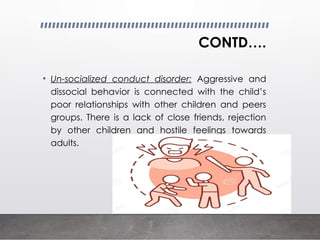
• Un-socialized conduct disorder: Aggressive and
dissocial behavior is connected with the child’s
poor relationships with other children and peers
groups. There is a lack of close friends, rejection
by other children and hostile feelings towards
adults.
CONTD….
• Socialized conduct disorder: Child is showing
aggressive and dissocial behavior, but
relationship with children of the same age is
adequate.
CONTD….
• Oppositional defiant disorder: Child shows
persistently destructive, aggressive and
troublesome behavior. The more aggressive
conduct disorders are not present, general law
and rights of other people are respected
CONTD….
2. CONDUCT DISORDERS BASED ON AGE:
• Childhood onset (Before the age of 10 years):
Behaviors that are typical occur during childhood
and characterized by the aggression, property
destruction (Deliberately breaking things, setting
fires) and poor peer relationships.
CONTD….
• Adolescent onset (After the age of 10 years):
Adolescent conduct disorder should be
considered in social context. Adolescents
exhibiting conduct disorder behavior as a part of
gang culture or to meet basic survival needs (e.g.
Stealing food) are often less psychologically
disturbed than those with early childhood histories
of behavior disorders.
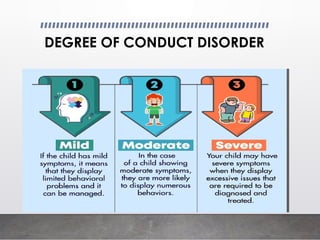
DEGREE OF CONDUCT DISORDER
ETIOLOGY
• Psychodynamic theory: According to this theory,
children who are fixed in separation-individuation
phase of development may develop conduct
disorders. Because of fixation individual fails to
build up identification and differentiation
between self and others which leads to
underdeveloped superego and further it will lead
to conduct disorder as id will dominate the child’s
behavior.
CONTD….
• Psychological: Some experts believe that
conduct disorders can reflect problem with moral
awareness (notably, lack of guilt and remorse)
and deficit in cognitive processing.
CONTD….
• Genetic/ Physical factors:
- Autonomic under-arousal
- Brain damage to the prefrontal cortex
- Insensitivity to the physical pain and punishment
- Learning impairments
- Neurological factors due to birth complications
- Low birth weight
CONTD….
• Familial factors:
- Exposure to parental antisocial behavior is the
most influential factor
- Parental substance abuse, psychiatric illness,
marital conflict, child abuse and neglect.
- Poverty, parent absence and inconsistent
discipline
CONTD….
• Social factors:
- School failure
- Traumatic life events
- Early institutionalization
- More susceptible to peer influence
CONTD….
• Environmental:
Factors such as a dysfunctional family life,
childhood abuse, traumatic experiences, a family
history of substance abuse, and inconsistent
discipline by parents may contribute to the
development of conduct disorder
RISK FACTORS
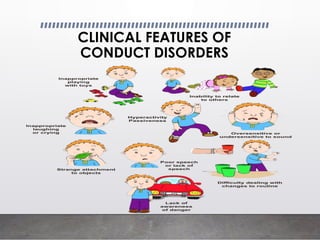
CLINICAL FEATURES OF
CONDUCT DISORDERS
CONTD….
• Very early disturbances:
- Irritable temperament
- Poor compliance
- Inattentiveness
- Impulsivity
- Aggressive behaviour
CONTD….
• Elementary school Progression:
- Aggressive tendencies with other adults and
peers
- Lack of social skills to interact with peers
- Disrespect for others
- Low self esteem
- Stealing
CONTD….
• Middle and High school:
- Noncompliance with commands
- Emotional overreaction
- Failure to take responsibility for one’s own actions.
- Rude, cruel, truancy
- Alcohol, drug abuse
- Destroy other properties
- Risk taking behaviour
- Physical fights
- Run away from home
DIAGNOSIS
• Complete history
• Educational history (To determine cognitive
deficit, learning disabilities or problems in
intellectual functioning)
• Neurological examination
MANAGEMENT
Treatment should consist of a management
program determined by the needs of the child and
family, which may include:
• Early Intervention: Appropriate training and
education of primary care givers regarding
management of behavior of child having
conduct disorders
CONTD….
• Parent skills and education: Teach positive
parenting skills.
• Counselling parents about clear communication:
Parents should communicate clear, direct and
specific requests, Do all efforts to make child to
follow these requests
CONTD….
• Reinforcements of positive behavior: Positive
reinforcement for desirable behavior will reduce
reliance on punishment.
• Cognitive behavioral therapy: Focuses on
encouraging and rewarding appropriate
behavior and helps children to learn what
behavior is expected of them.
CONTD….
• Social skills training: Children with conduct
problems often need to be encouraged to
develop alternative ways of relating to other
children and adults
• Family therapy: Focused on improving
communication skills and family interactions
CONTD….
• Peer group therapy: Focused on developing
social skills and interpersonal skills.
• Family meetings: Help family to understand
child’s illness and learn better ways to react to a
child with separation anxiety.
CONTD….
• Group therapy: A series of meetings that child
goes to with other children who have similar
problems. During these meetings, the children
and staff talk together about aways to cope with
the problems.
CONTD….
• Assertiveness training: It teaches child how to ask
for what he needs, how to set limits, and how to
say no.
• School interventions: Communication between
teachers, carers and parents needs to open and
cooperative to work best for the child.
CONTD….
• Pharmacotherapy: There are no formally
approved medications for conduct disorders,
pharmacotherapy may help specific symptoms.
Commonly used medications are:
- CNS Stimulants: Methylphenidate
- Dextroamphetamine (Dexedrine)
- Lithium (Aggression)
- Clonidine (Over-arousal)
NURSING MANAGEMENT
• Allot sufficient staff and provide close supervision to the child.
• Observe the child for anger cues, encouraging activities and
aggressive behavior.
• Set limits on manipulative behavior and identify the
consequences of manipulative behavior.
• Provide immediate feedback for positive behavior.
• Encourage the child to maintain the activity log book and
make daily entry of activities in his own way. Later on analyze
the activity which provide insight to the child about activity
and responses.
Conduct Disorders.pptx   Conduct disorders

Conduct Disorders.pptx Conduct disorders

  • 1.
    CONDUCT DISORDERS PRESENTED BY: MS.MONIKA KANWAR M.Sc. (N) MENTAL HEALTH NURSING
  • 2.
    INTRODUCTION Conduct disorder (CD)is a behavioral and emotional disorder of childhood and adolescence.  Children with conduct disorder act inappropriately, infringe on the rights of others, and violate the behavioral expectations of others.
  • 3.
    CONTD…. Children with conduct disorderact out aggressively and express anger inappropriately. They engage in a variety of antisocial and destructive acts.
  • 4.
    DEFINITION • Conduct disorderis a common childhood psychiatric problem that has an increased incidence in adolescence. The primary diagnostic feature of conduct disorder include aggression, theft, vandalism, violations of rules and/or lying. Searight HR, Rottnek F, Abby SL, 2001
  • 5.
  • 6.
    CONTD…. 1. CONDUCT DISORDERSBASED ON THE SEVERITY OF SYMTOMS: • Conduct disorders confined to the family context: This dissocial or aggressive behavior is directed on family members and occurs mostly at home or immediate household. Social relationships outside the family are within the normal range.
  • 7.
    CONTD…. • Un-socialized conductdisorder: Aggressive and dissocial behavior is connected with the child’s poor relationships with other children and peers groups. There is a lack of close friends, rejection by other children and hostile feelings towards adults.
  • 8.
    CONTD…. • Socialized conductdisorder: Child is showing aggressive and dissocial behavior, but relationship with children of the same age is adequate.
  • 9.
    CONTD…. • Oppositional defiantdisorder: Child shows persistently destructive, aggressive and troublesome behavior. The more aggressive conduct disorders are not present, general law and rights of other people are respected
  • 10.
    CONTD…. 2. CONDUCT DISORDERSBASED ON AGE: • Childhood onset (Before the age of 10 years): Behaviors that are typical occur during childhood and characterized by the aggression, property destruction (Deliberately breaking things, setting fires) and poor peer relationships.
  • 11.
    CONTD…. • Adolescent onset(After the age of 10 years): Adolescent conduct disorder should be considered in social context. Adolescents exhibiting conduct disorder behavior as a part of gang culture or to meet basic survival needs (e.g. Stealing food) are often less psychologically disturbed than those with early childhood histories of behavior disorders.
  • 12.
  • 13.
    ETIOLOGY • Psychodynamic theory:According to this theory, children who are fixed in separation-individuation phase of development may develop conduct disorders. Because of fixation individual fails to build up identification and differentiation between self and others which leads to underdeveloped superego and further it will lead to conduct disorder as id will dominate the child’s behavior.
  • 14.
    CONTD…. • Psychological: Someexperts believe that conduct disorders can reflect problem with moral awareness (notably, lack of guilt and remorse) and deficit in cognitive processing.
  • 15.
    CONTD…. • Genetic/ Physicalfactors: - Autonomic under-arousal - Brain damage to the prefrontal cortex - Insensitivity to the physical pain and punishment - Learning impairments - Neurological factors due to birth complications - Low birth weight
  • 16.
    CONTD…. • Familial factors: -Exposure to parental antisocial behavior is the most influential factor - Parental substance abuse, psychiatric illness, marital conflict, child abuse and neglect. - Poverty, parent absence and inconsistent discipline
  • 17.
    CONTD…. • Social factors: -School failure - Traumatic life events - Early institutionalization - More susceptible to peer influence
  • 18.
    CONTD…. • Environmental: Factors suchas a dysfunctional family life, childhood abuse, traumatic experiences, a family history of substance abuse, and inconsistent discipline by parents may contribute to the development of conduct disorder
  • 19.
  • 20.
  • 21.
    CONTD…. • Very earlydisturbances: - Irritable temperament - Poor compliance - Inattentiveness - Impulsivity - Aggressive behaviour
  • 22.
    CONTD…. • Elementary schoolProgression: - Aggressive tendencies with other adults and peers - Lack of social skills to interact with peers - Disrespect for others - Low self esteem - Stealing
  • 23.
    CONTD…. • Middle andHigh school: - Noncompliance with commands - Emotional overreaction - Failure to take responsibility for one’s own actions. - Rude, cruel, truancy - Alcohol, drug abuse - Destroy other properties - Risk taking behaviour - Physical fights - Run away from home
  • 24.
    DIAGNOSIS • Complete history •Educational history (To determine cognitive deficit, learning disabilities or problems in intellectual functioning) • Neurological examination
  • 25.
    MANAGEMENT Treatment should consistof a management program determined by the needs of the child and family, which may include: • Early Intervention: Appropriate training and education of primary care givers regarding management of behavior of child having conduct disorders
  • 26.
    CONTD…. • Parent skillsand education: Teach positive parenting skills. • Counselling parents about clear communication: Parents should communicate clear, direct and specific requests, Do all efforts to make child to follow these requests
  • 27.
    CONTD…. • Reinforcements ofpositive behavior: Positive reinforcement for desirable behavior will reduce reliance on punishment. • Cognitive behavioral therapy: Focuses on encouraging and rewarding appropriate behavior and helps children to learn what behavior is expected of them.
  • 28.
    CONTD…. • Social skillstraining: Children with conduct problems often need to be encouraged to develop alternative ways of relating to other children and adults • Family therapy: Focused on improving communication skills and family interactions
  • 29.
    CONTD…. • Peer grouptherapy: Focused on developing social skills and interpersonal skills. • Family meetings: Help family to understand child’s illness and learn better ways to react to a child with separation anxiety.
  • 30.
    CONTD…. • Group therapy:A series of meetings that child goes to with other children who have similar problems. During these meetings, the children and staff talk together about aways to cope with the problems.
  • 31.
    CONTD…. • Assertiveness training:It teaches child how to ask for what he needs, how to set limits, and how to say no. • School interventions: Communication between teachers, carers and parents needs to open and cooperative to work best for the child.
  • 32.
    CONTD…. • Pharmacotherapy: Thereare no formally approved medications for conduct disorders, pharmacotherapy may help specific symptoms. Commonly used medications are: - CNS Stimulants: Methylphenidate - Dextroamphetamine (Dexedrine) - Lithium (Aggression) - Clonidine (Over-arousal)
  • 33.
    NURSING MANAGEMENT • Allotsufficient staff and provide close supervision to the child. • Observe the child for anger cues, encouraging activities and aggressive behavior. • Set limits on manipulative behavior and identify the consequences of manipulative behavior. • Provide immediate feedback for positive behavior. • Encourage the child to maintain the activity log book and make daily entry of activities in his own way. Later on analyze the activity which provide insight to the child about activity and responses.