
Jens Martensson
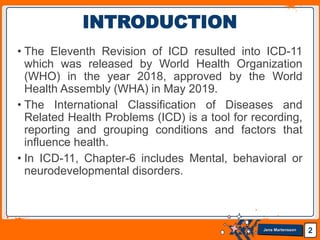
• The Eleventh Revision of ICD resulted into ICD-11
which was released by World Health Organization
(WHO) in the year 2018, approved by the World
Health Assembly (WHA) in May 2019.
• The International Classification of Diseases and
Related Health Problems (ICD) is a tool for recording,
reporting and grouping conditions and factors that
influence health.
• In ICD-11, Chapter-6 includes Mental, behavioral or
neurodevelopmental disorders.
2
INTRODUCTION
Jens Martensson
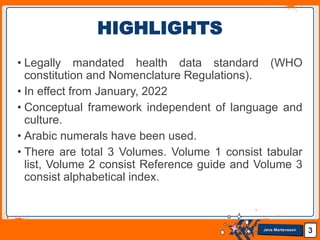
• Legally mandated health data standard (WHO
constitution and Nomenclature Regulations).
• In effect from January, 2022
• Conceptual framework independent of language and
culture.
• Arabic numerals have been used.
• There are total 3 Volumes. Volume 1 consist tabular
list, Volume 2 consist Reference guide and Volume 3
consist alphabetical index.
3
HIGHLIGHTS
Jens Martensson
• New chapters have been added:
- Sleep wake disorders
- Conditions related to sexual health (contains gender
incongruence, earlier included in mental health)
- Disease of blood and blood forming organs
- Disorders of immune system
- Traditional medicine
- Extension codes.
4
CONTD….
Jens Martensson
• Codings
- V- Supplementary section for functioning assessment
- X- Extension codes
- Y category- Residual category with other specified
disease
- Z category- Residual category with other unspecified
disease
5
CONTD….
Jens Martensson
• To allow the systematic recording, analysis,
interpretation and comparison of mortality and
morbidity data collected in different countries or
regions and at different times.
• Substantial advancements in medicine and the
science of disease have occurred over past 30 years.
• ICD-10 is outdated both clinically and from a
classification perspective.
6
NEED
Jens Martensson
• Structural changes were needed to some chapters.
• Changes could not be handled under the normal ICD-
10 updating mechanism.
• Increasing need to operate in an electronic
environment.
7
CONTD….
Jens Martensson
• Principles for ordering disorder groupings in ICD-11 is
based on etiology, pathophysiology and
phenomenology.
• ICD-11 is based on clinical utility, globally applicable
and evidence based.
8
PRINCIPLES
Jens Martensson
• Easy to use
• Digital capabilities
• Updated structure and content reflecting current
scientific knowledge.
• New and improved
• Better coding Quality
9
ADVANTAGES
Jens Martensson 10
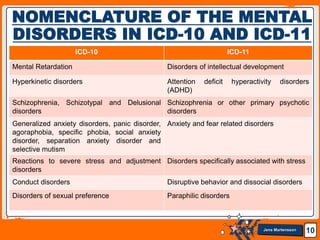
NOMENCLATURE OF THE MENTAL
DISORDERS IN ICD-10 AND ICD-11
ICD-10 ICD-11
Mental Retardation Disorders of intellectual development
Hyperkinetic disorders Attention deficit hyperactivity disorders
(ADHD)
Schizophrenia, Schizotypal and Delusional
disorders
Schizophrenia or other primary psychotic
disorders
Generalized anxiety disorders, panic disorder,
agoraphobia, specific phobia, social anxiety
disorder, separation anxiety disorder and
selective mutism
Anxiety and fear related disorders
Reactions to severe stress and adjustment
disorders
Disorders specifically associated with stress
Conduct disorders Disruptive behavior and dissocial disorders
Disorders of sexual preference Paraphilic disorders
Jens Martensson 11
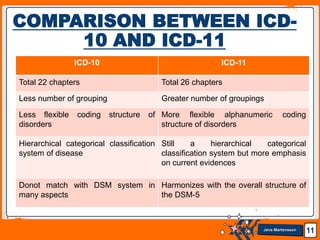
COMPARISON BETWEEN ICD-
10 AND ICD-11
ICD-10 ICD-11
Total 22 chapters Total 26 chapters
Less number of grouping Greater number of groupings
Less flexible coding structure of
disorders
More flexible alphanumeric coding
structure of disorders
Hierarchical categorical classification
system of disease
Still a hierarchical categorical
classification system but more emphasis
on current evidences
Donot match with DSM system in
many aspects
Harmonizes with the overall structure of
the DSM-5
Jens Martensson
• Unlike the ICD-10 codes, the ICD-11 MMS codes
never contain the letters I or O, to prevent confusion
with the numbers 1 and 0.
• Stroke is now classified as a neurological disorder
instead of a disease of the circulatory system.
• Allergies are now coded under diseases of
the immune system.
12
CHANGES
Jens Martensson
• In the ICD-10, a distinction was made between Sleep
disorders (G47), included in nervous system diseases
chapter, and Nonorganic sleep disorders (F51),
included in the mental disorders chapter. In the ICD-
11, they are merged and placed into a new chapter
called Sleep-wake disorders, since the separation
between organic (physical) and non-organic (mental)
disorders is considered obsolete
13
CONTD….
Jens Martensson
• ICD-10: Mental and Behavioral Disorders
• ICD-11: Mental, Behavioral or Neurodevelopmental
Disorders
• The codes of ICD-11 are alphanumeric and cover the
range from 1A00.00 to ZZ9Z.ZZ.
14
CHAPTER NAME
Jens Martensson
• Chapter numbering:
- Now Arabic numbers not Roman numerals
• Coding Scheme for Categories
- Now minimum 4 characters
- 2 level of subcategories
15
ICD-11 CODING SCHEME
Jens Martensson
• Coding Scheme:
- Always has a letter in the second position to
distinguish from the codes of ICD-10
- No I, I (L,i);0 , O (Zero, o)
• First character of the code always relates to the
chapter number
- 1-Z
16
CONTD….
Jens Martensson
• Neurodevelopmental disorders (6A00-6A0Z)
• Schizophrenia or other primary psychotic disorders
(6A20-6A2Z).
• Catatonia (6A40-614Z)
• Mood Disorders (6A60-6A6Z)
• Anxiety or fear-related disorders (6B00-6B0Z)
• Obsessive-compulsive or related disorders (6B20-
6B2Z)
• Disorders specifically associated with stress (6B40-
6B4Z)
17
SECTIONS/CODES IN THIS
CHAPTER
Jens Martensson
• Dissociative Disorders (6B60-6B6Z)
• Feeding or eating disorders (6B80-6B8Z)
• Elimination disorders (6C00-6C0Z)
• Disorders of bodily distress or bodily experiences
(6C20-6C2Z)
• Disorders due to substance use or addictive
behaviors (6C40-6C5Z)
• Impulse control disorders (6C70-6C7Z)
• Disruptive behavior or dissocial disorders (6C90-
6C9Z)
• Personality disorders and related traits (6D10-6D11.5)
• Paraphilic disorders (6D30-6D3Z)
18
CONTD….
Jens Martensson
• Factitious disorders (6D50-6D5Z)
• Neurocognitive disorders (6D70-6E0Z)
• Mental or behavioral disorders associated with
pregnancy, childbirth or the puerperium (6E20-6E2Z)
• Psychological or behavioral factors affecting disorders
or diseases classified elsewhere (6E40)
• Secondary mental or behavioral syndromes associated
with disorders or disease classified elsewhere (6E60-
6E6Z)
• Other specified mental, behavioral or
neurodevelopmental disorders (6A8Y)
• Mental, behavioral or neurodevelopmental disorders,
unspecified (6E8Z)
19
CONTD….
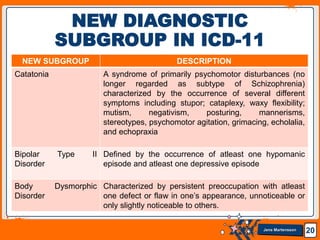
Jens Martensson 20
NEW DIAGNOSTIC
SUBGROUP IN ICD-11
NEW SUBGROUP DESCRIPTION
Catatonia A syndrome of primarily psychomotor disturbances (no
longer regarded as subtype of Schizophrenia)
characterized by the occurrence of several different
symptoms including stupor; cataplexy, waxy flexibility;
mutism, negativism, posturing, mannerisms,
stereotypes, psychomotor agitation, grimacing, echolalia,
and echopraxia
Bipolar Type II
Disorder
Defined by the occurrence of atleast one hypomanic
episode and atleast one depressive episode
Body Dysmorphic
Disorder
Characterized by persistent preoccupation with atleast
one defect or flaw in one’s appearance, unnoticeable or
only slightly noticeable to others.
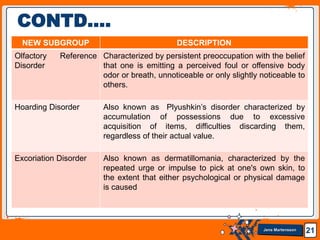
Jens Martensson 21
CONTD….
NEW SUBGROUP DESCRIPTION
Olfactory Reference
Disorder
Characterized by persistent preoccupation with the belief
that one is emitting a perceived foul or offensive body
odor or breath, unnoticeable or only slightly noticeable to
others.
Hoarding Disorder Also known as Plyushkin’s disorder characterized by
accumulation of possessions due to excessive
acquisition of items, difficulties discarding them,
regardless of their actual value.
Excoriation Disorder Also known as dermatillomania, characterized by the
repeated urge or impulse to pick at one's own skin, to
the extent that either psychological or physical damage
is caused
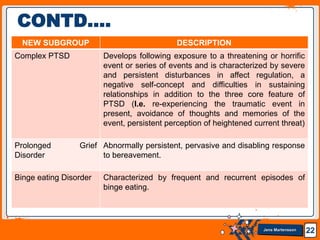
Jens Martensson 22
CONTD….
NEW SUBGROUP DESCRIPTION
Complex PTSD Develops following exposure to a threatening or horrific
event or series of events and is characterized by severe
and persistent disturbances in affect regulation, a
negative self-concept and difficulties in sustaining
relationships in addition to the three core feature of
PTSD (I.e. re-experiencing the traumatic event in
present, avoidance of thoughts and memories of the
event, persistent perception of heightened current threat)
Prolonged Grief
Disorder
Abnormally persistent, pervasive and disabling response
to bereavement.
Binge eating Disorder Characterized by frequent and recurrent episodes of
binge eating.
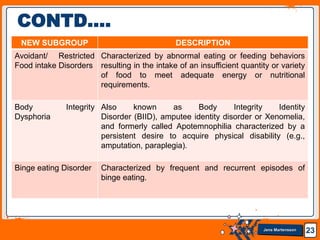
Jens Martensson 23
CONTD….
NEW SUBGROUP DESCRIPTION
Avoidant/ Restricted
Food intake Disorders
Characterized by abnormal eating or feeding behaviors
resulting in the intake of an insufficient quantity or variety
of food to meet adequate energy or nutritional
requirements.
Body Integrity
Dysphoria
Also known as Body Integrity Identity
Disorder (BIID), amputee identity disorder or Xenomelia,
and formerly called Apotemnophilia characterized by a
persistent desire to acquire physical disability (e.g.,
amputation, paraplegia).
Binge eating Disorder Characterized by frequent and recurrent episodes of
binge eating.
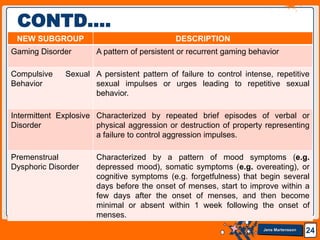
Jens Martensson 24
CONTD….
NEW SUBGROUP DESCRIPTION
Gaming Disorder A pattern of persistent or recurrent gaming behavior
Compulsive Sexual
Behavior
A persistent pattern of failure to control intense, repetitive
sexual impulses or urges leading to repetitive sexual
behavior.
Intermittent Explosive
Disorder
Characterized by repeated brief episodes of verbal or
physical aggression or destruction of property representing
a failure to control aggression impulses.
Premenstrual
Dysphoric Disorder
Characterized by a pattern of mood symptoms (e.g.
depressed mood), somatic symptoms (e.g. overeating), or
cognitive symptoms (e.g. forgetfulness) that begin several
days before the onset of menses, start to improve within a
few days after the onset of menses, and then become
minimal or absent within 1 week following the onset of
menses.
Jens Martensson
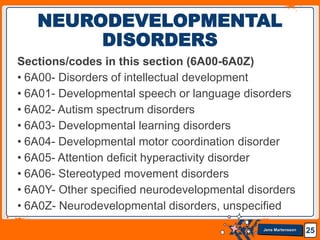
Sections/codes in this section (6A00-6A0Z)
• 6A00- Disorders of intellectual development
• 6A01- Developmental speech or language disorders
• 6A02- Autism spectrum disorders
• 6A03- Developmental learning disorders
• 6A04- Developmental motor coordination disorder
• 6A05- Attention deficit hyperactivity disorder
• 6A06- Stereotyped movement disorders
• 6A0Y- Other specified neurodevelopmental disorders
• 6A0Z- Neurodevelopmental disorders, unspecified
25
NEURODEVELOPMENTAL
DISORDERS
Jens Martensson
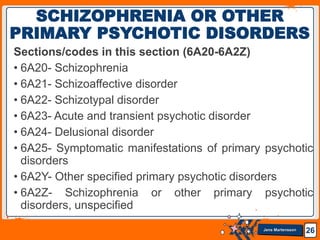
Sections/codes in this section (6A20-6A2Z)
• 6A20- Schizophrenia
• 6A21- Schizoaffective disorder
• 6A22- Schizotypal disorder
• 6A23- Acute and transient psychotic disorder
• 6A24- Delusional disorder
• 6A25- Symptomatic manifestations of primary psychotic
disorders
• 6A2Y- Other specified primary psychotic disorders
• 6A2Z- Schizophrenia or other primary psychotic
disorders, unspecified
26
SCHIZOPHRENIA OR OTHER
PRIMARY PSYCHOTIC DISORDERS
Jens Martensson
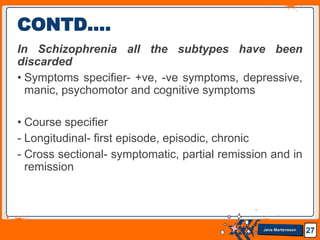
In Schizophrenia all the subtypes have been
discarded
• Symptoms specifier- +ve, -ve symptoms, depressive,
manic, psychomotor and cognitive symptoms
• Course specifier
- Longitudinal- first episode, episodic, chronic
- Cross sectional- symptomatic, partial remission and in
remission
27
CONTD….
Jens Martensson
Acute Psychosis
Subtypes have been discarded
• Acute onset, brief duration and polymorphic nature
have been recognized
• Not much change with regard to schizotypal
delusional disorder and schizoaffective disorder
28
CONTD….
Jens Martensson
Sections/codes in this section (6A40-6A4Z)
• 6A40- Catatonia associated with another mental
disorder
• 6A41- Catatonia induced by substances or
medications
• 6A4Z- Catatonia, unspecified
29
CATATONIA
Jens Martensson
Sections/codes in this section (6A60-6A8Z)
• 6A60-6A6Z- Bipolar or related disorders
- 6A60- Bipolar type-I Disorder
- 6A61- Bipolar type-II Disorder
- 6A62- Cyclothymic Disorder
- 6A6Y- Other Bipolar Disorders
- 6A6Z- Bipolar Disorders, Unspecified
30
MOOD DISORDERS
Jens Martensson
• 6A70-6A7Z- Depressive disorders
- 6A70- Single episode Depressive Disorder
- 6A71- Recurrent depressive Disorder
- 6A72- Dysthymic Disorder
- 6A73- Mixed depressive and anxiety disorder
- 6A7Y- Other Depressive Disorders
- 6A7Z- Depressive Disorders, Unspecified.
31
CONTD….
Jens Martensson
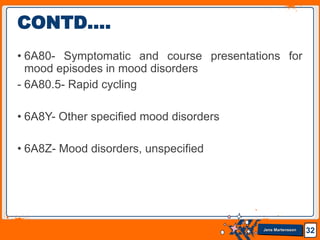
• 6A80- Symptomatic and course presentations for
mood episodes in mood disorders
- 6A80.5- Rapid cycling
• 6A8Y- Other specified mood disorders
• 6A8Z- Mood disorders, unspecified
32
CONTD….
Jens Martensson
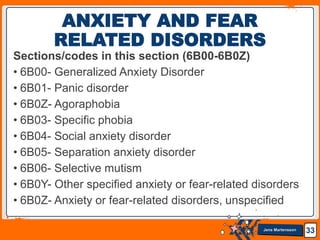
Sections/codes in this section (6B00-6B0Z)
• 6B00- Generalized Anxiety Disorder
• 6B01- Panic disorder
• 6B0Z- Agoraphobia
• 6B03- Specific phobia
• 6B04- Social anxiety disorder
• 6B05- Separation anxiety disorder
• 6B06- Selective mutism
• 6B0Y- Other specified anxiety or fear-related disorders
• 6B0Z- Anxiety or fear-related disorders, unspecified
33
ANXIETY AND FEAR
RELATED DISORDERS
Jens Martensson
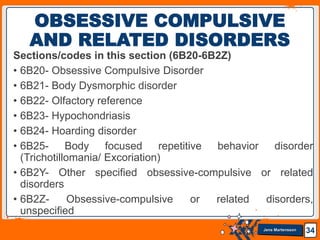
Sections/codes in this section (6B20-6B2Z)
• 6B20- Obsessive Compulsive Disorder
• 6B21- Body Dysmorphic disorder
• 6B22- Olfactory reference
• 6B23- Hypochondriasis
• 6B24- Hoarding disorder
• 6B25- Body focused repetitive behavior disorder
(Trichotillomania/ Excoriation)
• 6B2Y- Other specified obsessive-compulsive or related
disorders
• 6B2Z- Obsessive-compulsive or related disorders,
unspecified
34
OBSESSIVE COMPULSIVE
AND RELATED DISORDERS
Jens Martensson
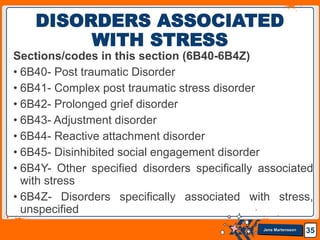
Sections/codes in this section (6B40-6B4Z)
• 6B40- Post traumatic Disorder
• 6B41- Complex post traumatic stress disorder
• 6B42- Prolonged grief disorder
• 6B43- Adjustment disorder
• 6B44- Reactive attachment disorder
• 6B45- Disinhibited social engagement disorder
• 6B4Y- Other specified disorders specifically associated
with stress
• 6B4Z- Disorders specifically associated with stress,
unspecified
35
DISORDERS ASSOCIATED
WITH STRESS
Jens Martensson
Sections/codes in this section (6B60-6B6Z)
• 6B60- Dissociative neurological disorders (Visual,
Auditory, Dizziness, Sensory, Non-epileptic,
Paralysis, Gait, Movement disturbance)
• 6B62- Dissociative Amnesia
• 6B63- Possession trance disorder
• 6B64- Dissociative identity disorder
• 6B66- Depersonalization and Derealization
36
DISSOCIATIVE DISORDERS
Jens Martensson
Sections/codes in this section (6B80-6B8Z)
• 6B80- Anorexia Nervosa
• 6B81- Bulimia Nervosa
• 6B82- Binge eating disorder
• 6B83- Avoidant-restrictive food intake disorder
• 6B84- Pica
• 6B85- Rumination-regurgitation disorder
• 6B8Y- Other specified feeding or eating disorders
• 6B8Z- Feeding or eating disorders, unspecified
37
FEEDING OR EATING
DISORDERS
Jens Martensson
Sections/codes in this section (6C00-6C0Z)
• Elimination disorders. Enuresis and Encopresis
(Nocturnal, diurnal or both)
38
ELIMINATION DISORDERS
Jens Martensson
Sections/codes in this section (6C20-6C2Z)
• 6C20- Bodily distress disorder
Mild (<1 hr), Moderate (>1 hr), and severe (most of the
day with impairment in functioning)
• 6C21- Body integrity dysphoria
• 6C2Y- Other specified disorders of bodily distress or
bodily experience
• 6C2Z- Disorders of bodily distress or bodily experience,
unspecified
39
DISORDERS OF BODILY
DISTRESS OR BODILY
EXPERIENCES
Jens Martensson
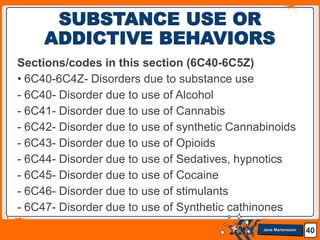
Sections/codes in this section (6C40-6C5Z)
• 6C40-6C4Z- Disorders due to substance use
- 6C40- Disorder due to use of Alcohol
- 6C41- Disorder due to use of Cannabis
- 6C42- Disorder due to use of synthetic Cannabinoids
- 6C43- Disorder due to use of Opioids
- 6C44- Disorder due to use of Sedatives, hypnotics
- 6C45- Disorder due to use of Cocaine
- 6C46- Disorder due to use of stimulants
- 6C47- Disorder due to use of Synthetic cathinones
40
SUBSTANCE USE OR
ADDICTIVE BEHAVIORS
Jens Martensson
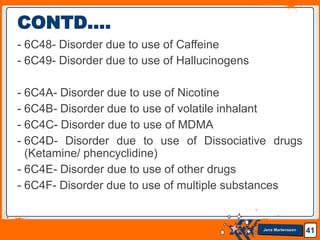
- 6C48- Disorder due to use of Caffeine
- 6C49- Disorder due to use of Hallucinogens
- 6C4A- Disorder due to use of Nicotine
- 6C4B- Disorder due to use of volatile inhalant
- 6C4C- Disorder due to use of MDMA
- 6C4D- Disorder due to use of Dissociative drugs
(Ketamine/ phencyclidine)
- 6C4E- Disorder due to use of other drugs
- 6C4F- Disorder due to use of multiple substances
41
CONTD….
Jens Martensson
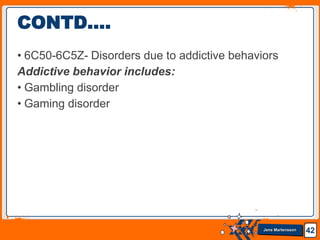
• 6C50-6C5Z- Disorders due to addictive behaviors
Addictive behavior includes:
• Gambling disorder
• Gaming disorder
42
CONTD….
Jens Martensson
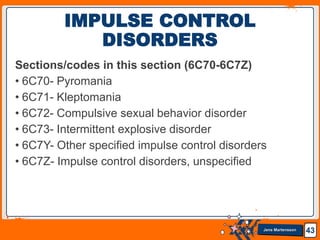
Sections/codes in this section (6C70-6C7Z)
• 6C70- Pyromania
• 6C71- Kleptomania
• 6C72- Compulsive sexual behavior disorder
• 6C73- Intermittent explosive disorder
• 6C7Y- Other specified impulse control disorders
• 6C7Z- Impulse control disorders, unspecified
43
IMPULSE CONTROL
DISORDERS
Jens Martensson
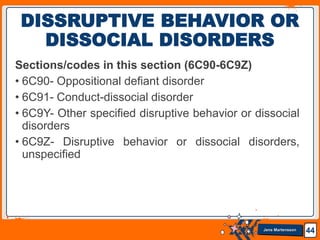
Sections/codes in this section (6C90-6C9Z)
• 6C90- Oppositional defiant disorder
• 6C91- Conduct-dissocial disorder
• 6C9Y- Other specified disruptive behavior or dissocial
disorders
• 6C9Z- Disruptive behavior or dissocial disorders,
unspecified
44
DISSRUPTIVE BEHAVIOR OR
DISSOCIAL DISORDERS
Jens Martensson
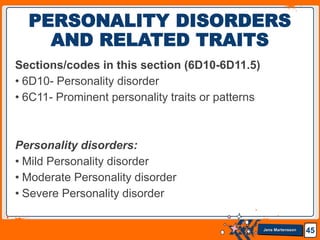
Sections/codes in this section (6D10-6D11.5)
• 6D10- Personality disorder
• 6C11- Prominent personality traits or patterns
Personality disorders:
• Mild Personality disorder
• Moderate Personality disorder
• Severe Personality disorder
45
PERSONALITY DISORDERS
AND RELATED TRAITS
Jens Martensson
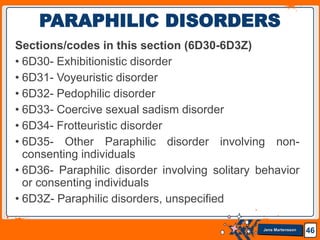
Sections/codes in this section (6D30-6D3Z)
• 6D30- Exhibitionistic disorder
• 6D31- Voyeuristic disorder
• 6D32- Pedophilic disorder
• 6D33- Coercive sexual sadism disorder
• 6D34- Frotteuristic disorder
• 6D35- Other Paraphilic disorder involving non-
consenting individuals
• 6D36- Paraphilic disorder involving solitary behavior
or consenting individuals
• 6D3Z- Paraphilic disorders, unspecified
46
PARAPHILIC DISORDERS
Jens Martensson
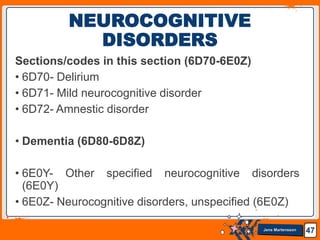
Sections/codes in this section (6D70-6E0Z)
• 6D70- Delirium
• 6D71- Mild neurocognitive disorder
• 6D72- Amnestic disorder
• Dementia (6D80-6D8Z)
• 6E0Y- Other specified neurocognitive disorders
(6E0Y)
• 6E0Z- Neurocognitive disorders, unspecified (6E0Z)
47
NEUROCOGNITIVE
DISORDERS
Jens Martensson
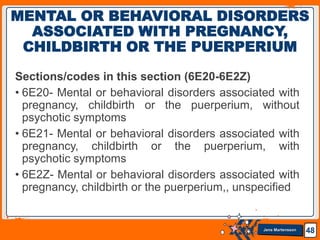
Sections/codes in this section (6E20-6E2Z)
• 6E20- Mental or behavioral disorders associated with
pregnancy, childbirth or the puerperium, without
psychotic symptoms
• 6E21- Mental or behavioral disorders associated with
pregnancy, childbirth or the puerperium, with
psychotic symptoms
• 6E2Z- Mental or behavioral disorders associated with
pregnancy, childbirth or the puerperium,, unspecified
48
MENTAL OR BEHAVIORAL DISORDERS
ASSOCIATED WITH PREGNANCY,
CHILDBIRTH OR THE PUERPERIUM
Jens Martensson
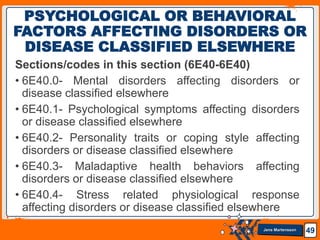
Sections/codes in this section (6E40-6E40)
• 6E40.0- Mental disorders affecting disorders or
disease classified elsewhere
• 6E40.1- Psychological symptoms affecting disorders
or disease classified elsewhere
• 6E40.2- Personality traits or coping style affecting
disorders or disease classified elsewhere
• 6E40.3- Maladaptive health behaviors affecting
disorders or disease classified elsewhere
• 6E40.4- Stress related physiological response
affecting disorders or disease classified elsewhere
49
PSYCHOLOGICAL OR BEHAVIORAL
FACTORS AFFECTING DISORDERS OR
DISEASE CLASSIFIED ELSEWHERE
Jens Martensson
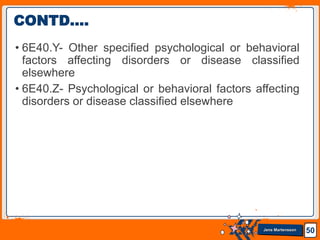
• 6E40.Y- Other specified psychological or behavioral
factors affecting disorders or disease classified
elsewhere
• 6E40.Z- Psychological or behavioral factors affecting
disorders or disease classified elsewhere
50
CONTD….
Jens Martensson
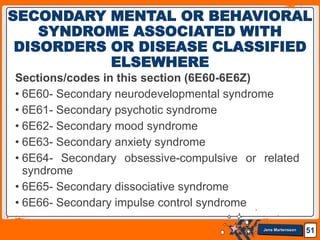
Sections/codes in this section (6E60-6E6Z)
• 6E60- Secondary neurodevelopmental syndrome
• 6E61- Secondary psychotic syndrome
• 6E62- Secondary mood syndrome
• 6E63- Secondary anxiety syndrome
• 6E64- Secondary obsessive-compulsive or related
syndrome
• 6E65- Secondary dissociative syndrome
• 6E66- Secondary impulse control syndrome
51
SECONDARY MENTAL OR BEHAVIORAL
SYNDROME ASSOCIATED WITH
DISORDERS OR DISEASE CLASSIFIED
ELSEWHERE
Jens Martensson
• 6E67- Secondary neurocognitive syndrome
• 6E68- Secondary personality syndrome
• 6E69- Secondary catatonia syndrome
• 6E6Y- Other specified secondary mental or behavioral
syndrome
• 6E6Z- Secondary mental or behavioral syndrome,
unspecified
52
CONTD….
Jens Martensson
• Acute stress reaction (QE84)
• Uncomplicated bereavement (QE62)
53
ICD-11 (EXCULSION)
Jens Martensson
• Sleep wake disorders (7A00-7B2Z)
• Sexual dysfunctions (HA00-HA0Z)
• Gender incongruence (HA60-HA6Z)
54
ICD-11 (CODED ELSEWHERE/
MOVED OUT)
Launch

ICD-11

  • 2.
    Jens Martensson • TheEleventh Revision of ICD resulted into ICD-11 which was released by World Health Organization (WHO) in the year 2018, approved by the World Health Assembly (WHA) in May 2019. • The International Classification of Diseases and Related Health Problems (ICD) is a tool for recording, reporting and grouping conditions and factors that influence health. • In ICD-11, Chapter-6 includes Mental, behavioral or neurodevelopmental disorders. 2 INTRODUCTION
  • 3.
    Jens Martensson • Legallymandated health data standard (WHO constitution and Nomenclature Regulations). • In effect from January, 2022 • Conceptual framework independent of language and culture. • Arabic numerals have been used. • There are total 3 Volumes. Volume 1 consist tabular list, Volume 2 consist Reference guide and Volume 3 consist alphabetical index. 3 HIGHLIGHTS
  • 4.
    Jens Martensson • Newchapters have been added: - Sleep wake disorders - Conditions related to sexual health (contains gender incongruence, earlier included in mental health) - Disease of blood and blood forming organs - Disorders of immune system - Traditional medicine - Extension codes. 4 CONTD….
  • 5.
    Jens Martensson • Codings -V- Supplementary section for functioning assessment - X- Extension codes - Y category- Residual category with other specified disease - Z category- Residual category with other unspecified disease 5 CONTD….
  • 6.
    Jens Martensson • Toallow the systematic recording, analysis, interpretation and comparison of mortality and morbidity data collected in different countries or regions and at different times. • Substantial advancements in medicine and the science of disease have occurred over past 30 years. • ICD-10 is outdated both clinically and from a classification perspective. 6 NEED
  • 7.
    Jens Martensson • Structuralchanges were needed to some chapters. • Changes could not be handled under the normal ICD- 10 updating mechanism. • Increasing need to operate in an electronic environment. 7 CONTD….
  • 8.
    Jens Martensson • Principlesfor ordering disorder groupings in ICD-11 is based on etiology, pathophysiology and phenomenology. • ICD-11 is based on clinical utility, globally applicable and evidence based. 8 PRINCIPLES
  • 9.
    Jens Martensson • Easyto use • Digital capabilities • Updated structure and content reflecting current scientific knowledge. • New and improved • Better coding Quality 9 ADVANTAGES
  • 10.
    Jens Martensson 10 NOMENCLATUREOF THE MENTAL DISORDERS IN ICD-10 AND ICD-11 ICD-10 ICD-11 Mental Retardation Disorders of intellectual development Hyperkinetic disorders Attention deficit hyperactivity disorders (ADHD) Schizophrenia, Schizotypal and Delusional disorders Schizophrenia or other primary psychotic disorders Generalized anxiety disorders, panic disorder, agoraphobia, specific phobia, social anxiety disorder, separation anxiety disorder and selective mutism Anxiety and fear related disorders Reactions to severe stress and adjustment disorders Disorders specifically associated with stress Conduct disorders Disruptive behavior and dissocial disorders Disorders of sexual preference Paraphilic disorders
  • 11.
    Jens Martensson 11 COMPARISONBETWEEN ICD- 10 AND ICD-11 ICD-10 ICD-11 Total 22 chapters Total 26 chapters Less number of grouping Greater number of groupings Less flexible coding structure of disorders More flexible alphanumeric coding structure of disorders Hierarchical categorical classification system of disease Still a hierarchical categorical classification system but more emphasis on current evidences Donot match with DSM system in many aspects Harmonizes with the overall structure of the DSM-5
  • 12.
    Jens Martensson • Unlikethe ICD-10 codes, the ICD-11 MMS codes never contain the letters I or O, to prevent confusion with the numbers 1 and 0. • Stroke is now classified as a neurological disorder instead of a disease of the circulatory system. • Allergies are now coded under diseases of the immune system. 12 CHANGES
  • 13.
    Jens Martensson • Inthe ICD-10, a distinction was made between Sleep disorders (G47), included in nervous system diseases chapter, and Nonorganic sleep disorders (F51), included in the mental disorders chapter. In the ICD- 11, they are merged and placed into a new chapter called Sleep-wake disorders, since the separation between organic (physical) and non-organic (mental) disorders is considered obsolete 13 CONTD….
  • 14.
    Jens Martensson • ICD-10:Mental and Behavioral Disorders • ICD-11: Mental, Behavioral or Neurodevelopmental Disorders • The codes of ICD-11 are alphanumeric and cover the range from 1A00.00 to ZZ9Z.ZZ. 14 CHAPTER NAME
  • 15.
    Jens Martensson • Chapternumbering: - Now Arabic numbers not Roman numerals • Coding Scheme for Categories - Now minimum 4 characters - 2 level of subcategories 15 ICD-11 CODING SCHEME
  • 16.
    Jens Martensson • CodingScheme: - Always has a letter in the second position to distinguish from the codes of ICD-10 - No I, I (L,i);0 , O (Zero, o) • First character of the code always relates to the chapter number - 1-Z 16 CONTD….
  • 17.
    Jens Martensson • Neurodevelopmentaldisorders (6A00-6A0Z) • Schizophrenia or other primary psychotic disorders (6A20-6A2Z). • Catatonia (6A40-614Z) • Mood Disorders (6A60-6A6Z) • Anxiety or fear-related disorders (6B00-6B0Z) • Obsessive-compulsive or related disorders (6B20- 6B2Z) • Disorders specifically associated with stress (6B40- 6B4Z) 17 SECTIONS/CODES IN THIS CHAPTER
  • 18.
    Jens Martensson • DissociativeDisorders (6B60-6B6Z) • Feeding or eating disorders (6B80-6B8Z) • Elimination disorders (6C00-6C0Z) • Disorders of bodily distress or bodily experiences (6C20-6C2Z) • Disorders due to substance use or addictive behaviors (6C40-6C5Z) • Impulse control disorders (6C70-6C7Z) • Disruptive behavior or dissocial disorders (6C90- 6C9Z) • Personality disorders and related traits (6D10-6D11.5) • Paraphilic disorders (6D30-6D3Z) 18 CONTD….
  • 19.
    Jens Martensson • Factitiousdisorders (6D50-6D5Z) • Neurocognitive disorders (6D70-6E0Z) • Mental or behavioral disorders associated with pregnancy, childbirth or the puerperium (6E20-6E2Z) • Psychological or behavioral factors affecting disorders or diseases classified elsewhere (6E40) • Secondary mental or behavioral syndromes associated with disorders or disease classified elsewhere (6E60- 6E6Z) • Other specified mental, behavioral or neurodevelopmental disorders (6A8Y) • Mental, behavioral or neurodevelopmental disorders, unspecified (6E8Z) 19 CONTD….
  • 20.
    Jens Martensson 20 NEWDIAGNOSTIC SUBGROUP IN ICD-11 NEW SUBGROUP DESCRIPTION Catatonia A syndrome of primarily psychomotor disturbances (no longer regarded as subtype of Schizophrenia) characterized by the occurrence of several different symptoms including stupor; cataplexy, waxy flexibility; mutism, negativism, posturing, mannerisms, stereotypes, psychomotor agitation, grimacing, echolalia, and echopraxia Bipolar Type II Disorder Defined by the occurrence of atleast one hypomanic episode and atleast one depressive episode Body Dysmorphic Disorder Characterized by persistent preoccupation with atleast one defect or flaw in one’s appearance, unnoticeable or only slightly noticeable to others.
  • 21.
    Jens Martensson 21 CONTD…. NEWSUBGROUP DESCRIPTION Olfactory Reference Disorder Characterized by persistent preoccupation with the belief that one is emitting a perceived foul or offensive body odor or breath, unnoticeable or only slightly noticeable to others. Hoarding Disorder Also known as Plyushkin’s disorder characterized by accumulation of possessions due to excessive acquisition of items, difficulties discarding them, regardless of their actual value. Excoriation Disorder Also known as dermatillomania, characterized by the repeated urge or impulse to pick at one's own skin, to the extent that either psychological or physical damage is caused
  • 22.
    Jens Martensson 22 CONTD…. NEWSUBGROUP DESCRIPTION Complex PTSD Develops following exposure to a threatening or horrific event or series of events and is characterized by severe and persistent disturbances in affect regulation, a negative self-concept and difficulties in sustaining relationships in addition to the three core feature of PTSD (I.e. re-experiencing the traumatic event in present, avoidance of thoughts and memories of the event, persistent perception of heightened current threat) Prolonged Grief Disorder Abnormally persistent, pervasive and disabling response to bereavement. Binge eating Disorder Characterized by frequent and recurrent episodes of binge eating.
  • 23.
    Jens Martensson 23 CONTD…. NEWSUBGROUP DESCRIPTION Avoidant/ Restricted Food intake Disorders Characterized by abnormal eating or feeding behaviors resulting in the intake of an insufficient quantity or variety of food to meet adequate energy or nutritional requirements. Body Integrity Dysphoria Also known as Body Integrity Identity Disorder (BIID), amputee identity disorder or Xenomelia, and formerly called Apotemnophilia characterized by a persistent desire to acquire physical disability (e.g., amputation, paraplegia). Binge eating Disorder Characterized by frequent and recurrent episodes of binge eating.
  • 24.
    Jens Martensson 24 CONTD…. NEWSUBGROUP DESCRIPTION Gaming Disorder A pattern of persistent or recurrent gaming behavior Compulsive Sexual Behavior A persistent pattern of failure to control intense, repetitive sexual impulses or urges leading to repetitive sexual behavior. Intermittent Explosive Disorder Characterized by repeated brief episodes of verbal or physical aggression or destruction of property representing a failure to control aggression impulses. Premenstrual Dysphoric Disorder Characterized by a pattern of mood symptoms (e.g. depressed mood), somatic symptoms (e.g. overeating), or cognitive symptoms (e.g. forgetfulness) that begin several days before the onset of menses, start to improve within a few days after the onset of menses, and then become minimal or absent within 1 week following the onset of menses.
  • 25.
    Jens Martensson Sections/codes inthis section (6A00-6A0Z) • 6A00- Disorders of intellectual development • 6A01- Developmental speech or language disorders • 6A02- Autism spectrum disorders • 6A03- Developmental learning disorders • 6A04- Developmental motor coordination disorder • 6A05- Attention deficit hyperactivity disorder • 6A06- Stereotyped movement disorders • 6A0Y- Other specified neurodevelopmental disorders • 6A0Z- Neurodevelopmental disorders, unspecified 25 NEURODEVELOPMENTAL DISORDERS
  • 26.
    Jens Martensson Sections/codes inthis section (6A20-6A2Z) • 6A20- Schizophrenia • 6A21- Schizoaffective disorder • 6A22- Schizotypal disorder • 6A23- Acute and transient psychotic disorder • 6A24- Delusional disorder • 6A25- Symptomatic manifestations of primary psychotic disorders • 6A2Y- Other specified primary psychotic disorders • 6A2Z- Schizophrenia or other primary psychotic disorders, unspecified 26 SCHIZOPHRENIA OR OTHER PRIMARY PSYCHOTIC DISORDERS
  • 27.
    Jens Martensson In Schizophreniaall the subtypes have been discarded • Symptoms specifier- +ve, -ve symptoms, depressive, manic, psychomotor and cognitive symptoms • Course specifier - Longitudinal- first episode, episodic, chronic - Cross sectional- symptomatic, partial remission and in remission 27 CONTD….
  • 28.
    Jens Martensson Acute Psychosis Subtypeshave been discarded • Acute onset, brief duration and polymorphic nature have been recognized • Not much change with regard to schizotypal delusional disorder and schizoaffective disorder 28 CONTD….
  • 29.
    Jens Martensson Sections/codes inthis section (6A40-6A4Z) • 6A40- Catatonia associated with another mental disorder • 6A41- Catatonia induced by substances or medications • 6A4Z- Catatonia, unspecified 29 CATATONIA
  • 30.
    Jens Martensson Sections/codes inthis section (6A60-6A8Z) • 6A60-6A6Z- Bipolar or related disorders - 6A60- Bipolar type-I Disorder - 6A61- Bipolar type-II Disorder - 6A62- Cyclothymic Disorder - 6A6Y- Other Bipolar Disorders - 6A6Z- Bipolar Disorders, Unspecified 30 MOOD DISORDERS
  • 31.
    Jens Martensson • 6A70-6A7Z-Depressive disorders - 6A70- Single episode Depressive Disorder - 6A71- Recurrent depressive Disorder - 6A72- Dysthymic Disorder - 6A73- Mixed depressive and anxiety disorder - 6A7Y- Other Depressive Disorders - 6A7Z- Depressive Disorders, Unspecified. 31 CONTD….
  • 32.
    Jens Martensson • 6A80-Symptomatic and course presentations for mood episodes in mood disorders - 6A80.5- Rapid cycling • 6A8Y- Other specified mood disorders • 6A8Z- Mood disorders, unspecified 32 CONTD….
  • 33.
    Jens Martensson Sections/codes inthis section (6B00-6B0Z) • 6B00- Generalized Anxiety Disorder • 6B01- Panic disorder • 6B0Z- Agoraphobia • 6B03- Specific phobia • 6B04- Social anxiety disorder • 6B05- Separation anxiety disorder • 6B06- Selective mutism • 6B0Y- Other specified anxiety or fear-related disorders • 6B0Z- Anxiety or fear-related disorders, unspecified 33 ANXIETY AND FEAR RELATED DISORDERS
  • 34.
    Jens Martensson Sections/codes inthis section (6B20-6B2Z) • 6B20- Obsessive Compulsive Disorder • 6B21- Body Dysmorphic disorder • 6B22- Olfactory reference • 6B23- Hypochondriasis • 6B24- Hoarding disorder • 6B25- Body focused repetitive behavior disorder (Trichotillomania/ Excoriation) • 6B2Y- Other specified obsessive-compulsive or related disorders • 6B2Z- Obsessive-compulsive or related disorders, unspecified 34 OBSESSIVE COMPULSIVE AND RELATED DISORDERS
  • 35.
    Jens Martensson Sections/codes inthis section (6B40-6B4Z) • 6B40- Post traumatic Disorder • 6B41- Complex post traumatic stress disorder • 6B42- Prolonged grief disorder • 6B43- Adjustment disorder • 6B44- Reactive attachment disorder • 6B45- Disinhibited social engagement disorder • 6B4Y- Other specified disorders specifically associated with stress • 6B4Z- Disorders specifically associated with stress, unspecified 35 DISORDERS ASSOCIATED WITH STRESS
  • 36.
    Jens Martensson Sections/codes inthis section (6B60-6B6Z) • 6B60- Dissociative neurological disorders (Visual, Auditory, Dizziness, Sensory, Non-epileptic, Paralysis, Gait, Movement disturbance) • 6B62- Dissociative Amnesia • 6B63- Possession trance disorder • 6B64- Dissociative identity disorder • 6B66- Depersonalization and Derealization 36 DISSOCIATIVE DISORDERS
  • 37.
    Jens Martensson Sections/codes inthis section (6B80-6B8Z) • 6B80- Anorexia Nervosa • 6B81- Bulimia Nervosa • 6B82- Binge eating disorder • 6B83- Avoidant-restrictive food intake disorder • 6B84- Pica • 6B85- Rumination-regurgitation disorder • 6B8Y- Other specified feeding or eating disorders • 6B8Z- Feeding or eating disorders, unspecified 37 FEEDING OR EATING DISORDERS
  • 38.
    Jens Martensson Sections/codes inthis section (6C00-6C0Z) • Elimination disorders. Enuresis and Encopresis (Nocturnal, diurnal or both) 38 ELIMINATION DISORDERS
  • 39.
    Jens Martensson Sections/codes inthis section (6C20-6C2Z) • 6C20- Bodily distress disorder Mild (<1 hr), Moderate (>1 hr), and severe (most of the day with impairment in functioning) • 6C21- Body integrity dysphoria • 6C2Y- Other specified disorders of bodily distress or bodily experience • 6C2Z- Disorders of bodily distress or bodily experience, unspecified 39 DISORDERS OF BODILY DISTRESS OR BODILY EXPERIENCES
  • 40.
    Jens Martensson Sections/codes inthis section (6C40-6C5Z) • 6C40-6C4Z- Disorders due to substance use - 6C40- Disorder due to use of Alcohol - 6C41- Disorder due to use of Cannabis - 6C42- Disorder due to use of synthetic Cannabinoids - 6C43- Disorder due to use of Opioids - 6C44- Disorder due to use of Sedatives, hypnotics - 6C45- Disorder due to use of Cocaine - 6C46- Disorder due to use of stimulants - 6C47- Disorder due to use of Synthetic cathinones 40 SUBSTANCE USE OR ADDICTIVE BEHAVIORS
  • 41.
    Jens Martensson - 6C48-Disorder due to use of Caffeine - 6C49- Disorder due to use of Hallucinogens - 6C4A- Disorder due to use of Nicotine - 6C4B- Disorder due to use of volatile inhalant - 6C4C- Disorder due to use of MDMA - 6C4D- Disorder due to use of Dissociative drugs (Ketamine/ phencyclidine) - 6C4E- Disorder due to use of other drugs - 6C4F- Disorder due to use of multiple substances 41 CONTD….
  • 42.
    Jens Martensson • 6C50-6C5Z-Disorders due to addictive behaviors Addictive behavior includes: • Gambling disorder • Gaming disorder 42 CONTD….
  • 43.
    Jens Martensson Sections/codes inthis section (6C70-6C7Z) • 6C70- Pyromania • 6C71- Kleptomania • 6C72- Compulsive sexual behavior disorder • 6C73- Intermittent explosive disorder • 6C7Y- Other specified impulse control disorders • 6C7Z- Impulse control disorders, unspecified 43 IMPULSE CONTROL DISORDERS
  • 44.
    Jens Martensson Sections/codes inthis section (6C90-6C9Z) • 6C90- Oppositional defiant disorder • 6C91- Conduct-dissocial disorder • 6C9Y- Other specified disruptive behavior or dissocial disorders • 6C9Z- Disruptive behavior or dissocial disorders, unspecified 44 DISSRUPTIVE BEHAVIOR OR DISSOCIAL DISORDERS
  • 45.
    Jens Martensson Sections/codes inthis section (6D10-6D11.5) • 6D10- Personality disorder • 6C11- Prominent personality traits or patterns Personality disorders: • Mild Personality disorder • Moderate Personality disorder • Severe Personality disorder 45 PERSONALITY DISORDERS AND RELATED TRAITS
  • 46.
    Jens Martensson Sections/codes inthis section (6D30-6D3Z) • 6D30- Exhibitionistic disorder • 6D31- Voyeuristic disorder • 6D32- Pedophilic disorder • 6D33- Coercive sexual sadism disorder • 6D34- Frotteuristic disorder • 6D35- Other Paraphilic disorder involving non- consenting individuals • 6D36- Paraphilic disorder involving solitary behavior or consenting individuals • 6D3Z- Paraphilic disorders, unspecified 46 PARAPHILIC DISORDERS
  • 47.
    Jens Martensson Sections/codes inthis section (6D70-6E0Z) • 6D70- Delirium • 6D71- Mild neurocognitive disorder • 6D72- Amnestic disorder • Dementia (6D80-6D8Z) • 6E0Y- Other specified neurocognitive disorders (6E0Y) • 6E0Z- Neurocognitive disorders, unspecified (6E0Z) 47 NEUROCOGNITIVE DISORDERS
  • 48.
    Jens Martensson Sections/codes inthis section (6E20-6E2Z) • 6E20- Mental or behavioral disorders associated with pregnancy, childbirth or the puerperium, without psychotic symptoms • 6E21- Mental or behavioral disorders associated with pregnancy, childbirth or the puerperium, with psychotic symptoms • 6E2Z- Mental or behavioral disorders associated with pregnancy, childbirth or the puerperium,, unspecified 48 MENTAL OR BEHAVIORAL DISORDERS ASSOCIATED WITH PREGNANCY, CHILDBIRTH OR THE PUERPERIUM
  • 49.
    Jens Martensson Sections/codes inthis section (6E40-6E40) • 6E40.0- Mental disorders affecting disorders or disease classified elsewhere • 6E40.1- Psychological symptoms affecting disorders or disease classified elsewhere • 6E40.2- Personality traits or coping style affecting disorders or disease classified elsewhere • 6E40.3- Maladaptive health behaviors affecting disorders or disease classified elsewhere • 6E40.4- Stress related physiological response affecting disorders or disease classified elsewhere 49 PSYCHOLOGICAL OR BEHAVIORAL FACTORS AFFECTING DISORDERS OR DISEASE CLASSIFIED ELSEWHERE
  • 50.
    Jens Martensson • 6E40.Y-Other specified psychological or behavioral factors affecting disorders or disease classified elsewhere • 6E40.Z- Psychological or behavioral factors affecting disorders or disease classified elsewhere 50 CONTD….
  • 51.
    Jens Martensson Sections/codes inthis section (6E60-6E6Z) • 6E60- Secondary neurodevelopmental syndrome • 6E61- Secondary psychotic syndrome • 6E62- Secondary mood syndrome • 6E63- Secondary anxiety syndrome • 6E64- Secondary obsessive-compulsive or related syndrome • 6E65- Secondary dissociative syndrome • 6E66- Secondary impulse control syndrome 51 SECONDARY MENTAL OR BEHAVIORAL SYNDROME ASSOCIATED WITH DISORDERS OR DISEASE CLASSIFIED ELSEWHERE
  • 52.
    Jens Martensson • 6E67-Secondary neurocognitive syndrome • 6E68- Secondary personality syndrome • 6E69- Secondary catatonia syndrome • 6E6Y- Other specified secondary mental or behavioral syndrome • 6E6Z- Secondary mental or behavioral syndrome, unspecified 52 CONTD….
  • 53.
    Jens Martensson • Acutestress reaction (QE84) • Uncomplicated bereavement (QE62) 53 ICD-11 (EXCULSION)
  • 54.
    Jens Martensson • Sleepwake disorders (7A00-7B2Z) • Sexual dysfunctions (HA00-HA0Z) • Gender incongruence (HA60-HA6Z) 54 ICD-11 (CODED ELSEWHERE/ MOVED OUT)
  • 55.