PREVENTIVE PSYCHIATRY
PRESENTED BY
Sakuntala Giri
SUM Nursing College
M.sc. Tutor
Mental Health Nursing
LEVELS OF PREVENTION
Introduction
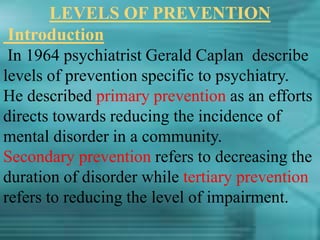
In 1964 psychiatrist Gerald Caplan describe
levels of prevention specific to psychiatry.
He described primary prevention as an efforts
directs towards reducing the incidence of
mental disorder in a community.
Secondary prevention refers to decreasing the
duration of disorder while tertiary prevention
refers to reducing the level of impairment.
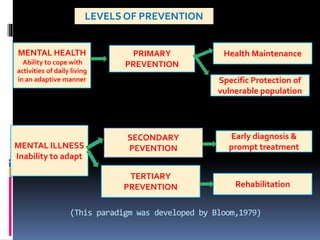
(This paradigm was developed by Bloom,1979)
MENTAL ILLNESS
Inability to adapt
MENTAL HEALTH
Ability to cope with
activities of daily living
in an adaptive manner
PRIMARY
PREVENTION
SECONDARY
PEVENTION
TERTIARY
PREVENTION
Health Maintenance
Rehabilitation
Early diagnosis &
prompt treatment
Specific Protection of
vulnerable population
LEVELS OF PREVENTION
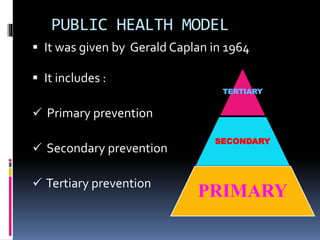
PUBLIC HEALTH MODEL
 It was given by Gerald Caplan in 1964
 It includes :
 Primary prevention
 Secondary prevention
 Tertiary prevention
TERTIARY
SECONDARY
PRIMARY
PRIMARY PREVENTION
 Primary prevention seeks to prevent the
occurrence of mental disorders by
strengthening individual, family and group
coping abilities
PRIMARY PREVENTION
 AIM
 Reducing the incidence of mental disorder
within the population.
 TARGET
 Individual
 Environment
PRIMARY PREVENTION
 STRATEGIES
 Assisting individual to increase their ability to
cope effectively with stress .
 Targeting and diminishing harmful forces i.e,
stressor within the environment.
Role of a Nurse
 1.Individual centered intervention
 Antenatal care to the mother and educating
her regarding the adverse effects of
irradiation, certain drugs and prematurity
 Dietary corrections to those infants suffering
from metabolic disorders.
 Correction of endocrine disorders.
 Liberalization of laws regarding termination
of pregnancy, when it is unwanted.
 Counseling the parents of physically and
mentally handicapped children, with
particular reference to the nature of defects.
 Fostering bonding behaviors.
 Explaining importance of warm, accepting,
intimate relationship and avoiding the
prolonged separation of mother and child are
essential.
 2. Interventions oriented to the child in the
school
 •Teaching growth and development to
parents and teachers.
 Identifying the problems of scholastic
performance and emotional disturbances
among school children
 School teachers can be taught to recognize
the beginning symp toms of problems and
referring to appropriate agencies.
 3. Family centered interventions to ensure
harmonious relationship
 Consulting with parents about appropriate
disciplinary measures.
 Promoting open health communication in
families.
 Rendering crisis counseling to the parents of
physically and mentally handicapped
children.
 Ensuring harmonious relationship among
members of the family and teaching healthy
adaptive techniques at the time of stress
producing events
 4. Interventions oriented to keep families
intact
 Mental health education about child rearing
practices.
 Strengthening social support for the
frustrated aged and helping them to retain
their usefulness.
 Promoting educational services in the field of
mental health and mental hygiene.
 Providing marital counseling for those
having marital problems
 5. Interventions for families in crisis
 In developmental crisis situations such as the
child passing through adolescence, birth of a
new baby, retirement or menopause, death
of a wage earner by the family describe by
the spouse etc.
Crisis intervention can be given at:
 Mental hygiene clinics
 Psychiatric first-aid centers
 Walk-in clinics
 6. Mental health education
 • Conduct mass health education programs
through film shows, flash cards and
appropriate audio-visual aids regarding
prevention of mental illnesses and pro-
motion of mental health in the community.
 • Educate health workers regarding
prevention of mental illness.
 7. Society-centered preventive measures
 Community development culturally deprived
families need biological and psychosocial
supplies.
 They need better hygienic living conditions,
proper food, education, health facilities, and
recreational facilities.
 Otherwise, psychopathy, alcoholism, drug
addiction, crime and mental illness, will result
in such situations.
 • Collection and evaluation of
epidemiological, biostatistical data.
SECONDARY PREVENTION
 Secondary prevention targets people who
show early symptoms of mental health
disruption but regain premorbid level of
functioning through aggressive treatment.
SECONDARY PREVENTION
 TARGET
Recognition of symptoms and provision of
referral for treatment
Ongoing assessment of individuals at high
risk for illness
 during home visit.
 day care or community health centre.
Role of a Nurse
 Early diagnosis and case finding:
 This can be achieved by educating the public,
community leaders in how to recognize early
symptoms of mental illness.
 Community mental health nurses detect:
early signs of increased levels of anxiety,
decreased ability to cope with stress and
provide direct services as appropriate.
 Early reference:
 The public should be educated to refer these
cases to proper hospitals as soon as they
recognize early symptoms of mental illness.
 Screening programs :
 Simple questionnaires should be developed
to identify the symptoms of mental illness in
the community
 Early and effective treatment for patient, and
family members, provide counseling services
to caregivers of mentally ill patients.
Training of health personnel:
 Orientation courses should be provided to
health workers to detect cases in the course of
their routine work.
Consultation services:
 Nurses working in general hospitals may come
across various conditions such as puerperal
psychosis, anxiety states, peptic ulcer, ulcerative
colitis, bronchial asthma etc.These basic care
providers need guidance and consultation to
deal with these conditions in an effective
manner.
Crisis intervention:
 If crisis is not tackled in time it may lead to
suicide or mental disorder.
TERTIARY PREVENTION
 Tertiary prevention targets those with mental
illness and helps to reduce the severity,
discomfort and disability associated with
their illness.
DISABILITY
 Disability is “ any restriction or lack of ability
to perform an activity in the manner or within
the range considered normal for the human
being”.
TERTIARY PREVENTION
 AIM:
o Reducing the residual defects that are
associated with severe and persistent mental
illness.
TERTIARY PREVENTION
 STRATEGIES
 Preventing complications of the illness.
Promoting rehabilitation that is directed
towards the achievement of each
individuals maximum levels of
functioning.
TERTIARY PREVENTION
 Role of Nurse:
 Family involvement
 Occupational and recreational activities
 Rehabilitation
 Teaching the client daily living skills
 Encouraging independence
 Referring clients to various aftercare services
 Community based programmes.
PSYCHIATRIC REHABILITATION
 Rehabilitation is the process of enabling the
individual to return to his highest possible
level of functioning. It is an important
component of the community mental health
program, and is under taken at the level of
tertiary prevention.
DEFINITION
 Rehabilitation is " an attempt to provide the
best possible community role which will
enable the patient to achieve the maximum
range of activity, interest and of which he is
capable". -Maxwell Jones [1952]
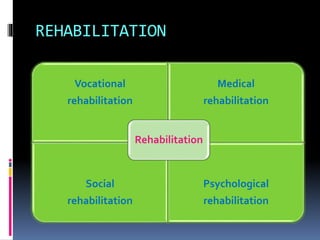
REHABILITATION
Vocational
rehabilitation
Medical
rehabilitation
Social
rehabilitation
Psychological
rehabilitation
Rehabilitation
INDICATION
 The following disorders are indicated
commonly for rehabilitation:
 Chronic schizophrenia
 Chronic organic mental disorders
 Mental retardation
 Alcohol and drug dependence
Principles of Rehabilitation
 Increasing independence would be the first step
in rehabilitation process.
 Primary focus is on improvement of capabilities
and competence of clients with psychiatric
problems.
 • Maximum use must be made of residual
capacities.
 • Patient's active participation is very essential.
 • Skill development, therapeutic environment
are fundamental interventions for a successful
rehabilitation process.
Psychiatric Rehabilitation
Approaches
 a. Psycho education: Includes diagnosing the
problem, telling the person what to expect
regarding illness and discussing treatment
alternatives.
 b.Working with families: Encouraging family
members to get involved in treatment and
rehabilitation programs.
Cont…
 c. Group therapy: Positive aspects of group
therapy include an opportunity for ongoing
contact with others, sharing their views about
problems and problem solving abilities.
 d. Social skills training: It involves teaching
specific living skills that the patient is
expected to have in order to survive in the
community
BIBLIOGRAPHY
 Psychiatric mental health nursing, Mary C.Townsend , jaypee publication,7th
edition .
 Mental health and Psychiatric nursing, k Lalitha ,CBS Publisher,1st edition ,
 Essentials of Psychiatric and mental health nursing ,Mary verghese,s2nd
edition,
 Textbook of mental health nursing, D Elakkuvana bhakara Raj ,jaypee
publication,
 Basic concept of Psychiatric mental health nursing, louise rebraca shives,6th
edition ,
 Psychiatric mental health nursing,katherine m.fortinash ,patricia a holoday
worret,mosby publication 3rd edition ,
 A guide to mental health nursing and pychiatric nursing , Rsreevani jaypee
publication
 Essentials of Psychiatric and mental health nursing pawan sharma , jaypee
publication
 Essentials of mental health nursing, BT Basavantahappa, jaypee
publication
Preventive psychiatric

Preventive psychiatric

  • 1.
    PREVENTIVE PSYCHIATRY PRESENTED BY SakuntalaGiri SUM Nursing College M.sc. Tutor Mental Health Nursing
  • 2.
    LEVELS OF PREVENTION Introduction In1964 psychiatrist Gerald Caplan describe levels of prevention specific to psychiatry. He described primary prevention as an efforts directs towards reducing the incidence of mental disorder in a community. Secondary prevention refers to decreasing the duration of disorder while tertiary prevention refers to reducing the level of impairment.
  • 3.
    (This paradigm wasdeveloped by Bloom,1979) MENTAL ILLNESS Inability to adapt MENTAL HEALTH Ability to cope with activities of daily living in an adaptive manner PRIMARY PREVENTION SECONDARY PEVENTION TERTIARY PREVENTION Health Maintenance Rehabilitation Early diagnosis & prompt treatment Specific Protection of vulnerable population LEVELS OF PREVENTION
  • 4.
    PUBLIC HEALTH MODEL It was given by Gerald Caplan in 1964  It includes :  Primary prevention  Secondary prevention  Tertiary prevention TERTIARY SECONDARY PRIMARY
  • 5.
    PRIMARY PREVENTION  Primaryprevention seeks to prevent the occurrence of mental disorders by strengthening individual, family and group coping abilities
  • 6.
    PRIMARY PREVENTION  AIM Reducing the incidence of mental disorder within the population.  TARGET  Individual  Environment
  • 7.
    PRIMARY PREVENTION  STRATEGIES Assisting individual to increase their ability to cope effectively with stress .  Targeting and diminishing harmful forces i.e, stressor within the environment.
  • 8.
    Role of aNurse  1.Individual centered intervention  Antenatal care to the mother and educating her regarding the adverse effects of irradiation, certain drugs and prematurity  Dietary corrections to those infants suffering from metabolic disorders.  Correction of endocrine disorders.  Liberalization of laws regarding termination of pregnancy, when it is unwanted.
  • 9.
     Counseling theparents of physically and mentally handicapped children, with particular reference to the nature of defects.  Fostering bonding behaviors.  Explaining importance of warm, accepting, intimate relationship and avoiding the prolonged separation of mother and child are essential.
  • 10.
     2. Interventionsoriented to the child in the school  •Teaching growth and development to parents and teachers.  Identifying the problems of scholastic performance and emotional disturbances among school children  School teachers can be taught to recognize the beginning symp toms of problems and referring to appropriate agencies.
  • 11.
     3. Familycentered interventions to ensure harmonious relationship  Consulting with parents about appropriate disciplinary measures.  Promoting open health communication in families.  Rendering crisis counseling to the parents of physically and mentally handicapped children.  Ensuring harmonious relationship among members of the family and teaching healthy adaptive techniques at the time of stress producing events
  • 12.
     4. Interventionsoriented to keep families intact  Mental health education about child rearing practices.  Strengthening social support for the frustrated aged and helping them to retain their usefulness.  Promoting educational services in the field of mental health and mental hygiene.  Providing marital counseling for those having marital problems
  • 13.
     5. Interventionsfor families in crisis  In developmental crisis situations such as the child passing through adolescence, birth of a new baby, retirement or menopause, death of a wage earner by the family describe by the spouse etc. Crisis intervention can be given at:  Mental hygiene clinics  Psychiatric first-aid centers  Walk-in clinics
  • 14.
     6. Mentalhealth education  • Conduct mass health education programs through film shows, flash cards and appropriate audio-visual aids regarding prevention of mental illnesses and pro- motion of mental health in the community.  • Educate health workers regarding prevention of mental illness.
  • 15.
     7. Society-centeredpreventive measures  Community development culturally deprived families need biological and psychosocial supplies.  They need better hygienic living conditions, proper food, education, health facilities, and recreational facilities.  Otherwise, psychopathy, alcoholism, drug addiction, crime and mental illness, will result in such situations.  • Collection and evaluation of epidemiological, biostatistical data.
  • 16.
    SECONDARY PREVENTION  Secondaryprevention targets people who show early symptoms of mental health disruption but regain premorbid level of functioning through aggressive treatment.
  • 17.
    SECONDARY PREVENTION  TARGET Recognitionof symptoms and provision of referral for treatment Ongoing assessment of individuals at high risk for illness  during home visit.  day care or community health centre.
  • 18.
    Role of aNurse  Early diagnosis and case finding:  This can be achieved by educating the public, community leaders in how to recognize early symptoms of mental illness.  Community mental health nurses detect: early signs of increased levels of anxiety, decreased ability to cope with stress and provide direct services as appropriate.
  • 19.
     Early reference: The public should be educated to refer these cases to proper hospitals as soon as they recognize early symptoms of mental illness.  Screening programs :  Simple questionnaires should be developed to identify the symptoms of mental illness in the community  Early and effective treatment for patient, and family members, provide counseling services to caregivers of mentally ill patients.
  • 20.
    Training of healthpersonnel:  Orientation courses should be provided to health workers to detect cases in the course of their routine work. Consultation services:  Nurses working in general hospitals may come across various conditions such as puerperal psychosis, anxiety states, peptic ulcer, ulcerative colitis, bronchial asthma etc.These basic care providers need guidance and consultation to deal with these conditions in an effective manner. Crisis intervention:  If crisis is not tackled in time it may lead to suicide or mental disorder.
  • 21.
    TERTIARY PREVENTION  Tertiaryprevention targets those with mental illness and helps to reduce the severity, discomfort and disability associated with their illness.
  • 22.
    DISABILITY  Disability is“ any restriction or lack of ability to perform an activity in the manner or within the range considered normal for the human being”.
  • 23.
    TERTIARY PREVENTION  AIM: oReducing the residual defects that are associated with severe and persistent mental illness.
  • 24.
    TERTIARY PREVENTION  STRATEGIES Preventing complications of the illness. Promoting rehabilitation that is directed towards the achievement of each individuals maximum levels of functioning.
  • 25.
    TERTIARY PREVENTION  Roleof Nurse:  Family involvement  Occupational and recreational activities  Rehabilitation  Teaching the client daily living skills  Encouraging independence  Referring clients to various aftercare services  Community based programmes.
  • 26.
    PSYCHIATRIC REHABILITATION  Rehabilitationis the process of enabling the individual to return to his highest possible level of functioning. It is an important component of the community mental health program, and is under taken at the level of tertiary prevention.
  • 27.
    DEFINITION  Rehabilitation is" an attempt to provide the best possible community role which will enable the patient to achieve the maximum range of activity, interest and of which he is capable". -Maxwell Jones [1952]
  • 28.
  • 29.
    INDICATION  The followingdisorders are indicated commonly for rehabilitation:  Chronic schizophrenia  Chronic organic mental disorders  Mental retardation  Alcohol and drug dependence
  • 30.
    Principles of Rehabilitation Increasing independence would be the first step in rehabilitation process.  Primary focus is on improvement of capabilities and competence of clients with psychiatric problems.  • Maximum use must be made of residual capacities.  • Patient's active participation is very essential.  • Skill development, therapeutic environment are fundamental interventions for a successful rehabilitation process.
  • 31.
    Psychiatric Rehabilitation Approaches  a.Psycho education: Includes diagnosing the problem, telling the person what to expect regarding illness and discussing treatment alternatives.  b.Working with families: Encouraging family members to get involved in treatment and rehabilitation programs.
  • 32.
    Cont…  c. Grouptherapy: Positive aspects of group therapy include an opportunity for ongoing contact with others, sharing their views about problems and problem solving abilities.  d. Social skills training: It involves teaching specific living skills that the patient is expected to have in order to survive in the community
  • 33.
    BIBLIOGRAPHY  Psychiatric mentalhealth nursing, Mary C.Townsend , jaypee publication,7th edition .  Mental health and Psychiatric nursing, k Lalitha ,CBS Publisher,1st edition ,  Essentials of Psychiatric and mental health nursing ,Mary verghese,s2nd edition,  Textbook of mental health nursing, D Elakkuvana bhakara Raj ,jaypee publication,  Basic concept of Psychiatric mental health nursing, louise rebraca shives,6th edition ,  Psychiatric mental health nursing,katherine m.fortinash ,patricia a holoday worret,mosby publication 3rd edition ,  A guide to mental health nursing and pychiatric nursing , Rsreevani jaypee publication  Essentials of Psychiatric and mental health nursing pawan sharma , jaypee publication  Essentials of mental health nursing, BT Basavantahappa, jaypee publication