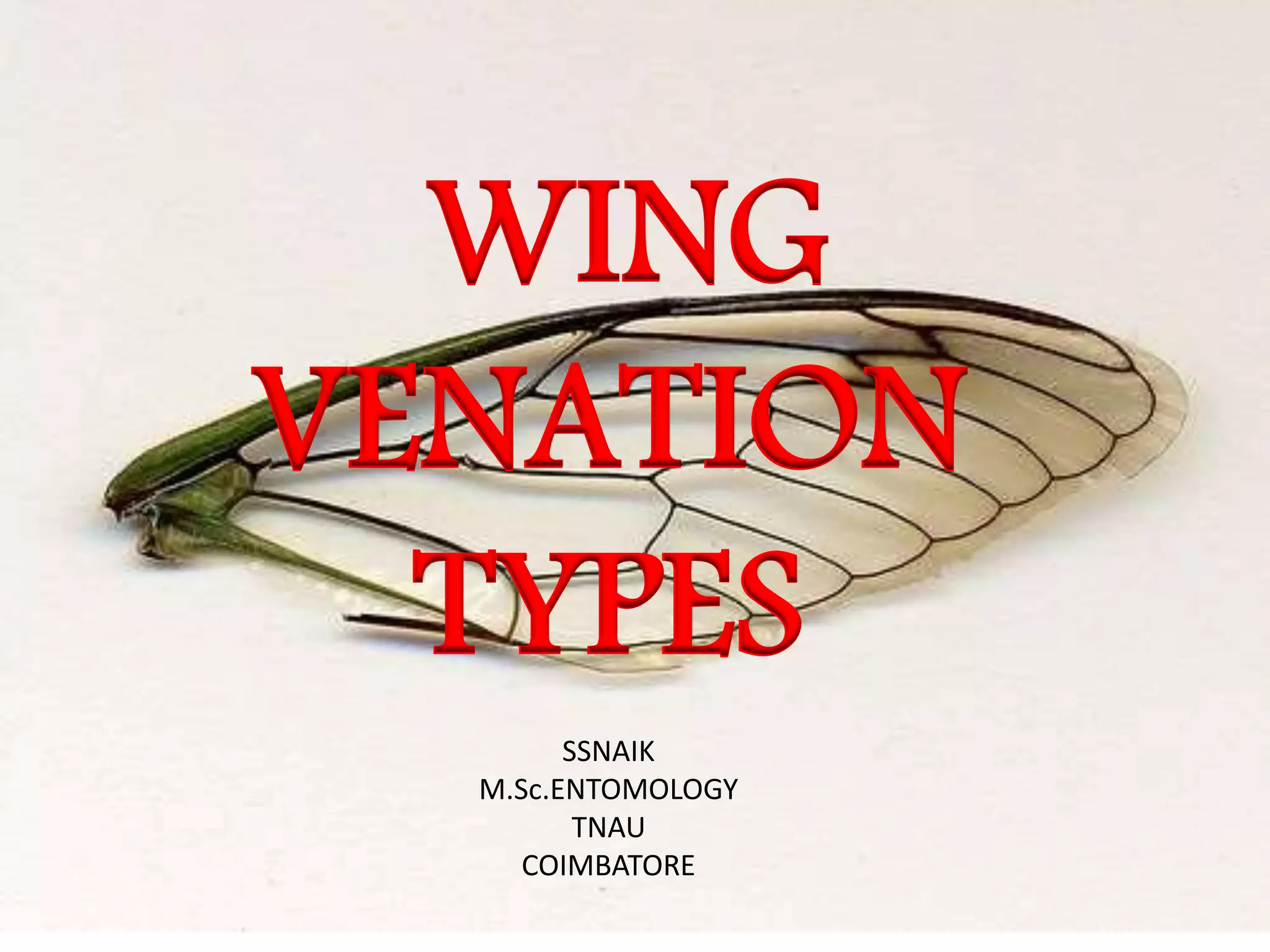
WING 
VENATION 
TYPES 
SSNAIK 
M.Sc.ENTOMOLOGY 
TNAU 
COIMBATORE
INTRODUCTION: 
Is insect is an animal ?
KINGDOM 
ANIMALIA 
INVERTEBRATA VERTEBRATA 
PROTOZOA 
PORIFERA 
CNIDARIA 
PLATYHELMINTHES 
NEMATODA 
ANNELIDA 
ARTHROPODA 
MOLLUSCA, 
ECHINODERMATA 
CHORDATA: 
FISHES, 
AMPHIBIANS, 
REPTILES, APES, 
MAMMALS
The only invertebrate 
animal and it is the first 
animal having the wings 
___insect
2.ORIGIN 
AND 
EVOLUTION OF 
WING
Fossil records in Carboniferous times,. 
2 pairs of fully developed wings+ 2 paranotal 
lobes
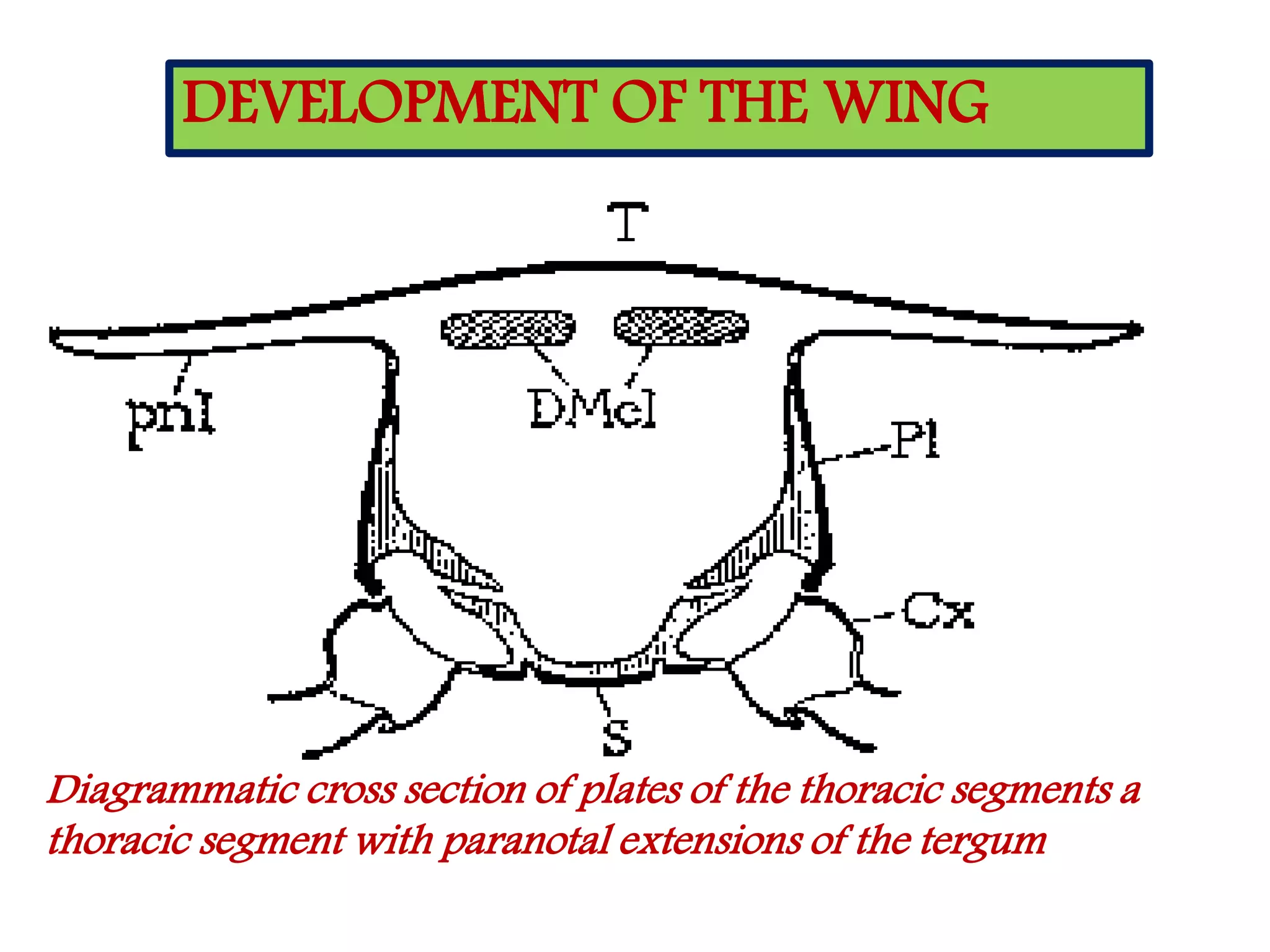
DEVELOPMENT OF THE WING 
Diagrammatic cross section of plates of the thoracic segments a 
thoracic segment with paranotal extensions of the tergum
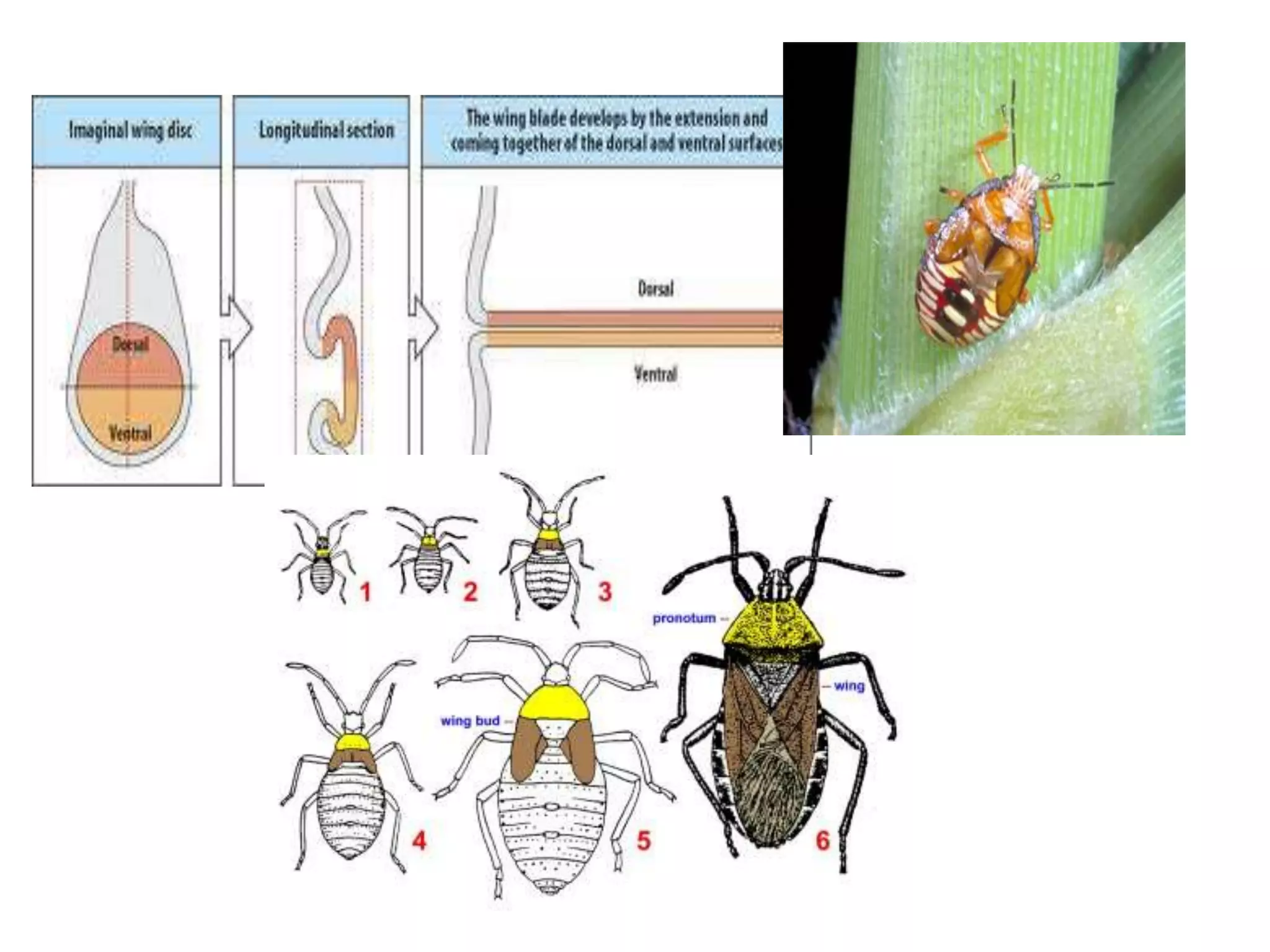
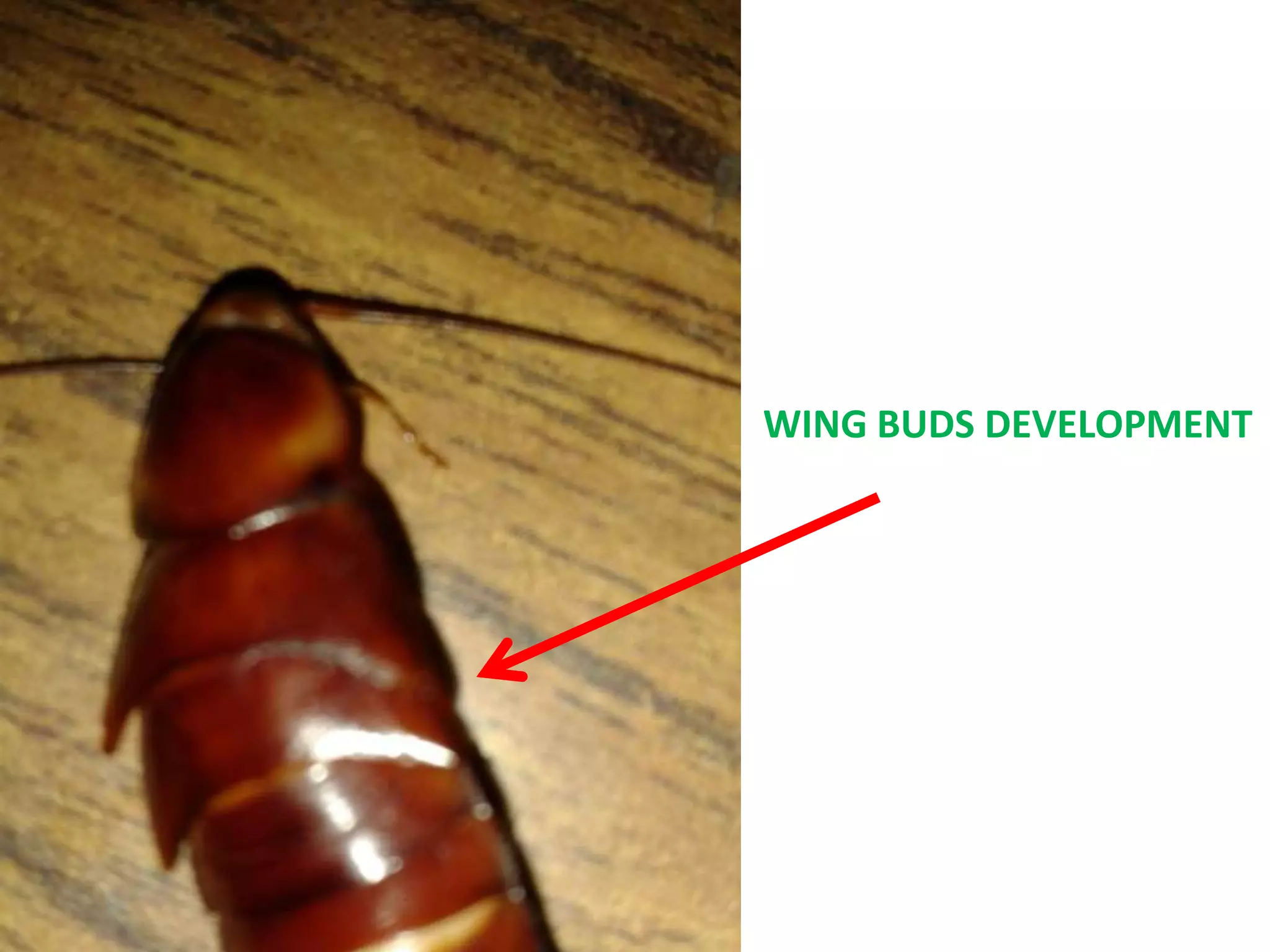
WING BUDS DEVELOPMENT
CONTRIBUTIONS : 
STRUCTURE-COMSTOCK, 
SNODGRASS 
COUPLING-TILLYARD 
ARTICULATION-PRINGLE 
WINGS
3.W3.WININGG S STTRRUUCCTTUURERE
Anterior 
…………………. 
…………………… 
PTEROTHORAX 
HEAD NECK THORAX 
ABDOMEN 
INSECT:
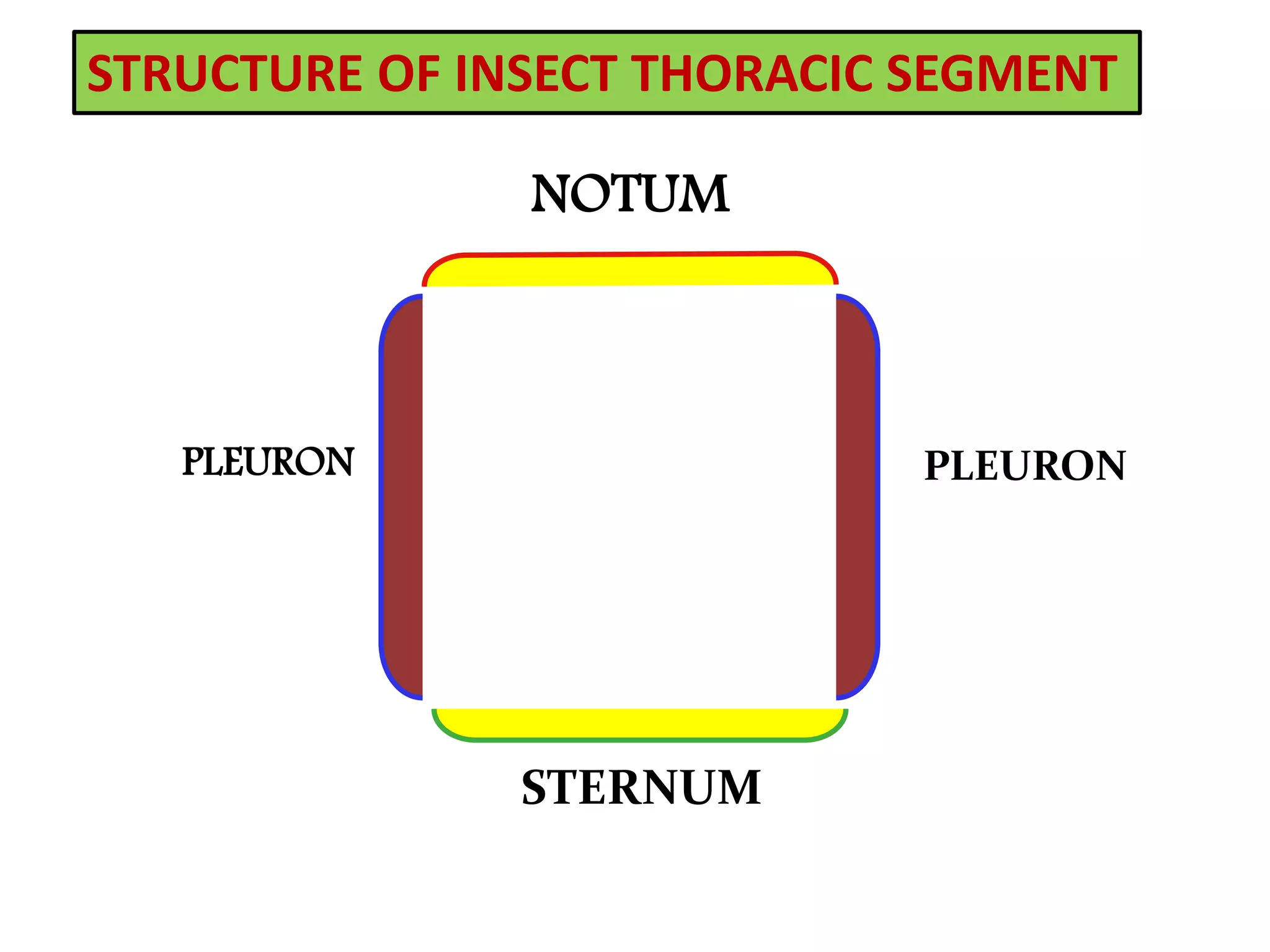
STRUCTURE OF INSECT THORACIC SEGMENT 
NOTUM 
PLEURON PLEURON 
STERNUM
• 1 2 
3 
A 
B 
C
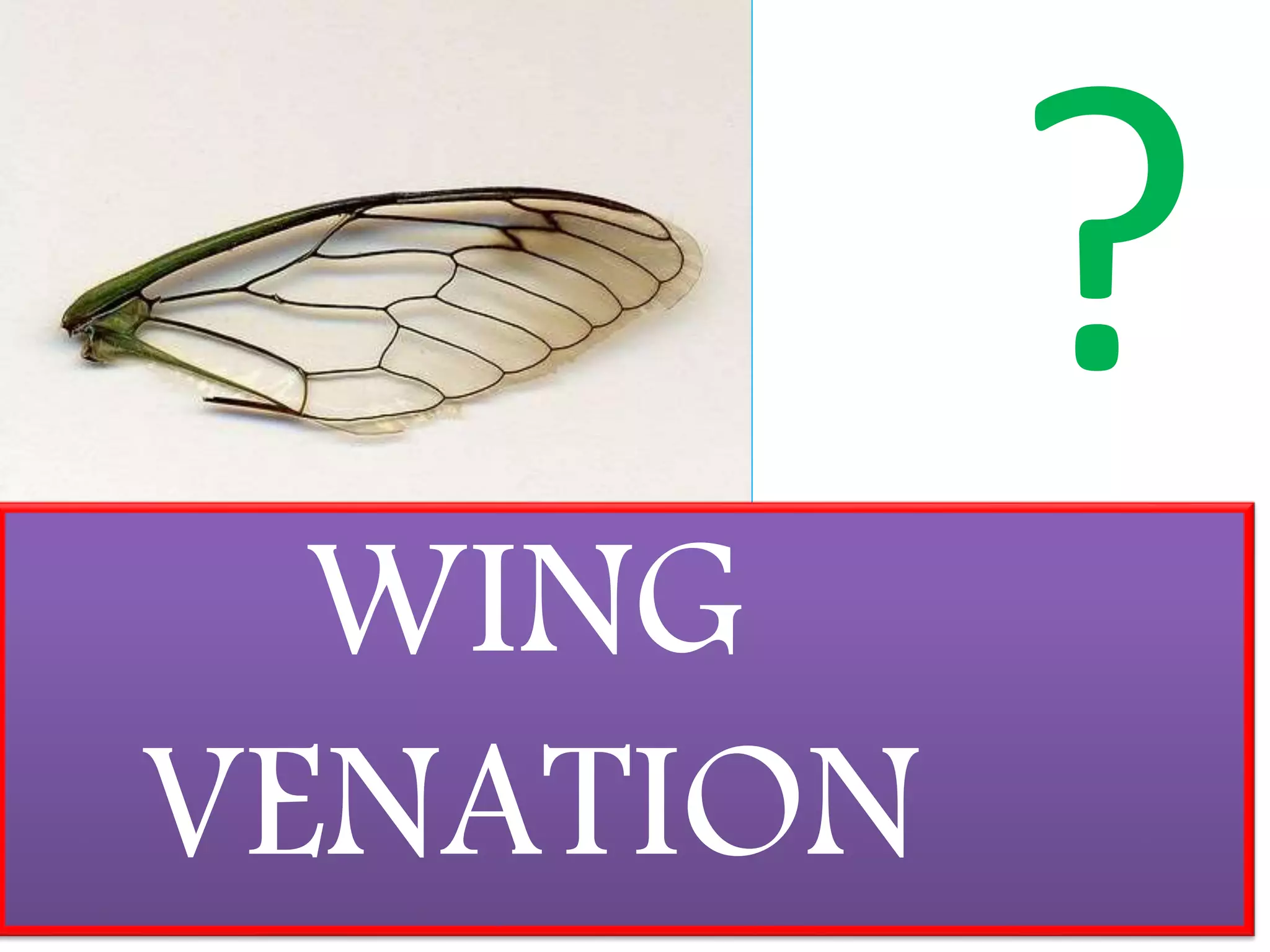
WING 
VENATION
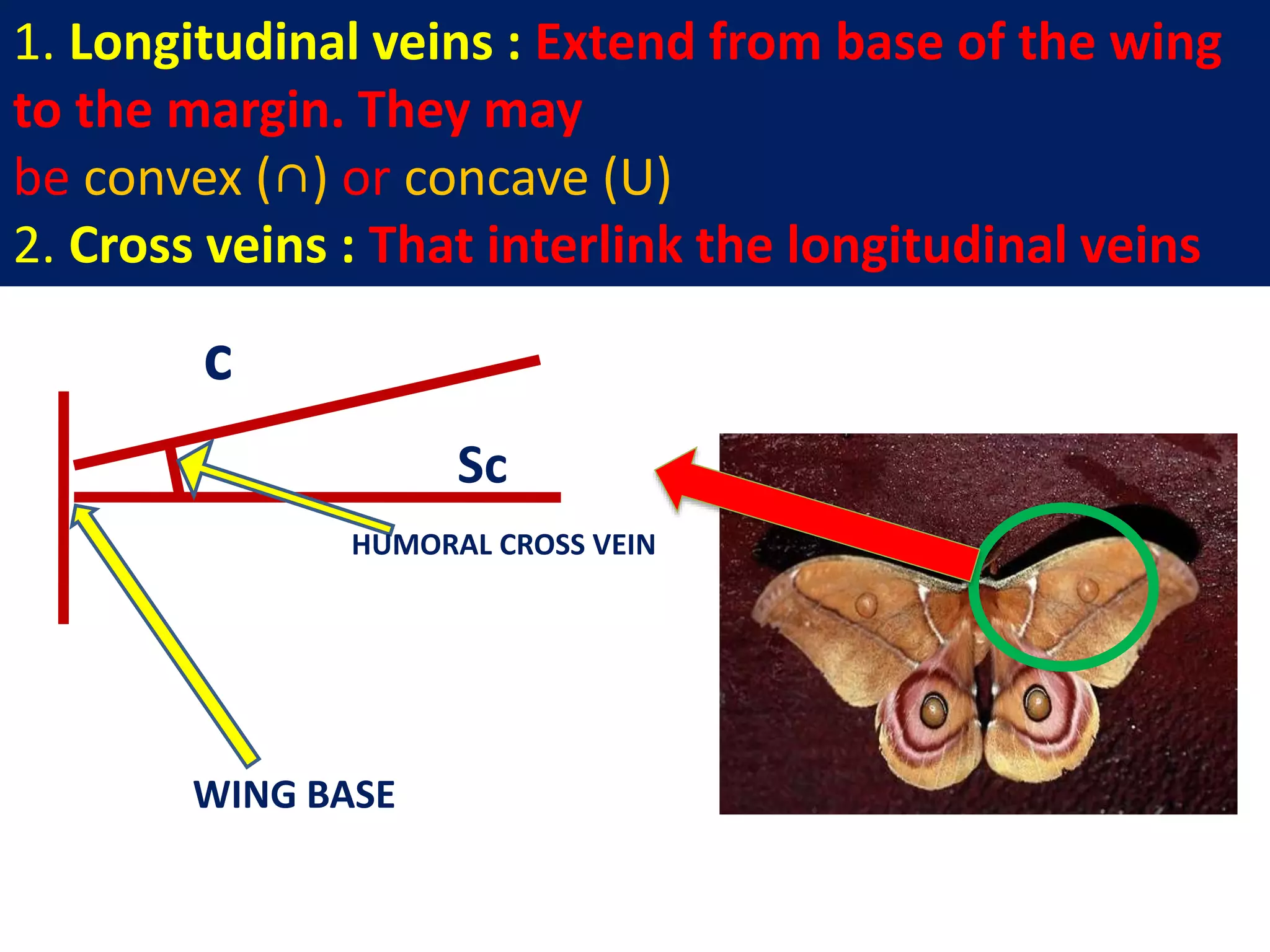
VEIN:
1. Longitudinal veins : Extend from base of the wing 
to the margin. They may 
be convex (∩) or concave (U) 
2. Cross veins : That interlink the longitudinal veins 
c 
Sc 
HUMORAL CROSS VEIN 
WING BASE
Precoasta (PC): This vein is fused with costa 
in all extant insects, mostly unrecognisable. 
1.Costa (C) : at the leading edge of the wing, 
strong and marginal, extends to the apex of the 
wing, it is unbranched. 
c
Sub costa (Sc) : It runs immediately below 
the costa always in the bottom of a trough 
between C and R .It is forked distally .The two 
branches of SC are Sc1 and Sc2 and is concave 
Sc 
Sc1 
Sc2 
Subcosta (Sc): the second longitudinal vein, 
mainly the subcosta posterior sector (ScP). Sc 
is reduced or fused with R in most Hemiptera.
3. Radial vein (R ): It is the next main vein , stout and connects 
at the base with second auxillary sclerite , it divided in to two 
branches R1 and Rs (Radial sector). R1 goes directly towards 
apical margin and is convex; Rs is concave and divided in to 4 
branches, R2, R3,R4, R5. 
R 
R1 
R1 
Rs 
R2 
R3 
R4 
R5 
Radius (R) -- the third vein, usually the strongest vein on the wing, with 
branches usually cover the largest area of wing apex. RP is often referred 
to as radial sector (Rs) and the end branches as R1-5.
Media (M) :It is one of the two veins articulating 
with some of the small median seclerites. 
It is divided in two branches 1. Media anterior (MA) 
which is convex and Media posterior(MP) and is 
concave. 
Media anterior is again divided into MA1 and MA2. 
Median posterior is again divided in to MP1, MP2, 
MP3, MP4. 
MA1 
MA2. 
Mp1 
Mp2 
Mp3 
Mp4 
M 
MA 
MP
5. Cubitus (Cu): It articulates with median auxillary 
sclerite. Cubitus is divided into convex CU1 and 
concave CU2. CU1 is again divided into CU1a and 
CU1b. 
Cu Cu1 
Cu2 
Cu2 
Cu1a 
Cu1b
6. Anal veins (A) : These veins are convex. 
They are individual un-branched, 1-3 in number. 
1A 
2A
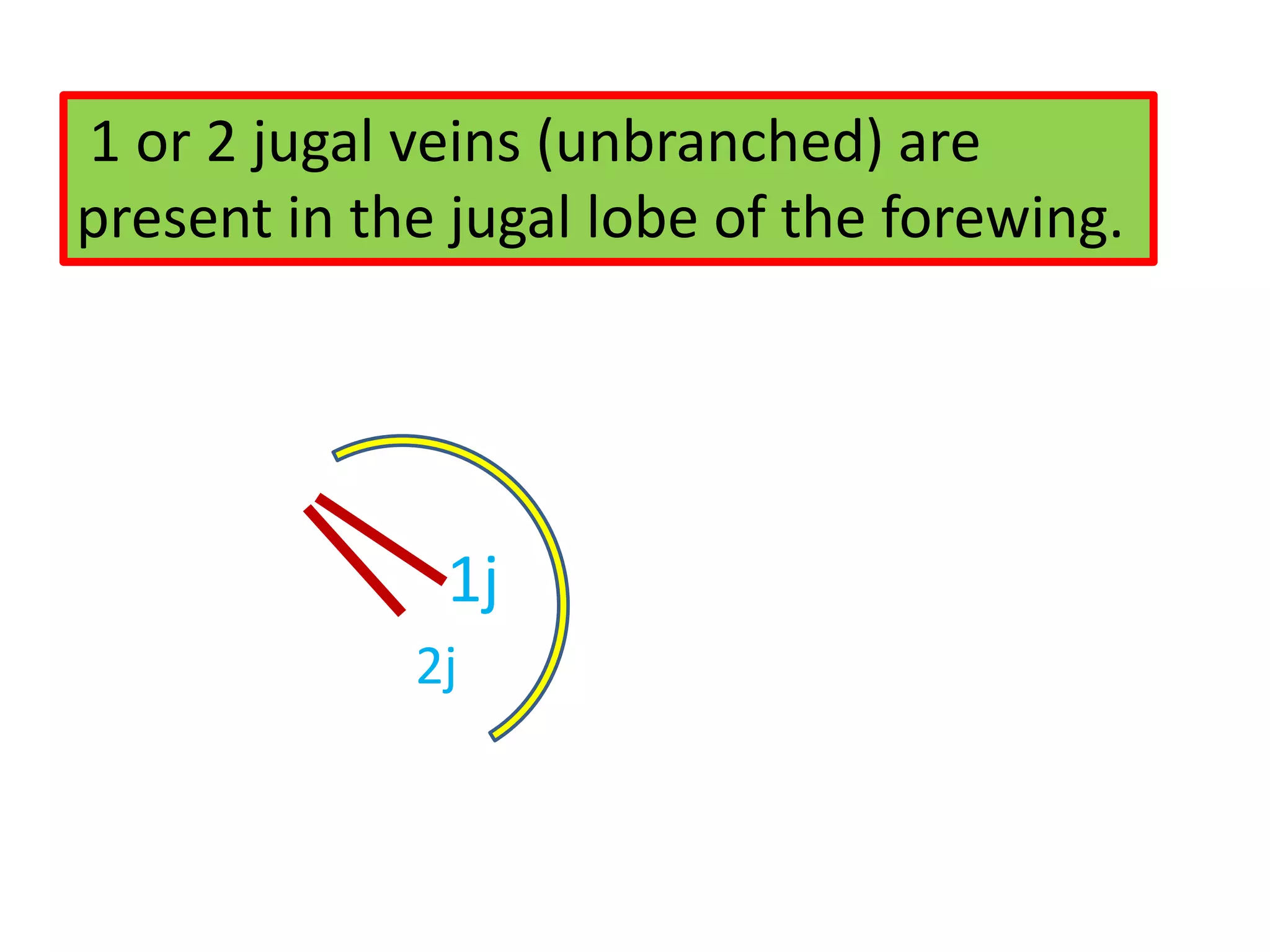
1 or 2 jugal veins (unbranched) are 
present in the jugal lobe of the forewing. 
1j 
2j
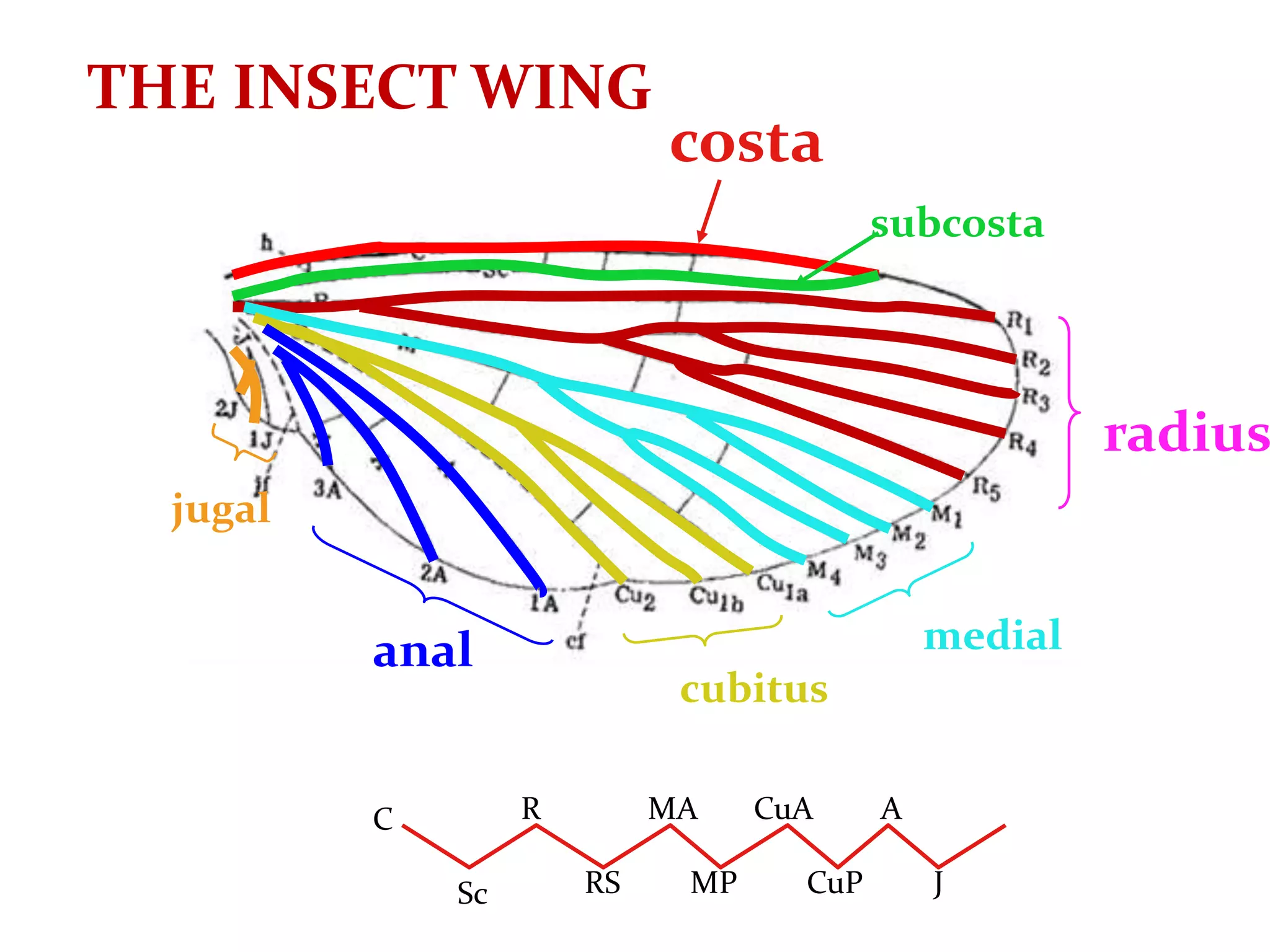
THE INSECT WING 
costa 
subcosta 
radius 
medial 
cubitus 
anal 
jugal 
C 
Sc 
R 
RS 
MA 
MP 
CuA 
CuP 
A 
J
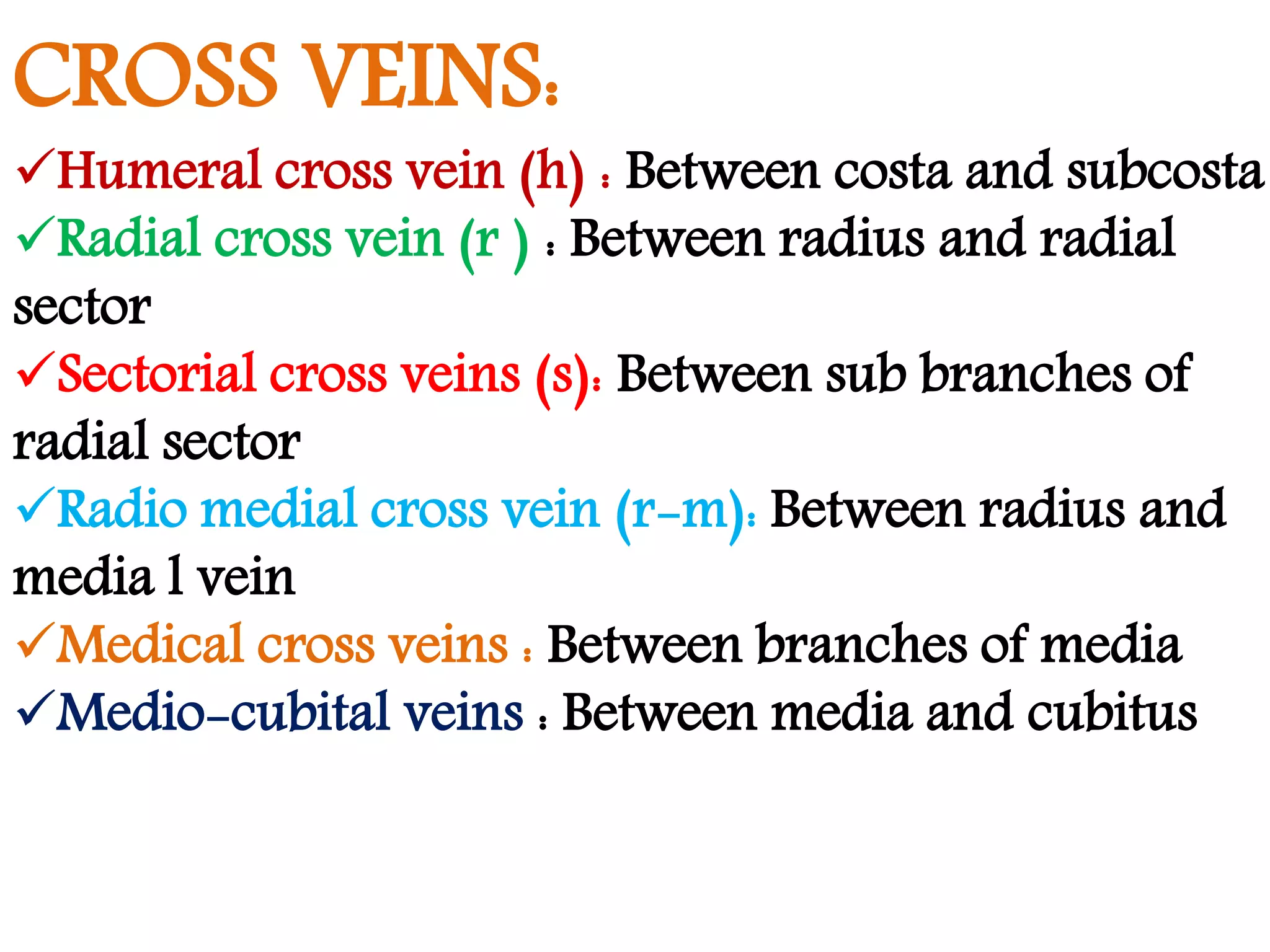
CROSS VEINS: 
Humeral cross vein (h) : Between costa and subcosta 
Radial cross vein (r ) : Between radius and radial 
sector 
Sectorial cross veins (s): Between sub branches of 
radial sector 
Radio medial cross vein (r-m): Between radius and 
media l vein 
Medical cross veins : Between branches of media 
Medio-cubital veins : Between media and cubitus
VIEN
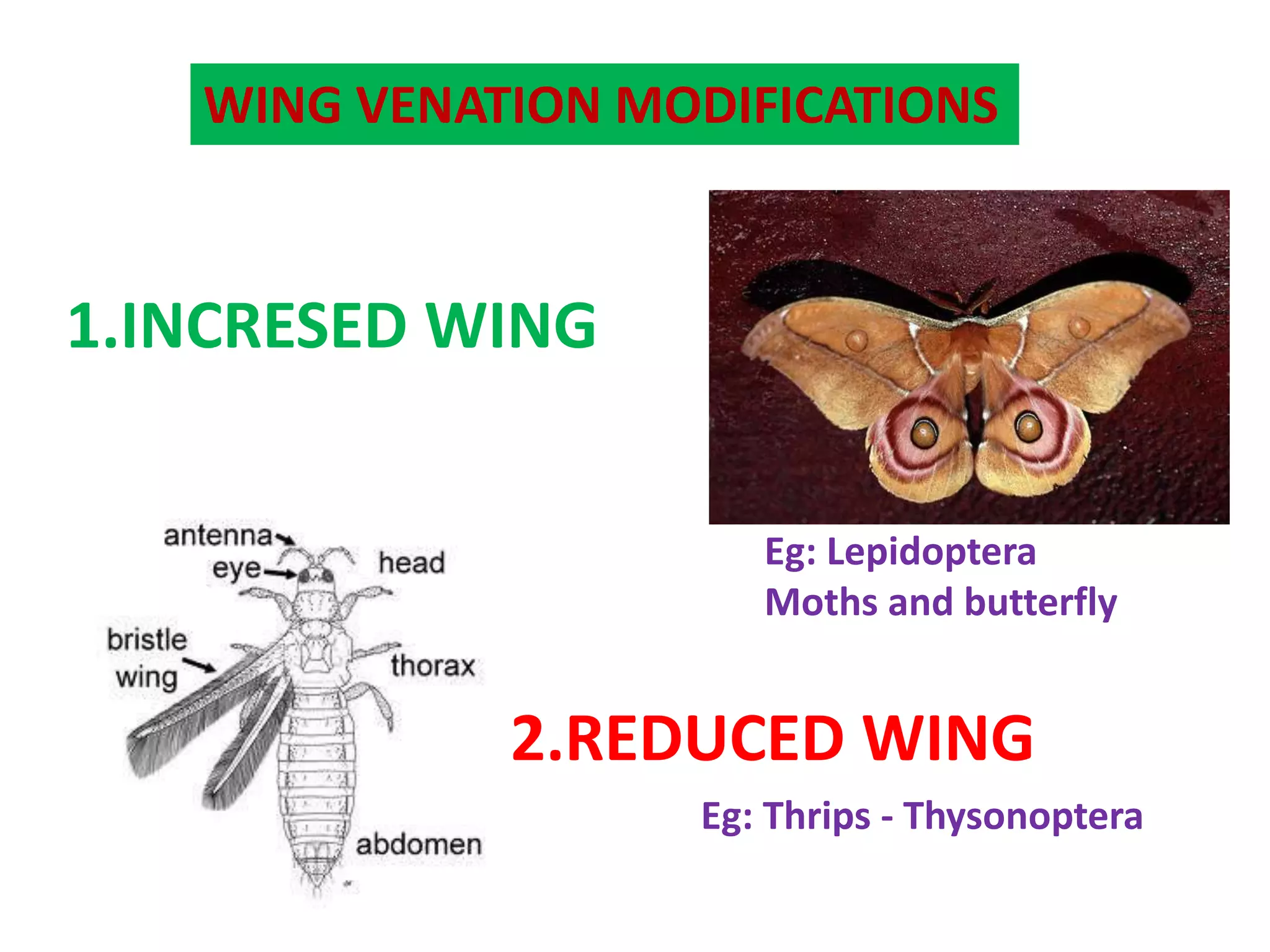
WING VENATION MODIFICATIONS 
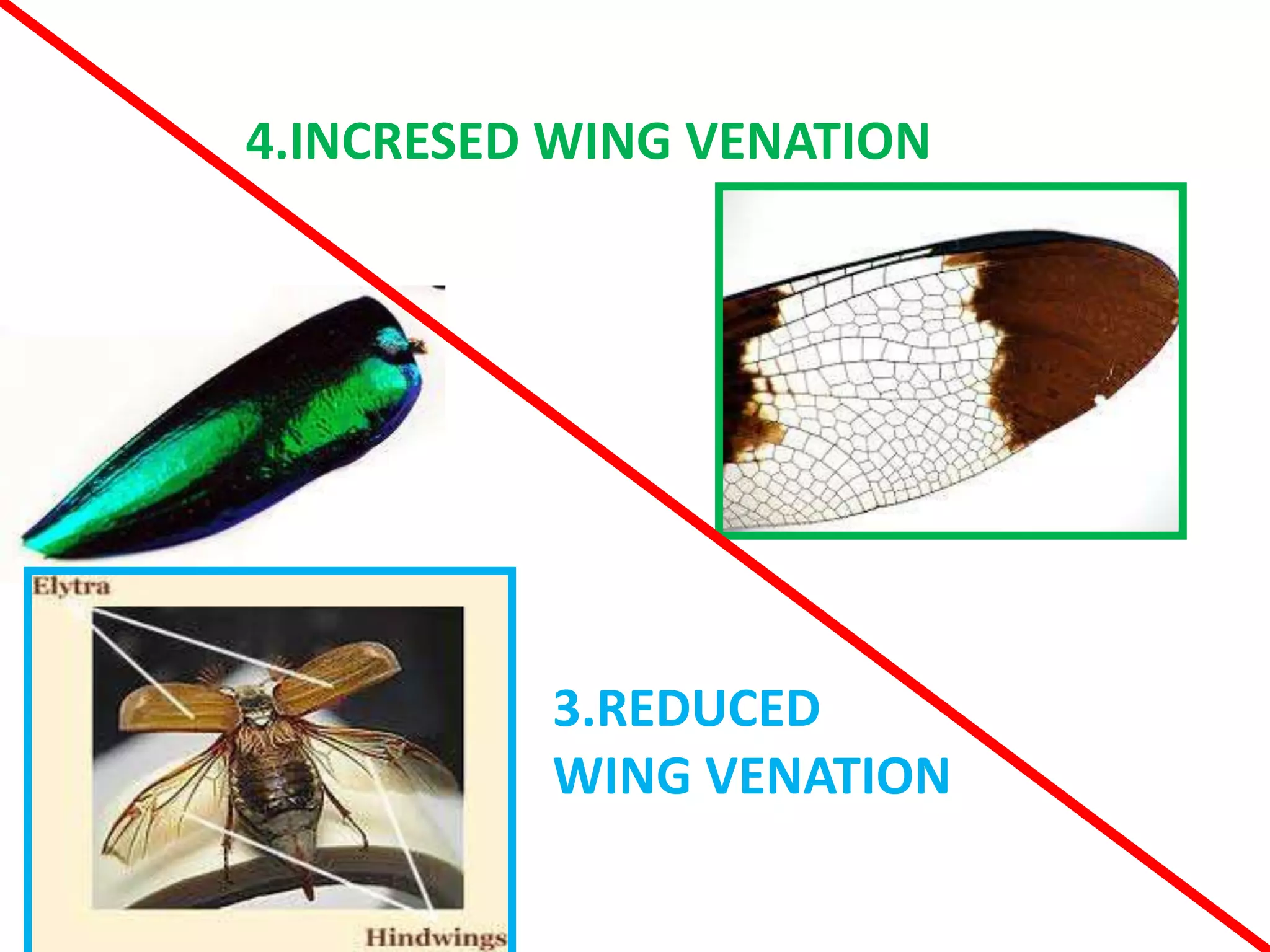
1.INCRESED WING 
Eg: Lepidoptera 
Moths and butterfly 
2.REDUCED WING 
Eg: Thrips - Thysonoptera
4.INCRESED WING VENATION 
3.REDUCED 
WING VENATION
WING 
VENATION 
MODIFICATION
Damselfly and Dragonfly's Wings
Here are five (R+M counted as 1) main vein stems on dragonfly and damselfly 
wings; 
1. Costa (C) -- at the leading edge of the wing, strong and marginal, extends to 
the apex of the wing. 
2. Subcosta (Sc) -- second longitudinal vein, it is unbranched, joins C at nodus. 
3. Radius and Media (R+M) -- third and fourth longitudinal vein, the strongest 
vein on the wing, with branches, R1-R4, reach the wing margin, the media 
anterior (MA) are also reach the wing margin. IR2 and IR3 are intercalary 
veins behind R2 and R3 respectively. 
4. Cubitus (Cu) -- fifth longitudinal vein, cubitus posterior (CuP) is unbranched 
and reach the wing margin. 
5. Anal veins (1A) -- unbranched veins behind the cubitus. 
6. A nodus is formed where the second main vein meets the leading edge of the 
wing. The black pterostigma is carried near the wing tip. 
The main veins and the crossveins form the wing venation pattern. The 
venation patterns are different in different species. There may be very 
numerous crossveins or rather few. The Australian Flatwing Damselfly's 
wings are one of the few veins patterns. The venation pattern is useful for 
species identification.
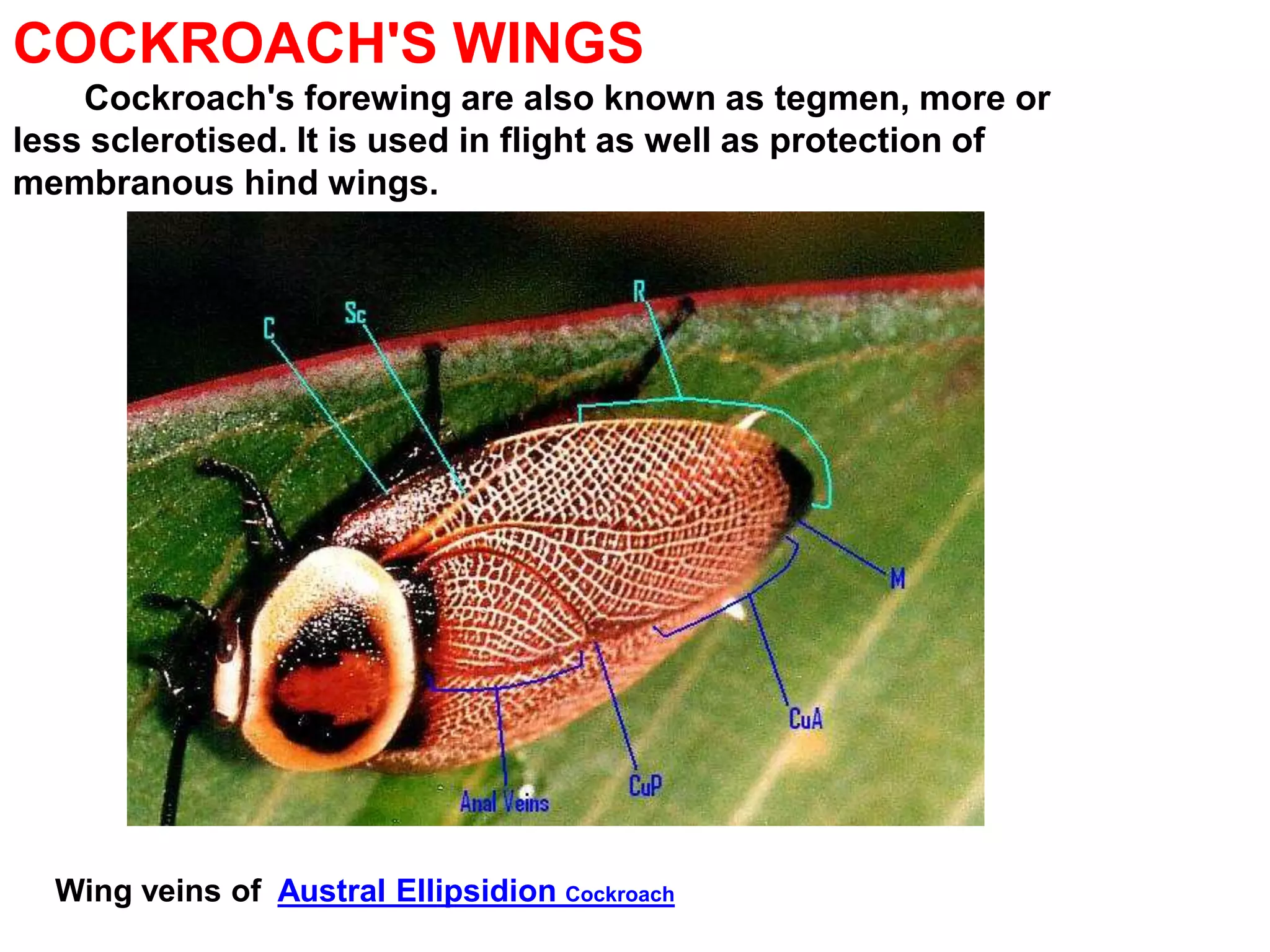
COCKROACH'S WINGS 
Cockroach's forewing are also known as tegmen, more or 
less sclerotised. It is used in flight as well as protection of 
membranous hind wings. 
Wing veins of Austral Ellipsidion Cockroach
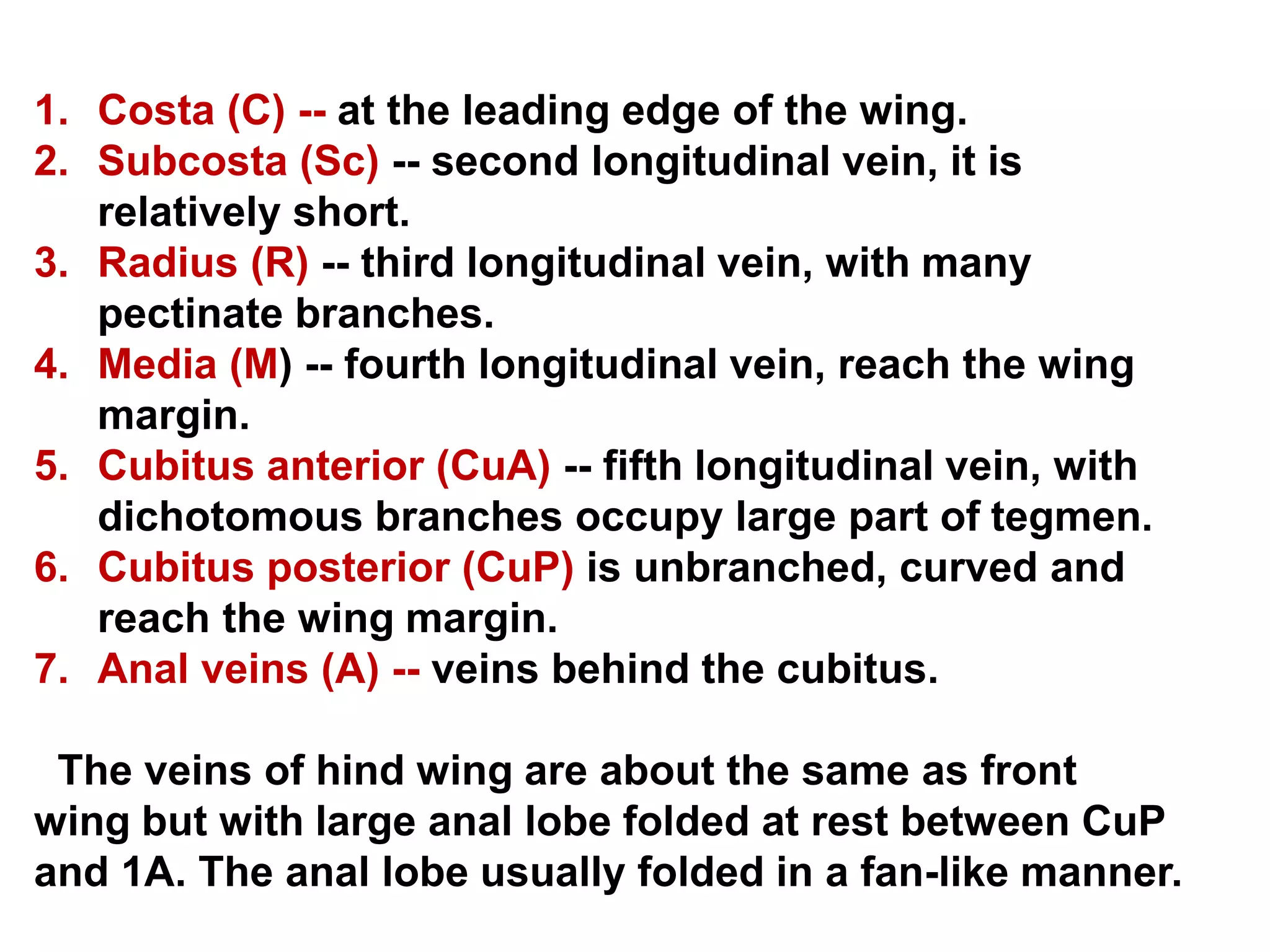
1. Costa (C) -- at the leading edge of the wing. 
2. Subcosta (Sc) -- second longitudinal vein, it is 
relatively short. 
3. Radius (R) -- third longitudinal vein, with many 
pectinate branches. 
4. Media (M) -- fourth longitudinal vein, reach the wing 
margin. 
5. Cubitus anterior (CuA) -- fifth longitudinal vein, with 
dichotomous branches occupy large part of tegmen. 
6. Cubitus posterior (CuP) is unbranched, curved and 
reach the wing margin. 
7. Anal veins (A) -- veins behind the cubitus. 
The veins of hind wing are about the same as front 
wing but with large anal lobe folded at rest between CuP 
and 1A. The anal lobe usually folded in a fan-like manner.
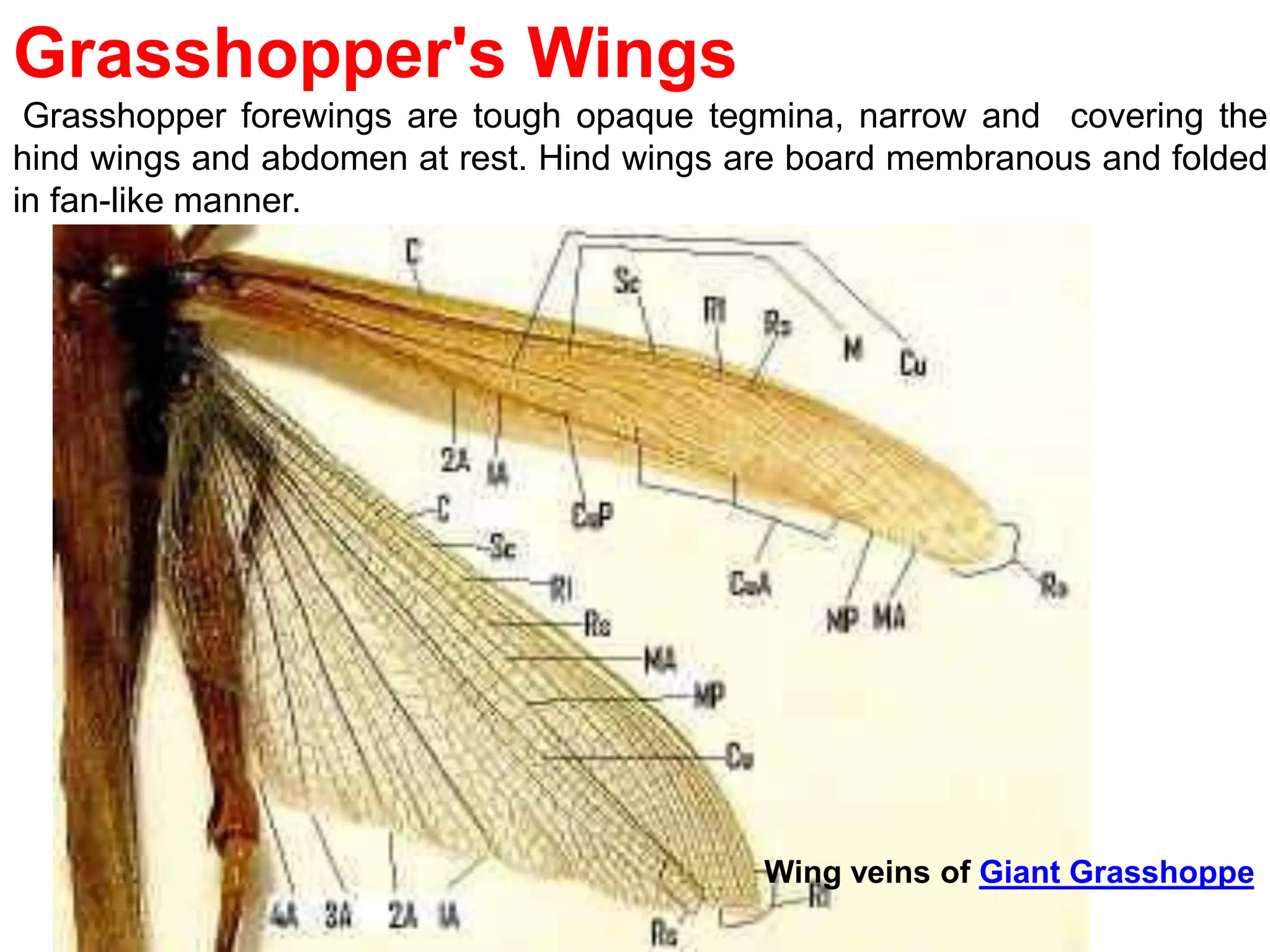
Grasshopper's Wings 
Grasshopper forewings are tough opaque tegmina, narrow and covering the 
hind wings and abdomen at rest. Hind wings are board membranous and folded 
in fan-like manner. 
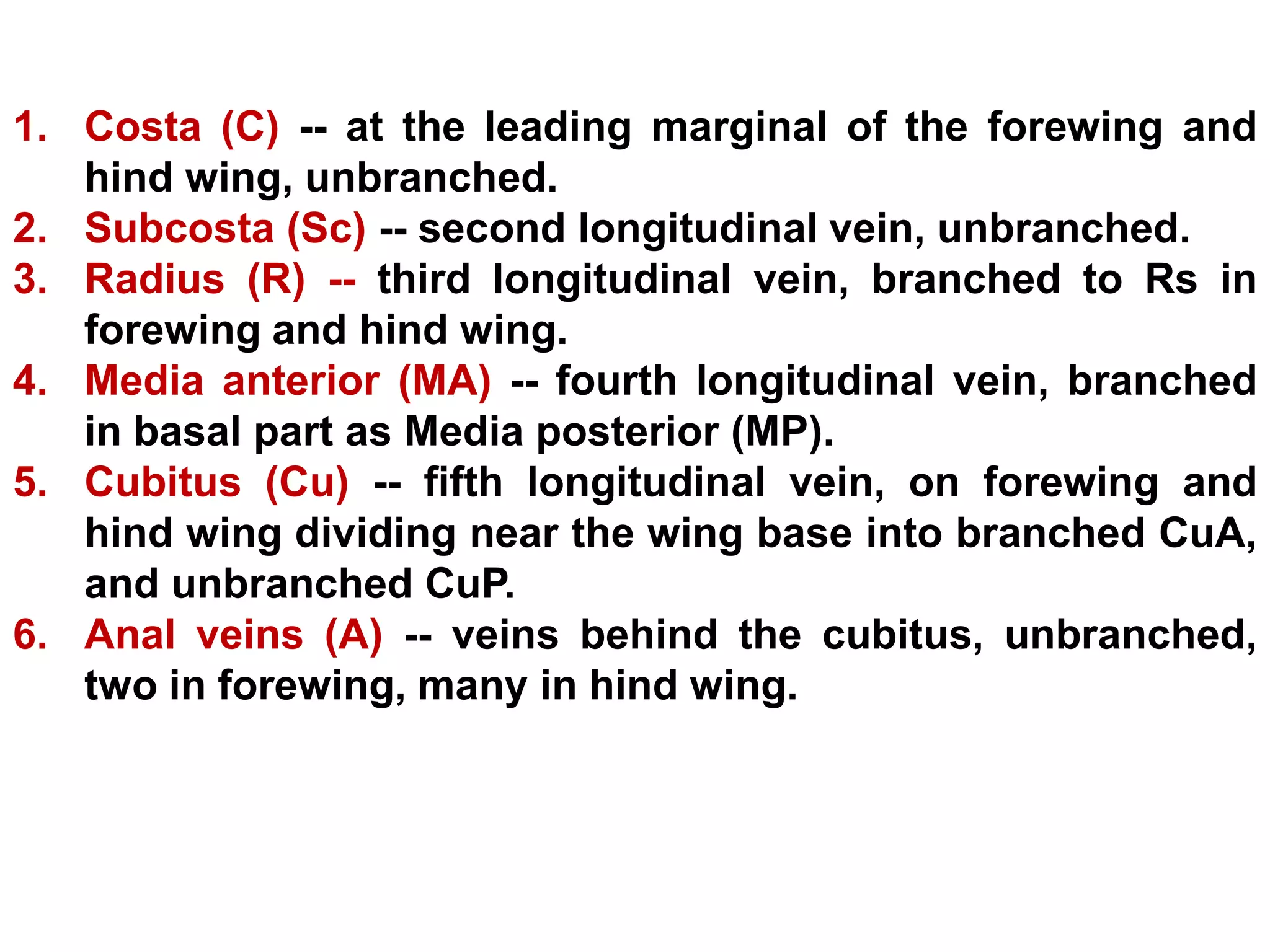
Wing veins of Giant Grasshoppe
1. Costa (C) -- at the leading marginal of the forewing and 
hind wing, unbranched. 
2. Subcosta (Sc) -- second longitudinal vein, unbranched. 
3. Radius (R) -- third longitudinal vein, branched to Rs in 
forewing and hind wing. 
4. Media anterior (MA) -- fourth longitudinal vein, branched 
in basal part as Media posterior (MP). 
5. Cubitus (Cu) -- fifth longitudinal vein, on forewing and 
hind wing dividing near the wing base into branched CuA, 
and unbranched CuP. 
6. Anal veins (A) -- veins behind the cubitus, unbranched, 
two in forewing, many in hind wing.
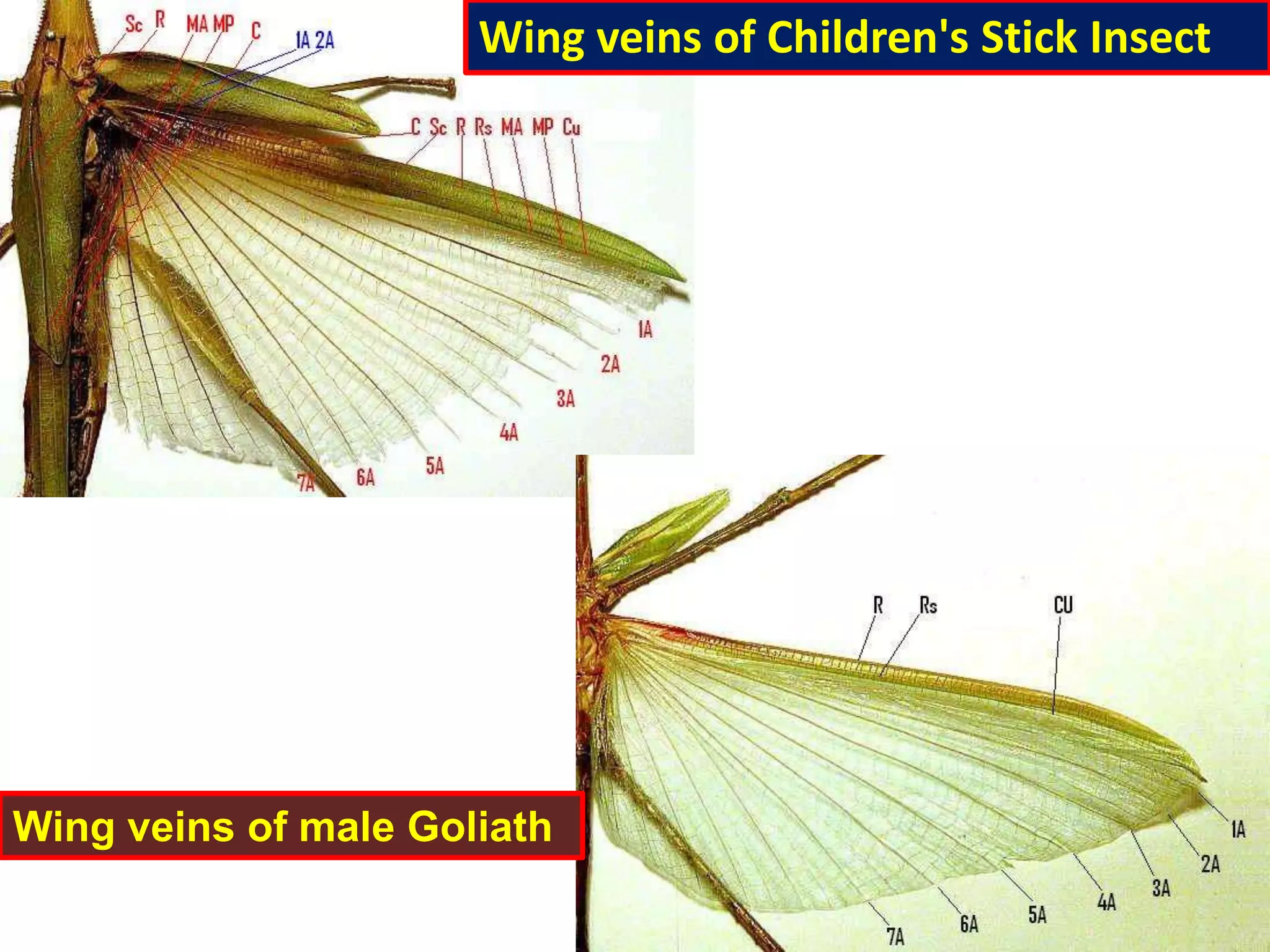
STICK INSECT'S WINGS 
Stick insect forewings are tough opaque 
tegmina, short and covering only the base part 
of the hind wings at rest. Hind wings from costa 
to Cubitus are tough and opaque like the 
forewings. The large anal area are membranous 
and folded in fan-like manner. There are no or 
very few branching in Stick Insect wing veins.
Wing veins of Children's Stick Insect 
Wing veins of male Goliath
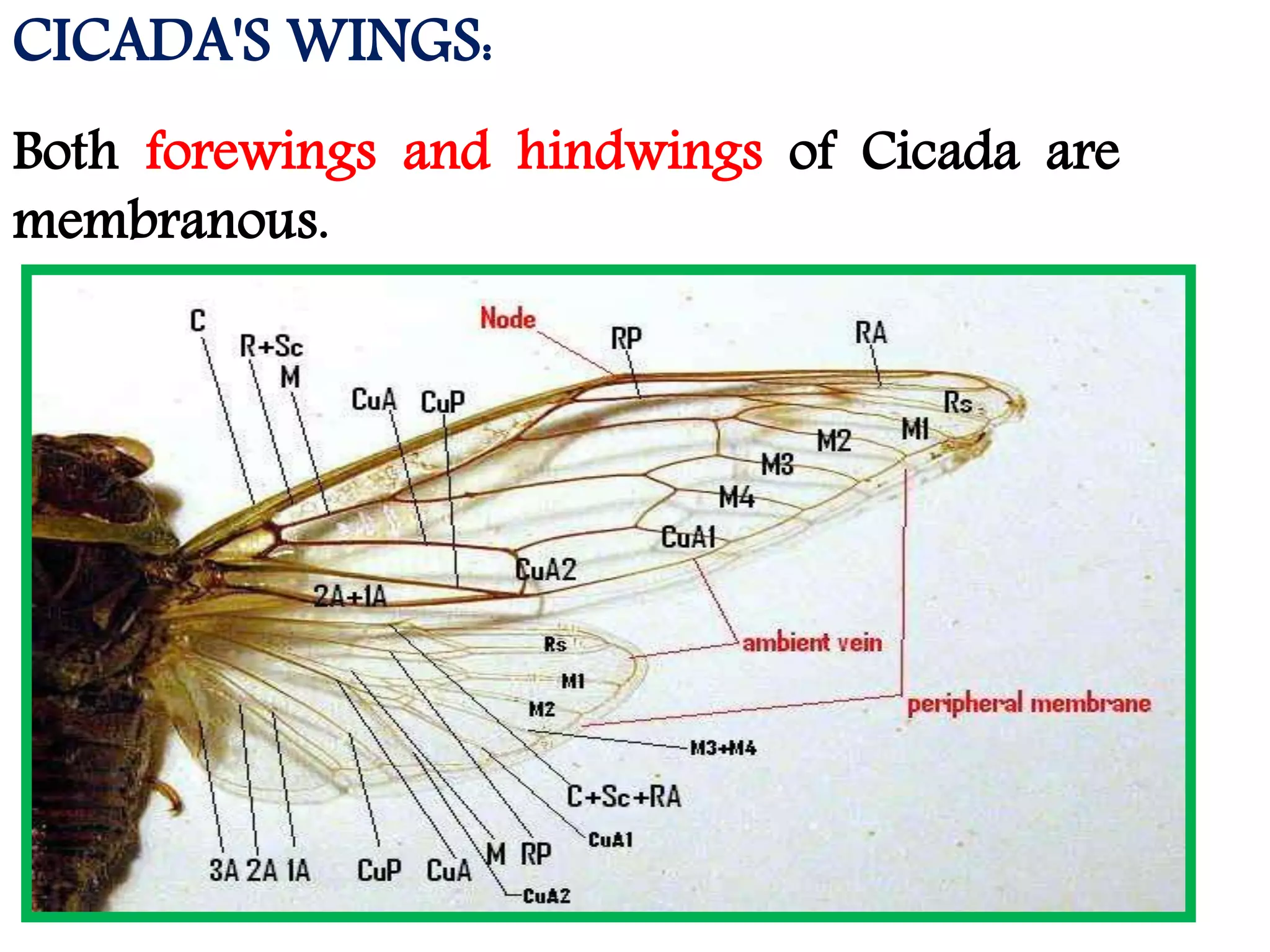
CICADA'SWINGS: 
Both forewings and hindwings of Cicada are 
membranous.
1. Costa (C) -- at the leading wing marginal, in forewing 
extends to the node and lies close to Sc+R. 
2. Subcosta + Radius (Sc+R) -- in forewing Sc and R 
fused together to the node. Radial sector (Rs) arises 
near the node and unbranches. 
3. Radius anterior (RA) 
4. Radius posterior (RP) 
5. Media (M) -- branches to M1 to M4. 
6. Cubitus anterior (CuA) -- branches to CuA1 and 
CuA2. 
7. Cubitus posterior (CuP) -- unbranches. 
8. Anal veins (A) -- veins behind the cubitus, 1A and 2A 
fused in the forewing, CuP and 2A are folded.
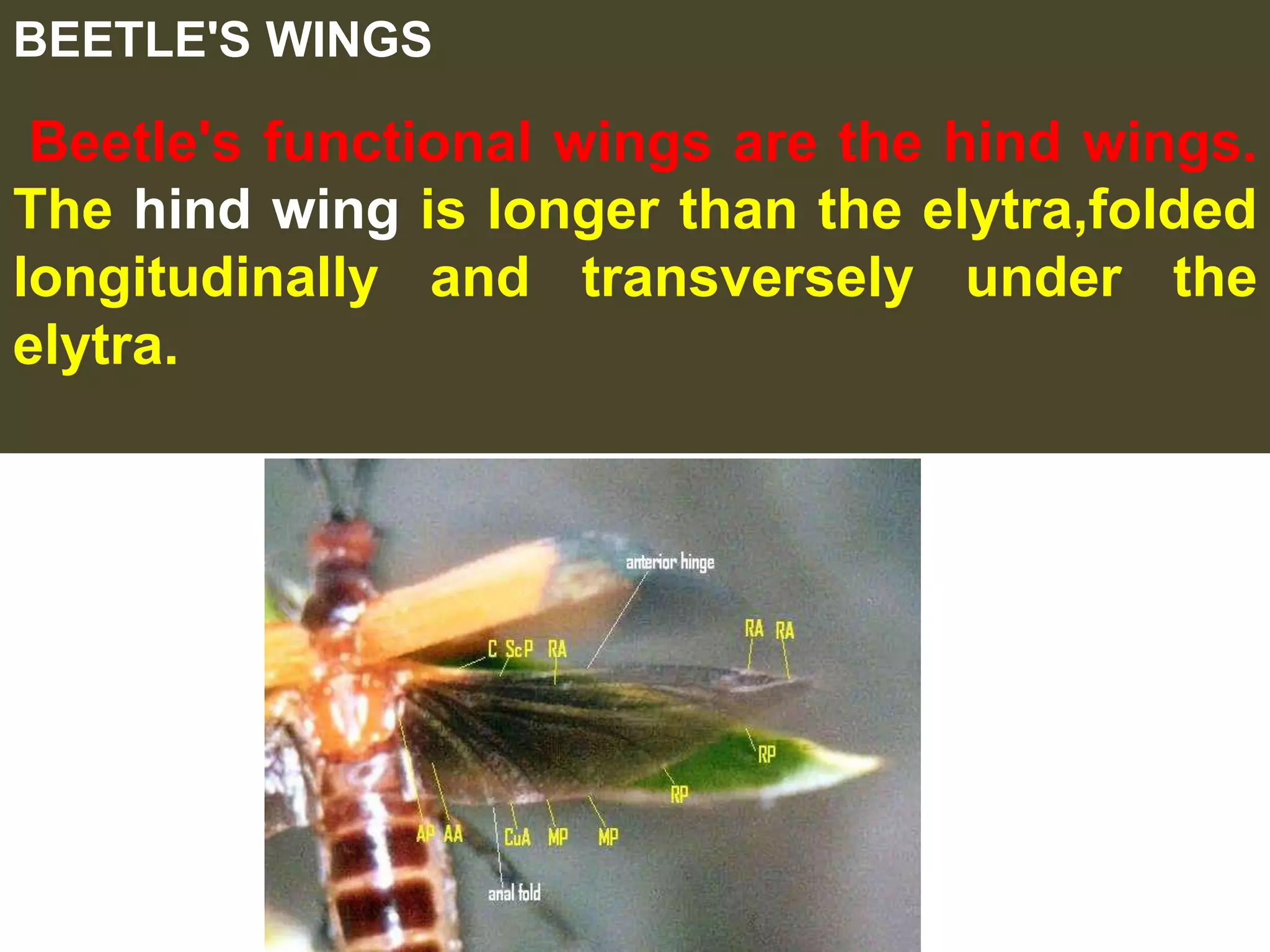
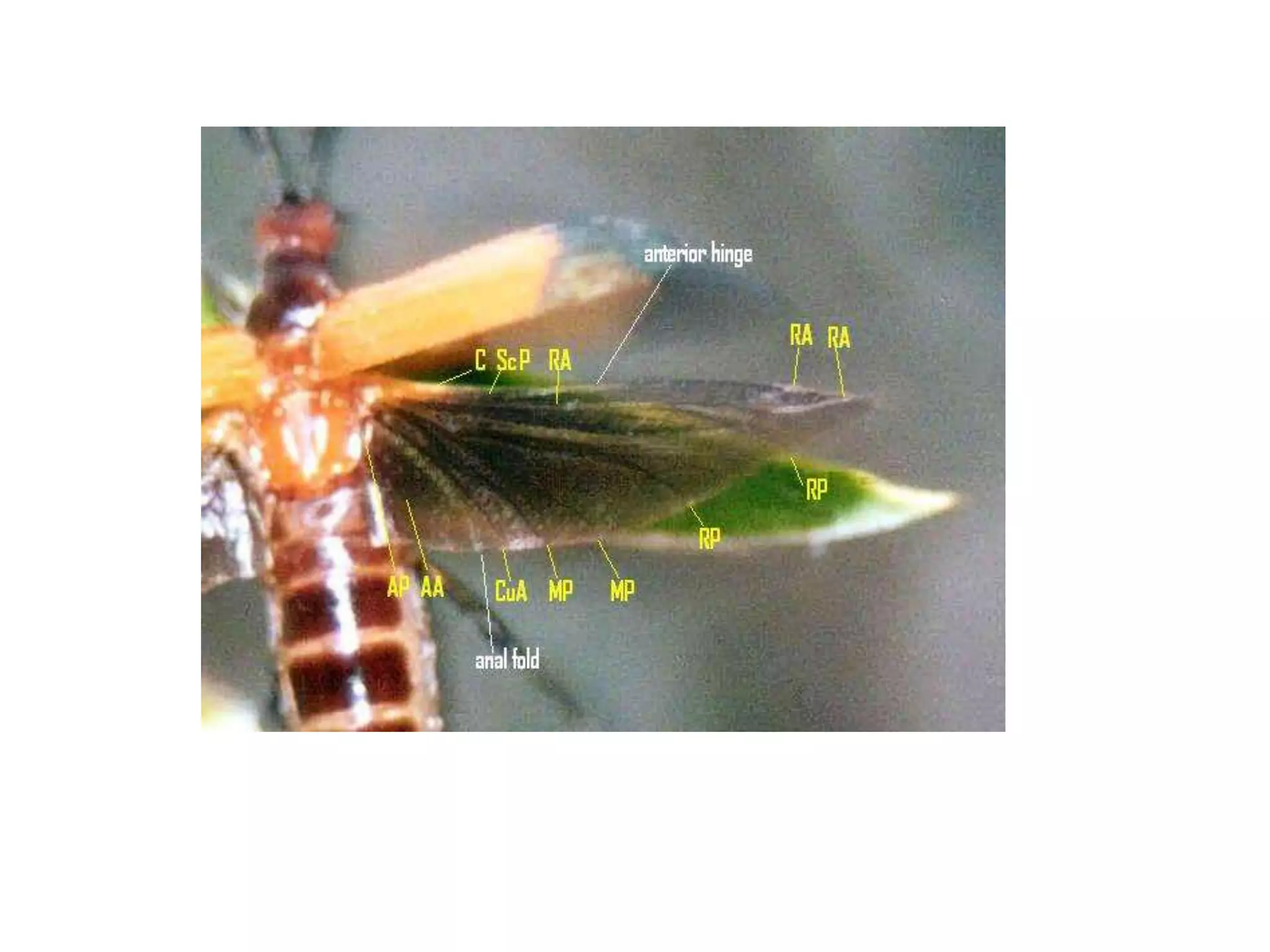
BEETLE'S WINGS 
Beetle's functional wings are the hind wings. 
The hind wing is longer than the elytra,folded 
longitudinally and transversely under the 
elytra.
Beetle wing venation is reduced and modified 
due to the folding structure. 
1.Costa (C), Subcosta posterior (ScP) -- at the leading wing 
marginal, fused for most of the length. 
2.Radius anterior (RA) - divided into two branches beyond 
the middle of the wing. 
3.Radius posterior (RP) - basal connection is lost. 
4.Media posterior (MP) -- branches, long and strong vein. 
5.Cubitus anterior (CuA) 
6.Anal veins (AA, AP) -- veins behind the cubitus, separated 
by anal fold.
FLY'S WINGS 
Fly has only one pair of functional wings. The hind 
wings reduced to small club-like structure known as 
halteres. The halteres vibrate rapidly during flight, act 
as gyroscopic sense organs of balance. 
WING VEINS OF TIPULIDAE WING VEINS OF TABANOIDAE
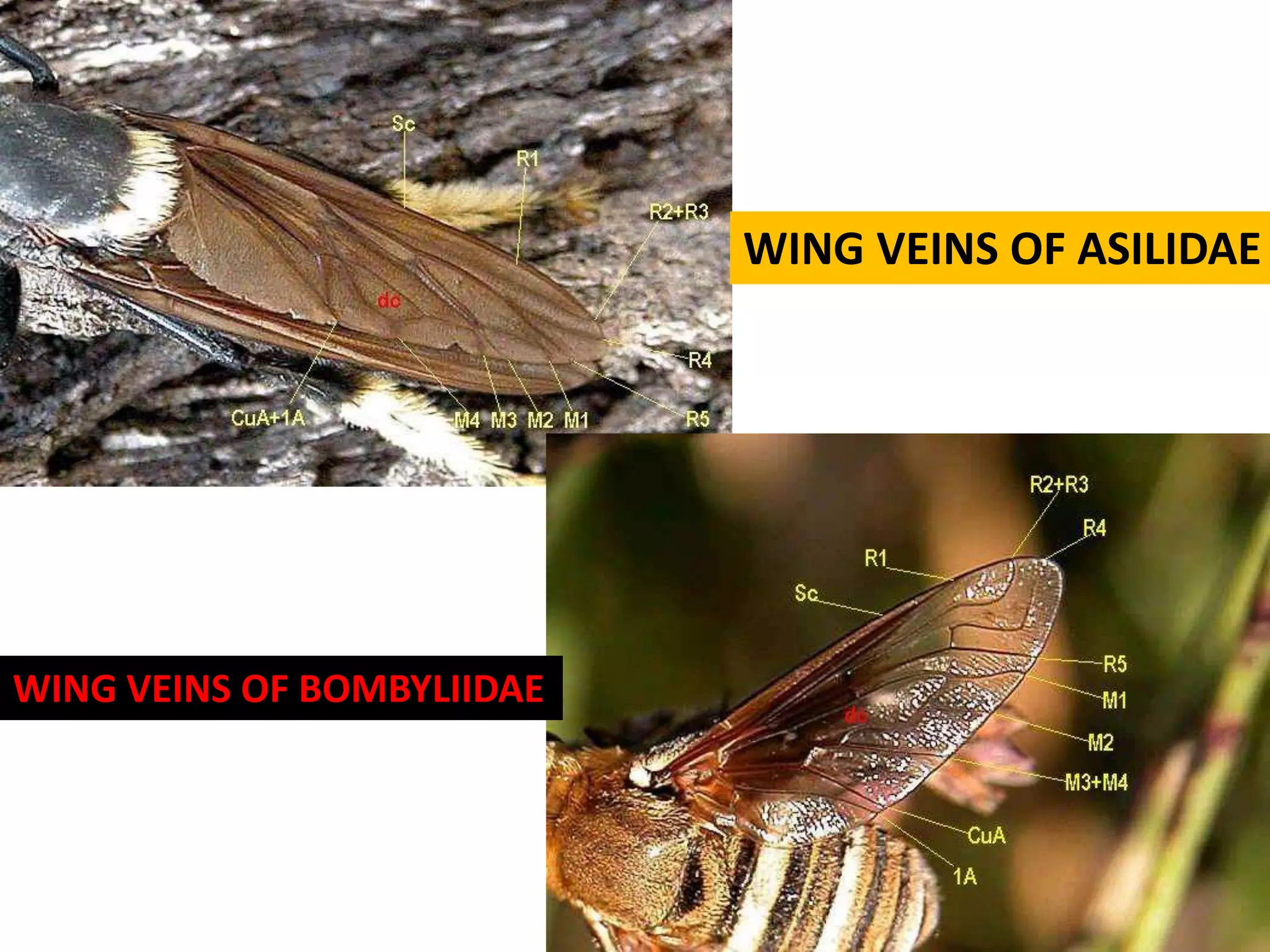
WING VEINS OF ASILIDAE 
WING VEINS OF BOMBYLIIDAE
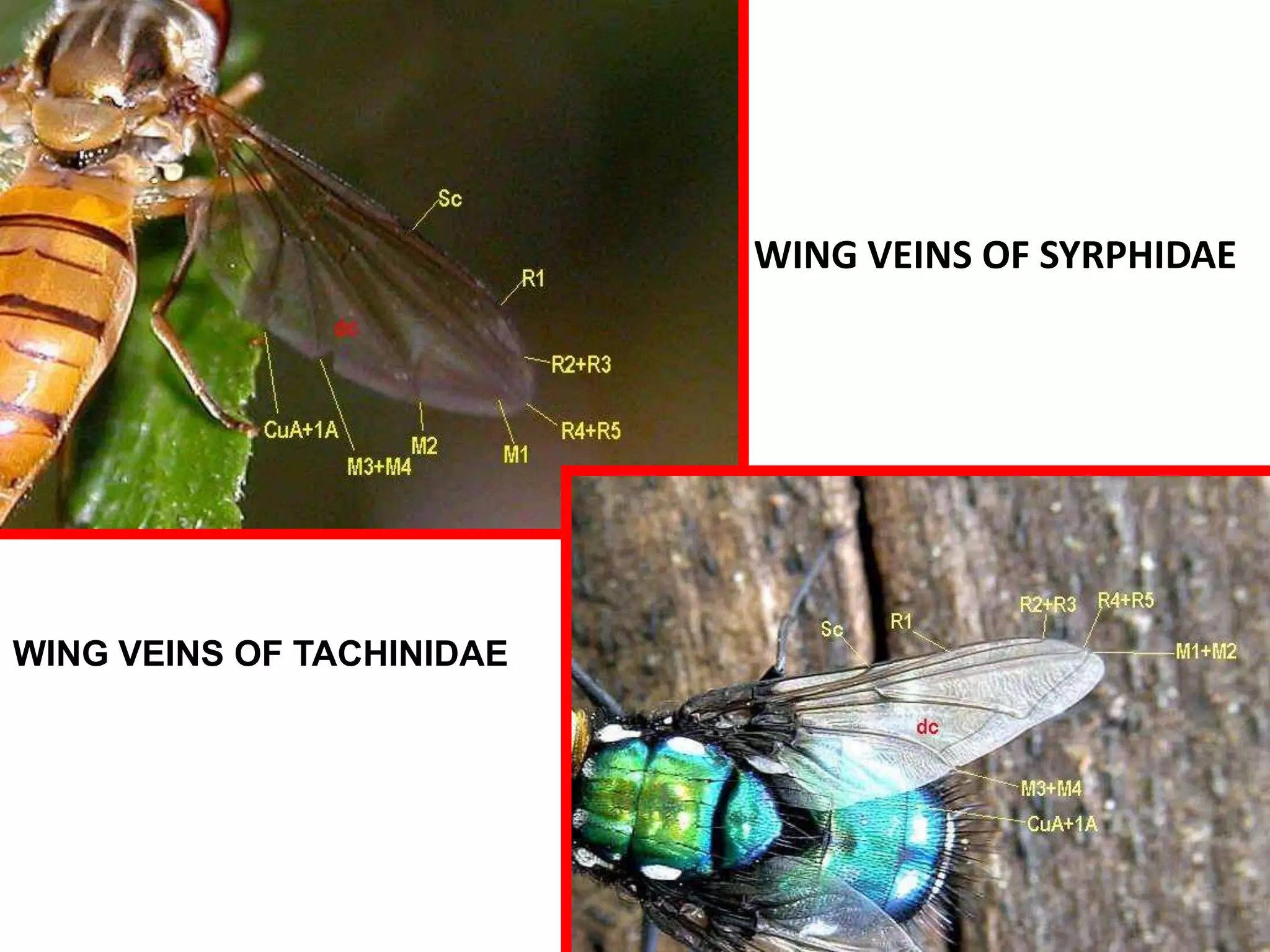
WING VEINS OF SYRPHIDAE 
WING VEINS OF TACHINIDAE
1. Costa (C) -- not found in Diptera. 
2. Subcosta (Sc) -- became the leading wing vein, 
unbranched. 
3. Radius (R) -- branched to R1-R5. 
4. Media (M) -- branched to M1-M4. 
5. Cubitus (CuA) -- unbranched, CuP is reduced in 
Diptera. Some species CuA and 1A are separated, 
some species meets when reaching the wing 
margin, some species fused. 
6. Anal veins (A) -- only two anal veins 1A and 2A 
are present, 2A is not distinctive in some species. 
7.Discal Cell (dc) -- well define in most spe
BUTTERFLY'S WINGS 
Butterfly has two pairs of membranous wings, clothed with with two 
layers of 'scales'. 
WING VEINS OF PIERIDAE 
WING VEINS OF PAPIOLONIDAE
WING VEINS OF NYMPHALIDAE 
WING VEINS OF LYCAENIDAE
Costa (C) -- not found in Butterflies. 
Subcosta + Radius 1 (Sc+R1) -- at the leading wing marginal, fused or 
very close for most of the length, in hind wing fused and well developed 
in the humeral area, subcosta never branches in butterfly. 
Radius (R2-R5) - radius divides into branches beyond the middle of the 
wing up to five branches in Papilionidae. On forewing, the last R is stalked 
in all butterflies except Hesperiidae is separated. 
Radius sector (Rs) - in hind wing. 
Media (M1-M3) - the basal section has been lost. 
Cubitus anterior (CuA1-CuA2) - CuP section has been lost. 
Anal veins (A, 1A+2A, 3A) - either one vein A, or two veins 1A+2A, 3A. 
Humeral vein - Notice that the hind wing of most butterflies (except 
Lycaenidae) has the humeral vein. There is the enlargement of the 
humeral area of the hind wing which is overlapped with the fore wing. 
The humeral vein strengthened the hind wing overlapped area so that the 
two wings coupling better.
HYMENOPTERA WING 
WING VEINS OF SAWFLY 
WING VEINS OF WASP
WING VEINS OF ANT 
Costa (C) -- not found in Hymenoptera. 
Subcosta (Sc) -- unbranched. 
Radius (R) -- branched to R1-R5. 
Media (M) -- M is unbranches, in forewing M is 
fused with Rs for part of its length. 
Cubitus (CuA) -- unbranched, CuP is absent in 
Hymenoptera. 
Anal veins (A) -- only two anal veins 1A and 2A are 
present, 2A is not distinctive in some species.
1.ODONATA: 
 Pterostigma-both the fore and 
hind wings 
 Reticulum-both wings
2.HYMONOPTERA,PSOCOPTERA, 
MEGALOPTERA AND MECOPTERA 
PTEROSTIGMA.
3. CHALCIDOIDEA: 
only the subcosta and the part of the 
radius present. 
SUBCOSTA
4.Lepidoptera : Sc is in circular in cross section-bending 
in any direction 
Wing membrane 
SUB COSTA
Wing modifications: 
1.SCLEROTIZED FOREWINGS: 
Tegmina – Orthoptera and Dermaptera 
Hemelytra – Hemiptera/Heteroptera 
Elytra – Coleoptera 
2.WING REDUCTION: 
Halteres (reduced HW) – Diptera 
Acts as balancers during flight 
3.APTEROUS – NO WINGS: 
Flies, Dermaptera, Thysanura, etc. 
Brachypterous – shortened/reduced wings 
Gerrids, Orthoptera, etc.
ELYTRA - COLEOPTERA 
Hard shell like without 
clear venation. They 
form horny sheet and 
protect membranous 
hind wings.
Tegmina - Orthoptera 
TEGMINA 
Forewings are leathery and tough .They 
protect the membranous hindwings.
COCKROACH
ORDER DIPTERA-HALTERES 
One pair of well-developed wings, other 
pair reduced to knob like halteres 
eg :Flies
HALTERES
Order -Lepidoptera-SCALES 
Wings are broad thin , 
membranous but covered with 
unicellular scales all over the 
surface 
BUTTERFLIES 
MOTHS
ODONATA -MEMBRANOUS 
Naked thin with clear venation. Always 
useful of flight. 
DRAGONFLY,DAMSELFLY
THYSANAPTERA [FRINGED WINGS] 
Wings are highly reduced with reduced venation. 
wings are fringed with long marginal hairs giving 
feather like appearance. 
THRIPS
FISSURED WINGS(Plume moth)
ORDERS AND THEIR MODIFATIONS 
1.THYSANURA: 
2. COLLUMBOLA 
3.PROTURA 
4.DIPLURA 
APTERYGOTA
5. EPHEMEROPTERA-Wing flexing menism is absent. 
6.ODONATA –broad wings and petiolated wings.
7.ORTHOPTERA:TEGMINA 
TETTIGONIDAE _ALAR TYPE OF SOUND PRODUTION 
8.PHASMIDA – LEAF LIKE MODIFIED WINGS
9.DICTYOPTERA: NETWORK LIKE WING FW- TEGMINA 
HW- MEMBRANOUS 
10.ISOPTERA:EQUAL WINGS
11. HEMIPTERA: 
TINGIDAE :LACE WING BUGS 
MIRIDAE :CORIUM, CLAUS AND CUNIUS 
LYGAEIDAE :CUNIUS IS ABSENT 
ANTHOCORIADE:EMBOLIUM IS PRESENT
12.DERMAPTERA –FW : TEGMINA OR ELYTRA 
HW:EAR LIKE SEMCIRULAR ,MEMBRANOUS ANAL AREA BRANCHES - FAN LIKE – 
LONGITUDINALLY, TWICE TRANSEVERSELY
13.MALLOPHAGA, SIPHONULATA,PSOCOPTERA:- 
2NDRY WING LESS
16.THYSONOPTERA – 
FRINGED WINGS 
17. NUEROPTERA – 
NERVE LIKE WINGS
14 . DIPTERA :HALTERES 
15.COLEOPTERA : ELYTRA
16. HYMENOPTERA : 
FW – LARGE 
HW- SMALL 
REDUCED WING VENATION 
17. LEPIDOPTERA: SCALES
WING COUPLING 
1. Jugate 
2. Male frenate 
3. Female frenate 
4. Amplexiform 
5. Hamulate
1.JUGATE TYPE 
• Costal margin of front wing possess a small lobe 
at its base called fibula, which rest on the 
surface of the hind wings.
2.Frenate (Lepidoptera) 
FRENULUM RETINACULUM 
MALE 
FEMALE
3.AMPLEXIFORM 
• Costal margin of hind wing and anal 
margin of fore wing overlap one above 
the other.
4.Hamulate (Hymenoptera) 
Hamuli (hooks)
HAMULI
USES OF INSECT WINGS 
The ability to fly allowed insects to use widely 
 Scattered Food Resources. 
 To Invade New Habitats. 
 Escape unfavorable environments.
 Important adaptation mechanisms 
 Seal to protect spiracles (pleural 
and dorsal) 
 Prevents dessication (water loss)
WHAT IS THE USE TO A 
TAXANOMIST? 
CLASSIFICATION
DRAGONFLIES DAMSELFLIES 
Wings are unequal 
hind wings are basally 
broader than fore wings 
Equal 
Wings are broadly 
attached to the abdomen 
Petiolated wings 
Venation is not similar 
in both the wings 
Venation is similar in 
both the wings 
Wings are spread 
laterally at rest 
Wings are held at an 
angle above the abdomen
DRAGON FLY DAMSELFLY
Flight along with other arthropod 
characteristics, has resulted in insects 
becoming the most abundant and 
diverse group of terrestrial animals.
PRESENTED BY 
SABHAVAT SRINIVAS NAIK 
ID NO: 13-503 -010

WING TYPES AND VENATION SSNAIK

  • 1.
    WING VENATION TYPES SSNAIK M.Sc.ENTOMOLOGY TNAU COIMBATORE
  • 2.
  • 3.
    KINGDOM ANIMALIA INVERTEBRATAVERTEBRATA PROTOZOA PORIFERA CNIDARIA PLATYHELMINTHES NEMATODA ANNELIDA ARTHROPODA MOLLUSCA, ECHINODERMATA CHORDATA: FISHES, AMPHIBIANS, REPTILES, APES, MAMMALS
  • 4.
    The only invertebrate animal and it is the first animal having the wings ___insect
  • 5.
  • 6.
    Fossil records inCarboniferous times,. 2 pairs of fully developed wings+ 2 paranotal lobes
  • 7.
    DEVELOPMENT OF THEWING Diagrammatic cross section of plates of the thoracic segments a thoracic segment with paranotal extensions of the tergum
  • 10.
  • 11.
    CONTRIBUTIONS : STRUCTURE-COMSTOCK, SNODGRASS COUPLING-TILLYARD ARTICULATION-PRINGLE WINGS
  • 12.
  • 13.
    Anterior …………………. …………………… PTEROTHORAX HEAD NECK THORAX ABDOMEN INSECT:
  • 14.
    STRUCTURE OF INSECTTHORACIC SEGMENT NOTUM PLEURON PLEURON STERNUM
  • 15.
    • 1 2 3 A B C
  • 16.
  • 17.
  • 19.
    1. Longitudinal veins: Extend from base of the wing to the margin. They may be convex (∩) or concave (U) 2. Cross veins : That interlink the longitudinal veins c Sc HUMORAL CROSS VEIN WING BASE
  • 20.
    Precoasta (PC): Thisvein is fused with costa in all extant insects, mostly unrecognisable. 1.Costa (C) : at the leading edge of the wing, strong and marginal, extends to the apex of the wing, it is unbranched. c
  • 21.
    Sub costa (Sc): It runs immediately below the costa always in the bottom of a trough between C and R .It is forked distally .The two branches of SC are Sc1 and Sc2 and is concave Sc Sc1 Sc2 Subcosta (Sc): the second longitudinal vein, mainly the subcosta posterior sector (ScP). Sc is reduced or fused with R in most Hemiptera.
  • 22.
    3. Radial vein(R ): It is the next main vein , stout and connects at the base with second auxillary sclerite , it divided in to two branches R1 and Rs (Radial sector). R1 goes directly towards apical margin and is convex; Rs is concave and divided in to 4 branches, R2, R3,R4, R5. R R1 R1 Rs R2 R3 R4 R5 Radius (R) -- the third vein, usually the strongest vein on the wing, with branches usually cover the largest area of wing apex. RP is often referred to as radial sector (Rs) and the end branches as R1-5.
  • 23.
    Media (M) :Itis one of the two veins articulating with some of the small median seclerites. It is divided in two branches 1. Media anterior (MA) which is convex and Media posterior(MP) and is concave. Media anterior is again divided into MA1 and MA2. Median posterior is again divided in to MP1, MP2, MP3, MP4. MA1 MA2. Mp1 Mp2 Mp3 Mp4 M MA MP
  • 24.
    5. Cubitus (Cu):It articulates with median auxillary sclerite. Cubitus is divided into convex CU1 and concave CU2. CU1 is again divided into CU1a and CU1b. Cu Cu1 Cu2 Cu2 Cu1a Cu1b
  • 25.
    6. Anal veins(A) : These veins are convex. They are individual un-branched, 1-3 in number. 1A 2A
  • 26.
    1 or 2jugal veins (unbranched) are present in the jugal lobe of the forewing. 1j 2j
  • 27.
    THE INSECT WING costa subcosta radius medial cubitus anal jugal C Sc R RS MA MP CuA CuP A J
  • 28.
    CROSS VEINS: Humeralcross vein (h) : Between costa and subcosta Radial cross vein (r ) : Between radius and radial sector Sectorial cross veins (s): Between sub branches of radial sector Radio medial cross vein (r-m): Between radius and media l vein Medical cross veins : Between branches of media Medio-cubital veins : Between media and cubitus
  • 29.
  • 30.
    WING VENATION MODIFICATIONS 1.INCRESED WING Eg: Lepidoptera Moths and butterfly 2.REDUCED WING Eg: Thrips - Thysonoptera
  • 31.
    4.INCRESED WING VENATION 3.REDUCED WING VENATION
  • 32.
  • 33.
  • 34.
    Here are five(R+M counted as 1) main vein stems on dragonfly and damselfly wings; 1. Costa (C) -- at the leading edge of the wing, strong and marginal, extends to the apex of the wing. 2. Subcosta (Sc) -- second longitudinal vein, it is unbranched, joins C at nodus. 3. Radius and Media (R+M) -- third and fourth longitudinal vein, the strongest vein on the wing, with branches, R1-R4, reach the wing margin, the media anterior (MA) are also reach the wing margin. IR2 and IR3 are intercalary veins behind R2 and R3 respectively. 4. Cubitus (Cu) -- fifth longitudinal vein, cubitus posterior (CuP) is unbranched and reach the wing margin. 5. Anal veins (1A) -- unbranched veins behind the cubitus. 6. A nodus is formed where the second main vein meets the leading edge of the wing. The black pterostigma is carried near the wing tip. The main veins and the crossveins form the wing venation pattern. The venation patterns are different in different species. There may be very numerous crossveins or rather few. The Australian Flatwing Damselfly's wings are one of the few veins patterns. The venation pattern is useful for species identification.
  • 35.
    COCKROACH'S WINGS Cockroach'sforewing are also known as tegmen, more or less sclerotised. It is used in flight as well as protection of membranous hind wings. Wing veins of Austral Ellipsidion Cockroach
  • 36.
    1. Costa (C)-- at the leading edge of the wing. 2. Subcosta (Sc) -- second longitudinal vein, it is relatively short. 3. Radius (R) -- third longitudinal vein, with many pectinate branches. 4. Media (M) -- fourth longitudinal vein, reach the wing margin. 5. Cubitus anterior (CuA) -- fifth longitudinal vein, with dichotomous branches occupy large part of tegmen. 6. Cubitus posterior (CuP) is unbranched, curved and reach the wing margin. 7. Anal veins (A) -- veins behind the cubitus. The veins of hind wing are about the same as front wing but with large anal lobe folded at rest between CuP and 1A. The anal lobe usually folded in a fan-like manner.
  • 37.
    Grasshopper's Wings Grasshopperforewings are tough opaque tegmina, narrow and covering the hind wings and abdomen at rest. Hind wings are board membranous and folded in fan-like manner. Wing veins of Giant Grasshoppe
  • 38.
    1. Costa (C)-- at the leading marginal of the forewing and hind wing, unbranched. 2. Subcosta (Sc) -- second longitudinal vein, unbranched. 3. Radius (R) -- third longitudinal vein, branched to Rs in forewing and hind wing. 4. Media anterior (MA) -- fourth longitudinal vein, branched in basal part as Media posterior (MP). 5. Cubitus (Cu) -- fifth longitudinal vein, on forewing and hind wing dividing near the wing base into branched CuA, and unbranched CuP. 6. Anal veins (A) -- veins behind the cubitus, unbranched, two in forewing, many in hind wing.
  • 39.
    STICK INSECT'S WINGS Stick insect forewings are tough opaque tegmina, short and covering only the base part of the hind wings at rest. Hind wings from costa to Cubitus are tough and opaque like the forewings. The large anal area are membranous and folded in fan-like manner. There are no or very few branching in Stick Insect wing veins.
  • 40.
    Wing veins ofChildren's Stick Insect Wing veins of male Goliath
  • 41.
    CICADA'SWINGS: Both forewingsand hindwings of Cicada are membranous.
  • 42.
    1. Costa (C)-- at the leading wing marginal, in forewing extends to the node and lies close to Sc+R. 2. Subcosta + Radius (Sc+R) -- in forewing Sc and R fused together to the node. Radial sector (Rs) arises near the node and unbranches. 3. Radius anterior (RA) 4. Radius posterior (RP) 5. Media (M) -- branches to M1 to M4. 6. Cubitus anterior (CuA) -- branches to CuA1 and CuA2. 7. Cubitus posterior (CuP) -- unbranches. 8. Anal veins (A) -- veins behind the cubitus, 1A and 2A fused in the forewing, CuP and 2A are folded.
  • 43.
    BEETLE'S WINGS Beetle'sfunctional wings are the hind wings. The hind wing is longer than the elytra,folded longitudinally and transversely under the elytra.
  • 45.
    Beetle wing venationis reduced and modified due to the folding structure. 1.Costa (C), Subcosta posterior (ScP) -- at the leading wing marginal, fused for most of the length. 2.Radius anterior (RA) - divided into two branches beyond the middle of the wing. 3.Radius posterior (RP) - basal connection is lost. 4.Media posterior (MP) -- branches, long and strong vein. 5.Cubitus anterior (CuA) 6.Anal veins (AA, AP) -- veins behind the cubitus, separated by anal fold.
  • 46.
    FLY'S WINGS Flyhas only one pair of functional wings. The hind wings reduced to small club-like structure known as halteres. The halteres vibrate rapidly during flight, act as gyroscopic sense organs of balance. WING VEINS OF TIPULIDAE WING VEINS OF TABANOIDAE
  • 47.
    WING VEINS OFASILIDAE WING VEINS OF BOMBYLIIDAE
  • 48.
    WING VEINS OFSYRPHIDAE WING VEINS OF TACHINIDAE
  • 49.
    1. Costa (C)-- not found in Diptera. 2. Subcosta (Sc) -- became the leading wing vein, unbranched. 3. Radius (R) -- branched to R1-R5. 4. Media (M) -- branched to M1-M4. 5. Cubitus (CuA) -- unbranched, CuP is reduced in Diptera. Some species CuA and 1A are separated, some species meets when reaching the wing margin, some species fused. 6. Anal veins (A) -- only two anal veins 1A and 2A are present, 2A is not distinctive in some species. 7.Discal Cell (dc) -- well define in most spe
  • 50.
    BUTTERFLY'S WINGS Butterflyhas two pairs of membranous wings, clothed with with two layers of 'scales'. WING VEINS OF PIERIDAE WING VEINS OF PAPIOLONIDAE
  • 51.
    WING VEINS OFNYMPHALIDAE WING VEINS OF LYCAENIDAE
  • 52.
    Costa (C) --not found in Butterflies. Subcosta + Radius 1 (Sc+R1) -- at the leading wing marginal, fused or very close for most of the length, in hind wing fused and well developed in the humeral area, subcosta never branches in butterfly. Radius (R2-R5) - radius divides into branches beyond the middle of the wing up to five branches in Papilionidae. On forewing, the last R is stalked in all butterflies except Hesperiidae is separated. Radius sector (Rs) - in hind wing. Media (M1-M3) - the basal section has been lost. Cubitus anterior (CuA1-CuA2) - CuP section has been lost. Anal veins (A, 1A+2A, 3A) - either one vein A, or two veins 1A+2A, 3A. Humeral vein - Notice that the hind wing of most butterflies (except Lycaenidae) has the humeral vein. There is the enlargement of the humeral area of the hind wing which is overlapped with the fore wing. The humeral vein strengthened the hind wing overlapped area so that the two wings coupling better.
  • 53.
    HYMENOPTERA WING WINGVEINS OF SAWFLY WING VEINS OF WASP
  • 55.
    WING VEINS OFANT Costa (C) -- not found in Hymenoptera. Subcosta (Sc) -- unbranched. Radius (R) -- branched to R1-R5. Media (M) -- M is unbranches, in forewing M is fused with Rs for part of its length. Cubitus (CuA) -- unbranched, CuP is absent in Hymenoptera. Anal veins (A) -- only two anal veins 1A and 2A are present, 2A is not distinctive in some species.
  • 56.
    1.ODONATA:  Pterostigma-boththe fore and hind wings  Reticulum-both wings
  • 57.
  • 58.
    3. CHALCIDOIDEA: onlythe subcosta and the part of the radius present. SUBCOSTA
  • 59.
    4.Lepidoptera : Scis in circular in cross section-bending in any direction Wing membrane SUB COSTA
  • 60.
    Wing modifications: 1.SCLEROTIZEDFOREWINGS: Tegmina – Orthoptera and Dermaptera Hemelytra – Hemiptera/Heteroptera Elytra – Coleoptera 2.WING REDUCTION: Halteres (reduced HW) – Diptera Acts as balancers during flight 3.APTEROUS – NO WINGS: Flies, Dermaptera, Thysanura, etc. Brachypterous – shortened/reduced wings Gerrids, Orthoptera, etc.
  • 61.
    ELYTRA - COLEOPTERA Hard shell like without clear venation. They form horny sheet and protect membranous hind wings.
  • 62.
    Tegmina - Orthoptera TEGMINA Forewings are leathery and tough .They protect the membranous hindwings.
  • 63.
  • 64.
    ORDER DIPTERA-HALTERES Onepair of well-developed wings, other pair reduced to knob like halteres eg :Flies
  • 65.
  • 66.
    Order -Lepidoptera-SCALES Wingsare broad thin , membranous but covered with unicellular scales all over the surface BUTTERFLIES MOTHS
  • 67.
    ODONATA -MEMBRANOUS Nakedthin with clear venation. Always useful of flight. DRAGONFLY,DAMSELFLY
  • 68.
    THYSANAPTERA [FRINGED WINGS] Wings are highly reduced with reduced venation. wings are fringed with long marginal hairs giving feather like appearance. THRIPS
  • 69.
  • 70.
    ORDERS AND THEIRMODIFATIONS 1.THYSANURA: 2. COLLUMBOLA 3.PROTURA 4.DIPLURA APTERYGOTA
  • 71.
    5. EPHEMEROPTERA-Wing flexingmenism is absent. 6.ODONATA –broad wings and petiolated wings.
  • 72.
    7.ORTHOPTERA:TEGMINA TETTIGONIDAE _ALARTYPE OF SOUND PRODUTION 8.PHASMIDA – LEAF LIKE MODIFIED WINGS
  • 73.
    9.DICTYOPTERA: NETWORK LIKEWING FW- TEGMINA HW- MEMBRANOUS 10.ISOPTERA:EQUAL WINGS
  • 74.
    11. HEMIPTERA: TINGIDAE:LACE WING BUGS MIRIDAE :CORIUM, CLAUS AND CUNIUS LYGAEIDAE :CUNIUS IS ABSENT ANTHOCORIADE:EMBOLIUM IS PRESENT
  • 75.
    12.DERMAPTERA –FW :TEGMINA OR ELYTRA HW:EAR LIKE SEMCIRULAR ,MEMBRANOUS ANAL AREA BRANCHES - FAN LIKE – LONGITUDINALLY, TWICE TRANSEVERSELY
  • 76.
  • 77.
    16.THYSONOPTERA – FRINGEDWINGS 17. NUEROPTERA – NERVE LIKE WINGS
  • 78.
    14 . DIPTERA:HALTERES 15.COLEOPTERA : ELYTRA
  • 79.
    16. HYMENOPTERA : FW – LARGE HW- SMALL REDUCED WING VENATION 17. LEPIDOPTERA: SCALES
  • 80.
    WING COUPLING 1.Jugate 2. Male frenate 3. Female frenate 4. Amplexiform 5. Hamulate
  • 81.
    1.JUGATE TYPE •Costal margin of front wing possess a small lobe at its base called fibula, which rest on the surface of the hind wings.
  • 82.
    2.Frenate (Lepidoptera) FRENULUMRETINACULUM MALE FEMALE
  • 83.
    3.AMPLEXIFORM • Costalmargin of hind wing and anal margin of fore wing overlap one above the other.
  • 84.
  • 85.
  • 86.
    USES OF INSECTWINGS The ability to fly allowed insects to use widely  Scattered Food Resources.  To Invade New Habitats.  Escape unfavorable environments.
  • 87.
     Important adaptationmechanisms  Seal to protect spiracles (pleural and dorsal)  Prevents dessication (water loss)
  • 88.
    WHAT IS THEUSE TO A TAXANOMIST? CLASSIFICATION
  • 89.
    DRAGONFLIES DAMSELFLIES Wingsare unequal hind wings are basally broader than fore wings Equal Wings are broadly attached to the abdomen Petiolated wings Venation is not similar in both the wings Venation is similar in both the wings Wings are spread laterally at rest Wings are held at an angle above the abdomen
  • 90.
  • 91.
    Flight along withother arthropod characteristics, has resulted in insects becoming the most abundant and diverse group of terrestrial animals.
  • 92.
    PRESENTED BY SABHAVATSRINIVAS NAIK ID NO: 13-503 -010