LOUCESLOUCES
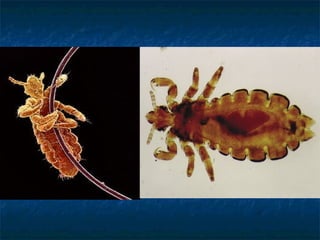
Lice (singular: louse) are insects belonging to
either the sucking louse order (Anoplura) or the
chewing or biting louse order (Mallophaga). All
lice are obligatory (dependent on) ectoparasites of
birds and mammals. There are about 460 species
of sucking lice and 3,000 species of chewing lice.
Sucking lice feed solely on blood and have
mouthparts designed for sucking. Their mouthparts
penetrate the skin and actually fit into a
blood vessel, from which the blood meal is
drawn. Sucking lice only occur on mammals.
Lice On HorsesLice On Horses
The chewing louse,The chewing louse, Bovicola equi,Bovicola equi, feeds offfeeds off
tissue and cells sloughed from the surface oftissue and cells sloughed from the surface of
the skin. The sucking louse of horses,the skin. The sucking louse of horses,
Haematopinus asini,Haematopinus asini, feeds off blood. Thefeeds off blood. The
species of lice is important since it is easier tospecies of lice is important since it is easier to
kill sucking lice with a systemic insecticide thankill sucking lice with a systemic insecticide than
it is to kill biting lice. Lice cause intense itchingit is to kill biting lice. Lice cause intense itching
(pruritus) around the base of the tail, head and(pruritus) around the base of the tail, head and
mane. Horses will rub themselves raw.mane. Horses will rub themselves raw.
Lice On HorsesLice On Horses
Lice are normally species-specific. However, theLice are normally species-specific. However, the
chewing lice of poultry can also affect horseschewing lice of poultry can also affect horses
when housed together. The horses should bewhen housed together. The horses should be
removed from the building. If the poultry isremoved from the building. If the poultry is
removed, the lice will continue to harass theremoved, the lice will continue to harass the
horses unless a good cleanup and premisehorses unless a good cleanup and premise
insecticide treatment is used.insecticide treatment is used.
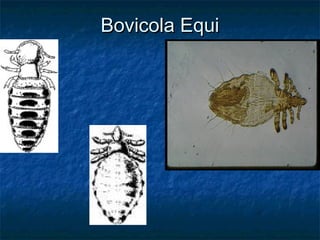
Bovicola EquiBovicola Equi
Lice can be found on all parts of the horse but
are usually first noticed on the head, neck,
mane and tail. There are two different species of
lice which are occasionally a problem on
horses. Signs of lice include scurfy skin,
unkempt coat and excessive rubbing and
scratching. Lice reproduce all year but are
more of a problem during winter. Their entire
life cycle is spent on the horse.
The horse-biting louse, Bovicola equi, is about
1/10 inch long and very flat. It has chewing
mouthparts and feeds on dry skin, skin
secretions and hair. Biting lice lay their eggs
around the angle of the jaw and on the flanks.
The eggs hatch in five to 10 days. Nymphs
begin feeding immediately, reaching maturity in
three to four weeks.
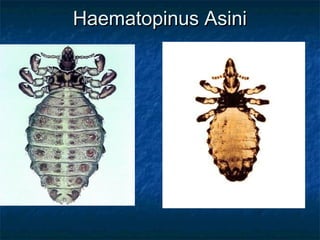
 The blood-sucking louse, Haematopinus asini,
is about 1/8 inch long and a dirty gray color.
Sucking lice are more common, as well as
more irritating, than biting lice. They have
piercing, sucking mouthparts and with large
infestations cause the host to become severely
anemic. The horse rubs off patches of hair.
Louse infestations are more commonly seen on
horses on inadequate diets. Weight loss,
stunted growth and susceptibility to diseases
are
associated with heavy infestations. Lice are not
considered important in the transmission of
 Control is achieved by proper grooming,
feeding and chemical treatment. Owners
usually spot the problem quicker when
grooming. Proper nutrition allows the animal to
better withstand the blood loss or irritation of a
severe louse infestation.
 When using insecticides, wettable powder (WP)
formulations are generally preferred over
emulsifiable concentrates (EC) because some
horses are more sensitive to skin burns from
solvents in EC formulations. However,
problems should not occur if the insecticide is
labeled for use on horses for lice and used
according to the label directions.
Haematopinus AsiniHaematopinus Asini
Lice on CattleLice on Cattle
Lice irritate cattle, causing the cattle to bite,
scratch and rub.
The coats of lousy cattle take on a rough scruffy
appearance, and, at times, areas of skin are
rubbed raw.
The effect of lice on the production and growth
rate of cattle is a matter for continued debate.
Lice on CattleLice on Cattle
Lice can be an important cause of economic loss
when cattle are in poor condition or if
infestations are heavy. If only a few animals in
a mob are severely affected by lice, always
look for an underlying cause. Diseased or
nutritionally stressed animals will develop more
severe lice infestations than healthy animals.
General Types of Cattle LiceGeneral Types of Cattle Lice
Bovicola BovisBovicola Bovis
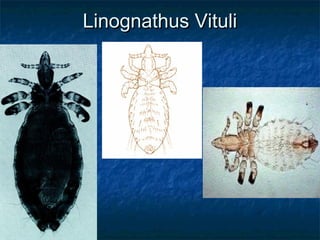
Linognathus VituliLinognathus Vituli
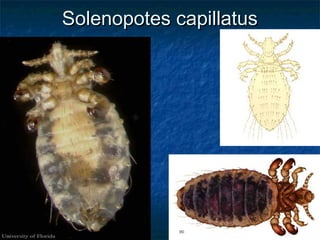
Solenopotes CapillatusSolenopotes Capillatus
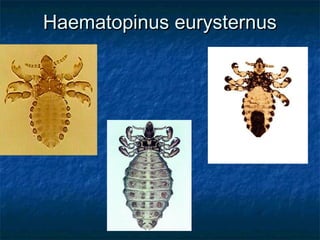
Haematopinus EurysternusHaematopinus Eurysternus
Lice on CattleLice on Cattle
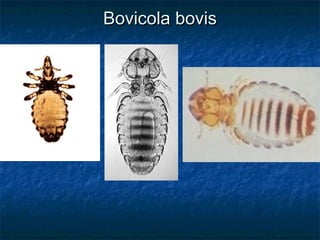
There are two types of cattle lice: biting lice and
sucking lice.
Biting lice ::
Biting lice feed on skin debris and can cause
severe irritation. The cattle biting louse
(Bovicola bovis) is a reddish-brown louse about
2 mm long with a brown head. It is mostly found
on the neck, shoulders, back and rump.
Lice on CattleLice on Cattle
Sucking lice :
Sucking lice pierce the skin and suck blood. In
large numbers they can cause anaemia.
 The short-nosed cattle louse
(Haematopinus eurysternus) is dark-grey. The
female is 3.5–5 mm long. The male is smaller.
It is mostly found around the cattle’s eyes and
in the long hair around the neck and tail, but in
heavy infestations it can occur anywhere in the
hair coat. In summer it is found in and around
the ears and under the tail.
Lice on CattleLice on Cattle
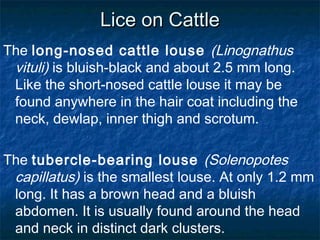
The long-nosed cattle louse (Linognathus
vituli) is bluish-black and about 2.5 mm long.
Like the short-nosed cattle louse it may be
found anywhere in the hair coat including the
neck, dewlap, inner thigh and scrotum.
The tubercle-bearing louse (Solenopotes
capillatus) is the smallest louse. At only 1.2 mm
long. It has a brown head and a bluish
abdomen. It is usually found around the head
and neck in distinct dark clusters.
Life Cycle of Cattle LiceLife Cycle of Cattle Lice
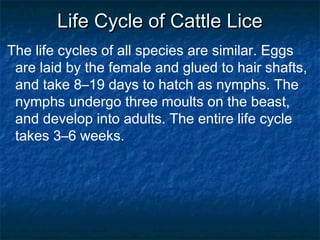
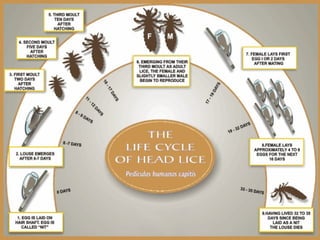
The life cycles of all species are similar. Eggs
are laid by the female and glued to hair shafts,
and take 8–19 days to hatch as nymphs. The
nymphs undergo three moults on the beast,
and develop into adults. The entire life cycle
takes 3–6 weeks.
Bovicola bovisBovicola bovis
Linognathus VituliLinognathus Vituli
Solenopotes capillatusSolenopotes capillatus
Haematopinus eurysternusHaematopinus eurysternus

Louces

  • 1.
    LOUCESLOUCES Lice (singular: louse)are insects belonging to either the sucking louse order (Anoplura) or the chewing or biting louse order (Mallophaga). All lice are obligatory (dependent on) ectoparasites of birds and mammals. There are about 460 species of sucking lice and 3,000 species of chewing lice. Sucking lice feed solely on blood and have mouthparts designed for sucking. Their mouthparts penetrate the skin and actually fit into a blood vessel, from which the blood meal is drawn. Sucking lice only occur on mammals.
  • 3.
    Lice On HorsesLiceOn Horses The chewing louse,The chewing louse, Bovicola equi,Bovicola equi, feeds offfeeds off tissue and cells sloughed from the surface oftissue and cells sloughed from the surface of the skin. The sucking louse of horses,the skin. The sucking louse of horses, Haematopinus asini,Haematopinus asini, feeds off blood. Thefeeds off blood. The species of lice is important since it is easier tospecies of lice is important since it is easier to kill sucking lice with a systemic insecticide thankill sucking lice with a systemic insecticide than it is to kill biting lice. Lice cause intense itchingit is to kill biting lice. Lice cause intense itching (pruritus) around the base of the tail, head and(pruritus) around the base of the tail, head and mane. Horses will rub themselves raw.mane. Horses will rub themselves raw.
  • 4.
    Lice On HorsesLiceOn Horses Lice are normally species-specific. However, theLice are normally species-specific. However, the chewing lice of poultry can also affect horseschewing lice of poultry can also affect horses when housed together. The horses should bewhen housed together. The horses should be removed from the building. If the poultry isremoved from the building. If the poultry is removed, the lice will continue to harass theremoved, the lice will continue to harass the horses unless a good cleanup and premisehorses unless a good cleanup and premise insecticide treatment is used.insecticide treatment is used.
  • 5.
  • 6.
    Lice can befound on all parts of the horse but are usually first noticed on the head, neck, mane and tail. There are two different species of lice which are occasionally a problem on horses. Signs of lice include scurfy skin, unkempt coat and excessive rubbing and scratching. Lice reproduce all year but are more of a problem during winter. Their entire life cycle is spent on the horse.
  • 7.
    The horse-biting louse,Bovicola equi, is about 1/10 inch long and very flat. It has chewing mouthparts and feeds on dry skin, skin secretions and hair. Biting lice lay their eggs around the angle of the jaw and on the flanks. The eggs hatch in five to 10 days. Nymphs begin feeding immediately, reaching maturity in three to four weeks.
  • 8.
     The blood-suckinglouse, Haematopinus asini, is about 1/8 inch long and a dirty gray color. Sucking lice are more common, as well as more irritating, than biting lice. They have piercing, sucking mouthparts and with large infestations cause the host to become severely anemic. The horse rubs off patches of hair. Louse infestations are more commonly seen on horses on inadequate diets. Weight loss, stunted growth and susceptibility to diseases are associated with heavy infestations. Lice are not considered important in the transmission of
  • 9.
     Control isachieved by proper grooming, feeding and chemical treatment. Owners usually spot the problem quicker when grooming. Proper nutrition allows the animal to better withstand the blood loss or irritation of a severe louse infestation.
  • 10.
     When usinginsecticides, wettable powder (WP) formulations are generally preferred over emulsifiable concentrates (EC) because some horses are more sensitive to skin burns from solvents in EC formulations. However, problems should not occur if the insecticide is labeled for use on horses for lice and used according to the label directions.
  • 11.
  • 12.
    Lice on CattleLiceon Cattle Lice irritate cattle, causing the cattle to bite, scratch and rub. The coats of lousy cattle take on a rough scruffy appearance, and, at times, areas of skin are rubbed raw. The effect of lice on the production and growth rate of cattle is a matter for continued debate.
  • 13.
    Lice on CattleLiceon Cattle Lice can be an important cause of economic loss when cattle are in poor condition or if infestations are heavy. If only a few animals in a mob are severely affected by lice, always look for an underlying cause. Diseased or nutritionally stressed animals will develop more severe lice infestations than healthy animals.
  • 14.
    General Types ofCattle LiceGeneral Types of Cattle Lice Bovicola BovisBovicola Bovis Linognathus VituliLinognathus Vituli Solenopotes CapillatusSolenopotes Capillatus Haematopinus EurysternusHaematopinus Eurysternus
  • 15.
    Lice on CattleLiceon Cattle There are two types of cattle lice: biting lice and sucking lice. Biting lice :: Biting lice feed on skin debris and can cause severe irritation. The cattle biting louse (Bovicola bovis) is a reddish-brown louse about 2 mm long with a brown head. It is mostly found on the neck, shoulders, back and rump.
  • 16.
    Lice on CattleLiceon Cattle Sucking lice : Sucking lice pierce the skin and suck blood. In large numbers they can cause anaemia.  The short-nosed cattle louse (Haematopinus eurysternus) is dark-grey. The female is 3.5–5 mm long. The male is smaller. It is mostly found around the cattle’s eyes and in the long hair around the neck and tail, but in heavy infestations it can occur anywhere in the hair coat. In summer it is found in and around the ears and under the tail.
  • 17.
    Lice on CattleLiceon Cattle The long-nosed cattle louse (Linognathus vituli) is bluish-black and about 2.5 mm long. Like the short-nosed cattle louse it may be found anywhere in the hair coat including the neck, dewlap, inner thigh and scrotum. The tubercle-bearing louse (Solenopotes capillatus) is the smallest louse. At only 1.2 mm long. It has a brown head and a bluish abdomen. It is usually found around the head and neck in distinct dark clusters.
  • 18.
    Life Cycle ofCattle LiceLife Cycle of Cattle Lice The life cycles of all species are similar. Eggs are laid by the female and glued to hair shafts, and take 8–19 days to hatch as nymphs. The nymphs undergo three moults on the beast, and develop into adults. The entire life cycle takes 3–6 weeks.
  • 20.
  • 21.
  • 22.
  • 23.