Introduction
 Insect pests are responsible for serious losses in agricultural crops and
for realizing economically higher yields they should be controlled at the
appropriate time.
 Before taking up control measures it would be essential to have an idea
of the infestation and the damage that is likely to be caused.
 However, in assessing the effects of pests on yield, the pests should be
assessed and crop damage estimated.
Insect population
 Population of an insect is the number of individuals of a particular
species in a particular area.
 In economic entomology the assessment of insect population is
very important as the population density of the pest is generally
related to the extent of damage caused by the pest.
 study involves 2 main aspects
1. stage of the pest viz., egg, larva or nymph, pupa or adult at
which the counting is to be done
2. actual process of counting and estimation
 As it may not possible to count all the
insects on a crop in the field, the
population assessment should be done
from samples.
 Insects can be counted in the air over a
crop, on the plants or in the soil.
 It is desirable to take the samples at
regular intervals and to extent possible
at the time of the day and in similar
weather.
Stages to be counted
 Usually the population of the most injurious stage or stages of the
pest are counted
 Egg stage is the most ideal stage for population assessment, due
to practical difficulties under field conditions it is not usually
considered.
 The injurious stage of the pest like larvae (Lepidopterous pest) or
the nymph (bugs) or the adults (beetles) or both the nymph and
the adults (earhead bugs, grasshoppers etc.) are counted.
Nature of sample
Nature of sample
 This depends on the insect, its distribution and the stage of the pest to
be sampled. The methods are..
1. Net sweepings 9. Sight counting
2. Sudden trappings 10.Fixed volume or area of earth
3. Narcotized collections 11 Crop samples
4. Light trap catch 12 Emergence cages
5. Water trap 13 Amount of damage
6. Suction trap 14.Marking and recapture
7. Adhesive or inspection or sticky traps 15 Colonies of social insects
8. Bait trap catch 16 Transect and point sampling
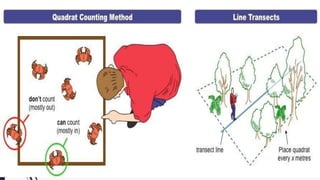
Transect sampling
 In transect samples, the person taking the samples follows a
predetermined sampling path and records the presence of all
organisms that are to be counted within a fixed distance (i.e., 1m ,5m
) on either side of a specified length of travel along the transect.
 Data reported as the no: of organisms per unit of ground surface,
calculated as length traveled along the transect times ,lateral distance
examined.
 i.e., if someone traveled 100m along a transect and counted all
ladybugs within 1m on either side of the transect they would report
data as the number per 200 m².
Point sample technique
 Fixed sample sites are established and the person making the counts
moves from sites to site recording the no : of organisms observed during
a predetermined period of time (i.e., 5 min,10 min ) at each sample site.
 Sites should be chosen so that all habitat types within the study area are
included.
 These data reported as the no: of organisms per unit observation time (
i.e., number of butterflies per 15 minutes).
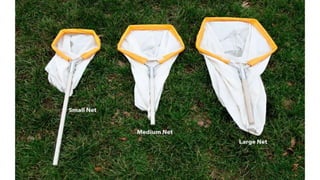
Net Sweepings
 The points to be considered in this methods assessment are time of
sampling, density and height of the crop, the number of sweeps required
and the type of insect pest involved in the study.
 A sweep consists of a half circle 0r 180º swing with a hoop of 43 cm
insect held in a vertical plane.
 The length of the handle should be one meter.
 Usually ten sweeps may be sufficient to assess the general population of
any species and the population is terms of number per 100 sweeps.
 This method is useful in insects like adult beetles, nymph and adults of
bugs and grasshoppers.
Sudden trappings
 Insect in an unit area are suddenly trapped with suitable traps
without causing disturbance and trapped insects are later counted.
 This is useful in the case of collembola, certain grasshoppers,
sorghum earhead bug etc..
Narcotized collections
 This method is useful for counting quick moving insects
 The insects are killed by spraying non persistent chemicals such as
dichlorvos, pyrethrum etc.. Or anesthetized
 Falling insects are collected on a sheet below the plant and counted
 E.g : mirid bugs on fruit trees
Light trap catch
 This method is useful in the quantitative estimation of seasonal
abundance of several species of moths and other insects which are
attracted to light.
 Most effective bulbs to use for survey trapping would be 60W
‘black light bulb’.
 The brood emergence of the rice stem borer Scirpophaga incertulas
is fixed by light trap catches.
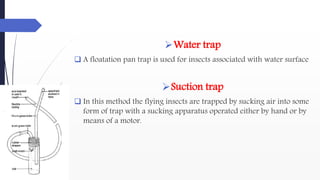
Water trap
 A floatation pan trap is used for insects associated with water surface
Suction trap
 In this method the flying insects are trapped by sucking air into some
form of trap with a sucking apparatus operated either by hand or by
means of a motor.
Adhesive or inspection or Sticky traps
 A suitable persistent adhesive materials like gum, grease, tar etc.. Which
will not dry out, is spread on strips of paper and supported on a
cylinder.
 Such sticky traps set in the fields and flying insects are trapped in them.
 The factors like wind velocity, temperature, colour of the trap etc.. Have
a bearing number of the insects caught in such traps.
 It is also necessary to clean the traps often; otherwise the efficiency of
the trap may go down
 Used for aphid migration studies
 Yellow sticky traps have been used to trap adults of the aleyrodids
Bemisia tabaci and Trialeurodes vaporariorum for monitoring.
Bait trap catch
 Many materials varying from raw plant materials and crushed insects
to refined chemical attractants which stimulate sexual odours or food
odours are known to attract insects.
 These materials are used as baits in special type of traps made for the
purpose depending on the insect species to be trapped.
 This type sampling is more complex and is utilized in the case of fruit
flies.
Sight counting
 The population of the insects in measured area is counted
Fixed volume or area of earth
 For soil insects like grubs this method is suggested wherein the soil
samples of known volume are taken from fixed area to fixed depths.
 Insects extracted from these samples which can be done by Berless
funnel method, floatation method, hand picking method etc.. Then
counted
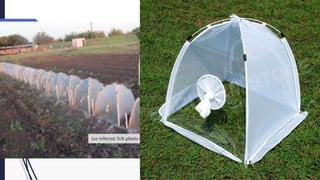
Emergence cages
 Emergence cages of known sampling area are used so that emerging
adults are trapped and counted.
Crop samples
 The population of the insect in the crop samples drawn is counted
and recorded.
 This method is very widely followed in economic entomology with
reference to insect pests like rice stem borer, sorghum stem borer,
gall midges, aphids, thrips, ball worms
 However the technique are to be perfected depending on the pest
species and crops
 Eg: in cotton for estimating the population of aphids, leaf hoppers
and thrips – leaves from terminal, central and basal portions of the
plants are examined.
Amount of damage
 The amount of degree of damage is some times taken as the index
in estimating the population fluctuation of pest.
 In cotton four grade of damage due to leaf hopper attack have been
recognized.
Marking and recapture
 A large number of individuals are marked with pain or tagged, released in the
field to mix with general population and later collected at different distances
from the releasing point.
 This would be helpful in assessing population, growth and activity of the pest
species.
 Tagging insects with radio-active tracers is another method
 This type of study is mainly intended for study of rate of dispersal, flight range
and migration of insects.
Population density =
𝑵 𝟏×𝑵 𝟐
𝑵 𝟑
𝑁1 = no: of individuals marked and released
𝑁2 = total no: of individual recaptured
Colonies of social insects
 Though a very difficult process especially in ants and termites, the
counting of individuals is done generally during cold weather when
they will be inactive.
 In honey bee it is further complicated as the population to be
assessed in sections.
 In the case assessing field bee population, the difference between the
maximum (morning) and minimum (afternoon) weights of the hive
gives the weight of filed bees from which the actual population is
computed.
 Similarly the area of the brood cell given an idea of the population of
the brood.
Method of samplings
Method of samplings
Random sampling
 Random sampling involves selecting a number of samples from a
population such that every sample has an equal chance of selection
 The simplest method for field or tree crop studies is base the sampling
pattern on coordinates selected from random number tables.
Stratified random sampling
 Stratified random sampling differs from random sampling only in the
division of population into different strata from which random samples
are then taken.
 The strata are subdivisions of the samples based on knowledge of the
distribution of the population
 Eg: insects may exhibit different preference for particular plant
parts.
 The strata reflect real differences in population level while each
strata consists of a more homogenous subpopulation.
Systematic sampling
 Systematic sampling involves taking samples at fixed intervals
 The size of the fixed interval and the reference or starting point for
the interval are chosen, within defined limits, from random
number tables.
 The first samples is taken at the reference point and subsequent
samples at successive intervals beyond that
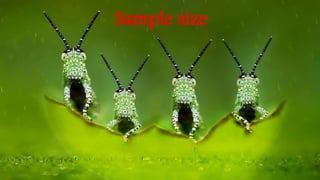
Sample size
Sample size
 There is a point in any sampling program when a decision has to
be made about the number of samples that should be used.
 Since the number of samples taken will influence the precision of
the final estimate the importance of this should not be
underestimated.
 Too few samples will reduce the value of the estimate (Vlug & Paul
1986) and too many samples will increase the cost of the program ,
cost measured in terms of time, labour , equipment or financial
outlay (Blackshaw et al., 1994).
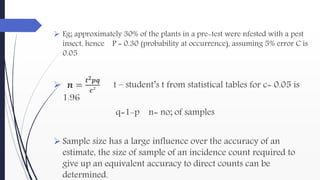
 Eg; approximately 30% of the plants in a pre-test were nfested with a pest
insect, hence P = 0.30 (probability at occurrence), assuming 5% error C is
0.05
 𝒏 =
𝒕 𝟐 𝒑𝒒
𝒄²
t – student’s t from statistical tables for c= 0.05 is
1.96
q=1-p n= no; of samples
 Sample size has a large influence over the accuracy of an
estimate, the size of sample of an incidence count required to
give up an equivalent accuracy to direct counts can be
determined.
 two different models for determining sample size with incidence
counts (Wards et al 1985).
1. Probit model
log µ= a+b . Probit (P)
µ = mean density
p = proportion of plants or plants parts infected
a and b = intercept and slope obtained from regression analysis
2. Nachman model
log µ = a+b.log.[ln
𝟏
𝟏−𝒑
]
ln= natural logarithm
log = logarithm to base 10
µ = mean density
p = proportion of plants or plants parts infected
a and b = intercept and slope obtained from regression analysis
Mode of sampling and number and size of samples
Mode of sampling and number and size of
samples
 It is desirable to fix up the maximum number of samples depending on
the nature of the crop and distribution of the pest species is to be studied.
However it is always better to have larger number of samples.
 The sampling techniques also vary very much depending on the pest and
crop.
 Usually the sample units are formed on random plant basis.
 In the case of the densely populated insects smaller size of the samples
may be sufficient.
 Whereas with heterogeneity of the population and decrease in
population density of the insect studied, the size and number of samples
will have to be increased.
 The incidence of both pest and parasitoids is generally recorded in
terms of percentage values.
 In the case of pests it is expressed with reference to the damage
caused whereas in the case of parasitoids it is recorded as
percentage of the host affected.
 However, the obtaining accurate and reliable data it should always
be arrived at with reference to some fixed scale.
Method of collection
 One of the best way to learn about insects is to go out into the fields
and collect them from their habitat, handle them and manage the
collections.
 The best period for collection is from early spring until late rainfall
and the best time for collection of the most of the species during
day time.
 Since, insects live in diverse habitats, they. may be collected in
several ways
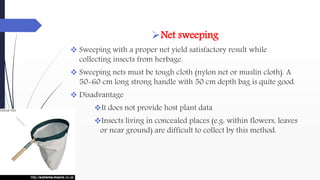
Net sweeping
 Sweeping with a proper net yield satisfactory result while
collecting insects from herbage.
 Sweeping nets must be tough cloth (nylon net or muslin cloth). A
50-60 cm long strong handle with 50 cm depth bag is quite good.
 Disadvantage
It does not provide host plant data
Insects living in concealed places (e.g: within flowers, leaves
or near ground) are difficult to collect by this method.
By hand picking
 Small insects, specially the soft bodied ones should be collected by hand
either with help of a fine camel brush or by a forceps.
 The soft brush should be dipped in the medium in which the insects
have to be preserved, so as to minimize the damage to soft skin.
 Insects like leaf-miners (Diptera), aphids (Hemiptera),bark inhabiting
beetles, insects living under stone and vegetable (Dermaptera and
Coleoptera), termites and ants etc.. Are collected by hand picking.
By beating
 Beating is usually employed to dislodge insects from foliage or
trees.
 A long stick is used to beat the plant part with downward strokes
and a tray or clothe is kept or spread over the ground to get the
falling insects.
 A net may also be kept on the ground to prevent the insects from
escape, after they fall to the ground.
By aerial netting
 Aerial nets are most widely used to collect free living flying insects
eg: dragonflies, moth, butterflies, wasps, flies, bees etc..
 The length of handle, diameter of ring, depth of the net may vary
on individual collectors’ preference
 But normally strong, light, easily manageable handle with 30-40
cm diameter ring and strong, durable, nylon bags with a depth of
50-70 cm are used.
 After netting the insects, the net should be turned to prevent the
escape of captured insects.
By collecting with aspirator
 Small active insects like leafhoppers, white flies, other bugs, beetles
etc.. May be collected by a sucking tube or aspirator, straight from
the plant surface.
 It is a very simple device and if used with little patience and
caution may yield desirable result.
 It is also useful to transfer insects from sweeping nets or from
rearing cages.
 All that one has to do is to suck the air by rubber tubing which
would draw the insect into the main tube through the glass tube.
 A vacuum cleaner may also be used as aspirator to suck the insects
from herbage or from their hides.
By trapping
 Traps are an easy & often very effective method of collecting several
types of insects.
 A trap is any device containing something to which the insects are
attracted and which is so arranged that once the insects get into it they
cannot get out.
 The attractive materials used & the general forms of the trap depends
on the type of insects one wish to collect. Some common types of traps
are :
1. Light trap
2. Bait trap
3. Wind trap
1.Light trap
 An artificial light (Kerosene lamp, petromax gas light, electrical
lamp) if placed adjacent to a white muslin cloth in field attracts a
number of insects like crickets, grasshoppers, moths, mantids,
beetles etc..
 Most of the insects attracted to the light would rest on the white
cloth from where they may easily be picked up by hand or by
aspirator.
 Simplest from would be to suspend a light source over a broad
rimmed funnel which in turn may be fitted in a glass jar
containing poison vapour or other killing agent
 Light traps may work all night and may also supply data indicating
seasonal incidence, peak period for a population etc..
2.Bait traps
 The odour of the particular kind, food or pheromones (sex attractants)
act as the principal agent in bait traps.
 Baits may include over-ripe fruit, piece of meat or fish, rotten fungi,
animal excreta etc. and these may be put at proper place where the
insects would gather.
1. Pit fall trap
simplest form trap, where a jar containing bait is placed below
the soil level to catch crawling insects like ground beetles, ants etc…
2. Aerial bait trap / pheromone trap
for flying insects. A simple device is to put a metal funnel with bait
suspended at top level, inside a killing bottle, which would be attract the
flying insects.
3.Wind traps
 The wind traps may range between a simple sock attached to a pole
in the direction of wind or may be electrically operated suction
device.
 In India, not much of insect collections have been made by wind
traps.
 A yellow pan water trap is simple device to attract aphids to the
preferable colour, in which the pan is painted.
 It is a metal tray painted in yellow and half filled up with water:
insects being attracted to colour, fall into the water
By using Berlese funnel
 Soil insects or insects living in leaf litter are collected along with
part of habitat and brought to the laboratory where they usually
put in a funnel which act as a separator.
 The simplest form being a metal funnel with sieve, inserted inside a
can or collecting tube, the materials is put on the sieve which is
subjected continuous heating by light bulb
 The collecting tube contains preserving fluid like alcohol and the
lip of funnel touches the fluid.
 Insects in order to escape from the heat move down through the
sieve and fall into the preservative.
Reference
 Elements of Entomology
DR. Rajendra singh & DR. G C sachan
 Elements of economic entomology
DR. Vasantharaj David & V V Ramamurthy
 Entomology and pest management
Larry P Pedigo
 Insect pest management
D.Dent
Insect population

Insect population

  • 2.
    Introduction  Insect pestsare responsible for serious losses in agricultural crops and for realizing economically higher yields they should be controlled at the appropriate time.  Before taking up control measures it would be essential to have an idea of the infestation and the damage that is likely to be caused.  However, in assessing the effects of pests on yield, the pests should be assessed and crop damage estimated.
  • 3.
    Insect population  Populationof an insect is the number of individuals of a particular species in a particular area.  In economic entomology the assessment of insect population is very important as the population density of the pest is generally related to the extent of damage caused by the pest.  study involves 2 main aspects 1. stage of the pest viz., egg, larva or nymph, pupa or adult at which the counting is to be done 2. actual process of counting and estimation
  • 4.
     As itmay not possible to count all the insects on a crop in the field, the population assessment should be done from samples.  Insects can be counted in the air over a crop, on the plants or in the soil.  It is desirable to take the samples at regular intervals and to extent possible at the time of the day and in similar weather.
  • 5.
    Stages to becounted
  • 6.
    Stages to becounted  Usually the population of the most injurious stage or stages of the pest are counted  Egg stage is the most ideal stage for population assessment, due to practical difficulties under field conditions it is not usually considered.  The injurious stage of the pest like larvae (Lepidopterous pest) or the nymph (bugs) or the adults (beetles) or both the nymph and the adults (earhead bugs, grasshoppers etc.) are counted.
  • 7.
  • 8.
    Nature of sample This depends on the insect, its distribution and the stage of the pest to be sampled. The methods are.. 1. Net sweepings 9. Sight counting 2. Sudden trappings 10.Fixed volume or area of earth 3. Narcotized collections 11 Crop samples 4. Light trap catch 12 Emergence cages 5. Water trap 13 Amount of damage 6. Suction trap 14.Marking and recapture 7. Adhesive or inspection or sticky traps 15 Colonies of social insects 8. Bait trap catch 16 Transect and point sampling
  • 9.
    Transect sampling  Intransect samples, the person taking the samples follows a predetermined sampling path and records the presence of all organisms that are to be counted within a fixed distance (i.e., 1m ,5m ) on either side of a specified length of travel along the transect.  Data reported as the no: of organisms per unit of ground surface, calculated as length traveled along the transect times ,lateral distance examined.  i.e., if someone traveled 100m along a transect and counted all ladybugs within 1m on either side of the transect they would report data as the number per 200 m².
  • 11.
    Point sample technique Fixed sample sites are established and the person making the counts moves from sites to site recording the no : of organisms observed during a predetermined period of time (i.e., 5 min,10 min ) at each sample site.  Sites should be chosen so that all habitat types within the study area are included.  These data reported as the no: of organisms per unit observation time ( i.e., number of butterflies per 15 minutes).
  • 13.
    Net Sweepings  Thepoints to be considered in this methods assessment are time of sampling, density and height of the crop, the number of sweeps required and the type of insect pest involved in the study.  A sweep consists of a half circle 0r 180º swing with a hoop of 43 cm insect held in a vertical plane.  The length of the handle should be one meter.  Usually ten sweeps may be sufficient to assess the general population of any species and the population is terms of number per 100 sweeps.  This method is useful in insects like adult beetles, nymph and adults of bugs and grasshoppers.
  • 15.
    Sudden trappings  Insectin an unit area are suddenly trapped with suitable traps without causing disturbance and trapped insects are later counted.  This is useful in the case of collembola, certain grasshoppers, sorghum earhead bug etc..
  • 16.
    Narcotized collections  Thismethod is useful for counting quick moving insects  The insects are killed by spraying non persistent chemicals such as dichlorvos, pyrethrum etc.. Or anesthetized  Falling insects are collected on a sheet below the plant and counted  E.g : mirid bugs on fruit trees
  • 17.
    Light trap catch This method is useful in the quantitative estimation of seasonal abundance of several species of moths and other insects which are attracted to light.  Most effective bulbs to use for survey trapping would be 60W ‘black light bulb’.  The brood emergence of the rice stem borer Scirpophaga incertulas is fixed by light trap catches.
  • 19.
    Water trap  Afloatation pan trap is used for insects associated with water surface Suction trap  In this method the flying insects are trapped by sucking air into some form of trap with a sucking apparatus operated either by hand or by means of a motor.
  • 20.
    Adhesive or inspectionor Sticky traps  A suitable persistent adhesive materials like gum, grease, tar etc.. Which will not dry out, is spread on strips of paper and supported on a cylinder.  Such sticky traps set in the fields and flying insects are trapped in them.  The factors like wind velocity, temperature, colour of the trap etc.. Have a bearing number of the insects caught in such traps.  It is also necessary to clean the traps often; otherwise the efficiency of the trap may go down  Used for aphid migration studies  Yellow sticky traps have been used to trap adults of the aleyrodids Bemisia tabaci and Trialeurodes vaporariorum for monitoring.
  • 22.
    Bait trap catch Many materials varying from raw plant materials and crushed insects to refined chemical attractants which stimulate sexual odours or food odours are known to attract insects.  These materials are used as baits in special type of traps made for the purpose depending on the insect species to be trapped.  This type sampling is more complex and is utilized in the case of fruit flies. Sight counting  The population of the insects in measured area is counted
  • 24.
    Fixed volume orarea of earth  For soil insects like grubs this method is suggested wherein the soil samples of known volume are taken from fixed area to fixed depths.  Insects extracted from these samples which can be done by Berless funnel method, floatation method, hand picking method etc.. Then counted Emergence cages  Emergence cages of known sampling area are used so that emerging adults are trapped and counted.
  • 26.
    Crop samples  Thepopulation of the insect in the crop samples drawn is counted and recorded.  This method is very widely followed in economic entomology with reference to insect pests like rice stem borer, sorghum stem borer, gall midges, aphids, thrips, ball worms  However the technique are to be perfected depending on the pest species and crops  Eg: in cotton for estimating the population of aphids, leaf hoppers and thrips – leaves from terminal, central and basal portions of the plants are examined.
  • 27.
    Amount of damage The amount of degree of damage is some times taken as the index in estimating the population fluctuation of pest.  In cotton four grade of damage due to leaf hopper attack have been recognized.
  • 28.
    Marking and recapture A large number of individuals are marked with pain or tagged, released in the field to mix with general population and later collected at different distances from the releasing point.  This would be helpful in assessing population, growth and activity of the pest species.  Tagging insects with radio-active tracers is another method  This type of study is mainly intended for study of rate of dispersal, flight range and migration of insects. Population density = 𝑵 𝟏×𝑵 𝟐 𝑵 𝟑 𝑁1 = no: of individuals marked and released 𝑁2 = total no: of individual recaptured
  • 30.
    Colonies of socialinsects  Though a very difficult process especially in ants and termites, the counting of individuals is done generally during cold weather when they will be inactive.  In honey bee it is further complicated as the population to be assessed in sections.  In the case assessing field bee population, the difference between the maximum (morning) and minimum (afternoon) weights of the hive gives the weight of filed bees from which the actual population is computed.  Similarly the area of the brood cell given an idea of the population of the brood.
  • 31.
  • 32.
    Method of samplings Randomsampling  Random sampling involves selecting a number of samples from a population such that every sample has an equal chance of selection  The simplest method for field or tree crop studies is base the sampling pattern on coordinates selected from random number tables. Stratified random sampling  Stratified random sampling differs from random sampling only in the division of population into different strata from which random samples are then taken.  The strata are subdivisions of the samples based on knowledge of the distribution of the population
  • 33.
     Eg: insectsmay exhibit different preference for particular plant parts.  The strata reflect real differences in population level while each strata consists of a more homogenous subpopulation. Systematic sampling  Systematic sampling involves taking samples at fixed intervals  The size of the fixed interval and the reference or starting point for the interval are chosen, within defined limits, from random number tables.  The first samples is taken at the reference point and subsequent samples at successive intervals beyond that
  • 34.
  • 35.
    Sample size  Thereis a point in any sampling program when a decision has to be made about the number of samples that should be used.  Since the number of samples taken will influence the precision of the final estimate the importance of this should not be underestimated.  Too few samples will reduce the value of the estimate (Vlug & Paul 1986) and too many samples will increase the cost of the program , cost measured in terms of time, labour , equipment or financial outlay (Blackshaw et al., 1994).
  • 36.
     Eg; approximately30% of the plants in a pre-test were nfested with a pest insect, hence P = 0.30 (probability at occurrence), assuming 5% error C is 0.05  𝒏 = 𝒕 𝟐 𝒑𝒒 𝒄² t – student’s t from statistical tables for c= 0.05 is 1.96 q=1-p n= no; of samples  Sample size has a large influence over the accuracy of an estimate, the size of sample of an incidence count required to give up an equivalent accuracy to direct counts can be determined.
  • 37.
     two differentmodels for determining sample size with incidence counts (Wards et al 1985). 1. Probit model log µ= a+b . Probit (P) µ = mean density p = proportion of plants or plants parts infected a and b = intercept and slope obtained from regression analysis
  • 38.
    2. Nachman model logµ = a+b.log.[ln 𝟏 𝟏−𝒑 ] ln= natural logarithm log = logarithm to base 10 µ = mean density p = proportion of plants or plants parts infected a and b = intercept and slope obtained from regression analysis
  • 39.
    Mode of samplingand number and size of samples
  • 40.
    Mode of samplingand number and size of samples  It is desirable to fix up the maximum number of samples depending on the nature of the crop and distribution of the pest species is to be studied. However it is always better to have larger number of samples.  The sampling techniques also vary very much depending on the pest and crop.  Usually the sample units are formed on random plant basis.  In the case of the densely populated insects smaller size of the samples may be sufficient.  Whereas with heterogeneity of the population and decrease in population density of the insect studied, the size and number of samples will have to be increased.
  • 41.
     The incidenceof both pest and parasitoids is generally recorded in terms of percentage values.  In the case of pests it is expressed with reference to the damage caused whereas in the case of parasitoids it is recorded as percentage of the host affected.  However, the obtaining accurate and reliable data it should always be arrived at with reference to some fixed scale.
  • 42.
  • 43.
    Method of collection One of the best way to learn about insects is to go out into the fields and collect them from their habitat, handle them and manage the collections.  The best period for collection is from early spring until late rainfall and the best time for collection of the most of the species during day time.  Since, insects live in diverse habitats, they. may be collected in several ways
  • 44.
    Net sweeping  Sweepingwith a proper net yield satisfactory result while collecting insects from herbage.  Sweeping nets must be tough cloth (nylon net or muslin cloth). A 50-60 cm long strong handle with 50 cm depth bag is quite good.  Disadvantage It does not provide host plant data Insects living in concealed places (e.g: within flowers, leaves or near ground) are difficult to collect by this method.
  • 45.
    By hand picking Small insects, specially the soft bodied ones should be collected by hand either with help of a fine camel brush or by a forceps.  The soft brush should be dipped in the medium in which the insects have to be preserved, so as to minimize the damage to soft skin.  Insects like leaf-miners (Diptera), aphids (Hemiptera),bark inhabiting beetles, insects living under stone and vegetable (Dermaptera and Coleoptera), termites and ants etc.. Are collected by hand picking.
  • 46.
    By beating  Beatingis usually employed to dislodge insects from foliage or trees.  A long stick is used to beat the plant part with downward strokes and a tray or clothe is kept or spread over the ground to get the falling insects.  A net may also be kept on the ground to prevent the insects from escape, after they fall to the ground.
  • 48.
    By aerial netting Aerial nets are most widely used to collect free living flying insects eg: dragonflies, moth, butterflies, wasps, flies, bees etc..  The length of handle, diameter of ring, depth of the net may vary on individual collectors’ preference  But normally strong, light, easily manageable handle with 30-40 cm diameter ring and strong, durable, nylon bags with a depth of 50-70 cm are used.  After netting the insects, the net should be turned to prevent the escape of captured insects.
  • 49.
    By collecting withaspirator  Small active insects like leafhoppers, white flies, other bugs, beetles etc.. May be collected by a sucking tube or aspirator, straight from the plant surface.  It is a very simple device and if used with little patience and caution may yield desirable result.  It is also useful to transfer insects from sweeping nets or from rearing cages.  All that one has to do is to suck the air by rubber tubing which would draw the insect into the main tube through the glass tube.  A vacuum cleaner may also be used as aspirator to suck the insects from herbage or from their hides.
  • 50.
    By trapping  Trapsare an easy & often very effective method of collecting several types of insects.  A trap is any device containing something to which the insects are attracted and which is so arranged that once the insects get into it they cannot get out.  The attractive materials used & the general forms of the trap depends on the type of insects one wish to collect. Some common types of traps are : 1. Light trap 2. Bait trap 3. Wind trap
  • 51.
    1.Light trap  Anartificial light (Kerosene lamp, petromax gas light, electrical lamp) if placed adjacent to a white muslin cloth in field attracts a number of insects like crickets, grasshoppers, moths, mantids, beetles etc..  Most of the insects attracted to the light would rest on the white cloth from where they may easily be picked up by hand or by aspirator.  Simplest from would be to suspend a light source over a broad rimmed funnel which in turn may be fitted in a glass jar containing poison vapour or other killing agent  Light traps may work all night and may also supply data indicating seasonal incidence, peak period for a population etc..
  • 52.
    2.Bait traps  Theodour of the particular kind, food or pheromones (sex attractants) act as the principal agent in bait traps.  Baits may include over-ripe fruit, piece of meat or fish, rotten fungi, animal excreta etc. and these may be put at proper place where the insects would gather. 1. Pit fall trap simplest form trap, where a jar containing bait is placed below the soil level to catch crawling insects like ground beetles, ants etc… 2. Aerial bait trap / pheromone trap for flying insects. A simple device is to put a metal funnel with bait suspended at top level, inside a killing bottle, which would be attract the flying insects.
  • 54.
    3.Wind traps  Thewind traps may range between a simple sock attached to a pole in the direction of wind or may be electrically operated suction device.  In India, not much of insect collections have been made by wind traps.  A yellow pan water trap is simple device to attract aphids to the preferable colour, in which the pan is painted.  It is a metal tray painted in yellow and half filled up with water: insects being attracted to colour, fall into the water
  • 55.
    By using Berlesefunnel  Soil insects or insects living in leaf litter are collected along with part of habitat and brought to the laboratory where they usually put in a funnel which act as a separator.  The simplest form being a metal funnel with sieve, inserted inside a can or collecting tube, the materials is put on the sieve which is subjected continuous heating by light bulb  The collecting tube contains preserving fluid like alcohol and the lip of funnel touches the fluid.  Insects in order to escape from the heat move down through the sieve and fall into the preservative.
  • 57.
    Reference  Elements ofEntomology DR. Rajendra singh & DR. G C sachan  Elements of economic entomology DR. Vasantharaj David & V V Ramamurthy  Entomology and pest management Larry P Pedigo  Insect pest management D.Dent