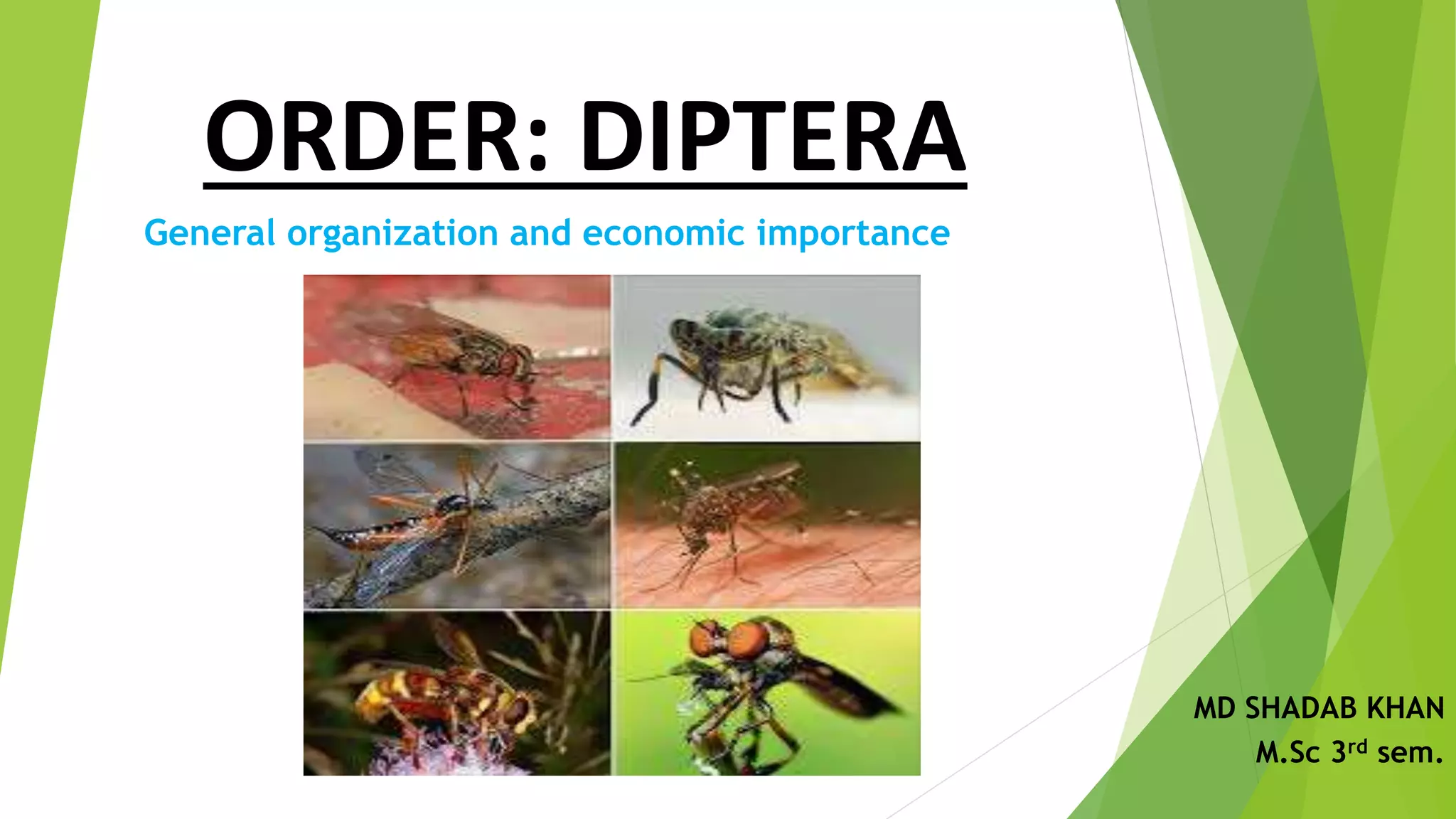
ORDER: DIPTERA
General organization and economic importance
MD SHADAB KHAN
M.Sc 3rd sem.
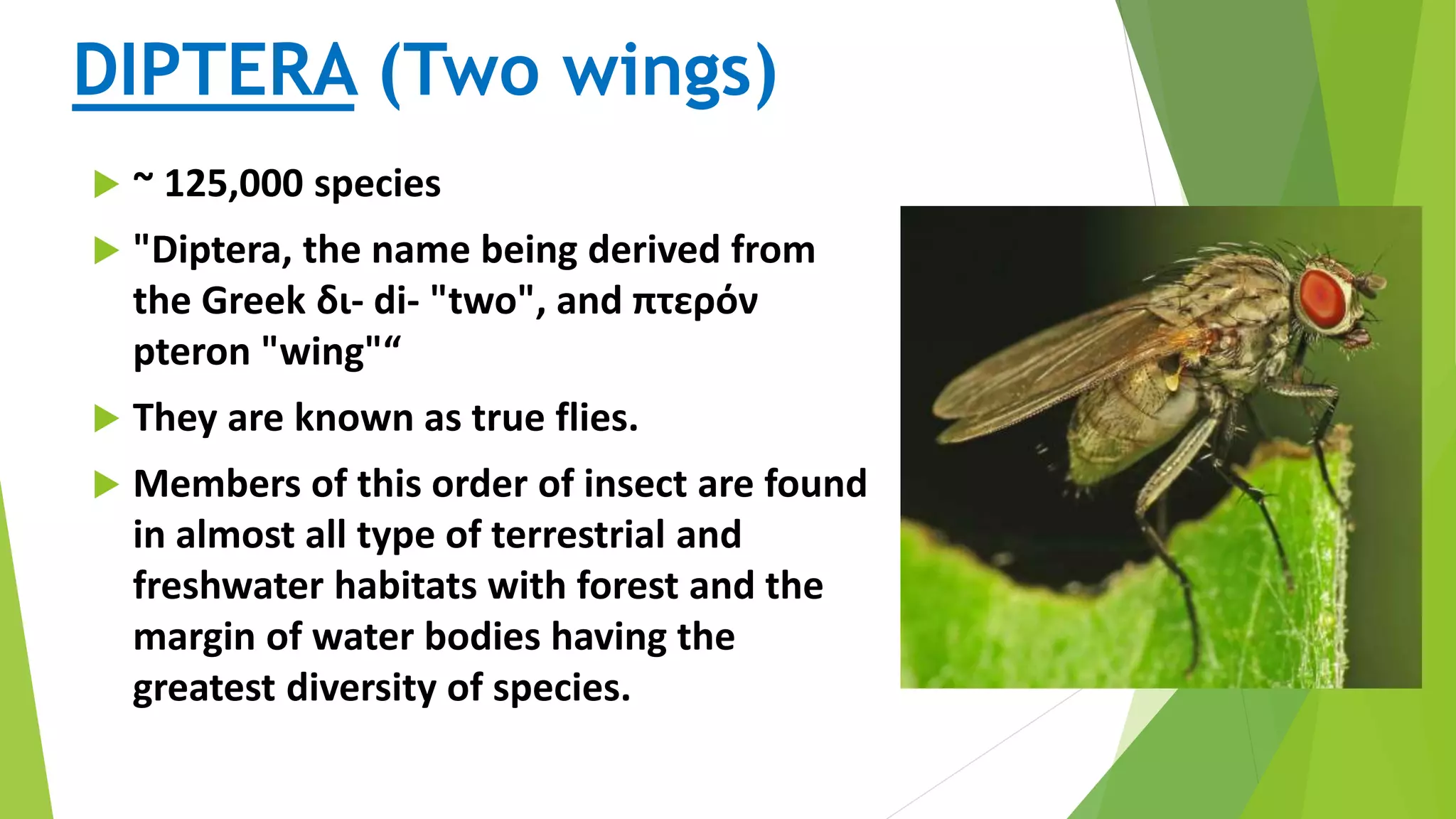
DIPTERA (Two wings)
 ~ 125,000 species
 "Diptera, the name being derived from
the Greek δι- di- "two", and πτερόν
pteron "wing"“
 They are known as true flies.
 Members of this order of insect are found
in almost all type of terrestrial and
freshwater habitats with forest and the
margin of water bodies having the
greatest diversity of species.
Characteristics of Diptera
 One pair of membranous wings.
 Hind wing are reduced to small club like
structures called halteres. The halteres
are used as stabilisers during flight.
 Mobile head with large compound eyes .
 Sucking mouthparts, sometimes adapted
for piercing e.g mosquitoes .
 Highly modified thorax, with a reduced
prothorax and metathorax and a greatly
enlarged mesothorax.
 Short simple antennae, frilled or bushy in
mosquitoes and crane flies.
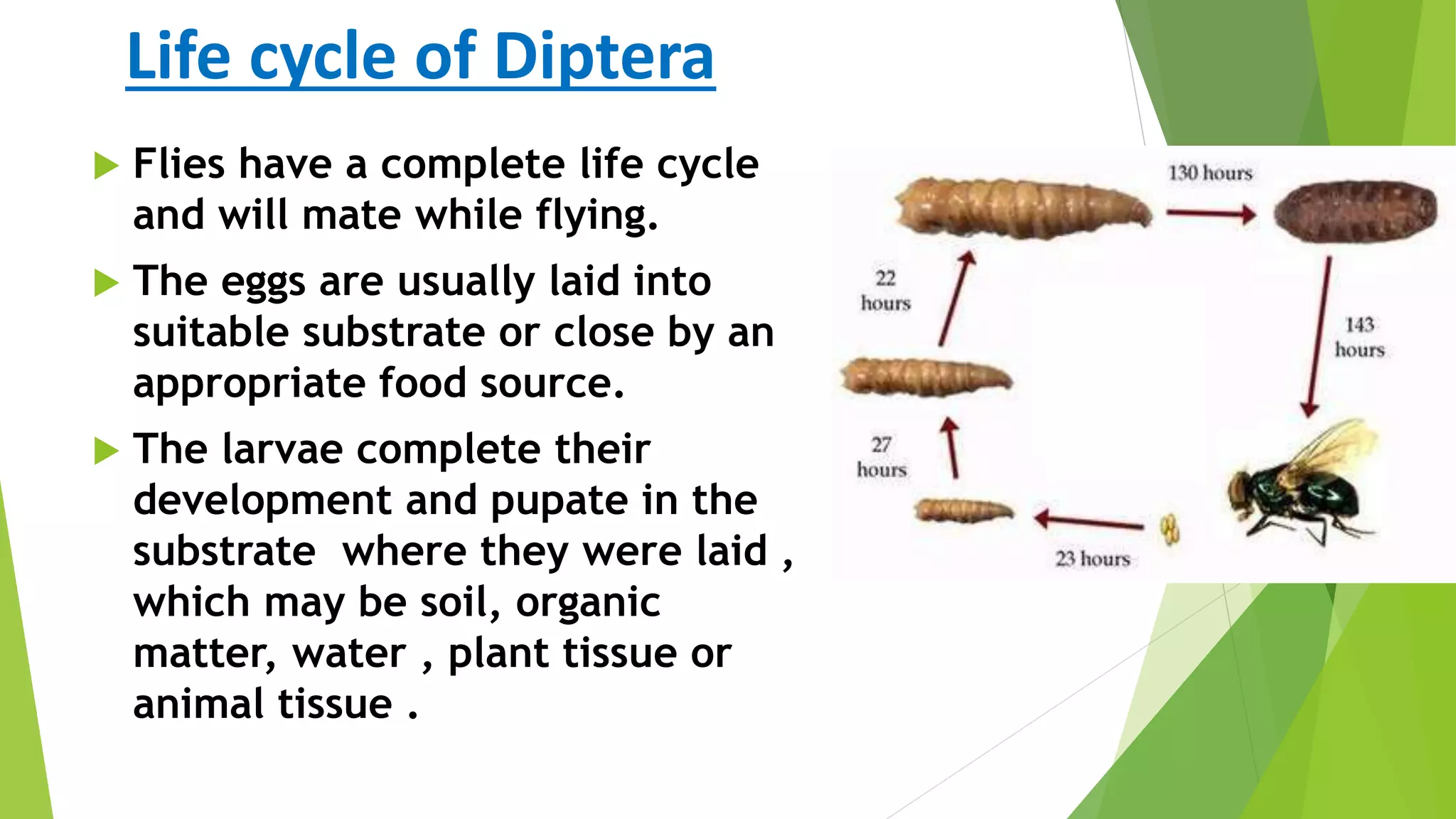
 Complete metamorphosis, they go through
at least 4 stages which include egg, larva,
pupa and adult .
Feeding
 Adult flies are only able to ingest liquid
foods due to their sucking / piercing
mouthparts.
 In most species digestion is partially
external and salivary secretion are
introduced to liquefy the food and then the
softened product is mopped up.
Life cycle of Diptera
 Flies have a complete life cycle
and will mate while flying.
 The eggs are usually laid into
suitable substrate or close by an
appropriate food source.
 The larvae complete their
development and pupate in the
substrate where they were laid ,
which may be soil, organic
matter, water , plant tissue or
animal tissue .
Order diptera is divided into two
suborders
Nematocera
 Many primitive suborders includes craneflies,
mosquitoes, midges and fungus gnats , Thread
like antennae.
Brachycera
 More robust with short stout antennae of less than
six segments and include the orthorrhapan groups,
fruit flies hover flies flesh flies etc
Why diptera are successful insects ?
 Due to its short life cycle there is enough time for
selection and evolution to take place .
 The high reproduction ability of them has paved a way
for a large variation for selection.
 The increased interaction with other organisms has led
to diverse specialisation in order to minimise
competition thus increasing chance of survival.
 Mouth parts has become highly specialised.
Economic Importance
 Most of the species that make up
this huge and diverse order are
beneficial to ecosystem as
pollinators, parasites, predators
and are vital to the process of
decomposition and nutrient
recycling.
 However the activities of
relatively few species have a
greater impact on man and other
animals than any other insect
group. They causes malaria,
yellow fever, Dengue fever,
leishmaniasis.
Uses
 Drosophila melanogaster a fruit
fly has long been used as model
in genetic research.
 Maggots formed on corpses are
useful to forensic entomologist
 Some species of maggots such
as blow fly larvae are bait in
angling and as food for
carnivorous animals in
Zoological parks.
THANK YOU

Order diptera by shadab khan 1

  • 1.
    ORDER: DIPTERA General organizationand economic importance MD SHADAB KHAN M.Sc 3rd sem.
  • 2.
    DIPTERA (Two wings) ~ 125,000 species  "Diptera, the name being derived from the Greek δι- di- "two", and πτερόν pteron "wing"“  They are known as true flies.  Members of this order of insect are found in almost all type of terrestrial and freshwater habitats with forest and the margin of water bodies having the greatest diversity of species.
  • 3.
    Characteristics of Diptera One pair of membranous wings.  Hind wing are reduced to small club like structures called halteres. The halteres are used as stabilisers during flight.  Mobile head with large compound eyes .  Sucking mouthparts, sometimes adapted for piercing e.g mosquitoes .  Highly modified thorax, with a reduced prothorax and metathorax and a greatly enlarged mesothorax.
  • 4.
     Short simpleantennae, frilled or bushy in mosquitoes and crane flies.  Complete metamorphosis, they go through at least 4 stages which include egg, larva, pupa and adult . Feeding  Adult flies are only able to ingest liquid foods due to their sucking / piercing mouthparts.  In most species digestion is partially external and salivary secretion are introduced to liquefy the food and then the softened product is mopped up.
  • 5.
    Life cycle ofDiptera  Flies have a complete life cycle and will mate while flying.  The eggs are usually laid into suitable substrate or close by an appropriate food source.  The larvae complete their development and pupate in the substrate where they were laid , which may be soil, organic matter, water , plant tissue or animal tissue .
  • 6.
    Order diptera isdivided into two suborders Nematocera  Many primitive suborders includes craneflies, mosquitoes, midges and fungus gnats , Thread like antennae. Brachycera  More robust with short stout antennae of less than six segments and include the orthorrhapan groups, fruit flies hover flies flesh flies etc
  • 7.
    Why diptera aresuccessful insects ?  Due to its short life cycle there is enough time for selection and evolution to take place .  The high reproduction ability of them has paved a way for a large variation for selection.  The increased interaction with other organisms has led to diverse specialisation in order to minimise competition thus increasing chance of survival.  Mouth parts has become highly specialised.
  • 8.
    Economic Importance  Mostof the species that make up this huge and diverse order are beneficial to ecosystem as pollinators, parasites, predators and are vital to the process of decomposition and nutrient recycling.  However the activities of relatively few species have a greater impact on man and other animals than any other insect group. They causes malaria, yellow fever, Dengue fever, leishmaniasis.
  • 9.
    Uses  Drosophila melanogastera fruit fly has long been used as model in genetic research.  Maggots formed on corpses are useful to forensic entomologist  Some species of maggots such as blow fly larvae are bait in angling and as food for carnivorous animals in Zoological parks.
  • 10.