Presented by;m.farooq
topic;collembola
email;sfarooq027@gil.comma
1
Collembola (springtails)
Taxonomic position
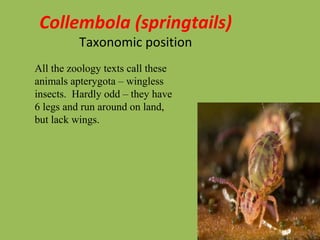
All the zoology texts call these
animals apterygota – wingless
insects. Hardly odd – they have
6 legs and run around on land,
but lack wings.
Collembola (springtails)
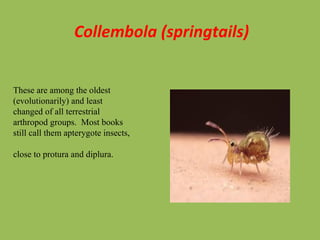
These are among the oldest
(evolutionarily) and least
changed of all terrestrial
arthropod groups. Most books
still call them apterygote insects,
close to protura and diplura.
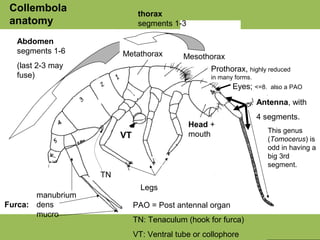
Antenna, with
4 segments.
This genus
(Tomocerus) is
odd in having a
big 3rd
segment.
Eyes; <=8. also a PAO
Head +
mouth
manubrium
Furca: dens
mucro
Legs
TN
Metathorax Mesothorax
Prothorax, highly reduced
in many forms.
VT
Abdomen
segments 1-6
(last 2-3 may
fuse)
thorax
segments 1-3
PAO = Post antennal organ
TN: Tenaculum (hook for furca)
VT: Ventral tube or collophore
Collembola
anatomy
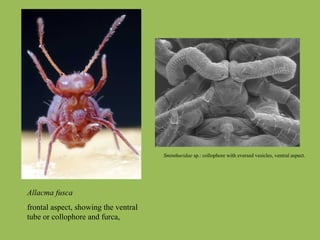
Allacma fusca
frontal aspect, showing the ventral
tube or collophore and furca,
Sminthuridae sp.: collophore with eversed vesicles, ventral aspect.
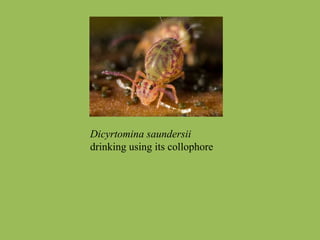
Dicyrtomina saundersii
drinking using its collophore
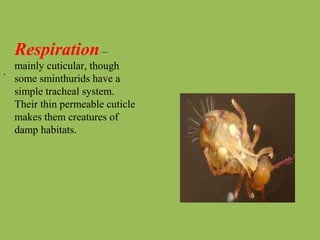
Respiration –
mainly cuticular, though
some sminthurids have a
simple tracheal system.
Their thin permeable cuticle
makes them creatures of
damp habitats.
.
8
reproduction
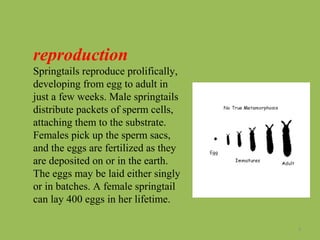
Springtails reproduce prolifically,
developing from egg to adult in
just a few weeks. Male springtails
distribute packets of sperm cells,
attaching them to the substrate.
Females pick up the sperm sacs,
and the eggs are fertilized as they
are deposited on or in the earth.
The eggs may be laid either singly
or in batches. A female springtail
can lay 400 eggs in her lifetime.
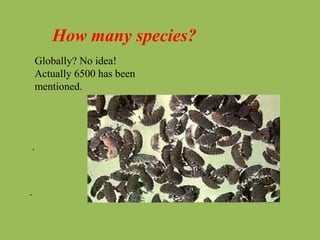
How many species?
Globally? No idea!
Actually 6500 has been
mentioned.
.
.
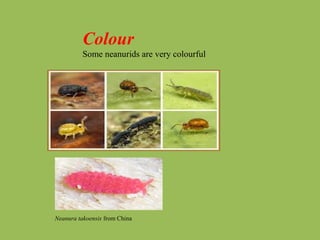
Colour
Some neanurids are very colourful
Neanura takoensis from China
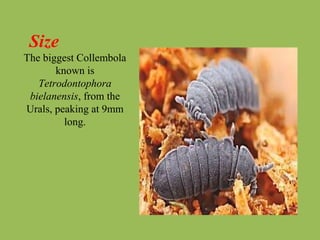
Size
The biggest Collembola
known is
Tetrodontophora
bielanensis, from the
Urals, peaking at 9mm
long.
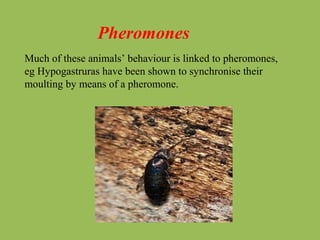
Pheromones
Much of these animals’ behaviour is linked to pheromones,
eg Hypogastruras have been shown to synchronise their
moulting by means of a pheromone.
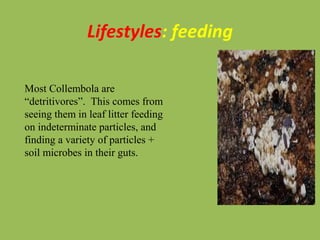
Lifestyles: feeding
Most Collembola are
“detritivores”. This comes from
seeing them in leaf litter feeding
on indeterminate particles, and
finding a variety of particles +
soil microbes in their guts.
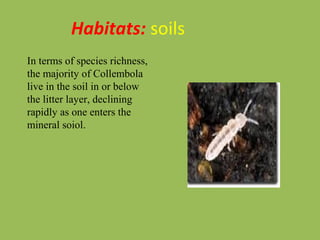
Habitats: soils
In terms of species richness,
the majority of Collembola
live in the soil in or below
the litter layer, declining
rapidly as one enters the
mineral soiol.
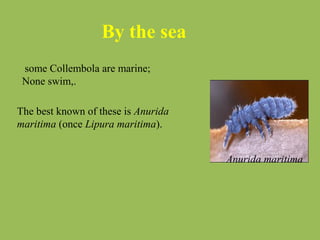
By the sea
some Collembola are marine;
None swim,.
The best known of these is Anurida
maritima (once Lipura maritima).
Anurida maritima
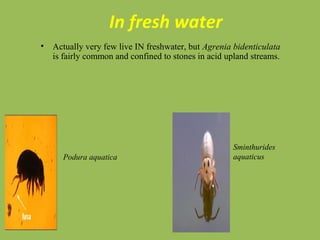
In fresh water
• Actually very few live IN freshwater, but Agrenia bidenticulata
is fairly common and confined to stones in acid upland streams.
Podura aquatica
Sminthurides
aquaticus
Thanks all of youThanks all of you
17

Introduction to collembola_march 3

  • 1.
  • 2.
    Collembola (springtails) Taxonomic position Allthe zoology texts call these animals apterygota – wingless insects. Hardly odd – they have 6 legs and run around on land, but lack wings.
  • 3.
    Collembola (springtails) These areamong the oldest (evolutionarily) and least changed of all terrestrial arthropod groups. Most books still call them apterygote insects, close to protura and diplura.
  • 4.
    Antenna, with 4 segments. Thisgenus (Tomocerus) is odd in having a big 3rd segment. Eyes; <=8. also a PAO Head + mouth manubrium Furca: dens mucro Legs TN Metathorax Mesothorax Prothorax, highly reduced in many forms. VT Abdomen segments 1-6 (last 2-3 may fuse) thorax segments 1-3 PAO = Post antennal organ TN: Tenaculum (hook for furca) VT: Ventral tube or collophore Collembola anatomy
  • 5.
    Allacma fusca frontal aspect,showing the ventral tube or collophore and furca, Sminthuridae sp.: collophore with eversed vesicles, ventral aspect.
  • 6.
  • 7.
    Respiration – mainly cuticular,though some sminthurids have a simple tracheal system. Their thin permeable cuticle makes them creatures of damp habitats. .
  • 8.
    8 reproduction Springtails reproduce prolifically, developingfrom egg to adult in just a few weeks. Male springtails distribute packets of sperm cells, attaching them to the substrate. Females pick up the sperm sacs, and the eggs are fertilized as they are deposited on or in the earth. The eggs may be laid either singly or in batches. A female springtail can lay 400 eggs in her lifetime.
  • 9.
    How many species? Globally?No idea! Actually 6500 has been mentioned. . .
  • 10.
    Colour Some neanurids arevery colourful Neanura takoensis from China
  • 11.
    Size The biggest Collembola knownis Tetrodontophora bielanensis, from the Urals, peaking at 9mm long.
  • 12.
    Pheromones Much of theseanimals’ behaviour is linked to pheromones, eg Hypogastruras have been shown to synchronise their moulting by means of a pheromone.
  • 13.
    Lifestyles: feeding Most Collembolaare “detritivores”. This comes from seeing them in leaf litter feeding on indeterminate particles, and finding a variety of particles + soil microbes in their guts.
  • 14.
    Habitats: soils In termsof species richness, the majority of Collembola live in the soil in or below the litter layer, declining rapidly as one enters the mineral soiol.
  • 15.
    By the sea someCollembola are marine; None swim,. The best known of these is Anurida maritima (once Lipura maritima). Anurida maritima
  • 16.
    In fresh water •Actually very few live IN freshwater, but Agrenia bidenticulata is fairly common and confined to stones in acid upland streams. Podura aquatica Sminthurides aquaticus
  • 17.
    Thanks all ofyouThanks all of you 17