
Inquiry
Jinan Karameh
Introduction
According to Webster’s Third International
Dictionary (1986), inquiry is an
“act or an instance of seeking for
truth, information, or knowledge; investigation;
research; or a question or query” (p. 1167), while
the root word inquire means “to
ask for information about, to make an investigation
or search, to seek information
or questioning” (p. 1167)
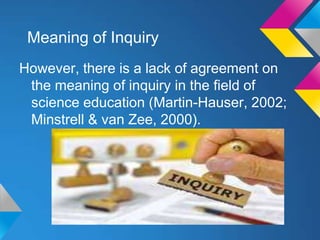
Meaning of Inquiry
However, there is a lack of agreement on
the meaning of inquiry in the field of
science education (Martin-Hauser, 2002;
Minstrell & van Zee, 2000).
Different points of views!!!
Minstrell (2000) listed several
Barman (2002)
different definitions of
presented his
inquiry: encouraging
interpretation about
inquisitiveness (habit of the
inquiry as a teaching
mind), teaching strategy for
strategy and a set of
motivating learning,
student
hands-on and mindson, manipulating materials
skills (i.e., individual
to study particular
process skills).
phenomena, and
stimulating questions by
students.
Early Historical Perspective

• The inclusion of inquiry into K–12 science
curriculum was recommended by John
Dewey (1910), a former science teacher.
Dewey considered that there was too
much emphasis on facts without enough
emphasis on science for thinking and an
attitude of the mind
Inquiry through history

•

The National Science Foundation (NSF) had
funded the development of an innovative
science curriculum in 1956; The subsequent
science curricula were implemented with an
emphasis on “thinking like a scientist” and an
emphasis on science processes as individual
skills (i.e., observing, classifying, inferring etc.).
Schwab (1960) had described two types of inquiry:
1. stable (growing body of knowledge)
2. fluid (invention of new conceptual structures
that revolutionize science).

He also encouraged science teachers to use the
laboratory to assist students in their study of
science concepts.
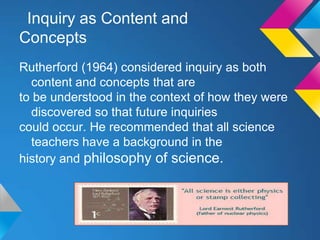
Inquiry as Content and
Concepts
Rutherford (1964) considered inquiry as both
content and concepts that are
to be understood in the context of how they were
discovered so that future inquiries
could occur. He recommended that all science
teachers have a background in the
history and philosophy of science.
The Start Of Action!!!
Project Synthesis was a compilation of three
major NSF sponsored projects.
There were four different goal clusters developed:
personal needs, societal
issues, academic preparation, and career
education and awareness. The greatest
emphasis (95%) was on academic preparation.
Inquiry was one of the five areas of Project
Synthesis
Challenges!
They recognized reasons that teachers do not use
inquiry and identified limited teacher
preparation,including management; lack of
time, limited available materials; lack of support;
emphasis only on content; and difficult to teach.
Subsequently, they identified three reasons for
avoiding inquiry (state documents emphasizing
content, easier to access content, and textbooks’
emphasis of science as a body of knowledge).
Science for all Americans
(SFAA)
Project 2061 established goals for the
teaching of inquiry in the SFAA chapter
entitled “Habits of the Mind,” and inquiry
was considered as a science content topic
using the following recommendations:
start with questions about nature,
engage students actively,
concentrate on the collection and use of
evidence,

•
•
•
• provide historical perspective,
• insist on clear expression,
• use a team approach,
• do not separate knowledge from finding
out,
• and deemphasize the memorization of
technical vocabulary
Now a date!!!!
Many dicsussions continue among
educational organizations in USA about
inquiry implementations and
strategies, however; here in
Lebanon, although inquiry is present as a
main objective in our lebanese
curriculum, inquiry is rarely
implemented!!!!!!!!
To sum up: What is Inquiry??
The Standards define inquiry as:
A multifaceted activity that involves:
1. making observation
2. researching
3. planning investigations
4. using experimental evidences
5. using tools to collect and analyze data
6. proposing answers and explanations
7. communicating the results.
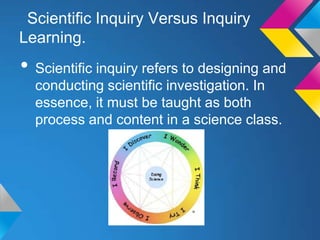
Scientific Inquiry Versus Inquiry
Learning.

• Scientific inquiry refers to designing and
conducting scientific investigation. In
essence, it must be taught as both
process and content in a science class.
Inquiry Learning
The NRC (2000) provides and explains a
working definition of an inquiry approach
to teaching science. Their definitions
centers on "Five Essential features of
Classroom Inquiry" that are:
1. Learners engage in scientifically oriented
questions.
2. Learners give priority to evidence in
responding to questions.
3. Learners formulate explanations from
Inquiry Learning
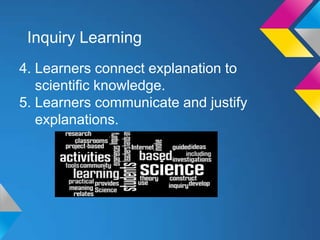
4. Learners connect explanation to
scientific knowledge.
5. Learners communicate and justify
explanations.
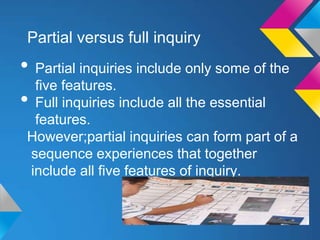
Partial versus full inquiry

• Partial inquiries include only some of the
five features.
• Full inquiries include all the essential
features.
However;partial inquiries can form part of a
sequence experiences that together
include all five features of inquiry.
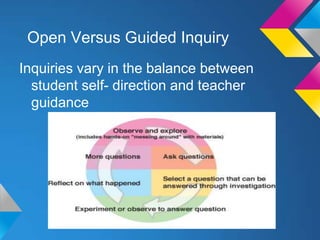
Open Versus Guided Inquiry
Inquiries vary in the balance between
student self- direction and teacher
guidance
Tips to implement inquiry in our
lesson plans!
1. Initiating inquiry: Discrepant event
2. Converting Cookbooks labs to inquiry
3. Questioning in an inquiry classroom
4. " The Lab Didn't work"
5. Assessing inquiry investigation
6. Scientific Reporting
Resources For Educators

• Biology Sciences Curriculum Study has

•
•
•

promoted the inquiry approach since 1950s.
They developed the 5Es model:
Engage, Explore, Explain, Elaborate, Evaluate.
(www.bscs.org)
The access Excellence website
(www.accessexcellence.org)
(www.nsta.org) Membership
(www.exploratorium.com)
References:
http://www.uhu.es/gaiainm/invest_escolar/httpdocs/biblioteca_pdf
/4_Abriefhistoryofinquiry.pdf

Inquiry based teaching and its historical background

  • 1.
  • 2.
    Introduction According to Webster’sThird International Dictionary (1986), inquiry is an “act or an instance of seeking for truth, information, or knowledge; investigation; research; or a question or query” (p. 1167), while the root word inquire means “to ask for information about, to make an investigation or search, to seek information or questioning” (p. 1167)
  • 3.
    Meaning of Inquiry However,there is a lack of agreement on the meaning of inquiry in the field of science education (Martin-Hauser, 2002; Minstrell & van Zee, 2000).
  • 4.
    Different points ofviews!!! Minstrell (2000) listed several Barman (2002) different definitions of presented his inquiry: encouraging interpretation about inquisitiveness (habit of the inquiry as a teaching mind), teaching strategy for strategy and a set of motivating learning, student hands-on and mindson, manipulating materials skills (i.e., individual to study particular process skills). phenomena, and stimulating questions by students.
  • 5.
    Early Historical Perspective •The inclusion of inquiry into K–12 science curriculum was recommended by John Dewey (1910), a former science teacher. Dewey considered that there was too much emphasis on facts without enough emphasis on science for thinking and an attitude of the mind
  • 6.
    Inquiry through history • TheNational Science Foundation (NSF) had funded the development of an innovative science curriculum in 1956; The subsequent science curricula were implemented with an emphasis on “thinking like a scientist” and an emphasis on science processes as individual skills (i.e., observing, classifying, inferring etc.).
  • 7.
    Schwab (1960) haddescribed two types of inquiry: 1. stable (growing body of knowledge) 2. fluid (invention of new conceptual structures that revolutionize science). He also encouraged science teachers to use the laboratory to assist students in their study of science concepts.
  • 8.
    Inquiry as Contentand Concepts Rutherford (1964) considered inquiry as both content and concepts that are to be understood in the context of how they were discovered so that future inquiries could occur. He recommended that all science teachers have a background in the history and philosophy of science.
  • 9.
    The Start OfAction!!! Project Synthesis was a compilation of three major NSF sponsored projects. There were four different goal clusters developed: personal needs, societal issues, academic preparation, and career education and awareness. The greatest emphasis (95%) was on academic preparation. Inquiry was one of the five areas of Project Synthesis
  • 10.
    Challenges! They recognized reasonsthat teachers do not use inquiry and identified limited teacher preparation,including management; lack of time, limited available materials; lack of support; emphasis only on content; and difficult to teach. Subsequently, they identified three reasons for avoiding inquiry (state documents emphasizing content, easier to access content, and textbooks’ emphasis of science as a body of knowledge).
  • 11.
    Science for allAmericans (SFAA) Project 2061 established goals for the teaching of inquiry in the SFAA chapter entitled “Habits of the Mind,” and inquiry was considered as a science content topic using the following recommendations: start with questions about nature, engage students actively, concentrate on the collection and use of evidence, • • •
  • 12.
    • provide historicalperspective, • insist on clear expression, • use a team approach, • do not separate knowledge from finding out, • and deemphasize the memorization of technical vocabulary
  • 13.
    Now a date!!!! Manydicsussions continue among educational organizations in USA about inquiry implementations and strategies, however; here in Lebanon, although inquiry is present as a main objective in our lebanese curriculum, inquiry is rarely implemented!!!!!!!!
  • 14.
    To sum up:What is Inquiry?? The Standards define inquiry as: A multifaceted activity that involves: 1. making observation 2. researching 3. planning investigations 4. using experimental evidences 5. using tools to collect and analyze data 6. proposing answers and explanations 7. communicating the results.
  • 15.
    Scientific Inquiry VersusInquiry Learning. • Scientific inquiry refers to designing and conducting scientific investigation. In essence, it must be taught as both process and content in a science class.
  • 16.
    Inquiry Learning The NRC(2000) provides and explains a working definition of an inquiry approach to teaching science. Their definitions centers on "Five Essential features of Classroom Inquiry" that are: 1. Learners engage in scientifically oriented questions. 2. Learners give priority to evidence in responding to questions. 3. Learners formulate explanations from
  • 17.
    Inquiry Learning 4. Learnersconnect explanation to scientific knowledge. 5. Learners communicate and justify explanations.
  • 18.
    Partial versus fullinquiry • Partial inquiries include only some of the five features. • Full inquiries include all the essential features. However;partial inquiries can form part of a sequence experiences that together include all five features of inquiry.
  • 19.
    Open Versus GuidedInquiry Inquiries vary in the balance between student self- direction and teacher guidance
  • 20.
    Tips to implementinquiry in our lesson plans! 1. Initiating inquiry: Discrepant event 2. Converting Cookbooks labs to inquiry 3. Questioning in an inquiry classroom 4. " The Lab Didn't work" 5. Assessing inquiry investigation 6. Scientific Reporting
  • 21.
    Resources For Educators •Biology Sciences Curriculum Study has • • • promoted the inquiry approach since 1950s. They developed the 5Es model: Engage, Explore, Explain, Elaborate, Evaluate. (www.bscs.org) The access Excellence website (www.accessexcellence.org) (www.nsta.org) Membership (www.exploratorium.com)
  • 22.