SOCIOLOGICAL FOUNDATIONS OF
CURRICULUM DEVELOPMENT
JUNRIE V. BANDOLON
SOCIOLOGY
From the Latin word “ Socius” meaning social or
being with others
And the Greek word “Logos” meaning to study.
Is the study of relationship between man and his
human environment.
Schools exist within, not apart
from, social context .
Schools emerges within
society.
CURRICULUM
Planned sequence of (1) what
students are to learn, (2) how
students acquire that learning,
and (3) how students’ learning is
verified.
SOCIOLOGICAL FOUNDATION OF
CURRICULUM DEVELOPMENT
The balancing act between developing the
potential of the individual and improving society.
The sociological foundation of the school curriculum affects the
development of the curriculum in the sense that there are
certain factors which intervene in the curriculum development
process due to cultural beliefs, societal expectations, values,
norms and traditions emanating from the background of
stakeholders.
Society is a general body of people, communities or nations
constituting civilized mankind. It is a body of processes associated
with one another for common objectives. Therefore, curriculum
should be designed in light of the main trends and development
of society. Any curriculum worth of it’s safe should try to reflect
the cultural and social needs of that particular society.
Culture is simply the way people live
including their intellectual, discipline, dressing
and training. Therefore, curriculum developers
should look into moral and artistic
development of its society [Taba 1962].
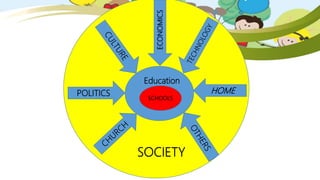
ECONOMICS
SCHOOLS
Education
HOMEPOLITICS
SOCIETY
CONCLUSION
Education takes place in the society
Education is essentially a social process
Social environment educates the child education has a social
role play
Education is a lifelong process
Education is not only in schooling
Education is formal, non- formal and informal
Education must be social in nature and develop democratic
skills and values in structure
- John Dewey
Salamat Kaayo sa Pagpamati! 

Sociological foundations of curriculum development

  • 1.
    SOCIOLOGICAL FOUNDATIONS OF CURRICULUMDEVELOPMENT JUNRIE V. BANDOLON
  • 2.
    SOCIOLOGY From the Latinword “ Socius” meaning social or being with others And the Greek word “Logos” meaning to study. Is the study of relationship between man and his human environment.
  • 3.
    Schools exist within,not apart from, social context . Schools emerges within society.
  • 4.
    CURRICULUM Planned sequence of(1) what students are to learn, (2) how students acquire that learning, and (3) how students’ learning is verified.
  • 5.
    SOCIOLOGICAL FOUNDATION OF CURRICULUMDEVELOPMENT The balancing act between developing the potential of the individual and improving society.
  • 6.
    The sociological foundationof the school curriculum affects the development of the curriculum in the sense that there are certain factors which intervene in the curriculum development process due to cultural beliefs, societal expectations, values, norms and traditions emanating from the background of stakeholders.
  • 7.
    Society is ageneral body of people, communities or nations constituting civilized mankind. It is a body of processes associated with one another for common objectives. Therefore, curriculum should be designed in light of the main trends and development of society. Any curriculum worth of it’s safe should try to reflect the cultural and social needs of that particular society.
  • 8.
    Culture is simplythe way people live including their intellectual, discipline, dressing and training. Therefore, curriculum developers should look into moral and artistic development of its society [Taba 1962].
  • 9.
  • 10.
    CONCLUSION Education takes placein the society Education is essentially a social process Social environment educates the child education has a social role play Education is a lifelong process Education is not only in schooling Education is formal, non- formal and informal Education must be social in nature and develop democratic skills and values in structure
  • 11.
  • 12.
    Salamat Kaayo saPagpamati! 