Inquiry-Based Learning Janetta Garton Technology Curriculum Director Willard R-II School http://www.willard.k12.mo.us/co/tech/inquiry.htm Based on John Dewey's philosophy that education begins with the curiosity of the learner  Works well with many educational techniques including multiple-intelligence, cooperative learning, and constructivism  Can be implemented during any activity and with any subject or grade level  Focuses on information-processing and problem-solving skills  More emphasis on "how we come to know" and less on "what we know."  Students learn how to continue learning.
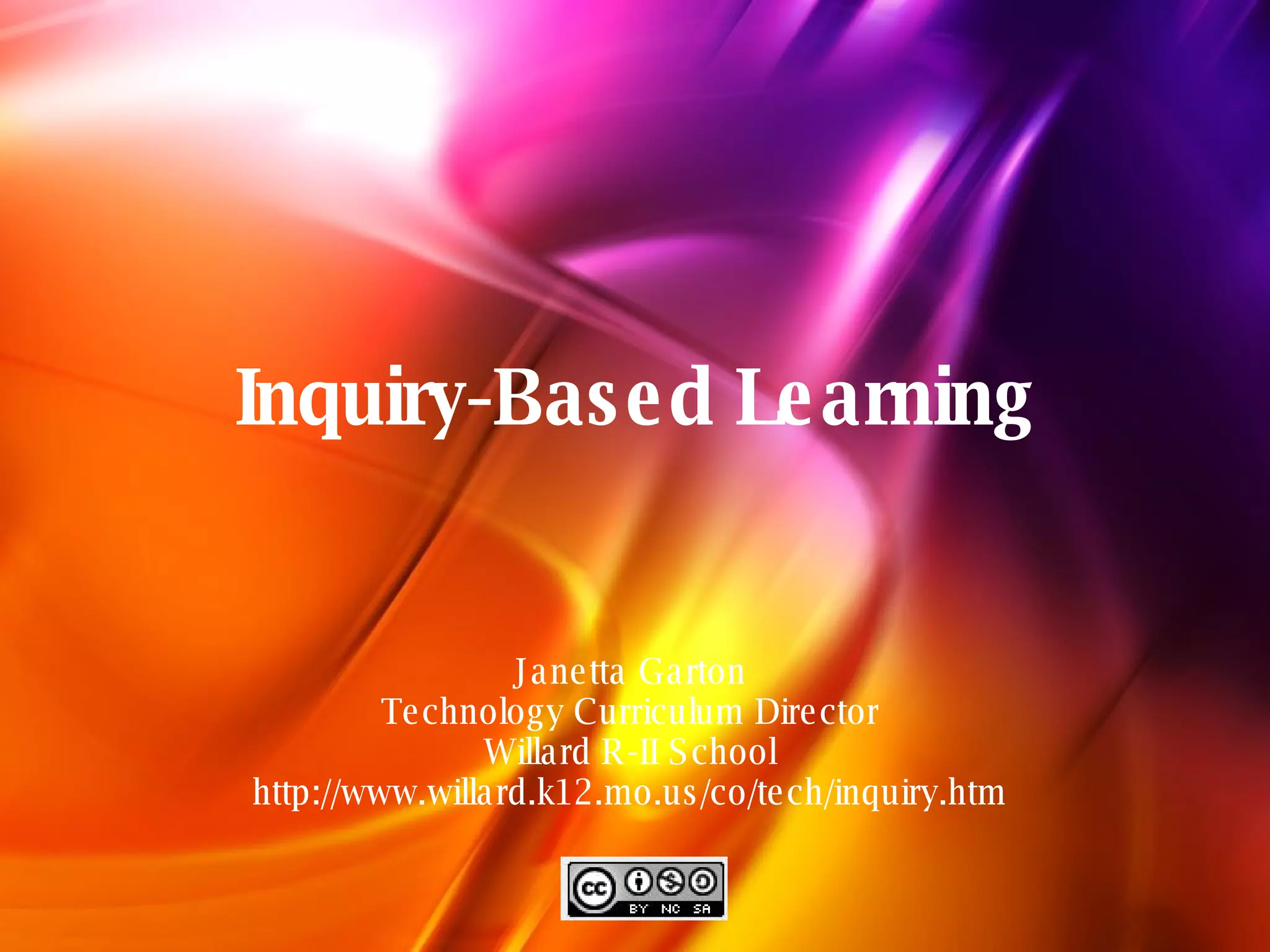
Inquiry-Based Learning has 5 common components  Questions Student Engagement Cooperative Interaction Performance Evaluation Variety of Resources
Lesson begins with a question  Essential question The teacher asks an essential question  Stimulates investigation and sparks curiosity Can be asked over and over, no one right answer Answer must be invented or constructed From the top of  Bloom's Taxonomy   Requires students to EVALUATE (make a thoughtful choice between options, with the choice based upon clearly stated criteria)  Requires students to SYNTHESIZE (invent a new or different version)  Requires students to ANALYZE (develop a thorough and complex understanding through skillful questioning) General in nature and lead to more questions Example Essential Questions Must a story have a moral?  Were mathematical theorems invented or discovered? Subsidiary/Unit Questions Developed by students and teacher to find an answer to the essential question Topic orientated Specific Example Essential Question: Do we have to fight wars? Unit Question: What events lead to the Civil War? Questions
Teacher is  facilitator Students  carry out activities using materials, observing, evaluating, and recording information  sort out information and decide what is important  see detail  detect sequences and events  notice change detect differences and similarities are creating a unique product that shows their understanding Student Engagement
Students are asked to  work in pairs or groups  discussing ideas  Not a competition.  Answers come in all shapes and forms. Cooperative Interaction
Students create an end product to communicate their knowledge,  slideshow graph  poster  song  mural  Scoring Guides  students see SG prior to creating product Performance Evaluation
textbooks  reference books magazines web sites  videos  podcasts posters experts  Variety of Resources
Traditional Lesson Students will be taught the 3 types of rocks (sedimentary, igneous, metamorphic) using a textbook. Students will then create a flipbook of the three types of rocks that includes definitions and examples. The Inquiry-Based Learning Version Essential Question : What patterns exist under the earth's crust? Student Engagement : Students observe rock samples detecting differences and similarities, sorting and recording information Cooperative Learning : Students will work in research groups Performance Evaluation : Students will publish a multimedia slide to be shared with their classmates, scored with a scoring guide Variety of Resources : textbook, Internet, CD-ROMS, and rock samples. Example
Graphics courtesy of  lumaxart  via Flickr www.flickr.com/photos/lumaxart/ thegoldguys.blogspot.com  www.lumaxart.com

Inquiry-based Learning

  • 1.
    Inquiry-Based Learning JanettaGarton Technology Curriculum Director Willard R-II School http://www.willard.k12.mo.us/co/tech/inquiry.htm Based on John Dewey's philosophy that education begins with the curiosity of the learner Works well with many educational techniques including multiple-intelligence, cooperative learning, and constructivism Can be implemented during any activity and with any subject or grade level Focuses on information-processing and problem-solving skills More emphasis on "how we come to know" and less on "what we know." Students learn how to continue learning.
  • 2.
    Inquiry-Based Learning has5 common components Questions Student Engagement Cooperative Interaction Performance Evaluation Variety of Resources
  • 3.
    Lesson begins witha question Essential question The teacher asks an essential question Stimulates investigation and sparks curiosity Can be asked over and over, no one right answer Answer must be invented or constructed From the top of Bloom's Taxonomy Requires students to EVALUATE (make a thoughtful choice between options, with the choice based upon clearly stated criteria) Requires students to SYNTHESIZE (invent a new or different version) Requires students to ANALYZE (develop a thorough and complex understanding through skillful questioning) General in nature and lead to more questions Example Essential Questions Must a story have a moral? Were mathematical theorems invented or discovered? Subsidiary/Unit Questions Developed by students and teacher to find an answer to the essential question Topic orientated Specific Example Essential Question: Do we have to fight wars? Unit Question: What events lead to the Civil War? Questions
  • 4.
    Teacher is facilitator Students carry out activities using materials, observing, evaluating, and recording information sort out information and decide what is important see detail detect sequences and events notice change detect differences and similarities are creating a unique product that shows their understanding Student Engagement
  • 5.
    Students are askedto work in pairs or groups discussing ideas Not a competition. Answers come in all shapes and forms. Cooperative Interaction
  • 6.
    Students create anend product to communicate their knowledge, slideshow graph poster song mural Scoring Guides students see SG prior to creating product Performance Evaluation
  • 7.
    textbooks referencebooks magazines web sites videos podcasts posters experts Variety of Resources
  • 8.
    Traditional Lesson Studentswill be taught the 3 types of rocks (sedimentary, igneous, metamorphic) using a textbook. Students will then create a flipbook of the three types of rocks that includes definitions and examples. The Inquiry-Based Learning Version Essential Question : What patterns exist under the earth's crust? Student Engagement : Students observe rock samples detecting differences and similarities, sorting and recording information Cooperative Learning : Students will work in research groups Performance Evaluation : Students will publish a multimedia slide to be shared with their classmates, scored with a scoring guide Variety of Resources : textbook, Internet, CD-ROMS, and rock samples. Example
  • 9.
    Graphics courtesy of lumaxart via Flickr www.flickr.com/photos/lumaxart/ thegoldguys.blogspot.com www.lumaxart.com

Editor's Notes

  • #2 Based on John Dewey's philosophy that education begins with the curiosity of the learner Works well with many educational techniques including multiple-intelligence, cooperative learning, and constructivism Can be implemented during any activity and with any subject or grade level Focuses on information-processing and problem-solving skills More emphasis on "how we come to know" and less on "what we know." Students learn how to continue learning.