Investment is defined as the commitment of current
financial resources in order to achieve higher gains in
the future. https://cma.org
Education is a discipline that is concerned with
methods of teaching and learning in schools or
school-like environments
www.britannica.com
1. Insufficient Funding:
One of the primary concerns is the inadequacy
of funding for education. The Philippine
government allocates a significant portion of its
budget to education, but it may still be insufficient
to meet the growing needs of the education
sector.
The education sector, which is composed of the Department of
Education (DepEd), State Universities and Colleges (SUCs),
Commission on Higher Education (CHED), and Technical
Education and Skills Development Authority (TESDA) will receive
an 8.2 percent increase next year at Php 852.8-Billion and will
remain as being the highest budgetary priority as mandated by
the Constitution.
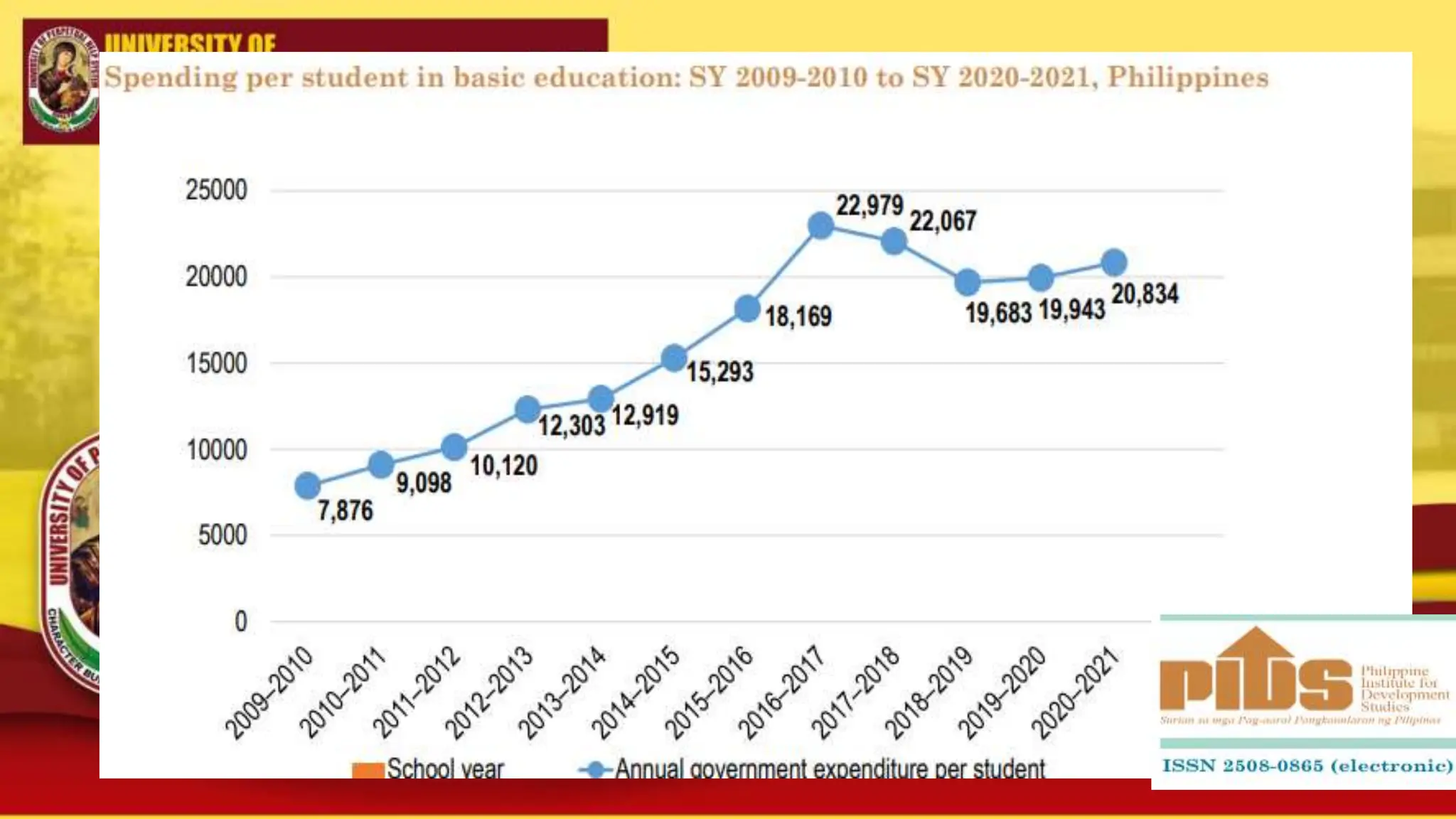
The budget of DepEd shall increase from Php 633.3-Billion in
2022 to Php 710.6- Billion in 2023.
2023 Budget in Philippine Education
https://www.dbm.gov.p
h
THANK YOU!
https://www.britannica.com/topic/education
https://cma.org
https://www.dbm.gov.ph
https://www.rappler.com/nation/dep
ed-report-classroom-shortage-
school-year-2023-2024/
Reality Check: Philippines still has
one of the lowest budget
allocations to education among the
ASEAN countries.
Country Budget per student AY 2022
Philippines PHP 21,000
Singapore
PHP 887,435.17
Thailand
1,514,385.90
Indonesia
65,271.25
2. Infrastructure and Facilities:
Many schools in the Philippines, especially in
rural areas, lack proper infrastructure and
facilities. This includes classrooms, libraries,
laboratories, and other essential amenities.
Insufficient infrastructure can hinder the quality
of education provided.
MANILA, Philippines – The Department of
Education (DepEd) said the country was
short of 159,000 classrooms this coming
school year which is set to start next week.
This 2023-2024 school year classroom
deficit is far more severe than last year’s
shortage of 91,000 classrooms.
Assistant Secretary Francis (August 23, 2023)
DepEd’s standard classroom to student ratios are one classroom for
every 35 students for primary school ,and one classroom for every
40 students for junior and senior high school.
Based on this parameters, at least 50% of all 7,520 existing senior
high school classrooms are congested, while 41% of all 10,188 junior
high school classrooms are overcrowded. Meanwhile, 32% of all
primary school (K-6) are crammed.
Schools are preparing to open the school year on Tuesday, August 29. – Rappler.com
3. Quality of Education:
While access to education has improved, there
are concerns about the overall quality of
education. This includes outdated curriculum,
inadequate teacher training, and the need for
improvements in teaching methods and materials.
Citing a World Bank study, it is said that 90 percent of
10-year-old students in the country cannot read and
understand a simple text.
A 2018 study found that a sample number of 15-year-
old Filipino students ranked last in reading
comprehension out of 79 countries. They also ranked
78th in science and math. One key insight from this
study is it implies those tested mostly came from
public schools. Hence, the crisis also lies in the fact
that a lot of Filipinos can’t read or do simple math.
Ph participation
in the PISA for
the first time in
2018 yielded a
dismal
performance,
ranking last in
reading and
second to last in
Science and
Mathematics
among 79
participating
countries and
economies.
Not enough textbooks
have been getting to the
hands of students since
2012 despite yearly
commitments to
provide enough
materials for learners,
data from the
Department of
Education shows.
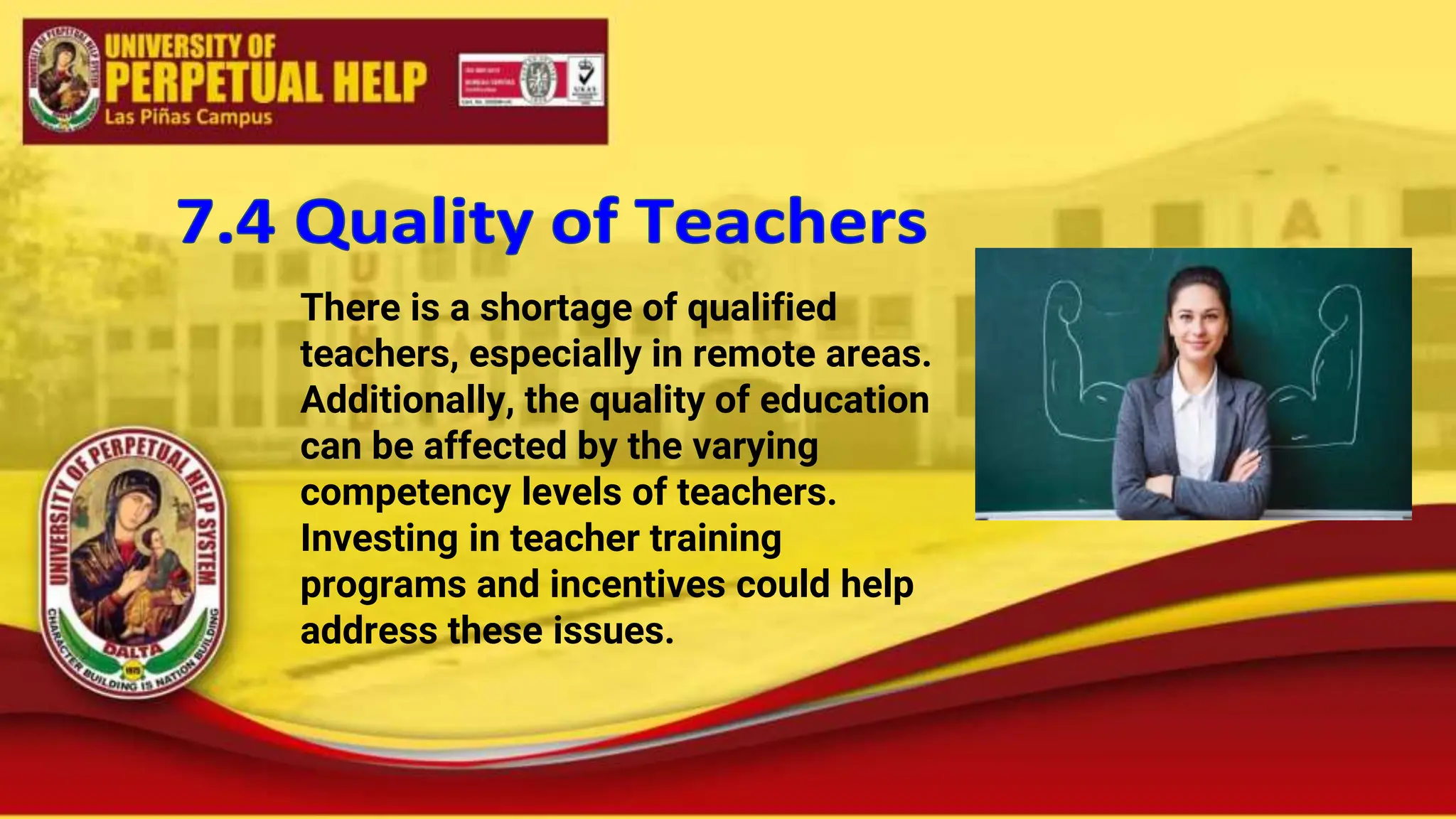
There is a shortage of qualified
teachers, especially in remote areas.
Additionally, the quality of education
can be affected by the varying
competency levels of teachers.
Investing in teacher training
programs and incentives could help
address these issues.
Findings from a new World Bank report
focusing on the East Asia and Pacific region
found that teachers in the Philippines have
one of the most ineffective methods in
Southeast Asia and teacher training
programs targeted at them have failed to
improve their mastery of content.
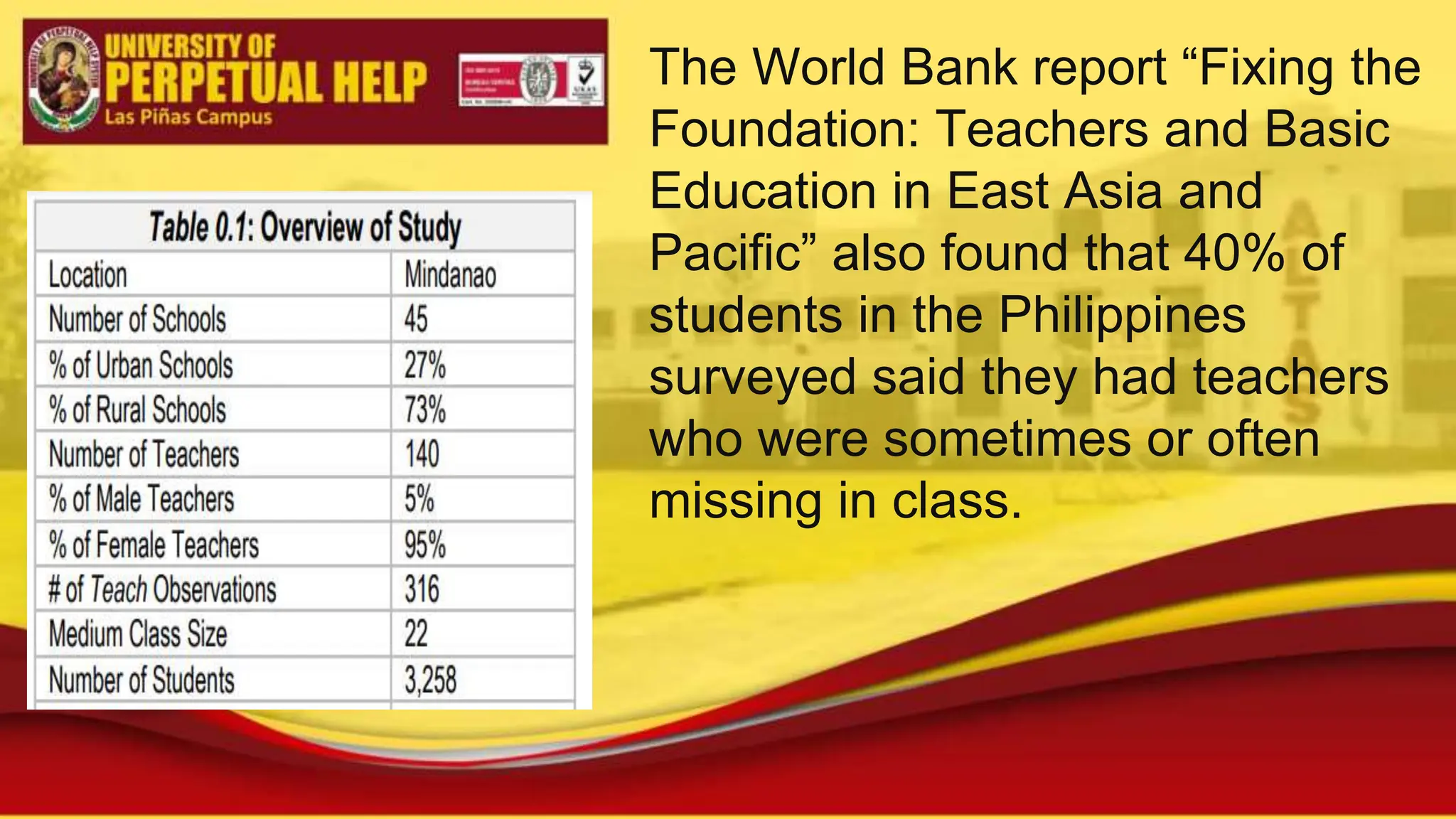
The World Bank report “Fixing the
Foundation: Teachers and Basic
Education in East Asia and
Pacific” also found that 40% of
students in the Philippines
surveyed said they had teachers
who were sometimes or often
missing in class.
In particular, the World Bank study found that 66% of teachers
observed in the Philippines had a "medium-low" use of effective
teaching practices, 19% had “low” use, and only 15% had “medium-
high” use of effective teaching practices. No share of teachers was
observed having a "high" use of effective pedagogy.
Effective teaching practice is measured by the World
Bank as "teachers’ capacity to create a classroom
culture conducive to learning, to challenge and engage
students, and to foster students’ socioemotional skills
to be successful learners."
New survey data collected for the World Bank report found that “many East
Asian and Pacific countries’ in-service training programs lack the four
elements of effective teacher training programs.”
These are the following:
● A focus on content knowledge
● opportunities to practice what is learned with colleagues
● continued support through follow-up visits focused on training
content, and
● career incentives through promotion or increased salary
Improving teachers’ skills is the first and most basic step
that countries with a high learning poverty can take, the
WB said.
The WB said that among the countries surveyed, only
14% of teacher training programs focused on subject
content compared to 81% of programs associated with
improvements in student learning globally.
REFERENCES:
https://www.britannica.com/topic/education
https://cma.org
https://www.dbm.gov.ph
https://www.rappler.com/nation/deped-report-
classroom-shortage-school-year-2023-2024/
https://www.philstar.com/headlines/2023/09/22/2298233/learning-
poverty-philippines-linked-poor-teaching-quality-world-bank-study
THANK YOU!

Issues and Concerns in Philippine Education (1).pptx

  • 5.
    Investment is definedas the commitment of current financial resources in order to achieve higher gains in the future. https://cma.org Education is a discipline that is concerned with methods of teaching and learning in schools or school-like environments www.britannica.com
  • 6.
    1. Insufficient Funding: Oneof the primary concerns is the inadequacy of funding for education. The Philippine government allocates a significant portion of its budget to education, but it may still be insufficient to meet the growing needs of the education sector.
  • 7.
    The education sector,which is composed of the Department of Education (DepEd), State Universities and Colleges (SUCs), Commission on Higher Education (CHED), and Technical Education and Skills Development Authority (TESDA) will receive an 8.2 percent increase next year at Php 852.8-Billion and will remain as being the highest budgetary priority as mandated by the Constitution. The budget of DepEd shall increase from Php 633.3-Billion in 2022 to Php 710.6- Billion in 2023. 2023 Budget in Philippine Education https://www.dbm.gov.p h
  • 9.
  • 11.
    Reality Check: Philippinesstill has one of the lowest budget allocations to education among the ASEAN countries.
  • 12.
    Country Budget perstudent AY 2022 Philippines PHP 21,000 Singapore PHP 887,435.17 Thailand 1,514,385.90 Indonesia 65,271.25
  • 15.
    2. Infrastructure andFacilities: Many schools in the Philippines, especially in rural areas, lack proper infrastructure and facilities. This includes classrooms, libraries, laboratories, and other essential amenities. Insufficient infrastructure can hinder the quality of education provided.
  • 16.
    MANILA, Philippines –The Department of Education (DepEd) said the country was short of 159,000 classrooms this coming school year which is set to start next week. This 2023-2024 school year classroom deficit is far more severe than last year’s shortage of 91,000 classrooms. Assistant Secretary Francis (August 23, 2023)
  • 17.
    DepEd’s standard classroomto student ratios are one classroom for every 35 students for primary school ,and one classroom for every 40 students for junior and senior high school. Based on this parameters, at least 50% of all 7,520 existing senior high school classrooms are congested, while 41% of all 10,188 junior high school classrooms are overcrowded. Meanwhile, 32% of all primary school (K-6) are crammed. Schools are preparing to open the school year on Tuesday, August 29. – Rappler.com
  • 18.
    3. Quality ofEducation: While access to education has improved, there are concerns about the overall quality of education. This includes outdated curriculum, inadequate teacher training, and the need for improvements in teaching methods and materials.
  • 19.
    Citing a WorldBank study, it is said that 90 percent of 10-year-old students in the country cannot read and understand a simple text. A 2018 study found that a sample number of 15-year- old Filipino students ranked last in reading comprehension out of 79 countries. They also ranked 78th in science and math. One key insight from this study is it implies those tested mostly came from public schools. Hence, the crisis also lies in the fact that a lot of Filipinos can’t read or do simple math.
  • 20.
    Ph participation in thePISA for the first time in 2018 yielded a dismal performance, ranking last in reading and second to last in Science and Mathematics among 79 participating countries and economies.
  • 21.
    Not enough textbooks havebeen getting to the hands of students since 2012 despite yearly commitments to provide enough materials for learners, data from the Department of Education shows.
  • 22.
    There is ashortage of qualified teachers, especially in remote areas. Additionally, the quality of education can be affected by the varying competency levels of teachers. Investing in teacher training programs and incentives could help address these issues.
  • 23.
    Findings from anew World Bank report focusing on the East Asia and Pacific region found that teachers in the Philippines have one of the most ineffective methods in Southeast Asia and teacher training programs targeted at them have failed to improve their mastery of content.
  • 24.
    The World Bankreport “Fixing the Foundation: Teachers and Basic Education in East Asia and Pacific” also found that 40% of students in the Philippines surveyed said they had teachers who were sometimes or often missing in class.
  • 25.
    In particular, theWorld Bank study found that 66% of teachers observed in the Philippines had a "medium-low" use of effective teaching practices, 19% had “low” use, and only 15% had “medium- high” use of effective teaching practices. No share of teachers was observed having a "high" use of effective pedagogy. Effective teaching practice is measured by the World Bank as "teachers’ capacity to create a classroom culture conducive to learning, to challenge and engage students, and to foster students’ socioemotional skills to be successful learners."
  • 27.
    New survey datacollected for the World Bank report found that “many East Asian and Pacific countries’ in-service training programs lack the four elements of effective teacher training programs.” These are the following: ● A focus on content knowledge ● opportunities to practice what is learned with colleagues ● continued support through follow-up visits focused on training content, and ● career incentives through promotion or increased salary
  • 28.
    Improving teachers’ skillsis the first and most basic step that countries with a high learning poverty can take, the WB said. The WB said that among the countries surveyed, only 14% of teacher training programs focused on subject content compared to 81% of programs associated with improvements in student learning globally.
  • 30.
  • 31.