Teaching as Inquiry
Turning classroom experience into
classroom expertise
Workshop aims
• To develop an understanding of the ‘teaching
as inquiry’ framework
• To discuss and plan a teacher inquiry into:
‘How can my students and I successfully
develop our understandings and practice of
the ‘Thinking Competency’? (example)
Inquiry into the ‘teaching – learning’
relationship is the basis of effective
pedagogy.
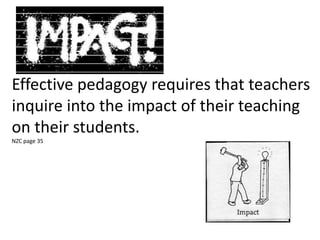
Effective pedagogy requires that teachers
inquire into the impact of their teaching
on their students.
NZC page 35
Teaching as Inquiry
Pages 34 & 35
Discuss our understandings
‘Teaching as Inquiry’ will stimulate
teachers to look closely at their
practice with a view to improving
teaching and learning.
Read and discuss
Case studies
‘Teaching as Inquiry’ challenges teachers to
• Articulate their beliefs
• Adopt an inquiry stance
• Participate in professional conversations based on
teaching and learning
• Ask the real questions -
"What are the next steps for learning?"
"Is there something I need to change?”
Are you up for the ?
You will
• Identify the needs of your students (how?)
• Collect and synthesise data
• Plan your inquiry
• Seek and analyse data and evidence to inform
of change
• Accept feedback (colleagues & students) and
act on it
• Share your findings and the outcomes
It’s about improving competence …
not proving competence
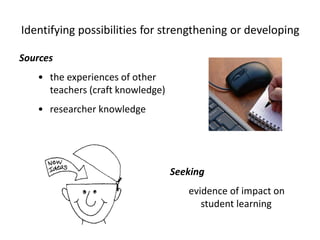
Identifying possibilities for strengthening or developing
Sources
• the experiences of other
teachers (craft knowledge)
• researcher knowledge
Seeking
evidence of impact on
student learning
Posing questions about
• outcomes
• alignment
• engagement
• success
Collection of high quality evidence
• student achievement data
• teacher documentation
• classroom observation
• Student voice
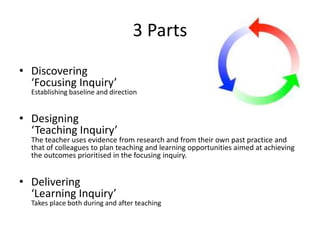
3 Parts
• Discovering
‘Focusing Inquiry’
Establishing baseline and direction
• Designing
‘Teaching Inquiry’
The teacher uses evidence from research and from their own past practice and
that of colleagues to plan teaching and learning opportunities aimed at achieving
the outcomes prioritised in the focusing inquiry.
• Delivering
‘Learning Inquiry’
Takes place both during and after teaching
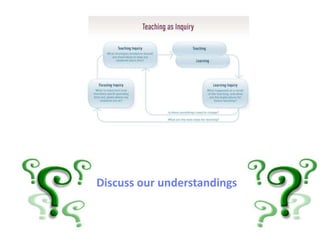
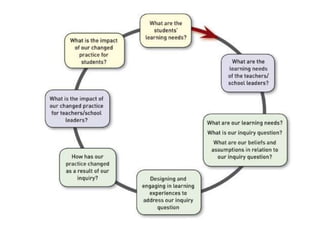
Inquiry into the teaching–learning relationship
can be visualised as a cyclical process that goes
on moment by moment (as teaching takes
place), day by day, and over the longer term.
In this process, the teacher asks:
Discover:
What is important (and therefore worth
spending time on), given where my
students are at?
This focusing inquiry establishes
a baseline and a direction. The
teacher uses all available information
to determine what their students
have already learned and what they
need to learn next. (NZC, p.35)
Design:
What strategies (evidence-based) are most
likely to help my students learn this?
In this teaching inquiry, the teacher uses
evidence from research and from their own past
practice and that of colleagues to plan teaching and
learning opportunities aimed at achieving the
outcomes prioritised in the focusing inquiry.
Deliver:
What happened as a result of the
teaching, and what are the implications
for future teaching?
In this learning inquiry, the teacher:
• Puts ideas into practice (embedded in authentic learning experiences)
• Monitors and reflects - Investigates the success of
the teaching in terms of the prioritised outcomes
• Uses a range of assessment approaches (short
term and long term)
• Analyses and interpret the information to
consider what they should do next.
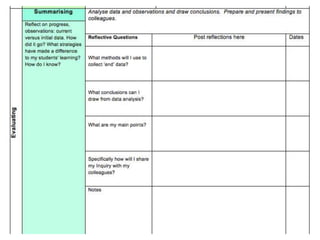
Evaluating
• Summarise -reflect on progress, observations,
current vs initial data. How did it go? What
strategies have made a difference to my
students' learning?
• Provide evidence
• What will you do now? Present findings to
colleagues, principal, BOT
How might professional learning
underpinned by ‘teaching as
inquiry’ be the same/different to
approaches that we currently use?
Discuss
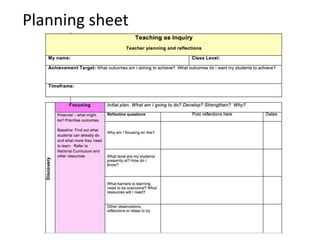
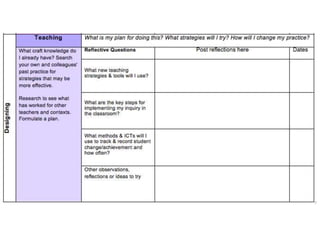
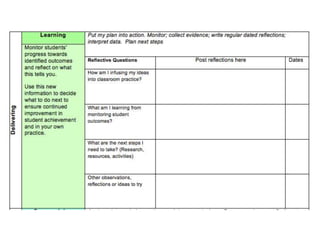
Planning sheet
Reflective blog or wiki
• How could this be used?
• What could we put on it?
• Why and when will we add to it?
• What will happen then?
Discuss
‘How can my students and I successfully
develop our understandings and practice
of the ‘Thinking Competency’?
Brainstorm ideas in
syndicate groups
References & acknowledgements
New Zealand Curriculum Online: Teaching as Inquiry
Alton-Lee (2003) Quality Teaching for Diverse Students in Schooling: Best Evidence
Synthesis Iteration [BES]
Ministry of Education (2007) The New Zealand Curriculum. Wellington: Learning
Media
Graeme Aitken, Dean of Education, University of Auckland
David Reardon – Russell Street School
Rochelle Jenson

Teaching as Inquiry

  • 1.
    Teaching as Inquiry Turningclassroom experience into classroom expertise
  • 2.
    Workshop aims • Todevelop an understanding of the ‘teaching as inquiry’ framework • To discuss and plan a teacher inquiry into: ‘How can my students and I successfully develop our understandings and practice of the ‘Thinking Competency’? (example)
  • 3.
    Inquiry into the‘teaching – learning’ relationship is the basis of effective pedagogy.
  • 4.
    Effective pedagogy requiresthat teachers inquire into the impact of their teaching on their students. NZC page 35
  • 5.
  • 6.
  • 7.
    ‘Teaching as Inquiry’will stimulate teachers to look closely at their practice with a view to improving teaching and learning.
  • 8.
  • 9.
    ‘Teaching as Inquiry’challenges teachers to • Articulate their beliefs • Adopt an inquiry stance • Participate in professional conversations based on teaching and learning • Ask the real questions - "What are the next steps for learning?" "Is there something I need to change?” Are you up for the ?
  • 10.
    You will • Identifythe needs of your students (how?) • Collect and synthesise data • Plan your inquiry • Seek and analyse data and evidence to inform of change • Accept feedback (colleagues & students) and act on it • Share your findings and the outcomes
  • 11.
    It’s about improvingcompetence … not proving competence
  • 13.
    Identifying possibilities forstrengthening or developing Sources • the experiences of other teachers (craft knowledge) • researcher knowledge Seeking evidence of impact on student learning
  • 14.
    Posing questions about •outcomes • alignment • engagement • success Collection of high quality evidence • student achievement data • teacher documentation • classroom observation • Student voice
  • 15.
    3 Parts • Discovering ‘FocusingInquiry’ Establishing baseline and direction • Designing ‘Teaching Inquiry’ The teacher uses evidence from research and from their own past practice and that of colleagues to plan teaching and learning opportunities aimed at achieving the outcomes prioritised in the focusing inquiry. • Delivering ‘Learning Inquiry’ Takes place both during and after teaching
  • 16.
    Inquiry into theteaching–learning relationship can be visualised as a cyclical process that goes on moment by moment (as teaching takes place), day by day, and over the longer term. In this process, the teacher asks:
  • 17.
    Discover: What is important(and therefore worth spending time on), given where my students are at? This focusing inquiry establishes a baseline and a direction. The teacher uses all available information to determine what their students have already learned and what they need to learn next. (NZC, p.35)
  • 18.
    Design: What strategies (evidence-based)are most likely to help my students learn this? In this teaching inquiry, the teacher uses evidence from research and from their own past practice and that of colleagues to plan teaching and learning opportunities aimed at achieving the outcomes prioritised in the focusing inquiry.
  • 19.
    Deliver: What happened asa result of the teaching, and what are the implications for future teaching? In this learning inquiry, the teacher: • Puts ideas into practice (embedded in authentic learning experiences) • Monitors and reflects - Investigates the success of the teaching in terms of the prioritised outcomes • Uses a range of assessment approaches (short term and long term) • Analyses and interpret the information to consider what they should do next.
  • 20.
    Evaluating • Summarise -reflecton progress, observations, current vs initial data. How did it go? What strategies have made a difference to my students' learning? • Provide evidence • What will you do now? Present findings to colleagues, principal, BOT
  • 21.
    How might professionallearning underpinned by ‘teaching as inquiry’ be the same/different to approaches that we currently use? Discuss
  • 22.
  • 26.
    Reflective blog orwiki • How could this be used? • What could we put on it? • Why and when will we add to it? • What will happen then? Discuss
  • 27.
    ‘How can mystudents and I successfully develop our understandings and practice of the ‘Thinking Competency’? Brainstorm ideas in syndicate groups
  • 29.
    References & acknowledgements NewZealand Curriculum Online: Teaching as Inquiry Alton-Lee (2003) Quality Teaching for Diverse Students in Schooling: Best Evidence Synthesis Iteration [BES] Ministry of Education (2007) The New Zealand Curriculum. Wellington: Learning Media Graeme Aitken, Dean of Education, University of Auckland David Reardon – Russell Street School Rochelle Jenson

Editor's Notes

  • #7 What do we understand by ‘Teaching as Inquiry’? - Share ideas with a partner. Share commonalities back to the group. Discuss the ways we currently incorporate ‘teaching as inquiry’ into our practice.