Inquiry
Techniques
Dr. Maham Saddique
Inquiry Techniques in Study
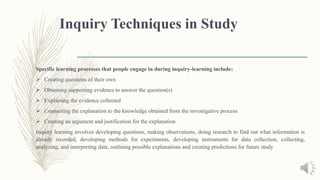
Specific learning processes that people engage in during inquiry-learning include:
 Creating questions of their own
 Obtaining supporting evidence to answer the question(s)
 Explaining the evidence collected
 Connecting the explanation to the knowledge obtained from the investigative process
 Creating an argument and justification for the explanation
Inquiry learning involves developing questions, making observations, doing research to find out what information is
already recorded, developing methods for experiments, developing instruments for data collection, collecting,
analyzing, and interpreting data, outlining possible explanations and creating predictions for future study
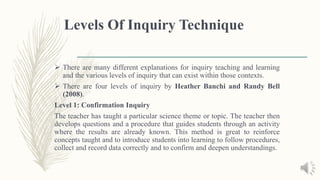
Levels Of Inquiry Technique
 There are many different explanations for inquiry teaching and learning
and the various levels of inquiry that can exist within those contexts.
 There are four levels of inquiry by Heather Banchi and Randy Bell
(2008).
Level 1: Confirmation Inquiry
The teacher has taught a particular science theme or topic. The teacher then
develops questions and a procedure that guides students through an activity
where the results are already known. This method is great to reinforce
concepts taught and to introduce students into learning to follow procedures,
collect and record data correctly and to confirm and deepen understandings.
Levels Of Inquiry Technique
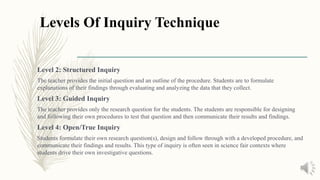
Level 2: Structured Inquiry
The teacher provides the initial question and an outline of the procedure. Students are to formulate
explanations of their findings through evaluating and analyzing the data that they collect.
Level 3: Guided Inquiry
The teacher provides only the research question for the students. The students are responsible for designing
and following their own procedures to test that question and then communicate their results and findings.
Level 4: Open/True Inquiry
Students formulate their own research question(s), design and follow through with a developed procedure, and
communicate their findings and results. This type of inquiry is often seen in science fair contexts where
students drive their own investigative questions.
Banchi and Bell (2008) explain that teachers should begin their
inquiry instruction at the lower levels and work their way to open
inquiry in order to effectively develop students' inquiry skills. Open
inquiry activities are only successful if students are motivated by
intrinsic interests and if they are equipped with the skills to conduct
their own research study.
Open/true inquiry learning
 An important aspect of inquiry-based learning is the use of open learning, as evidence suggests that
only utilizing lower level inquiry is not enough to develop critical and scientific thinking to the full
potential.
 Open learning has no prescribed target or result that people have to achieve. There is an emphasis on
the individual manipulating information and creating meaning from a set of given materials or
circumstances.
 In many conventional and structured learning environments, people are told what the outcome is
expected to be, and then they are simply expected to 'confirm' or show evidence that this is the case.
Open learning has many benefits.
1. It means students do not simply perform experiments in a routine like fashion, but actually think
about the results they collect and what they mean.
2. With traditional non-open lessons there is a tendency for students to say that the experiment 'went
wrong' when they collect results contrary to what they are told to expect.
3. In open learning there are no wrong results, and students have to evaluate the strengths and
weaknesses of the results they collect themselves and decide their value.
Inquisitive Learning
Sociologist of education Phillip Brown defined inquisitive learning as learning that
is intrinsically motivated (e.g. by curiosity and interest in knowledge for its own
sake), as opposed to acquisitive learning that is extrinsically motivated (e.g. by
acquiring high scores on examinations to earn credentials). However, occasionally
the term inquisitive learning is simply used as a synonym for inquiry-based
learning.
Inquiry-based learning in academic
disciplines
Inquiry learning in science education
Brief History
 Inquiry learning has been used as a teaching and learning tool for thousands of years,
however, the use of inquiry within public education has a much briefer history.
 Ancient Greek and Roman educational philosophies focused much more on the art of
agricultural and domestic skills for the middle class and oratory for the wealthy upper class.
 It was not until the Enlightenment, or the Age of Reason, during the late 17th and 18th century
that the subject of Science was considered a respectable academic body of knowledge.
 Up until the 1900s the study of science within education had a primary focus on memorizing
and organizing facts.
 John Dewey, a well-known philosopher of education at the beginning of the 20th
century, was the first to criticize the fact that science education was not taught in
a way to develop young scientific thinkers.
 Dewey proposed that science should be taught as a process and way of thinking –
not as a subject with facts to be memorized. While Dewey was the first to draw
attention to this issue, much of the reform within science education followed the
lifelong work and efforts of Joseph Schwab.
 Joseph Schwab was an educator who proposed that science did not need to be a
process for identifying stable truths about the world that we live in, but rather
science could be a flexible and multi-directional inquiry driven process of
thinking and learning. Schwab believed that science in the classroom should more
closely reflect the work of practicing scientists. Schwab developed three levels of
open inquiry that align with the breakdown of inquiry processes that we see today
The graduated levels of scientific inquiry
by Schwab
 Schwab demonstrate that students need to develop thinking skills and strategies
prior to being exposed to higher levels of inquiry. Effectively, these skills need to
be scaffolded by the teacher or instructor until students are able to develop
questions, methods, and conclusions on their own.
 A catalyst for reform within North American science education was the 1957
launch of Sputnik, the Soviet Union satellite. This historical scientific
breakthrough caused a great deal of concern around the science and technology
education the American students were receiving.
 In 1958 the U.S. congress developed and passed the National Defense Education
Act in order to provide math and science teachers with adequate teaching
materials.
America's National Science Education
Standards (NSES)
America's National Science Education Standards (NSES) (1996) outlines six important aspects
pivotal to inquiry learning in science education.
1. Students should be able to recognize that science is more than memorizing and knowing facts.
2. Students should have the opportunity to develop new knowledge that builds on their prior
knowledge and scientific ideas.
3. Students will develop new knowledge by restructuring their previous understandings of
scientific concepts and adding new information learned.
4. Learning is influenced by students' social environment whereby they have an opportunity to
learn from each other.
5. Students will take control of their learning.
6. The extent to which students are able to learn with deep understanding will influence how
transferable their new knowledge is to real life contexts.

Inquiry Techniques used in bachelor.ppsx

  • 1.
  • 2.
    Inquiry Techniques inStudy Specific learning processes that people engage in during inquiry-learning include:  Creating questions of their own  Obtaining supporting evidence to answer the question(s)  Explaining the evidence collected  Connecting the explanation to the knowledge obtained from the investigative process  Creating an argument and justification for the explanation Inquiry learning involves developing questions, making observations, doing research to find out what information is already recorded, developing methods for experiments, developing instruments for data collection, collecting, analyzing, and interpreting data, outlining possible explanations and creating predictions for future study
  • 3.
    Levels Of InquiryTechnique  There are many different explanations for inquiry teaching and learning and the various levels of inquiry that can exist within those contexts.  There are four levels of inquiry by Heather Banchi and Randy Bell (2008). Level 1: Confirmation Inquiry The teacher has taught a particular science theme or topic. The teacher then develops questions and a procedure that guides students through an activity where the results are already known. This method is great to reinforce concepts taught and to introduce students into learning to follow procedures, collect and record data correctly and to confirm and deepen understandings.
  • 4.
    Levels Of InquiryTechnique Level 2: Structured Inquiry The teacher provides the initial question and an outline of the procedure. Students are to formulate explanations of their findings through evaluating and analyzing the data that they collect. Level 3: Guided Inquiry The teacher provides only the research question for the students. The students are responsible for designing and following their own procedures to test that question and then communicate their results and findings. Level 4: Open/True Inquiry Students formulate their own research question(s), design and follow through with a developed procedure, and communicate their findings and results. This type of inquiry is often seen in science fair contexts where students drive their own investigative questions.
  • 5.
    Banchi and Bell(2008) explain that teachers should begin their inquiry instruction at the lower levels and work their way to open inquiry in order to effectively develop students' inquiry skills. Open inquiry activities are only successful if students are motivated by intrinsic interests and if they are equipped with the skills to conduct their own research study.
  • 6.
    Open/true inquiry learning An important aspect of inquiry-based learning is the use of open learning, as evidence suggests that only utilizing lower level inquiry is not enough to develop critical and scientific thinking to the full potential.  Open learning has no prescribed target or result that people have to achieve. There is an emphasis on the individual manipulating information and creating meaning from a set of given materials or circumstances.  In many conventional and structured learning environments, people are told what the outcome is expected to be, and then they are simply expected to 'confirm' or show evidence that this is the case. Open learning has many benefits. 1. It means students do not simply perform experiments in a routine like fashion, but actually think about the results they collect and what they mean. 2. With traditional non-open lessons there is a tendency for students to say that the experiment 'went wrong' when they collect results contrary to what they are told to expect. 3. In open learning there are no wrong results, and students have to evaluate the strengths and weaknesses of the results they collect themselves and decide their value.
  • 7.
    Inquisitive Learning Sociologist ofeducation Phillip Brown defined inquisitive learning as learning that is intrinsically motivated (e.g. by curiosity and interest in knowledge for its own sake), as opposed to acquisitive learning that is extrinsically motivated (e.g. by acquiring high scores on examinations to earn credentials). However, occasionally the term inquisitive learning is simply used as a synonym for inquiry-based learning.
  • 8.
    Inquiry-based learning inacademic disciplines Inquiry learning in science education Brief History  Inquiry learning has been used as a teaching and learning tool for thousands of years, however, the use of inquiry within public education has a much briefer history.  Ancient Greek and Roman educational philosophies focused much more on the art of agricultural and domestic skills for the middle class and oratory for the wealthy upper class.  It was not until the Enlightenment, or the Age of Reason, during the late 17th and 18th century that the subject of Science was considered a respectable academic body of knowledge.  Up until the 1900s the study of science within education had a primary focus on memorizing and organizing facts.
  • 9.
     John Dewey,a well-known philosopher of education at the beginning of the 20th century, was the first to criticize the fact that science education was not taught in a way to develop young scientific thinkers.  Dewey proposed that science should be taught as a process and way of thinking – not as a subject with facts to be memorized. While Dewey was the first to draw attention to this issue, much of the reform within science education followed the lifelong work and efforts of Joseph Schwab.  Joseph Schwab was an educator who proposed that science did not need to be a process for identifying stable truths about the world that we live in, but rather science could be a flexible and multi-directional inquiry driven process of thinking and learning. Schwab believed that science in the classroom should more closely reflect the work of practicing scientists. Schwab developed three levels of open inquiry that align with the breakdown of inquiry processes that we see today
  • 10.
    The graduated levelsof scientific inquiry by Schwab  Schwab demonstrate that students need to develop thinking skills and strategies prior to being exposed to higher levels of inquiry. Effectively, these skills need to be scaffolded by the teacher or instructor until students are able to develop questions, methods, and conclusions on their own.  A catalyst for reform within North American science education was the 1957 launch of Sputnik, the Soviet Union satellite. This historical scientific breakthrough caused a great deal of concern around the science and technology education the American students were receiving.  In 1958 the U.S. congress developed and passed the National Defense Education Act in order to provide math and science teachers with adequate teaching materials.
  • 11.
    America's National ScienceEducation Standards (NSES) America's National Science Education Standards (NSES) (1996) outlines six important aspects pivotal to inquiry learning in science education. 1. Students should be able to recognize that science is more than memorizing and knowing facts. 2. Students should have the opportunity to develop new knowledge that builds on their prior knowledge and scientific ideas. 3. Students will develop new knowledge by restructuring their previous understandings of scientific concepts and adding new information learned. 4. Learning is influenced by students' social environment whereby they have an opportunity to learn from each other. 5. Students will take control of their learning. 6. The extent to which students are able to learn with deep understanding will influence how transferable their new knowledge is to real life contexts.