Assessing Science
Inquiry
Science inquiryis a process of exploring the natural world through
observation, questioning, experimentation, and analysis. Assessing
science inquiry involves evaluating students' abilities to engage in this
process and apply their knowledge to real-world scenarios.
MI
by Ma Izabel
2.
What is ScienceInquiry?
1 Active Learning
Science inquiry is an active
learning process that
encourages students to ask
questions, make
observations, and draw
conclusions.
2 Critical Thinking
It involves developing
critical thinking skills, such
as problem-solving,
analysis, and interpretation.
3 Real-World Connections
Science inquiry connects classroom learning to real-world
applications and promotes a deeper understanding of scientific
concepts.
3.
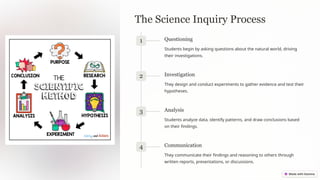
The Science InquiryProcess
1 Questioning
Students begin by asking questions about the natural world, driving
their investigations.
2 Investigation
They design and conduct experiments to gather evidence and test their
hypotheses.
3 Analysis
Students analyze data, identify patterns, and draw conclusions based
on their findings.
4 Communication
They communicate their findings and reasoning to others through
written reports, presentations, or discussions.
4.
Purposes of AssessingScience Inquiry
Identify Strengths and
Weaknesses
Assessments help teachers
understand students' strengths and
areas for improvement in the science
inquiry process.
Provide Feedback
Assessments offer opportunities to
provide targeted feedback to
students, supporting their learning
and development.
Guide Instruction
Assessment data helps inform
instructional decisions, ensuring that
instruction aligns with students'
needs and learning objectives.
5.
Formative Assessment Strategies
Observation
Teachersobserve students as they
engage in science inquiry activities,
noting their questions, procedures,
and reasoning.
Questioning
Teachers ask open-ended
questions to assess students'
understanding, reasoning, and
problem-solving abilities.
Exit Tickets
Students complete short, focused
tasks at the end of a lesson to
demonstrate their understanding
and identify areas for further
support.
6.
Summative Assessment
Techniques
Type Description
ScienceFair Project Students design, conduct, and
present an independent research
project.
Lab Reports Students document their
experimental procedures, data
analysis, and conclusions in a
formal written report.
Performance Tasks Students demonstrate their
understanding of scientific
concepts through hands-on
activities, simulations, or role-
playing.
7.
Rubrics for EvaluatingScience Inquiry
Establish Criteria
Rubrics clearly define the criteria for
successful science inquiry, such as
questioning, investigation, analysis,
and communication.
Define Levels of Achievement
They outline different levels of
achievement for each criterion,
providing a framework for evaluating
student work.
Provide Feedback
Rubrics help teachers provide specific
and constructive feedback to
students, highlighting their strengths
and areas for growth.
8.
Providing Feedback andGuidance
Specific and Timely
Feedback should be specific, focused
on the criteria, and provided in a timely
manner to support learning.
Growth Mindset
Guidance should foster a growth
mindset, encouraging students to
learn from mistakes and strive for
improvement.
Differentiated Support
Provide differentiated support based
on students' individual needs, helping
them reach their full potential.
9.
Continuous Improvement of
Assessments
1Data Analysis
Regularly analyze
assessment data to identify
patterns and trends in
student performance.
2 Feedback Collection
Seek feedback from
students, colleagues, and
stakeholders to improve
assessment practices.
3 Professional Development
Engage in professional development opportunities to stay
updated on current assessment strategies and best practices.
10.
Difference and Planning
assessmentfor Learning, as
learning and of learning
Assessment for Learning
This type of assessment is
used to inform teaching and
learning, providing ongoing
feedback and guidance to
students.
Assessment as Learning
Students are actively involved
in self-assessment, reflecting
on their learning and
identifying areas for
improvement.
Assessment of Learning
This type of assessment measures student learning at the end of a
unit or course to evaluate their progress and understanding.