Company
LOGO
CONDUCTING AN
ACTION RESEARCH
Lilian B. Salan
ICT Coordinator
Balingasag Central School
Action Research Defined:
• According to Richard A. Schmuck (1997)
Action research is a model of
professional development where educators
study student learning related to their own
teaching a process that allows to learn about
their own instructional practices and to
continue to monitor improved student learning.
Action Research Defined:
• Conducting action research provides
educators with an avenue to reflect on
one’s own teaching practices and
engage in self-directed learning with
the ultimate goal of improving student
learning.
• Action research is a natural extension
of good teaching.
Action Research Defined:
analyzing their needs
adjusting the curriculum
Important skills demonstrated by fine
teachers.
observing closely
• Action Research is a process through
which teachers collaborate in evaluating
practice, try out new strategies, and record
their work in a form that is understandable
by other teachers.
Action Research Defined:
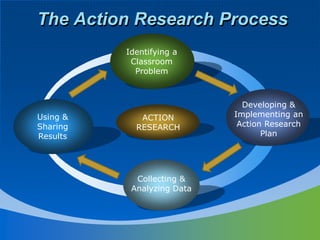
The Action Research Process
ACTION
RESEARCH
Identifying a
Classroom
Problem
Developing &
Implementing an
Action Research
Plan
Using &
Sharing
Results
Collecting &
Analyzing Data
The Action Research Process
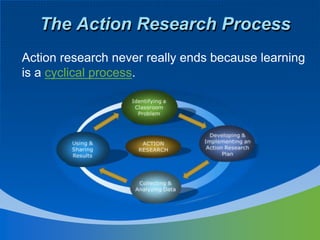
Action research never really ends because learning
is a cyclical process.
The Action Research Process
An action researcher is always observing,
analyzing, designing, assessing and
adjusting.
The cyclical nature of action research
provides teachers with ongoing opportunities
to reflect on and refine their own teaching -
practices.
The Phases of Action Research
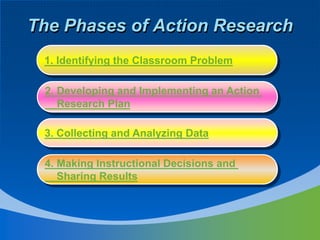
1. Identifying the Classroom Problem
2. Developing and Implementing an Action
Research Plan
3. Collecting and Analyzing Data
4. Making Instructional Decisions and
Sharing Results
The Phases of Action Research
To begin the action research process, teachers
must first observe, questions and reflect on the
actual current situation in order to investigate the
classroom concerns.
- Beginning the Action Research Process
This activity five probing statements to guide this
initial phased of action research.
1. Identifying the Classroom Problem
The Phases of Action Research
After completing this activity, choose one concern
that is most important for the learners, that is a
priority learning need, and that can produce positive
results. Select target you can impact that aligned
with the curricular standards.
The problem statement will become the framework
of the action research.
1. Identifying the Classroom Problem
The Phases of Action Research
According to Hubbard and Power (1999)
Before engaging in the “research” of action
research, it is helpful to outline actions by
answering the “What” the “How” and the “When”
2. Developing and Implementing an Action
Research Plan
The Phases of Action Research
Describe the action research plan as a kind of
backbone for the study – skeletal frame on which to
hang all emerging thought about the research
question, data collection, and how to sustain the
research.
Consider different instructional approaches geared
towards meeting learners’ instructional goal.
2. Developing and Implementing an Action
Research Plan
The Phases of Action Research
In order to build a complete picture of learners’
learning abilities, data should be gathered from any
sources of information.
In research terminology, the process of collecting
multiple sources of data for every problem or issue
being studied is called triangulation. (Sagor 1992)
3. Collecting and Analyzing Data
The Phases of Action Research
Examples of classroom data collection tools include
but not limited to:
• Observation (checklists, anecdotal records,
charts/grid), interviews and conversations,
learners’ work, grades, reports cards, cumulative
records and test.
3. Collecting and Analyzing Data
The Phases of Action Research
After planning, teaching and collecting data, it is
very important to follow through by analyzing the
results of the action research and making
instructional decisions based on your findings.
“Where do I go next?”
4. Making Instructional Decisions and
Sharing Results
The Phases of Action Research
Once the learners meet the instructional goals
identified on the action research plan, it is time to
Share and Reports Results.
4. Making Instructional Decisions and
Sharing Results
Are you ready to take off for the
ACTION RESEARCH flight?

Guide in Conducting an Action Research

  • 1.
    Company LOGO CONDUCTING AN ACTION RESEARCH LilianB. Salan ICT Coordinator Balingasag Central School
  • 3.
    Action Research Defined: •According to Richard A. Schmuck (1997) Action research is a model of professional development where educators study student learning related to their own teaching a process that allows to learn about their own instructional practices and to continue to monitor improved student learning.
  • 4.
    Action Research Defined: •Conducting action research provides educators with an avenue to reflect on one’s own teaching practices and engage in self-directed learning with the ultimate goal of improving student learning.
  • 5.
    • Action researchis a natural extension of good teaching. Action Research Defined: analyzing their needs adjusting the curriculum Important skills demonstrated by fine teachers. observing closely
  • 6.
    • Action Researchis a process through which teachers collaborate in evaluating practice, try out new strategies, and record their work in a form that is understandable by other teachers. Action Research Defined:
  • 7.
    The Action ResearchProcess ACTION RESEARCH Identifying a Classroom Problem Developing & Implementing an Action Research Plan Using & Sharing Results Collecting & Analyzing Data
  • 8.
    The Action ResearchProcess Action research never really ends because learning is a cyclical process.
  • 9.
    The Action ResearchProcess An action researcher is always observing, analyzing, designing, assessing and adjusting. The cyclical nature of action research provides teachers with ongoing opportunities to reflect on and refine their own teaching - practices.
  • 10.
    The Phases ofAction Research 1. Identifying the Classroom Problem 2. Developing and Implementing an Action Research Plan 3. Collecting and Analyzing Data 4. Making Instructional Decisions and Sharing Results
  • 11.
    The Phases ofAction Research To begin the action research process, teachers must first observe, questions and reflect on the actual current situation in order to investigate the classroom concerns. - Beginning the Action Research Process This activity five probing statements to guide this initial phased of action research. 1. Identifying the Classroom Problem
  • 12.
    The Phases ofAction Research After completing this activity, choose one concern that is most important for the learners, that is a priority learning need, and that can produce positive results. Select target you can impact that aligned with the curricular standards. The problem statement will become the framework of the action research. 1. Identifying the Classroom Problem
  • 13.
    The Phases ofAction Research According to Hubbard and Power (1999) Before engaging in the “research” of action research, it is helpful to outline actions by answering the “What” the “How” and the “When” 2. Developing and Implementing an Action Research Plan
  • 14.
    The Phases ofAction Research Describe the action research plan as a kind of backbone for the study – skeletal frame on which to hang all emerging thought about the research question, data collection, and how to sustain the research. Consider different instructional approaches geared towards meeting learners’ instructional goal. 2. Developing and Implementing an Action Research Plan
  • 15.
    The Phases ofAction Research In order to build a complete picture of learners’ learning abilities, data should be gathered from any sources of information. In research terminology, the process of collecting multiple sources of data for every problem or issue being studied is called triangulation. (Sagor 1992) 3. Collecting and Analyzing Data
  • 16.
    The Phases ofAction Research Examples of classroom data collection tools include but not limited to: • Observation (checklists, anecdotal records, charts/grid), interviews and conversations, learners’ work, grades, reports cards, cumulative records and test. 3. Collecting and Analyzing Data
  • 17.
    The Phases ofAction Research After planning, teaching and collecting data, it is very important to follow through by analyzing the results of the action research and making instructional decisions based on your findings. “Where do I go next?” 4. Making Instructional Decisions and Sharing Results
  • 18.
    The Phases ofAction Research Once the learners meet the instructional goals identified on the action research plan, it is time to Share and Reports Results. 4. Making Instructional Decisions and Sharing Results
  • 19.
    Are you readyto take off for the ACTION RESEARCH flight?