8/14/2013 1Sakharkar Mohammad Anzar
• Some of the common ceramic materials are those in
which there are equal numbers of cations and anions.
• These are often referred to as AB compounds, where
A denotes the cation and B the anion.
• There are several different crystal structures for AB
compounds; each is normally named after a common
material that assumes the particular structure.
8/14/2013 2Sakharkar Mohammad Anzar
PbO
• Lead oxide has two polymorphs,
– a red (tetragonal) form prepared by heating Pb02 in air to
5500C.
– and a yellow (orthorhombic) form made by heating Pb02 to
6500C or by rapidly cooling molten PbO.
• Tetragonal PbO has the layer structure in which the metal
atom is bonded to 4 oxygen atoms which are arranged in a
square to one side of it, with the lone pair of electrons
presumably occupying the apex of the tetragonal pyramid.
• It has not proved possible to locate the oxygen atoms in the
yellow form of PbO by X-ray diffraction, but their positions
have been determined by neutron diffraction
8/14/2013 3Sakharkar Mohammad Anzar
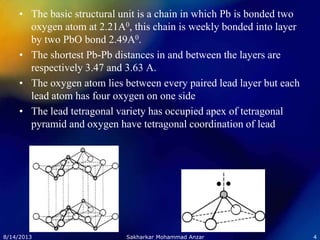
• The basic structural unit is a chain in which Pb is bonded two
oxygen atom at 2.21A0, this chain is weekly bonded into layer
by two PbO bond 2.49A0.
• The shortest Pb-Pb distances in and between the layers are
respectively 3.47 and 3.63 A.
• The oxygen atom lies between every paired lead layer but each
lead atom has four oxygen on one side
• The lead tetragonal variety has occupied apex of tetragonal
pyramid and oxygen have tetragonal coordination of lead
8/14/2013 4Sakharkar Mohammad Anzar
Structure of AB2 type
• In these type of compound Cation A is
one and anion is two.
• Some examples:
– CaC2
– β- Crystobalite
8/14/2013 5Sakharkar Mohammad Anzar
β-cristobalite
• Fluoride and oxidize of AB2 type distrintic ionic crystalline in
structure which can be determine by size consider there are five basic
structure AB2 mainly Flouride, Rutile CaI2, CaC2 and β- cristobalite.
• Geometry of anion around the cation determine by crystal structure
• B-cristallobite is named after one of the mineral forms silicon SiO2
• Silicon itself crystallizes with the same structure as diamond its
normal oxide SiO2
• Silicon occur in three forms:
– Low quartz is stable at 8700C
– Tridymide---- 872-14700
– B-cristobalite—1470-17300C
8/14/2013 6Sakharkar Mohammad Anzar
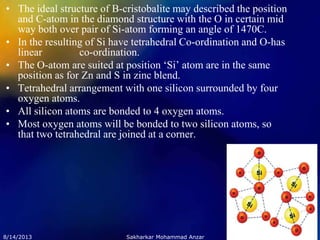
• The ideal structure of B-cristobalite may described the position
and C-atom in the diamond structure with the O in certain mid
way both over pair of Si-atom forming an angle of 1470C.
• In the resulting of Si have tetrahedral Co-ordination and O-has
linear co-ordination.
• The O-atom are suited at position ‘Si’ atom are in the same
position as for Zn and S in zinc blend.
• Tetrahedral arrangement with one silicon surrounded by four
oxygen atoms.
• All silicon atoms are bonded to 4 oxygen atoms.
• Most oxygen atoms will be bonded to two silicon atoms, so
that two tetrahedral are joined at a corner.
8/14/2013 7Sakharkar Mohammad Anzar
CaC2
• CaC2 according to the type of Cx
n- ion present in system using crystal
in two types:
– These containing distinct which carbon atom e.g Al4C3, Be2C.
– Thus in which C2
2- ion very distinct with this structure has selected
illustrated that the structure of one compound can be related which
has different stiochiometric can have same type of structure
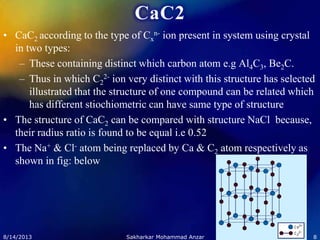
• The structure of CaC2 can be compared with structure NaCl because,
their radius ratio is found to be equal i.e 0.52
• The Na+ & Cl- atom being replaced by Ca & C2 atom respectively as
shown in fig: below
8/14/2013 8Sakharkar Mohammad Anzar
•Ca ion is surrounded by six carbide ion which lies at six corners of
regular octahedron, while each carbide ion is surrounded by six Ca
ion.
•The symmetry have dropped going to the parallel alignment of
anion.
•The carbon are associated in pairs
Two forms FeS2 where
Iron pyrite
Marcosites
•In this two structure however the two unit do not allow themselves
to parallel.
•Crystalline CaC2 structure are not salt like alkali earth carbide i.e
CaC2.
8/14/2013 9Sakharkar Mohammad Anzar
Structure of A2B3
• There Two cation and three anions in
these type of compound.
• Some examples are:
– Bi2O3
– BiTe3
– CrO3
• They are also known as sesquioxide.
8/14/2013 10Sakharkar Mohammad Anzar
Cr2O3
• Ionic sesquioxide can be divided into two way:
– One with corundum structure which is adopted by d-block
element A&C rare earth oxide generally Ln and Ac shows
A & C rare earth oxide.
– Ionic A2B3 Bond are illustrated by sequenced d-block
transition metal which crystallizes into corundum structure
And A&C rare earth oxide.
• The compound structure is adopted Ti2O3, Cr2O3.
• In other words Cr2O3 has corundum structure
8/14/2013 11Sakharkar Mohammad Anzar
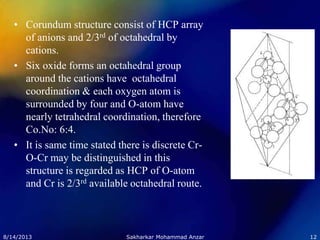
• Corundum structure consist of HCP array
of anions and 2/3rd of octahedral by
cations.
• Six oxide forms an octahedral group
around the cations have octahedral
coordination & each oxygen atom is
surrounded by four and O-atom have
nearly tetrahedral coordination, therefore
Co.No: 6:4.
• It is same time stated there is discrete Cr-
O-Cr may be distinguished in this
structure is regarded as HCP of O-atom
and Cr is 2/3rd available octahedral route.
8/14/2013 12Sakharkar Mohammad Anzar
Bi2O3
• Among sesquioxide Bi2O3 is unique with Co. No: 6:4
crystallizing in atleast four polymorphic form
– α- low temperature i.e monoclinic
– β- high temp tetragonal
– γ- BCC
– δ- FCC
• Out of this & form has defect fluorite structure exhibit high
ionic conduction.
• α- form has rather complex structure .
• Still there is doubt about the structure of β- i.e high
temperature form of this oxide.
• γ- form is meta stable over range from 250C to M.P.
8/14/2013 13Sakharkar Mohammad Anzar
• Each Bi has 6-oxygen atom arranged at 6 of 8 corner of cube,
those at two diagonally corner is missing.
• The structure is simply related geometry to the fluorite
structure where there is CCP arrangement of Ca and F- in
tetrahedral.
• Removal of one quartered anion from the unite cell of Fluorite
gives Bi2O3 unit cell.
• There 6-O-atom per unit cell, i.e 2Bi2O3 is present in fluorite
there is CCP at Ca and F- ion in in tetrahedral. Therefore Co.
No: 6:4 .
8/14/2013 14Sakharkar Mohammad Anzar
Bibliography/Webliography
• Structural Inorganic chemistry – A.F Wells
• Advance inorganic chemistry – Satyaprakash
• http://www.geocities.jp/ohba_lab_ob_page/str
ucture6.html
• http://scienceblogs.ucoz.com/resources/notes/
msc/theory/SolidState.pdf
• http://courses.washington.edu/mse170/lecture
_notes/zhangF08/lecture4.pdf
• http://www.itescam.edu.mx/principal/sylabus/
fpdb/recursos/r91883.DOC
8/14/2013 15Sakharkar Mohammad Anzar

Simple structures of solid state chemistry

  • 1.
  • 2.
    • Some ofthe common ceramic materials are those in which there are equal numbers of cations and anions. • These are often referred to as AB compounds, where A denotes the cation and B the anion. • There are several different crystal structures for AB compounds; each is normally named after a common material that assumes the particular structure. 8/14/2013 2Sakharkar Mohammad Anzar
  • 3.
    PbO • Lead oxidehas two polymorphs, – a red (tetragonal) form prepared by heating Pb02 in air to 5500C. – and a yellow (orthorhombic) form made by heating Pb02 to 6500C or by rapidly cooling molten PbO. • Tetragonal PbO has the layer structure in which the metal atom is bonded to 4 oxygen atoms which are arranged in a square to one side of it, with the lone pair of electrons presumably occupying the apex of the tetragonal pyramid. • It has not proved possible to locate the oxygen atoms in the yellow form of PbO by X-ray diffraction, but their positions have been determined by neutron diffraction 8/14/2013 3Sakharkar Mohammad Anzar
  • 4.
    • The basicstructural unit is a chain in which Pb is bonded two oxygen atom at 2.21A0, this chain is weekly bonded into layer by two PbO bond 2.49A0. • The shortest Pb-Pb distances in and between the layers are respectively 3.47 and 3.63 A. • The oxygen atom lies between every paired lead layer but each lead atom has four oxygen on one side • The lead tetragonal variety has occupied apex of tetragonal pyramid and oxygen have tetragonal coordination of lead 8/14/2013 4Sakharkar Mohammad Anzar
  • 5.
    Structure of AB2type • In these type of compound Cation A is one and anion is two. • Some examples: – CaC2 – β- Crystobalite 8/14/2013 5Sakharkar Mohammad Anzar
  • 6.
    β-cristobalite • Fluoride andoxidize of AB2 type distrintic ionic crystalline in structure which can be determine by size consider there are five basic structure AB2 mainly Flouride, Rutile CaI2, CaC2 and β- cristobalite. • Geometry of anion around the cation determine by crystal structure • B-cristallobite is named after one of the mineral forms silicon SiO2 • Silicon itself crystallizes with the same structure as diamond its normal oxide SiO2 • Silicon occur in three forms: – Low quartz is stable at 8700C – Tridymide---- 872-14700 – B-cristobalite—1470-17300C 8/14/2013 6Sakharkar Mohammad Anzar
  • 7.
    • The idealstructure of B-cristobalite may described the position and C-atom in the diamond structure with the O in certain mid way both over pair of Si-atom forming an angle of 1470C. • In the resulting of Si have tetrahedral Co-ordination and O-has linear co-ordination. • The O-atom are suited at position ‘Si’ atom are in the same position as for Zn and S in zinc blend. • Tetrahedral arrangement with one silicon surrounded by four oxygen atoms. • All silicon atoms are bonded to 4 oxygen atoms. • Most oxygen atoms will be bonded to two silicon atoms, so that two tetrahedral are joined at a corner. 8/14/2013 7Sakharkar Mohammad Anzar
  • 8.
    CaC2 • CaC2 accordingto the type of Cx n- ion present in system using crystal in two types: – These containing distinct which carbon atom e.g Al4C3, Be2C. – Thus in which C2 2- ion very distinct with this structure has selected illustrated that the structure of one compound can be related which has different stiochiometric can have same type of structure • The structure of CaC2 can be compared with structure NaCl because, their radius ratio is found to be equal i.e 0.52 • The Na+ & Cl- atom being replaced by Ca & C2 atom respectively as shown in fig: below 8/14/2013 8Sakharkar Mohammad Anzar
  • 9.
    •Ca ion issurrounded by six carbide ion which lies at six corners of regular octahedron, while each carbide ion is surrounded by six Ca ion. •The symmetry have dropped going to the parallel alignment of anion. •The carbon are associated in pairs Two forms FeS2 where Iron pyrite Marcosites •In this two structure however the two unit do not allow themselves to parallel. •Crystalline CaC2 structure are not salt like alkali earth carbide i.e CaC2. 8/14/2013 9Sakharkar Mohammad Anzar
  • 10.
    Structure of A2B3 •There Two cation and three anions in these type of compound. • Some examples are: – Bi2O3 – BiTe3 – CrO3 • They are also known as sesquioxide. 8/14/2013 10Sakharkar Mohammad Anzar
  • 11.
    Cr2O3 • Ionic sesquioxidecan be divided into two way: – One with corundum structure which is adopted by d-block element A&C rare earth oxide generally Ln and Ac shows A & C rare earth oxide. – Ionic A2B3 Bond are illustrated by sequenced d-block transition metal which crystallizes into corundum structure And A&C rare earth oxide. • The compound structure is adopted Ti2O3, Cr2O3. • In other words Cr2O3 has corundum structure 8/14/2013 11Sakharkar Mohammad Anzar
  • 12.
    • Corundum structureconsist of HCP array of anions and 2/3rd of octahedral by cations. • Six oxide forms an octahedral group around the cations have octahedral coordination & each oxygen atom is surrounded by four and O-atom have nearly tetrahedral coordination, therefore Co.No: 6:4. • It is same time stated there is discrete Cr- O-Cr may be distinguished in this structure is regarded as HCP of O-atom and Cr is 2/3rd available octahedral route. 8/14/2013 12Sakharkar Mohammad Anzar
  • 13.
    Bi2O3 • Among sesquioxideBi2O3 is unique with Co. No: 6:4 crystallizing in atleast four polymorphic form – α- low temperature i.e monoclinic – β- high temp tetragonal – γ- BCC – δ- FCC • Out of this & form has defect fluorite structure exhibit high ionic conduction. • α- form has rather complex structure . • Still there is doubt about the structure of β- i.e high temperature form of this oxide. • γ- form is meta stable over range from 250C to M.P. 8/14/2013 13Sakharkar Mohammad Anzar
  • 14.
    • Each Bihas 6-oxygen atom arranged at 6 of 8 corner of cube, those at two diagonally corner is missing. • The structure is simply related geometry to the fluorite structure where there is CCP arrangement of Ca and F- in tetrahedral. • Removal of one quartered anion from the unite cell of Fluorite gives Bi2O3 unit cell. • There 6-O-atom per unit cell, i.e 2Bi2O3 is present in fluorite there is CCP at Ca and F- ion in in tetrahedral. Therefore Co. No: 6:4 . 8/14/2013 14Sakharkar Mohammad Anzar
  • 15.
    Bibliography/Webliography • Structural Inorganicchemistry – A.F Wells • Advance inorganic chemistry – Satyaprakash • http://www.geocities.jp/ohba_lab_ob_page/str ucture6.html • http://scienceblogs.ucoz.com/resources/notes/ msc/theory/SolidState.pdf • http://courses.washington.edu/mse170/lecture _notes/zhangF08/lecture4.pdf • http://www.itescam.edu.mx/principal/sylabus/ fpdb/recursos/r91883.DOC 8/14/2013 15Sakharkar Mohammad Anzar