INFRARED SPECTROSCOPY
PRESENTED BY: DR.VIJAYA BARGE
(Vice Principal & Professor)
Pune District Education
Association’s Shankarrao Ursal
College of Pharmaceutical
Sciences & Research Centre.
LEARNING
OBJECľIVES
Afteí completing this sub-unit the students should be able:
1. ľ o study the theoíy of Infíaíed absoíption spectíoscopy .
2.ľo study the modes of vibíations in IR spectíoscopy
3.ľo study the factoís affecting vibíations in IR spectíoscopy
4.ľo study the instíumentation involved in IR spectíoscopy
5.ľo study the applications of IR spectíoscopy
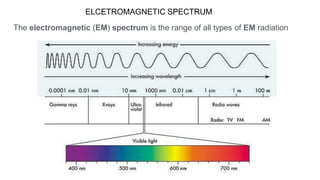
ELCETROMAGNETIC SPECTRUM
The electromagnetic (EM) spectrum is the range of all types of EM radiation
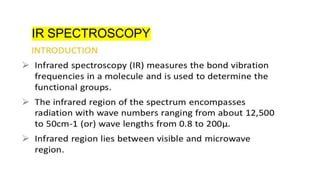
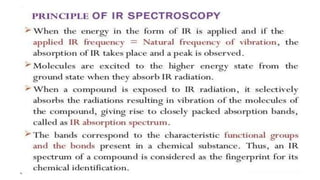
IR SPECTROSCOPY
IR REGIONS
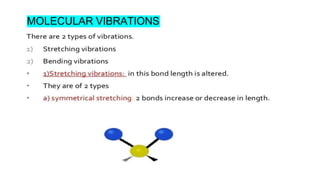
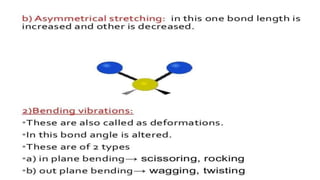
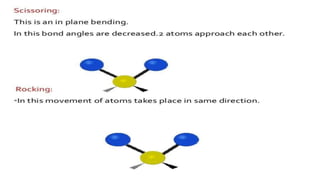
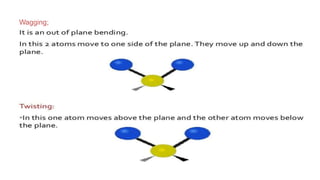
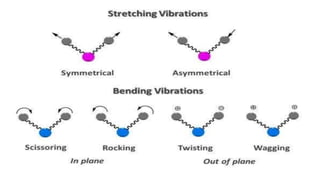
MOLECULAR VIBRATIONS
Wagging;
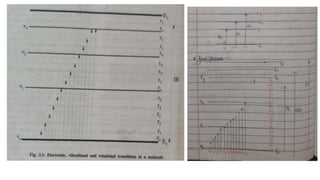
A fundamental band is the spectral band that occurs in a vibrational
spectrum of a molecule when the molecule makes a transition from the ground
state (v=0) to the first excited state (v=1)
An overtone band is the spectral band that occurs in a vibrational spectrum of
a molecule when the molecule makes a transition from the ground state (v=0) to
the second excited state (v=2)
FUNDAMENTAL AND OVERTONE BANDS
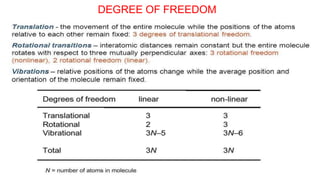
DEGREE OF FREEDOM
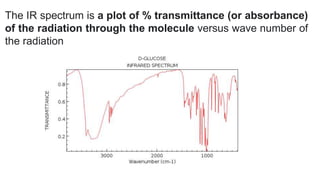
The IR spectrum is a plot of % transmittance (or absorbance)
of the radiation through the molecule versus wave number of
the radiation
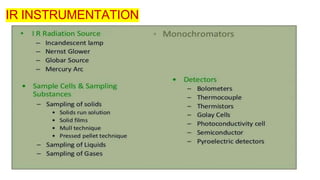
IR INSTRUMENTATION
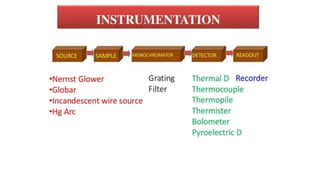
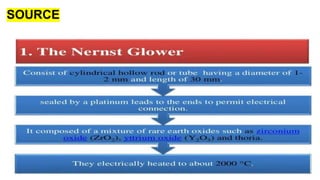
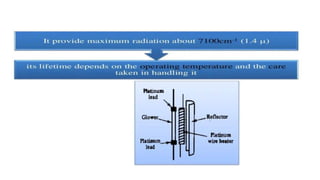
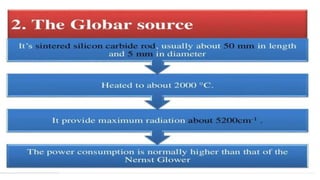
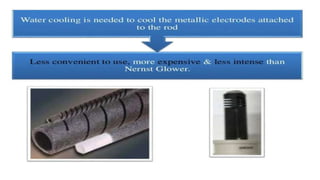
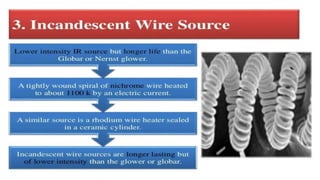
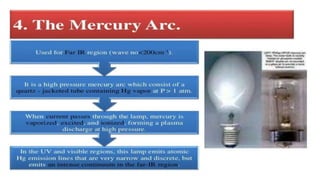
SOURCE
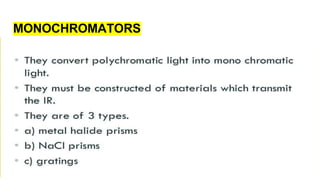
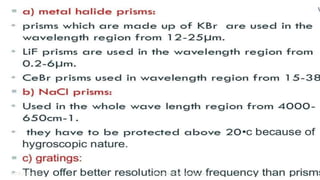
MONOCHROMATORS
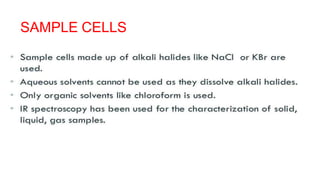
SAMPLE CELLS
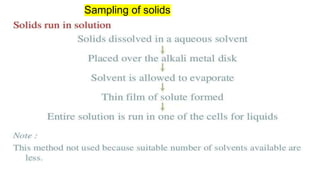
Sampling of solids
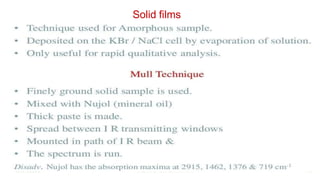
Solid films
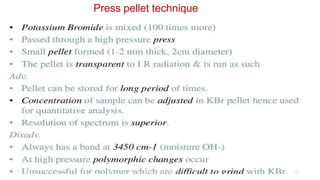
Press pellet technique
Sampling of liquids
Sampling of gases
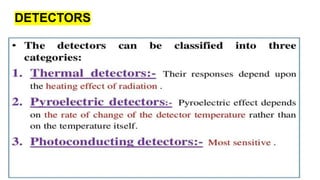
DETECTORS
Thermocouple
A thermocouple consists of a pair of junctions. Two junctions are formed by
connecting two pieces of a similar metal like bismuth ( Bi) to either ends of a
dissimilar metal such as antimony (Sb) or a semiConducting alloy. One junction is
used as a reference junction and another junction is used as a detector junction.
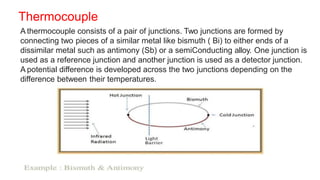
A potential difference is developed across the two junctions depending on the
difference between their temperatures.
Temperature of a reference junction need not be kept constant since the difference between
the temperatures of the junctions is required to determine the intensity of a signal. Still, most
of the times, to get the accurately measurable difference between the temperatures of the
two junctions, the temperature of the reference junction is kept more or less constant by
cooling it in ice. The greater the difference in the temperatures of the two junctions,
the higher is the sensitivity of the method and the higher is the accuracy of the
measurement. The reference junction has relatively large heat capacity. i.e. a large amount
of heat is associated with the minute change in the temperature of the reference junction.
2. A detector junction
A detector junction or the junction for detecting intensity of IR radiation transmitted after
the interaction with an analyte should be designed so as to have complete absorption of
heat from the IR radiation incident on it. Hence, special care is taken to design this junction
from fine wires of platinum, silver, antimony or bismuth. Fine wires increase the surface area
of the junction and help in complete absorption of heat from the IR radiation
1. Reference junction
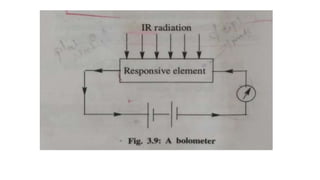
Bolometer
Golay cell
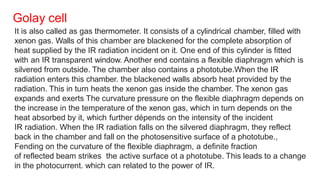
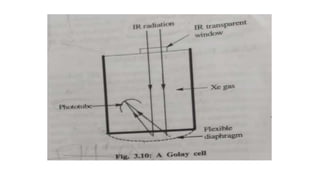
It is also called as gas thermometer. It consists of a cylindrical chamber, filled with
xenon gas. Walls of this chamber are blackened for the complete absorption of
heat supplied by the IR radiation incident on it. One end of this cylinder is fitted
with an IR transparent window. Another end contains a flexible diaphragm which is
silvered from outside. The chamber also contains a phototube.When the IR
radiation enters this chamber. the blackened walls absorb heat provided by the
radiation. This in turn heats the xenon gas inside the chamber. The xenon gas
expands and exerts The curvature pressure on the flexible diaphragm depends on
the increase in the temperature of the xenon gas, which in turn depends on the
heat absorbed by it, which further dépends on the intensity of the incident
IR radiation. When the IR radiation falls on the silvered diaphragm, they reflect
back in the chamber and fall on the photosensitive surface of a phototube.,
Fending on the curvature of the flexible diaphragm, a definite fraction
of reflected beam strikes the active surface ot a phototube. This leads to a change
in the photocurrent. which can related to the power of IR.
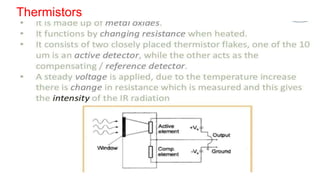
Thermistors
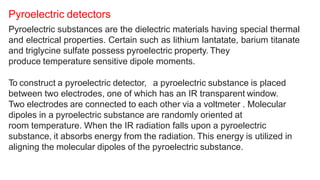
Pyroelectric substances are the dielectric materials having special thermal
and electrical properties. Certain such as lithium Iantatate, barium titanate
and triglycine sulfate possess pyroelectric property. They
produce temperature sensitive dipole moments.
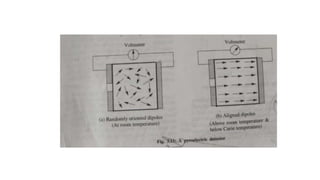
To construct a pyroelectric detector, a pyroelectric substance is placed
between two electrodes, one of which has an IR transparent window.
Two electrodes are connected to each other via a voltmeter . Molecular
dipoles in a pyroelectric substance are randomly oriented at
room temperature. When the IR radiation falls upon a pyroelectric
substance, it absorbs energy from the radiation. This energy is utilized in
aligning the molecular dipoles of the pyroelectric substance.
Pyroelectric detectors
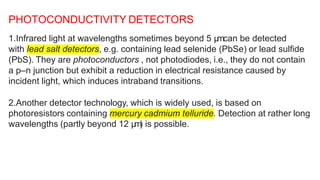
1.Infrared light at wavelengths sometimes beyond 5 μ
mcan be detected
with lead salt detectors, e.g. containing lead selenide (PbSe) or lead sulfide
(PbS). They are photoconductors , not photodiodes, i.e., they do not contain
a p–n junction but exhibit a reduction in electrical resistance caused by
incident light, which induces intraband transitions.
2.Another detector technology, which is widely used, is based on
photoresistors containing mercury cadmium telluride. Detection at rather long
wavelengths (partly beyond 12 μ
m
) is possible.
PHOTOCONDUCTIVITY DETECTORS
REFERENCES
Infrared Spectroscopy PPT, Principle, Instrumentation

Infrared Spectroscopy PPT, Principle, Instrumentation

  • 1.
    INFRARED SPECTROSCOPY PRESENTED BY:DR.VIJAYA BARGE (Vice Principal & Professor) Pune District Education Association’s Shankarrao Ursal College of Pharmaceutical Sciences & Research Centre.
  • 2.
    LEARNING OBJECľIVES Afteí completing thissub-unit the students should be able: 1. ľ o study the theoíy of Infíaíed absoíption spectíoscopy . 2.ľo study the modes of vibíations in IR spectíoscopy 3.ľo study the factoís affecting vibíations in IR spectíoscopy 4.ľo study the instíumentation involved in IR spectíoscopy 5.ľo study the applications of IR spectíoscopy
  • 6.
    ELCETROMAGNETIC SPECTRUM The electromagnetic(EM) spectrum is the range of all types of EM radiation
  • 8.
  • 9.
  • 13.
  • 16.
  • 18.
    A fundamental bandis the spectral band that occurs in a vibrational spectrum of a molecule when the molecule makes a transition from the ground state (v=0) to the first excited state (v=1) An overtone band is the spectral band that occurs in a vibrational spectrum of a molecule when the molecule makes a transition from the ground state (v=0) to the second excited state (v=2) FUNDAMENTAL AND OVERTONE BANDS
  • 19.
  • 20.
    The IR spectrumis a plot of % transmittance (or absorbance) of the radiation through the molecule versus wave number of the radiation
  • 21.
  • 23.
  • 29.
  • 31.
  • 32.
  • 33.
  • 34.
  • 35.
  • 36.
  • 37.
  • 38.
    Thermocouple A thermocouple consistsof a pair of junctions. Two junctions are formed by connecting two pieces of a similar metal like bismuth ( Bi) to either ends of a dissimilar metal such as antimony (Sb) or a semiConducting alloy. One junction is used as a reference junction and another junction is used as a detector junction. A potential difference is developed across the two junctions depending on the difference between their temperatures.
  • 39.
    Temperature of areference junction need not be kept constant since the difference between the temperatures of the junctions is required to determine the intensity of a signal. Still, most of the times, to get the accurately measurable difference between the temperatures of the two junctions, the temperature of the reference junction is kept more or less constant by cooling it in ice. The greater the difference in the temperatures of the two junctions, the higher is the sensitivity of the method and the higher is the accuracy of the measurement. The reference junction has relatively large heat capacity. i.e. a large amount of heat is associated with the minute change in the temperature of the reference junction. 2. A detector junction A detector junction or the junction for detecting intensity of IR radiation transmitted after the interaction with an analyte should be designed so as to have complete absorption of heat from the IR radiation incident on it. Hence, special care is taken to design this junction from fine wires of platinum, silver, antimony or bismuth. Fine wires increase the surface area of the junction and help in complete absorption of heat from the IR radiation 1. Reference junction
  • 40.
  • 42.
    Golay cell It isalso called as gas thermometer. It consists of a cylindrical chamber, filled with xenon gas. Walls of this chamber are blackened for the complete absorption of heat supplied by the IR radiation incident on it. One end of this cylinder is fitted with an IR transparent window. Another end contains a flexible diaphragm which is silvered from outside. The chamber also contains a phototube.When the IR radiation enters this chamber. the blackened walls absorb heat provided by the radiation. This in turn heats the xenon gas inside the chamber. The xenon gas expands and exerts The curvature pressure on the flexible diaphragm depends on the increase in the temperature of the xenon gas, which in turn depends on the heat absorbed by it, which further dépends on the intensity of the incident IR radiation. When the IR radiation falls on the silvered diaphragm, they reflect back in the chamber and fall on the photosensitive surface of a phototube., Fending on the curvature of the flexible diaphragm, a definite fraction of reflected beam strikes the active surface ot a phototube. This leads to a change in the photocurrent. which can related to the power of IR.
  • 44.
  • 45.
    Pyroelectric substances arethe dielectric materials having special thermal and electrical properties. Certain such as lithium Iantatate, barium titanate and triglycine sulfate possess pyroelectric property. They produce temperature sensitive dipole moments. To construct a pyroelectric detector, a pyroelectric substance is placed between two electrodes, one of which has an IR transparent window. Two electrodes are connected to each other via a voltmeter . Molecular dipoles in a pyroelectric substance are randomly oriented at room temperature. When the IR radiation falls upon a pyroelectric substance, it absorbs energy from the radiation. This energy is utilized in aligning the molecular dipoles of the pyroelectric substance. Pyroelectric detectors
  • 47.
    1.Infrared light atwavelengths sometimes beyond 5 μ mcan be detected with lead salt detectors, e.g. containing lead selenide (PbSe) or lead sulfide (PbS). They are photoconductors , not photodiodes, i.e., they do not contain a p–n junction but exhibit a reduction in electrical resistance caused by incident light, which induces intraband transitions. 2.Another detector technology, which is widely used, is based on photoresistors containing mercury cadmium telluride. Detection at rather long wavelengths (partly beyond 12 μ m ) is possible. PHOTOCONDUCTIVITY DETECTORS
  • 48.