X-Ray Crystallography
Presented by : Dr. Vijaya U. Barge
( Vice- Principal & Professor)
Pune District Education Association’s
Shankarrao Ursal College of
Pharmaceutical Sciences & Research
Centre, , Kharadi, Pune.
• Contents:
1. Introduction
2. Production of x ray
3. X-ray diffraction methods
4. Bragg‘s law
Introduction
 X ray is an electromagnetic wave of high energy
and very short wavelength (between ultraviolet
light and gamma ray).
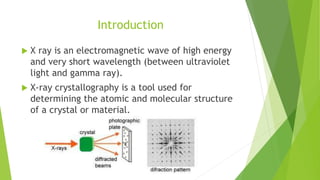
 X-ray crystallography is a tool used for
determining the atomic and molecular structure
of a crystal or material.
Production of X ray
 Power is send to X-Ray tube via cables .
 Ma ( milliamperage ) is send to filament on cathode side.
 Filament heats up electron “ boil off ”
 Negetive charge
 Positive Voltage ( KVP ) is applied to ANODE.
 Negetive Electrons = attracted across the tube to the positive
ANODE.
 Electrons “ Slam into” anode suddenly stopped .
 X-Ray photons are created .
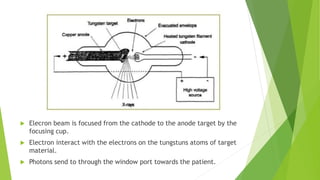
 Elecron beam is focused from the cathode to the anode target by the
focusing cup.
 Electron interact with the electrons on the tungstuns atoms of target
material.
 Photons send to through the window port towards the patient.
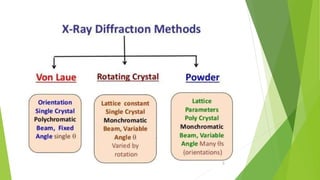
X-ray diffraction methods
These are generally used for investigating the internal structures and
crystal structures of various compounds .They are as follows,
 Laue’s photographic method.
a) Transmission method.
b) Black reflection method.
 Rotating crystal method .
 Powder method .
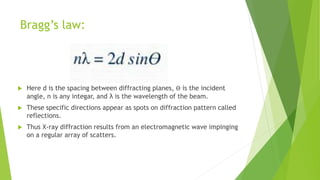
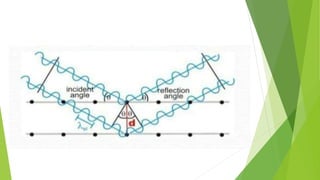
Bragg’s law:
 Here d is the spacing between diffracting planes, Ɵ is the incident
angle, n is any integar, and λ is the wavelength of the beam.
 These specific directions appear as spots on diffraction pattern called
reflections.
 Thus X-ray diffraction results from an electromagnetic wave impinging
on a regular array of scatters.
X ray crystallography.pptx principle, instrumentation

X ray crystallography.pptx principle, instrumentation

  • 1.
    X-Ray Crystallography Presented by: Dr. Vijaya U. Barge ( Vice- Principal & Professor) Pune District Education Association’s Shankarrao Ursal College of Pharmaceutical Sciences & Research Centre, , Kharadi, Pune.
  • 2.
    • Contents: 1. Introduction 2.Production of x ray 3. X-ray diffraction methods 4. Bragg‘s law
  • 3.
    Introduction  X rayis an electromagnetic wave of high energy and very short wavelength (between ultraviolet light and gamma ray).  X-ray crystallography is a tool used for determining the atomic and molecular structure of a crystal or material.
  • 4.
    Production of Xray  Power is send to X-Ray tube via cables .  Ma ( milliamperage ) is send to filament on cathode side.  Filament heats up electron “ boil off ”  Negetive charge  Positive Voltage ( KVP ) is applied to ANODE.  Negetive Electrons = attracted across the tube to the positive ANODE.  Electrons “ Slam into” anode suddenly stopped .  X-Ray photons are created .
  • 5.
     Elecron beamis focused from the cathode to the anode target by the focusing cup.  Electron interact with the electrons on the tungstuns atoms of target material.  Photons send to through the window port towards the patient.
  • 6.
    X-ray diffraction methods Theseare generally used for investigating the internal structures and crystal structures of various compounds .They are as follows,  Laue’s photographic method. a) Transmission method. b) Black reflection method.  Rotating crystal method .  Powder method .
  • 8.
    Bragg’s law:  Hered is the spacing between diffracting planes, Ɵ is the incident angle, n is any integar, and λ is the wavelength of the beam.  These specific directions appear as spots on diffraction pattern called reflections.  Thus X-ray diffraction results from an electromagnetic wave impinging on a regular array of scatters.