FLUORIMETRY
PRESENTED BY
B. LIKHITHA
B. PHARMACY
CONTENT
INTRODUCTION
DEFINITION
THEORY
PRINCIPLE
FACTORS AFFECTING FLUORESCENCE
QUENCHING
INSTRUMENTATION
APPLICATIONS
INTRODUCTION
• A large number of substances are known which can absorb UV
or visible light energy.
• But these substance loses its excess energy as heat and emit
the remaining energy as electromagnetic radiation of a
wavelength longer than that absorbed.
• This process of emitting radiation (fluorescence and
phosphorescence) is collectively called as Luminescence.
DEFINITION
Fluorimetry (or fluorescence spectrometry) is an analytical
technique used to measure the intensity of fluorescence emitted by a
substance after it has absorbed light. When a sample is exposed to
light of a specific wavelength, the molecules in the sample may
absorb that energy and move to an excited state. As the molecules
return to their ground state, they release energy in the form of light,
which is typically of a longer wavelength than the absorbed light. This
emitted light is called fluorescence.
THEORY
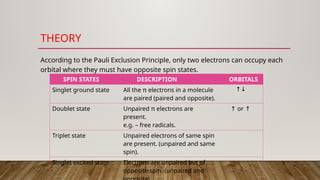
According to the Pauli Exclusion Principle, only two electrons can occupy each
orbital where they must have opposite spin states.
SPIN STATES DESCRIPTION ORBITALS
Singlet ground state All the π electrons in a molecule
are paired (paired and opposite).
↑↓
Doublet state Unpaired π electrons are
present.
e.g. – free radicals.
↑ or ↑
Triplet state Unpaired electrons of same spin
are present. (unpaired and same
spin).
Singlet excited state Electrons are unpaired but of
opposite spin. (unpaired and
PRINCIPLE
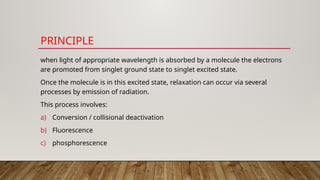
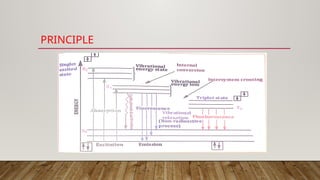
when light of appropriate wavelength is absorbed by a molecule the electrons
are promoted from singlet ground state to singlet excited state.
Once the molecule is in this excited state, relaxation can occur via several
processes by emission of radiation.
This process involves:
a) Conversion / collisional deactivation
b) Fluorescence
c) phosphorescence
PRINCIPLE
PRINCIPLE
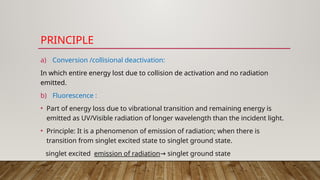
a) Conversion /collisional deactivation:
In which entire energy lost due to collision de activation and no radiation
emitted.
b) Fluorescence :
• Part of energy loss due to vibrational transition and remaining energy is
emitted as UV/Visible radiation of longer wavelength than the incident light.
• Principle: It is a phenomenon of emission of radiation; when there is
transition from singlet excited state to singlet ground state.
singlet excited emission of radiation singlet ground state
→
PRINCIPLE
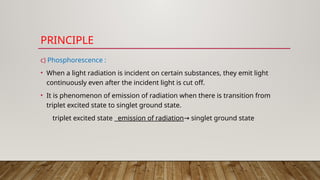
c) Phosphorescence :
• When a light radiation is incident on certain substances, they emit light
continuously even after the incident light is cut off.
• It is phenomenon of emission of radiation when there is transition from
triplet excited state to singlet ground state.
triplet excited state emission of radiation singlet ground state
→
FACTORS AFFECTING FLUORESCENCE
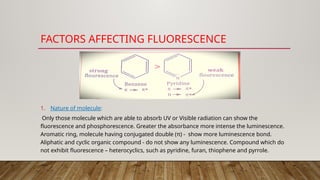
1. Nature of molecule:
Only those molecule which are able to absorb UV or Visible radiation can show the
fluorescence and phosphorescence. Greater the absorbance more intense the luminescence.
Aromatic ring, molecule having conjugated double (π) - show more luminescence bond.
Aliphatic and cyclic organic compound - do not show any luminescence. Compound which do
not exhibit fluorescence – heterocyclics, such as pyridine, furan, thiophene and pyrrole.
FACTORS AFFECTING FLUORESCENCE
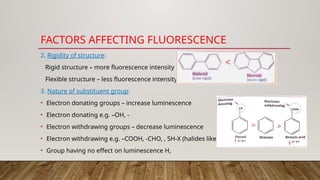
2. Rigidity of structure:
Rigid structure – more fluorescence intensity
Flexible structure – less fluorescence intensity
3. Nature of substituent group:
• Electron donating groups – increase luminescence
• Electron donating e.g. –OH, -
• Electron withdrawing groups – decrease luminescence
• Electron withdrawing e.g. –COOH, -CHO, , SH-X (halides like F, Cl).
• Group having no effect on luminescence H,
FACTORS AFFECTING FLUORESCENCE
4. Effect of temperature:
Less temperature – decrease collisions of molecules, increase luminescence.
High temperature – increase collision of molecules, decrease luminescence.
5. viscosity:
Increase in viscosity decrease collisions of molecules increase
→ →
luminescence.
Decrease in viscosity increase collisions of molecules decrease
→ →
luminescence.
FACTORS AFFECTING FLUORESCENCE
6. Effect of dissolved oxygen:
presence of oxygen may decrease the fluorescent intensity in two ways:
a) Oxidation of fluorescent species to a non-fluorescent species.
b) Quenches fluorescent substance because paramagnetic properties of
molecular energy.
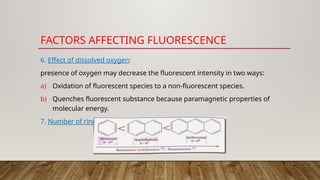
7. Number of rings:
FACTORS AFFECTING FLUORESCENCE
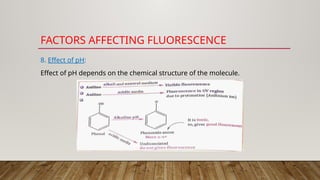
8. Effect of pH:
Effect of pH depends on the chemical structure of the molecule.
QUENCHING
Quenching is the reduction of fluorescence intensity by the
presence of substance in the sample other than the fluorescence.
This effect may be due to various factors like:
Concentration quenching: concentration quenching is a kind of
self-quenching. It occurs when the concentration of the
fluorescing molecule increase in a sample solution.
Chemical quenching: Due to various factors like change in pH,
presence of oxygen, halides, and electron-withdrawing groups,
heavy metals, etc.
FLUORESCENT INDICATORS
Name of indicator pH range color change
Eosin 3 – 4 color less to green
Fluorescein 4 – 6 color less to green
Quinine sulphate 3 – 5 blue to violet
Acridine 5.2 – 6.6 green to violet blue
2 - Naphthoquinone 4.4 – 6.3 blue to color less
INSTRUMENTATION
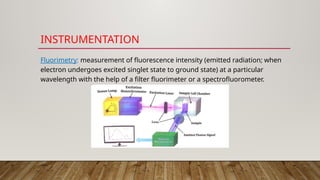
Fluorimetry: measurement of fluorescence intensity (emitted radiation; when
electron undergoes excited singlet state to ground state) at a particular
wavelength with the help of a filter fluorimeter or a spectrofluorometer.
INSTRUMENTATION
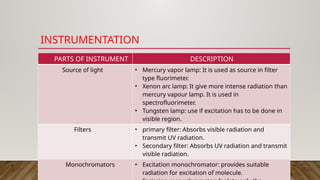
PARTS OF INSTRUMENT DESCRIPTION
Source of light • Mercury vapor lamp: It is used as source in filter
type fluorimeter.
• Xenon arc lamp: It give more intense radiation than
mercury vapour lamp. It is used in
spectrofluorimeter.
• Tungsten lamp: use if excitation has to be done in
visible region.
Filters • primary filter: Absorbs visible radiation and
transmit UV radiation.
• Secondary filter: Absorbs UV radiation and transmit
visible radiation.
Monochromators • Excitation monochromator: provides suitable
radiation for excitation of molecule.
INSTRUMENTATION
PARTS OF INSTRUMENT DESCRIPTION
Sample holder Made up of quartz or glass
Detectors • which transforms light energy into
electrical signals that are observed
on recorder.
• PMT (photomultiplier tube) is
commonly used as detectors.
APPLICATIONS
• Determination of inorganic substance.
• Determination of phenytoin.
• Determination of thiamine.
• Determination of phenols, indoles.
• Detection of impurities at nanogram quantity.
Thank you

FLUORIMETRY principle and applications.pptx

  • 1.
  • 2.
  • 3.
    INTRODUCTION • A largenumber of substances are known which can absorb UV or visible light energy. • But these substance loses its excess energy as heat and emit the remaining energy as electromagnetic radiation of a wavelength longer than that absorbed. • This process of emitting radiation (fluorescence and phosphorescence) is collectively called as Luminescence.
  • 4.
    DEFINITION Fluorimetry (or fluorescencespectrometry) is an analytical technique used to measure the intensity of fluorescence emitted by a substance after it has absorbed light. When a sample is exposed to light of a specific wavelength, the molecules in the sample may absorb that energy and move to an excited state. As the molecules return to their ground state, they release energy in the form of light, which is typically of a longer wavelength than the absorbed light. This emitted light is called fluorescence.
  • 5.
    THEORY According to thePauli Exclusion Principle, only two electrons can occupy each orbital where they must have opposite spin states. SPIN STATES DESCRIPTION ORBITALS Singlet ground state All the π electrons in a molecule are paired (paired and opposite). ↑↓ Doublet state Unpaired π electrons are present. e.g. – free radicals. ↑ or ↑ Triplet state Unpaired electrons of same spin are present. (unpaired and same spin). Singlet excited state Electrons are unpaired but of opposite spin. (unpaired and
  • 6.
    PRINCIPLE when light ofappropriate wavelength is absorbed by a molecule the electrons are promoted from singlet ground state to singlet excited state. Once the molecule is in this excited state, relaxation can occur via several processes by emission of radiation. This process involves: a) Conversion / collisional deactivation b) Fluorescence c) phosphorescence
  • 7.
  • 8.
    PRINCIPLE a) Conversion /collisionaldeactivation: In which entire energy lost due to collision de activation and no radiation emitted. b) Fluorescence : • Part of energy loss due to vibrational transition and remaining energy is emitted as UV/Visible radiation of longer wavelength than the incident light. • Principle: It is a phenomenon of emission of radiation; when there is transition from singlet excited state to singlet ground state. singlet excited emission of radiation singlet ground state →
  • 9.
    PRINCIPLE c) Phosphorescence : •When a light radiation is incident on certain substances, they emit light continuously even after the incident light is cut off. • It is phenomenon of emission of radiation when there is transition from triplet excited state to singlet ground state. triplet excited state emission of radiation singlet ground state →
  • 10.
    FACTORS AFFECTING FLUORESCENCE 1.Nature of molecule: Only those molecule which are able to absorb UV or Visible radiation can show the fluorescence and phosphorescence. Greater the absorbance more intense the luminescence. Aromatic ring, molecule having conjugated double (π) - show more luminescence bond. Aliphatic and cyclic organic compound - do not show any luminescence. Compound which do not exhibit fluorescence – heterocyclics, such as pyridine, furan, thiophene and pyrrole.
  • 11.
    FACTORS AFFECTING FLUORESCENCE 2.Rigidity of structure: Rigid structure – more fluorescence intensity Flexible structure – less fluorescence intensity 3. Nature of substituent group: • Electron donating groups – increase luminescence • Electron donating e.g. –OH, - • Electron withdrawing groups – decrease luminescence • Electron withdrawing e.g. –COOH, -CHO, , SH-X (halides like F, Cl). • Group having no effect on luminescence H,
  • 12.
    FACTORS AFFECTING FLUORESCENCE 4.Effect of temperature: Less temperature – decrease collisions of molecules, increase luminescence. High temperature – increase collision of molecules, decrease luminescence. 5. viscosity: Increase in viscosity decrease collisions of molecules increase → → luminescence. Decrease in viscosity increase collisions of molecules decrease → → luminescence.
  • 13.
    FACTORS AFFECTING FLUORESCENCE 6.Effect of dissolved oxygen: presence of oxygen may decrease the fluorescent intensity in two ways: a) Oxidation of fluorescent species to a non-fluorescent species. b) Quenches fluorescent substance because paramagnetic properties of molecular energy. 7. Number of rings:
  • 14.
    FACTORS AFFECTING FLUORESCENCE 8.Effect of pH: Effect of pH depends on the chemical structure of the molecule.
  • 15.
    QUENCHING Quenching is thereduction of fluorescence intensity by the presence of substance in the sample other than the fluorescence. This effect may be due to various factors like: Concentration quenching: concentration quenching is a kind of self-quenching. It occurs when the concentration of the fluorescing molecule increase in a sample solution. Chemical quenching: Due to various factors like change in pH, presence of oxygen, halides, and electron-withdrawing groups, heavy metals, etc.
  • 16.
    FLUORESCENT INDICATORS Name ofindicator pH range color change Eosin 3 – 4 color less to green Fluorescein 4 – 6 color less to green Quinine sulphate 3 – 5 blue to violet Acridine 5.2 – 6.6 green to violet blue 2 - Naphthoquinone 4.4 – 6.3 blue to color less
  • 17.
    INSTRUMENTATION Fluorimetry: measurement offluorescence intensity (emitted radiation; when electron undergoes excited singlet state to ground state) at a particular wavelength with the help of a filter fluorimeter or a spectrofluorometer.
  • 18.
    INSTRUMENTATION PARTS OF INSTRUMENTDESCRIPTION Source of light • Mercury vapor lamp: It is used as source in filter type fluorimeter. • Xenon arc lamp: It give more intense radiation than mercury vapour lamp. It is used in spectrofluorimeter. • Tungsten lamp: use if excitation has to be done in visible region. Filters • primary filter: Absorbs visible radiation and transmit UV radiation. • Secondary filter: Absorbs UV radiation and transmit visible radiation. Monochromators • Excitation monochromator: provides suitable radiation for excitation of molecule.
  • 19.
    INSTRUMENTATION PARTS OF INSTRUMENTDESCRIPTION Sample holder Made up of quartz or glass Detectors • which transforms light energy into electrical signals that are observed on recorder. • PMT (photomultiplier tube) is commonly used as detectors.
  • 20.
    APPLICATIONS • Determination ofinorganic substance. • Determination of phenytoin. • Determination of thiamine. • Determination of phenols, indoles. • Detection of impurities at nanogram quantity.
  • 21.