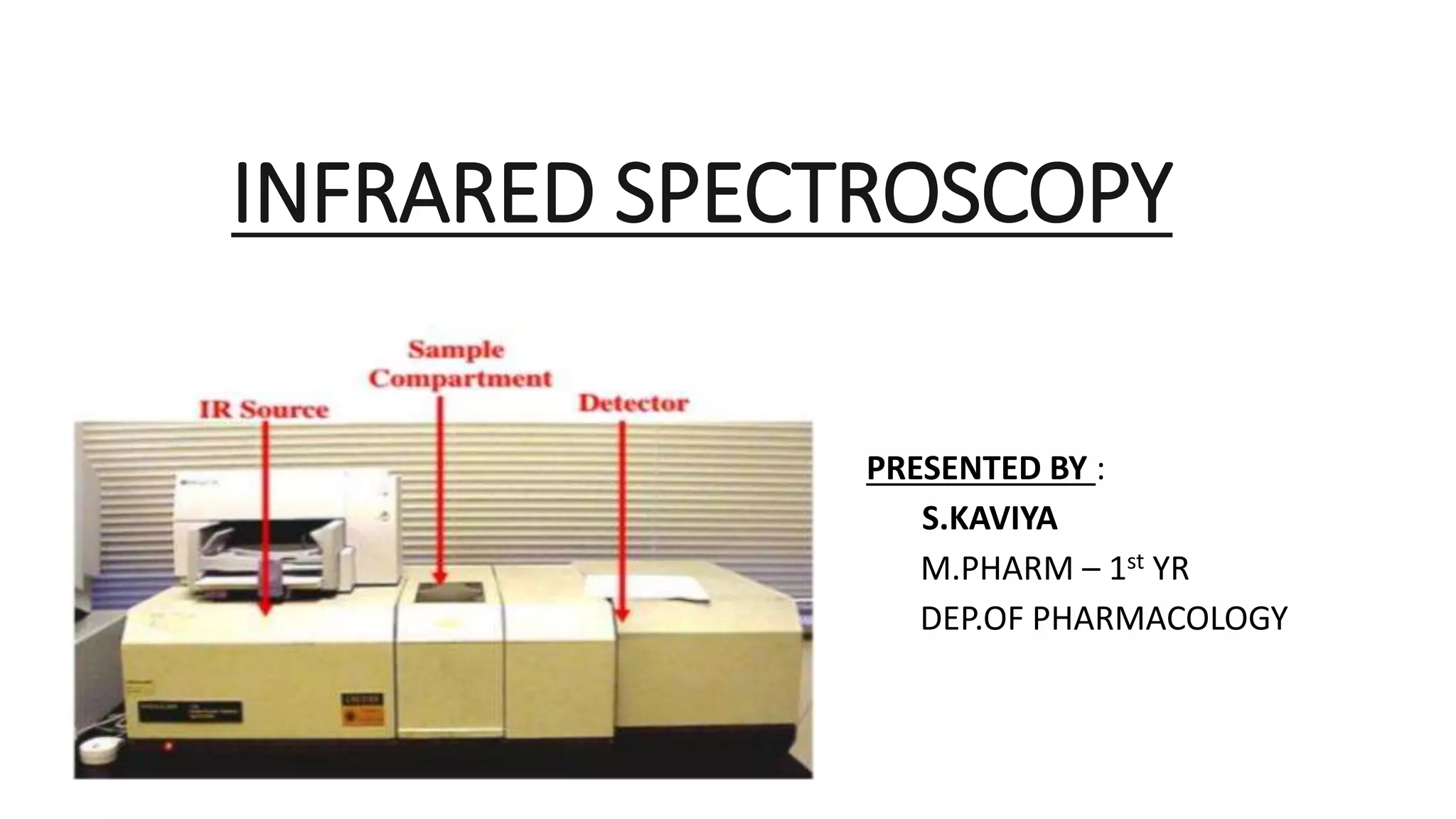
INFRARED SPECTROSCOPY
PRESENTED BY :
S.KAVIYA
M.PHARM – 1st YR
DEP.OF PHARMACOLOGY
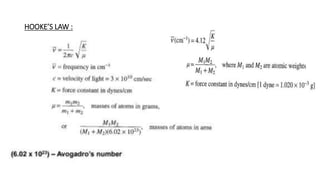
HOOKE’S LAW :
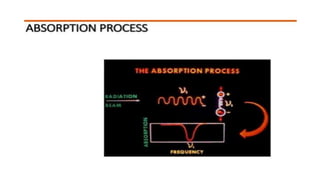
Absorbed energy brings the changes which depends upon
1. Mass of the atom
2. Strength of the bond
3. Arrangement of atoms
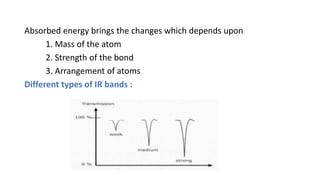
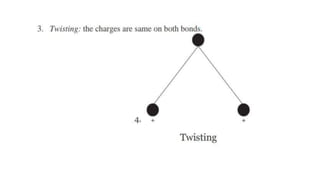
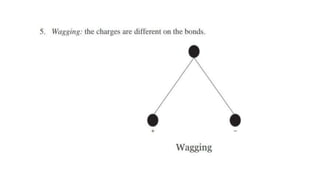
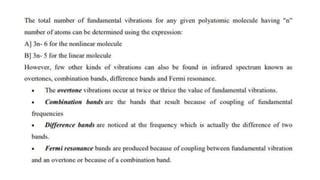
Different types of IR bands :
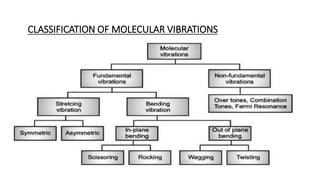
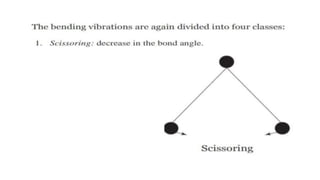
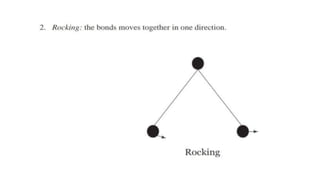
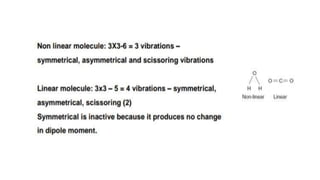
CLASSIFICATION OF MOLECULAR VIBRATIONS
FACTORS AFFECTING VIBRATIONAL FREQUENCIES IN IR :
1) Coupled vibrations
2) Fermi resonance
3) Electronic effects
4)Hydrogen bonding
1. COUPLED VIBRATIONS:
An isolated C-H bond has only one stretching vibrational frequency where as
methylene group shows two stretching vibrations, symmetrical and asymmetrical.
Asymmetric vibrations occur at higher frequencies than symmetric
vibrations. These are known as coupled vibrations because these vibrations occur at
different frequencies than that required for an isolated C-H stretching.
A strong vibrational coupling is present in carboxylic acid, anhydrides in
which symmetrical and asymmetrical stretching vibrations appear in the range of 1720-
1825/cm and the interaction is effective because of partial double bond due to resonance
which keeps system planar for effective coupling.
2. FERMI RESONANCE:
Fermi resonance bands are produced because of coupling between
fundamental vibration and an overtone or because of a combination band.
A Fermi resonance is shifting of energies and intensities of absorption bands in
the infrared or Raman spectrum. The phenomenon was explained by the Italian
physicist Emico Fermi.
3. ELECTRONIC EFFEECT:
Depends on presence of substituent. Conjugation cause delocalization of
electron which shows decrease in bond strength which in turn shows decrease in
vibrational frequency.
The changes in the absorption frequencies for a particular group take place
when the substituents in the neighbourhood of that particular group are changed . It
includes:
(a) Conjugation effect
(b) Inductive effect
(c) Mesomeric effect
(d) Field effect
a)CONJUGATION EFFECT:
It is observed to lower the frequency of both C=C stretchirg and C=O stretching,
irrespective of the fact it is brought about by either a, ß-unsaturation or by an aromatic
ring.
b)INDUCTIVE EFFECT:
The inductive effects solely depends upon the 'intrinsic' tendency of a
substituent to either release or withdraw electrons by definition, its electronegativity
acting either through the molecular chain or through space.
This effect usually weakens steadily with increasing distance from the
substituent.
c)MESOMERIC EFFECT:
The mesomeric effect involves the electrons in the pie and nonbonding
orbitals and it operates in general opposite to the inductive effect.
These effects cannot be isolated from one another and at a time only one of
them can be applied to determine approximate results.
d)FIELD EFFECT: It has been observed that two functional groups often
influence each other's vibrational frequencies by a through space interaction
that may be either steric and/or electrostatic in nature.
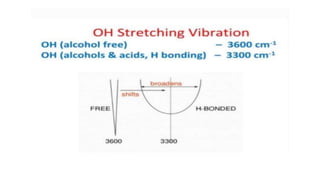
4. HYDROGEN BONDING:
Hydrogen bonds itself do not show any peaks for themselves in IR
spectrum but certainly affect the spectrum of covalent bonds between O-H
atoms which are involved in hydrogen bonding. It shows broadening of peaks
corresponding to O-H covalent bond.
The presence of hydrogen bonding changes the position and shape of
an infrared absorption band. Frequencies of both stretching as well as
bending vibrations are changed because of hydrogen bonding.
The X-H stretching bands move to lower frequency usually with
increased intensity and band widening. The X-H bending vibration usually shifts
to higher frequencies.
Stronger the hydrogen bonding, greater is the absorption shift from the
normal values. The two types of hydrogen bonding (intramolecular and
intermolecular) can be differentiated by the use of infrared spectroscopy .
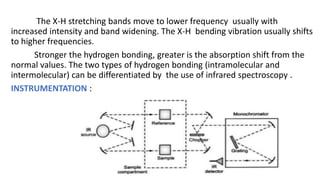
INSTRUMENTATION :
DETECTORS :
The various types of detectors are:
(a) Bolometers
(b) Thermocouples
(c) Thermistors
(d) Golay cell
(e) Pyroelectric detector
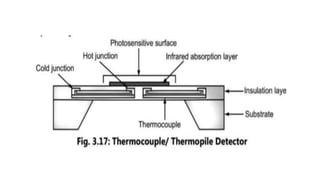
a)Thermocouples / Thermopiles:
Thermocouples / Thermopiles are formed by joining two dissimilar metals that
create a voltage at their junction. This voltage is proportional to the
temperature of the junction.
When a substance is optically focused onto a thermocouple
detector, its temperature increases or decreases as the incident IR flux
increases or decreases.
The change in IR flux emitted by the substance can be
detected by monitoring the voltage generated by the thermocouple.
For sensitive detection, the thermocouple must be thermally insulated
from its surroundings. For fast response, the thermocouple must be
able to quickly release built up heat.
This tradeoff between sensitivity of detection and the
ability to respond to quickly changing scenes is inherent to all energy
detectors.
A thermopile is a series of thermocouples connected
together to provide increased responsivity.
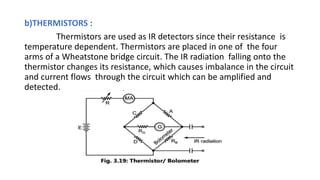
b)THERMISTORS :
Thermistors are used as IR detectors since their resistance is
temperature dependent. Thermistors are placed in one of the four
arms of a Wheatstone bridge circuit. The IR radiation falling onto the
thermistor changes its resistance, which causes imbalance in the circuit
and current flows through the circuit which can be amplified and
detected.

c)GOLAY DETECTOR:
It consists of the chamber containing a gas which expands due to
the heat when IR radiation falls on it. The expansion of gas bends the flexible
diaphragm to which is attached a mirror. The recorder response is
proportional to the degree of deflection.
• It uses the expansion of a gas as the measuring device
• The unit consists of a small metal cylinder closed by a rigid blackened
metal plate at one end and by a flexible silvered diaphragm at the other
end.
• The chamber is filled with xenon.
• Heat, conducted to the gas, causes it to expand and deform the
flexible diaphragm
Advantage is wide wavelength range
Disadvantage is more expensive
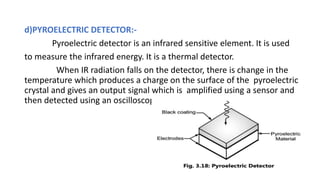
d)PYROELECTRIC DETECTOR:-
Pyroelectric detector is an infrared sensitive element. It is used
to measure the infrared energy. It is a thermal detector.
When IR radiation falls on the detector, there is change in the
temperature which produces a charge on the surface of the pyroelectric
crystal and gives an output signal which is amplified using a sensor and
then detected using an oscilloscope.
Selection of the conditions for the IR spectra:
1. Frequency range: The frequency should be in the range of 600–4,000cm−1.
2. Band width and the scan speed: The slit width limits the scan speed effectively.
APPLICATION OF INFRARED SPECTROSCOPY TO ORGANIC COMPUND:
1. Identification of Substance:
Infrared spectroscopy is used to establish whether a given sample
or an organic substance is identical with another or not. Such as; Alkanes, Alkenes,
Alkynes, Aromatic ring, etc.
2. Determination of Molecular Structure:
Infrared spectroscopy is helpful in determining molecular
structure of an unknown substance. From an examination of the position of
absorption band in the spectrum, it is possible to establish the nature of the gas
groups present in the molecule.
3. Detection of impurities.
4. Isomerism in organic chemistry.
5. Identification of functional groups.
6. Miscellaneous: The following are some important
application:
(a) Determination of purity.
(b) Shape of symmetry of a molecule.
(c) Presence of water in a sample. Eg: Moisture content
determination
(d) Measurement of paints and varnishes.
LIMITATIONS OF IR SPECTROSCOPY
It is not possible to determine pure substance present in the mixture
of substances.
It does not give the information about the positioning of the
functional groups.
ADVANTAGES
Cheap.
High acceptability.
Wide applicability.
DISADVANTAGES
It is time consuming for the sample preparation.
It is a destructive method
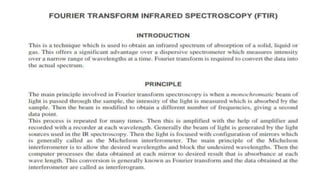
INSTRUMENTATION OF FT-IR :
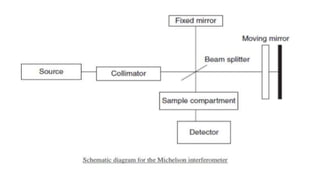
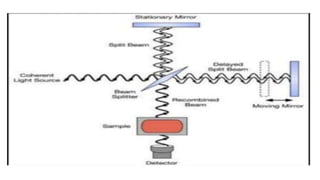
MICHELSON INTERFEROMETER
• It consists of three active components: a moving mirror, a fixed mirror,
and a beam splitter.
• The two mirrors are perpendicular to each other.
• The beam splitter is a semi reflecting device and is often made by
depositing a thin film of germanium onto a flat KBr substrate.
• Radiation from the broadband IR source is collimated and directed into
the interferometer, and impinges on the beam splitter.
• At the beam splitter, half the IR beam is transmitted to to the fixed mirror
and the remaining half is reflected to the moving mirror.
• After the divided beams are reflected from the two mirrors, they are
recombined at the beam splitter.
• Due to changes in the relative position of the moving mirror to the fixed
mirror, an interference pattern is generated.
• The resulting beam then passes through the sample and is eventually
focused on the detector.
• Differences in the optical paths between the two split beams are created
by varying the relative position of moving mirror to the fixed mirror.
• If the two arms of the interferometer are of equal length, the two split
beams travel through the exact same path length.
ADVANTAGES OF FTIR
1) Fellgett’s advantage : The wavelengths are collected simultaneously
and result in a higher signal to noise ratio for a given scan time or a shorter
scan time for a given resolution.
2) Jacquinot’s advantage : The interferometer throughput is determined
by the diameter of collimated beam coming from the radiation source .
3) Better wavelength frequency
4)less sensitivity to stray light .
APPLICATIONS :
Used in the separation of mixture of components to individual components
which is not be possible by general IR spectra.
Example: Isomers separation.
Used in the analysis of minute fractions of samples.
Example: Elemental analysis.
Used in the characterisation of artistic materials in old master paintings.
Example: Aging of paintings.
Used in the identification of chemicals from spills, paints, polymers,
coatings, drugs and contaminants.
Example: Pollutants, Evolved gases.
Used in the quantitation of silicone, esters, etc., as contamination on
various materials.
Used in the identification of the molecular structure of organic
compounds for contamination analysis.
Example: Purity studies.
Used in the identification of organic particles, powders, films, and liquids
(material identification).
Example: Particle analysis.
Used in the quantification of O and H in Si, and H in SiN wafers .
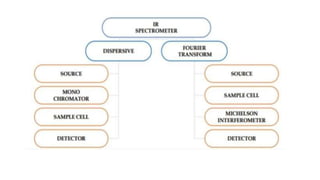
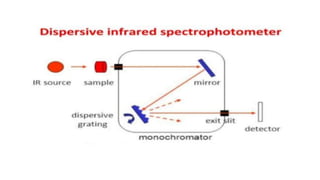
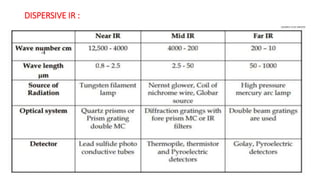
DISPERSIVE IR :
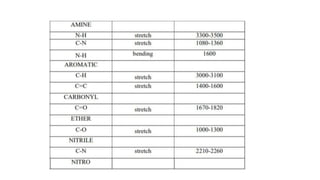
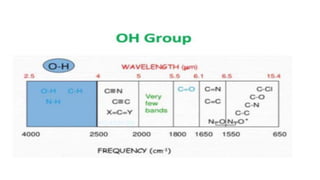
DATA INTERPRETATION:
THANK YOU

IR spectroscopy -Kaviya.pptx

  • 1.
    INFRARED SPECTROSCOPY PRESENTED BY: S.KAVIYA M.PHARM – 1st YR DEP.OF PHARMACOLOGY
  • 3.
  • 6.
    Absorbed energy bringsthe changes which depends upon 1. Mass of the atom 2. Strength of the bond 3. Arrangement of atoms Different types of IR bands :
  • 7.
  • 18.
    FACTORS AFFECTING VIBRATIONALFREQUENCIES IN IR : 1) Coupled vibrations 2) Fermi resonance 3) Electronic effects 4)Hydrogen bonding 1. COUPLED VIBRATIONS: An isolated C-H bond has only one stretching vibrational frequency where as methylene group shows two stretching vibrations, symmetrical and asymmetrical. Asymmetric vibrations occur at higher frequencies than symmetric vibrations. These are known as coupled vibrations because these vibrations occur at different frequencies than that required for an isolated C-H stretching. A strong vibrational coupling is present in carboxylic acid, anhydrides in which symmetrical and asymmetrical stretching vibrations appear in the range of 1720- 1825/cm and the interaction is effective because of partial double bond due to resonance which keeps system planar for effective coupling.
  • 19.
    2. FERMI RESONANCE: Fermiresonance bands are produced because of coupling between fundamental vibration and an overtone or because of a combination band. A Fermi resonance is shifting of energies and intensities of absorption bands in the infrared or Raman spectrum. The phenomenon was explained by the Italian physicist Emico Fermi. 3. ELECTRONIC EFFEECT: Depends on presence of substituent. Conjugation cause delocalization of electron which shows decrease in bond strength which in turn shows decrease in vibrational frequency. The changes in the absorption frequencies for a particular group take place when the substituents in the neighbourhood of that particular group are changed . It includes: (a) Conjugation effect (b) Inductive effect (c) Mesomeric effect (d) Field effect
  • 20.
    a)CONJUGATION EFFECT: It isobserved to lower the frequency of both C=C stretchirg and C=O stretching, irrespective of the fact it is brought about by either a, ß-unsaturation or by an aromatic ring. b)INDUCTIVE EFFECT: The inductive effects solely depends upon the 'intrinsic' tendency of a substituent to either release or withdraw electrons by definition, its electronegativity acting either through the molecular chain or through space. This effect usually weakens steadily with increasing distance from the substituent. c)MESOMERIC EFFECT: The mesomeric effect involves the electrons in the pie and nonbonding orbitals and it operates in general opposite to the inductive effect. These effects cannot be isolated from one another and at a time only one of them can be applied to determine approximate results.
  • 21.
    d)FIELD EFFECT: Ithas been observed that two functional groups often influence each other's vibrational frequencies by a through space interaction that may be either steric and/or electrostatic in nature. 4. HYDROGEN BONDING: Hydrogen bonds itself do not show any peaks for themselves in IR spectrum but certainly affect the spectrum of covalent bonds between O-H atoms which are involved in hydrogen bonding. It shows broadening of peaks corresponding to O-H covalent bond. The presence of hydrogen bonding changes the position and shape of an infrared absorption band. Frequencies of both stretching as well as bending vibrations are changed because of hydrogen bonding.
  • 22.
    The X-H stretchingbands move to lower frequency usually with increased intensity and band widening. The X-H bending vibration usually shifts to higher frequencies. Stronger the hydrogen bonding, greater is the absorption shift from the normal values. The two types of hydrogen bonding (intramolecular and intermolecular) can be differentiated by the use of infrared spectroscopy . INSTRUMENTATION :
  • 28.
    DETECTORS : The varioustypes of detectors are: (a) Bolometers (b) Thermocouples (c) Thermistors (d) Golay cell (e) Pyroelectric detector a)Thermocouples / Thermopiles: Thermocouples / Thermopiles are formed by joining two dissimilar metals that create a voltage at their junction. This voltage is proportional to the temperature of the junction.
  • 29.
    When a substanceis optically focused onto a thermocouple detector, its temperature increases or decreases as the incident IR flux increases or decreases. The change in IR flux emitted by the substance can be detected by monitoring the voltage generated by the thermocouple. For sensitive detection, the thermocouple must be thermally insulated from its surroundings. For fast response, the thermocouple must be able to quickly release built up heat. This tradeoff between sensitivity of detection and the ability to respond to quickly changing scenes is inherent to all energy detectors. A thermopile is a series of thermocouples connected together to provide increased responsivity.
  • 31.
    b)THERMISTORS : Thermistors areused as IR detectors since their resistance is temperature dependent. Thermistors are placed in one of the four arms of a Wheatstone bridge circuit. The IR radiation falling onto the thermistor changes its resistance, which causes imbalance in the circuit and current flows through the circuit which can be amplified and detected.
  • 32.
    c)GOLAY DETECTOR: It consistsof the chamber containing a gas which expands due to the heat when IR radiation falls on it. The expansion of gas bends the flexible diaphragm to which is attached a mirror. The recorder response is proportional to the degree of deflection.
  • 33.
    • It usesthe expansion of a gas as the measuring device • The unit consists of a small metal cylinder closed by a rigid blackened metal plate at one end and by a flexible silvered diaphragm at the other end. • The chamber is filled with xenon. • Heat, conducted to the gas, causes it to expand and deform the flexible diaphragm Advantage is wide wavelength range Disadvantage is more expensive
  • 34.
    d)PYROELECTRIC DETECTOR:- Pyroelectric detectoris an infrared sensitive element. It is used to measure the infrared energy. It is a thermal detector. When IR radiation falls on the detector, there is change in the temperature which produces a charge on the surface of the pyroelectric crystal and gives an output signal which is amplified using a sensor and then detected using an oscilloscope.
  • 35.
    Selection of theconditions for the IR spectra: 1. Frequency range: The frequency should be in the range of 600–4,000cm−1. 2. Band width and the scan speed: The slit width limits the scan speed effectively. APPLICATION OF INFRARED SPECTROSCOPY TO ORGANIC COMPUND: 1. Identification of Substance: Infrared spectroscopy is used to establish whether a given sample or an organic substance is identical with another or not. Such as; Alkanes, Alkenes, Alkynes, Aromatic ring, etc. 2. Determination of Molecular Structure: Infrared spectroscopy is helpful in determining molecular structure of an unknown substance. From an examination of the position of absorption band in the spectrum, it is possible to establish the nature of the gas groups present in the molecule.
  • 36.
    3. Detection ofimpurities. 4. Isomerism in organic chemistry. 5. Identification of functional groups. 6. Miscellaneous: The following are some important application: (a) Determination of purity. (b) Shape of symmetry of a molecule. (c) Presence of water in a sample. Eg: Moisture content determination (d) Measurement of paints and varnishes.
  • 37.
    LIMITATIONS OF IRSPECTROSCOPY It is not possible to determine pure substance present in the mixture of substances. It does not give the information about the positioning of the functional groups. ADVANTAGES Cheap. High acceptability. Wide applicability. DISADVANTAGES It is time consuming for the sample preparation. It is a destructive method
  • 42.
    INSTRUMENTATION OF FT-IR: MICHELSON INTERFEROMETER • It consists of three active components: a moving mirror, a fixed mirror, and a beam splitter. • The two mirrors are perpendicular to each other. • The beam splitter is a semi reflecting device and is often made by depositing a thin film of germanium onto a flat KBr substrate. • Radiation from the broadband IR source is collimated and directed into the interferometer, and impinges on the beam splitter. • At the beam splitter, half the IR beam is transmitted to to the fixed mirror and the remaining half is reflected to the moving mirror.
  • 43.
    • After thedivided beams are reflected from the two mirrors, they are recombined at the beam splitter. • Due to changes in the relative position of the moving mirror to the fixed mirror, an interference pattern is generated. • The resulting beam then passes through the sample and is eventually focused on the detector. • Differences in the optical paths between the two split beams are created by varying the relative position of moving mirror to the fixed mirror. • If the two arms of the interferometer are of equal length, the two split beams travel through the exact same path length.
  • 44.
    ADVANTAGES OF FTIR 1)Fellgett’s advantage : The wavelengths are collected simultaneously and result in a higher signal to noise ratio for a given scan time or a shorter scan time for a given resolution. 2) Jacquinot’s advantage : The interferometer throughput is determined by the diameter of collimated beam coming from the radiation source . 3) Better wavelength frequency 4)less sensitivity to stray light .
  • 45.
    APPLICATIONS : Used inthe separation of mixture of components to individual components which is not be possible by general IR spectra. Example: Isomers separation. Used in the analysis of minute fractions of samples. Example: Elemental analysis. Used in the characterisation of artistic materials in old master paintings. Example: Aging of paintings.
  • 46.
    Used in theidentification of chemicals from spills, paints, polymers, coatings, drugs and contaminants. Example: Pollutants, Evolved gases. Used in the quantitation of silicone, esters, etc., as contamination on various materials. Used in the identification of the molecular structure of organic compounds for contamination analysis. Example: Purity studies. Used in the identification of organic particles, powders, films, and liquids (material identification). Example: Particle analysis. Used in the quantification of O and H in Si, and H in SiN wafers .
  • 48.
  • 49.
  • 62.