FACTORS AFFECTING
FLUORESCENCE INTENSITY
PRESENTED BY,
BHUVANESWARAN D
M.PHARM-1ST SEMESTER
DEPT.OF PHARM.ANALYSIS
1
FLUORESCENCE
 Fluorescence is based on photoluminescence, a process
of glow and light emission. It is a physical process in which
light is emitted after it has been absorbed by a substance.
The fluorescence intensity indicates how much light
(photons) is emitted.
 Fluorescence is created by the absorption of energy (light)
by fluorescent molecules, called fluorophores.
2
JABLONSKI DIAGRAM
3
FACTORS AFFECTING FLUORESCENCE
INTENSITY
 Conjugation
 Nature of substituent group
 Rigidity of structure
 Effect of temperature
 Viscosity
 Oxygen
 Effect of pH
 Photochemical decomposition
 Effect of concentration
 Quenching
4
I. CONJUGATION
 A molecule must have an unsaturation (π electrons i.e.
Conjugation)
 So that molecule absorbs UV/Visible radiation, which leads
to increase in fluorescence.
 If there is no absorption of radiation, there will not be any
fluorescence.
5
II. NATURE OF SUBSTITUENT GROUPS
 Electron donating groups like amino (NH2) and hydroxyl
(OH) groups increasing the fluorescence intensity.
 Electron withdrawing groups like nitro (NO2) and carboxyl
(COOH) groups decreasing the fluorescence intensity.
 Groups like SO3 or NH4 have no effect on fluorescence
intensity.
6
S.NO SUBSTITUENTS EFFECT ON λ EFFECT ON INTENSITY
1. Alkyl No effect Slight increase or decrease
2. COOH, CHO, COOR, COR Increase Decrease
3. OH, OMe, Oet Increase Increase
4. CN No effect Increase
5. NH2, NHR, NR Increase Increase
6. NO2, NO Increase Increase
7. SH Increase Decrease
8. SO3H No effect No effect
9. F, CL, Br, I Increase Decrease
7
Electron donating group Electron withdrawing group
Ed
Phenol Benzene Benzoic acid
8
III. RIGIDITY OF STRUCTURE
 Rigid structure gives more
fluorescence intensity.
 Flexible structure gives less
fluorescence intensity.
E.g. : Fluorene
E.g. : Biphenyl
9
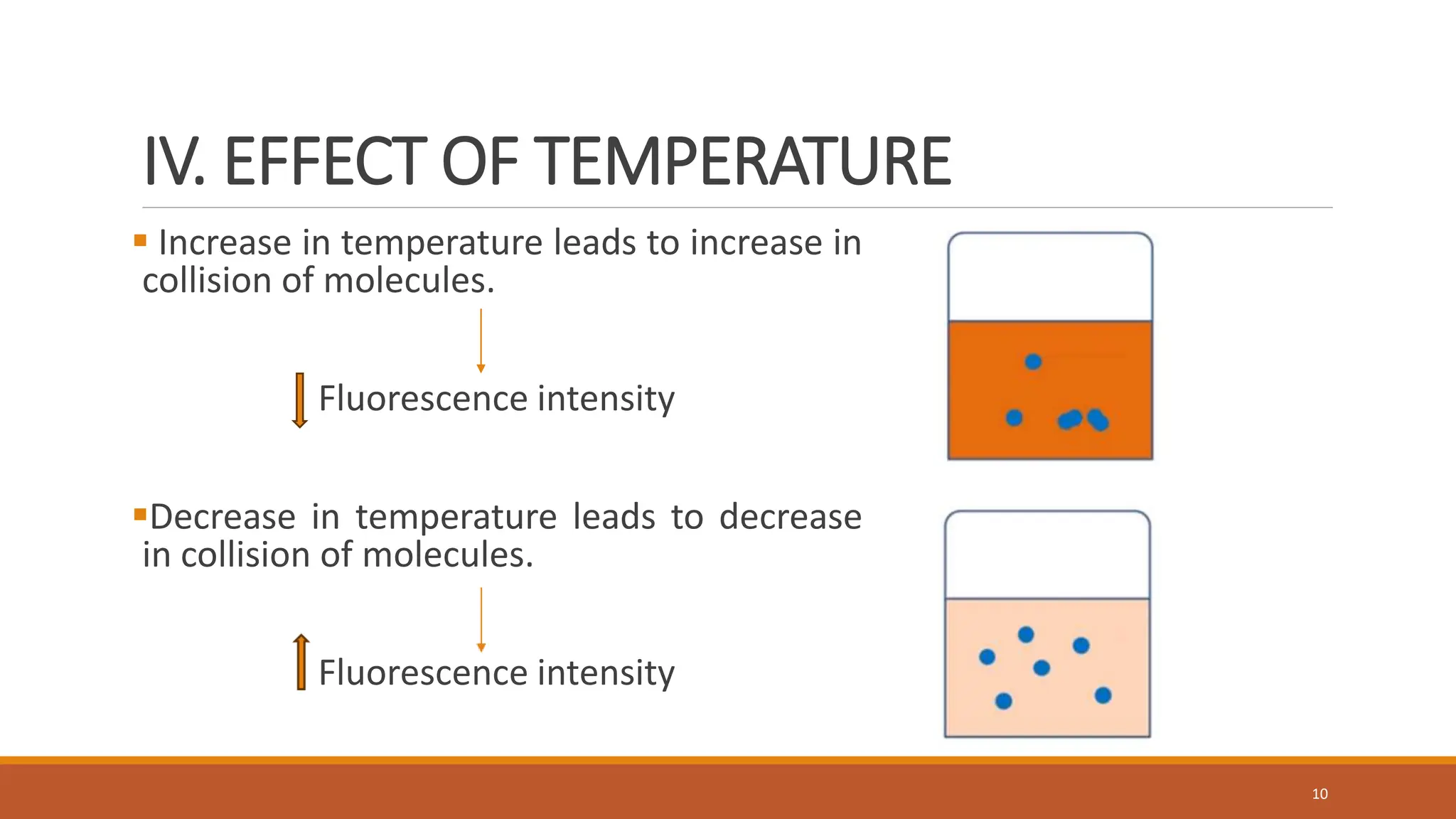
IV. EFFECT OF TEMPERATURE
 Increase in temperature leads to increase in
collision of molecules.
Fluorescence intensity
Decrease in temperature leads to decrease
in collision of molecules.
Fluorescence intensity
10
V. VISCOSITY
 Increase in viscosity leads to
decrease in collision of molecules.
Fluorescence intensity
 Decrease in viscosity leads to
increase in collision of molecules.
Fluorescence intensity
11
VI. OXYGEN
 Oxygen decreases the fluorescence intensity in two ways:
i. It oxidizes fluorescent substance to non-fluorescent
substance.
ii. It quenches (decrease) fluorescence, because of the
paramagnetic properties of molecular energy, as it has
triplet ground state.
12
VII. EFFECT OF pH
 The effect of pH depends on the chemical structure of molecule.
i. Phenols in acidic condition are undissociated and do not give
fluorescence, but in alkaline condition, they are dissociated
(ionic) and gives good fluorescent.
Phenol phenoxide ion
13
ii. Aniline in neutral or alkaline gives visible fluorescence but in acidic
condition gives fluorescence in UV region only.
Aniline Anilinium ion
14
VIII.PHOTOCHEMICAL DECOMPOSITION
UV/vis absorption sometimes leads to photochemical reaction. In
such case, fluorescence cannot be seen. Hence a wavelength which
is not strongly absorbed should be chosen to avoid such a reaction.
Otherwise errors up to 20% is possible.
15
IX. EFFECT OF CONCENTRATION
Fluorescence intensity is directly proportional to the concentration
of the substances.
i. At high concentration
seeing deviation in
linearity. i.e. When
concentration increases,
fluorescence intensity
does not increase.
16
At low concentration
seeing no deviation in
linearity. i.e. When
concentration increases,
fluorescence intensity
increase.
ii.
17
X. QUENCHING
 Quenching is the decrease in fluorescence intensity due to specific
effects of constituents of solution itself.
 Various types of quenching are,
1) Self quenching
2) Chemical quenching
3) Static quenching
4) Collision quenching
18
i. SELF QUENCHING
At low concentration linearity should be observed, at high
concentration of same substance, increase in fluorescence
intensity does not occur. This phenomenon is called as self
quenching or concentration quenching.
19
ii. CHEMICAL QUENCHING
 It occurs due to the following factors,
Change in pH
Presence of oxygen
Halides or heavy metals
1. pH: -
Aniline at pH 5 to 13 gives fluorescence when excited at
290nm. But at < 5 (exist as cation) and pH at >13 (exist as anion)
it does not exhibit fluorescence.
20
2. OXYGEN: -
Prescence of oxygen leads to quenching because of its paramagnetic
property (triplet ground state).
3. HALIDES: -
Halides like bromide, chloride, iodide and electron withdrawing group
like nitro and carboxylic group leads to quenching. (decrease in
fluorescence intensity)
4. HEAVY METALS: -
Prescence of heavy metals also leads to quenching because of its
collision and triplet ground state.
21
iii. STATIC QUENCHING: -
 This occurs because of its complex formation. (i.e. caffeine reduces
the fluorescence intensity of riboflavin by complex formation).
iv. COLLISION QUENCHING: -
 It is results of several factors like presence of heavy metals, halides,
increase in temperature and decrease in viscosity where the number
of collisions increased. Hence quenching takes place.
22
CONCLUSION
 Fluorescence intensity measurement allows the determination of
the presence of fluorophores and their concentrations.
Fluorescence intensity measurement is used in numerous
biochemical assays.
23
REFERENCES
Dr.S. Ravi Sankar. The text book of pharmaceutical analysis, Fourth
Edition.
Joseph R. Lakowicz. Principles of Fluorescence Spectroscopy, Third
Edition.
24
Thank you…
25

FACTORS AFFECTING FLUORESCENCE INTENSITY.pptx

  • 1.
    FACTORS AFFECTING FLUORESCENCE INTENSITY PRESENTEDBY, BHUVANESWARAN D M.PHARM-1ST SEMESTER DEPT.OF PHARM.ANALYSIS 1
  • 2.
    FLUORESCENCE  Fluorescence isbased on photoluminescence, a process of glow and light emission. It is a physical process in which light is emitted after it has been absorbed by a substance. The fluorescence intensity indicates how much light (photons) is emitted.  Fluorescence is created by the absorption of energy (light) by fluorescent molecules, called fluorophores. 2
  • 3.
  • 4.
    FACTORS AFFECTING FLUORESCENCE INTENSITY Conjugation  Nature of substituent group  Rigidity of structure  Effect of temperature  Viscosity  Oxygen  Effect of pH  Photochemical decomposition  Effect of concentration  Quenching 4
  • 5.
    I. CONJUGATION  Amolecule must have an unsaturation (π electrons i.e. Conjugation)  So that molecule absorbs UV/Visible radiation, which leads to increase in fluorescence.  If there is no absorption of radiation, there will not be any fluorescence. 5
  • 6.
    II. NATURE OFSUBSTITUENT GROUPS  Electron donating groups like amino (NH2) and hydroxyl (OH) groups increasing the fluorescence intensity.  Electron withdrawing groups like nitro (NO2) and carboxyl (COOH) groups decreasing the fluorescence intensity.  Groups like SO3 or NH4 have no effect on fluorescence intensity. 6
  • 7.
    S.NO SUBSTITUENTS EFFECTON λ EFFECT ON INTENSITY 1. Alkyl No effect Slight increase or decrease 2. COOH, CHO, COOR, COR Increase Decrease 3. OH, OMe, Oet Increase Increase 4. CN No effect Increase 5. NH2, NHR, NR Increase Increase 6. NO2, NO Increase Increase 7. SH Increase Decrease 8. SO3H No effect No effect 9. F, CL, Br, I Increase Decrease 7
  • 8.
    Electron donating groupElectron withdrawing group Ed Phenol Benzene Benzoic acid 8
  • 9.
    III. RIGIDITY OFSTRUCTURE  Rigid structure gives more fluorescence intensity.  Flexible structure gives less fluorescence intensity. E.g. : Fluorene E.g. : Biphenyl 9
  • 10.
    IV. EFFECT OFTEMPERATURE  Increase in temperature leads to increase in collision of molecules. Fluorescence intensity Decrease in temperature leads to decrease in collision of molecules. Fluorescence intensity 10
  • 11.
    V. VISCOSITY  Increasein viscosity leads to decrease in collision of molecules. Fluorescence intensity  Decrease in viscosity leads to increase in collision of molecules. Fluorescence intensity 11
  • 12.
    VI. OXYGEN  Oxygendecreases the fluorescence intensity in two ways: i. It oxidizes fluorescent substance to non-fluorescent substance. ii. It quenches (decrease) fluorescence, because of the paramagnetic properties of molecular energy, as it has triplet ground state. 12
  • 13.
    VII. EFFECT OFpH  The effect of pH depends on the chemical structure of molecule. i. Phenols in acidic condition are undissociated and do not give fluorescence, but in alkaline condition, they are dissociated (ionic) and gives good fluorescent. Phenol phenoxide ion 13
  • 14.
    ii. Aniline inneutral or alkaline gives visible fluorescence but in acidic condition gives fluorescence in UV region only. Aniline Anilinium ion 14
  • 15.
    VIII.PHOTOCHEMICAL DECOMPOSITION UV/vis absorptionsometimes leads to photochemical reaction. In such case, fluorescence cannot be seen. Hence a wavelength which is not strongly absorbed should be chosen to avoid such a reaction. Otherwise errors up to 20% is possible. 15
  • 16.
    IX. EFFECT OFCONCENTRATION Fluorescence intensity is directly proportional to the concentration of the substances. i. At high concentration seeing deviation in linearity. i.e. When concentration increases, fluorescence intensity does not increase. 16
  • 17.
    At low concentration seeingno deviation in linearity. i.e. When concentration increases, fluorescence intensity increase. ii. 17
  • 18.
    X. QUENCHING  Quenchingis the decrease in fluorescence intensity due to specific effects of constituents of solution itself.  Various types of quenching are, 1) Self quenching 2) Chemical quenching 3) Static quenching 4) Collision quenching 18
  • 19.
    i. SELF QUENCHING Atlow concentration linearity should be observed, at high concentration of same substance, increase in fluorescence intensity does not occur. This phenomenon is called as self quenching or concentration quenching. 19
  • 20.
    ii. CHEMICAL QUENCHING It occurs due to the following factors, Change in pH Presence of oxygen Halides or heavy metals 1. pH: - Aniline at pH 5 to 13 gives fluorescence when excited at 290nm. But at < 5 (exist as cation) and pH at >13 (exist as anion) it does not exhibit fluorescence. 20
  • 21.
    2. OXYGEN: - Prescenceof oxygen leads to quenching because of its paramagnetic property (triplet ground state). 3. HALIDES: - Halides like bromide, chloride, iodide and electron withdrawing group like nitro and carboxylic group leads to quenching. (decrease in fluorescence intensity) 4. HEAVY METALS: - Prescence of heavy metals also leads to quenching because of its collision and triplet ground state. 21
  • 22.
    iii. STATIC QUENCHING:-  This occurs because of its complex formation. (i.e. caffeine reduces the fluorescence intensity of riboflavin by complex formation). iv. COLLISION QUENCHING: -  It is results of several factors like presence of heavy metals, halides, increase in temperature and decrease in viscosity where the number of collisions increased. Hence quenching takes place. 22
  • 23.
    CONCLUSION  Fluorescence intensitymeasurement allows the determination of the presence of fluorophores and their concentrations. Fluorescence intensity measurement is used in numerous biochemical assays. 23
  • 24.
    REFERENCES Dr.S. Ravi Sankar.The text book of pharmaceutical analysis, Fourth Edition. Joseph R. Lakowicz. Principles of Fluorescence Spectroscopy, Third Edition. 24
  • 25.